Loman AI Pricing 2026: Restaurant Plans & Real Costs
TL;DR
Loman AI does not publish a single price. Its pricing page lists three tiers (Starter, Premium and Enterprise) with feature lists and a "Contact Us" button on every one. There is no rate card, no free trial, and no public per-location figure.
Third-party trackers report anywhere from $199 to $529 per location per month, but they contradict each other and none is confirmed by Loman. The only Loman-controlled number we found is on Loman's own blog: "starting at $199 per month."
What we could verify is the contract. Loman's Terms name setup fees, integration charges, additional-location charges and overage charges. "Unlimited" minutes are subject to a fair-use clause that lets Loman throttle, suspend or rebill. Fees are non-refundable, the subscription auto-renews, early termination makes all remaining months immediately due, and billing disputes expire after 120 days.
Here is how the tiers break down:
| Plan | Published Price | What It Covers | Best For |
|---|---|---|---|
| Starter | Contact Us (reported ~$199 to $249/location/mo) | Call answering, FAQs, call transfer, outbound SMS, menu updates, up to 50 simultaneous calls | Single-location restaurants that just need the phone answered |
| Premium | Contact Us (reported ~$299 to $529/location/mo) | Everything in Starter plus takeout and delivery ordering, phone reservations, POS integration, card payments by phone, upsell engine | Takeout-driven and full-service restaurants that want orders taken on the call |
| Enterprise | Custom quote | Custom integrations and enterprise features, aimed at multi-unit and franchise groups | Groups and franchises with several locations |
Bottom line: if calls are how your restaurant makes money, the sticker price is the least of it. Model the contract, not the plan.

Restaurant phone calls shouldn't cost you a sales call to price. See CloudTalk's published rates.

What Are Loman AI's Pricing Plans?
Loman AI pricing plans come in three tiers: Starter, Premium and Enterprise. None of them has a published price. Every tier on Loman's pricing page ends in a "Contact Us" button, so the only way to learn what Loman AI costs is to book a demo and get quoted.
That is worth naming up front, because it shapes everything else about evaluating Loman AI pricing for restaurants. You cannot compare Loman against another vendor on a spreadsheet, you cannot budget before a sales conversation, and you cannot check whether the quote you were given matches what the restaurant down the road pays.
What Loman does publish is the feature split between tiers, which is genuinely useful. The line between Starter and Premium is whether the AI can take an order. Starter answers the phone, handles questions and transfers calls. Premium is where takeout and delivery ordering, phone reservations, POS integration and card payments live.
How Is Loman AI's Pricing Structured?
Loman AI restaurant pricing is charged per location, not per user or per seat. This is confirmed in Loman's Terms, which refer to "the Monthly Fee per Location set forth on your Order" and bill additional locations as an add-on charge.
For a single restaurant that is simple. For a three-location group it means multiplying, and the Terms publish no volume discount, so assume you pay the full per-location rate at each site until a salesperson tells you otherwise.
What Do Third-Party Sources Say Loman AI Costs?
Because Loman publishes nothing, a set of software directories have filled the gap with numbers of their own. They do not agree, and some of them contradict Loman's own marketing. Here is what is actually out there:
| Source | Reported Price | Worth Knowing |
|---|---|---|
| Loman's own blog | "Starting at $199 per month" | The only Loman-controlled figure we found. Described as flat monthly with unlimited calls and no per-minute fees. |
| BackOfHouse.io | Starter $249/mo, Premium $399+/mo | Says Premium "varies by call volume," which directly contradicts Loman's "no per minute fees" claim. |
| Tekpon | Standard $299/mo (up to 500 minutes, 1 location), Premium $529/mo (up to 1,000 minutes, 3 locations) | The only source claiming explicit minute caps. Also contradicts the no-per-minute-fees claim. Treat with caution. |
| RestaurantTools.ai | Starter ~$199, Premium ~$299 | Self-declares its figures are "sourced from vendor blog and third-party reports," so secondhand. |
| SpotSaaS | "Custom pricing / quotation based" | Checked Loman's site in May 2026 and found no public pricing, which corroborates the gating. |
how to read this table
What Do Real Users Say About Loman AI's Pricing?
Loman AI holds 4.5 out of 5 on G2, from three reviews. Three. That is not a rating, it is an anecdote, and any article presenting it as a consensus is misleading you.
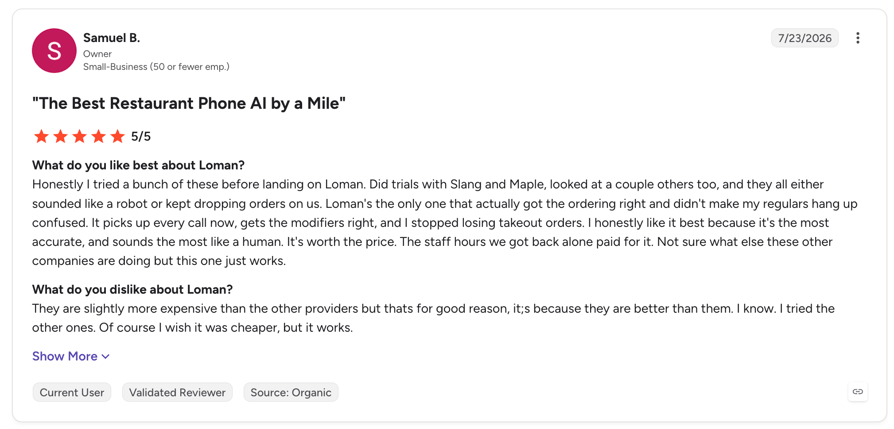
Across every review platform we checked, Loman has roughly eight verifiable independent reviews in total: three on G2 and five on SourceForge. There is no Capterra listing, no Trustpilot profile, and no Square or Clover marketplace listing. A FeaturedCustomers page shows 406 "reviews," but that platform hosts vendor-supplied testimonials rather than open user reviews, so it is not comparable.
The positive reviews are specific and credible. One pizza shop owner describes accurate orders printing straight to the kitchen, responsive support, and a second location going live two months later. Another owner reports onboarding finished in under five days.
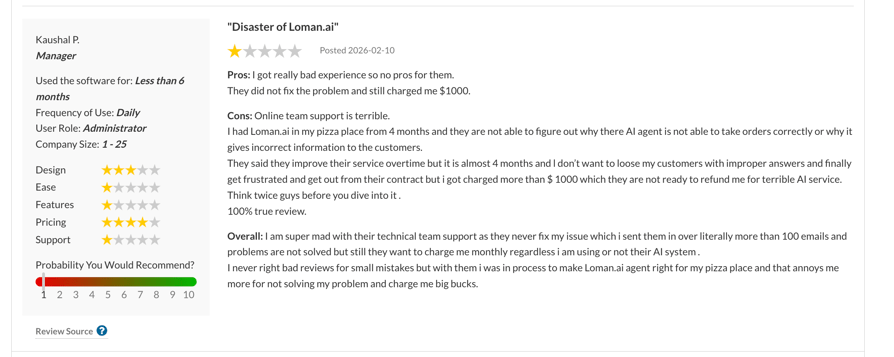
The one detailed negative review is the one to read before you sign. A restaurant manager, posting in February 2026, reported that after four months the agent still could not take orders correctly, that support requests went unanswered, and that he had been charged over $1,000 while the problems remained open. It is a single review, so weigh it accordingly, but it hits order accuracy, support and billing at the same time, which is exactly the combination the contract terms below make expensive to escape.
a note on review timing
What Is Loman AI's Starter Plan?
The Starter plan is Loman's entry tier, described on the pricing page as "for basic call management." It answers the phone, deals with questions, and moves callers to a human when it cannot help. It does not take orders and it does not book reservations. Those sit behind Premium.
For a restaurant whose phone problem is missed calls rather than missed orders, this is the tier that solves it. If you are weighing it against other options, our roundup of the best AI phone answering systems for restaurants covers the wider field.
What's Included in Loman AI's Starter Plan
- Humanlike voice AI answering, 24/7
- Handles customer inquiries: hours, location, menu questions, allergens
- Automated call transfer to staff
- Outbound SMS
- Automatic menu updates
- Restaurant knowledge graph
- Up to 50 calls handled at once
- Human-level interruption handling
- Customer dashboard with call transcripts and analytics
Loman AI's Starter Plan: Who Is It Best For?
Single-location restaurants that lose calls at peak service and after hours, and whose phone traffic is mostly questions rather than orders. Cafes, bars, and full-service restaurants that take bookings through a separate system will get most of the value here.
What You Need to Know About Loman AI's Starter Plan
Two things. First, the 50-simultaneous-call ceiling is a real number, not marketing shorthand for unlimited, so a Friday rush at a busy pizza shop is worth sizing against it. Second, the jump to Premium is not an incremental upgrade, it is the difference between a receptionist and an order taker. If ordering is why you are buying, Starter will not do the job at any price.
What Is Loman AI's Premium Plan?
Premium is the plan Loman is actually built around, described as "for ordering & reservations." This is where the AI stops answering questions and starts transacting: taking takeout and delivery orders with modifiers, booking tables, pushing orders into the POS, and taking card payments over the phone.
It is also where Loman's differentiation sits. Most AI answering tools for restaurants hand callers a text link when they want to order. Loman completes the order on the call and drops it into the kitchen workflow.
What's Included in Loman AI's Premium Plan
- Everything in Starter
- Takeout and delivery ordering with modifiers and combos
- Automated phone reservations: book, modify, confirm and cancel
- Complete POS integration
- Secure card payment over the phone
- Smart guest memory for repeat callers
- Dynamic upsell engine
- Out-of-stock AI menu updates
- Intelligent SMS updates
Loman AI's Premium Plan: Who Is It Best For?
Takeout-driven concepts where the phone is a revenue channel rather than a service channel. Loman's own positioning leans heavily on pizza, wings and takeout, and its published customer stories skew the same way. If a meaningful share of your tickets arrive by phone, Premium is the only tier worth evaluating.
What You Need to Know About Loman AI's Premium Plan
Check which POS you actually run before the demo. Loman displays eight or more POS logos, but only Toast (formal partner, July 2026), SpotOn (partnership announced January 2026) and OpenTable (native, December 2025) have announced partnerships behind them. Square, Shift4, Aloha, Olo and Stream are named but we could not verify the depth of those connections. Otter, Owner.com and Popmenu are absent entirely.
the integration contradiction
What Is Loman AI's Enterprise Plan?
Enterprise is Loman's custom tier, triggered by restaurants needing "custom integrations or enterprise features." In practice it is the route for multi-unit groups, franchise groups and national brands, and Loman explicitly markets multi-location and franchise-group capability.
What's Included in Loman AI's Enterprise Plan
- Everything in Premium
- Custom integrations built to your stack
- Enterprise features (not itemised publicly)
- Custom pricing across multiple locations
Loman AI's Enterprise Plan: Who Is It Best For?
Groups running several locations on a POS that is not Toast or SpotOn, or brands that need the agent wired into an existing ordering or loyalty stack. If you are running a genuine multi-site operation, our guide to building a restaurant call center covers what to specify before you take quotes.
What You Need to Know About Loman AI's Enterprise Plan
Loman publishes no volume or multi-location discount. Pricing is per location, so a ten-site group should assume ten times the per-location rate as the starting point of the negotiation, not the end of it. Ask directly what the per-location rate drops to at your site count, and get the whole-group number rather than the unit number.
Compare it against a phone system that publishes every rate. 50 free AI minutes, no sales call.
What Are Loman AI's Additional Costs?
Loman's pricing page carries two claims in large type: "No per minute fees. No hidden costs." Loman's Terms and Conditions, last updated 26 May 2026, name setup fees, integration charges, additional-location charges and overage charges, and qualify "unlimited" minutes with a fair-use clause.
Both documents are Loman's. Only one of them is binding. Here is what the contract actually allows:
| Additional Cost | Amount | Notes |
|---|---|---|
| Setup fee | Not published | Terms say "You agree to pay the Setup Fee (if any)" and that it is "due upon acceptance." The amount appears on your individual Order, not the website. |
| Additional locations | Per-location Monthly Fee | Named in the Terms as an add-on charge. No published volume discount. |
| Integrations | Not published | Listed in the Terms as a chargeable add-on, despite "complete POS integration" appearing as an included Premium feature. |
| Overage charges | Not published | Explicitly named in the Terms as an add-on charge. No rate published, and no statement of whether it is billed per minute or as a plan bump. |
| Taxes | Variable | Fees are quoted in USD and are exclusive of applicable taxes, which are your responsibility. |
| Telephony and equipment | Variable | You are responsible for your own equipment, internet connectivity, telephony provider and any third-party software. |
What "No Per Minute Fees" Actually Means
The Terms are worth reading in full, but this is the clause that matters. Verbatim:
"'Unlimited' minute plans are subject to fair use. Loman may, after written notice and an opportunity to remedy, throttle, suspend, or rebill accounts that exhibit usage patterns that are abusive, fraudulent, materially inconsistent with typical restaurant operations of similar size, or that impose disproportionate cost on Loman's underlying telephony or AI infrastructure."
Elsewhere the Terms confirm the Monthly Fee covers "talk-time minutes at the level described on the Order," which means minutes are metered on your contract even on an "unlimited" plan. This is not unusual, and most vendors have a fair-use policy. What is unusual is marketing the plan as having no per-minute fees while the contract reserves the right to rebill.
The practical question for the demo: what minute level is written on my Order, and what happens at the month I exceed it?
The Contract Terms That Don't Appear on the Pricing Page
This is the part of Loman AI pricing that nobody publishes, and it is more consequential than the monthly number. All of the following comes from Loman's own Terms and Conditions.
- Initial term of 1, 3, 6 or 12 months, and you are "contractually obligated to pay for every month of the Initial Term, regardless of usage."
- Early termination makes everything due at once. If you leave early for any reason other than Loman's uncured material breach, "all remaining Monthly Fees for the Initial Term become immediately due and payable."
- Auto-renewal month to month at the then-current rate, unless cancelled at least 30 days before the end of the term.
- All fees are non-refundable, "including for partial months and unused Service."
- Billing disputes expire after 120 days. After that, "the charge is deemed accurate and you release Loman from any related claim."
- Binding arbitration in Delaware with a class-action waiver and a one-year statute of limitations.
- Uptime is a target, not an SLA. Loman "targets 99% monthly uptime," which allows for roughly 7.2 hours of downtime a month, with no service credits attached.
read the order form, not the website
Does Loman AI Offer a Free Trial?
No. Loman offers a free demo, which is a sales call, not a trial. Its Terms contain no trial, pilot or proof-of-concept provision anywhere.
Some software directories list "free trial: yes" for Loman. We could not find any trial offer on Loman's own site, and the contract contains no clause supporting one, so treat those listings as stale. Combined with the initial-term commitment, this means your first real test of the product happens after you are already contractually obligated to pay for it.
Does Loman AI Offer Annual or Volume Discounts?
Not publicly. The Terms offer initial terms of 1, 3, 6 or 12 months but state no discount for the longer commitments, and there is no published multi-location or franchise-group pricing. There is no education or non-profit pricing, which is unsurprising given Loman sells only to restaurants.
What Will Loman AI Actually Cost?
Because Loman publishes nothing, any cost model is an estimate. The scenarios below use the reported $199 to $399 per-location range and Loman's own "starting at $199" figure, and they exist to show how the structure behaves as you grow, not to quote you a price. Treat every total as a hypothesis to check against a real Order form.
Scenario 1: Single Pizza Shop, Starter Plan, 12-Month Term
Profile: one location, phone used mostly for questions and a handful of orders. Wants the phone answered at peak and after hours. No POS integration needed.
| Cost Item | Estimated Monthly Cost |
|---|---|
| Starter plan, 1 location | ~$199 |
| Setup fee | Unknown, one-time |
| POS integration | $0 (not used) |
| Estimated monthly total | ~$199 |
| 12-month commitment | ~$2,388, non-refundable |
Verdict: this is Loman's best-case scenario and it is a reasonable price for 24/7 coverage. The number to hold in your head is not the $199, it is the $2,388: on a 12-month initial term you owe all of it whether the agent works out or not.
Scenario 2: Single Takeout Restaurant, Premium Plan, With Ordering
Profile: one location, roughly 60% of tickets arrive by phone. Running Toast. Wants orders taken on the call, pushed into the POS, with card payment by phone.
| Cost Item | Estimated Monthly Cost |
|---|---|
| Premium plan, 1 location | ~$299 to $399 |
| POS integration (Toast) | Included per pricing page, chargeable per Terms. Confirm. |
| Setup fee | Unknown, one-time |
| Overage risk above contracted minutes | Unknown rate |
| Estimated monthly total | ~$299 to $399+ |
Verdict: this is the use case Loman is genuinely built for, and where the ROI argument is strongest. At $25 to $50 per phone ticket, recovering a handful of missed calls a day covers the subscription. The exposure is the unknown overage rate on a high-volume phone line, which is exactly the account profile the fair-use clause describes.
Scenario 3: Three-Location Group, Premium Plan
Profile: three sites under one owner, all takeout-heavy, all on the same POS. Wants consistent phone handling across the group.
| Cost Item | Estimated Monthly Cost |
|---|---|
| Premium plan, 3 locations | ~$897 to $1,197 (3 x per-location rate) |
| Volume discount | None published |
| Setup fees, 3 locations | Unknown, one-time |
| Estimated monthly total | ~$897 to $1,197+ |
| 12-month commitment | ~$10,764 to $14,364, non-refundable |
Verdict: this is where per-location pricing bites. Nothing about answering a phone gets three times harder at three sites, but the bill does. If you are here, the entire negotiation is the per-location rate, and you should be asking for the group number rather than accepting the unit number multiplied out.
Scenario 4: Multi-Unit Franchise Group, Enterprise
Profile: 12 locations, mixed POS estate, needs custom integrations and centralised reporting.
| Cost Item | Estimated Monthly Cost |
|---|---|
| Enterprise plan, 12 locations | Custom quote |
| Custom integration build | Custom, named as a chargeable add-on |
| Setup fees | Unknown |
| Estimated monthly total | Custom, plausibly $2,400+ before negotiation |
Verdict: entirely opaque. At this size you have real leverage, so use it on the terms as much as the rate: push for a shorter initial term, a written overage rate, and integration costs fixed up front rather than billed as they arise.
The Bottom Line on Loman AI Pricing Per Month
For a single takeout restaurant, the reported Loman AI pricing per month is defensible against what the phone brings in. The risk is not the headline figure. It is that you cannot verify it before a sales call, the initial term is non-refundable, the overage rate is unpublished, and the one detailed negative review on record describes paying over $1,000 while the product was not working.
Ask for the Order form, check the five numbers, and negotiate a one-month or three-month initial term for the first commitment. If the product works, you can extend it.
Every CloudTalk rate is published. Every plan is cancellable. Start with 50 free AI minutes.
Which Alternatives Are Better and Cheaper Than Loman AI?
Loman does a specific job well: taking restaurant orders on the phone and pushing them into the POS. But the pricing opacity, the non-refundable initial term and the very thin review base are all reasons to see what else is out there. Here are four alternatives, each with published pricing you can check without booking a call.
CloudTalk: Best for Restaurants That Want Published Pricing and a Full Phone System
What Is CloudTalk?
CloudTalk is an AI-powered business phone system with voice agents built into the call flow rather than bolted on. For restaurants that means the AI answers, books tables, takes orders and handles FAQs, and everything it cannot resolve routes to a human on the same system, with the same reporting.
The AI voice agent for restaurants connects to OpenTable and Resy for live availability, and to Toast, Square and SkyTab on the POS side. It speaks 60+ languages and answers in the caller's language automatically, which matters more in a busy neighbourhood restaurant than most vendors admit.
Why CloudTalk Is Better Than Loman AI
The difference is transparency and commitment structure, before you get to features:
- Every rate is published. No sales call required to learn what it costs.
- 50 free AI minutes on every account, including trials, plus a 14-day platform trial. You test before you commit, not after.
- One-month minimum on AI Receptionist packages. No 12-month non-refundable initial term.
- It is a full phone system, not just an answering layer. Local numbers in 160+ countries, call routing, queues, IVR, and a call flow designer where the AI is one step among many.
- 100+ native integrations including HubSpot, Salesforce, Pipedrive and Zendesk, on top of the POS and reservation connections.
- Published compliance: GDPR, ISO 27001, SOC 2 and CCPA. Loman publishes no certifications at all, despite taking card payments over the phone.
- Human handoff with full context on the same platform, so the person who picks up is not starting cold.
What Is CloudTalk's Pricing?
Flexible Pricing Plans to Scale with You
Compare our plans
CloudTalk Pricing vs Loman AI Pricing
| CloudTalk | Loman AI | |
|---|---|---|
| Published pricing | Yes, every tier | No, all tiers "Contact Us" |
| Entry price | €0 with 50 free AI minutes | Reported ~$199/location, unconfirmed |
| Free trial | Yes, 14 days plus 50 free minutes | No trial. Demo only. |
| Minimum commitment | 1 month | 1, 3, 6 or 12 months, non-refundable |
| Pricing unit | Per minute package plus per seat | Per location |
| Order taking into POS | Toast, Square, SkyTab | Toast, SpotOn confirmed. Others named, unverified. |
| Reservations | OpenTable, Resy | OpenTable native |
| Languages | 60+ with auto-detection | 30+, specific languages not published |
| Compliance published | GDPR, ISO 27001, SOC 2, CCPA | None published |
| G2 rating | 4.4/5 from 1,852 reviews | 4.5 from 3 reviews |
“We just copy the agents, update the scripts, and we're live. No need to hire and train a completely new team from scratch.”
Owner of Circle Gym

Bottom line: if your restaurant needs the phone answered, tables booked and calls routed to staff, CloudTalk does it for a published price with no lock-in. If your single requirement is deep native order injection into a niche POS, Loman is more specialised. See how the two compare on features in our full Loman AI review.
Slang.ai: Best for Full-Service Restaurants Focused on Reservations
What Is Slang.ai?
Slang.ai is a restaurant-only voice agent built around the host stand rather than the order line. It handles reservations, FAQs, VIP routing, private-events enquiries, and cross-sells to sister locations when you are fully booked. It has the deepest review base of any tool in this comparison and raised a $36M Series B in February 2026.
Why Slang.ai May Be Better Than Loman AI
- Published per-location pricing on its own site, which Loman does not offer
- 57 G2 reviews at 4.4/5, against Loman's three, so you can actually judge it on user evidence
- Native OpenTable, SevenRooms, Yelp, Tripleseat and Fishbowl integrations for booking-led restaurants
- Call recordings and summaries, real-time alerts, and cross-location cross-selling
- Setup claimed at under 30 minutes with same-day go-live
The honest caveat: Slang does not take food orders on the call. It texts the caller an ordering link instead, and it has no Toast, Square or Clover integration. If phone orders are your revenue, this is the wrong tool and Loman is the better fit.
What Is Slang.ai's Pricing?
- Core: from $399/month per location
- Premium: from $599/month per location, adding custom branding, reservation cross-selling, real-time alerts and bilingual support
- Enterprise: custom
- No free trial. Setup fees, minute allowances and overage rates are not published.
What Are G2 Users Rating Slang.AI?
Slang AI is rated 4.4/5 by 50+ verified users on the platform.
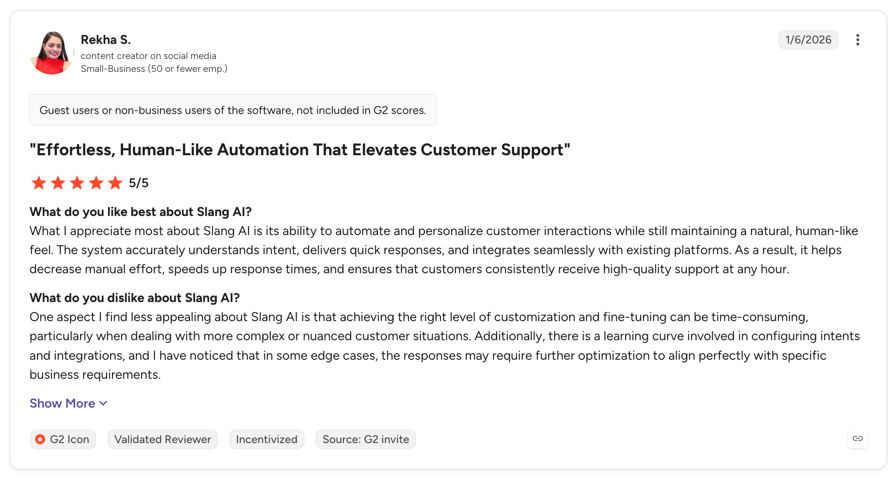
Worth knowing: G2's listing still shows "from $299/month," which contradicts Slang's own site. Use the $399 figure. Reviewers also consistently flag that speech recognition struggles with strong accents and fast talkers.
Popmenu: Best for Restaurants That Want Phone, Website and Marketing in One Bill
What Is Popmenu?
Popmenu is a restaurant marketing platform covering website, menus, online ordering and marketing, with AI phone answering available as an add-on module. Founded in 2016 and backed by a $65M Series C, it is the most established company in this comparison.
Why Popmenu May Be Better Than Loman AI
- AI phone answering starts at $149/month, published on the product page
- The strongest POS integration list here: Toast, Square, Clover, NCR Voyix, SpotOn, Deliverect and Genius, plus OpenTable, Resy and Yelp on reservations
- No contracts, cancel anytime, which is the direct opposite of Loman's non-refundable initial term
- Setup included, 10% discount for annual prepay
- One vendor for website, menu, ordering and phone, which is genuinely simpler to administer
Two honest caveats. The $149 is an add-on to the platform, not a standalone product, so realistic entry is roughly $308/month once you add the cheapest platform tier. And the G2 review corpus contains no mentions of the phone-answering feature at all, so those 22 reviews validate the company rather than this product.
What Is Popmenu's Pricing?
- AI Answering: from $149/month, as an add-on
- Starter platform: $159/month annual, $179 monthly
- Essentials: $269/month annual, $299 monthly
- Premier: $449/month annual, $499 monthly
- Online ordering: $1.00 flat per online order
- Annual prepay saves 10%. No free trial.
What Are G2 Users Rating Popmenu?
Popmenu is rated 4.7/5 by 20+ verified users on the platform.
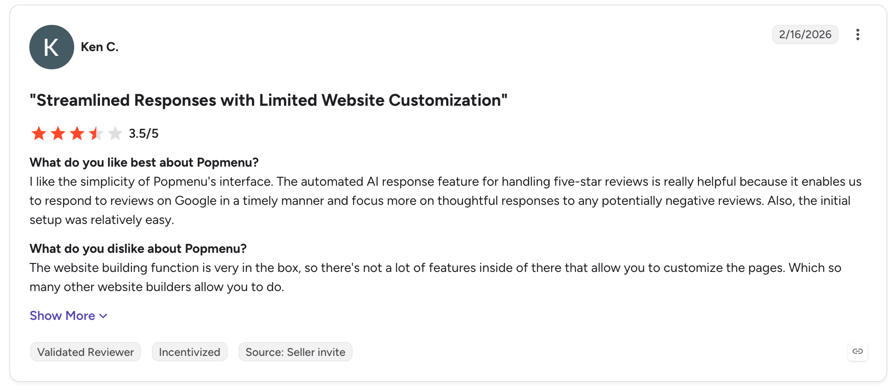
Worth knowing: the $1.00 per-order fee draws real complaints from reviewers, and Trustpilot sits at 3.2/5 across 54 reviews with a polarised split (50% five-star, 37% one-star). Multi-location operators also report having to make changes site by site with no bulk update.
Newo.ai: Best for Multilingual Restaurants That Want to Test Before Paying
What Is Newo.ai?
Newo.ai is a horizontal AI receptionist platform with a restaurant vertical, backed by a $25M Series A in February 2026 and co-founded by David Yang of ABBYY. On paper it is the closest feature match to Loman Premium: order intake, reservations and phone payments, plus 60 languages with mid-call switching.
Why Newo.ai May Be Better Than Loman AI
- Fully public unit pricing and a genuine free tier, so you can test the product before any commitment
- 50 free units with no payment method required, the best free entry point in this comparison
- 60 languages with mid-call switching, against Loman's unpublished 30+
- Order intake, reservations and phone payments, matching Loman Premium's feature set
- No setup costs and no minimum term
The honest caveat: Newo's restaurant page claims Toast, Resy, SevenRooms and Yelp connections that its own integrations directory does not list. Verify any specific integration directly before you buy. Its review base is also thin at 11 G2 reviews.
What Is Newo.ai's Pricing?
- Pay As You Go: $0/month, 50 free units one-time, then $1.75 per unit
- AI Receptionist: $299/month including 200 units, then $1.50 per unit
- Enterprise: custom
- A unit is roughly one voice call: under 30 seconds counts as 0.2 units, 30 seconds to 3 minutes as 1 unit, then billed in 3-minute increments
- No annual billing option and no annual discount
What Are G2 Users Rating Newo.ai?
Newo.ai is rated 4.9/5 by 10+ verified users on the platform.
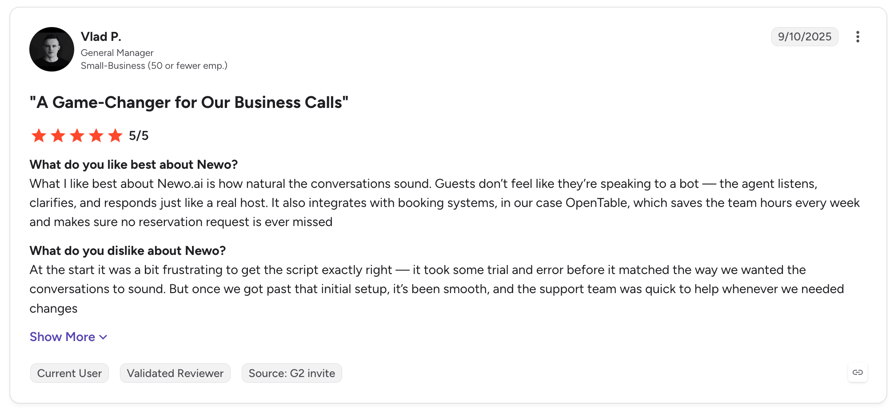
Worth knowing: the unit model is cheap at low volume and expensive at high volume. A restaurant taking 1,000 calls a month pays $299 plus 800 units at $1.50, which is roughly $1,499. Model your real call volume before choosing this over a flat rate.
What Are Loman AI's Best Features?
Loman is a narrow product and that is its strength. It does not try to be a phone system, a marketing platform or a general AI assistant. It answers a restaurant's phone and takes the order. Here are the four things it does genuinely well, with an honest note on each.
On-Call Order Taking Straight Into the POS
This is the feature that separates Loman from most restaurant answering tools. Where competitors text the caller an ordering link, Loman completes the order on the phone, handles modifiers and combos, and pushes it into the POS workflow without manual re-entry. The Toast partnership announced in July 2026 is the most mature version of this.
Where it could be better: the depth of that integration outside Toast and SpotOn is unclear. Loman displays eight or more POS logos but only three partnerships have been announced, and the Terms list integrations as a chargeable add-on. Confirm your specific POS before you buy.
Phone Reservations With OpenTable
Loman handles the full reservation lifecycle by phone: booking, modifying, confirming and cancelling, natively through OpenTable's Integration Marketplace since December 2025. For a full-service restaurant, this removes the single most repetitive category of inbound call.
Where it could be better: OpenTable is the only reservation platform with a confirmed native integration. Resy is named on Loman's site but we could not verify the depth, and SevenRooms and Tock do not appear at all.
Secure Card Payments Over the Phone
Premium takes payment during the call, which closes the loop on a takeout order without a human touching it. For a busy pizza or wings operation, that is the difference between the AI reducing work and the AI just rerouting it.
Where it could be better: this is the feature that most needs a compliance answer, and Loman publishes none. We found no PCI DSS, SOC 2, HIPAA or GDPR claim anywhere on the site, in the Terms, or in any press release, despite the product handling card data over the phone. Ask about PCI compliance directly and get the answer in writing.
Concurrency and Interruption Handling
Loman handles up to 50 calls at once on Starter, which means a Friday rush does not produce a busy signal, and it handles mid-sentence interruptions rather than talking over callers. For restaurants, where every unanswered call at peak is a lost ticket worth $25 to $50, concurrency is the feature that pays for the subscription.
Where it could be better: the accuracy claims have moved without explanation, from 98.6% in the December 2025 OpenTable release to 99.6% on the pricing page in August 2026. Both are company-sourced with no methodology published, and the one detailed negative review on record describes an agent that could not take orders correctly after four months.
What Are the Pros and Cons of Loman AI?
| Pros | Cons |
|---|---|
| Real order taking: completes takeout and delivery orders on the call and pushes them into the POS, which most competitors do not do | No published pricing: every tier is "Contact Us," so you cannot compare or budget without a sales call |
| Restaurant-only focus: built for one industry, trained on restaurant calls, with menu, allergen and out-of-stock logic that generalist tools lack | No free trial: a demo is not a trial, and the Terms contain no trial or pilot clause, so your first real test happens after you have committed |
| Confirmed Toast, SpotOn and OpenTable partnerships, announced publicly rather than just claimed on a logo wall | Non-refundable initial term: you owe every month of a 1 to 12 month term regardless of usage, and early exit makes the balance immediately due |
| 50 simultaneous calls and interruption handling, so peak service does not produce a busy signal | "Unlimited" is contractually qualified: minutes are metered on your Order and fair use permits throttling, suspension or rebilling |
| Fast onboarding: 24 to 48 hours claimed, and a reviewer independently reports completion in under five days | Almost no independent reviews: roughly eight verifiable reviews exist in total, and no compliance certifications are published despite taking card payments |
Is Loman AI Worth the Cost for Your Restaurant?
Loman AI is a good product for a specific restaurant. If a meaningful share of your revenue arrives by phone as takeout and delivery orders, if you run Toast or SpotOn, and if your main frustration is orders being missed or mis-taken at peak, Loman does something most alternatives genuinely cannot: it completes the order on the call and puts it in the kitchen.
Whether it is worth the cost is a separate question, and it comes down to what you are willing to sign without seeing a price.
Loman AI Makes Sense If:
- Phone orders are a real revenue channel, not just a service channel, and you are losing them at peak
- You run Toast or SpotOn, or take bookings through OpenTable, where the integrations are confirmed
- You are a single location or small group where the per-location rate is manageable
- You are comfortable committing to a non-refundable initial term before you have tested the product
- You will negotiate a one-month or three-month initial term for the first commitment rather than accepting twelve
Loman AI Is Probably Not the Right Fit If:
- Your phone traffic is questions and bookings rather than orders, where cheaper answering tools do the same job
- You run a POS outside Toast and SpotOn and cannot confirm the integration depth in writing
- You need to compare options on price before a sales call, which Loman does not permit
- You want to trial the product before paying for it
- You are a multi-location group and the per-location model multiplies without a published volume discount
- You need documented PCI or SOC 2 compliance, which Loman does not publish despite taking card payments
The decision, put plainly: get the Order form before you commit and check five numbers on it. The per-location Monthly Fee, the setup fee, the contracted talk-time minutes, the overage rate, and whether your POS integration is included. If Loman will not put those in writing, that itself is the answer.
And if what you actually need is a restaurant phone system where the AI answers, books, routes and hands off to your staff, with every rate published and no lock-in, CloudTalk covers it from €0 with 50 free AI minutes. Start with our guide to the best phone system for a restaurant, or see the wider use cases for AI voice agents if you are still scoping what to automate.
FAQs: Loman AI Pricing
Loman AI does not publish pricing. All three tiers (Starter, Premium and Enterprise) show "Contact Us" on the pricing page, so the only way to get a figure is to book a demo. Third-party trackers report between $199 and $529 per location per month, but these sources contradict each other and none is confirmed by Loman. The only Loman-controlled figure we found is on Loman's own blog: "starting at $199 per month." Budget for a setup fee too, since the Terms reference one without publishing an amount.
Loman AI is an independent, venture-backed company founded in summer 2024 and headquartered in Austin, Texas. Christian Wiens is the founder and CEO, with Anita Liu as Chief Design Officer and Jansen Derr as CTO. It raised a $3.5M seed round announced in August 2025, led by Next Coast Ventures with participation from TenOneTen Ventures and Antler. It is not a subsidiary of a larger company and has 11 to 50 employees.
Loman AI is an AI phone agent for restaurants. It answers calls 24/7, handles questions about hours, menu items and allergens, transfers calls to staff, and sends outbound SMS. On the Premium tier it also takes takeout and delivery orders with modifiers, books and modifies reservations, pushes orders into the POS, and takes card payments over the phone. It handles up to 50 calls at once and supports 30+ languages.
No. Loman offers a free demo, which is a sales call, not a trial. Its Terms and Conditions contain no trial, pilot or proof-of-concept provision. Some software directories list a free trial for Loman, but we found no trial offer on Loman's own site and no contractual basis for one. Because the initial term is non-refundable, this means your first real test of the product happens after you are already committed to paying for it.
Loman's pricing page states "No per minute fees." Its Terms tell a more complicated story. The Terms confirm the Monthly Fee covers "talk-time minutes at the level described on the Order," meaning minutes are metered on your contract. They also name overage charges as an add-on, and a fair-use clause allows Loman to "throttle, suspend, or rebill" accounts whose usage is materially inconsistent with typical restaurants of similar size. No overage rate is published. Ask for the contracted minute level and the overage rate in writing.
Loman names Toast, SpotOn, Clover, Shift4, Square, Aloha by NCR, Olo and Stream on its site. Three integrations have announced partnerships behind them: Toast (formal Toast Partner Ecosystem member since July 2026), SpotOn (January 2026) and OpenTable for reservations (December 2025). The depth of the others is not documented publicly. Otter, Owner.com and Popmenu are not supported. If you run a POS outside Toast and SpotOn, get the integration confirmed in writing before signing.
Yes, but only on the Premium tier. Starter handles calls, questions, transfers and SMS, but does not take orders or book tables. Premium adds takeout and delivery ordering with modifiers and combos, automated phone reservations (book, modify, confirm, cancel) through OpenTable, POS order injection, secure card payment on the call, and a dynamic upsell engine. If ordering is why you are buying, Starter will not do the job at any price.
For a takeout-driven restaurant on Toast or SpotOn where phone orders are real revenue, the reported $199 to $399 per month is defensible. At $25 to $50 per phone ticket, recovering a few missed calls a day covers it. The risk in a Loman AI subscription is the contract, not the rate. The initial term is non-refundable, the overage rate is unpublished, there is no trial, and billing disputes expire after 120 days. Negotiate a one-month or three-month initial term for your first commitment, and extend it once the product proves itself.
They solve overlapping problems from different directions. Loman is a specialist: restaurant-only, built around taking orders on the call and injecting them into the POS. CloudTalk is a phone system with AI inside it: the agent answers, books through OpenTable and Resy, handles FAQs in 70+ languages, and routes anything it cannot resolve to your staff with full context, all on one platform.