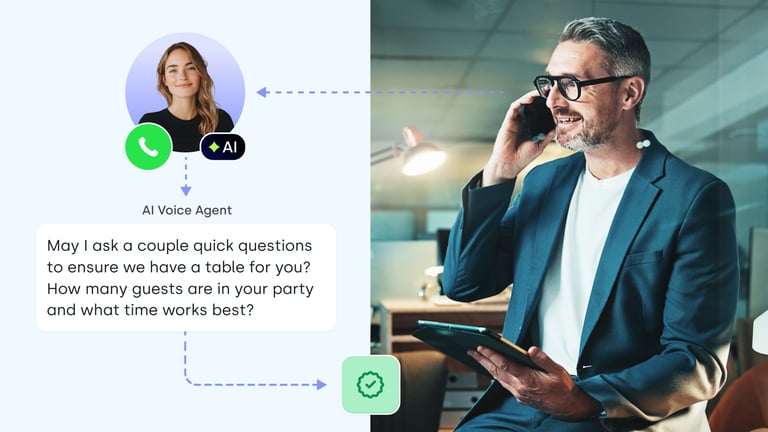
TL;DR: Our Verdict on Loman AI
| Area | The Verdict |
|---|---|
| Overall Rating | 3.2/5. CloudTalk's own editorial assessment against the rubric below, not a user-review average. |
| Best For | Independent and multi-unit restaurants on Toast, Square, Clover, SpotOn, Shift4, Aloha, Olo or Stream that lose orders to a ringing phone. |
| Not Good For | Teams that need outbound calling, non-restaurant businesses, and anyone who wants a price before a sales call. |
| Starting Price | Not published. Both tiers show "Contact Us". Figures still circulating online range from $199 to $399+ a month and contradict each other. |
| Free Tier? | None, and no self-serve trial. Loman's homepage does give you a free live demo call in about 30 seconds. |
| Setup Time | 24 to 48 hours, per Loman's own pricing page. |
| Standout Strength | Ordering and reservations in one system, with tickets pushed straight into the POS. |
| Standout Risk | The contract: a setup fee, per-location fees, and a 1 to 12 month initial term with the full remaining balance due if you leave early. |
| User Sentiment | 4.5/5 on G2, but only 3 reviews so far, too thin to call a trend. |
According to the National Restaurant Association's 2026 State of the Restaurant Industry report, 42% of operators said their restaurant was not profitable last year. That is the backdrop for every AI phone pitch landing in restaurant inboxes right now.
So operators go shopping for software, and that's where this category gets awkward. Most of the AI phone answering systems for restaurants won't tell you what they charge until you've sat through a demo, and Loman is one of them.
We spent a day inside Loman's pricing page, its integration pages, its funding announcements, its End-User License Agreement, and the one public thread where Toast operators discuss it. What we found is below, and the contract section is the part no other page on this topic touches.
Loman AI at a Glance
| Area | Detail |
|---|---|
| Founded | Summer 2024, Austin, Texas |
| Team size | 11 to 50 employees, per Crunchbase. Not disclosed by Loman itself; its careers page lists 9 open roles as of August 2026 |
| Country coverage | United States focused. Loman says it serves customers nationwide; a third-party restaurant-tech directory lists availability in the U.S. and Canada |
| G2 rating | 4.5 / 5 (3 reviews) |
| Starting price | Not published. Contact vendor for current pricing |
| Funding | $3.5M seed, announced August 2025 |
What Is Loman AI?
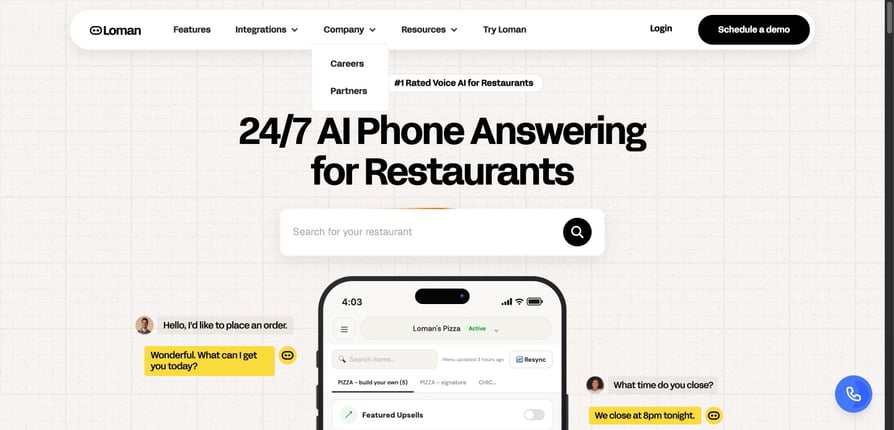
Loman AI is a voice AI built specifically for restaurants. It answers your phone around the clock, takes full takeout and delivery orders, books tables, and pushes everything into your point-of-sale (POS) system without anyone re-keying a ticket.
The company is Loman AI, Inc., a Delaware corporation with offices in Austin, Texas. According to its August 2025 funding announcement, it was founded in Summer 2024 by Christian Wiens and raised a $3.5 million seed round led by Next Coast Ventures, with TenOneTen Ventures and Antler participating.
Loman sells to single locations, multi-unit groups and enterprise brands. In that same announcement, the company said it had taken millions of phone calls and processed tens of millions in order volume over the previous year, with particular traction in pizza. Those are Loman's figures, not audited ones.
Loman's advantage is scope. Most voice AI vendors in this space handle reservations or ordering. Loman handles both in one system, and its POS integrations run direct rather than through middleware. It is not a full restaurant call center platform, though. There are no agent seats, no outbound campaigns and no queue management.
Where it gets thin is everything around the product: no published pricing, no security page, a review history that barely exists yet, and fine print that is stricter than the marketing suggests.
Who Loman AI Is Best Suited For
The clearest fit is a high-volume phone-ordering restaurant on a supported POS: pizza, wings, sushi, anything where a big share of revenue arrives as a phone order during a two-hour peak. Full-service restaurants that take reservations by phone come second, especially if you already run OpenTable and want one system covering the booking and the takeout call.
Read it as an add-on to your phone setup rather than a replacement for it. Loman answers the line; it does not give you the phone system for a restaurant that your managers, hosts and multi-site staff work in all day.
What Are Loman AI's Key Features?
- 24/7 inbound call answering.Loman's user agreement describes the service as 24/7/365 inbound call answering, so calls don't hit hold music or voicemail after close.
- Full phone ordering.Takeout and delivery orders with modifiers and substitutions, on the Premium tier.
- Phone reservations.Automated booking by phone, with a dedicated OpenTable integration.
- Direct POS integrations.Toast, Square, Clover, SpotOn, Shift4, Aloha by NCR, Olo and Stream, plus ezCater for catering.
- Automated call transfer.Available from the Starter tier, so complex calls reach a person.
- Secure payment over the phone.A Premium feature, per Loman's pricing page.
- Dynamic upsell engine and guest memory.Also Premium: the agent suggests add-ons and remembers repeat callers.
- Dashboard.Live calls, transcripts, orders, outcomes, revenue and peak call times in one view.
- Concurrency.Loman's pricing page states Starter handles up to 50 calls at once.
See an AI Voice Agent Handle a Real Call
Loman AI Scorecard: Our Editorial Ratings
Read the rubric before the numbers. These Loman AI scores are CloudTalk's own editorial assessment, not an average of user reviews. Loman's own review footprint is still small: 3 reviews on G2 and a FeaturedCustomers page, nothing yet on Capterra, Trustpilot, GetApp or Software Advice, so no cross-platform aggregate exists to report.
Each dimension is scored out of 5 against what we verified from primary sources on 10 August 2026: Loman's pricing and integration pages, its user agreement, its funding announcements, and one public operator discussion. Claims that exist only as vendor marketing don't earn points, and we judge call quality on evidence instead of vendor wording, against the same criteria we publish for our own call quality.
Over the last decade we've helped 30,000+ professionals pick business communication tools, and every vendor gets scored the same way.
Loman AI Scorecard
| Dimension | Rating | Why |
|---|---|---|
| Ease of setup | 4/5 | Loman advertises 24 to 48 hour onboarding with white-glove help. Fast for a system that touches your POS and menu. |
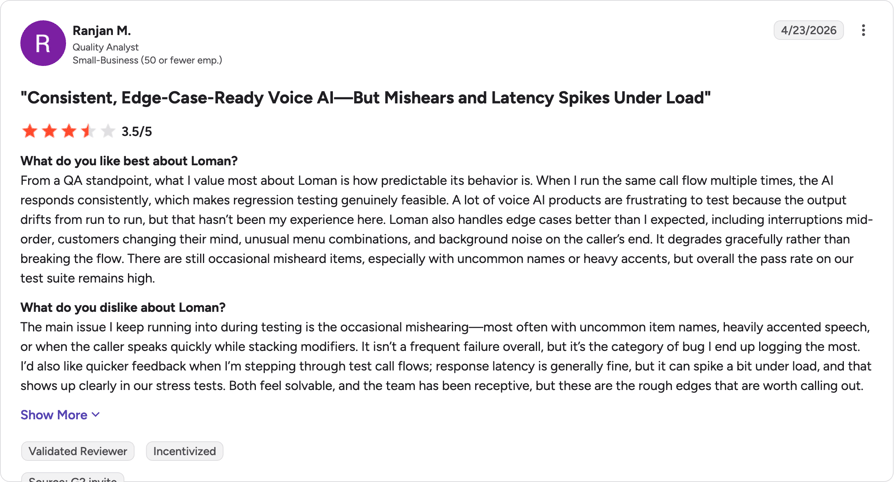
| Call quality & accuracy | 3/5 | Loman's pricing page claims 99.6% order accuracy, but the figure is uncited and no independent testing exists. A G2 reviewer who stress-tested the system flagged occasional mishearing on heavily accented speech, and an operator in the r/ToastPOS thread raised the same concern. |
| Pricing clarity | 1.5/5 | Nothing published. Three different figures circulate online, none of them from the current pricing page, and the setup fee and lock-in only appear in the user agreement. |
| Features & capabilities | 4/5 | Ordering, reservations and phone payments in one product is more than most rivals ship. Inbound only, though. |
| Integrations | 4.5/5 | Ten verified POS, reservation and catering integrations with direct ticket injection, including live menu and 86'd-item sync. |
| Support & reputation | 2.5/5 | Founded in 2024, business-hours-only support for a 24/7 product, a 99% uptime target rather than a service-level agreement (SLA), and no published certifications. |
| Overall | 3.2/5 | A strong product wrapped in commercial terms you should question hard before signing. |
How Does Loman AI Work?
Loman AI answers inbound calls on your existing restaurant number, holds a two-way conversation with the caller, then writes the result into your POS or reservation system.
Answering Calls and Taking Full Orders
A caller reaches your normal restaurant number and Loman's agent picks up immediately, at any hour. It handles interruptions mid-sentence rather than starting over, which is what separates a voice bot from something your guests will tolerate.
On the Premium tier the agent takes the whole order, modifiers and substitutions included, then pushes it into the POS as a ticket. Loman's pricing page also lists secure payment over the phone on that tier.
Reservations and POS Sync
Premium adds automated phone reservations, and Loman ships an OpenTable integration for restaurants already running it. That's the part that separates Loman from the reservation-only and ordering-only vendors.
The sync runs both ways. Loman's Toast integration page says the agent reads your live Toast menu, so it quotes 86'd items, price changes and specials correctly without anyone touching a second system.
Escalation and Human Handoff
When a caller needs a person, automated call transfer routes the call to your team. It's on the Starter tier, so you don't need the top plan to keep a human in the loop. What you get is a transfer, not the conditional call routing a phone system gives you, so rules like "sommelier questions to the bar, catering to the GM after 4pm" live outside Loman.
Loman does put transcripts in the dashboard, but nothing public says a transcript travels with the transfer. If context for whoever picks up matters to you, get that behavior confirmed in writing.
Loman AI Pricing: Three Numbers, None of Them on the Pricing Page
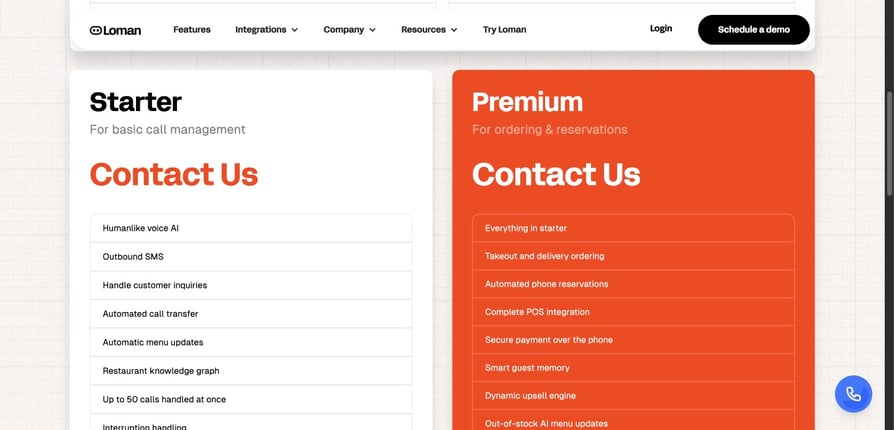
We checked Loman's pricing page on 10 August 2026. Both plans, Starter and Premium, show "Contact Us". A footer line invites you to get in touch about enterprise plans. There is no published price anywhere on the page.
The page does tell you what's in each tier. Starter covers humanlike voice AI, outbound SMS, customer inquiries, automated call transfer, automatic menu updates, a restaurant knowledge graph, interruption handling, the dashboard, and up to 50 calls handled at once.
Premium adds the parts most operators are shopping for: takeout and delivery ordering, automated phone reservations, complete POS integration, secure payment over the phone, guest memory, the upsell engine, out-of-stock menu updates and SMS updates. If you want Loman to take orders, you want Premium.
The page also carries a banner reading "No per minute fees. No hidden costs." The user agreement below complicates that second sentence.
The Three Prices That Don't Match
Loman publishes nothing, and numbers are still out there. Every figure we could find sits below with its source and date.
The Three Prices That Don't Match
| Source | Starter | Premium | Date | What It Is |
|---|---|---|---|---|
| Loman's own pricing page | Contact Us | Contact Us | Verified 10 August 2026 | Current, official |
| Loman's own blog | “starting at $199 per month” | Not stated | Published 30 March 2026, still live | Vendor's own, stale |
| A third-party restaurant-tech directory | $249/month | $399+/month, varying by call volume | Listing updated 11 May 2026 | Third party, unverified by Loman |
Two things stand out. The highest figure is roughly double the lowest, and the directory listing describes Starter as including unlimited calls while Loman's own pricing page caps Starter at 50 concurrent calls.
We won't tell you what Loman charges, because Loman doesn't say. None of these numbers belongs in your budget without written confirmation from a rep.
The Real Cost: What to Ask For Before You Sign
The contract is public, and it is where the real cost lives. Loman's End-User License Agreement, last updated 26 May 2026, sets out a commercial structure that looks nothing like a monthly SaaS subscription:
- There's a setup fee.The agreement says the Setup Fee, if any, is due on acceptance of the terms, separate from the monthly fee.
- Pricing is per location.Your Order specifies a per-location Monthly Fee and the number of Locations, so a five-store group is not paying one subscription.
- You're locked in for a term.Initial Terms are 1, 3, 6 or 12 months, and you're obligated to pay the Monthly Fee for every month of that term regardless of usage.
- Leaving early costs the full balance.If you terminate early for any reason other than Loman's uncured material breach, all remaining Monthly Fees for the Initial Term become immediately due.
- It auto-renews.The contract rolls month to month unless either side cancels at least 30 days before the end of the current term.
- No refunds.All fees are non-refundable, including for partial months and unused service, except where law requires otherwise.
- “Unlimited” has a limit.The fair-use clause lets Loman throttle, suspend or rebill accounts whose usage is materially inconsistent with typical restaurant operations of similar size.
- 99% is a target, not an SLA.Loman targets 99% monthly uptime for the core service, and the agreement defines no service credits if it misses.
- Support is business hours.Email, phone and text support run during normal business hours, for a product that answers your phone at 2am.
- Late payment carries interest.1.5% per month or the legal maximum, plus collection costs.
- Some integrations are billed by the partner, not by Loman.
None of that makes Loman a bad vendor. Term contracts, setup fees and auto-renewal are normal in restaurant tech. It does mean the "no hidden costs" banner is doing a lot of work, and it hands you a list of questions for the sales call:
- What is my Setup Fee, and is it waivable?
- What is the per-location Monthly Fee, and does it change at five or ten locations?
- Which Initial Term am I signing, and exactly what do I owe if I exit in month two?
- How many talk-time minutes does my Order include, and what's the overage rate?
- Which integrations are billed by the partner instead of by you?
- Is there any credit if you miss the 99% uptime target?
Get the answers in the Order document, not in an email.
Is Loman AI Free?
No. There's no free tier and no self-serve trial anywhere on loman.ai. Every plan button is a demo request or a contact form, and the user agreement confirms a paid Order with a setup fee and an initial term.
Loman's homepage does give away one genuinely useful thing: a live demo call. Pick a cuisine, enter your details, and the AI phones you within about 30 seconds so you can place an order the way a guest would.
Do it before your sales call, and do it with the accents and the messy orders your guests really use. It costs nothing and it's the fastest accuracy test available.
Security, Compliance and Who Carries the Risk
Loman publishes no SOC 2, ISO 27001, PCI-DSS or HIPAA attestation. We checked the full site map on 10 August 2026 and found no security or trust page at all, only Terms and a Privacy Policy. That privacy language stays generic: administrative, technical and physical measures, plus a caveat that no system is impenetrable. Loman states no retention period for call recordings.
Loman sells secure payment over the phone on Premium, while its user agreement places PCI-DSS compliance on the restaurant. That same agreement puts TCPA compliance, state two-party consent recording laws and the legality of recording calls on you.
The agreement is equally blunt about accuracy: AI outputs may contain errors, and you are responsible for reviewing and verifying orders, reservations and other material actions taken by the service.
Read the data clause before you sign. Customer Data covers call recordings, transcripts, orders, customer phone numbers and menu data, and Loman may use de-identified, aggregated data to train and refine its AI models. You keep your rights; the anonymized version still feeds the product.
None of this is unusual for an early-stage vendor. It does mean a multi-unit group with a compliance team should ask for the PCI attestation in writing before taking card numbers over an AI-answered line. A useful benchmark for that conversation is the certification list an established vendor publishes; ours sits on CloudTalk's security page.
Who Owns Loman AI? Is It Legit?
Loman AI is owned by Loman AI, Inc., a Delaware corporation headquartered in Austin, Texas. Christian Wiens is the founder and CEO.
It's a real, funded company. Loman announced a $3.5 million seed round on 26 August 2025, led by Next Coast Ventures with TenOneTen Ventures and Antler participating. Michael Maloney of Next Coast and Eric Pakravan of TenOneTen are both quoted in Antler's funding release.
The company was founded in Summer 2024, which makes it young even by voice AI standards. We found no funding round after the August 2025 seed, and the careers page currently lists nine open roles across finance, engineering and go-to-market.
So it's a real company with real investors, and it's very young. Both facts belong in your thinking before you sign a multi-month contract with a two-year-old vendor, the same way track record would weigh on your choice of any business phone system.
What Users Say About Loman AI?
Loman AI's review footprint is small, but it isn't empty. Here is what four platforms showed when we checked, alongside the themes from a public operator discussion in r/ToastPOS and from verified product facts.
Loman AI Ratings Across Platforms
| Platform | Rating | Sample |
|---|---|---|
| G2 | 4.5/5 | 3 reviews |
| FeaturedCustomers | 4.8/5 | 401 reference ratings, 14 references total |
| Slashdot | 4.2/5 | 5 reviews |
| SourceForge | 4.2/5 | 5 reviews |
None of these samples are large enough to call a consensus, and Loman still has no listing on Capterra, Trustpilot, GetApp or Software Advice.
👍 What Users Love
- The product itself gets credit even from people who left.One operator in the r/ToastPOS thread said they cut Loman purely on cost, adding that the product is good and their customers liked it.
- A Toast operator who booked a demo went ahead with it.The person who started that thread edited the post later to say they'd had a great experience and were moving forward with Loman.
- Ordering plus reservations in one place.Restaurants running both don't need a second vendor, which is the most common complaint about the reservation-only tools.
- POS depth your staff feel mid-service.Direct ticket injection with live menu and 86'd-item sync means nobody re-keys an order during a rush.
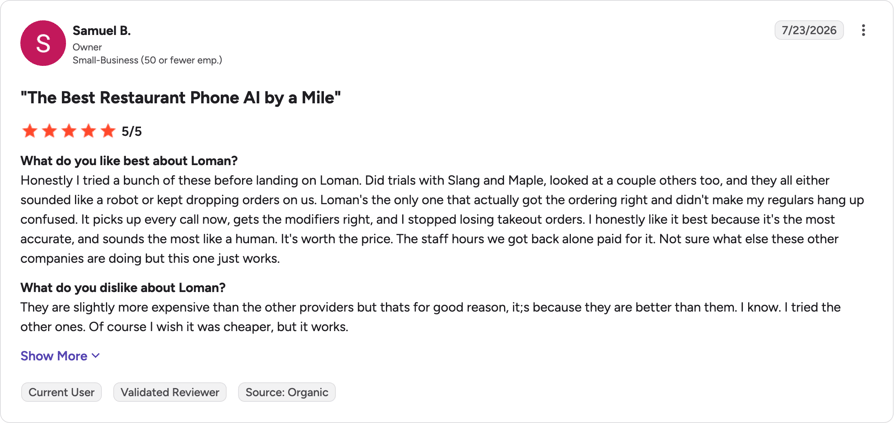
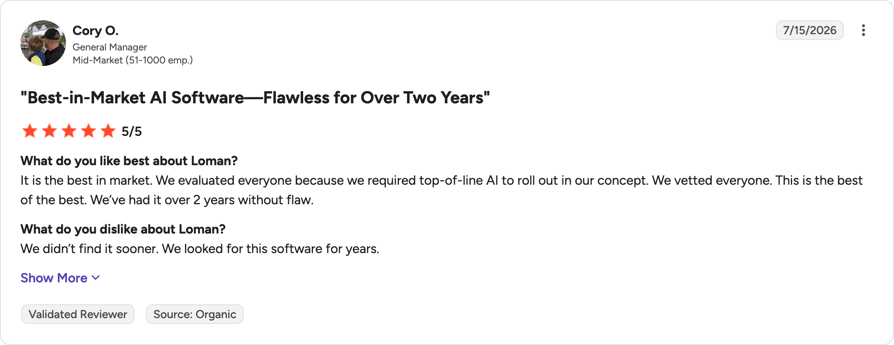
- One reviewer calls it the best in the category.Cory O., a general manager at a mid-market restaurant group, told G2 he evaluated competitors first and still calls Loman "the best in market," reporting two years without a flaw alongside a 4% labor cut and a 6% sales lift on phone orders. (Source: Loman AI reviews on G2)
🤔 What Users Hate
- Price relative to value at small scale.The same operator who praised the product dropped it because it cost too much for their restaurant at that time.
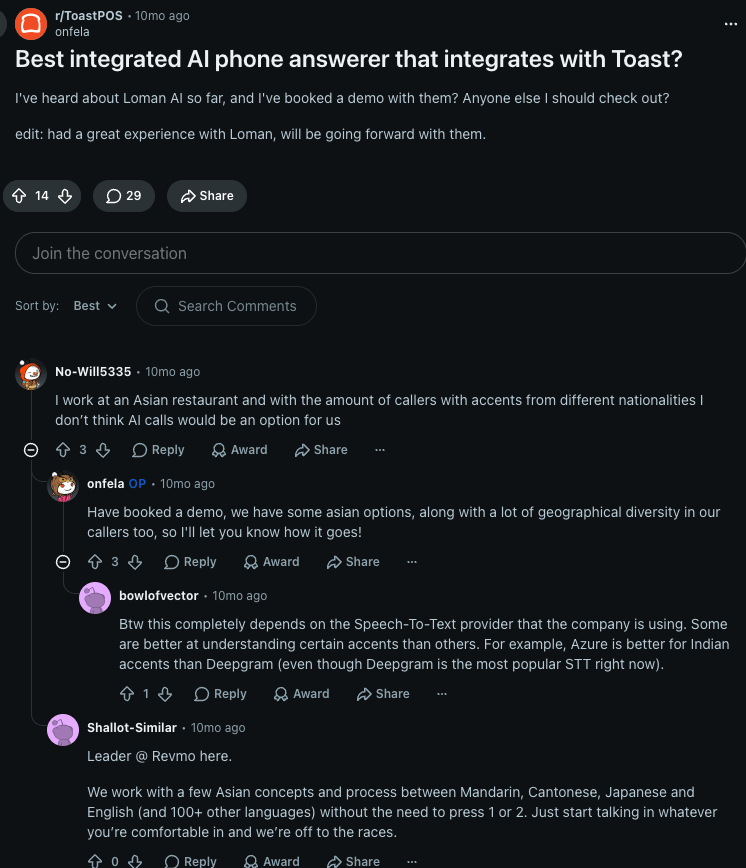
- Accents.An operator at an Asian restaurant said the range of caller nationalities made AI answering a non-starter, and a reply noted that results depend on which speech-to-text vendor sits underneath.
- Guests who hang up on robots.Consumer resistance was the loudest theme in the thread, with several people saying they hang up when AI answers a restaurant phone.
- Mixed results at franchise scale.A pizza-sector operator reported feedback across their franchise as "pretty mixed" and said it wasn't the right move for lower-volume, high-service situations.
- No published pricing.You cannot compare Loman against alternatives without a sales conversation first.
- Business-hours support.The product runs 24/7; the humans behind it don't.
- Accents and heavy load still trip it up.Ranjan M., a quality analyst who stress-tested the system for a G2 review, found it handles interruptions and background noise well, but still gets "occasional mishearing" on "uncommon item names, heavily accented speech," with response lag creeping in under load. (Source: Loman AI reviews on G2)
What Reddit Says About Loman AI
The r/ToastPOS thread from October 2025 is the most useful public discussion of Loman anywhere, mostly because it isn't a vendor page. Read it with your eyes open, though: at least one competitor's leadership pitched in the comments. The operators there disagree about the price, not about whether the software works, which is the better of those two problems to have. The risk they keep circling back to is diner reaction rather than the technology.
Is Loman AI Worth It? Who Should (and Shouldn't) Use It
Whether Loman AI is worth it comes down to how much of your revenue arrives by phone and how much of that lands inside a two-hour peak, the same question you'd ask of any tool built for high call volume.
Who Is Loman AI a Good Fit For?
- High-volume phone-ordering restaurants on Toast, Square, Clover, SpotOn, Shift4, Aloha, Olo or Stream.
- Pizza and quick-service restaurant (QSR) operators losing orders during a predictable nightly peak.
- Full-service restaurants that want reservations and takeout handled by the same agent.
- Small groups that can absorb a per-location fee and a term contract without flinching.
Who Should Not Use Loman AI?
- Any team that needs outbound calls.Loman's user agreement describes the service as inbound call answering, and only SMS goes out. Reminder calls, reactivation campaigns and follow-ups are outside the product.
- Businesses outside restaurants.The knowledge graph, menu sync and POS integrations are the whole product.
- Restaurants with a heavily multilingual caller base, until you've tested it.Loman's supported-language list isn't published anywhere we could find.
- Buyers who need a price to run a comparison.There isn't one.
- Enterprise and drive-thru operators with procurement standards.Loman does market to enterprise brands, so this isn't a positioning mismatch. The caution is elsewhere: no published drive-thru capability, a company founded in 2024, a 99% uptime target with no service credits, and business-hours support.
If you run on Toast, weigh the platform risk too. An operator in that same thread mentioned an option to join a waitlist for a Toast in-house version inside Toast's "Test Kitchen". Toast hasn't announced a product, and a waitlist isn't a roadmap, but if your POS vendor ships its own phone answering, a point solution bolted onto that POS is the thing it replaces first.
Which Restaurant Types Fit Loman AI?
Which Restaurant Types Fit Loman AI?
| Scenario | Fit |
|---|---|
| Pizza, wings or QSR with heavy phone ordering | Strong |
| Full-service restaurant taking phone reservations | Strong |
| Multi-location group on a supported POS | Moderate, budget per location |
| Restaurant that needs outbound calling | Weak, the product is inbound only |
| Heavily multilingual caller base | Test first, language support is unpublished |
| Any non-restaurant business | Not applicable |
The Best Loman AI Alternatives in 2026
The four strongest Loman AI alternatives are CloudTalk, Slang AI, Hostie and Bite Buddy. Start there if the pricing opacity or the inbound-only design is your blocker. One thing to settle early if you're comparing Loman AI vs Slang AI: Slang doesn't take phone orders at all, it sends an ordering link by text instead. We verified every figure below on each vendor's own site on 10 August 2026.
Loman AI Alternatives Compared
| Provider | Phone Orders | Reservations | Outbound Calls | Languages | Published Starting Price | G2 Rating | Best For |
|---|---|---|---|---|---|---|---|
| Loman AI (reviewed here) | Yes, Premium | Yes, Premium | No, inbound only | Not published | None published | 4.5/5 (3 reviews) | Phone-heavy restaurants on a supported POS |
| CloudTalk | Yes, via AI Voice Agent | Yes, via AI Voice Agent | Yes, inbound and outbound | 60+ | $25/user/month, AI Voice Agent from $99/month | 4.4/5 | Restaurant groups that also need outbound calls and a real phone system |
| Slang AI | No, sends ordering links by SMS | Yes, core focus | No, inbound plus outbound SMS | Bilingual Spanish, Premium only | From $399/month per location | 4.4/5 (57 reviews) | Full-service reservation-led restaurants |
| Hostie | Yes, Premium and above | Yes, Premium and above | Inbound, plus SMS marketing on the top tier | 20, on Premium | From $199/month per location | 4.6/5 (23 reviews) | Groups wanting calls, texts and email in one inbox |
| Bite Buddy | Yes | Yes | Not stated | Claims 70+ | $0/month, offset by a per-order digital fee passed to the guest | No rating yet, too few reviews on G2 | Operators who prefer a per-order fee to a subscription |
Bite Buddy's $0 headline is a fee model rather than free software, and the company publishes no founding date, funding or team information. An operator in the r/ToastPOS thread also called Hostie's Toast integration early and slow, so test that one on your own POS first.
Loman AI vs CloudTalk: Where Each One Wins
One concession up front. If your only job is taking phone orders for a pizza shop running Toast, Loman's direct ticket injection, menu sync and 86'd-item handling go deeper than a general-purpose voice agent will. We won't argue that away.
What you give up is a price you can read before the demo, and the ability to make calls rather than only answer them.
Loman AI vs CloudTalk
| Category | Loman AI | CloudTalk |
|---|---|---|
| Pricing transparency | No prices published. Both tiers show "Contact Us", and three conflicting figures circulate elsewhere online | Plans published on the pricing page from $25/user/month, with every add-on priced on the same page |
| Contract terms | 1, 3, 6 or 12 month initial term with all remaining fees due on early exit, auto-renewal with 30 days' notice, no refunds | Monthly or annual billing, plus a 14-day free trial you can start without talking to sales |
| Outbound calling | Inbound only. The user agreement describes 24/7/365 inbound call answering; only SMS goes outbound | AI Voice Agent handles both inbound and outbound conversations, including reminder and follow-up campaigns (add-on) |
| Languages and coverage | Supported language list not published. U.S. focused | 60+ languages on the AI Voice Agent, with local numbers in 160+ countries |
| Uptime commitment | Targets 99% monthly uptime, with no service credits defined in the agreement | 99.999% uptime SLA on decentralized infrastructure with multiple backup carriers |
| Support hours | Email, phone and text during normal business hours, per the user agreement | 24/7 live support from the Essential plan up |
| Systems of record | Ten restaurant POS, reservation and catering integrations | 100+ native integrations with two-way CRM and helpdesk sync, available from the Essential plan |
The country-by-country list behind that coverage row sits on CloudTalk's country coverage page, which matters if you're opening locations across borders rather than across town.
Why Restaurant Groups Choose CloudTalk Over Loman AI
CloudTalk is a full business phone system with an AI Voice Agent add-on, so it covers the outbound calls and the multi-industry workflows Loman AI does not.
An AI Voice Agent That Answers at 2am
CloudTalk's AI Voice Agent holds a free-flowing two-way conversation instead of walking callers down an IVR (interactive voice response) tree. It answers routine questions, takes messages, books appointments and routes calls when someone needs a person, which is the whole job of after-hours call handling. It's a usage-based add-on from $99/month for 200 minutes, with the first 50 minutes free.
Outbound Campaigns From the Same Agent
Loman answers your phone. CloudTalk's AI Voice Agent also places calls: booking confirmations and appointment reminders, feedback collection, winning back guests who haven't ordered in three months. An inbound-only tool can't close that gap.
AI Insights Across Every Call
AI Conversation Intelligence turns each recorded call into a transcript, topic list, sentiment score and summary, so you can find every call where a guest complained about a wait without listening to any of them. It's an add-on at $9 per user/month.
Call Flows You Can Change Mid-Service
The Call Flow Designer is a drag-and-drop builder with branching logic, failover actions and condition-based routing, editable in real time without interrupting live calls. IVR and skill-based routing come included from the Starter plan.
Local Numbers in 160+ Countries
Every location gets a local number, backed by a multi-carrier network. Groups expanding across regions run one platform instead of a phone vendor per market.
A Price You Can Read Before the Sales Call
Starter is $25/user/month, Essential is $29/user/month and Expert is $49/user/month, billed annually, and the AI Voice Agent pricing is published on the same page as the plans. Compare us against anyone without booking a demo first.
Businesses That Switched to CloudTalk
Real results from real companies that made the move, and never looked back. Hotels, short-term rentals and restaurants all lose the same thing when the phone goes unanswered, which is why CloudTalk's hospitality call center customers show up across all three.
Ready to Experience Superior Call Quality?
Frequently Asked Questions about Loman AI
Direct answers to the questions buyers ask most about Loman AI.
Loman AI is owned by Loman AI, Inc., a Delaware corporation in Austin, Texas. Christian Wiens founded it in Summer 2024 and is CEO. It raised a $3.5M seed in August 2025, which is young for a restaurant phone system vendor.
Christian Wiens is Loman AI's founder and CEO, named as both in the company's August 2025 funding release. He started it in Summer 2024 in Austin, Texas, so treat Loman as an early-stage AI voice agent vendor.
Loman publishes no prices; both tiers show "Contact Us". Expect a per-location monthly fee, a setup fee and a 1 to 12 month term, none of which you can line up against a published list the way you can with CloudTalk's pricing.
Yes. Loman's Toast integration page says orders push straight into Toast POS and the kitchen display, and the agent reads your live menu, so 86'd items and specials land correctly, which is the bar any restaurant call center setup has to clear.
No. Loman has no free tier and no self-serve trial; every plan button is a demo request. Its homepage calls you back with a live AI demo in 30 seconds, unlike a 14-day free trial you start yourself.
CloudTalk for inbound and outbound AI calling with published pricing, Slang AI for reservations, Hostie for calls and texts in one inbox, and Bite Buddy's per-order fee model. The wider field is in our AI phone answering roundup.
Loman is restaurant-only, inbound-only, and won't quote a price without a demo. CloudTalk's AI voice agent for restaurants handles inbound and outbound calls in 60+ languages, on published plans, with the agent as an add-on.