10 Best AI Phone Answering Systems for Restaurants in 2026: Start Booking 24/7
SUMMARY:
The best AI phone answering system for restaurants captures every reservation and takeout order without increasing your front-of-house overhead.
To help you find the right one, we reviewed 25+ top restaurant voice agents that actually increase your table turnover. While manual answering was once the standard, the 2026 trend is a move toward autonomous AI receptionists for 24/7 intake and instant POS syncing.
Top 10 AI phone answering systems for restaurants by use case:
-
CloudTalk: Best overall for scaling restaurant groups needing deep data sync and multilingual support.
-
Slang.ai: Best for independent restaurants wanting a premium, highly customizable brand voice.
-
Maple: Best for high-volume takeout requiring intelligent order-taking and menu sync.
-
Hostie.ai: Best for European hospitality groups needing to reduce staff phone burnout.
-
Loman AI: Best affordable entry point for 24/7 digital assistance with orders and FAQs.
-
Smith.ai: Best hybrid model for fine dining where AI speed meets live human backup.
-
PolyAI: Best enterprise-grade solution for massive chains needing complex conversational logic.
-
Goodcall: Best for automated table management and Resy-integrated bookings.
-
Dialzara: Best budget-friendly choice for solo owners needing a fast 15-minute setup.
-
Kea AI: Best specialized cashier assistant for high-speed drive-thru and franchise operations.
CloudTalk is the most efficient choice for 2026 if you want to automate routine chores and lower costs. Slang.ai remains the top contender for those prioritizing unique brand personality.
Missing a single reservation call during the Friday night rush is a direct loss of revenue, but forcing your host to choose between the phone and a guest at the door is a loss of hospitality.
Every unanswered ring at a restaurant is a potential guest calling your competitor instead. Research confirms that 78% of customers buy from the first business to respond, making speed the deciding factor in high-stakes hospitality.¹
This “front-of-house burnout” is the primary bottleneck when scaling a restaurant. When your hosts spend their entire shift answering repetitive questions about parking or dietary options, guest service on the floor suffers. These routine chores keep your team stuck in the weeds and prevent the high-level hospitality that actually drives repeat business
You can reclaim the wasted hours with a 24/7 AI receptionist for restaurants. It handles the heavy lifting by managing bookings, answering FAQs, and syncing order data directly into your POS (Point-of-Sale) system. This lets your team focus on the dining room while the system manages the intake.
In this guide, we’ll take you through the 10 best solutions for restaurants in 2026. We’ll also show you how to stop the “leaky bucket,” kill admin chores, and capture more revenue without adding a single person to your payroll.
Stop Juggling Hotlines and Hot Plates
How We Chose the Best AI Restaurant Phone Systems
To find the best solutions, we prioritized high-concurrency platforms that handle peak-hour surges without sacrificing “human” hospitality or menu accuracy. We evaluated 25+ platforms based on their performance in high-pressure restaurant environments.
Our selection was narrowed down using five essential pillars:
-
Multilingual Support: The ability to detect and switch between multiple languages instantly to serve every guest.
-
Conversational Quality: Sub-800ms response times and natural voices to prevent guest hang-ups.
-
Ecosystem Integration: The capacity to connect your phone data with your existing tech stack, from POS systems like Square and Shopify to CRMs like HubSpot and Salesforce.
-
Infinite Concurrency: The capacity to handle dozens of simultaneous calls without ever giving a busy signal.
-
Order & FAQ Accuracy: Precision in handling complex menu modifiers and answering repetitive guest questions.
Why Trust Our Software Reviews
Over the last decade, we have helped 30,000+ hospitality and business professionals implement smarter communication tools.
To build this guide, we evaluated over 25 AI-powered platforms and virtual receptionist services specifically designed for high-volume environments.
We cross-referenced verified data from G2 and Trustpilot with real-world feedback from operators to see how these tools perform during the “Friday night weeds.”
Our software review methodology cuts through the marketing fluff to show you which systems actually solve front-of-house burnout.
Top 10 AI Phone Answering Software for Restaurants in 2026
Stop wasting your most expensive resources on repetitive questions. Use these platforms to automate the gatekeeper role, so your team only speaks to guests who truly need a human touch.
Side-by-Side Comparison: 10 Best Restaurant AI Phone Systems
The 2026 market ranges from all-in-one virtual receptionists that sync with your CRM to specialized voice cashiers designed for high-speed drive-thrus.
Best AI Restaurant Phone Systems in 2026
| Platform | Best for | Starting Price (annual billing) | G2 Rating |
|---|---|---|---|
| CloudTalk | Scaling restaurant groups needing deep POS/CRM sync, 24/7 intake, and multilingual support | Platform: $19/user/mo AI receptionist: First month for free (50 min), then $99/mo (200 min bundle) | 4.4/5 |
| Slang.ai | Independent restaurants wanting a premium, highly customizable brand voice and concierge feel | Platform: included AI receptionist: $379/mo | 4.4/5 |
| Maple | High-volume takeout and QSR establishments requiring intelligent, POS-integrated order-taking and menu sync | Platform: included AI receptionist: $120/mo | N/A |
| Hostie.ai | Busy European hospitality groups needing specialized AI support to reduce staff phone burnout and protect host sanity | Platform: included AI receptionist: $199/mo | 4.5/5 |
| Loman AI | Independent owners needing an affordable 24/7 digital assistant for pickup orders, delivery, and guest FAQs | Platform: included AI receptionist: $199/mo | N/A |
| Smith.ai | Fine dining establishments requiring AI speed with 24/7 live human backup for high-stakes or sensitive VIP guest calls | Platform: included AI receptionist: $95/mo (2 calls/day) Human receptionist: $300/mo (30 calls) | 4.9/5 |
| PolyAI | Global restaurant chains needing massive enterprise concurrency and complex, multilingual conversational logic | Platform: included AI receptionist: $150,000/year (Bespoke) | 5/5 |
| Goodcall | Small, local shops needing a simple, 24/7 automated assistant specifically for Resy-integrated bookings | Platform: included AI receptionist: $66/mo | 3.5/5 |
| Dialzara | Solo restaurant owners and local services needing the fastest, most affordable 15-minute AI phone setup | Platform: included AI receptionist: $29/mo (60 min bundle) | N/A |
| Kea AI | Drive-thru and large franchises needing a specialized “Cashier in the Clouds” to automate high-speed ordering | Platform: included AI receptionist: $150,000/year (Bespoke) | N/A |
1. CloudTalk: Best Overall AI Virtual Receptionist for Scaling Restaurants
CloudTalk’s AI virtual receptionist is the benchmark for restaurant groups that treat their phone system as a revenue engine. While many tools are simple bots, CloudTalk’s AI voice agent (CeTe) provides a fully autonomous digital host that integrates directly into your business calling infrastructure.
CloudTalk stands out as the only platform that combines a top-tier VoIP phone system with native AI assistants capable of handling hundreds of concurrent calls.
CloudTalk’s AI phone answering for restaurants is the definitive fix for front-of-house burnout, ensuring your staff never has to choose between a ringing phone and the guest standing right in front of them.
Key receptionist features:
-
Multilingual Guest Support: Serve diverse neighborhoods and international tourists instantly by speaking 60+ languages without the cost of a bilingual team.
-
Simultaneous Call Handling: Protect your revenue during peak rushes by answering hundreds of calls simultaneously, so no hungry guest ever calls your competitor.
-
Zero-Latency Calls: Build instant trust with guests through a sub-800ms response engine that removes the awkward, robotic pauses that usually drive callers away.
-
Deep CRM & Data Sync: Ensure 100% accurate guest profiles by letting the AI summarize and sync every preference or allergy directly into your CRM.
-
Smart Inbound Routing: Use smart routing to recognize your “high-spenders” and send your VIPs straight to a manager, while the AI handles routine inquiries.
Other platform features:
-
Conversation Intelligence: Use automated sentiment scores to identify exactly why guests are cancelling or which menu items they are raving about.
-
Workflow Automation: Boost your booking rate by triggering instant SMS confirmations the second a guest finishes speaking with the AI.
-
Call Flow Designer: Use a visual builder to create custom paths for catering, private events, or standard tables in minutes.
-
Multi-Unit Centralization: Ensure every location in your group provides the exact same high level of hospitality from one central dashboard.
CloudTalk’s AI receptionist is a scalable staff member that delivers measurable ROI. Consider the impact it had for Circle Gym, where replacing static booking links with a conversational AI scheduler led to a 150% increase in trial bookings.
Platform limitations:
Deep data sync and advanced guest sentiment insights are available only from the Essential plan, and the Conversation Intelligence suite is an add-on.
CloudTalk starts at $19/user/month for the platform plus $99/month for the AI virtual receptionist, which includes a 200-minute bundle. CloudTalk also offers its AI virtual receptionist free of charge during the first month, with the first 50 minutes provided for free.
G2 rating: 4.4/5 (1,600+ reviews)
Bottom line:
CloudTalk is the best AI phone answering service for restaurant groups that want to automate routine chores and keep their guest data 100% accurate. It’s a restaurant call center built for operators who view their phone system as a growth tool, not just a utility.
2. Slang.ai: Best for Branded Brand Voice

Slang.ai is a premium AI phone receptionist for restaurants that focuses heavily on the “concierge” experience. It’s designed to sound like a natural extension of your brand, offering high-fidelity voices that can match the vibe of a trendy bistro or a formal steakhouse.
Key receptionist features:
-
Custom Brand Voice: Slang offers human-sounding voices that ensure your guests’ first interaction feels authentic, not robotic.
-
FAQ Automation: It excels at answering repetitive questions about dress codes, parking, and specific menu items without staff intervention.
-
Reservation Platform Sync: It integrates natively with OpenTable and Resy to manage bookings directly from a phone call.
Platform limitations:
Slang.ai often sits on top of your existing phone system as a point solution, which may create a data silo if you need deep, bi-directional telephony analytics.
Slang AI pricing:
Slang.ai starts at $379/month for their Core plan when billed annually. For high-volume locations needing advanced “Superhost” features, pricing typically scales to approximately $450/month per location.
G2 rating: 4.4/5 (50+ reviews)
Bottom line:
Slang.ai is the ideal choice for independent restaurants where a polished, branded first impression is a non-negotiable part of the dining experience.
3. Maple: Best for High-Volume Ordering

Maple is a specialized restaurant phone answering service focused on the takeout and delivery market. It’s built to integrate directly with major POS systems like Toast and SkyTab to take phone orders as accurately as a human cashier.
Key receptionist features:
-
Intelligent Order-Taking: The AI understands complex modifiers and suggests upshells, which can increase average ticket sizes by up to 25%.
-
Direct POS Injection: Orders are sent straight to your kitchen printer, eliminating the need for staff to manually re-key phone orders.
-
Real-Time Menu Sync: If an item is marked as out-of-stock in your POS, the AI knows not to sell it during the call.
Platform limitations:
Maple is highly specialized for ordering. Restaurants looking for broad internal team communication features may find the ordering-first focus too restrictive.
Maple pricing:
Maple starts at $249/month for their AI receptionist services. For high-volume QSR (Quick-Service Restaurant) franchises requiring custom enterprise integrations, pricing is available upon request.
G2 rating: N/A
Bottom line:
Maple is the strongest contender for high-volume takeout spots that need to automate order intake while ensuring 100% accuracy in their POS system.
4. Hostie.ai: Best for Staff Support

Hostie.ai is designed by restaurant experts to manage peak-hour call volumes and improve staff efficiency. It acts as a specialized AI concierge that understands the specific pressures of the European hospitality group environment.
Key receptionist features:
-
Peak Volume Management: It’s specifically engineered to handle sudden call surges during dinner rushes without losing booking quality.
-
Staff-Centric Logic: The system is built to deflect routine inquiries so your hosts only handle the calls that require a human manager.
-
Multilingual Capacity: It assists a diverse customer base by providing 24/7 coverage in multiple regional dialects.
Platform limitations:
As a specialized concierage tool, Hostie AI may lack the advanced outbound sales dialers found in multi-channel communication platforms like CloudTalk.
Hostie AI pricing:
Hostie.ai starts at $199/month for their basic AI receptionist plan. For full-service restaurants requiring deep event management and multi-channel support, plans typically begin at $399/month.
G2 rating: 4.5/5 (only 19 reviews)
Bottom line:
Hostie.ai is a solid move for growing hospitality groups that want a system designed specifically to protect their front-of-house staff from phone burnout.
5. Loman AI: Best for Independent Value

Loman AI is a rising star in the AI restaurant phone system market, offering a simplified and affordable solution for independent operators. It focuses on the core basics: taking orders and answering FAQs with high accuracy at a lower starting price point.
Key receptionist features:
-
Low Entry Price: With plans starting around $199/month, it is one of the most accessible professional systems for independent shops.
-
24/7 Order-Taking: The AI stays on the line all night, ensuring you never miss a takeout inquiry even when the kitchen is closed.
-
FAQ Hub: It effectively manages routine guest questions about location, hours, and dietary options based on your menu data.
Platform limitations:
Loman AI lacks the deep bi-directional CRM data writing and advanced agent scoring found in more robust, sales-heavy platforms.
Loman AI pricing:
Loman AI starts at $199/month for their AI receptionist services, plus a one-time setup fee of $149. Premium tiers that include full POS order injection are priced from $299/month (scored 4.4/5 on Trustpilot).
G2 rating: N/A
Bottom line:
Loman AI is the best value choice for independent restaurant owners who need a reliable digital assistant without an enterprise-level budget.
6. Smith.ai: Best for Fine Dining Hybrid Model
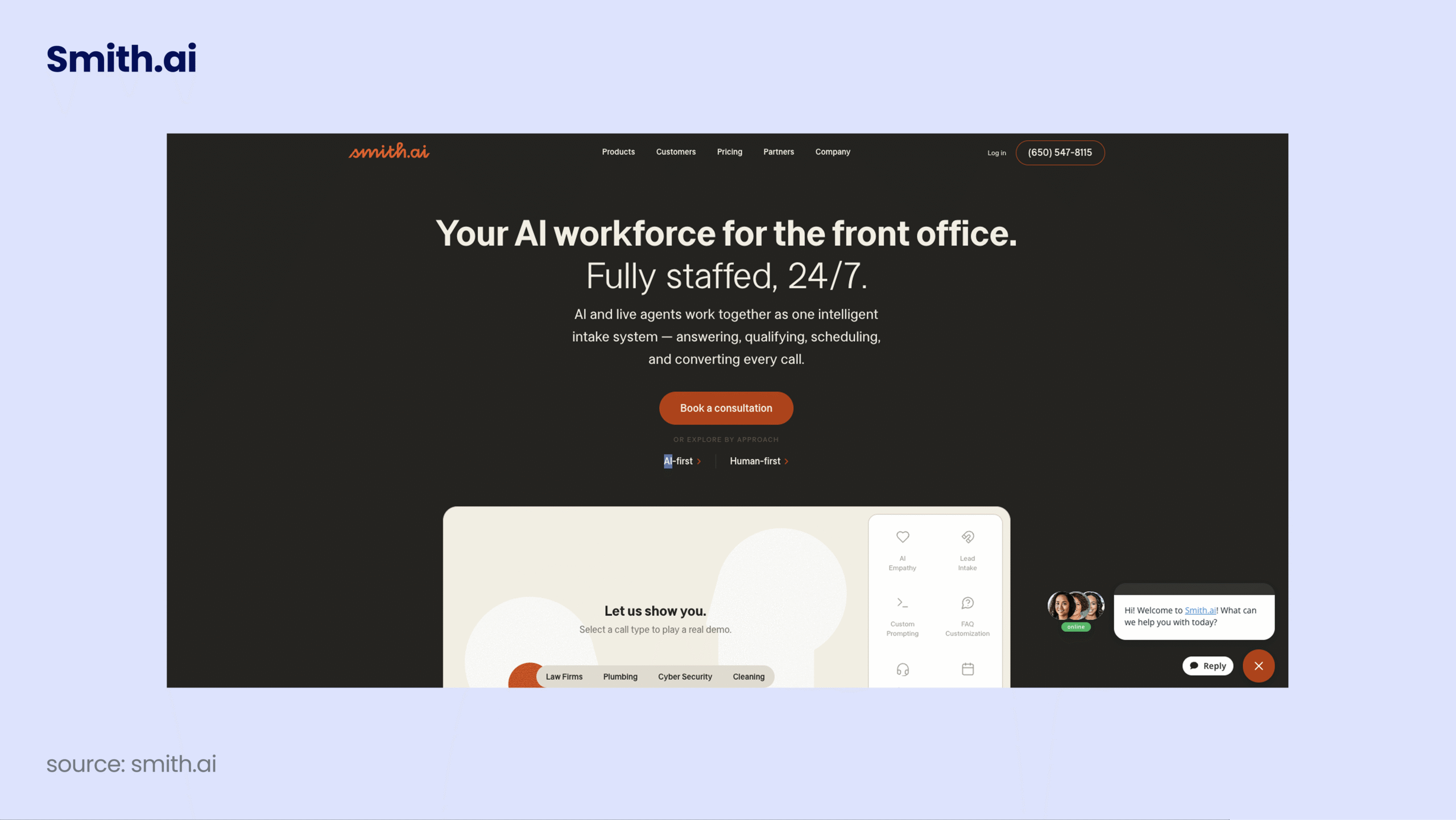
Smith.ai provides a unique “safety net” for restaurants that want the efficiency of an AI receptionist for restaurants but require human backup for high-stakes calls. This hybrid approach is popular for Michelin-star or high-end establishments where a VIP guest may require a more sensitive touch.
Key receptionist features:
-
Hybrid AI-to-Human Handoff: If a guest has a complex request or shows frustration, a live, North American-based agent can take over seamlessly.
-
Payment Collection & Booking: Smith.ai can collect deposits for large parties or book appointments directly into your calendar.
-
24/7 Bilingual Support: The platform offers native-level fluency in English and Spanish to capture every guest inquiry.
Platform limitations:
The per-call pricing model can become expensive very quickly for high-volume casual dining spots compared to unlimited-minute AI-only plans.
Smith.ai starts at $95/month for the “self-service” AI receptionist, which includes 50 monthly calls. For the hybrid human-backed service, plans typically begin at $300/month for a bundle of 30 live calls.
G2 rating: 4.9/5 (only 70+ reviews)
Bottom line:
Smith.ai is the best choice for fine dining establishments that want to automate lead qualification but aren’t ready to go ‘AI-only’ for their high-ticket guests.
7. PolyAI: Best for Large Enterprises

PolyAI is one of the best enterprise AI virtual receptionists, built for large restaurant chains handling millions of calls. It is ideal for organizations needing complex conversational capabilities and high-capacity multilingual support on a global scale.
Key receptionist features:
-
Massive Concurrency: The system handles an infinite number of simultaneous calls, ensuring zero hold times for guests during nationwide promotions.
-
High-Fidelity NLU: It is exceptionally good at understanding messy speech, thick accents, and noisy environments typical of high-traffic stores.
-
Fully-Managed Service: PolyAI helps you design and deploy your virtual host logic to ensure it meets strict brand and security standards.
Platform limitations:
The high cost and white-glove setup complexity make it inaccessible for SMBs and mid-market restaurants.
PolyAI functions on a quote-based system, typically starting around as much as $150,000/year for enterprise-level deployment.
G2 rating: 5/5 (only 12 reviews)
Bottom line:
PolyAI is the only choice for massive restaurant chains that need to automate millions of minutes of guest interaction without sacrificing their global reputation.
8. Goodcall: Best for Resy Users

Goodcall is a specialized virtual receptionist designed to sit at the intersection of your phone line and your reservation book. It’s the definitive choice for establishments using Resy, OpenTable, or SevenRooms that need to automate high-volume table bookings without losing the natural feel of a human host.
Key receptionist features:
-
API-Native Booking: It integrates with your reservation software to provide real-time availability and instant booking directly into your system.
-
Intelligent Waitlist Handling: The AI suggests optimal times and manages waitlists during peak hours to keep your dining room full.
-
Predictable “Unique Caller” Pricing: You pay based on the number of customers helped, rather than the length of the call, making it highly cost-effective for long scheduling discussions.
Platform limitations:
It lacks deep CRM syncs and complex logic-trees, making it better suited for simplicity than enterprise-level data mapping.
Goodcall pricing:
The AI virtual receptionist starts at $66/month for their Starter plan when billed annually. Pricing scales based on the number of unique callers, with overages typically costing $0.50 per customer.
G2 rating: 3.5/5 (only 1 review)
Bottom line:
Goodcall is the best entry-point for local shop owners who want an AI receptionist to stop missing after-hours revenue without a complex tech stack.
9. Dialzara: Best for Solo Owners

Dialzara is the most affordable restaurant receptionist for solo owners who need to stop answering every routine call themselves. It focuses on speed and simplicity, allowing you to set up a functioning restaurant AI in about 15 minutes.
Key receptionist features:
-
15-Minute Setup: You can have an active AI receptionist live quickly using a simple builder that requires no technical help.
-
Knowledge Base Uploads: Provide the AI with your menu and hours to allow it to answer guest questions directly.
-
Minute-Based Scaling: A simple model that scales with your call volume, making it easy to manage costs as you grow.
Platform limitations:
Lacks the deep, native integrations with restaurant-specific CRMs and POS systems found in more comprehensive platforms.
Dialzara pricing:
Dialzara starts at $29/month for their Lite plan, which includes a 60-minute bundle. Additional minutes beyond the bundle are priced at $0.48 each.
G2 rating: N/A (scores 4.5/5 on TrustPilot)
Bottom line:
Dialzara is a great starter AI for solo operators who need a simple way to screen calls and book meetings without a high monthly fee.
10. Kea AI: Best for Drive-Thrus

Kea AI is a specialized voice assistant designed specifically for drive-thru and high-volume franchise operations. It acts as a “Cashier in the Clouds,” automating the order-taking process to increase throughput and reduce labor costs.
Key receptionist features:
-
Drive-Thru Optimization: Engineered for the high-speed environment of quick-service restaurants.
-
Upsell Logic: The AI is programmed to always ask for add-ons, consistently increasing the average check size.
-
Franchise Scalability: Easily deployed across dozens of locations with centralized management.
Platform limitations:
The tool’s specialized focus on orders means it may not handle complex, high-empathy reservation discussions for fine dining establishments.
Kea AI pricing:
Kea AI starts at $450/month for their specialized AI voice cashier services. For high-volume franchises requiring bespoke POS integrations, custom volume-based pricing is available upon request.
G2 rating: N/A (scores 4.5/5 on TrustPilot)
Bottom line:
Kea AI is the go-to choice for QSR franchises that want to replace manual order-taking with a high-speed, revenue-driving AI cashier.
What is an AI Phone Answering System for Restaurants?

An AI phone answering system for restaurants is an automation layer for your calling setup. It manages guest calls without a staff member ever touching a handset
It functions as a AI virtual receptionist (often called “digital host”) by using natural language to handle front-door logistics 24/7. This includes checking real-time table availability, taking takeout orders, and answering repetitive questions about your menu even when the restaurant is closed.
This technology acts as a high-speed filter for your business. By resolving routine inquiries automatically, the system ensures your human team stays on the floor with guests while preventing silent revenue loss from after-hours callers or those who would otherwise hang up after three rings.
Stop Letting the Phone Burn Your Staff
How Does AI Restaurant Phone Answering Work?
This system acts as an automated “first responder.” It classifies, resolves, and executes guest requests within your tech stack before your team even hears a ring.
Modern AI virtual receptionists use a five-step hospitality workflow to move guests from a dial tone to a confirmed seat:
-
Intent Recognition: Using Natural Language Processing (NLP), the AI identifies the call’s purpose instantly. It separates high-value reservation requests and takeout orders from routine questions like “What are your holiday hours?”.
-
Dynamic Discovery: The AI conducts a natural conversation based on your playbook. It captures party size, preferred time, and dietary modifiers like “gluten-free” just as a trained host would.
-
Real-Time Verification: Once details are captured, the AI interacts with your tools. It checks real-time table availability via platforms like OpenTable or Resy to ensure the request is actually possible.
-
Live Execution & Logging: The AI creates the booking instantly and syncs the interaction bi-directionally. It updates your CRM or POS guest profiles automatically so your staff have full context before the guest arrives.
-
Intelligent Escalation: For complex scenarios like a 20-person banquet or a VIP guest, the AI uses the “warm call transfer logic”. It notifies a manager and hands off the call with a full guest transcription already on the screen.
Why You Should Use an AI Phone Answering Service for Restaurant Growth
The main reason for restaurants (or chains) to implement an AI phone answering system is to stop silent revenue leaks.
In 2026, missing a single dinner reservation for four can cost $200 in immediate lost sales. If you do not answer on the first ring, you are actively sending that guest to a competitor.
-
Capture the “First-Mover” Advantage:Like we’ve already said, 78% of customers book with the first business that responds.¹ AI ensures you are always first by answering 100% of calls instantly, 24/7.
-
Plugging the 43% Revenue Leak:Recent industry research reveals that 43% of restaurant phone calls go unanswered during peak hours.² AI eliminates this gap, recovering significant monthly revenue that usually walks out the door.
-
Instant Multilingual Support:You no longer need to hunt for bilingual staff. Modern AI agents switch between 60+ languages in real-time, serving your entire community with native-level fluency without the hiring premium.
-
Infinite Front-of-House Scaling:A human host handles one call at a time. AI manages hundreds of simultaneous inquiries, ensuring your phone lines never hit capacity during a Friday night rush.
-
Reclaiming Staff Sanity:Studies show that over 25% of restaurant operators now use AI to handle administrative tasks.³ By automating routine questions like directions or hours, your team can focus on the high-impact hospitality happening on the floor.
-
Zero-Effort Lead Qualification:The system automatically filters out robocalls and telemarketers. This ensures your staff only speaks to high-value guests inquiring about large-party catering or private events.
AI vs. Human Receptionists: Navigating the Hospitality Trade-off
Choosing between an AI agent and a human host comes down to a choice between process and personality.
While a live host offers better empathy for complex situations, they are limited by their schedule and the speed of manual data entry.
AI virtual receptionists provide 24/7 reliability for the repetitive tasks that usually slow down your team.
AI vs Human Receptionist
| Feature | AI Virtual Receptionist | Human Receptionist |
|---|---|---|
| Availability | 24/7/365 (No “after hours”) | Typically 40 hours/week |
| Concurrency | Unlimited (100s of calls at once) | One call at a time |
| Scalability | Instant (Zero new hires needed) | Slow (Requires hiring/training) |
| Response Speed | Instant (First ring, every time) | Variable (Depends on floor traffic) |
| Data Logging | 100% Automatic CRM sync | Manual (Subject to error) |
| Empathy & Nuance | Logical and structured | Superior |
| Multilinguality | 60+ languages instantly | Limited to staff skills |
| Spam Filtering | Built-in/Automatic | Manual interruption |
| Cost | Predictable monthly fee | Salary, benefits, and overhead |
Most restaurant owners worry that AI sounds like a robot. That isn’t the case anymore. Systems now respond in under 800ms, which matches the natural timing of a real conversation.
You can hear exactly how this sounds by testing the quick voice agent demos below.

AI Voice Agents

Nudge expiring offer
Riley, Sales Reminder Agent

Qualify a student lead
Avery, Course Inquiry Agent

Get a payment reminder
Casey, Payment Reminder Agent

Qualify a patient lead
Jordan, Healthcare Intake Agent

Qualify insurance lead
Taylor, Insurance Intake Agent

Accept updated terms
Quinn, T&C Acceptance Agent

Qualify legal inquiry
Drew, Legal Intake Agent

Get post-interview feedback
Jamie, Candidate Feedback Agent

Pre-screen a candidate
Skyler, Applicant Pre-screen Agent

Confirm account action
Morgan, Action Reminder Agent

Get a renewal reminder
Logan, Subscription Renewal Agent

Get CSAT after support
Morgan, CX Feedback Agent

Get NPS or demo feedback
Parker, Post-Sales Feedback Agent

Qualify a trial lead
Blake, Trial Signup Qualifier
Sales Reminder
Agent
Client
Sales / Marketing
Course Inquiry
Agent
Client
Education / EdTech
Payment Reminder
Agent
Client
Financial Services
Healthcare Intake
Agent
Client
Healthcare
Insurance Intake
Agent
Client
Insurance
T&C Acceptance
Agent
Client
Legal Services
Legal Intake
Agent
Client
Legal Services
Candidate Feedback
Agent
Client
Recruitment / HR
Applicant Pre-screen
Agent
Client
Recruitment / HR
Action Reminder
Agent
Client
SaaS / Software & Apps
Subscription Renewal
Agent
Client
SaaS / Software & Apps
CX Feedback
Agent
Client
SaaS / Software & Apps
Post-Sales Feedback
Agent
Client
SaaS / Software & Apps
Trial Signup
Qualifier
Client
SaaS / Software & Apps
The Speed of AI with the Touch of a Host
How to Choose the Right AI Phone Answering System for Your Restaurant
The best AI phone answering system is one that executes bookings directly in your POS rather than just taking a message.
To find the right fit for your specific model, ask these four questions:
-
“Does it actually do the work, or just take a message?”During a rush, a service that only logs calls is useless. You need an AI phone answering system for restaurants that checks real-time availability and writes bookings directly into your system. CloudTalk is the standard here because it syncs your reservations across your tech stack in real-time.
-
“Are you a massive global chain or a growing group?”If you manage a global enterprise with millions of calls, PolyAI is the best AI phone answering service for restaurant giants needing deep, custom conversational logic. However, if you are an SMB or a growing multi-unit group, CloudTalk provides the same high-level automation without the enterprise-level setup cost.
-
“Can it handle the Friday night phone storm?”The best AI phone answering system for restaurants offers infinite concurrency. You need an AI restaurant phone system built on VoIP infrastructure (Voice over Internet Protocol) that can answer 20 calls at once without a busy signal. CloudTalk or Maple excel at this, ensuring you never lose a table to a dial tone.
-
“What happens when a VIP guest has a complex request?”If your brand relies on a “white-glove” touch, you may need a restaurant phone answering service that offers human backup. Smith.ai is a strong hybrid choice for these high-stakes calls, allowing a live person to step in when the AI reaches its limit.
-
“How big is your on-site team?”If you have a large floor team but they’re too busy to answer phones, you need a system that acts as a filter. A unified AI call answering for restaurants platform like CloudTalk can handle routine FAQs while “warm transferring” catering or event leads directly to your on-site manager.
-
“Is it a bolt-on tool or a full communication suite?”A simple AI receptionist for restaurants like Dialzara works for solo shops. However, growth-minded groups need a unified platform like CloudTalk to centralize guest data and call logs across every location. This prevents data silos and makes it easier to track which locations are losing the most revenue.
Why Restaurant Teams Trust CloudTalk for AI-powered Call Handling
CloudTalk is the only tool that bridges the gap between a high-end phone system and a fully autonomous digital host. By unifying your business numbers, routing, and AI agents in one place, you eliminate the technical friction of managing disconnected “bolt-on” bots.
-
24/7 Revenue Capture: Capture every reservation and lead, including late-night calls, without the overhead of a human answering service.
-
Infinite Concurrency: Answer dozens of calls simultaneously so your guests never hear a busy signal, even during the peak Friday night rush.
-
Precision Lead Qualification: The AI resolves routine FAQs and bookings automatically while “warm transferring” high-value catering or event inquiries directly to a manager.
-
Multi-Unit Centralization: Manage settings, menu updates, and AI personalities for 5 or 50 locations from one central dashboard.
-
Actionable Data Sync: The system logs every interaction and guest preference into your CRM, ensuring your floor team has full context before the guest arrives.
The real-world impact is a massive reduction in “phone fatigue” and a significant boost in operational capacity, as you can see in another AI voice agent case study below.
Recommended Articles
Bottom Line: Choose the Best AI Phone Answering System for Your Growth
The best AI phone answering system for restaurants is the one that kills the “silent leak” in your funnel so your hosts can actually host.
Every missed call on a Friday night is a guest who is already dialing the bistro across the street. If you aren’t capturing that intent on the first ring, you aren’t just losing a table; you are actively funding your competitor’s growth.
CloudTalk’s AI phone answering service combines the infrastructure of a global VoIP platform with the intelligence of a digital host. For scaling restaurants and groups, this means infinite concurrency to handle any holiday surge and deep CRM syncing to keep guest data accurate across every location.
Simply a lead-capture engine built to ensure your human team only picks up the phone when a guest truly needs a human touch.

Capture Every Cover, 24/7

Sources:
-
01
LeanData: Speed to Lead
-
02
Restaurantdive
-
03
Entrans