Summary of Voice.ai Pricing Plans
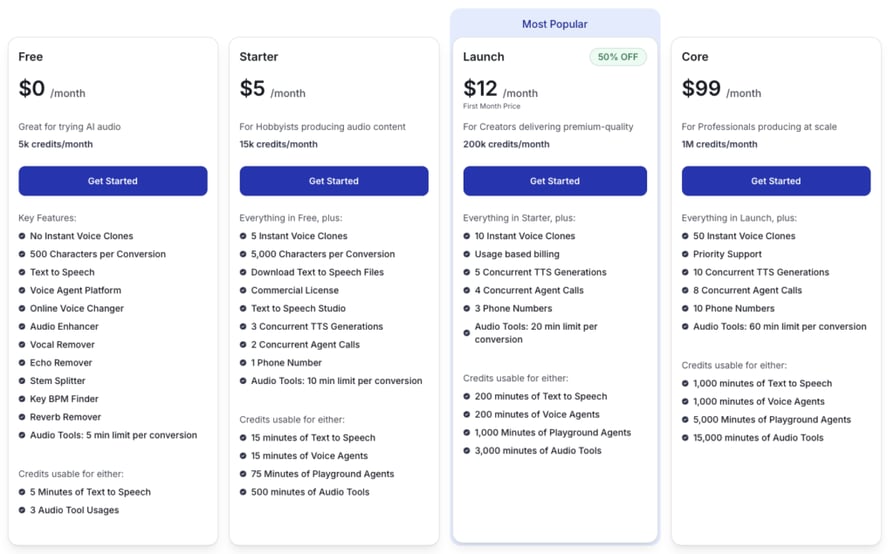
| Free | $0/month | Hobbyists wanting to experiment with AI audio tools and voice changing for fun |
| Starter | $5/month | Hobbyists producing basic audio content who need voice cloning and downloads |
| Launch | $12/month (first month at 50% off) | Creators delivering premium-quality audio content at scale |
| Core | $99/month | Professionals producing at high volumes with priority support needs |
| Scale | $330/month | Startups and publishers needing serious voice AI capacity |
| Business | $880/month | Rapidly scaling publishers and startups with enterprise-adjacent needs |
| Enterprise | Custom | Enterprises needing HIPAA compliance, custom SSO, SLAs, and volume discounts |
How Much Does Voice.ai Cost?
Voice.ai offers seven pricing tiers: Free ($0), Starter ($5/mo), Launch ($12/mo first month), Core ($99/mo), Scale ($330/mo), Business ($880/mo), and Enterprise (custom). Plans are structured around a credit system that converts into minutes of Text to Speech, Voice Agent calls, or Audio Tool usage.
A free plan is available with 5,000 credits per month — enough to test the basics. Paid plans unlock instant voice cloning, more concurrent agent calls, commercial licensing, and significantly higher usage limits. Voice ai pricing 2026 is particularly relevant for teams evaluating Voice.ai for business use, where the Scale and Business tiers unlock the capacity and concurrency required for production workloads.


What Pricing Plans Does Voice.ai Offer?
Voice.ai structures its voice ai pricing plans around a unified credit system. Credits are consumed across three different usage types — Text to Speech (TTS), Voice Agent calls, and Audio Tools — and the conversion rate differs significantly depending on how you use them. One credit buys you far more Audio Tool minutes than Voice Agent minutes, which matters a lot for budget planning.
There are seven tiers in total: a free plan, four self-serve paid plans (Starter, Launch, Core, Scale), one higher-volume plan (Business), and an Enterprise tier. All plans except Enterprise are available on monthly billing, with an annual option that provides roughly two months free.
What Do Real Users Say About Voice.ai Pricing?
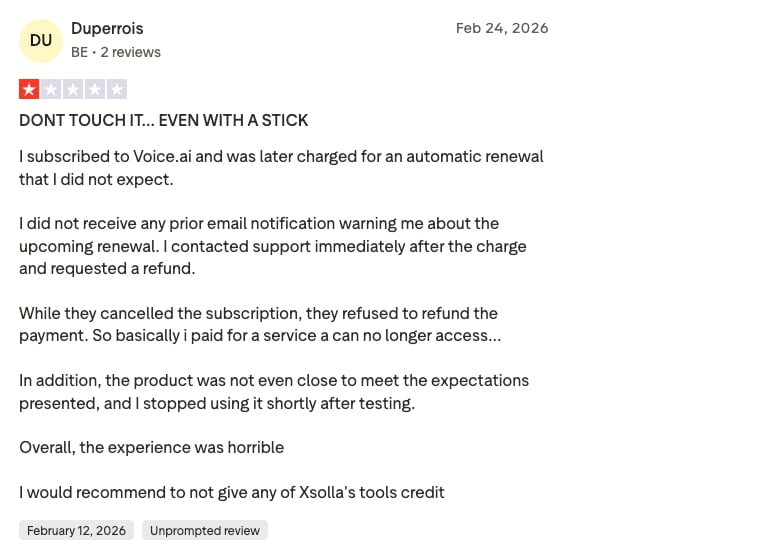
User sentiment around voice ai subscription billing is a significant concern based on publicly available reviews. Trustpilot tells a sobering story: out of 221 reviews, the overwhelming majority report negative experiences — particularly around unexpected automatic renewal charges, difficulty canceling subscriptions, and refund requests being denied.
One recurring complaint involves the platform's payment processor (Xsolla) complicating the cancellation process. Several users report having to block charges on their credit cards as a last resort.
There are also positive voices: some users praise the TTS quality, the real-time voice changer performance when hardware requirements are met, and responsive support in isolated cases. But the pattern of billing complaints is prominent enough that any prospective subscriber should enter with eyes open — use a payment method you can control, monitor renewals closely, and test the free plan before committing to an annual subscription.
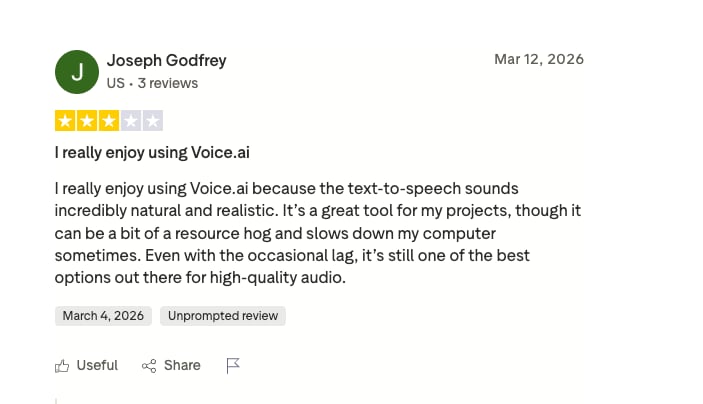
The takeaway: Voice.ai has genuine fans among gamers, streamers, and TTS creators — but the credit model and subscription management friction are real concerns worth factoring into your evaluation before paying for any annual plan.
What Is Voice.ai's Free Plan?
Voice.ai's Free lets you explore the platform, including trying out the speech-to-text and AI voice agents. It's meaningfully limited compared to paid tiers but functional enough to validate whether Voice.ai fits your use case.
What's Included in Voice.ai's Free Plan?
- 5,000 credits per month (5 minutes of TTS or 3 Audio Tool usages)
- Text to Speech (no downloads)
- Voice Agent Platform (basic access)
- Online Voice Changer
- Audio Enhancer, Vocal Remover, Echo Remover, Stem Splitter, Key BPM Finder, Reverb Remover
- Audio Tools: 5-minute limit per conversion
- No Instant Voice Clones
- 500 characters per TTS conversion
Voice.ai's Free Plan: Who Is It Best For?
The Free plan is best for individuals who want to explore Voice.ai's audio tools casually — particularly gamers curious about the real-time voice changer or creators wanting to test TTS quality before investing in a paid tier. It is not suitable for anyone needing voice cloning, downloadable files, or Voice Agent call capacity.
What You Need to Know About Voice.ai's Free Plan:
The 5-minute TTS and 3 Audio Tool usage limits reset monthly. Given how quickly credits burn through complex tasks, the free tier is best treated as a trial layer rather than a functional free product. Be particularly cautious: even signing up for a free account requires providing payment details to unlock some features, and multiple Trustpilot reviewers report unexpected charges following free usage.
What Is Voice.ai's Starter Plan?
At $5/month, the Starter plan is Voice.ai's entry-level paid tier. It unlocks Instant Voice Clones, downloadable TTS files, a commercial license, and the TTS Studio — making it the minimum viable plan for anyone producing audio content they intend to publish or monetize. The voice.ai price at this level is accessible, but the constraints are real: 15,000 credits per month converts to just 15 minutes of Voice Agent time, which is minimal for any production use case.
What's Included in Voice.ai's Starter Plan?
- 15,000 credits per month
- 5 Instant Voice Clones
- 5,000 characters per TTS conversion
- Downloadable TTS files
- Commercial license
- Text to Speech Studio
- 3 concurrent TTS generations
- 2 concurrent agent calls
- 1 phone number
- Audio Tools: 10-minute limit per conversion
Credits convert as: 15 minutes of Text to Speech, 15 minutes of Voice Agents, 75 minutes of Playground Agents, or 500 minutes of Audio Tools.
Voice.ai's Starter Plan: Who Is It Best For?
The Starter plan is best for individual hobbyists and content creators who need a commercial license for TTS output and want to experiment with voice cloning on a minimal budget. It is not appropriate for teams or for anyone running Voice Agent calls at any meaningful volume.
What You Need to Know About Voice.ai's Starter Plan:
The 15-minute Voice Agent limit is the critical constraint. For teams evaluating what AI voice agents can do for customer-facing workflows, 15 minutes of agent call time is a proof-of-concept ceiling, not a production capability. Usage-based billing is not available on this tier, meaning you cannot pay for overages — you simply hit the ceiling.
What Is Voice.ai's Launch Plan?
The Launch plan is Voice.ai's most popular tier, positioned for creators who need meaningful volume to produce premium audio at scale. It currently runs $12/month for the first month (50% introductory discount) and unlocks usage-based billing — a significant change from Starter that allows you to pay for additional credits when you exceed your monthly allowance. This is the first tier where Voice.ai becomes a viable voice ai agent cost option for creators with consistent production needs.
What's Included in Voice.ai's Launch Plan?
- 200,000 credits per month
- Everything in Starter
- 10 Instant Voice Clones
- Usage-based billing (pay for overages)
- 5 concurrent TTS generations
- 4 concurrent agent calls
- 3 phone numbers
- Audio Tools: 20-minute limit per conversion
Credits convert as: 200 minutes of Text to Speech, 200 minutes of Voice Agents, 1,000 minutes of Playground Agents, or 3,000 minutes of Audio Tools.
Voice.ai's Launch Plan: Who Is It Best For?
The Launch plan suits independent creators, podcasters, and small production teams who regularly produce TTS or audio content and need the flexibility of usage-based billing when production ramps up. With 200 minutes of Voice Agent time, it's also a viable starting point for small-scale agent testing.
What You Need to Know About Voice.ai's Launch Plan:
The introductory price of $12/month only applies to the first month — the standard rate is higher (pricing not explicitly stated beyond the discount promotion). Confirm the ongoing monthly rate before committing. Usage-based billing is a meaningful upgrade from Starter, but overage costs are not transparently published on the pricing page, which makes budgeting difficult for variable-volume use cases.
What Is Voice.ai's Core Plan?
At $99/month, the Core plan is Voice.ai's professional tier — designed for creators and small teams producing high-volume TTS, voice cloning, or AI agent content as a regular part of their workflow. It delivers 1,000,000 credits, unlocks priority support, and scales concurrent capacity significantly compared to Launch. This is where voice ai features pricing starts to make sense for a small professional operation.
What's Included in Voice.ai's Core Plan?
- 1,000,000 credits per month
- Everything in Launch
- 50 Instant Voice Clones
- Priority support
- 10 concurrent TTS generations
- 8 concurrent agent calls
- 10 phone numbers
- Audio Tools: 60-minute limit per conversion
Credits convert as: 1,000 minutes of Text to Speech, 1,000 minutes of Voice Agents, 5,000 minutes of Playground Agents, or 15,000 minutes of Audio Tools.
Voice.ai's Core Plan: Who Is It Best For?
The Core plan is best for professional content studios, TTS-heavy publishing operations, and small development teams building and testing Voice Agent workflows at a level that justifies the $99/month investment. It's also the starting point for operations that need meaningful concurrent agent capacity (8 simultaneous calls).
What You Need to Know About Voice.ai's Core Plan:
The jump from $12/month (Launch) to $99/month (Core) is steep. Before upgrading, audit your actual credit consumption on Launch to verify you're consistently hitting the ceiling. Priority support is a meaningful upgrade for production workflows, but note that "priority" is relative — Voice.ai does not offer dedicated account management until the Business tier.
What Is Voice.ai's Scale Plan?
The Scale plan at $330/month is Voice.ai's entry point into the business tier — built for startups and publishers that need serious volume (5,500,000 credits) alongside higher concurrency and a larger phone number allocation. This is where voice ai subscription cost starts to reflect a genuine operational investment rather than an individual tool expense.
What's Included in Voice.ai's Scale Plan?
- 5,500,000 credits per month
- Everything in Core
- 200 Instant Voice Clones
- Higher priority generations
- 15 concurrent TTS generations
- 16 concurrent agent calls
- 20 phone numbers
- Audio Tools: 180-minute limit per conversion
Credits convert as: 5,500 minutes of Text to Speech, 5,500 minutes of Voice Agents, 20,000 minutes of Playground Agents, or 50,000 minutes of Audio Tools.
Voice.ai's Scale Plan: Who Is It Best For?
The Scale plan is best for media publishers, audiobook platforms, or SaaS startups embedding Voice Agent capabilities into their products and needing 16 concurrent calls and large voice clone libraries as part of their infrastructure.
What You Need to Know About Voice.ai's Scale Plan:
At $330/month, Scale is a meaningful financial commitment. Teams choosing this tier should run a detailed cost comparison against purpose-built AI voice agent platforms that offer flat-rate calling at scale — which often deliver better value for teams where Voice Agent minutes (not TTS or Audio Tools) are the primary use case.
What Is Voice.ai's Business Plan?
The Business plan at $880/month is Voice.ai's highest self-serve tier, offering 22,000,000 credits, 2,200 voice clones, 30 concurrent agent calls, and 50 phone numbers. It also includes access to a technical success manager — the first tier where dedicated human support is part of the package. This is where voice ai pricing per month reaches enterprise-adjacent territory without requiring a custom contract.
What's Included in Voice.ai's Business Plan?
- 22,000,000 credits per month
- Everything in Scale
- 2,200 Voice Clones
- Technical success manager support
- 15 concurrent TTS generations
- 30 concurrent agent calls
- 50 phone numbers
Credits convert as: 22,000 minutes of Text to Speech, 22,000 minutes of Voice Agents, 110,000 minutes of Playground Agents, or 150,000 minutes of Audio Tools.
Voice.ai's Business Plan: Who Is It Best For?
The Business plan suits rapidly scaling media companies, publishing platforms, or voice technology companies embedding Voice.ai's infrastructure into commercial products at high volume. At this price point, requesting an Enterprise quote for comparison is also worth doing — custom terms and volume discounts may be available.
What You Need to Know About Voice.ai's Business Plan:
At $880/month, this represents a significant operational budget line. Teams at this scale should run a detailed total-cost-of-ownership analysis, particularly comparing the effective per-minute Voice Agent cost against dedicated platforms purpose-built for high-volume calling. Also note: the Business plan maintains 15 concurrent TTS generations — identical to Scale — meaning the uplift here is primarily in credits, voice clones, and agent call concurrency.
What Is Voice.ai's Enterprise Plan?
Voice.ai's Enterprise plan is a fully custom tier for organizations requiring compliance coverage, security controls, and volume pricing that the self-serve tiers cannot accommodate. Pricing requires contacting the sales team directly — there are no published rates. For organizations in regulated industries or with data processing agreements (DPAs), this is the only tier where HIPAA-compliant BAAs and custom SSO are available.
What's Included in Voice.ai's Enterprise Plan?
- Everything in Business
- Custom terms and assurance around DPA/SLAs
- BAAs for HIPAA customers
- Custom SSO
- More seats and voices
- Elevated concurrency limits
- Significant volume discounts
- Priority support
Voice.ai's Enterprise Plan: Who Is It Best For?
Large organizations in healthcare, finance, or media that require HIPAA compliance, custom security controls, and negotiated volume pricing. Also suitable for companies embedding Voice.ai's technology into commercial products under custom licensing terms.
What Are Voice.ai's Additional Costs?
The listed plan prices tell only part of the voice ai cost story. Voice.ai's credit-based model, hardware requirements, and usage-based overages can push your actual monthly spend well above the plan price — and several of these costs are not clearly disclosed on the pricing page.
| Additional Cost | Amount | Notes |
|---|---|---|
| Usage-based overage credits | Rate not published on pricing page | Available from Launch plan upward; rate applied when monthly credit allowance is exceeded |
| High-end GPU requirement | $300+ hardware cost (one-time) | Required for real-time voice changer; minimum Nvidia GTX 980 or AMD RX 580 |
| Credit top-ups | Rate varies; not publicly listed | Available for purchase within the platform when monthly allowance runs low |
| Phone numbers | Included in paid plans (1–50 depending on tier) | Starter includes 1 number; additional numbers not available as separate purchases |
| Enterprise setup / BAA | Custom pricing | HIPAA BAA, custom SSO, DPA/SLA terms only available on Enterprise |
Voice.ai Credits: The Hidden Variable in Your Monthly Bill
The most significant additional cost most users don't anticipate is the voice ai credits pricing model and how unevenly credits convert across use types. One credit buys you dramatically different amounts of time depending on what you're doing:
- Text to Speech and Voice Agent calls consume credits at a 1:1 ratio (1,000 credits = 1 minute)
- Playground Agents are 5x more credit-efficient than production Voice Agents
- Audio Tools are by far the most efficient use of credits (up to 15x more efficient than Voice Agent calls)
In practice, this means that a team using Voice.ai primarily for Voice Agent calls will burn through their monthly allowance far faster than the plan's credit total suggests at first glance.
The GPU Tax: A Real Hardware Cost
For users primarily interested in Voice.ai's real-time voice changer feature, there is a hardware cost that does not appear anywhere on the pricing page. Voice.ai's local AI processing for real-time voice transformation requires a minimum Nvidia GTX 980 or AMD RX 580 GPU — hardware that costs $300 or more. Users with GPUs below this threshold report choppy, laggy, and effectively unusable real-time voice performance, as confirmed across multiple review sources. This is a real hidden cost for the platform's most marketed feature.
What Happens to Your Subscription If You Want to Cancel?
Based on publicly available Trustpilot reviews and user-reported experiences, cancellation is a documented friction point for Voice.ai subscribers. Multiple users report automatic renewals without email warning, difficulty reaching support to stop recurring charges, and a payment processor (Xsolla) that redirects refund requests back to Voice.ai — creating a loop that leaves subscribers paying for a service they no longer want. Use a payment method you can independently control if you choose to subscribe.
What Will Voice.ai Actually Cost You?
Understanding the real voice ai subscription cost means looking beyond the plan price and factoring in credit consumption rates, hardware requirements, and usage-based overages. Here are four realistic scenarios.
Scenario 1: Solo Creator, Starter Plan, TTS-Only Workflow
Profile: A podcaster or YouTube creator using Voice.ai to generate TTS voiceovers for 10–15 short videos per month. No Voice Agent calls, no real-time voice changer.
| Cost Item | Monthly Cost |
|---|---|
| Starter plan | $5 |
| TTS usage (15 mins/month included) | $0 |
| Extra credits (if needed for longer content) | $0–unknown overage rate |
| Total | ~$5/mo |
Verdict: Best-case scenario for Voice.ai. For pure TTS use at low volume, the Starter plan is genuinely affordable. The main risk: 15 minutes of TTS per month is very limited for any production content schedule, and the overage rate is not publicly disclosed.
Scenario 2: Small Gaming Team, Launch Plan, Voice Changer + TTS
Profile: A 2-person gaming content team using Voice.ai for real-time voice changing during streams and TTS for short-form content. Hardware cost already covered by existing gaming rigs. Using approximately 100 minutes of TTS per month.
| Cost Item | Monthly Cost |
|---|---|
| Launch plan (standard rate after intro month) | ~$24/mo (est.) |
| TTS usage (200 mins included) | $0 |
| Voice Agent usage (not needed) | $0 |
| Overage credits (for heavy months) | Unknown rate |
| Total | ~$24/mo |
Verdict: Reasonable for content creators who stay within the 200-minute TTS allowance. The unknown overage rate is the key variable — without published pricing for additional credits, budgeting for peak production months is guesswork.
Scenario 3: Small Business, Core Plan, Voice Agent Calls
Profile: A small business using Voice.ai's Voice Agent platform to handle inbound customer queries. Running approximately 500 minutes of Voice Agent calls per month across 8 concurrent call slots.
| Cost Item | Monthly Cost |
|---|---|
| Core plan | $99 |
| 500 minutes Voice Agent usage (1,000 mins included) | $0 (within allowance) |
| 10 phone numbers (included) | $0 |
| Overage credits (if volume spikes) | Rate unknown |
| Total | ~$99/mo (minimum) |
Verdict: The Core plan's 1,000 Voice Agent minutes provides reasonable headroom for a small inbound operation — but the moment call volume spikes, the unknown overage rate becomes a real budget risk. For customer-facing AI call answering at any meaningful scale, purpose-built platforms with transparent per-minute billing are significantly easier to budget and manage.
Scenario 4: Growing Startup, Scale Plan, Mixed TTS + Voice Agent Use
Profile: A growing media-tech startup using Voice.ai for both high-volume TTS content production and a lightweight Voice Agent deployment handling 2,000 minutes of calls per month, with 16 concurrent call slots active.
| Cost Item | Monthly Cost |
|---|---|
| Scale plan | $330 |
| 5,500 mins Voice Agent included (using 2,000) | $0 |
| TTS production (using remainder of 4M credits) | $0 |
| 20 phone numbers (included) | $0 |
| Total | ~$330/mo |
Verdict: At $330/month with heavy mixed usage, the Scale plan delivers reasonable value for a team using Voice.ai across TTS and Voice Agent workloads simultaneously. The 5,500-minute Voice Agent allowance provides genuine room for a growing deployment. However, teams primarily focused on Voice Agent calls should price-compare against calling-native platforms before committing — the per-agent-minute effective cost may be significantly higher than alternatives.
Which Alternatives Are Better and Cheaper Than Voice.ai?
Voice.ai covers a specific niche: audio creation tools, real-time voice changing, and TTS — bundled with a Voice Agent platform that is not the primary focus of most plans. For teams whose priority is actually running AI voice agent calls at scale, or for businesses that need predictable billing without a credit system, there are alternatives that deliver stronger value. Here are four worth evaluating.
CloudTalk: Best for Sales and Support Teams That Need AI-Powered Business Calling
Signature Capability
See CloudTalk’s AI Voice Agent in Action!
CeTe is an AI that talks like a human: no breaks, no training, no time off. It makes and answers calls, updates CRMs, books meetings, and loops in a human only when needed.
Press play to hear it. Want a wow moment? Get a free test call and try it live.
















What Is CloudTalk?
CloudTalk is an AI-powered business phone system purpose-built for sales and customer support teams. Where Voice.ai is primarily an audio creation platform with a voice agent layer added on top, CloudTalk is built from the ground up for business calling — with AI conversation intelligence, inbound routing, dialers, real-time analytics, and 160+ country coverage as core capabilities. If your team lives on the phone and needs AI voice agents to handle real customer interactions, CloudTalk is purpose-built for exactly that.
Why CloudTalk Is Better Than Voice.ai for Business Calling
- Flat-rate per-user pricing — no credits to monitor or overages to worry about
- AI call summaries, transcripts, sentiment analysis, and topic extraction included natively
- Power dialer, parallel dialer, and smart dialer for outbound sales teams
- Skills-based routing, IVR, and call flow designer for inbound support
- Native integrations with HubSpot, Salesforce, Pipedrive, Zendesk, and 100+ more
- 160+ country coverage with local numbers
- 14-day free trial, no credit card required
What Is CloudTalk's Pricing?
- Starter: $25/user/month
- Essential: $29/user/month
- Expert: $49/user/month
- AI Voice Agents: $99/200 minutes
- 14-day free trial included, no credit card required
What are Reviewers Saying About CloudTalk?
CloudTalk has a rating of 4.4/5 on G2:
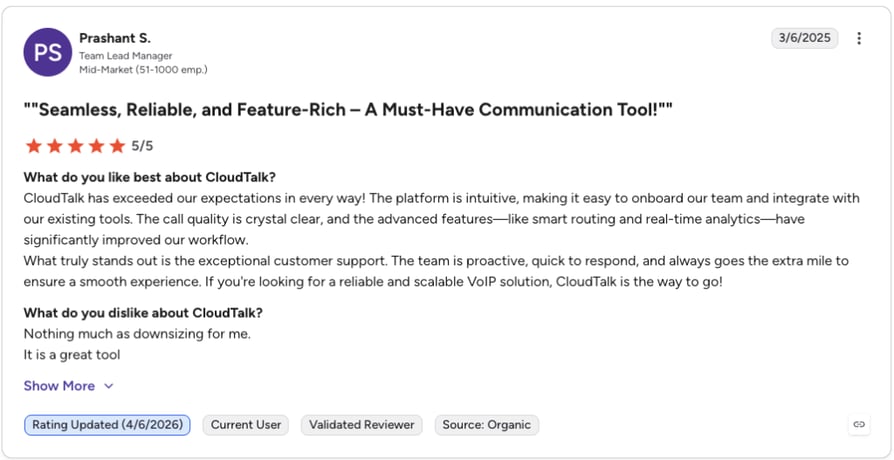
Bottom line: If your primary need is AI voice agents for customer-facing calls rather than audio production tools, CloudTalk delivers a more complete, more predictable, and more scalable solution than Voice.ai. For teams exploring AI-powered cold calling or inbound support automation, the comparison is clear.
ElevenLabs: Best for High-Quality TTS and Voice Synthesis Without the Calling Infrastructure
What Is ElevenLabs?
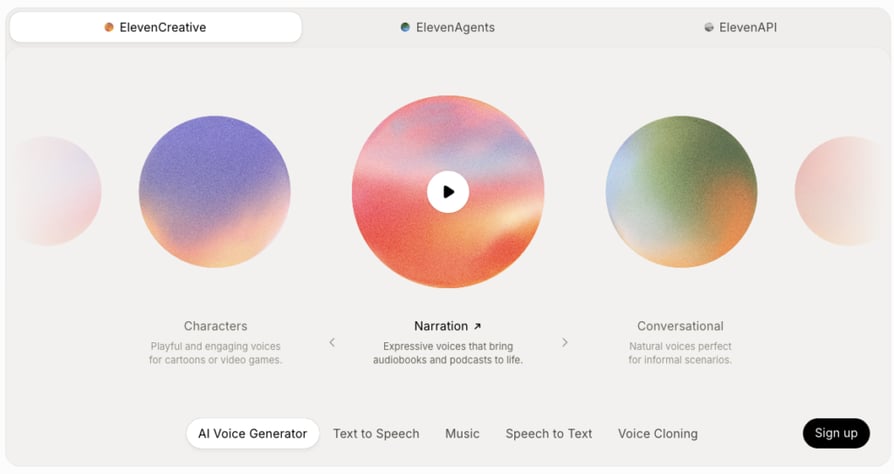
ElevenLabs is widely regarded as the most advanced AI voice synthesis platform available, specializing in natural-sounding TTS, voice cloning, and speech synthesis across 29+ languages. Unlike Voice.ai, ElevenLabs focuses entirely on voice quality rather than bundling in audio tools or real-time voice changing — making it the benchmark comparison for anyone who prioritizes TTS quality above everything else.
Why ElevenLabs Is Better Than Voice.ai for Pure TTS Use Cases
- Consistently rated highest for voice naturalness and emotional range in independent benchmarks
- Transparent character-based pricing that is easier to predict than Voice.ai's credit system
- Free tier includes 10,000 characters per month with no credit card required
- Professional voice cloning available from the Creator plan upward
- No GPU hardware requirements — fully cloud-processed
What Is ElevenLabs' Pricing?
- Free: $0/month, 10,000 characters
- Starter: $5/month, 30,000 characters
- Creator: $22/month, 100,000 characters, voice cloning
- Pro and Business: Custom pricing for production-level Conversational AI
Bottom line: For teams whose primary concern is TTS quality and voice cloning — without the Voice Agent calling infrastructure — ElevenLabs delivers cleaner output, more transparent pricing, and no hardware requirements at a comparable or lower price point than Voice.ai.
Retell AI: Best for Developers Building Production-Grade Voice Agent Workflows
What Is Retell AI?
Retell AI is the highest-rated AI voice agent platform on G2 with a 4.8/5 score from over 1,400 verified reviews — and was named G2's 2026 Best Agentic AI Software. It is a developer-focused platform for building conversational voice agents with near-human naturalness, bundled STT, LLM, TTS, and telephony on higher plans. Unlike Voice.ai, Retell AI is built specifically for the Voice Agent use case, not audio creation.
Why Retell AI Is Better Than Voice.ai for Voice Agent Deployments
- Purpose-built for voice agents — not a TTS and audio tool platform with agents added on
- 4.8/5 G2 rating from 1,400+ reviews — the most credible review sample in the category
- Bundled telephony on Business and Enterprise plans — no separate Twilio account required
- No charges for failed outbound call attempts
- Transparent per-minute pricing on developer plans
What Is Retell AI's Pricing?
- Developer plan: No monthly minimum, ~$0.07–$0.10/minute (excluding telephony)
- Business plan: $299/month with bundled telephony and higher concurrency
- Enterprise: Custom pricing
Bottom line: For developers building and deploying voice agents for customer interactions, Retell AI is significantly better suited than Voice.ai — with stronger reviews, more transparent pricing, and purpose-built infrastructure. Read more in our comparison of the best AI voice agents available in 2026.
Synthflow: Best for Non-Technical Teams Deploying Voice Agents Without Developer Resources
What Is Synthflow?
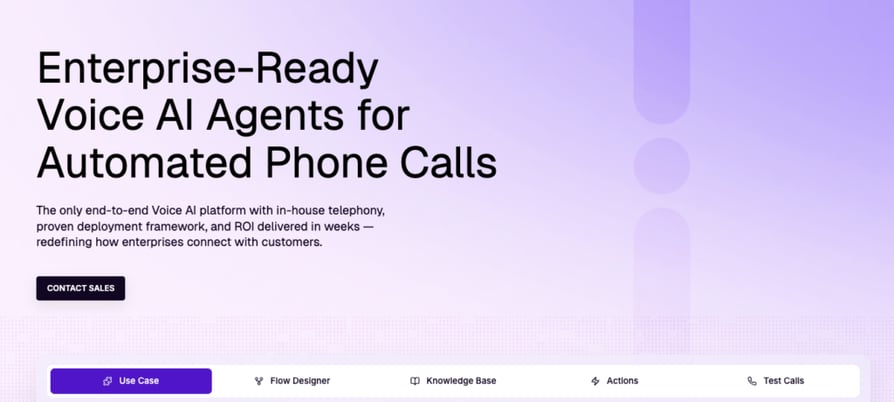
Synthflow is a no-code AI voice agent platform frequently adopted by small and mid-sized businesses that need to deploy conversational call flows without engineering resources. It bundles speech recognition, GPT-4o, ElevenLabs voices, call recording, transcription, CRM integration, and 24/7 support on Pro plans — and explicitly advertises no license fees, no required contracts, and no charges for failed calls. For non-technical teams, this is a meaningfully different value proposition from Voice.ai's more technical setup requirements.
Why Synthflow Is Better Than Voice.ai for Non-Technical Voice Agent Deployments
- Genuinely no-code — template-driven builder for appointment booking, lead qualification, and FAQ handling
- No charges for failed calls — unlike models where busy signals or voicemails cost credits
- Bundled premium AI components (GPT-4o, ElevenLabs voices) without needing to manage API keys
- CRM integrations included on Pro plans — not gated behind enterprise tiers
- Sub-500ms latency for natural conversation flow in independent testing
What Is Synthflow's Pricing?
Synthflow offers Starter, Pro, and Enterprise plans; detailed pricing requires contacting their team directly. No license fees or long-term contracts are required on standard plans. Review the best automated voice agents for lead generation to compare Synthflow against other options in context.
Bottom line: For small business teams that want to deploy a voice agent without a developer, Synthflow's no-code builder and bundled features deliver more out-of-the-box value for voice agent use cases than Voice.ai, with more transparent billing and no hardware requirements.
What Are Voice.ai's Best Features?
Understanding voice ai features pricing means understanding what Voice.ai actually does well. The platform is a genuine multi-tool for audio creators — with real strengths in specific areas, alongside limitations that matter depending on your primary use case.
Real-Time Voice Changer
Voice.ai's most distinctive feature is its real-time voice changing capability — the ability to alter your voice during live streams, gaming sessions, Discord calls, or video meetings using one of 15,000+ community-contributed voice models. When hardware requirements are met and the right voice model is selected, this feature genuinely works and is the primary reason many users choose Voice.ai over alternatives.
Where it could be better: The GPU requirement is a hard barrier for many users. On hardware below the minimum threshold, performance is choppy, delayed, and effectively unusable. Voice quality across the community model library also varies dramatically — many models are robotic or distorted, and finding genuinely usable voices requires significant trial and error.
Instant Voice Cloning
Voice.ai's Instant Voice Clone feature allows users to create a voice model from audio samples — available from the Starter plan (5 clones) up to Enterprise (custom). For content creators who need a consistent branded voice across multiple projects, this is a genuinely useful capability. The cloning process is accessible and does not require technical expertise.
Where it could be better: Clone quality depends heavily on source audio quality and length. Users report inconsistent results, particularly with accents or lower-quality recordings. There are also legitimate ethical and legal considerations around voice cloning that users should review against Voice.ai's Terms of Service before deploying cloned voices commercially.
Text to Speech Studio
Voice.ai's TTS Studio is available from the Starter plan and delivers natural-sounding AI voiceovers across a library of voices and styles. For creators producing narration, explainer content, or audio ads, the TTS quality is competitive — particularly at the lower price points where alternatives like ElevenLabs start to cost more. The studio interface allows users to adjust speed, emphasis, and delivery style without requiring audio editing expertise.
Where it could be better: The 500-character-per-conversion limit on the Free tier severely restricts usability for longer content. Paid tier character limits are significantly higher, but the TTS minute-to-credit conversion rate means short-form content is significantly more affordable than long-form narration projects. If TTS is your primary use case and volume matters, compare voice ai cost per character against ElevenLabs and other dedicated TTS platforms before committing.
Voice Agent Platform
Voice.ai offers a Voice Agent Platform that allows businesses to deploy conversational AI agents for inbound and outbound calling — available across all paid plans with phone numbers included. For small-scale deployments and testing, this is a legitimate feature that distinguishes Voice.ai from pure TTS competitors. The platform supports concurrent agent calls up to 30 on the Business plan.
Where it could be better: The Voice Agent capability is a secondary feature in an audio-first platform — not the core product. CRM integrations, real-time analytics, and call routing sophistication are significantly more limited than purpose-built platforms. For teams where AI voice agents are a core business requirement rather than a supplementary tool, the Voice Agent platform's depth will feel limited quickly. Explore how to improve cold calling with AI voice agents to understand what more advanced platforms offer.
What Are the Pros and Cons of Voice.ai?
| Pros | Cons |
|---|---|
| Real-time voice changer — Genuine live voice transformation for gaming and streaming (with adequate GPU) | Hardware dependency — Requires Nvidia GTX 980+ or AMD RX 580+; users below threshold face unusable performance |
| Free plan available — 5,000 credits/month with no credit card required to explore the platform | Subscription billing issues — Multiple documented cases of unexpected renewal charges and difficult cancellations |
| TTS quality — Competitive natural-sounding text to speech with commercial licensing from $5/month | Opaque overage pricing — Usage-based billing rates for additional credits are not published on the pricing page |
| Large voice library — 15,000+ community-contributed voices for the real-time changer | Voice quality inconsistency — Community voice models vary dramatically in quality; many reported as robotic or distorted |
| Multi-use credit system — Single credit pool usable across TTS, Voice Agents, and Audio Tools based on need | Limited Voice Agent depth — No native CRM integrations or advanced routing compared to purpose-built calling platforms |
Is Voice.ai the Right Solution for Your Team?
Voice.ai is a genuinely capable platform for a specific type of user: the individual creator, gamer, or streamer who wants real-time voice transformation, TTS voiceovers, and audio editing tools in a single product. For that use case, the Starter and Launch plans offer real value at accessible price points.
Voice.ai Makes Sense If:
- You are a gamer, streamer, or content creator primarily interested in real-time voice changing or TTS voiceovers
- You have a compatible GPU and the technical comfort to configure desktop audio routing
- Your primary need is audio creation tools — voice cloning, TTS Studio, and audio enhancement — rather than business phone calls
- You intend to stay on lower tiers with modest, predictable usage patterns
Voice.ai Is Probably Not the Right Fit If:
- Your primary use case is deploying AI voice agents for customer-facing sales or support calls at scale
- You need predictable, flat-rate pricing without a credit system or undisclosed overage rates
- You require CRM integrations, call analytics, or advanced routing as part of your voice agent deployment
- Billing transparency and easy subscription management are non-negotiable for your organization
- You don't have access to a high-end GPU for the real-time voice changer feature
For teams where AI voice agents for lead generation or customer support are a strategic priority, Voice.ai's audio-first architecture is a fundamental mismatch. The Voice Agent platform is a secondary feature — and the credit model, hardware requirements, and documented subscription friction compound the total cost of ownership beyond what the plan prices suggest.
If business calling is core to your operation, CloudTalk gives you a complete AI-powered calling infrastructure with flat-rate pricing, real-time analytics, and 160+ country coverage — purpose-built for the way sales and support teams actually work. Explore the full voice AI cost breakdown to see how platforms compare at scale.
FAQs: Voice.ai Pricing
Yes. Voice.ai offers an annual billing option that provides approximately two months free compared to paying monthly. The pricing page also occasionally features introductory discounts — for example, the Launch plan's first month at 50% off. Enterprise customers can negotiate custom pricing and volume discounts directly with the sales team. However, given documented subscription management issues reported by users, carefully read cancellation terms before committing to an annual contract.
Voice.ai does not publish a clear self-service upgrade/downgrade process in its public documentation. Based on user reports, plan changes and cancellations require contacting support rather than using a self-serve account management interface. Multiple Trustpilot reviewers report difficulty in downgrading or canceling — so before upgrading to a higher tier, confirm the downgrade process directly with the support team first.
Yes — all Voice.ai plans are limited by monthly credit allowances and concurrent usage caps. Credits convert to minutes of TTS, Voice Agent calls, or Audio Tool usage at different rates. The Free and Starter plans do not include usage-based billing, meaning you simply stop when credits run out. From the Launch plan upward, usage-based billing allows for overages — though the overage rate is not publicly published. Concurrent call limits range from 2 (Starter) to 30 (Business), and phone number allocations range from 1 to 50 depending on tier.
Voice.ai's lower tiers (Free through Core) are accessible for individuals and small teams with limited budgets. However, for small businesses deploying Voice Agents for customer-facing calls, Voice.ai's audio-tool-first architecture and opaque overage pricing make it a less practical choice than purpose-built AI voice agent platforms. Small businesses specifically evaluating voice AI for sales or support automation will find better ROI with platforms designed for business calling workflows.
On the Free and Starter plans, you cannot exceed your monthly credit allowance — generation simply stops until the next billing cycle. From the Launch plan upward, usage-based billing applies, meaning additional credits are billed when you exceed your monthly allowance. The rate for these overage credits is not publicly disclosed on the pricing page, which makes it difficult to budget for variable-volume months. Contact Voice.ai's sales team to request explicit overage rates before relying on this feature for production workloads.
Voice.ai is not a traditional call center platform and should not be compared directly on that basis. Traditional call center software like CloudTalk is priced per user per month with inclusive calling minutes, CRM integrations, routing logic, analytics, and compliance features as core capabilities. Voice.ai's Voice Agent platform is a secondary feature layered onto an audio creation tool — and for high-volume business calling, the credit model, hardware requirements, and lack of native CRM integrations make it a significantly more limited and often more expensive choice at scale. For a full comparison of what voice ai agent cost looks like across the market in 2026, review our dedicated cost breakdown.