10 Best Decagon AI Alternatives for AI Voice Calling in 2026
TL;DR: 10 Best Decagon AI Alternatives
| # | Platform | Best for | Starting Price (annual billing) |
|---|---|---|---|
| 1 | CloudTalk | SMB & mid-market voice teams | $25/user/mo |
| 2 | Sierra | Enterprise bespoke agents | Custom (~$150K+/yr) |
| 3 | Ada | High-volume automated resolutions | Custom (~$30K+/yr) |
| 4 | Intercom Fin | Intercom-native teams | $0.99/resolution |
| 5 | Zendesk AI Agents | Existing Zendesk customers | ~$1.50/resolution |
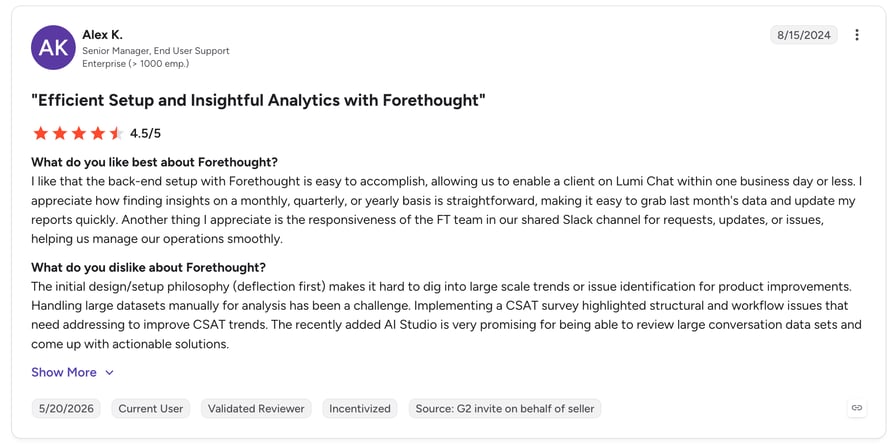
| 6 | Forethought | Triage & agent assist | Custom |
| 7 | PolyAI | Enterprise voice contact centers | Custom |
| 8 | Synthflow | No-code voice agent builder | ~$29/mo |
| 9 | Retell AI | Developer teams | ~$0.07/min |
| 10 | Bland AI | Outbound calling at scale | ~$0.09/min |
Why Teams Are Searching for a Decagon AI Alternative
Decagon is a genuinely impressive enterprise AI platform, with a G2 rating around 4.9/5 and customers like Duolingo, Chime, and Notion reporting 70–80% deflection rates. So why are so many teams evaluating Decagon AI competitors? Because what works for a Fortune 500 support org with dedicated "Agent Engineers" often doesn't work for everyone else.
According to procurement data from Vendr, the median Decagon contract runs around $386,000 per year. If you're an SMB or a lean mid-market team, that's not a rounding error — that's your entire support budget.
5 Main Cons of Decagon AI: Based on Real User Reviews
- Opaque Pricing With a High FloorDecagon publishes no pricing and offers no self-serve signup. Third-party data (Vendr) puts annual contracts between $95K and $590K, with a reported ~$50K platform fee before usage.
- Engineering-Heavy SetupReviewers consistently note that meaningful deployments need developers for integrations and maintenance. Decagon even promotes a dedicated "Agent Engineer" role for its customers.
- Built for Large Enterprises OnlyAnalysts note that if your annual contract value would fall below ~$50,000, you're outside Decagon's target market. Smaller teams pay for architecture they'll never use.
- Voice Capabilities Are Still MaturingDecagon Voice launched in 2025 with outbound arriving in Spring 2026. There's no native telephony — no numbers, dialers, or routing for your human team.
- Limited Visibility Into AI DecisionsG2 reviewers flag primitive user roles and shallow audit logs. Under per-conversation billing, you also pay even when the AI fails to resolve the issue.
What Is the Best Alternative to Decagon AI?
CloudTalk is the best alternative to Decagon AI for SMBs, mid-market sales teams, and support teams that need AI voice calling without enterprise contracts. Unlike Decagon, CloudTalk combines AI voice agents with a complete business phone system — local numbers in 160+ countries, AI transcripts, summaries, and sentiment analysis built into the plan rather than sold as a six-figure custom deal — starting at $25/user/month with a 14-day free trial and transparent, public pricing.
Why Users Consider CloudTalk the Best Decagon AI Alternative
5 Main Pros of CloudTalk vs. Decagon AI
- Start Today, Not Next QuarterSelf-serve signup and a 14-day free trial vs. Decagon's sales-gated, weeks-long onboarding. Most teams launch their first AI voice agent in days, no engineers required.
- Predictable Pricing From $25/user/monthPublic plans and a published AI add-on replace opaque $95K–$590K annual contracts, so finance can actually forecast costs.
- Voice-First by DesignNative telephony in 160+ countries, routing, IVR, dialers, and AI agents in one platform. Decagon runs on top of your phone system; CloudTalk is the phone system.
- AI for Your Human Agents TooReal-time AI Agent Assist, transcripts, smart summaries, and coaching insights are included — not gated behind a separate enterprise module.
- Trusted at Scale4.4/5 on G2 across 1,800+ reviews from 5,500+ companies in 100+ countries — verifiable social proof Decagon's ~30 G2 reviews can't yet match.
Skip the sales cycle. Start dialing.
How We Evaluated The Best Decagon AI Alternatives
To build this list, we evaluated 20+ AI voice and customer service platforms and narrowed it down to the 10 strongest tools like Decagon AI for teams that need calling automation in 2026. Every claim is backed by verified G2, Capterra, or Trustpilot reviews, vendor documentation, and hands-on testing.
Our selection focused on eight essential pillars:
- Hands-on testing of core AI voice, calling, and routing features.
- Pricing transparency — advertised price vs. real all-in cost with add-ons and usage fees.
- Verified reviews across G2, Capterra, and Trustpilot (minimum 100 reviews where available).
- Voice quality, latency, and international coverage across regions.
- AI and automation depth — what's included vs. what's a paid add-on.
- CRM and helpdesk integration depth (HubSpot, Salesforce, Pipedrive, Zendesk).
- Support responsiveness and onboarding quality.
- Migration ease from Decagon AI (or ease of running both in parallel).
1. CloudTalk: #1 Decagon AI Alternative for Teams That Live on the Phone
What Is CloudTalk?
CloudTalk is an AI-powered business calling platform used by 5,500+ sales and support teams worldwide. It combines a cloud phone system — local numbers in 160+ countries, smart routing, dialers — with AI voice agents that answer, qualify, and route calls autonomously. Its key differentiator: AI and telephony live in one platform, so you automate calls without stitching an AI vendor onto a separate phone system.
Why Is CloudTalk a Strong Decagon AI Alternative?
- Transparent pricing: public plans from $25/user/month vs. Decagon's estimated $95K–$590K annual contracts.
- Self-serve setup in days: no-code AI agent configuration vs. weeks of engineering-led AOP building.
- Native voice infrastructure: numbers in 160+ countries and 99.99%+ uptime.
- AI included, not add-on-only: transcripts, summaries, sentiment, and topic extraction ship with the platform.
- Human + AI on one platform: hand off from AI to human rep with full context, and coach humans with AI Agent Assist.
- SMB-friendly: no seat minimums, no mandatory annual enterprise commitments — for teams of 3 or 300.
What Are the Pros & Cons of CloudTalk?
| Pros | Cons |
|---|---|
| Rock-solid call quality via globally distributed data centers. | Voice-first: chat and email automation are lighter than Decagon's. |
| Fast, self-serve onboarding — teams report going live in days. | Advanced analytics and premium AI features sit on higher tiers. |
| AI features bundled at accessible price points. | Paid AI add-on for advanced Conversation Intelligence. |
| Deep, reliable CRM integrations that eliminate manual logging. | |
| Transparent pricing with a 14-day free trial. |
What Are CloudTalk's Plans & Pricing?
CloudTalk pricing starts at $25/user/month, and the platform offers the following plans:
- Lite - $25/user/month
- Starter - $25/user/month
- Essential - $29/user/month
- Expert - $49/user/month
- Custom - Quote-based, ideal for enterprises
CloudTalk vs. Decagon AI on Cost:
A 10-seat team on CloudTalk runs roughly $3,000/year. The same team on Decagon lands in the $95,000–$590,000/year range per Vendr data — before you add the separate helpdesk Decagon requires for your human agents.
What Are CloudTalk Customers Saying?
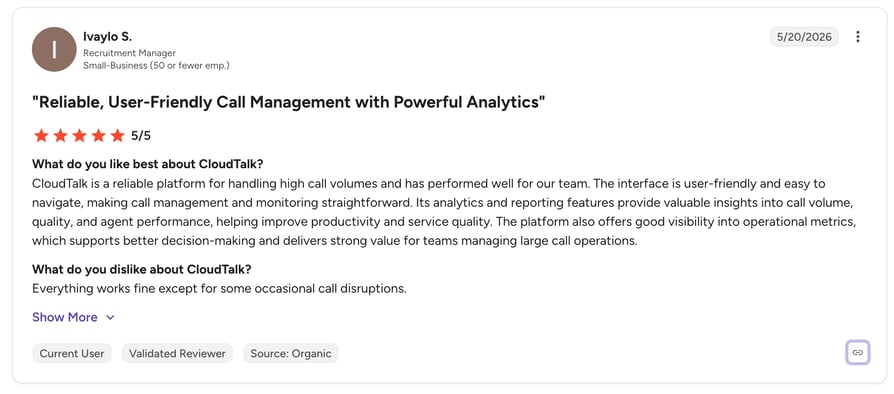
CloudTalk holds a 4.4/5 rating on G2 from 1,800+ reviews, with users repeatedly highlighting call quality, ease of use, and support responsiveness — the exact areas where teams outgrowing enterprise AI vendors feel the most friction.
- Clear Calls and Better Quality: Users highlight consistently crystal-clear audio, even on international calls.
- Support That Goes the Extra Mile: The support team is praised for being proactive and quick to respond.
- AI That Saves Time: Teams rely on AI to write call summaries and track call sentiment automatically.
- Fast and Simple Setup: Admins love how intuitive the platform is and how quickly reps can start calling.
See CloudTalk beat Decagon on your own call flows.
2. Sierra: Best for Enterprise Bespoke Agentic AI
What Is Sierra?
Sierra, founded by former Salesforce co-CEO Bret Taylor, builds branded, autonomous AI agents for large consumer companies like Sonos, ADT, and WeightWatchers. Its multi-model "constellation" architecture handles chat and voice, taking real actions in backend systems.
Why Is Sierra a Strong Decagon AI Alternative?
- Outcome-based pricing — you pay when the agent resolves, saves a cancellation, or upsells.
- Strong voice ambitions with the same agent logic across channels.
- Customer-cited resolution rates of 70–90% (Sonos 75%, Ramp 90%).
- Ghostwriter (2026) builds production agents from your SOPs in 30+ languages.
What Are the Pros & Cons of Sierra?
| Pros | Cons |
|---|---|
| Premium agent quality with strong brand-voice control | Six-figure custom contracts (est. $150K+/yr) |
| Serious compliance posture (ISO 42001, SOC 2, HIPAA) | 6–12 week implementations |
| Outcome-aligned billing model | Almost no public reviews to reference |
What Are Sierra's Plans & Pricing?
Custom enterprise pricing only — analysts estimate annual contracts from roughly $150,000. No free trial, no public tiers, and a separate helpdesk is still required for human agents.
What Are Sierra Customers Saying?
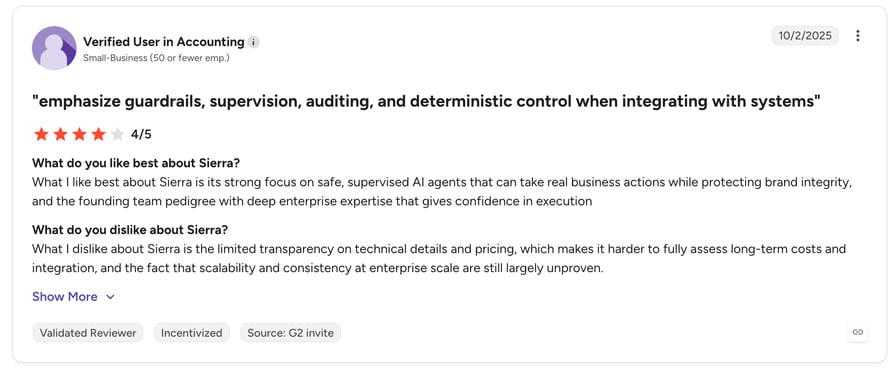
Sierra is sold via custom enterprise deals, so public review volume is thin. The G2 commentary that exists praises system integration depth while flagging limited client-side customization and occasional latency in live voice.
Not ready for a six-figure custom build?
3. Ada: Best for High-Volume AI Resolutions
What Is Ada?
Ada is one of the longest-standing AI customer service platforms, serving brands like Square and Canva. Its AI agent resolves inquiries across messaging, email, and phone, with a reasoning engine tuned on years of real support data.
Why Is Ada a Strong Decagon AI Alternative?
- More mature intent handling than newer entrants — years of tuning on production traffic.
- Multichannel including voice, with 50+ languages.
- No-code Playbooks let CX teams shape behavior without engineers.
- Procurement-friendly incumbent with far more public reviews than Decagon.
What Are the Pros & Cons of Ada?
| Pros | Cons |
|---|---|
| High claimed automation rates (80%+ resolution) | G2 reviewers report 8–16 week real deployments |
| Strong enterprise track record | End-customer Trustpilot sentiment is rough (~2.0/5) |
| Supportive team per Capterra reviewers | Vendor-friendly resolution definitions in contracts |
What Are Ada's Plans & Pricing?
Custom, consumption-based pricing — third-party reports estimate $1–$3.50 per resolution with contracts starting around $30,000/year. No free trial.
What Are Ada Customers Saying?
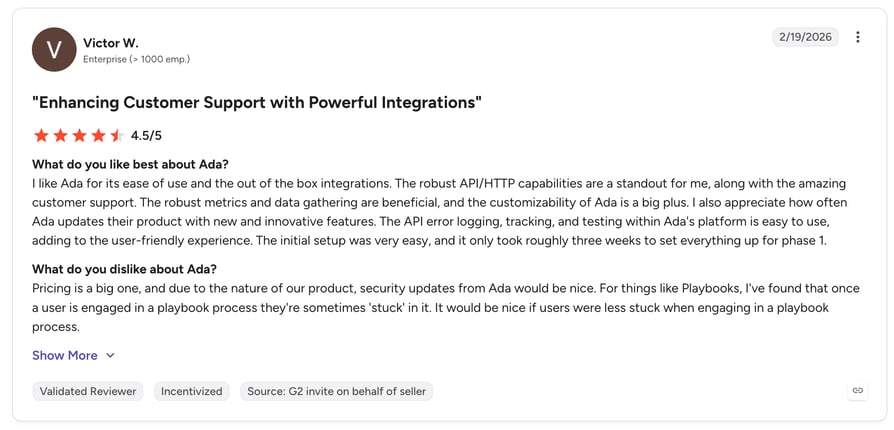
Ada holds roughly 4.6/5 on G2. Reviewers praise support responsiveness and automation depth, while critical reviews focus on setup effort and how "resolution" gets counted.
4. Intercom Fin: Best for Helpdesk-Native, Per-Resolution AI
What Is Fin?
Fin is Intercom's AI agent — the most-reviewed product in the category. It resolves customer issues across chat, email, voice, SMS, and social, either natively inside Intercom or layered on Zendesk, Salesforce, and other helpdesks.
Why Is Fin a Strong Decagon AI Alternative?
- $0.99 per resolution — you only pay for successful outcomes.
- Deploys in as little as 48 hours on Intercom vs. weeks for Decagon.
- Averages ~67–76% resolution across 7,000+ customers.
- Backed by a public resolution-rate guarantee for enterprise buyers.
What Are the Pros & Cons of Fin?
| Pros | Cons |
|---|---|
| Fast deployment and transparent per-outcome pricing | Costs climb quickly at scale under per-resolution billing |
| Huge review base (4.6/5 from 1,100+ G2 reviews) | Deep multi-system workflows hit a ceiling |
| Natural-sounding answers, especially for FAQ deflection | Strongest inside the Intercom ecosystem |
What Are Fin's Plans & Pricing?
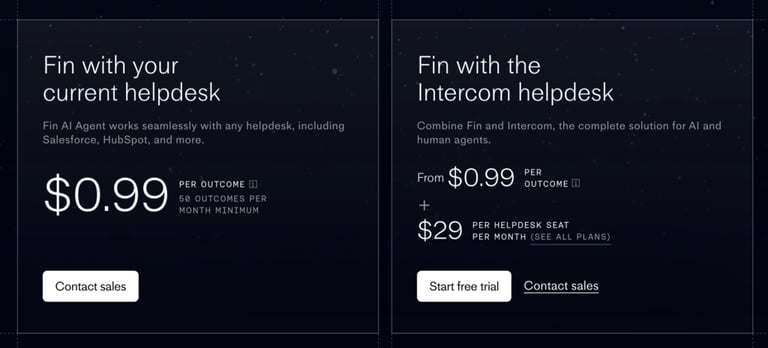
Fin costs $0.99 per resolution on top of an Intercom subscription (or standalone on other helpdesks). Free trial available.
What Are Fin Customers Saying?
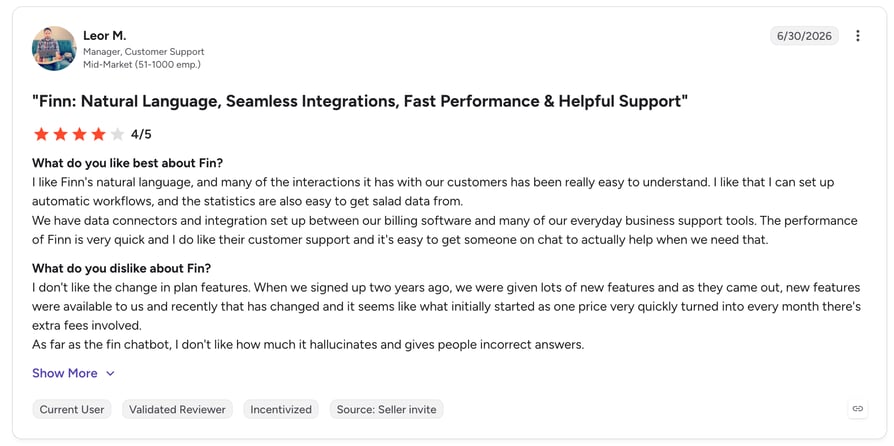
At 4.6/5 across 1,100+ G2 reviews, Fin is the category's most-validated agent. The recurring complaint mirrors its headline strength: per-resolution pricing gets expensive and harder to forecast at high volume.
Phone-first team, not chat-first?
5. Zendesk AI Agents: Best for Existing Zendesk Customers
What Is Zendesk AI?
Zendesk's native AI agents resolve tickets autonomously across messaging and email, built on tech from its Ultimate and Forethought acquisitions and trained against 19 billion historical tickets. They activate directly on existing Zendesk deployments.
Why Is Zendesk AI a Strong Decagon AI Alternative?
- No new vendor: AI switches on inside the helpdesk you already pay for.
- Per-resolution pricing (~$1.50 committed) with free assisted-escalation tiers.
- 1,500+ marketplace integrations connect nearly any stack.
- Decagon's own Agent Assist is reportedly gated to Zendesk anyway.
What Are the Pros & Cons of Zendesk AI?
| Pros | Cons |
|---|---|
| Zero-migration path for existing Zendesk shops | Billing unpredictability from generous "resolved" tagging |
| Massive ecosystem and predictable per-resolution rates | Dialogue builder frustrates many users |
| Enterprise-scale references (Riot, Discord) | Voice automation is weaker than dedicated platforms |
What Are Zendesk AI's Plans & Pricing?
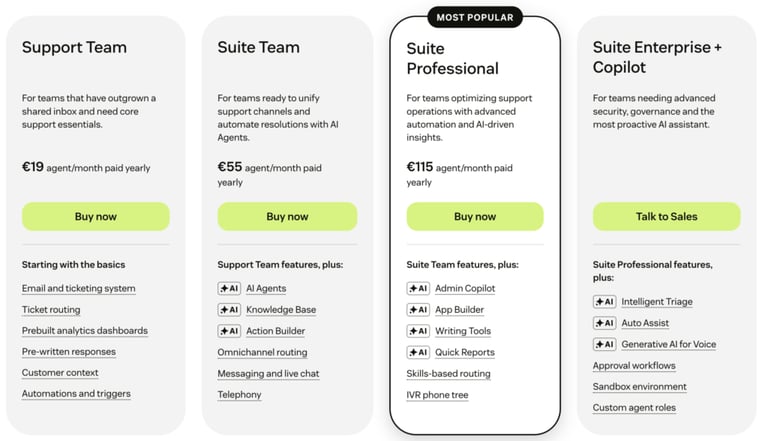
Pricing starts at $19 agent/per month (when paid yearly) on top of a Zendesk Suite subscription (from ~$115/agent/month for Professional). Trials available on Suite plans.
What Are Zendesk AI Customers Saying?
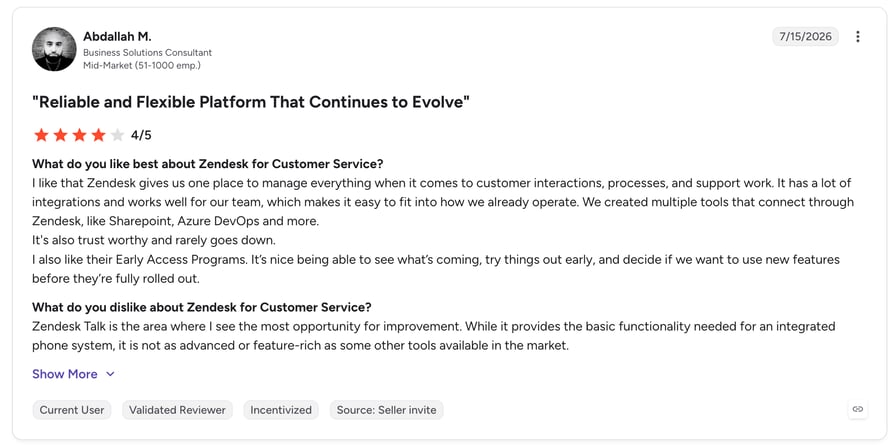
Zendesk sits around 4.3/5 on G2. Reviewers value the all-in-one convenience; critical reviews center on resolution counting and invoice surprises during seasonal spikes.
6. Forethought: Best for AI Triage and Agent Assist
What Is Forethought?
Forethought (acquired by Zendesk in March 2026, still sold as a platform) combines four specialized agents: Solve for autonomous resolution, Assist for human copiloting, Triage for routing, and Discover for support analytics — all powered by semantic search over your knowledge and ticket history.
Why Is Forethought a Strong Decagon AI Alternative?
- Incremental adoption: automate triage first, resolution later — no big-bang migration.
- Strong semantic search ranks the best answer before responding.
- Agent-assist depth Decagon reviewers say is platform-gated in their stack.
- Works across Zendesk, Salesforce, and other legacy helpdesks.
What Are the Pros & Cons of Forethought?
| Pros | Cons |
|---|---|
| Intuitive interface, reduces repetitive work fast | Opaque pricing with annual-only contracts |
| Flexible multi-agent architecture | Reported minimums of 20,000+ historical and 2,000+ monthly tickets |
| Solid 4.5/5 G2 rating | Future roadmap now tied to Zendesk |
What Are Forethought's Plans & Pricing?
No published pricing at any tier — quote-based annual contracts with ticket-volume minimums. No self-serve trial.
What Are Forethought Customers Saying?
G2 reviewers (≈4.5/5) consistently praise ease of use and time saved on triage, with criticism focused on pricing opacity and eligibility minimums.
7. PolyAI: Best for Managed Enterprise Voice AI
What Is PolyAI?
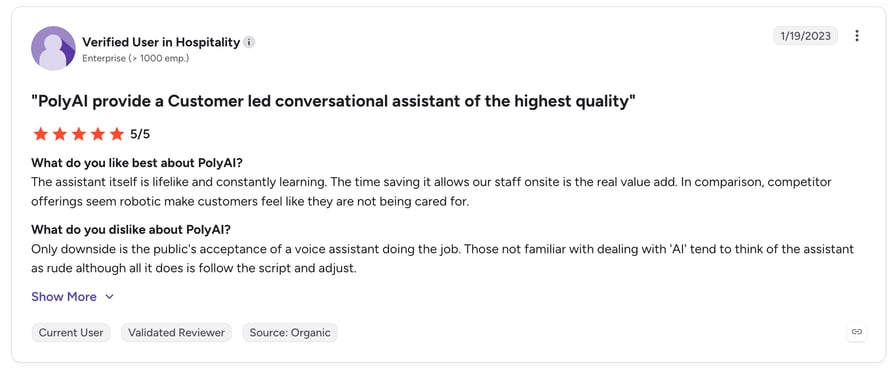
PolyAI builds lifelike, voice-first AI agents for enterprise contact centers in hospitality, financial services, utilities, and travel. Its managed-service model means PolyAI's team designs, tunes, and optimizes agents for you.
Why Is PolyAI a Strong Decagon AI Alternative?
- Voice is the entire product, not a 2025 add-on.
- Revenue-focused outcomes — one customer reported $7.2M in revenue and 75% call containment.
- Managed delivery removes the "Agent Engineer" burden Decagon pushes onto customers.
- Proven at millions-of-calls scale replacing legacy IVR.
What Are the Pros & Cons of PolyAI?
| Pros | Cons |
|---|---|
| Best-in-class voice naturalness | Voice-only — you'll need other tools for chat/email |
| Strong enterprise voice track record | Custom enterprise pricing only |
| Measurable revenue outcomes | Managed model means less self-serve control |
What Are PolyAI's Plans & Pricing?
Custom pricing based on call volume, complexity, and managed-service level. No public tiers or free trial.
What Are PolyAI Customers Saying?
G2 reviewers (~4.5/5) highlight caller experience quality and containment rates; the common caveat is dependency on PolyAI's team for changes.
Want voice-first AI without the managed-service price tag?
8. Synthflow: Best for No-Code AI Voice Agent Building
What Is Synthflow?
Synthflow is a no-code platform for creating AI voice agents that handle inbound and outbound calls — appointment booking, lead qualification, FAQ handling — via a drag-and-drop builder and template library.
Why Is Synthflow a Strong Decagon AI Alternative?
- Self-serve from ~$29/month vs. Decagon's sales-gated six figures.
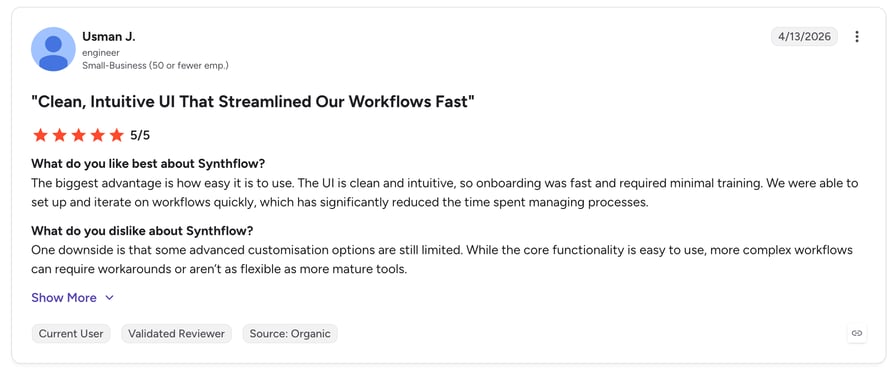
- Launch in hours: templates plus visual flows replace engineering sprints.
- Native calendar, CRM, and Zapier connections for real actions.
- Transparent per-minute usage you can actually forecast.
What Are the Pros & Cons of Synthflow?
| Pros | Cons |
|---|---|
| Very fast time-to-value | Not built for complex enterprise action workflows |
| Accessible pricing and strong 4.7/5 G2 rating | Per-minute costs add up at high volume |
| Agency-friendly with white-label options | Lighter analytics than enterprise suites |
What Are Synthflow's Plans & Pricing?
Plans start around $29/month plus per-minute usage, with pro and agency tiers. Free trial available.
What Are Synthflow Customers Saying?
At ~4.7/5 on G2, users praise how quickly non-technical teams ship working agents; critiques focus on edge-case handling in complex conversations.
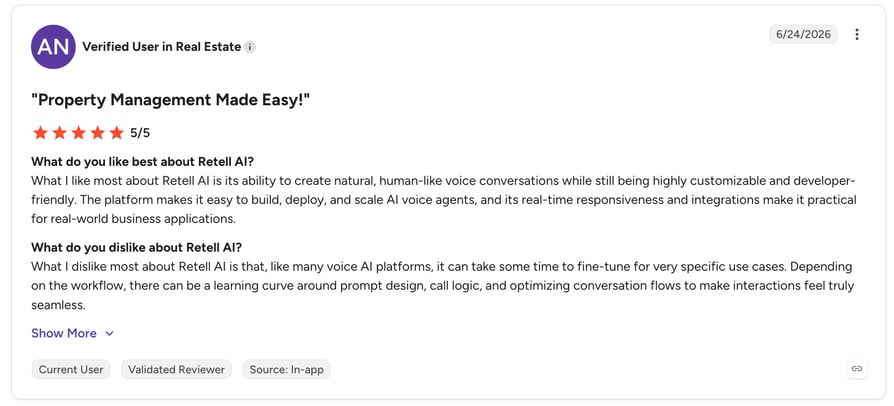
9. Retell AI: Best for Developer-First Voice Agent APIs
What Is Retell AI?
Retell AI provides API-first infrastructure for building production voice agents: low-latency speech pipelines, LLM orchestration, telephony hooks, and testing tools. It's the pick for product and engineering teams embedding voice AI into their own workflows.
Why Is Retell AI a Strong Decagon AI Alternative?
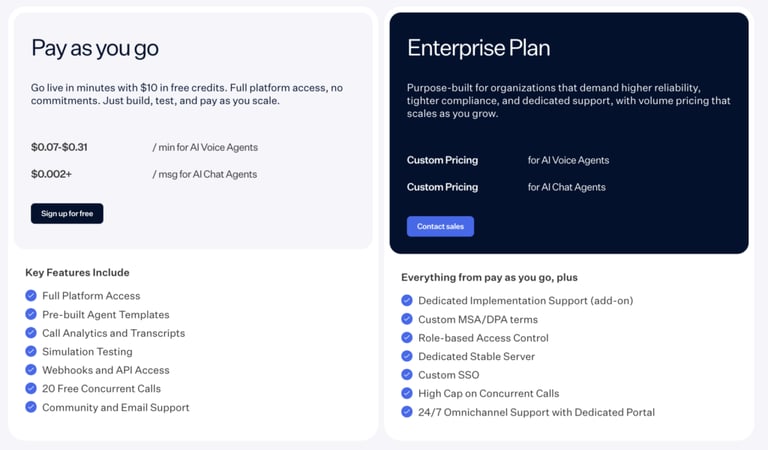
- Usage pricing from ~$0.07/minute — orders of magnitude below Decagon's contracts.
- If you have engineers anyway, you keep full control of the stack.
- Sub-second latency tuned for natural phone conversations.
- Bring-your-own LLM and telephony flexibility.
What Are the Pros & Cons of Retell AI?
| Pros | Cons |
|---|---|
| Excellent latency | Requires engineering to build and maintain |
| Transparent usage pricing | No business phone system features |
| Flexible architecture, ~4.7/5 on G2 | You own compliance and QA |
What Are Retell AI's Plans & Pricing?
Pay-as-you-go from roughly $0.07/minute for conversation processing plus telephony costs; free credits to start.
What Are Retell AI Customers Saying?
Developers on G2 (~4.7/5) highlight documentation quality and voice latency; the main criticism is that non-technical teams can't run it alone.
10. Bland AI: Best for Programmable Outbound Calls at Scale
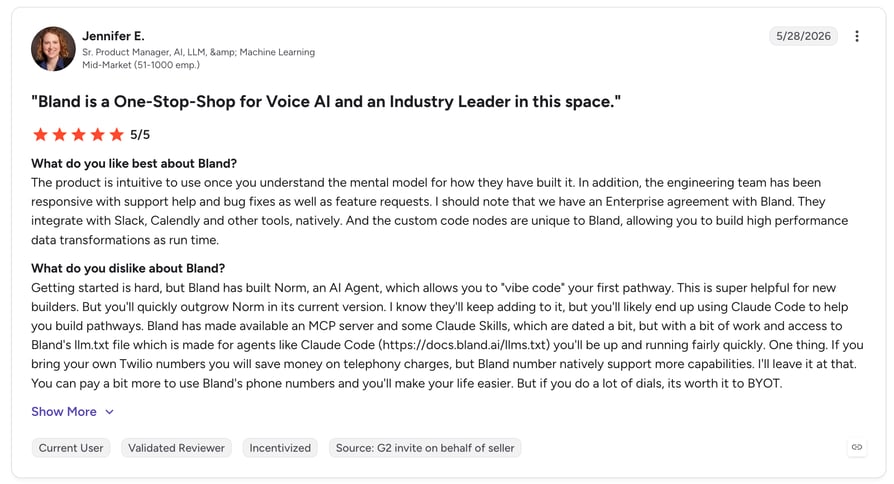
What Is Bland AI?
Bland AI offers developer-oriented infrastructure for AI phone calls — outbound campaigns, inbound handling, and "Conversational Pathways" that keep agents on script. It's popular for high-volume outbound use cases like lead follow-up and reminders.
Why Is Bland AI a Strong Decagon AI Alternative?
- Per-minute pricing (~$0.09/min) and self-serve signup vs. Decagon's sales gate.
- Outbound calling has been core since launch — Decagon only added it in Spring 2026.
- Pathways give deterministic control over agent behavior.
- Self-hosted / dedicated infrastructure options for scale and compliance.
What Are the Pros & Cons of Bland AI?
| Pros | Cons |
|---|---|
| Fast to start, cheap to test | Developer-centric with limited no-code |
| Strong outbound focus | Quality tuning takes iteration |
| Scales to large volumes | Compliance for outbound calling is on you |
What Are Bland AI's Plans & Pricing?
Pay-as-you-go around $0.14/minute with enterprise plans for dedicated capacity. Free credits to test.
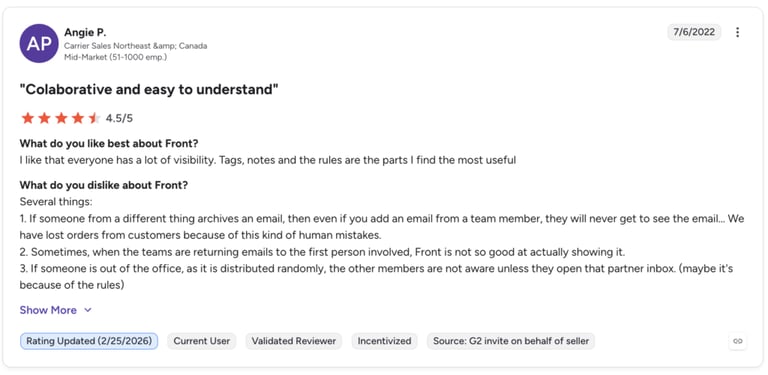
What Are Bland AI Customers Saying?
G2 sentiment (~4.5/5) centers on ease of launching outbound campaigns; critical reviews mention occasional latency and the tuning effort real deployments need.
Need outbound AI calling without stitching a stack together?
CloudTalk vs. Decagon AI: A Detailed Feature Comparison
When choosing between CloudTalk and Decagon AI, the main differences come down to voice infrastructure, pricing transparency, and time-to-launch. Here is the direct, side-by-side comparison of both platforms.
| Category | CloudTalk | Decagon AI | Winner |
|---|---|---|---|
| Starting Price (annual billing) | $25/user/mo | Custom; est. $50K+/yr platform fee | CloudTalk |
| Minimum commitment | None | Enterprise contract (~$50K+ ACV floor) | CloudTalk |
| Free Trial | 14 days, self-serve | None | CloudTalk |
| Native telephony & numbers | 160+ countries | None (BYO telephony) | CloudTalk |
| Call quality infrastructure | 99.99%+ uptime SLA | Depends on external provider | CloudTalk |
| Call Flow Designer / IVR | Visual drag-and-drop | AOP logic, no native IVR | CloudTalk |
| AI Voice Agents | Yes, no-code, inbound + outbound | Yes; voice launched 2025 | CloudTalk |
| Conversation Intelligence | Transcripts, summaries, sentiment | Enterprise analytics suite | Tie |
| Agent Assist for humans | Included | Reportedly gated to Zendesk | CloudTalk |
| CRM Integrations | 35+ native | API-based enterprise integrations | CloudTalk |
| Setup Time | Days, self-serve | Weeks, engineering-led | CloudTalk |
| G2 Rating | 4.4/5 (1,800+ reviews) | ~4.9/5 (~30 reviews) | Tie |
How to Choose the Right Decagon AI Alternative for Your Team
When picking a Decagon AI alternative, focus on your operational bottlenecks — not just the feature list. Here's how to match your use case to the right platform:
1. Which Decagon AI alternative is best for phone-first teams?
If most of your volume is phone calls, pick a platform where voice is native — not a chat-first tool where voice is a recent add-on.
- Top Picks: CloudTalk (native telephony in 160+ countries plus AI voice agents) or PolyAI (managed enterprise voice).
2. Which Decagon AI alternative offers transparent pricing?
If you can't budget without a sales call, you can't run a real evaluation. Prioritize vendors that publish their pricing.
- Top Picks: CloudTalk (from $25/user/mo), Intercom Fin ($0.99/resolution), Synthflow (~$29/mo), Retell AI (~$0.07/min), Bland AI (~$0.09/min).
3. Which Decagon AI alternative works without engineering resources?
Decagon, Sierra, and Ada assume technical ownership. If your roadmap can't absorb that, prioritize no-code platforms.
- Top Picks: CloudTalk and Synthflow (both launch in days without developers).
4. Which Decagon AI alternative is best for existing helpdesk users?
If your support team lives in Intercom or Zendesk, native AI agents will deploy fastest with the least friction.
- Top Picks: Intercom Fin (48-hour deploy, $0.99/resolution), Zendesk AI Agents (zero-migration on existing Zendesk), Forethought (incremental multi-agent).
5. Overall, what is the best Decagon AI alternative worth switching to?
If your goal is to automate real phone conversations without a six-figure contract or a stalled engineering roadmap, CloudTalk is the premier choice. It delivers AI voice agents, AI Agent Assist for humans, native telephony in 160+ countries, and deep CRM sync — at transparent, forecastable pricing.
- Top Pick: CloudTalk stands out as the definitive Decagon AI upgrade for SMB and mid-market teams that live on the phone.
Ready to Make the Switch from Decagon AI?
Decagon earned its reputation — but its six-figure contracts, sales-gated evaluation, engineering-heavy rollouts, and still-maturing voice product make it the wrong fit for most teams that primarily need calls answered, qualified, and resolved. Here's what switching to CloudTalk gets you:
- Transparent pricing: public plans from $25/user/month instead of Decagon's estimated $95K–$590K annual contracts.
- Voice-first infrastructure: native telephony in 160+ countries — no BYO phone system required.
- AI for humans and machines: AI voice agents plus AI Agent Assist for your reps, all included.
Stop paying for enterprise scaffolding you don't need. Test CloudTalk on your real call volume and let the results decide.
Ready to automate calls without a six-figure contract?
Frequently Asked Questions
About Decagon AI Alternatives
Find answers to the most common questions teams have about Decagon AI and its alternatives.
CloudTalk is the best Decagon AI alternative for phone-first teams, combining AI voice agents with native telephony in 160+ countries, transparent pricing from $25/user/mo, and a 14-day free trial.
Decagon contracts run $95K–$590K/year per Vendr data. CloudTalk starts at $25/user/mo with public tiers — a 10-seat team pays around $3,000/year vs. Decagon's six-figure floor.
In practice, yes — Decagon promotes a dedicated "Agent Engineer" role and typical rollouts take about 6 weeks. CloudTalk's no-code AI agent setup goes live in days without developer time.
CloudTalk. Decagon has no native telephony and runs on top of your phone system. CloudTalk is the phone system — local numbers in 160+ countries, dialers, IVR, and AI agents in one platform.
Yes. CloudTalk offers a 14-day free trial from $25/user/mo. Synthflow starts at ~$29/mo, and developer APIs like Retell AI (~$0.07/min) and Bland AI (~$0.09/min) offer pay-as-you-go with free credits.
For most SMB and mid-market teams, yes. CloudTalk delivers AI voice agents plus AI Agent Assist, CRM auto-logging, and voice-first infrastructure — the stack Decagon requires you to assemble separately.
It depends on channel mix. Fin wins for chat-heavy Intercom shops (48-hour deploy, $0.99/resolution). For phone-heavy teams, CloudTalk beats both on native voice infrastructure and predictable per-seat pricing.