Marlie AI Pricing 2026: Plans, Hidden Fees and Cost Scenarios
TL;DR: Marlie AI Pricing at a Glance
Marlie AI pricing runs from $49 to $399 per month across four published plans, plus a quote-based Enterprise tier. Every plan is a single subscription rather than a per-seat licence, and each one includes a block of AI talk time: 250, 500, 1,000, or 2,000 minutes. Go over that block and you pay $0.25 to $0.35 per extra minute, depending on your plan.
What the plans do not all include: call transfers, appointment booking, checkout links, document uploads, custom data fields, and extra phone numbers are gated to specific tiers rather than available everywhere. A 14-day free trial is offered, and a card is required at checkout.
Quick Answer: How Much Does Marlie AI Cost?
Marlie AI costs $49/month for 250 minutes on Basic, $99 for 500 minutes on Standard, $199 for 1,000 minutes on Pro, and $399 for 2,000 minutes on Premium, with overage billed at $0.25 to $0.35 per minute. Enterprise pricing is quote-based. There is no free tier and no published annual discount, so the honest answer to how much does Marlie cost for a small business is $49 a month plus whatever your call volume adds on top.
| Plan | Price (monthly) | Included minutes | Best for |
|---|---|---|---|
| Basic | $49 /month | 250 minutes, then $0.35/min | Solo operators who just need calls answered and messages taken. |
| Standard | $99 /month | 500 minutes, then $0.35/min | Small businesses that book appointments and need one transfer number. |
| Pro | $199 /month | 1,000 minutes, then $0.30/min | Teams routing to departments, selling over the phone, or training the agent on documents. |
| Premium | $399 /month | 2,000 minutes, then $0.25/min | Multi-location and franchise setups that want an account manager. |
| Enterprise | Quote-based | Custom volume | High-volume operations with custom routing requirements. |
Wondering what an AI receptionist costs when minutes are not the meter?
What Pricing Plans Does Marlie AI Offer?
Marlie AI sells five tiers: Basic, Standard, Pro, Premium, and a quote-based Enterprise plan. The pricing model is worth understanding before you compare anything, because it is not the per-user model most business phone systems use.
You buy one subscription for the AI receptionist, not a seat for every person on your team. The subscription carries a monthly allowance of AI talk time. Everything else, which plan features you get, how many people you can transfer to, how many notification channels you can send reports to, scales with the tier rather than with headcount. That makes Marlie AI plans cheap for a two-person clinic and potentially expensive for a busy line, because your bill tracks call minutes rather than staff.
The practical consequence: check your own call minutes before committing. Pull last month's total talk time from your current phone system and compare it against the allowances below. That number, not the plan price, is what decides the Marlie AI cost for your business.
What Is Marlie AI's Basic Plan?
Basic is the entry tier at $49/month, built for a business that mainly needs the phone answered and a message taken. It includes 250 minutes of AI talk time, which is roughly 80 to 100 calls a month at a typical two-to-three minute length.
What is included in Marlie AI's Basic Plan
- AI answering 24/7, with simultaneous call handling.
- Message taking with your own custom questions.
- One text action per call, such as sending a link to the caller.
- Basic post-call summaries tuned to your industry.
- Email and SMS reports to two notification channels.
- Spam and robocall screening.
What you need to know about Marlie AI's Basic Plan
Basic cannot transfer a call. If a caller needs a human, the agent takes a message and someone calls back, which is fine for a workshop and wrong for a practice where an urgent caller expects to reach someone. Appointment booking, custom data fields, and document uploads are also absent. Overage is the most expensive of any tier at $0.35 per minute, so a busy month costs more here than on a plan with a bigger allowance.
What Is Marlie AI's Standard Plan?
Standard is Marlie's most popular tier at $99/month with 500 included minutes. This is the first plan where the AI does something rather than only recording something, and for most small businesses it is the real starting point.
What is included in Marlie AI's Standard Plan
- Everything in Basic.
- Automatic appointment booking with calendar sync, plus real-time availability checks and rescheduling.
- Call transfers to your team, limited to one number.
- Situation messages: extra texts the agent picks based on what happened on the call.
- Up to three actions per call and reports to four notification channels.
What you need to know about Marlie AI's Standard Plan
The transfer limit is one number. Every escalation goes to the same phone, so a business that wants sales and billing handled by different people has to move up to Pro. Overage stays at $0.35 per minute, which means the jump from Basic buys you features and a bigger allowance, not a cheaper minute.
What Is Marlie AI's Pro Plan?
Pro costs $199/month and includes 1,000 minutes with overage dropping to $0.30 per minute. This is the tier where Marlie stops being a receptionist and starts being a front desk that can sell, route, and record structured data.
What is included in Marlie AI's Pro Plan
- Everything in Standard.
- Secure checkout links texted to callers, through Shopify and Square.
- Transfers to different people and departments rather than one number.
- Product and service listing for callers, plus booking cancellations.
- Custom post-call extraction with up to 10 of your own data fields.
- Training document and knowledge base uploads, unlimited actions per call, and reports to eight channels.
What you need to know about Marlie AI's Pro Plan
Pro is a $100 jump from Standard, and the two things most buyers move for are department routing and document training. If you only need one of them, the maths is worth checking: 500 extra minutes plus those features for $100 works out well if you are already paying overage on Standard, and poorly if your call volume is steady at 400 minutes.
What Is Marlie AI's Premium Plan?
Premium is $399/month with 2,000 included minutes and the cheapest overage rate at $0.25 per minute. It is aimed at multi-location businesses and franchises, and a good part of what you buy is human help rather than software.
What is included in Marlie AI's Premium Plan
- Everything in Pro.
- A dedicated account manager and regular review calls covering analysis and improvements.
- Sequential team ringing, where staff hear who is calling and accept by pressing 1.
- Multi-location and franchise setups arranged by Marlie's team.
- Extra AI phone numbers on request, call report routing by outcome, unlimited notification channels, and up to 25 custom data fields.
- Custom CRM and line-of-business integrations, with white-glove onboarding.
What you need to know about Marlie AI's Premium Plan
Extra phone numbers are described as set up for you on request rather than self-service, and no per-number price is published. For a franchise that needs a number per location, that is a line item to pin down in writing before signing, not after.
What Is Marlie AI's Enterprise Plan?
Enterprise is quote-based, built around custom volume, custom minute packages, and custom routing. There is no public price, so budgeting means a sales conversation. Worth asking on that call: what the per-minute rate drops to at your volume, whether unused minutes roll over, and what the contract term is.
Marlie AI Pricing Plans Compared
| Feature | Basic | Standard | Pro | Premium |
|---|---|---|---|---|
| Monthly price | $49 | $99 | $199 | $399 |
| Included minutes | 250 | 500 | 1,000 | 2,000 |
| Overage per minute | $0.35 | $0.35 | $0.30 | $0.25 |
| Appointment booking | No | Yes | Yes | Yes |
| Call transfers | No | 1 number | Departments | Departments, sequential ring |
| Checkout links (Shopify, Square) | No | No | Yes | Yes |
| Document and knowledge base uploads | No | No | Yes | Yes |
| Custom data fields | No | No | Up to 10 | Up to 25 |
| Actions per call | 1 | 3 | Unlimited | Unlimited |
| Notification channels | 2 | 4 | 8 | Unlimited |
Every tier shares the same foundations: the agent is trained on your brand voice, you pick the name, greeting, and personality, you choose the area code, and there are 8,000+ integrations behind it. What changes as you climb is how much the agent is allowed to do on a call.
Try an AI receptionist that comes with a real phone system behind it
What Are Marlie AI's Additional Costs?
Marlie's pricing page is refreshingly short on add-on SKUs. There is no separate AI fee, no analytics upsell, and no per-seat charge. The costs that move your invoice are usage and gating: minutes you did not plan for, and features that sit one tier above the plan you picked.
Overage minutes
This is the big one. Every plan meters AI talk time, and once you pass the allowance you pay per minute at $0.35, $0.30, or $0.25 depending on tier. A single busy month can add more than the subscription itself: 500 extra minutes on Standard is $175 on top of a $99 plan. Marlie AI included minutes are the number to watch, not the plan price.
Tier gating on features you may consider basic
Call transfers do not exist on Basic. Appointment booking does not exist on Basic. Department routing requires Pro. Document training requires Pro. None of these are add-ons you can buy: they are reasons to move up a plan, which means the practical cost of one missing feature can be $50 or $100 a month rather than a small line item.
Extra phone numbers
Additional AI phone numbers are available on Premium and Enterprise, set up on request. No per-number price is published, so for a multi-location business this is an unquantified line in the budget until sales quotes it.
Annual billing
Marlie AI annual pricing is not published as a discounted option. The plans are listed monthly, which is good for flexibility and means there is no advertised way to cut the rate by committing for a year, unlike most business phone systems where annual billing saves 20% or more.
| Cost | Price | What triggers it |
|---|---|---|
| Overage minutes | $0.35/min (Basic, Standard), $0.30/min (Pro), $0.25/min (Premium) | Charged automatically once the plan allowance runs out. |
| Call transfers | Effectively $50/month (the Basic to Standard jump) | Not sold as an add-on. One transfer number on Standard, departments on Pro. |
| Document training and custom fields | Effectively $100/month (the Standard to Pro jump) | Knowledge base uploads and post-call extraction start at Pro. |
| Extra AI phone numbers | Not published | Premium and Enterprise only, arranged on request. |
| Annual commitment discount | Not published | Plans are listed as monthly subscriptions. |
Tired of guessing what the meter will read?
What Will Marlie AI Actually Cost?
Plan prices tell you the floor. Your usage tells you the invoice. Here are four realistic scenarios, with the maths spelled out and an effective cost per minute at the end of each, because that is the number worth comparing against every other AI receptionist you are looking at.
Scenario 1: The solo operator (Basic, light volume)
The setup: a one-person trades business or consultancy that misses calls while working. Roughly 110 calls a month at an average of 2 minutes, so about 220 minutes of AI talk time. No transfers needed, because callers are happy with a callback.
| Line item | Unit cost | Quantity | Subtotal |
|---|---|---|---|
| Basic subscription | $49 / month | 1 | $49.00 |
| Overage minutes (220 used of 250 included) | $0.35 / min | 0 | $0.00 |
| Monthly bill | $49.00 / month |
Effective cost per minute:
$0.22. This is Marlie at its best value, because the allowance is nearly full and nothing spills into overage. The risk is a single busy month: 100 extra minutes adds $35, a 71% increase on the plan price.
Scenario 2: The small clinic that books appointments (Standard, running over)
The setup: a dental or veterinary practice taking around 230 calls a month. Booking conversations run longer than message-taking, roughly 3 minutes each, so about 700 minutes. Standard is required for calendar sync and the one transfer number.
| Line item | Unit cost | Quantity | Subtotal |
|---|---|---|---|
| Standard subscription (500 minutes included) | $99 / month | 1 | $99.00 |
| Overage minutes | $0.35 / min | 200 | $70.00 |
| Monthly bill | $169.00 / month |
Effective cost per minute:
$0.24, and 71% above the advertised $99. Note what happens next: moving to Pro at $199 buys 1,000 minutes and a cheaper overage rate, so this clinic pays $30 more for 300 spare minutes and department routing. Once you are 40% over your allowance, the next tier up is usually the cheaper option.
Scenario 3: The growing service business (Pro, sales over the phone)
The setup: a home services company routing callers to sales, scheduling, and billing, texting checkout links for deposits, and training the agent on a price list. Around 470 calls a month at 3 minutes, so roughly 1,400 minutes. Pro is the first tier that allows all of this.
| Line item | Unit cost | Quantity | Subtotal |
|---|---|---|---|
| Pro subscription (1,000 minutes included) | $199 / month | 1 | $199.00 |
| Overage minutes | $0.30 / min | 400 | $120.00 |
| Monthly bill | $319.00 / month |
Effective cost per minute:
$0.23, or 60% above the plan price. At this volume the business is paying roughly $3,800 a year, which is the point where a full phone system with AI attached starts to look like the same money for considerably more product.
Scenario 4: The multi-location operator (Premium, high volume)
The setup: three locations sharing one AI front desk, around 930 calls a month at 3 minutes, so roughly 2,800 minutes. Premium is required for the multi-location setup, sequential team ringing, and extra numbers.
| Line item | Unit cost | Quantity | Subtotal |
|---|---|---|---|
| Premium subscription (2,000 minutes included) | $399 / month | 1 | $399.00 |
| Overage minutes | $0.25 / min | 800 | $200.00 |
| Extra AI phone numbers (per location) | Not published | 2 | Quote required |
| Monthly bill | $599.00+ / month |
Effective cost per minute:
$0.21 and rising, before the unpublished cost of the two extra numbers. At roughly $7,200 a year this is the tier where Enterprise pricing becomes worth negotiating, and where you should be asking what the per-minute rate drops to rather than accepting the list rate.
The pattern across all four: the Marlie AI monthly cost lands 0% to 71% above the advertised plan price, and the effective rate settles around $0.21 to $0.24 per minute at every tier. That consistency is actually useful. It means you can budget Marlie as roughly 22 cents a minute of answered phone time and be close, whichever plan you land on.
See what your call volume costs on a published per-user plan
Which Alternatives Are Better and Cheaper Than Marlie AI?
Marlie AI alternatives pricing splits into three shapes: per-minute (what Marlie does), flat-rate unlimited, and per-user phone systems with AI attached. Which shape suits you depends less on your budget than on whether your call volume is predictable.
CloudTalk: Best for teams that need a phone system, not just a receptionist
What is CloudTalk
CloudTalk is a business phone system with AI voice agents built into it, used by sales and support teams that both answer and make calls. Where Marlie replaces a receptionist, CloudTalk replaces the phone system and adds an AI layer on top of it.
Why CloudTalk may be better than Marlie AI
- Your team gets real phone lines too: outbound dialing, call routing, recording, and analytics, not only an AI that answers.
- Local numbers in 160+ countries, against Marlie's single AI number on most tiers.
- The AI voice agent handles 70+ languages and accents, which matters if you need a bilingual virtual receptionist rather than an English-only front desk.
- Transfers, routing, and departments are core phone system features rather than tier-gated AI features.
- Call intelligence covers transcripts, summaries, sentiment, and topic detection across every call, human or AI.
What is CloudTalk's pricing
- Phone system plans from $25/user/month billed annually, with a one-licence minimum on the entry plans.
- AI Receptionist: 50 minutes free to start, so you can hear it on your own calls before paying.
- AI Specialist: €349/month for 1,000 minutes, with advanced workflows and integrations.
- High volume: from €0.15 per minute, which is 40% below Marlie's cheapest published overage rate.
CloudTalk pricing vs Marlie AI pricing
At low volume Marlie is cheaper, and that is a real advantage: $49 a month for an answered phone is hard to beat if 250 minutes covers you. The picture changes at scale. Marlie's best published per-minute rate is $0.25 on a $399 plan, while CloudTalk's volume rate starts at €0.15. And CloudTalk's number buys a phone system for the humans as well, which Marlie does not attempt to be.
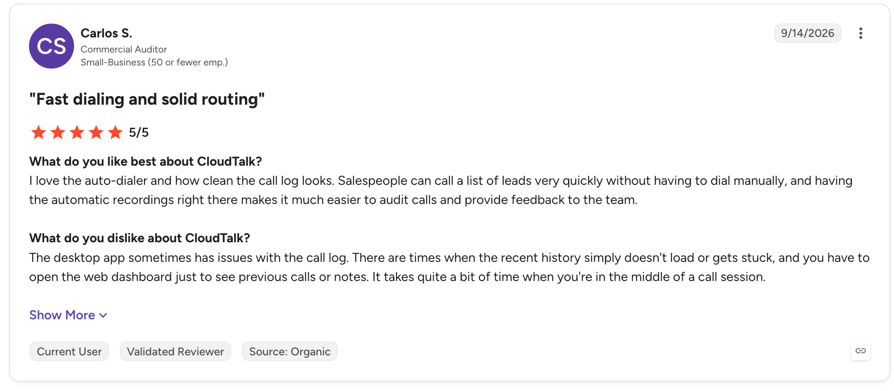
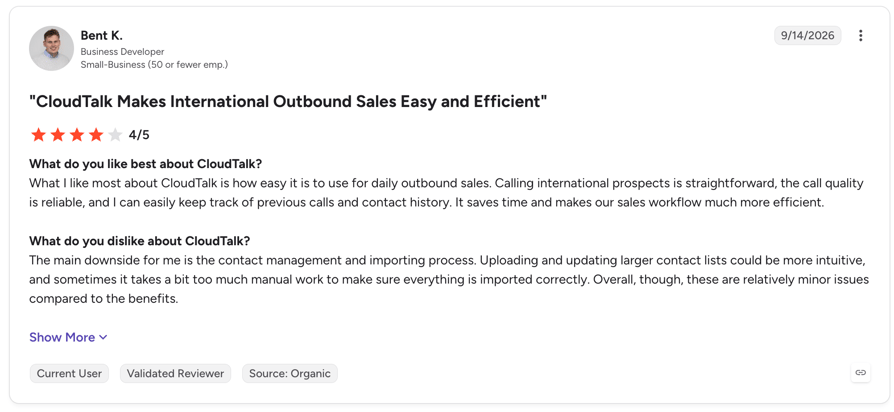
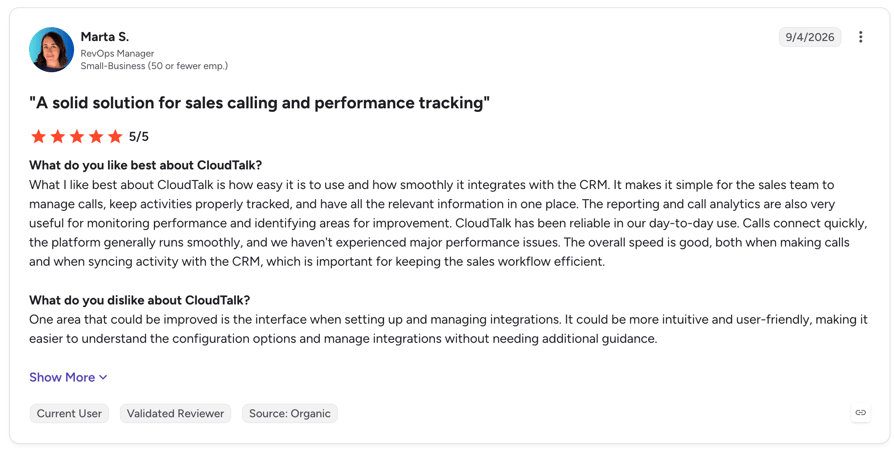
What Are G2 Users Rating CloudTalk?
CloudTalk is rated at 4.4/5 by 1,800+ verified users on the platform. Check out some of the reviews:
Other Providers Worth the Read
If you want to check out other providers, here are some worth your time:
Recommended articles
Compare the AI receptionist and the phone system in one demo
What Are Marlie AI's Best Features?
Appointment booking that writes to your calendar
- Syncs with Google Calendar, Outlook, and Calendly, checking real availability rather than promising a slot and hoping.
- Reschedules on Standard and cancels on Pro, which covers most of what a front desk does with a diary.
Texting the caller while still on the call
- Sends links, directions, or forms mid-conversation, with one action on Basic, three on Standard, and unlimited on Pro.
- On Pro and above it texts secure Shopify and Square checkout links, which turns an AI phone answering service into something that takes money.
Structured data out of every call
- Custom post-call extraction on Pro pulls up to 10 fields you define, 25 on Premium, so calls arrive as records rather than paragraphs.
- Reports route to email and SMS channels, with routing by call outcome on Premium.
Coverage when nobody is there
- 24/7 answering with simultaneous call handling, so two callers at 9pm both get answered. This is the core case for an after-hours AI virtual receptionist.
- Spam and robocall screening keeps junk calls from eating your minute allowance.
What Are the Pros and Cons of Marlie AI?
| Pros | Cons |
|---|---|
| Entry price of $49/month with no per-seat charge, so a solo operator pays once | Every plan meters minutes, so a busy month can add 50% or more to the invoice |
| Pricing is published in full, with clear minute allowances and overage rates per tier | The Basic plan cannot transfer a call, which rules it out for anyone with urgent callers |
| 14-day free trial, and $0 due at signup | No published annual discount, unlike most business phone systems |
| Books, reschedules, and cancels appointments against a real calendar | Extra phone numbers are quote-only and gated to Premium and Enterprise |
| 8,000+ integrations and custom post-call data extraction from the Pro plan | Too few verified reviews on G2, Capterra, or Trustpilot to sanity-check the vendor's claims |
Answer every call without watching a minute counter
Is Marlie AI Worth the Money for Your Business?
Marlie AI makes sense for a specific shape of business: small, inbound-heavy, with predictable call volume and no outbound calling to speak of. A clinic, a salon, a trades business, a single-location restaurant. For those, $49 to $99 a month buys back the calls you were missing, and the Marlie subscription cost is genuinely lower than a human answering service.
It makes less sense once any of three things is true. If your call volume swings, the minute meter turns a $99 plan into a $169 invoice without warning. If your team also makes calls, you are buying a receptionist and still need a phone system. And if you operate across locations or languages, the features you need sit on the $399 tier with an unquantified number cost attached.
The decision, in one line: if you need calls answered and nothing more, start on Marlie's Standard plan and watch your minutes for two months. If you need calls answered and made, or you are already past 1,000 minutes a month, price a phone system with an AI agent included, such as an AI virtual receptionist for small business that comes with real lines behind it, before you commit to a per-minute model.

Why pay per minute for an AI that cannot call anyone back?

Frequently asked questions
Both. You pay a monthly subscription that includes a block of AI talk time, then per minute once you exceed it. Basic is $49 for 250 minutes, Standard $99 for 500, Pro $199 for 1,000, and Premium $399 for 2,000. Overage runs $0.35 per minute on Basic and Standard, $0.30 on Pro, and $0.25 on Premium.
The agent keeps answering and the extra minutes are billed at your plan's overage rate. There is no published hard cap, so the cost is uncapped in practice: 200 minutes over on Standard adds $70 to a $99 plan. If your volume is unpredictable, either move to the tier above or ask sales whether a spend limit can be set on the account.
Yes. The Marlie AI free trial runs 14 days with $0 due at signup, and eligible new customers add a card at checkout. You can cancel any time before the first charge. For comparison, CloudTalk's 14-day trial requires no card at all.
No setup or cancellation fee is published, and white-glove onboarding is included on Premium. The costs that are easy to miss are overage minutes, the tier jumps required for transfers and document training, and extra AI phone numbers on Premium and Enterprise, which carry no published price.
At typical small-business volumes, yes. Human answering services are usually billed per minute or per call at rates well above $0.25, and they do not run at 3am without a night rate. The comparison to check is your own: multiply your monthly talk minutes by $0.22 to $0.24 to estimate Marlie, then put that next to your current service's invoice.
Most small businesses land between $49 and $169 a month. A solo operator taking about 110 calls stays inside Basic at $49. A clinic booking appointments across roughly 230 calls needs Standard and typically runs over, landing near $169. The Marlie AI cost per minute works out around $0.22 to $0.24 across every scenario we modelled.
Every plan includes 24/7 answering, an agent trained on your brand voice, a custom name and greeting, your choice of area code, spam screening, post-call summaries, and 8,000+ integrations. What scales with the tier is the minute allowance, whether the agent can transfer or book, how many actions it can take per call, and how many notification channels it reports to.
It depends on what else you need the phone to do. For answering only, on low predictable volume, a packaged receptionist like Marlie or Goodcall is the cheapest route. For teams that also make calls, route them, and report on them, an AI voice agent inside a phone system is the better buy, because you are not paying twice. Our roundup of the best AI voice agents compares them properly.
In this category it means your bill tracks how much the AI works rather than how many people you employ. Marlie charges by talk minute, some vendors charge per conversation, others charge per resolved issue. The practical effect is that costs rise with customer demand rather than with headcount, which is good when calls are steady and uncomfortable when they spike. Always convert a vendor's model into a cost per minute before comparing.
For a small inbound-heavy business with steady call volume, yes: the pricing is published, the entry point is low, and one recovered booking a month covers the Basic plan. It is worth less if your volume is spiky, if you need more than one transfer destination, or if your team also makes outbound calls, since in that last case you are paying for a receptionist and a phone system separately.