Talkie.ai Review 2026: Features, Pricing & User Feedback
Exploring Talkie.ai? Discover what real users say about its healthcare AI voice agent, EHR integrations, and pricing, plus see how CloudTalk compares.
TL;DR
Talkie.ai is a healthcare-specialized AI voice agent that answers, schedules, and triages patient calls for medical practices, then writes the results back into a handful of supported EHR systems. It's a solid fit for clinics on athenahealth, ModMed, Elation, or eMedicalPractice that are drowning in phone volume and want to go live in a few weeks. It's a weaker fit for anyone outside healthcare, anyone on Epic or Cerner, or anyone who wants to see a price before booking a call.
- Best for: Medical practices on a supported EHR that need 24/7 call coverage without adding front-desk headcount.
- Not for: Non-healthcare businesses, practices on unsupported EHRs, or buyers who need published pricing upfront.
- G2 rating: 4.9/5, but from only 10 reviews, which is thin for a category this competitive.
- Pricing: Quote-based only. Talkie.ai has no public pricing page and no self-serve free trial.
- Compliance: HIPAA compliant, SOC 2 Type II audited as of December 2024.
A Quick Note Before We Start: This Isn't the Talkie AI Chat App
If you searched "talkie ai review" expecting a companion chatbot you talk to for fun, you're thinking of a different product. This review covers Talkie.ai, the healthcare business platform that medical practices use to automate patient calls. The consumer app with a similar name is an unrelated AI companion service built for a completely different audience. We won't mention it again, but it's worth clearing up now since both products share almost the same name.
See CloudTalk's AI Voice Agent Handle a Real Call
Why Medical Practices Are Turning to AI Voice Agents
According to a March 2026 MGMA Stat poll,1 no-shows and missed appointments cost the healthcare industry about $150 billion a year, with front-desk time going more to eligibility and prior-authorization calls (45%) than scheduling (31%). For a practice manager, that’s the receptionist who can’t check in a waiting patient, or the after-hours call that turns into a no-show three days later.
Most practices respond by hiring more staff or bolting on a generic IVR menu. Both hit the same wall: hiring doesn’t scale with call spikes, and a phone tree that only routes calls still dumps the same work on a live person’s desk.
This is the gap healthcare-specific AI voice agents are built to close, and Talkie.ai is one of the more established names in the category. This review breaks down what it does, what it costs, who it fits, and how it compares to CloudTalk’s own AI Voice Agent.
Talkie.ai Scorecard
Talkie.ai doesn't have a large enough independent review footprint yet to lean on aggregated star ratings alone. We've paired the verified numbers below with our own editorial read of each category, the same method we use in our roundup of the best AI voice agents for healthcare.
| Category | Our take | Why |
|---|---|---|
| Healthcare specialization | Strong | Built only for medical practices, with templates for scheduling, intake, and refills. |
| EHR integration depth | Narrow but real | Four confirmed integrations: athenahealth, ModMed, Elation Health, eMedicalPractice. No Epic, Cerner, or eClinicalWorks support found. |
| Implementation speed | Fast | Talkie's own site claims new customers can go live in about three weeks. |
| Pricing transparency | Weak | No public pricing page. Every price requires a sales call. |
| Independent review volume | Thin | 4.9/5 on G2, but only 10 reviews. Capterra shows just one review, and it appears to be about an unrelated product. |
| Security and compliance | Strong | HIPAA compliant, SOC 2 Type II audited in December 2024, AES-256 encryption at rest. |
Basic information
| Field | Value |
|---|---|
| Founded | 2020, per Talkie.ai's own "About" page (some databases list 2018 for the underlying entity) |
| Team size | Not publicly disclosed |
| Country coverage | US-focused; HQ in Warsaw, Poland |
| G2 rating | 4.9/5 (10 reviews) |
| Starting price | Contact vendor for current pricing |
What Is Talkie.ai?
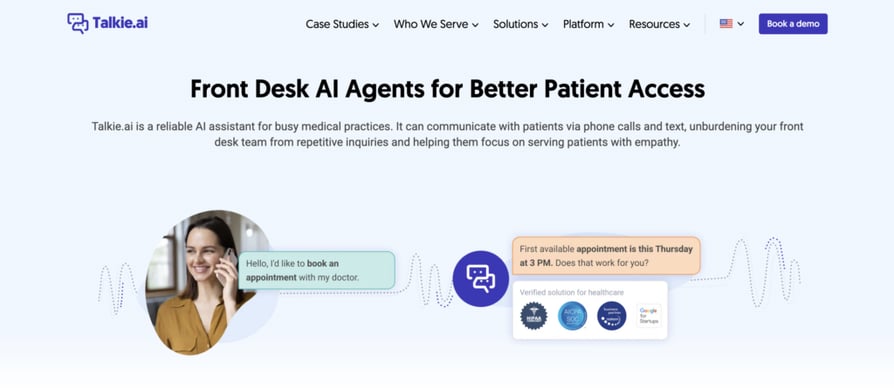
Talkie.ai is an AI voice agent built for healthcare practices: it answers inbound calls, handles scheduling, refills, and intake, then hands off anything it can’t resolve to staff, without callers needing to know they’re talking to software, one of the more common use cases for AI voice agents in healthcare today. It’s narrow by design, built for practices like pediatric, dermatology, and urology clinics, not general business calling, the same core job a virtual receptionist for healthcare handles, just scoped to Talkie’s own workflows.
Where it earns its strongest reviews is speed to value: new customers reportedly go live in about three weeks, per Talkie’s own homepage. Where it falls short is breadth: Epic, Cerner, and eClinicalWorks aren’t on its integrations page, so the EHR write-back automation won’t reach those systems without a workaround.
Talkie’s agents also identify themselves as AI when they answer, rather than pretending to be a person. For a healthcare front desk, that transparency matters more than it would for a retail hotline, since patients are already sharing sensitive information.
What Are Talkie.ai's Key Features?
- Automated call handling and intake. Talkie.ai states it automates up to 85% of the most repetitive calls a front desk fields, freeing staff for in-person patients, the same kind of workflow you'll find in CloudTalk's healthcare AI receptionist agent template.
- Appointment scheduling and rebooking. The agent books, reschedules, and confirms visits directly, aimed at the no-show problem that costs practices real revenue.
- EHR write-back. Confirmed integrations with athenahealth (athenaOne), ModMed, Elation Health, and eMedicalPractice push call outcomes straight into the patient record.
- Prescription refill requests. Patients can request refills by phone without waiting on hold for a nurse line.
- Multilingual support. The platform supports Spanish alongside English, with additional language coverage that Talkie.ai doesn't specify in exact numbers on its own site.
- Transparent AI disclosure and human handoff. Agents introduce themselves as AI assistants and escalate to staff when a call needs a human.
- 24/7 availability. Talkie.ai states its agents pick up 100% of inbound calls around the clock, which matters most for after-hours and weekend call volume that would otherwise go to voicemail.
How Does Talkie.ai Work?
Setup starts with connecting Talkie.ai to a practice’s EHR (one of the four supported systems), then tuning the agent’s scripts and escalation rules to the practice’s specialty, since a pediatric group and a urology clinic need very different scripting before the agent can safely handle scheduling or intake.
Once live, the agent answers calls like a trained front-desk hire: greeting the caller, identifying the reason for the call, and either resolving it directly (booking an appointment, confirming a refill) or gathering details before handing off to staff. Every interaction writes back into the EHR, so the next person sees the same record a human would have left.
Talkie.ai claims new customers go live in about three weeks, and some see value “in just a few days” for lighter setups, per its integrations page. That’s meaningfully faster than the multi-month rollouts often assumed for clinical software, and one of the more credible parts of the pitch since it comes with actual numbers.
Pricing Breakdown
Talkie.ai doesn’t publish pricing anywhere on its site. Its /pricing/ page returns a 404, and every call-to-action on the site points to booking a demo instead of a self-serve signup. There’s no free trial either.
That makes Talkie.ai a quote-first product: you’ll need to talk to sales before you know what it costs, likely based on call volume, locations, and which EHR integration you need. We won’t publish a figure we couldn’t verify on Talkie.ai’s own site, so get one directly from sales before booking a demo.
For contrast, CloudTalk takes the opposite approach: its AI Voice Agent pricing is published, not quote-gated, so you see the number before booking anything. Plans start at $25/user/month, with the AI Voice Agent priced separately from $99/200 minutes/month. See all plans.
What Real Users Say About Pricing
Talkie.ai's footprint on the major review platforms is thin. G2 shows only a small handful of ratings, and Capterra doesn't have a meaningful review base for this product line yet.
What we can confirm directly: the pricing model itself is quote-based, with no published number, confirmed on Talkie.ai's own site. Until more buyers weigh in publicly, that's the most concrete thing to go on.
Reviewing Talkie.ai Against 6 Must-Have Business Requirements
Before a practice signs a contract, these are the six things worth checking against any healthcare AI voice agent, Talkie.ai included, much like our checklist for choosing the best phone system for the healthcare industry.
| Requirement | Talkie.ai's standing |
|---|---|
| HIPAA and security compliance | Meets it. HIPAA compliant with a completed SOC 2 Type II audit (December 2024), AES-256 encryption at rest, TLS/SSL in transit, hosted on AWS. |
| EHR/practice management integration | Meets it, but only for four systems: athenahealth, ModMed, Elation Health, eMedicalPractice. |
| Implementation and time-to-value | Meets it. Roughly three weeks to go live per Talkie's own claim, faster than most clinical software rollouts. |
| Multilingual patient communication | Partially meets it. Spanish is confirmed; the full language count isn't published. |
| Human escalation and oversight | Meets it. Agents disclose they're AI and hand off to staff when needed. |
| Pricing transparency and contract flexibility | Doesn't meet it. No public pricing, no free trial, quote-only. |
Integrations ecosystem
| EHR / practice management system | Integration type |
|---|---|
| athenahealth (athenaOne) | Native, confirmed on Talkie.ai's integrations page |
| ModMed | Native, confirmed on Talkie.ai's integrations page |
| Elation Health | Native, confirmed on Talkie.ai's integrations page |
| eMedicalPractice | Native, confirmed on Talkie.ai's integrations page |
If your practice runs on Epic, Cerner, eClinicalWorks, or anything outside this list, confirm integration support directly with Talkie.ai's sales team before assuming it exists. We found no evidence of it on their own site.
What Users Say About Talkie.ai?
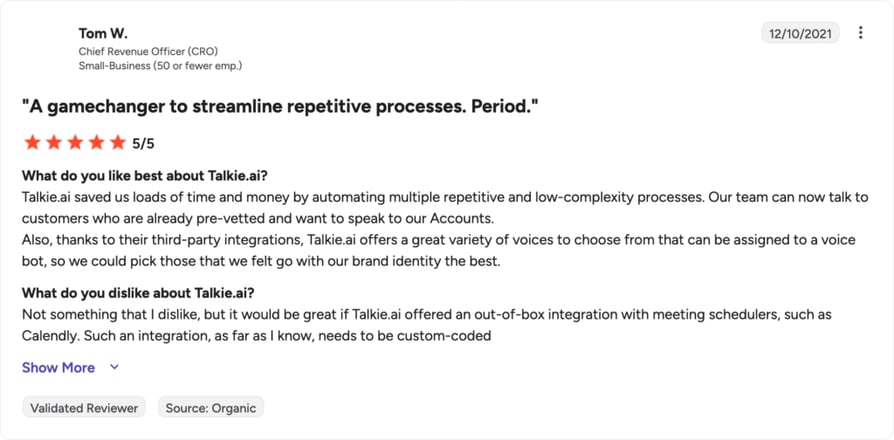
Independent review volume for Talkie.ai is thin. G2 shows 4.9/5 from just 10 reviews, and Capterra lists a single review whose content reads like it describes an unrelated consumer app rather than this product. Review volume for AI voice agents as a category is still catching up with how fast the space is moving. Talkie.ai is a clear example: 10 reviews is a small enough sample that it's worth naming directly, rather than treating the 4.9 rating as a settled verdict.
What users love
- Ease of setup and day-to-day use
- Time saved on repetitive front-desk calls
- Improved patient interactions during busy call periods
What users flag as limitations
- Custom reporting needs that require extra support to configure
- A very small independent review sample to judge consistency by
- No usable independent reviews on Capterra to cross-check against G2
Who Should (and Shouldn't) Use Talkie.ai
Talkie.ai is a strong fit for a specific buyer: a medical practice with real call volume, a supported EHR, and a front desk that's stretched thin. It's a poor fit for almost everyone else, the same profile we outline in our guide to the phone system for healthcare.
Good fit if you're:
- A medical practice on athenahealth, ModMed, Elation Health, or eMedicalPractice
- Fielding enough call volume that missed calls are costing you appointments or revenue
- Comfortable with a quote-based sales process instead of self-serve pricing
Not a good fit if you're:
- Running Epic, Cerner, eClinicalWorks, or any EHR outside Talkie's confirmed list
- Outside healthcare entirely (retail, real estate, financial services, and similar)
- Looking for outbound calling, a sales dialer, or a general business phone system alongside the AI agent
- Not ready to commit to a sales conversation before seeing a price
Industry fit
| Practice type | Fit |
|---|---|
| Pediatrics | Good, named customer example on Talkie's site |
| Urology | Good, named customer example on Talkie's site |
| Family medicine / primary care | Good, named customer example on Talkie's site |
| Dermatology / wellness | Good, named customer example on Talkie's site |
| Dental, veterinary, or non-medical health services | Unconfirmed, no named example found |
| Non-healthcare businesses | Not a fit, product is healthcare-only |
Security, Compliance, and Data Privacy
Talkie.ai states it’s HIPAA compliant and completed a SOC 2 Type II audit in December 2024. The platform runs on AWS, encrypts data in transit with TLS/SSL, and encrypts data at rest with AES-256, a layered setup roughly in line with what any HIPAA-compliant call center handling patient data needs to clear.
Worth flagging: Talkie’s own marketing cites two different figures for the same cost-reduction claim, 65% on its homepage and 60% on its integrations page. Neither is independently verified, so we treat both as vendor marketing claims, not audited results, and use the more conservative 60% figure elsewhere in this review.
Pros and Cons
Pros
- Purpose-built for healthcare, with scheduling, intake, and refill workflows out of the box
- Fast reported implementation, about three weeks to go live per Talkie's own claim
- HIPAA compliant with a completed SOC 2 Type II audit
- Transparent AI disclosure to patients, with human handoff when needed
Cons
- No public pricing and no self-serve free trial
- EHR integration limited to four systems, with no support for Epic, Cerner, or eClinicalWorks
- Thin independent review volume (10 reviews on G2; Capterra shows just one, and it doesn't appear to be about this product)
- Inconsistent cost-reduction claims across its own marketing pages (60% vs. 65%)
- Healthcare-only, so it's not an option if you also need general business calling or outbound sales tools
The Best 4 Alternatives to Talkie.ai
If Talkie.ai's EHR list, pricing opacity, or healthcare-only scope rules it out for you, here's how it stacks up against three other AI voice agent options.
| Provider | Best for | Key strength | Starting price | G2 rating |
|---|---|---|---|---|
| CloudTalk | Teams that need a full phone system plus AI, not just a voice bot | AI Voice Agent layered on a complete cloud phone system, across any industry | Starter at $25/user/month; AI Voice Agent add-on from $99/200 minutes/month | 4.4/5 (1928+ reviews) |
| Retell AI | Developers building custom voice agents via API | Usage-based voice AI infrastructure for teams that want to build their own agent logic | Contact vendor | Not independently verified |
| Synthflow AI | No-code teams building voice agents without an engineering team | Drag-and-drop agent builder aimed at non-technical setup | Contact vendor | 4.5/5 (950+ reviews) |
| Vapi | Developers who want a low-level voice AI API to build on | Infrastructure-first platform for teams building voice products, not a finished agent | Contact vendor | Not independently verified |
Retell AI and Vapi are developer-first: you build the agent yourself rather than buy a finished product. Synthflow leans no-code but isn’t healthcare-specific. CloudTalk is the only one of the four pairing an AI voice agent with a full phone system, useful if you need general business calling too. See our best AI voice agents roundup for more options.
Why CloudTalk's AI Voice Agent Is Worth Considering
Talkie.ai does one thing for one industry. CloudTalk’s AI Voice Agent, built on the CeTe engine, is general-purpose, handling inbound and outbound calls across any industry on top of CloudTalk’s full phone system rather than as a standalone bot. It even ships a healthcare intake template via its AI Voice Agent for healthcare.
| Dimension | Talkie.ai | CloudTalk AI Voice Agent |
|---|---|---|
| Industry scope | Healthcare only | Any industry, with a dedicated healthcare intake template |
| Pricing transparency | Quote-only, no public pricing | Published plans starting at $25/user/month, plus a published AI Voice Agent rate starting at $99/200 minutes/month |
| Setup speed | About three weeks per vendor claim | Teams can be live the same day |
| Outbound and sales tools | None, inbound-only | AI Sales Dialer built for high-volume outbound |
| Core phone system | Voice-AI layer only, no PBX, IVR, or call routing | Full cloud phone system with IVR, routing, and queues, plus the AI layer on top |
| Independent review volume | 10 reviews on G2, 0 usable reviews on Capterra | 1928+ reviews on G2 at 4.4/5 |
| Language and voice coverage | Spanish confirmed, other languages unspecified | 60+ languages supported on the AI Voice Agent |
A few things stand out. CloudTalk publishes its pricing, so you see the AI Voice Agent’s rate before booking a call, unlike Talkie.ai’s demo-gated model. Its agent also shares infrastructure with your human team, so an AI call handed off shows up as one CRM record, and its AI Sales Dialer covers outbound work Talkie.ai doesn’t touch at all.
To be fair, the reverse is also true: if your only need is inbound patient calls on a supported EHR, Talkie’s narrow focus means its scripts and escalation logic are already tuned for that exact job, a fit a general-purpose platform has to build toward. That’s a real trade-off, not a knock.
Test CloudTalk’s AI Voice Agent against your own patient call volume with a 14-day free trial.
Businesses That Switched to CloudTalk
Talkie.ai isn't the only way practices and support teams have tackled the missed-call problem. A few real examples from CloudTalk's own customer base show what that looks like in practice, though none of these three switched from Talkie.ai specifically:
- Booking Host (Travel, Hospitality & Restaurants) achieved a 90%+ call answer rate on CloudTalk, the same core missed-call problem a healthcare front desk runs into.
- Convergence (Healthcare & Wellness) scaled its recruiting calls across 150 nursing homes on CloudTalk, proof the platform holds up in healthcare-adjacent, high-call-volume environments.
- Oxford Royale Academy (Education) replaced a seasonal hiring dependency with multilingual AI voice calls, the same AI Voice Agent capability this review compares against Talkie.ai's narrower language coverage.
Final Verdict: Is Talkie.ai Worth It?
Good fit if: you run a medical practice on athenahealth, ModMed, Elation Health, or eMedicalPractice, your front desk is buried in call volume, and you're comfortable going through a sales conversation to get pricing. Talkie.ai's healthcare-specific tuning and reported three-week setup make it a credible option for that exact buyer.
Not a good fit if: you're on an unsupported EHR, you need anything outside healthcare, you want outbound calling alongside inbound AI, or you'd rather see a price before you talk to sales. In any of those cases, a broader platform like CloudTalk, or a developer-first option like Retell AI or Vapi if you want to build your own agent, is worth evaluating first.
The honest read is that Talkie.ai is a narrow, well-built tool for a narrow job. Whether that's a strength or a limitation depends entirely on how narrow your own requirements are.
Frequently Asked Questions


Frequently asked questions
No. Talkie.ai is a healthcare business platform for medical practices, not the unrelated consumer companion app with a similar name. If you're comparing broader AI voice agents, this review covers the healthcare product only.
Talkie.ai handles inbound patient calls for medical practices: scheduling, rebooking, refill requests, and intake, one of the more common use cases for AI voice agents in healthcare.
Talkie.ai costs whatever your sales call lands on: there's no public pricing page and no free trial. CloudTalk publishes its AI Voice Agent pricing instead, starting at $99 per 200 minutes.
Yes, Talkie.ai is HIPAA compliant and completed a SOC 2 Type II audit in December 2024, per its own security page. That's table stakes for any HIPAA-compliant call center handling patient data.
Yes, Talkie's agents introduce themselves as AI assistants rather than pretending to be human, per its own marketing. That transparency matters for a healthcare AI receptionist handling sensitive calls.
It's worth it if you're on a supported EHR and buried in call volume; the healthcare-specific tuning and fast setup are real strengths. For broader needs, CloudTalk's AI Voice Agent for healthcare covers more ground.