Voice.ai Review: The TL;DR Verdict
| Area | The Verdict |
|---|---|
| One-Line Verdict | Voice.ai is a best-in-class consumer voice changer that now offers a developer-first voice agent API. It's powerful for building voice experiences but not a turnkey business calling platform, so budget for credit-based costs above the headline $0.08/min and a developer to build it. |
| Overall Rating | We rate Voice.ai 3.0 out of 5: the voice tech is excellent, but business-calling readiness is where it falls short. |
| Best For | Developers and creators who want to build their own voice experiences will get the most out of Voice.ai. |
| Not Good For | It's a weak fit for teams that need a turnkey AI voice agent for business without engineering. |
| Starting Price | Voice.ai's pricing starts free, with paid plans from $4.17 to $733.33/month billed yearly on credits, business agent use from about $0.08/min, and quote-only enterprise deals. |
| Free Tier? | Yes, Voice.ai is free to start with 5,000 credits a month, though agent minutes burn through them quickly. |
| Setup Time | The consumer app is live in about 15 minutes, but a production business voice agent takes real developer build time. |
| Standout Pro | Its real-time voice changing, voice cloning, and voice AI text to speech are genuinely best-in-class. |
| Standout Con | Its credit-based pricing hides the true per-call cost, and a consumer, gaming-first brand feels off for business calls. |
| User Sentiment | Voice.ai reviews split hard: 2.1/5 on Trustpilot over billing complaints, but 4.0/5 on the Apple App Store, while business-agent reviews stay thin. |
| CloudTalk Verdict | If you need autonomous inbound and outbound calls, Q&A, and scheduling with no engineering, CloudTalk's AI voice agent is the business-ready pick. |
Most people know Voice.ai as the free, real-time voice changer for Discord, gaming, and streaming. But the company now markets a business Voice Agent Platform and APIs too. So this Voice.ai review answers the question buyers actually have: can a consumer-first voice-changer brand really run your business phone calls, or is it still a creator toy with an API bolted on?
We tested the business side to find out. This review covers what Voice.ai is on both sides, how the Voice Agent Platform and APIs work, pricing, security and trust, real user feedback, and the best AI voice agents for business if Voice.ai turns out to be the wrong shape for you. Do your own research too, since plans and features change fast.
See an AI Voice Agent Handle a Real Call
Voice.ai Scorecard: Our Honest Ratings
We scored the business voice-agent offering based on hands-on testing, official documentation, and verified user reviews. Where a score really reflects the consumer app, we say so.
Voice.ai Scorecard
| Dimension | Rating | Why |
|---|---|---|
| Ease of Setup | 2.5/5 | The consumer app is dead simple. The business agent is API and SDK work (LiveKit, Pipecat, and your own telephony wiring), not a no-code product an ops team runs alone. |
| Call Quality & Voice Tech | 4.5/5 | The real strength: real-time voice changing, cloning from short samples, a huge voice library, and sub-150ms text-to-speech latency. |
| Pricing Clarity | 3/5 | Voice.ai publishes seven tiers, which helps. But credits convert unevenly (about 1,000 per agent minute) and overage rates aren't public, so the real per-call cost is hard to pin down. |
| Features & Capabilities (Business) | 3/5 | Voice Agent API, TTS, cloning, on-prem, and scheduling are there. Business-calling essentials like deep telephony, native CRM, and QA tooling are thin. |
| Integrations | 2.5/5 | Strong with consumer apps like Discord and OBS. For business, integrations are API-driven and largely do-it-yourself. |
| Support, Trust & Compliance | 2.5/5 | Strong compliance on paper (SOC 2 Type II, HIPAA, PCI, GDPR, ISO 27001) against a mixed trust picture: 2.1/5 on Trustpilot over billing, but 4.0/5 on the App Store. |
Voice.ai overall rating: 3.0/5. Best-in-class consumer voice tech and a capable voice-API toolkit for builders, but not a turnkey business phone agent you can switch on today.
What Is Voice.ai?
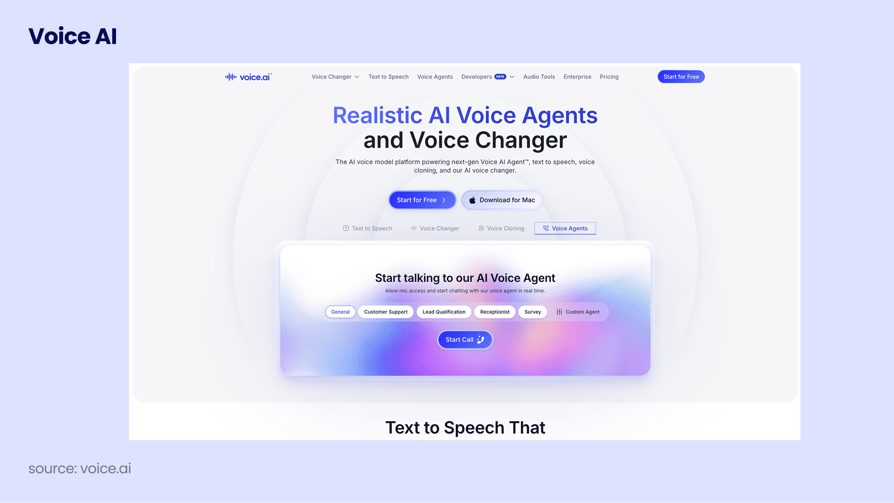
Voice.ai is two products under one brand. The famous one is a free real-time AI voice changer for PC and Mac that transforms or clones your voice inside Discord, Zoom, OBS, and games, with a huge user-generated voice library.
The newer one is a business play. Voice.ai now sells a Voice Agent Platform and a set of APIs (a Voice Agent API, a Text-to-Speech API, and a Voice Changer API) so teams can build AI agents that automate calls, answer questions, and book appointments. You can deploy in the cloud or fully on-premise.
Here is the framing that matters. This is voice infrastructure for developers to build on, layered on a consumer brand. It is not a turnkey, no-code business calling platform your operations team can run without help. If you want the wider category view, our guide to the capabilities and use cases of AI voice sets the baseline.
Voice.ai does bring real credibility signals: a large consumer community, voice cloning and TTS at scale, enterprise claims like on-prem deployment, and, per its own site, more than 100 million calls processed.
Who Voice.ai Is Best Suited For
On the consumer side, Voice.ai fits gamers, streamers, and content creators who want real-time voice changing and cloning. That is where the product is genuinely great.
On the business side, it fits developers and product teams that want voice APIs (text to speech, voice cloning, or agent building blocks) to build custom voice experiences, especially when on-prem or voice cloning is a hard requirement. Teams wanting an off-the-shelf AI voice agent will feel the gap.
How Does Voice.ai Work?
Voice.ai works in two very different ways depending on which product you mean. One is a plug-and-play desktop app. The other is a developer toolkit you assemble yourself.
The Consumer Voice Changer (Context)
The voice changer routes your microphone through a virtual audio device. You pick or clone a voice, and it transforms your speech in real time into any app that accepts a mic input. It is fast and fun, and it is why most people have heard of Voice.ai.
The Voice Agent Platform and APIs (Business Focus)
For business, you build agents through APIs. The Voice Agent API orchestrates the conversation, the TTS API generates lifelike speech at scale, and the Voice Changer API handles cloning. Agents can automate calls, answer questions, and schedule appointments, and you can run them in the cloud or in your own VPC.
The honest caveat: building a working business phone agent takes engineering. You wire up the telephony, the logic, and the testing yourself. It is a voice.ai voice agent toolkit, not a ready-to-run calling product.
Telephony, Integrations, and Human Handoff
This is where business buyers should look closely. Voice.ai plans include phone numbers and concurrent-call slots, but the enterprise page names no specific telephony carrier, CRM, or handoff flow. Connections run through developer frameworks like LiveKit and Pipecat, so how calls actually reach your customers is something you build and maintain.
Where Voice.ai Genuinely Shines
Voice.ai owns some of the best raw voice tech on the market: real-time changing, fast cloning, and low-latency TTS. If your goal is to build a custom voice experience, that is a real asset. The question is what happens when you just need calls answered, routed, and logged today.
What Are the Key Features of Voice.ai?
Voice.ai packs a lot of voice technology. Here are the core features that matter for business buyers, with an honest read on each. For every one, we note what it is, what it means for you, and where to be careful.
Real-Time Voice Changing and Voice Cloning
What it is: instant voice transformation and cloning from short samples, with thousands of voices in the library. What it means for you: the raw voice tech is strong, and branded or custom agent voices are realistic. The caution: cloning real voices raises consent and trust-and-safety questions for business use, so verify the guardrails before you ship.
Voice Agent API for Automated Calls
What it is: a voice AI agent API to build agents that handle calls end to end, answer questions, and book time. What it means for you: real flexibility if you have engineers. The caution: it is a building block, so you or a developer must assemble the full calling workflow around it.
Text-to-Speech at Scale
What it is: Voice AI text to speech with lifelike output, low latency, and support for more than 15 languages. What it means for you: useful for IVR prompts, notifications, and content at volume. This is one of the more production-ready parts of the platform.
On-Premise and Deployment Flexibility
What it is: cloud or on-premise (in-VPC) deployment. What it means for you: a genuine differentiator for data-sovereignty-sensitive teams, and few rivals offer it. The caution: on-prem usually means an enterprise contract and engineering effort, so confirm the terms.
Integrations and Compatibility
What it is: deep compatibility with consumer apps like Discord, Zoom, OBS, and games. What it means for you: not much, if you run a contact center. Business integrations (CRM, telephony, automation) are API-driven and limited compared with dedicated calling platforms.
Latency, Languages, and Security
What it is: sub-150ms TTS latency, multilingual voices, and enterprise claims like on-prem and zero-retention. What it means for you: the performance numbers are competitive. The caution: verify which languages are production-ready for live agents (not just novelty voices) and confirm the compliance specifics for your use case.
Skip the Build. Launch a Voice Agent This Week.
Voice.ai Pricing Breakdown
Voice.ai pricing runs on credits, and that is the first thing to understand. One credit buys far more audio-tool time than voice-agent time, so a team using it mainly for calls burns through an allowance much faster than the headline numbers suggest.
Voice.ai splits its plans into a consumer track (the voice changer and studio) and a business track (voice agents at scale). Prices below are annual, billed yearly, which is how Voice.ai shows its lowest rate.
Consumer Plans (Voice Changer and Studio)
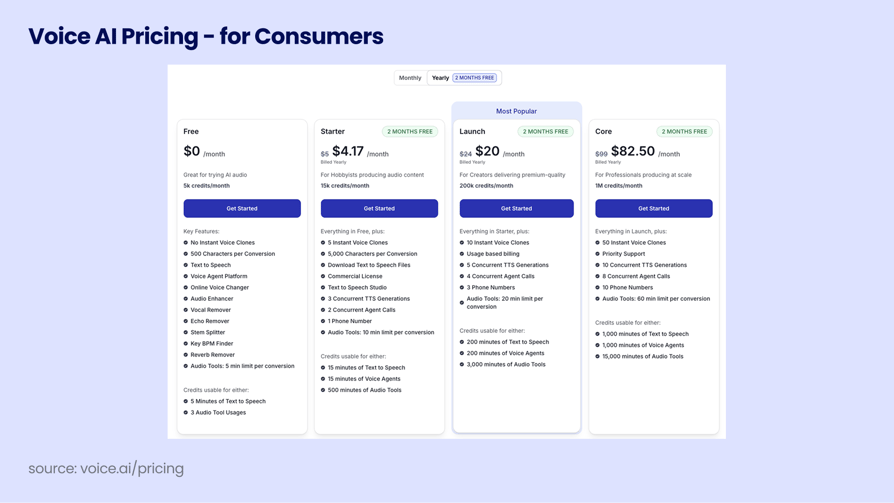
The consumer track runs four tiers, from a free plan up to Core, aimed at creators and hobbyists.
Voice.ai Consumer Plans
| Plan | Price/mo (billed yearly) | What's Included |
|---|---|---|
| Free | $0 | 5,000 credits, 500 characters per conversion, text to speech, voice agent platform, online voice changer, no instant voice clones |
| Starter | $4.17 | 15,000 credits, 5 instant voice clones, 5,000 characters per conversion, commercial license, TTS Studio, 1 phone number |
| Launch | $20 | 200,000 credits, 10 voice clones, 3 phone numbers, 5 concurrent TTS generations, 4 concurrent agent calls |
| Core | $82.50 | 1,000,000 credits, 50 voice clones, 10 phone numbers, 8 concurrent agent calls, priority support |
Business Plans (Voice Agents at Scale)
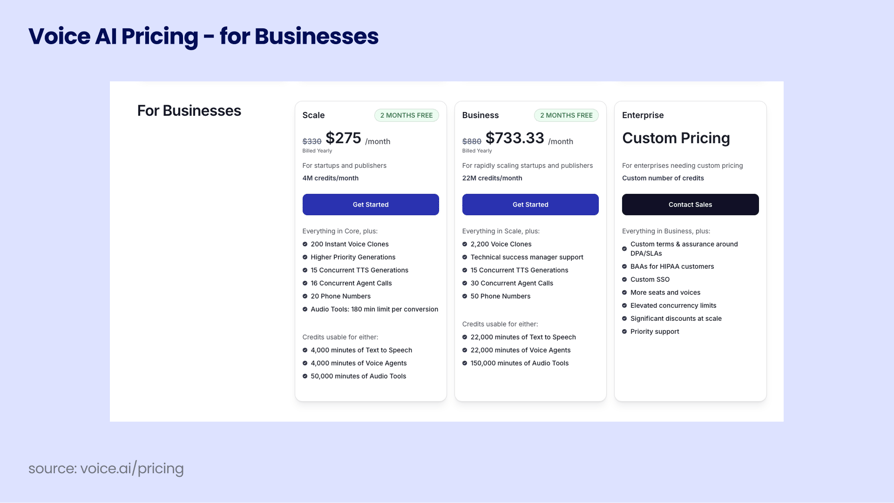
The business track adds three tiers for startups, publishers, and enterprises running higher call volumes. For business agents, Voice.ai points to usage-based pricing from about $0.08 per minute and lower on annual Business plans, but the real all-in cost still depends on your credit burn, concurrency, and whatever telephony you bring.
Voice.ai Business Plans
| Plan | Price/mo (billed yearly) | What's Included |
|---|---|---|
| Scale | $275 | 4,000,000 credits, 200 voice clones, 20 phone numbers, 16 concurrent agent calls |
| Business | $733.33 | 22,000,000 credits, 2,200 voice clones, 50 phone numbers, 30 concurrent agent calls, technical success manager |
| Enterprise | Custom | Custom credits, DPA and SLA, signed BAAs, custom SSO, elevated concurrency |
The Real Cost: What to Budget For
The sticker price is not the whole story. Budget for developer build time, your own telephony carrier, integration work, and any on-prem or enterprise add-ons. Overage rates are not published, and the consumer real-time changer needs a capable GPU (users report a $300-plus card) to run well.
For context, all-in business voice-agent costs across the market usually land between $0.08 and $0.33 per minute depending on setup. Our breakdown of how much Voice AI costs models the full picture, not just the headline rate. Business buyers who want a flat, predictable bill often prefer a turnkey platform for exactly this reason.
Real-World Cost Example
Say you need about 2,000 AI agent minutes a month. At roughly 1,000 credits per agent minute, that is close to 2,000,000 credits, past the Core tier's 1,000,000 (at $82.50) and into Scale at $275/month.
Those same credits also power text-to-speech and voice cloning, so any studio use drains the pool faster and can bump you to the next tier before your call minutes alone would.
The published '$0.08/min and lower' reads cheap, but the credit model, chunky jumps from $82.50 to $275 to $733.33, and unpublished overage rates make the real monthly bill hard to pin down until you are already running.
Customer story: CloudTalk's own team put an AI prequalification agent on 6,531 long-ignored leads and saw a 17x return, the kind of math you can only run when pricing is predictable up front. Read how they did it.
Is Voice.ai Free?
Yes and no. The consumer app is free with a 5,000-credit monthly allowance, and paid upgrades start at $4.17/month billed yearly. But Voice.ai is free only until you push real call volume through it: agent minutes eat credits quickly, and serious business use lands you on the $82.50-plus tiers or a custom enterprise contract fast.
What Real Users Say About Voice.ai
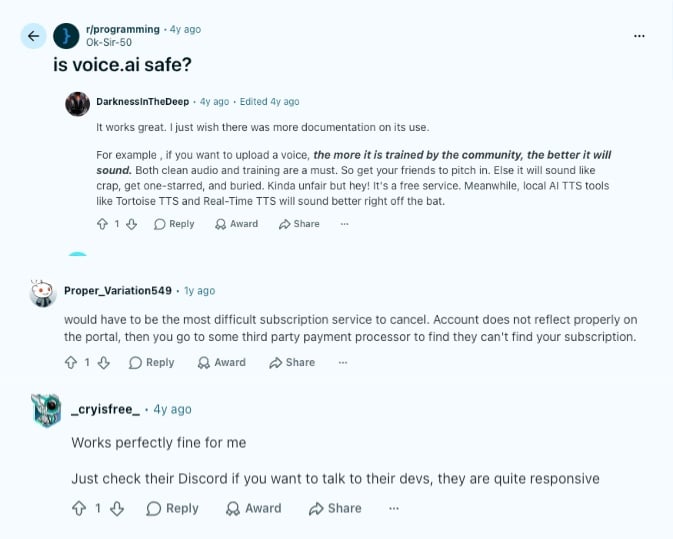
Voice.ai comes up plenty on Reddit, but almost all of it is about the consumer voice changer, and the question that keeps recurring is whether it is safe to install, not whether it is good for business calls. A technical r/programming thread titled "Is Voice.ai safe?" is a fair example, with people digging into what the app runs on your machine and how it handles your data.
On the business-software side, the picture flips to near silence. On G2, Voice.ai has a grand total of one review. It is a positive one, a mid-market BDR rates it 4.5/5 for lifelike voice quality and easy setup while building agents to answer calls, but a single review is a data point, not a track record.
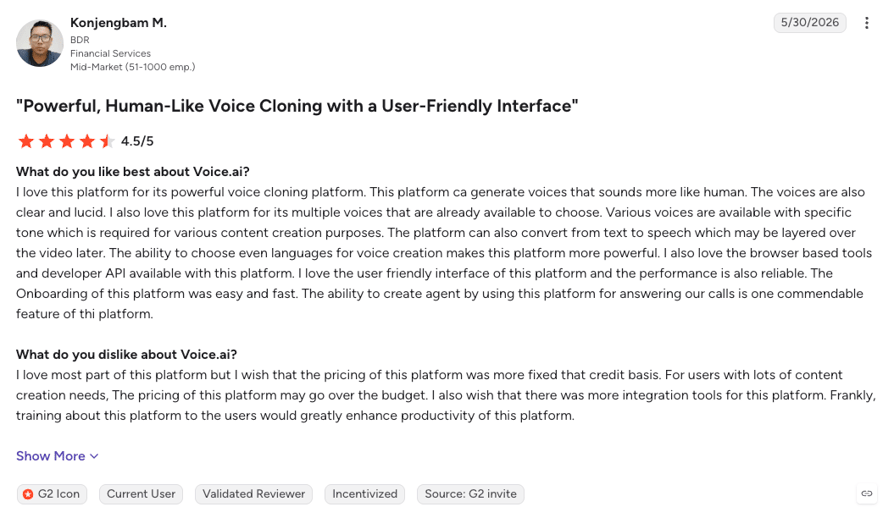
What stands out is that reviewer's two complaints: they want fixed pricing instead of credits, and more integrations. Those are the exact gaps a business buyer runs into. With so little third-party feedback to lean on, you would be judging Voice.ai mostly on the vendor's claims rather than peers' experience, an early-adopter position on the business side.
If that kind of validation matters to you, it is where CloudTalk's AI-powered platform stands apart: 1,850+ G2 reviews at 4.4/5, plus the flat pricing and native integrations that single Voice.ai reviewer asked for. You are vetting it on real teams' experience, not one data point.
Try It on Your Own Calls, Not on One Review
How Voice.ai Holds Up on Real Business Calls
A great voice engine is not the same as a working phone operation. Here is how the business Voice Agent stacks up against what companies actually need to run calls day to day.
Developer Capabilities
This is where Voice.ai concentrates its business value. You get a Voice Agent API, a TTS API, and a Voice Changer API, with Python and TypeScript SDKs, LiveKit and Pipecat compatibility, and full-duplex conversation in alpha. If you have engineers, there is a lot to work with here.
Usability and Interface
The flip side of that developer power is the ops experience. The consumer app is effortless, but the business side is API-first with limited no-code tooling. Standing up a business agent is an engineering project, so the honest verdict is that this is infrastructure for builders, not a ready-to-run product.
Language Support
Voice.ai claims more than 15 languages for text to speech, which is solid for prompts and content. Verify which are production-ready for live agents, whether mid-call language switching works, and how accurate speech recognition is for non-English callers before you commit.
Trust, Safety, and Support
A consumer, gaming-first brand plus voice cloning raises real brand-fit and trust-and-safety questions for business buyers. Enterprise support and SLAs exist at the top tier, but self-serve users are largely on their own, so map that against how much help your team will need.
The Business Integrations Reality
Voice.ai integrates deeply with consumer apps, but the business stack is where the gaps show. Use this as a checklist of what to verify before you buy.
Voice.ai Business Integrations Checklist
| Category | What to Expect |
|---|---|
| Consumer apps | Deep: Discord, Zoom, OBS, Skype, WhatsApp, Google Meet, and popular games |
| APIs and SDKs | Voice Agent API, TTS API, Voice Changer API; Python and TypeScript SDKs; LiveKit and Pipecat compatible |
| Telephony | No named carrier; you bring and wire your own telephony for real calls |
| CRM | No native CRM connectors documented; integration is do-it-yourself via API |
| Automation | Via API and developer frameworks rather than off-the-shelf connectors |
| Calendar and scheduling | Agents can schedule, but native calendar integrations are not documented |
| Deployment | Cloud or on-premise (in-VPC) |
| Languages | 15+ for TTS; verify production-ready count for live agents |
Voice.ai Real User Reviews: What Users Actually Think
Search "voice.ai review reddit" and what comes up is mostly the consumer voice changer: safety worries, free-versus-premium value, and gaming setups. The business agent barely registers yet, so we separate consumer sentiment from the thin business feedback and are honest about the gap.
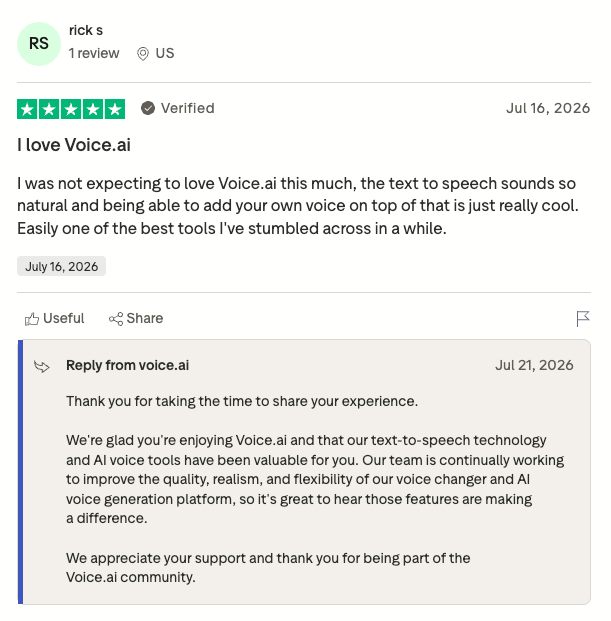
On the numbers, the picture splits. Voice.ai scores 2.1/5 on Trustpilot across roughly 240 reviews, where most are one-star and the complaints cluster on billing and cancellation. The Apple App Store tells a different story, though: 4.0/5 from 169 ratings. Either way, it has little to no presence on business review sites like G2 or Capterra.
Voice.ai Ratings Across Platforms
| Platform | Rating (Reviews) |
|---|---|
| Trustpilot | 2.1/5 (240 reviews), rated Poor |
| Apple App Store | 4.0/5 (169 ratings) |
| G2 | 4.5/5 (1 review) |
| Capterra | Not listed for the business agent |
| Product Hunt | Consumer interest only; no business-agent reviews |
What Users Love About Voice.ai
- Realistic real-time voice changingThe core experience works, and gamers and streamers rate the transformation quality highly.
- Huge voice library and fast cloningThousands of voices and quick cloning from short samples get consistent praise.
- Genuinely free to startA free tier plus $4-a-month upgrades make the consumer app easy to try.
Where Users Get Frustrated
- Billing and cancellation frictionSurprise renewals and hard-to-cancel complaints drive the low Trustpilot score.
- Heavy resource useThe real-time changer needs a strong GPU, and users report crashes and overheating.
- Consumer brand for business useTrust, privacy, and brand-fit questions make buyers hesitate on the phone side.
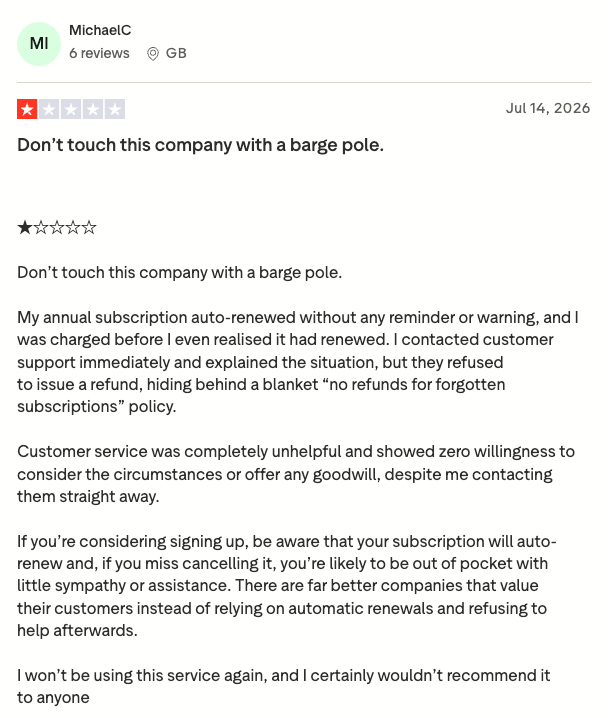
The safety question does surface, the r/programming "is Voice.ai safe?" thread above is the clearest example, but it is about the consumer app, not business calls. We dig into that next.
Rated 4.4/5 on G2. Try It on Your Own Calls.
Who Should (and Should Not) Use Voice.ai
Best Fit: Where Voice.ai Shines
- Gamers, streamers, and creatorsAnyone who wants a top-tier real-time voice changer for Discord, streams, or content.
- Developers building voice appsTeams that want TTS, cloning, or agent building blocks to assemble a custom voice experience.
- Teams that need on-prem voiceData-sovereignty-sensitive orgs that must keep voice processing in their own environment.
- Builders, not buyersCompanies that want to construct a bespoke voice product rather than buy a ready-made calling tool.
Poor Fit: When to Look Elsewhere
- Teams wanting turnkey callingIf you need inbound and outbound calls handled without engineering, this is the wrong tool. Consider CloudTalk AIVA instead.
- Ops and CX teamsGroups that need no-code setup plus built-in telephony and CRM out of the box.
- Buyers who want clear pricingAnyone who needs a transparent, all-in bill they can see upfront rather than credits to decode.
- Brand- and compliance-sensitive teamsBuyers wary of a consumer, gaming voice-changer origin on their customer calls.
Voice.ai Use-Case Fit
Voice.ai Use-Case Fit
| Use Case | Fit |
|---|---|
| Gaming, streaming, content creation | Strong: this is the core strength |
| Developers building custom voice apps | Strong: solid API and infrastructure |
| On-prem voice deployment | Strong if verified: a real differentiator |
| Turnkey inbound and outbound calling | Weak: not no-code, telephony and CRM gaps |
| Contact center and CX operations | Weak: infrastructure, not an ops product |
| SMB wanting a fast, no-code voice agent | Weak: consider a turnkey platform |
Security, Compliance, and Data Privacy of Voice.ai
Security matters more here than in a typical review, for two reasons: business buyers need real compliance, and voice cloning of real people raises trust-and-safety questions on its own. Here is what we found from open sources.
Compliance and Deployment
Voice.ai lists strong enterprise credentials: SOC 2 Type II, HIPAA, PCI Level 1, GDPR, and ISO 27001, plus a zero-retention mode, end-to-end encryption, and signed BAAs for healthcare. On-prem and in-VPC deployment back that up. Confirm which certifications apply to the exact product and plan you buy, since consumer and enterprise tiers differ.
Trust, Safety, and Voice Cloning
Like you could see by our Reddit example earlier, some people are asking whether Voice.ai is safe. The app itself is legitimate and is not malware or a crypto miner, despite the persistent rumor. The real concerns are softer: the privacy policy is vague on voice-data retention, the company shares some data with partners and marketers, and cloning real voices carries consent and misuse risk you have to govern yourself.
A Note on the 2023 Open-Source Dispute
There is also an older episode worth knowing. In 2023, a developer alleged that Voice.ai's Windows app linked open-source libraries, the GPL-licensed Praat and LGPL-licensed libgcrypt, without meeting the license terms, and said they were banned from its Discord after flagging it. It was covered by The Register.¹
Voice.ai denied any wrongdoing, said it was in full compliance with open-source licenses, and stated the GPL component did a minimal, non-core job that it removed within hours. The dispute is old and contested. But for a vendor that will handle your customers' voices, how it responds to scrutiny is a fair thing to weigh.
What Are the Pros and Cons of Voice.ai?
Rating the business offering, with the consumer strengths noted where they carry over.
Voice.ai Pros
- Best-in-class voice techReal-time changing, fast cloning, and low-latency TTS are genuinely excellent.
- Flexible developer APIsVoice Agent, TTS, and Voice Changer APIs with Python and TypeScript SDKs give builders room to work.
- On-premise deploymentIn-VPC hosting is a real differentiator for data-sovereignty-sensitive teams.
- Strong compliance on paperSOC 2 Type II, HIPAA, PCI, GDPR, and ISO 27001 cover the enterprise checklist.
- Easy, free consumer entryThe voice changer is free to start and simple to set up.
Voice.ai Cons
- Consumer, gaming-first brand for businessA voice-changer heritage sits awkwardly on customer-facing calls.
- Not turnkeyA production business agent needs a developer to build the calling workflow.
- Telephony, CRM, and ops gapsNo named carrier and no native CRM connectors for business calling.
- Credit pricing hides the real costUneven credit conversion and unpublished overage rates make budgeting hard.
- Mixed trust signals2.1/5 on Trustpilot and billing complaints, though the App Store is warmer at 4.0/5.
The Best 4 Voice.ai Alternatives in 2026
If Voice.ai is the wrong shape for your team, these four Voice.ai alternatives cover the range from turnkey to developer-first. See our full Voice.ai alternative guide for more, and the pricing pages for Retell AI, Vapi, and Synthflow. Because Voice.ai leans developer-first, CloudTalk stands out as the turnkey, business-ready option. Verify every figure before you buy, since rates change.
Voice.ai Alternatives Compared
| Capability | CloudTalk | Retell AI | Vapi | Synthflow |
|---|---|---|---|---|
| Best for | Turnkey business AI voice agents | Developer-first custom agents | Developer-first programmable voice | No-code voice agents (SMB/agency) |
| Build model | No-code + integrations | API-first (code) | API-first (code) | No-code |
| Telephony | Built in (owns carrier layer) | BYO SIP, or +$0.015/min | BYO (Twilio/Vonage) | Managed Twilio $0.02/min, or BYO |
| All-in cost | Flat per-user seats + AI add-ons (~$0.35-0.50/min effective) | ~$0.13-0.31/min | ~$0.30-0.33/min | ~$0.11-0.16/min |
| Pricing transparency | High (published) | Medium (component stacking) | Low (hidden provider costs) | Medium (usage + overage) |
| Setup time | Minutes to hours | Hours to prototype, weeks to prod | Weeks (engineering) | Under 1 hour (basic) |
| CRM integrations | 100+ native | Via API/webhooks | Via API | Via integrations, no native CRM |
| Inbound / outbound | Both (autonomous) | Both | Both | Both |
| On-prem option | No (cloud) | No | No | Enterprise only |
| No-code friendliness | High | Low | Low | High |
Why CloudTalk AIVA Is Worth Considering
One direct comparison, earned with real data. Voice.ai is powerful voice infrastructure and APIs, with consumer roots, that developers build on. CloudTalk AIVA is a business-ready AI Voice Agent that autonomously handles inbound and outbound calls, answers questions, and books appointments, with no engineering team required. Both are good at different jobs.
To be fair, Voice.ai wins on raw voice cloning, TTS, and on-prem deployment. CloudTalk wins on being a phone system you can switch on today.
Its AI Voice Agent starts at $99/month for 200 minutes, with 50 free minutes to try it first. The umbrella splits into a no-code Receptionist for inbound triage and a sales-led Specialist (from $349/month) for complex inbound and outbound workflows.
Voice.ai vs CloudTalk: Feature and Capability Comparison
Voice.ai vs CloudTalk
| Capability | Voice.ai | CloudTalk |
|---|---|---|
| Primary focus | Voice infrastructure and APIs | Turnkey business AI voice agents |
| Build model | Developer build | No-code + integrations |
| Telephony included | BYO / developer-wired | Built in, owns the carrier layer |
| Pricing model | Credit-based + usage, quote enterprise | Flat per-user + fixed AI add-ons |
| Pricing transparency | Low | High (published rates) |
| Setup time | Developer build | Minutes to hours (Receptionist) |
| CRM integrations | Via API (DIY) | 100+ native from Essential |
| Global coverage | Not detailed | 160+ number countries |
| Voice cloning | Core strength | Not offered (voice-first focus) |
| On-prem option | Yes (in-VPC) | No (cloud) |
| Inbound / outbound agents | Both (you build it) | Both (autonomous, no-code) |
| Support | Self-serve; enterprise SLAs at top tier | 24/7 chat and email; phone on Expert |
| Time to production | Weeks | Days |
Voice.ai vs CloudTalk: Pricing and Business-Readiness
Voice.ai charges usage on top of a developer build, and enterprise pricing is quote-only. CloudTalk publishes flat per-user plans plus fixed AI add-ons, so you can budget the whole stack before you talk to sales. The difference shows up as time to value: telephony and CRM are built in, and there is no engineering overhead to reach a live agent.
CloudTalk Plans and Pricing
| Plan | Price (annual billing) | Key Features |
|---|---|---|
| Starter | $25/user/month | Unlimited inbound & internal calls, 500 outbound minutes (regional calling bundle), call queues, transfers, click-to-call, automatic call recording (1-month retention) |
| Essential | $29/user/month | Everything in Starter + IVR and smart routing, 100+ CRM/helpdesk integrations, workflow automation, unlimited recording retention |
| Expert | $49/user/month | Everything in Essential + Power, Smart & Preview Dialers, Salesforce integration, 24/7 phone support (3-seat min) |
| Conversation Intelligence (add-on) | $9/user/month | AI transcripts, call summaries, call scoring, sentiment analysis, and agent coaching insights |
| AI Voice Agent: Receptionist | From $99/month (200 min) | No-code inbound AI answering, routing, and logging; 50 free minutes to try; tiers up to $699/mo (2,500 min) |
| AI Voice Agent: Specialist | From $349/month (1,000 min) | Sales-led custom agents for complex inbound and outbound workflows; scales to $1,249/mo (5,000 min) |
Where CloudTalk Fits Better
- Turnkey autonomous callingInbound and outbound AI calls, Q&A, and scheduling without building the workflow yourself.
- Starts at $99/month, 50 free minutes to tryThe AI Voice Agent starts at $99/month for 200 minutes on a no-code builder, with 50 free minutes to try it first.
- Telephony and CRM built inNumbers in 160+ countries and 100+ native CRM integrations, not a DIY wiring job.
- Transparent, flat pricingPublished per-user plans and fixed AI add-ons you can budget upfront.
- AI and humans on one platformRoute from AI to a live agent with full context, and cut average handle time with real-time analytics.
Voice.ai keeps the edge on voice cloning and on-prem control. For most teams that just need calls answered, routed, and logged, CloudTalk gets there faster.
Customer story: Trevo reached 20x more customers per campaign with CloudTalk's AI Voice Agent and cut handling time to under 30 seconds, with no engineering team standing by. Read the Trevo story.
"Originally, we sent a link for them to book online. Maybe 5% followed through. Now the AI just says: What time works for you? It is so simple, but it works. People reply, the AI locks it in, and we are done."
Owner of Circle Gym

Ready to Put AI on Your Calls?
Final Verdict: Is Voice.ai Worth It?
For the business voice agent, the honest answer is: Voice.ai is worth it if you are building, not buying. The voice tech is excellent and the APIs are capable, but running real business calls on it takes engineering, and the consumer brand and pricing model work against you. The consumer voice changer, judged on its own, remains a strong pick for creators.
Voice.ai Is a Good Fit For:
- Creators and gamersAnyone who wants a top-tier real-time voice changer.
- Developer and product teamsTeams needing voice APIs for TTS, cloning, or agent building blocks.
- On-prem voice needsOrganizations that must keep voice processing in their own environment.
Voice.ai Is Not a Good Fit For:
- Teams wanting turnkey callingBusinesses needing inbound and outbound AI calls without engineering should look at AI voice agents for SMBs.
- Ops and CX teamsGroups that need no-code plus built-in telephony and CRM.
- Buyers who want clear pricingAnyone who wants a transparent, all-in bill they can see upfront.
- Brand- and compliance-sensitive buyersTeams wary of a consumer, gaming voice-changer origin on customer calls.
Bottom line: Voice.ai rewards teams building voice with their own engineers, but if you just need business calls answered, routed, and booked on their own, CloudTalk's AI-powered business phone system and voice agents get you there with no code.
See the Business-Ready Alternative in Action
Sources:
1. The Register
2. Trustpilot
3. Apple App Store
4. G2
Frequently Asked Questions about Voice.ai
Direct answers to the questions buyers ask most when weighing Voice.ai for business use.
Voice.ai is best known as a free real-time AI voice changer for gaming and streaming, and it now also sells a business Voice Agent Platform and APIs to build agents that automate calls. It is voice infrastructure for developers rather than a turnkey calling product, so teams wanting a ready-made agent often choose AI voice agents with a built-in phone system.
For the consumer voice changer, yes, it is a strong pick for creators. For business calling, it is worth it only if you have developers to build the workflow, since it is not turnkey. Teams that want calls handled without engineering usually get more from a business-ready platform. See our best AI voice agents guide.
Both. The original product is a voice changer, and Voice.ai now offers a Voice Agent API that can power business calls. But wiring those calls into a real phone operation takes developer work, so it is a building block, not a finished platform like CloudTalk's AI voice agents.
The app is legitimate and is not malware or a crypto miner, despite the rumor. The real caveats are a vague voice-data retention policy, some data sharing with partners, and the consent risks of cloning real voices, which matter more for business use than for casual gaming. Business buyers often prefer a purpose-built AI voice agent with clearer data handling.
The consumer voice changer is free with a 5,000-credit monthly allowance, and paid plans start at $4.17/month billed yearly. Business agent use burns credits fast, so real call volume quickly pushes you onto the $82.50-plus tiers or a custom enterprise contract. Our Voice.ai pricing guide breaks it down.
Voice.ai points to usage from about $0.08 per minute and lower on annual Business plans, on top of a credit-based system where roughly 1,000 credits equal one agent minute. Overage rates are not published and enterprise is quote-only. Our guide to how much Voice AI costs models the real total.
Its Voice Agent API supports both inbound and outbound calls, but you have to build and connect the calling workflow yourself. For autonomous inbound and outbound calls out of the box, a turnkey AI voice agent for lead qualification and support is a better fit.
Yes. Voice.ai offers cloud or on-premise (in-VPC) deployment and lists SOC 2 Type II, HIPAA, PCI Level 1, GDPR, and ISO 27001, plus zero-retention mode and signed BAAs. Confirm which certifications apply to your specific plan. Teams wanting compliance without a build often compare AI voice agents for SMBs.
The best Voice.ai alternatives are CloudTalk for turnkey business calling, Retell AI and Vapi for developer-first custom agents, and Synthflow for no-code SMB agents. See the full Voice.ai alternative comparison for details.
Voice.ai is voice infrastructure and APIs that developers build on, with strong cloning and on-prem options. CloudTalk is a business-ready AI voice agent with built-in telephony, native CRM, and published pricing, so you go live in days without engineering. It comes down to build versus buy.