10 Best Cal.ai Competitors for AI-Powered Phone Calls Compared
| # | Platform | Best For | Starting Price |
|---|---|---|---|
| 1 | CloudTalk | Complete AI calling platform with built-in VoIP for sales & support teams | $99/month (AI Receptionist, 200 min) |
| 2 | Vapi | Developers who want full API control over their voice stack | $0.05/min + $10/line/month |
| 3 | Bland AI | High-volume outbound calling with branching call logic | $0.14/min |
| 4 | Retell AI | Fast deployment with natural-sounding voice AI | From $0.07+/minute |
| 5 | Smith.ai | Hybrid AI + human answering for lead-driven businesses | Free (25 calls/mo) |
| 6 | Synthflow | No-code AI voice builder with owned telephony infrastructure | Custom, usage-based |
| 7 | Replicant | Pre-built voice automation for contact centers | Custom, quote-based |
| 8 | Kore.ai | Enterprise AI agent lifecycle across every digital channel | Custom, quote-based |
| 9 | Amazon Lex | Teams already running on AWS infrastructure | $0.004 per speech request |
| 10 | Google Dialogflow | Established text and voice agent development on Google Cloud | Usage-based |
Why Teams Choose Cal.ai
Cal.ai earns its popularity from what it does inside the Cal.com ecosystem, not from a broad calling feature set—and that's a fair trade for teams who live in Cal.com already.
Based on verified G2 reviews, these are the standout strengths teams call out most.
5 Reasons Teams Choose Cal.ai
- Native Cal.com Workflows IntegrationAI calls trigger directly off bookings, no-shows, or cancellations—no third-party tools or manual back-and-forth required.
- Fully Customizable ConversationsYou set the personality and tone for every call type, from a firm confirmation call to a friendly reminder.
- Fast, Guided SetupThree steps—pick a trigger, assign a phone number, write a prompt—and the agent is live.
- Built-In Call AnalyticsTranscripts, completion rates, booking rates, and sentiment analysis are available directly in the Cal.com dashboard.
- Transparent Per-Minute Pricing$0.29/minute is a simple, visible line item, which is easier to reason about than other AI pricing models.
Why Are Teams Searching for a Cal.ai Alternative for AI-Powered Phone Calls?
Cal.ai is a solid fit if all you need is scheduling-related calls inside Cal.com. But teams evaluating it as a real AI-powered phone-call solution run into structural limits quickly.
4 Reasons Teams Look for a Cal.ai Alternative
- No Built-In Telephony InfrastructureCal.ai doesn't run its own calling infrastructure—it operates on top of Cal.com's platform-level calling layer. You get one dedicated number per agent, but there's no published country coverage or global number footprint, unlike a dedicated calling platform.
- Scoped Strictly to SchedulingCal.ai calls exist to book, confirm, remind, and re-engage no-shows—full stop. It doesn't handle general-purpose inbound support, outbound sales conversations, IVR-style menu navigation, or any call that isn't tied to a Cal.com booking event.
- No Standalone Use Outside Cal.com WorkflowsIf your team wants an AI voice agent for anything beyond scheduling—a support line, a sales qualification flow, an after-hours receptionist—Cal.ai can't do it. You'd need an entirely separate platform for every other calling use case, which defeats the point of consolidating tools.
- Usage Can Get Unpredictable at ScaleThere's no published volume discount or rate-lock for high-usage teams. A busy scheduling period—a product launch, an enrollment window, a seasonal booking spike—can burn through credits fast, and the per-minute meter keeps running with no cap in sight.
How We Chose the Best Cal.ai Alternatives for AI-Powered Phone Calls
To build this list, we combined hands-on evaluation with vendor documentation and verified user feedback from G2, Trustpilot, and Reddit, focused on the areas where teams most often find Cal.ai too narrow: telephony ownership, use-case flexibility, and pricing predictability.
We evaluated every platform on six pillars.
- Call StabilityHow reliably the platform handles live inbound and outbound conversations.
- Overall CostsAdvertised price versus real all-in cost at scale, including add-ons and required subscriptions.
- CRM Deep-SyncNative versus API-based integrations, and how reliably call data lands in the CRM.
- Global FootprintNumber coverage and telephony reach across markets.
- Support ResponseHow quickly a live person responds to a technical issue.
- AI ProductivityHow much manual work — call summaries, tagging, follow-up — the AI actually removes.
What Is the Best Alternative to Cal.ai for AI-Powered Phone Calls?
CloudTalk is the best Cal.ai alternative for teams that need AI-powered phone calls beyond scheduling—and a powerful Cal.ai alternative for business that handles sales, support, reminders, and outbound campaigns in one platform. Unlike Cal.ai, CloudTalk runs its own global VoIP infrastructure and combines AI voice agents with native CRM integrations, so you're not limited to a single Workflows trigger inside one scheduling tool.
Why Do Teams Consider CloudTalk the Best Cal.ai Alternative?
- Built-In Global VoIP, Not Borrowed InfrastructureCal.ai runs on top of Cal.com's platform-level calling layer, while CloudTalk operates its own telephony infrastructure with local numbers in 160+ countries.
- Transparent, Scalable AI PricingCal.ai charges per-minute credits, while CloudTalk’s AI Receptionist pricing starts at a flat $99/month for 200 minutes, giving you clear upfront visibility into costs as you scale.
- Calling That Goes Beyond SchedulingCal.ai calls exist only to book, confirm, and remind. CloudTalk's AI voice agents handle inbound and outbound calls for sales, support, and scheduling on the same platform.
- Real CRM and Workflow SyncCal.ai is limited to Cal.com's and third-party integrations. CloudTalk connects natively to 100+ tools, including HubSpot and Salesforce, with automatic call and AI summary logging.
- 24/7 Human Support, Not a Shared Help DeskBecause Cal.ai is a feature bolted onto Cal.com, support runs through Cal.com's general wrapper. CloudTalk provides dedicated 24/7 human support.
10 Best Cal.ai Alternatives for AI-Powered Phone Calls: Features Comparison
Here's how Cal.ai stacks up against the strongest AI-powered phone call platforms on the aspects that actually decide a deal—call infrastructure, pricing transparency, and whether you get a full voice agent or just a scheduling add-on.
Cal.ai vs. CloudTalk vs. Vapi vs. Bland AI vs. Retell AI
| Feature | Cal.ai | CloudTalk | Vapi | Bland AI | Retell AI |
|---|---|---|---|---|---|
| Starting Price | $0.29/min (29 credits/min) | $99/month (AI Receptionist, 200 min) | $0.05/min + $10/line/month | $0.14/min | $0.07+/minute |
| Free Trial |  |  | | | |
| Native AI Calling | Scheduling calls only | | | | |
| Built-in VoIP | | | | | |
| Standalone Product | | | | | |
| Call Analytics & Sentiment | | | Usage and call logs | Custom analytics, not core feature | Performance analytics |
| No-Code Setup | | | Limited | | |
See how CloudTalk's AI Voice Agent handles sales and support calls
Top 10 Cal.ai Alternatives for AI-Powered Phone Calls: Detailed Breakdowns
Below are the 10 best alternatives to Cal.ai, ranked and reviewed. Each profile covers what the tool does, where it beats Cal.ai, its pros and cons, pricing, and real user sentiment where it's available. CloudTalk leads as the best overall Cal.ai alternative for teams that need calling beyond scheduling.
1. CloudTalk: Best Cal.ai Alternative for AI-Powered Phone Calls Beyond Scheduling
What Is CloudTalk?
CloudTalk is a global AI-powered business calling platform built for sales and support teams. It combines AI Voice Agents, VoIP infrastructure, advanced analytics, and native CRM integrations in one system—without limiting AI calling to a single scheduling workflow the way Cal.ai does.
Why Is CloudTalk a Strong Cal.ai Alternative?
- A phone system, not a feature inside oneCal.ai only exists inside Cal.com's Workflows. CloudTalk is a full calling platform with its own global VoIP infrastructure and local numbers in 160+ countries.
- Scalable pricingCal.ai charges $0.29/minute with no volume discounts as usage increases, so costs don’t improve at higher scale. CloudTalk offers scalable pricing for its AI Voice Agent, with custom rates available for high-volume usage (e.g. $0.15 per minute for 10,000+ minutes).
- Multichannel customer communicationUnlike calendar-only tools, CloudTalk is a full call center platform with features like Power and Parallel Dialers that boost outbound efficiency and agent productivity at scale.
- AI that handles more than remindersCal.ai calls exist to book, confirm, and follow up on no-shows. CloudTalk's AI Voice Agents handle inbound and outbound conversations for sales and support, not just scheduling.
What Are the Pros & Cons of CloudTalk?
| Pros | Cons |
|---|---|
| Transparent, scalable pricing | No native video conferencing |
| Built-in global VoIP—no borrowed platform infrastructure | Solo users may not need its full CRM and routing depth |
| Handles sales, support, and scheduling calls in one platform | No support for on-premises landline (PBX) hardware |
What Are CloudTalk's Plans & Pricing?
CloudTalk pricing starts at $99/month for its AI receptionist and at $25/user/month for its calling platform plans. AI Voice Agent usage is packaged separately based on your automation needs:
CloudTalk AI Voice Agent Pricing Plans
| Plan | Price | Included Minutes | Key Features |
|---|---|---|---|
| AI Receptionist | $99/month | 200 min (50 free in month one) | 24/7 inbound coverage, 60+ language support, conversational routing (no phone trees) |
| AI Specialist | $349/month | 1,000 min | Everything in AI Receptionist + payment/invoice handling, calendar sync, live and post-call analytics |
| Custom | From $0.15/minute | 10,000+ min | Everything in AI Receptionist + volume discounts and bespoke workflow mapping for high-volume teams |
What Are CloudTalk's Customers Saying?
CloudTalk users consistently highlight ease of use, an intuitive interface, and affordability compared to stitching together separate scheduling and calling tools.
How Do G2 Users Rate CloudTalk?
CloudTalk's current G2 rating is 4.4/5, out of 1,844+ verified user reviews.
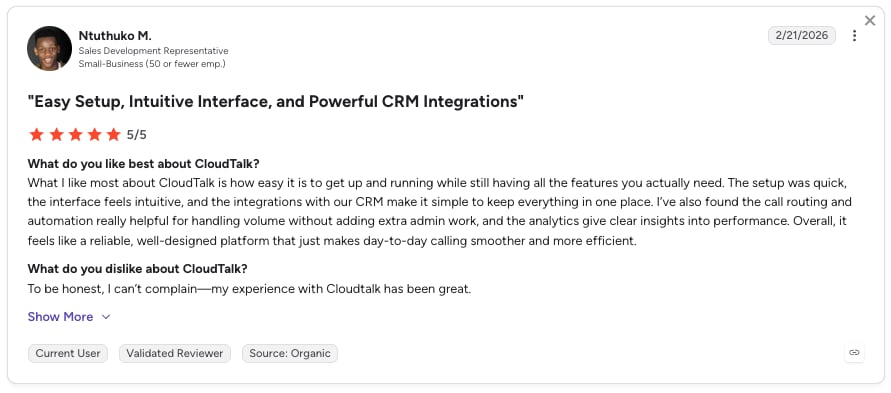
See Why Teams Choose CloudTalk over Cal.ai
2. Vapi: Best for Developers Who Want Full API Control
What Is Vapi?
Vapi is a developer-first platform for building AI voice agents via API. It gives technical teams full control over orchestration, LLM logic, and telephony integrations—useful if you want a custom reminder or confirmation flow that goes beyond Cal.ai's fixed, prompt-based setup.
Why Is Vapi a Strong Cal.ai Alternative?
- Full API access for custom call flowsCal.ai's calling logic is scoped to Cal.com's Workflows builder. Vapi gives developers direct API access to call orchestration and AI logic, so scheduling and reminder flows can be built exactly to spec.
- Choice of LLM provider, not a fixed setupCal.ai's conversation engine is bundled into the Cal.com product. Vapi lets teams plug in whichever LLM provider fits their cost and performance needs.
- Usable outside any single scheduling toolCal.ai only triggers off Cal.com bookings. Vapi's calling infrastructure can be wired into any calendar, CRM, or workflow system, not just one.
What Are the Pros & Cons of Vapi?
| Pros | Cons |
|---|---|
| Deep API-level control over the voice stack | Limited no-code tooling for non-technical teams |
| Works with multiple LLM providers | Real cost can run higher than advertised once telephony and LLM usage are added |
| Not tied to a single scheduling platform | Fewer built-in operational dashboards than a full calling platform |
What Are Vapi's Plans & Pricing?
Vapi pricing is usage-based, with the following rates:
- Pay As You Go: $0.05/min + $10/line/month
- Enterprise (Annual Contract): Custom pricing
The Vapi Telephony Surcharge
The $0.05/min rate only covers Vapi's own layer. Add a telephony provider and an LLM subscription on top, and the real per-minute cost climbs—similar to how Cal.ai's $0.29/minute rate sits on top of a required Cal.com subscription.
What Are Vapi's Customers Saying?
Vapi customers highlight ease of setup and flexibility for building voice AI agents, but report issues with latency, additional costs once telephony is added, and inconsistent support.
How Do G2 Users Rate Vapi?
Vapi has limited G2 review volume—just one review at 4.5/5, since it's a developer-focused API product. On Trustpilot, it has 15 reviews and an overall rating of 2.4/5.
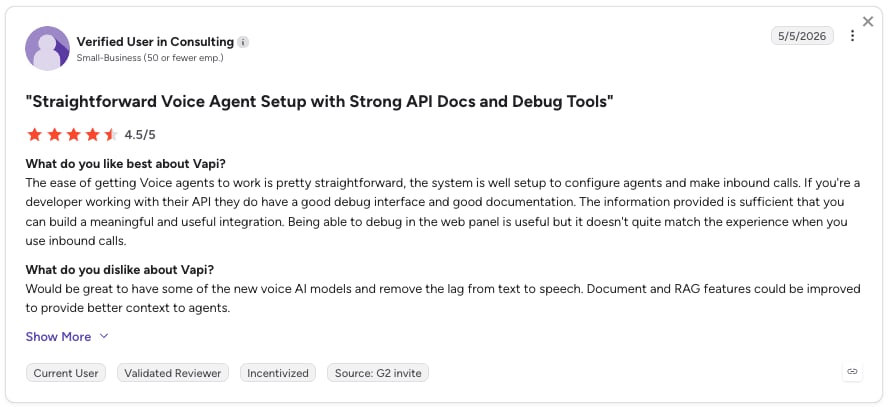
3. Bland AI: Best for High-Volume Outbound Calling With Branching Call Logic
What Is Bland AI?
Bland AI is a platform for building AI-powered phone agents that automate outbound and inbound calls with human-like voices. Where Cal.ai only places calls tied to Cal.com bookings, Bland AI is built around high-volume, branching outreach across any use case.
Why Is Bland AI a Strong Cal.ai Alternative?
- Outbound automation at real scaleCal.ai places one call per triggered event inside Cal.com Workflows. Bland AI runs thousands of automated outbound calls per day with high concurrency limits, well past what a scheduling feature is built to handle.
- Branching call logic beyond a single promptCal.ai's conversations follow a single custom prompt per call type. Bland AI's Pathways builder lets teams design complex, multi-branch call flows and capture information mid-conversation.
- A free tier to start testing outbound automationCal.ai's free Cal.com plan includes zero calling credits. Bland AI's Start plan lets you test outbound and inbound calling at no cost, up to 100 calls/day.
What Are the Pros & Cons of Bland AI?
| Pros | Cons |
|---|---|
| Free tier to start testing outbound automation | Not a full telephony platform |
| High concurrency for large outbound volumes | Steep learning curve for complex call flows |
| Branded voice personas and multi-branch call logic | Troubleshooting can be harder across transcription, prompts, and call logic layers |
What Are Bland AI's Plans & Pricing?
Bland AI pricing is plan-based with per-call caps:
Bland AI Pricing Plans
| Plan | Per-Minute Rate | Platform Fee | Key Features |
|---|---|---|---|
| Start | $0.14/min | $0/month, no card required | 2 credits + inbound number ($15/mo value), 100 calls/day cap, 10 concurrent calls, 1 voice clone, 10 knowledge bases, $0.05/transfer min |
| Build | $0.12/min | $299/month | 2,000 calls/day cap, 50 concurrent calls, 5 voice clones, 50 knowledge bases, $0.04/transfer min |
| Scale | $0.11/min | $499/month | 5,000 calls/day cap, 100 concurrent calls, 15 voice clones, 100 knowledge bases, $0.03/transfer min |
| Enterprise | Custom | Contracted to volume | Concurrency sized to volume, on-prem/VPC available, forward deployed engineer available, BAA, SSO, data residency |
The Bland AI Transfer-Minute Catch
The advertised per-minute rate doesn't include call transfers—those bill separately depending on your tier. Similar to Cal.ai's credit model, it's worth mapping your real call volume against the true cost before committing.
What Are Bland AI's Customers Saying?
Bland AI customers highlight ease of use and powerful conversational voice capabilities, but note a learning curve and added complexity when moving beyond basic outbound use cases.
How Do G2 Users Rate Bland AI?
Bland AI's current G2 rating is 5/5, based on 11+ verified user reviews.
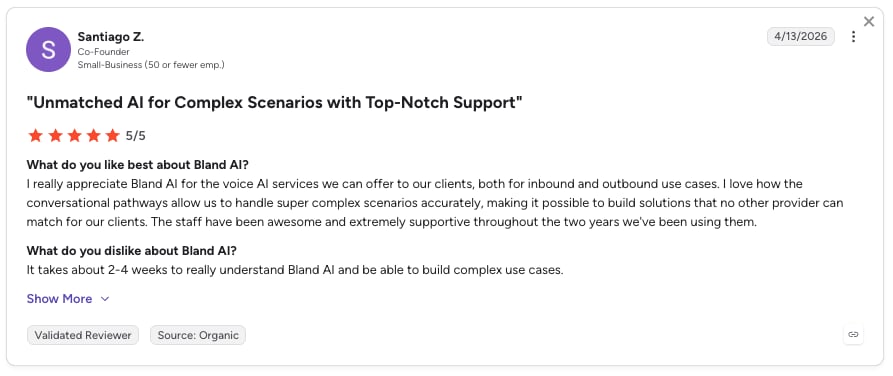
4. Retell AI: Best for Fast, Realistic Voice Deployment
What Is Retell AI?
Retell AI focuses on realistic conversational agents with fast setup and minimal technical overhead—a comparable "prompt in, agent live" simplicity to Cal.ai, but without being locked into a single scheduling tool.
Why Is Retell AI a Strong Cal.ai Alternative?
- $10 in free credits to test real callsCal.ai gives individuals no calling credits on the free Cal.com plan. Retell AI gives new signups $10 in free credits to try the platform directly, no subscription required first.
- Natural-sounding voice for reminders and confirmationsCal.ai's calls are prompt-driven within Cal.com's system. Retell AI is built specifically for low-latency, natural conversational voice, which matters just as much for a reminder call as it does for support.
- Deployment that isn't tied to one calendar toolCal.ai only works inside Cal.com Workflows. Retell AI's agents can be wired into any calendar, CRM, or scheduling system your team already uses.
What Are the Pros & Cons of Retell AI?
| Pros | Cons |
|---|---|
| Fast to deploy, intuitive workflow builder | Limited built-in VoIP infrastructure |
| Enterprise-grade compliance (SOC 2, HIPAA, GDPR) | Fewer native CRM integrations than a full phone system |
| $10 in free credits to start testing | Struggles with highly complex, dynamic conversational logic |
What Are Retell AI's Plans & Pricing?
Retell AI pricing is fully pay-as-you-go, with no mandatory subscription:
- Pay As You Go: From $0.07/minute for AI Voice Agents, or $0.002+/message for AI Chat Agents; $10 free credits on signup
- Enterprise: Custom pricing
The Retell AI Free-Credit Countdown
$10 in signup credit sounds generous until you do the math — at $0.07+/minute, it covers a little over two hours of calls. Teams that want to test real call volume, not just a demo, hit the pay-as-you-go rate fast — the same credit-burn dynamic that shows up with Cal.ai's per-minute meter.
What Are Retell AI's Customers Saying?
Retell AI customers highlight that they can go from idea to a working voice agent quickly, thanks to an intuitive interface and clear workflow builder, but note the platform struggles with highly complex or dynamic conversational logic.
How Do G2 Users Rate Retell AI?
Retell AI's current G2 rating is 4.8/5, out of 2,639+ verified user reviews.
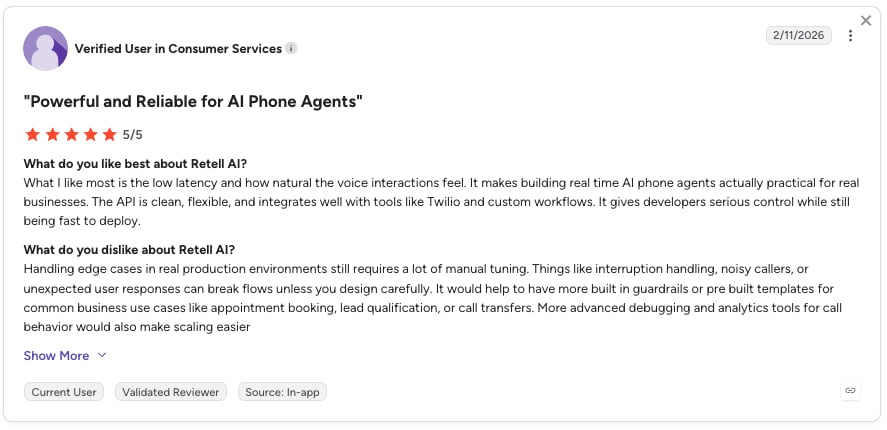
5. Smith.ai: Best Hybrid AI + Human Answering for Lead-Driven Businesses
What Is Smith.ai?
Smith.ai is an AI Receptionist that combines automated call answering with a network of 500+ live receptionists who step in when a conversation needs human judgment. Where Cal.ai handles scheduling calls with no human fallback, Smith.ai blends AI speed with a person on standby.
Why Is Smith.ai a Strong Cal.ai Alternative?
- A free plan with real calling volumeCal.ai's individuals get zero calling credits without a paid Cal.com plan. Smith.ai's Free plan includes 25 real calls a month at no cost, enough to test call quality before paying anything.
- Human backup when the AI hits its limitCal.ai has no escalation path if a caller needs more than a scripted confirmation. Smith.ai automatically escalates complex calls to a live receptionist.
- Built-in appointment booking that isn't locked to one calendarCal.ai only books through Cal.com. Smith.ai integrates natively with Calendly and other scheduling tools, so the AI can book, reschedule, or confirm directly on the call regardless of which calendar you use.
What Are the Pros & Cons of Smith.ai?
| Pros | Cons |
|---|---|
| Per-call billing means call length never inflates your bill | Per-call rate structure spans three tiers and gets complex |
| Free plan lets you test the AI before paying anything | Escalation to live agents can add cost without explicit approval |
| Automatically filters out robocalls and spam | Custom AI prompting and full-service setup are Enterprise-only |
What Are Smith.ai's Plans & Pricing?
Smith.ai pricing runs three tiers, billed per call rather than per minute:
Smith.ai Pricing Plans
| Plan | Price | Calls Included | Key Features |
|---|---|---|---|
| Free | $0/mo | 25 calls ($3.00/call after) | Call recording, transcription, lead qualification, AI scheduling via Calendly |
| Pro | From $150/mo | 75–300 calls | Everything in Free + dedicated onboarding, live support, custom AI prompting |
| Enterprise | From $500/mo | 300–1,000+ calls | Everything in Pro + full-service setup, dedicated success manager |
What Are Smith.ai's Customers Saying?
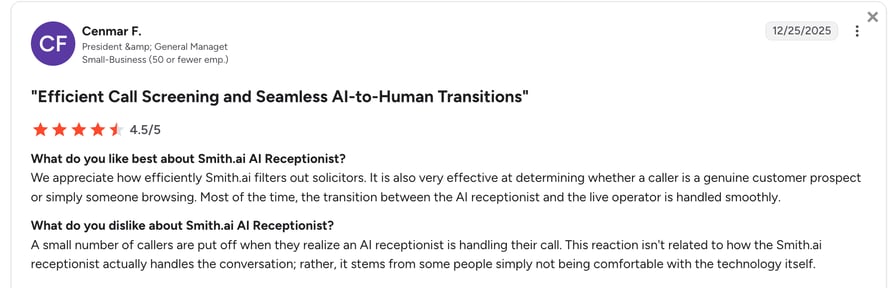
Smith.ai earns strong feedback for responsive customer support and reliable AI call handling, though several reviewers note that usage-based billing can make monthly costs harder to predict, especially with live-agent escalations or spam calls.
How Do G2 Users Rate Smith.ai?
Smith.ai's current G2 rating is 4.7/5, out of 21+ reviews.
6. Synthflow: Best No-Code AI Voice Builder With Owned Telephony
What Is Synthflow?
Synthflow is a no-code AI voice platform built to help businesses launch voice assistants quickly, with its own in-house telephony infrastructure rather than a third-party dependency—a meaningful difference from Cal.ai, which runs entirely on Cal.com's platform layer.
Why Is Synthflow a Strong Cal.ai Alternative?
- No-code editing outside a single scheduling toolCal.ai's prompts live inside Cal.com Workflows only. Synthflow's no-code visual builder lets teams design and deploy voice agents for any use case, not just scheduling.
- Owned telephony infrastructure, not borrowedCal.ai depends on Cal.com's platform-level calling layer. Synthflow runs its own infrastructure, supporting thousands of concurrent calls at 99.99% uptime.
- Broader integrations beyond one calendar systemSynthflow connects directly with a wider range of tools out of the box, including Cal.com.
What Are the Pros & Cons of Synthflow?
| Pros | Cons |
|---|---|
| No-code visual builder — fast to launch | Limited enterprise-level customization |
| Own telephony infrastructure, no third-party dependency | Fewer advanced analytics and operational tools |
| Strong compliance stack out of the box | Usage-based pricing can be harder to predict at scale |
What Are Synthflow's Plans & Pricing?
Synthflow uses usage-based pricing that varies by volume and features.
The Synthflow Scale Surprise
Rates depend on volume and feature tier, but neither is published upfront. Teams often can't model their real cost until they've already started scaling call volume — the same forecasting problem that shows up once Cal.ai's included credits run out.
What Are Synthflow's Customers Saying?
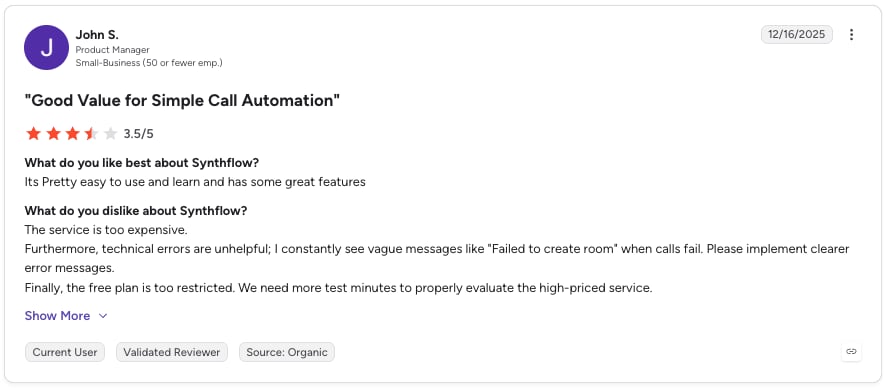
Synthflow customers highlight fast, self-serve deployment but mention high pricing and cost scaling at higher usage, along with a learning curve for advanced workflows.
How Do G2 Users Rate Synthflow?
Synthflow's G2 rating is 4.5/5, out of 1,015+ verified user reviews.
7. Replicant: Best for Contact Center Automation
What Is Replicant?
Replicant is a voice AI platform built for contact centers that want to automate repetitive inbound calls without a live agent on every interaction. Where Cal.ai handles a narrow set of scheduling-triggered calls, Replicant is trained to run inbound conversations at contact-center scale.
Why Is Replicant a Strong Cal.ai Alternative?
- Pre-built voice solutions instead of a single promptCal.ai's calls run off one custom prompt per trigger type. Replicant is pre-trained on tens of millions of real conversations, which shortens the path to a production-ready inbound flow.
- Multilingual and multichannel support out of the boxCal.ai's language support isn't publicly specified beyond its default configuration. Replicant supports multilingual, multichannel automation without extra customization.
- Built for calls beyond schedulingReplicant is purpose-built for contact-center-scale automation, covering inbound requests well outside the booking-and-reminder scope Cal.ai is limited to.
What Are the Pros & Cons of Replicant?
| Pros | Cons |
|---|---|
| Pre-built voice solutions for common contact-center requests | Less flexibility for outbound sales automation |
| Handles multilingual, multichannel support well | No built-in dialer or VoIP infrastructure |
| Strong for high-volume inbound automation | No free trial — enterprise sales process required |
What Are Replicant's Plans & Pricing?
Replicant pricing is quote-based.
The Replicant Sales-Cycle Catch
There's no self-serve tier and no published rate card — every deployment starts with a sales conversation sized to your call volume, a bigger commitment than Cal.ai's pay-per-minute model but with far more calling flexibility in return.
What Are Replicant's Customers Saying?
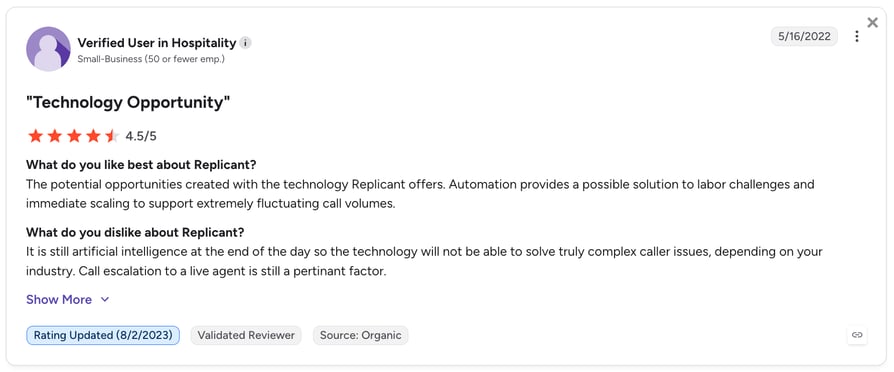
Users highlight fast, natural conversations and strong performance at high volume, but flag less flexibility for AI resolving complex issues.
How Do G2 Users Rate Replicant?
Replicant's current G2 rating is 4.7/5, out of 45+ verified user reviews.
8. Kore.ai: Best for Enterprise AI Agent Lifecycles
What Is Kore.ai?
Kore.ai is an enterprise-grade conversational AI platform for orchestrating virtual assistants across voice and digital channels. It's a much larger, more complex platform than Cal.ai's single-feature scope—worth considering only if your team needs omnichannel automation well beyond scheduling calls.
Why Is Kore.ai a Strong Cal.ai Alternative?
- Omnichannel coverage beyond a single scheduling triggerCal.ai only places calls tied to Cal.com bookings. Kore.ai automates voice, chat, messaging apps, and web channels from a single platform.
- Manages the full agent lifecycle, not one fixed promptCal.ai's customization is a single prompt per call type. Kore.ai gives enterprise teams tools to design, deploy, and optimize agents across their lifecycle.
- Analytics that extend past scheduling metricsCal.ai tracks completion and booking rates for scheduling calls. Kore.ai's reporting covers performance across every automated channel, not just one use case.
What Are the Pros & Cons of Kore.ai?
| Pros | Cons |
|---|---|
| Manages the full AI agent lifecycle across channels | Implementation is complex and resource-intensive |
| Strong compliance and security posture | Pricing is enterprise-focused and quote-based |
| Scales well for large deployments | Overkill for teams that only need scheduling calls |
What Are Kore.ai's Plans & Pricing?
Kore.ai uses enterprise, quote-based pricing—a steep contrast to Cal.ai's simple per-minute rate, though the two solve very different problems.
The Kore.ai Enterprise Contract Trap
Kore.ai doesn't publish rates. Budgeting requires a sales conversation and a contract commitment before you know what you're actually paying, which is a much bigger lift than mapping out Cal.ai's per-minute costs—but it buys a far broader platform.
What Are Kore.ai's Customers Saying?
Kore.ai customers consistently point to strong omnichannel automation and scalability for large deployments, but highlight a steep learning curve and usage limitations.
How Do G2 Users Rate Kore.ai?
Kore.ai's current G2 rating is 4.6/5, out of 474+ verified user reviews.
9. Amazon Lex: Best for Teams Already Running on AWS
What Is Amazon Lex?
Amazon Lex is AWS's conversational AI service for building voice and chat bots on the same technology behind Alexa—a fit for teams already operating inside the AWS ecosystem who want AI calling that isn't tied to a scheduling tool.
Why Is Amazon Lex a Strong Cal.ai Alternative?
- Omnichannel capabilities beyond scheduling callsCal.ai is limited to phone calls tied to bookings. Lex supports both voice and text interactions, letting you build self-service bots that work the same over the phone, web, or mobile apps.
- Deep AWS ecosystem integrationFor teams already running on AWS infrastructure, Lex plugs directly into services Cal.ai has no native connection to.
- Enterprise security & controlUnlike off-the-shelf AI agents, Lex gives engineering teams more control over data, privacy, and security, so they can manage everything more precisely.
What Are the Pros & Cons of Amazon Lex?
| Pros | Cons |
|---|---|
| Transparent, usage-based pricing | Requires technical expertise to set up and manage |
| Scales well within AWS infrastructure | No built-in telephony — needs Amazon Connect or a third-party provider |
| Flexible bot logic customization | Steeper learning curve outside the AWS ecosystem |
What Are Amazon Lex's Plans & Pricing?
- $0.004 per speech request
- $0.00075 per text request
The Amazon Lex Hidden Infrastructure Cost
The per-request rate looks like the cheapest option on this list, but it doesn't include actual phone calling. Add Amazon Connect or a third-party telephony provider, and the real cost of a working calling setup climbs well beyond the headline price.
What Are Amazon Lex's Customers Saying?
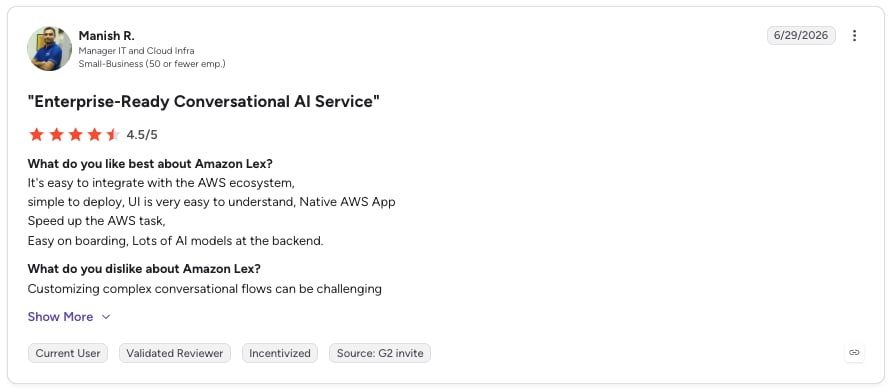
Amazon Lex customers highlight strong AWS integration and scalability, while noting that advanced flow management is complex and costs can rise quickly at scale.
How Do G2 Users Rate Amazon Lex?
Amazon Lex's G2 rating is 4.2/5, out of 39+ verified user reviews.
10. Google Dialogflow: Best for Established Text and Voice Agent Development
What Is Google Dialogflow?
Google Dialogflow is a conversational AI platform from Google Cloud for building voice and chat-based agents that integrate across websites, apps, and telephony systems—a much broader development platform than Cal.ai's single-purpose scheduling feature.
Why Is Google Dialogflow a Strong Cal.ai Alternative?
- Deep context handling for more than one call typeCal.ai's conversations follow a single prompt per trigger. Dialogflow excels at managing complex, multi-turn conversational flows and tracking session context across branching dialogues.
- Multi-platform deployment beyond phone callsCal.ai only places calls. Dialogflow deploys across websites, apps, and telephony systems, extending past a phone-only scheduling feature.
- Backed by Google Cloud's global infrastructureFor teams that want infrastructure-level reliability without negotiating an enterprise contract, Dialogflow's Google Cloud backbone is a significant step up from a single-tool scheduling integration.
What Are the Pros & Cons of Google Dialogflow?
| Pros | Cons |
|---|---|
| Reliable Google Cloud infrastructure | Lacks built-in, out-of-the-box business intelligence tools |
| Flexible text and voice agent development | Limited long-term user memory |
| Broad multi-platform deployment | Fewer no-code features for non-technical business users |
What Are Google Dialogflow's Plans & Pricing?
Usage-based pricing through Google Cloud, billed per text and voice request.
The Google Dialogflow Add-On Costs
The per-request billing looks lean, but it doesn't include the business intelligence tooling or telephony integration most teams end up adding separately — costs that don't show up until you're already building.
What Are Google Dialogflow's Customers Saying?
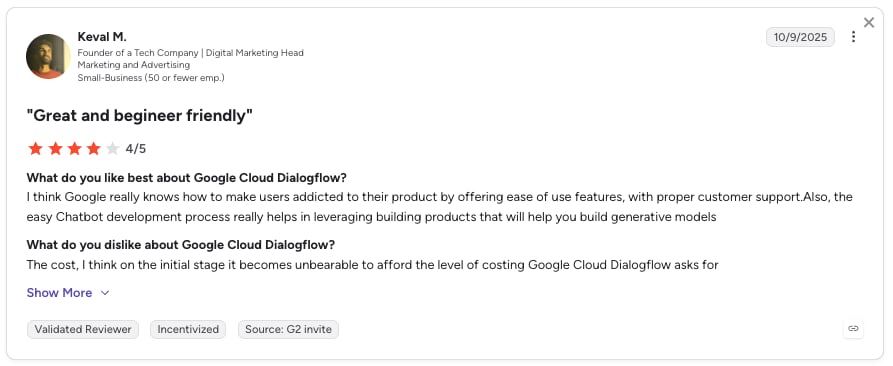
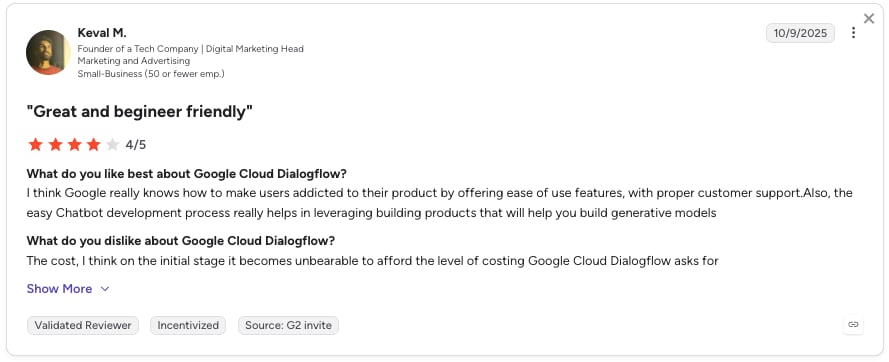
Google Dialogflow customers highlight seamless Google Cloud and contact center integrations, while noting that advanced conversation design has a steep learning curve and pricing can increase quickly as usage grows.
How Do G2 Users Rate Google Dialogflow?
Google Dialogflow's G2 rating is 4.4/5, out of 134+ verified user reviews.
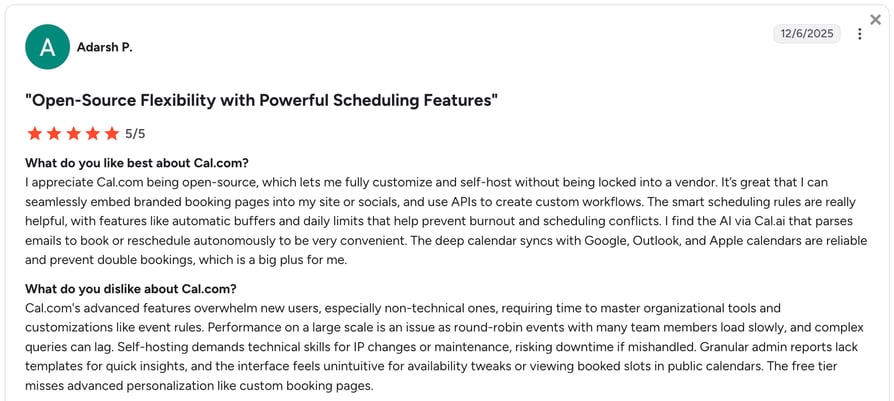
What Are Users Really Saying About Cal.ai and Its Alternatives?
There aren't many public Cal.ai alternative reviews yet. It's a relatively new feature, so there isn't much discussion on platforms like Reddit or Quora compared to more established AI voice tools such as Retell AI or Bland AI.
Most of the feedback comes from people reviewing Cal.com as a whole rather than Cal.ai specifically. Overall, G2 reviewers like that the AI can automatically schedule and reschedule meetings, saving them time. The main hesitation isn't about how well it works—it's that some people aren't fully comfortable with AI making scheduling calls on their behalf yet.
Interestingly, some reviewers even asked for AI scheduling features that Cal.ai already offers, suggesting there's growing interest in AI-powered scheduling but limited awareness of the product itself.


How to Choose the Right Cal.ai Alternative for AI-Powered Phone Calls
Not every alternative on this list fits every team. Your best choice depends on whether you need calling beyond scheduling, how much control you want over the voice stack, and whether a free tier matters before you commit.
1. What is the best Cal.ai alternative for AI-powered phone calls beyond scheduling?
CloudTalk is the best Cal.ai alternative for teams that need AI calling beyond scheduling—sales, support, and outbound outreach, not just booking reminders. Bland AI is a strong second pick for high-volume outbound with branching call logic.
2. Which Cal.ai alternative is best for teams that still want scheduling-focused calls?
Smith.ai is a strong choice thanks to its AI receptionist, human backup, and native Calendly integration. If you expect your needs to grow beyond scheduling, CloudTalk is the better fit, combining AI voice agents with a full call center platform that supports both inbound and outbound customer conversations.
3. What's the best Cal.ai alternative for developers who want full control?
Vapi is the best choice for developers who want full API-level control over orchestration and LLM choice instead of working within a fixed workflow prompt. Retell AI is a close second, with fast deployment and a no-code option too.
4. What is the best free Cal.ai alternative?
Bland AI's Free plan (100 calls/day) is the best free Cal.ai alternative for testing real call volume. Smith.ai's Free plan (25 calls/month) is a strong second option with human escalation built in.
5. Overall, what is the best Cal.ai alternative worth switching to?
CloudTalk is the definitive upgrade for teams that need real AI calling capability—inbound, outbound, VoIP, and CRM sync—instead of a scheduling feature that only works inside one calendar tool.
See CloudTalk in Action
Ready to Make the Switch from Cal.ai?
If Cal.ai's narrow scheduling scope, required Cal.com subscription, or lack of built-in telephony are holding your team back, here's what switching to CloudTalk actually gets you:
- A complete calling platformPhone numbers in 160+ countries, native CRM integrations, and real-time analytics in one place.
- AI voice agents for real conversationsInbound and outbound automation at scale, with seamless handoffs to human agents and automatic CRM updates after every call.
- Scalable pricing that rewards growthAI Receptionist plans start at $99/month, with lower per-minute rates available for high-volume teams, so your costs become more efficient as you scale.
Stop limiting your AI calling to one scheduling tool's Workflows builder.
See exactly how CloudTalk solves the limitations
FAQ
Answers to the most common questions about Cal.ai, its competitors, and switching to a more capable AI calling platform in 2026.
Cal.ai is an AI-powered phone calling feature built into Cal.com's Workflows product. It automates scheduling-related calls—booking, confirmations, reminders, and no-show follow-ups—at $0.29 per minute.
No. Cal.ai is a feature inside Cal.com, not a separate app or company. That's also why it doesn't have independent reviews on G2, Trustpilot, or Reddit—reviews under "Cal.com" reflect the broader scheduling platform, not the AI-calling feature specifically.
CloudTalk is the strongest choice if you are looking for something better than Cal.ai. It includes built-in global VoIP, AI voice agents for sales and support, and scalable pricing starting at $99/month for its AI receptionist.
Yes, there are several apps like Cal.ai that provide AI-powered voice capabilities. CloudTalk, Vapi, and Retell AI are popular choices that offer distinct advantages in telephony infrastructure, API control, and ease of deployment.
When searching for tools like Cal.ai, consider your specific needs. CloudTalk is ideal for businesses needing a full phone system, while Vapi and Retell AI are strong options for developers and those needing rapid, flexible deployment.
Finding the right Cal.ai replacement depends on whether you need a standalone calling platform or just a simple scheduling add-on. If you require inbound/outbound support and deep CRM integration, CloudTalk is a comprehensive upgrade.
Yes, CloudTalk is the premier Cal.ai alternative for business. Unlike Cal.ai, which is strictly limited to Cal.com scheduling, CloudTalk manages sales, support, and outbound campaigns in one platform.
The best Cal.ai phone agent alternative should offer built-in telephony (VoIP), scalable pricing, and CRM sync. You want an agent that doesn't just trigger from a single scheduling event but can handle varied customer conversations.
Yes. While Cal.ai acts as an AI-powered scheduling assistant, alternatives like CloudTalk or Smith.ai can also handle booking, rescheduling, and confirmations, often with better support for multiple calendar platforms and human fallback options.
As noted earlier in the article, there are currently no specific Reddit threads regarding Cal.ai alternatives, as it is a relatively new feature with limited independent discussion on the platform.
For teams looking for a Cal.ai cheaper alternative, platforms like Vapi or Retell AI offer lower per-minute base rates, though they often require additional telephony and LLM costs. For high-volume teams, CloudTalk's tiered plans often provide better overall value than per-minute credit models.
Cal.ai's $0.29/minute rate is on the higher end, especially since it sits on top of a required Cal.com subscription. Dedicated calling platforms often provide more scalable, predictable pricing models.