Replicant AI Pricing & Plans: Complete Guide for 2026
Replicant AI Plans at a Glance
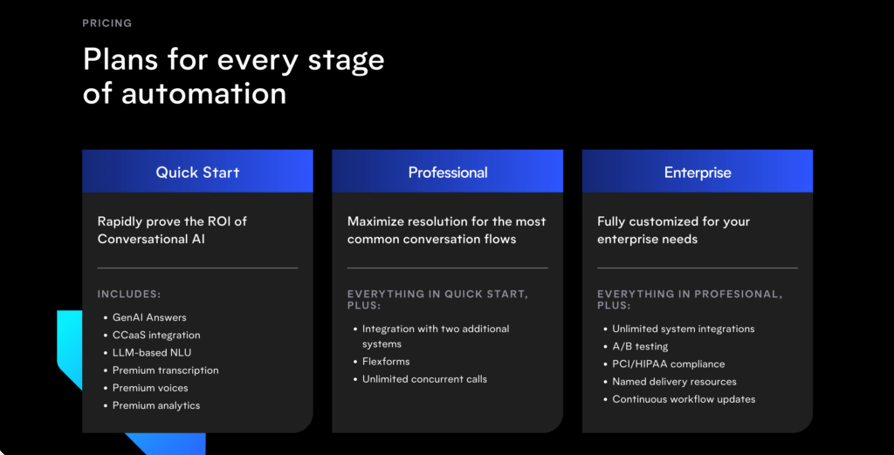
There are three Replicant AI pricing plans, Quick Start, Professional, and Enterprise, built around the same conversational AI core with increasing integration depth, scale, and compliance coverage.
None of the three plans carry a published price. All pricing is custom, usage-based, and requires a direct sales conversation. One-time implementation fees reportedly start in the thousands, and there is no free trial.
Replicant AI Plans at a Glance
| Plan | Best For | Key Differentiator | Pricing |
|---|---|---|---|
| Quick Start | Proving conversational AI ROI | 10 concurrent calls, CCaaS integration, GenAI Answers | Custom quote |
| Professional | Scaling automation across common call flows | Unlimited concurrent calls, 2 system integrations, Flexforms | Custom quote |
| Enterprise | Large enterprises with compliance and scale requirements | Unlimited integrations, PCI/HIPAA compliance, 35+ languages | Custom quote |


What Pricing Plans Does Replicant AI Offer?
Replicant AI pricing doesn't live on a public page with dollar amounts. Like most enterprise contact center platforms, pricing is a sales conversation, not a self-serve decision.
Replicant's billing model is usage-based: your Replicant AI price scales with the volume of conversations the AI actually handles, resolved calls, productive minutes, or total call volume, depending on how your contract is structured. There is no flat monthly fee per user and no self-service signup.
Replicant's typical buyer profile tells the story:
- Enterprises with 100+ contact center agents
- AI automation budgets in the $150,000–$500,000+ annual range
- Industries like insurance, healthcare, financial services, and retail
- VPs of Customer Service or Chief Customer Officers with established automation roadmaps
For teams using call routing and call flow automation today and considering an AI voice layer, Replicant's entry requirements are worth understanding before investing time in a sales process.
What Do Real Users Say About Replicant AI Pricing?
G2 reviewers are generally positive on capability. Multiple enterprise reviewers highlight improvements to IVR experience and customer engagement.
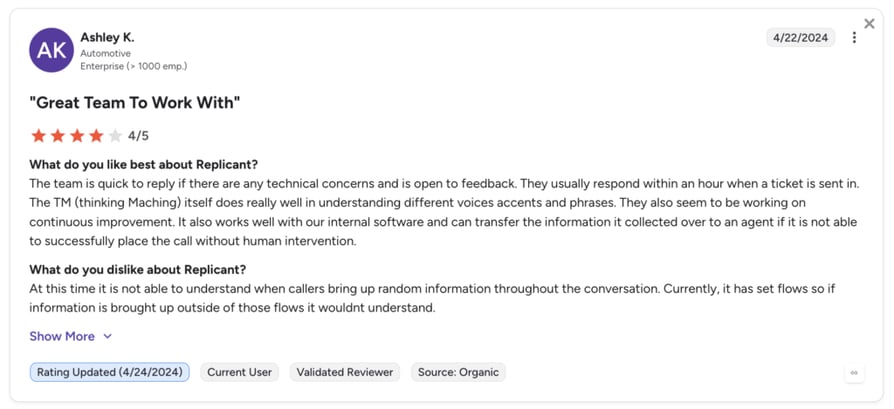
The consistent criticism is the pricing model itself. Reviewers describe the platform as expensive and flag the fixed-plus-variable cost structure as difficult to predict in practice, specifically, that they wish pricing would "adjust based on actual utilization of platform capabilities."
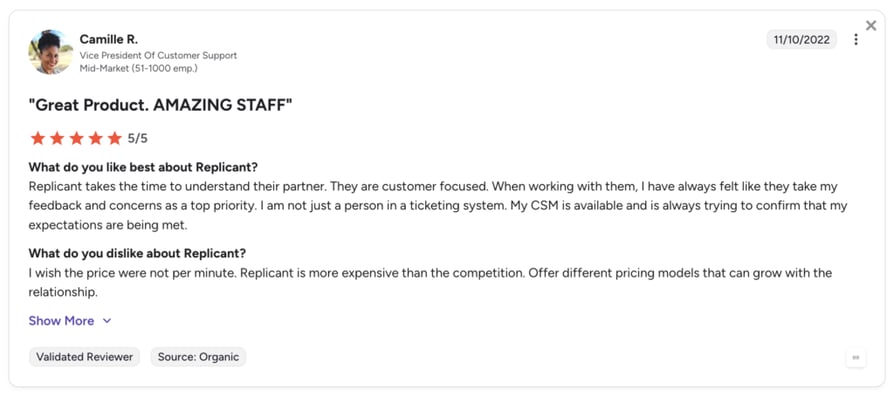
The takeaway: Replicant earns its reputation on performance, but the pricing opacity and enterprise-only entry point are legitimate concerns worth pressing on before you sign anything.
What Is Replicant's Quick Start Plan?
Quick Start is Replicant's entry tier, the "prove it before you scale it" option for organizations piloting conversational AI before committing to full deployment.
You get the full core automation stack from day one. What's capped is scale: 10 concurrent calls maximum and a single CCaaS integration, which makes this a pilot tier rather than a production one.
What's Included in Replicant's Quick Start Plan?
- GenAI Answers for common customer queries
- LLM-based NLU for natural, multi-turn conversation understanding
- One CCaaS integration
- Premium transcription and voice synthesis
- Premium analytics dashboard
- Up to 10 concurrent calls
- Automated QA capabilities
- Omnichannel automation (Chat/SMS) available as an add-on
Replicant's Quick Start Plan: Who Is It Best For?
Contact center leaders who need a structured proof-of-concept before procurement signs off on full deployment budgets. Also appropriate for organizations with moderate inbound volumes that don't require high concurrency, or teams replacing a basic IVR with AI for a single, well-defined use case.
What You Need to Know About Replicant's Quick Start Plan
The 10 concurrent call ceiling is the most important constraint to understand upfront. High-volume contact centers will hit it immediately during any real traffic peak.
More importantly: implementation fees reportedly start in the thousands of dollars before a single call has been automated. Using Quick Start purely as a test requires confidence that the Professional upgrade is already in the budget, not something to figure out after the pilot succeeds.
Since Replicant AI pricing per minute is not publicly disclosed, press for the exact variable rate and minimum volume commitment in your first sales conversation.
What Is Replicant's Professional Plan?
Professional is where Replicant becomes operationally meaningful for most contact centers. The concurrent call cap disappears (unlimited), two additional back-end system integrations come online, and Flexforms, Replicant's tool for capturing structured data during live conversations, arrives with custom branding.
Multi-language support is also introduced at this tier, covering six languages. For teams in regulated industries, workflow automation across multiple back-end systems without the need for custom middleware is one of Professional's practical advantages.
Teams evaluating AI voice agents for healthcare will find Professional is the practical minimum for production deployment, it's the first tier that can handle the integration depth healthcare workflows require.
What's Included in Replicant's Professional Plan?
- Everything in Quick Start, plus:
- Unlimited concurrent calls
- Integration with two additional systems (beyond CCaaS)
- Flexforms (custom branded)
- Multi-language support (6 languages)
- Call transcription and conversation logging
- Capacity for complex, multi-flow automation across high-frequency call types
Replicant's Professional Plan: Who Is It Best For?
Mid-to-large contact centers that have already validated conversational AI value and are ready for production-scale deployment. Best fit for organizations automating defined Tier 1 call types, bookings, billing inquiries, order status, authentication, at volume.
What You Need to Know About Replicant's Professional Plan
Replicant AI voice agent pricing at this tier remains custom, there's no published rate at any plan level. The six-language ceiling is the most common surprise at this tier. If your contact center serves a multilingual customer base, map your language requirements before signing. Discovering you need language 7 after contract execution means renegotiating, not clicking "upgrade."
What Is Replicant's Enterprise Plan?
Enterprise is Replicant's fully custom tier for organizations where compliance, regulatory requirements, and named delivery accountability define the purchase. It unlocks the capabilities that regulated industries need, PCI and HIPAA compliance, unlimited system integrations, A/B testing for conversation flows, 35+ language support, and continuous workflow updates.
It's also where Replicare, Replicant's all-inclusive delivery and support model, operates most fully: a flat annual fee covering deployment, maintenance, and ongoing optimization. For organizations also evaluating the best AI voice agents across the market, Enterprise is the only Replicant tier with the compliance and security controls that regulated industries require.
What's Included in Replicant's Enterprise Plan?
- Everything in Professional, plus:
- Unlimited system integrations
- PCI compliance
- HIPAA compliance
- A/B testing for conversation flows
- Named delivery resources
- Continuous workflow updates
- 35+ languages supported
- Replicare all-inclusive delivery and support
- Single sign-on (SSO) and enterprise identity management
Replicant's Enterprise Plan: Who Is It Best For?
Large enterprises in regulated industries with high call volumes, established compliance requirements, and the operational maturity to deploy AI automation at scale. Organizations where contact center automation is a multiyear strategic investment, not an experiment.
What You Need to Know About Replicant's Enterprise Plan
Replicant offers a 100% risk-free money-back guarantee on implementation and platform fees, notable at this price point. But enterprise contracts are multi-year by default, and the full deployment timeline runs six weeks at minimum.
Negotiate renewal caps before signing. At six- or seven-figure annual contract values, a 10–15% annual increase is a number worth fighting over in the initial term.
What Are Replicant's Additional Costs?
The three-tier plan structure is only part of what you'll actually pay. Here's what consistently surfaces beyond the base contract.
Implementation Fees: Unavoidable Upfront Cost
Replicant deployments involve discovery, solution design, AI model training, integration work, and go-live support. Implementation fees reportedly start in the thousands of dollars and run higher for complex deployments.
This isn't unusual for enterprise AI platforms, but it's a meaningful barrier for organizations still building the internal business case. Budget it as a committed cost, not a variable.
Usage Charges: The Variable That Compounds
Replicant bills on usage, resolved calls, productive minutes, or call volume. Your Replicant AI subscription cost in Month 1 may look very different from Month 6 as volumes shift and new automation flows go live.
This is where agent reporting and containment rate tracking become critical. Your Replicant AI pricing per month is tied directly to how well the AI resolves calls without escalation, unlike flat-rate seat pricing, it rewards high containment rates but spikes during seasonal peaks or when new flows underperform.
Compliance and Language: Tier-Gated Upgrades
Several capabilities are locked behind tier upgrades rather than available as standalone add-ons:
- PCI and HIPAA compliance: Enterprise only. Discovering this requirement mid-deployment means renegotiating your contract.
- Languages beyond 6: Enterprise only. Professional's ceiling can catch multilingual contact centers off-guard.
- Omnichannel (Chat and SMS): Add-on at all tiers.
- Call scoring and advanced QA tools: Functionality depth scales with tier.
Replicant Additional Cost Summary
Replicant AI: Full Cost Breakdown
| Cost Type | Details |
|---|---|
| Platform fee | Custom, included in annual contract |
| Usage charges | Per resolved call / productive minute (variable) |
| PCI/HIPAA compliance | Enterprise tier only |
| Languages beyond 6 | Enterprise tier only |
| Omnichannel (Chat/SMS) | Add-on at all tiers |
| Annual renewal increases | Negotiate caps before signing |
What Will Replicant AI Actually Cost?
Replicant AI cost looks tidy from the outside: three plans, request a quote. But once you factor in implementation, usage, compliance tiers, and multi-year contract terms, the Replicant voice AI pricing 2026 reality lands considerably heavier than the first proposal suggests.
Here are four realistic scenarios.
Scenario 1: Mid-Sized Contact Center, Quick Start Pilot, Single Use Case
Profile: 50-agent team for a home services company, piloting AI on appointment scheduling and outbound campaigns. ~8,000–10,000 calls/month. One CCaaS integration. No compliance requirements.
Verdict: Quick Start is the right structural entry point, but the high implementation fee means this "pilot" carries real financial weight before it's proven anything. Build the Professional upgrade path into the initial contract, not as a follow-up negotiation after success.
Scenario 2: Growing Retail Contact Center, Professional Plan, Multi-System Integration
Profile: 150-agent contact center handling order status, returns, and FAQ automation. Integrations: CCaaS, OMS, CRM. ~80,000 calls/month. Five languages needed. Teams also exploring automated voice agents for lead generation alongside inbound service automation.
Verdict: Professional fits the integration and language requirements. The usage-based billing model becomes significant at this scale, a strong AI containment rate (Replicant cites 80%+) translates into real savings, but it takes three to four months to reach peak performance. Budget for a ramp period before the ROI math closes.
Scenario 3: Healthcare Organization, Enterprise Plan, HIPAA Required
Profile: 300-agent healthcare provider. Use cases: appointment scheduling, prescription refills, insurance verification. HIPAA compliance non-negotiable. ~200,000+ calls/month. 15+ languages needed.
Verdict: Firmly Enterprise territory. All-in Replicant AI voice agent pricing 2026 for this deployment scope would likely fall in the $400,000–$600,000+ annual range across implementation, platform, and usage. The ROI math can work, but only if AI containment rates hold and human escalation volumes stay genuinely low. Track these on your wallboard and reporting tools from day one.
Scenario 4: Large Financial Services Enterprise, Full Platform, Multi-Region
Profile: 500+ agents across three regions. Full automation stack: voice, chat, SMS. PCI compliance required. A/B testing needed across markets. 3M+ annual calls.
Verdict: At this scale, pricing is a strategic negotiation. Expect Year 1 to run into seven figures when implementation and full-scale usage are combined. The Replicare all-inclusive model starts making structural sense here, trading month-to-month usage variability for a predictable annual fee.
The Bottom Line on Real Costs
The gap between Replicant's plan structure and what you'll actually pay widens every time a new language, compliance requirement, or integration enters the picture. For organizations where AI automation ROI is measurable at scale, Replicant can deliver. For teams still validating the hypothesis, the upfront commitment is substantial.
Which Alternatives Are Better and Cheaper Than Replicant AI?
Replicant is purpose-built for one scenario: enterprise contact centers automating Tier 1 calls at significant scale. For teams outside that profile, or enterprises that want pricing transparency before committing six figures, here are four better-value alternatives.
CloudTalk: Best for Growing Teams That Need AI Voice Without Enterprise Complexity
What Is CloudTalk?
CloudTalk is an AI-powered contact center platform built for sales and support teams that need intelligent voice automation without the enterprise overhead. Where Replicant targets organizations with 100+ agents and six-figure implementation budgets, CloudTalk is designed for teams at any scale, from 10-person support desks to multi-site contact centers.
It combines AI voice agents, inbound routing, outbound dialing, and conversation intelligence in one transparently priced platform that deploys in days, not weeks.
Why CloudTalk Is Better Than Replicant
Replicant AI features pricing requires a sales process, a custom quote, and a big budget before automation goes live. CloudTalk publishes its pricing, charges no implementation fee, and includes AI capabilities as part of the platform.
Key advantages:
- Published flat-rate pricing with no usage-based billing surprises
- CloudTalk AI, conversation intelligence, summaries, and insights included
- Smart dialer and power dialer for outbound teams
- Skill-based routing, call queuing, and IVR built in
- International numbers in 160+ countries
- 14-day free trial, no credit card required
What Is CloudTalk's Pricing?
- Starter: $25/user/month
- Essential: $29/user/month
- Expert: $49/user/month
- AI Voice Agents: $99/200 minutes
- 14-day free trial included, no credit card required
See the full CloudTalk pricing page for a complete breakdown.
Bottom line: For SMB and mid-market teams that want AI voice automation without enterprise overhead, CloudTalk delivers a comparable feature set at a fraction of Replicant's total cost of ownership, transparent pricing, fast deployment, no implementation fee.
Real Customer Review
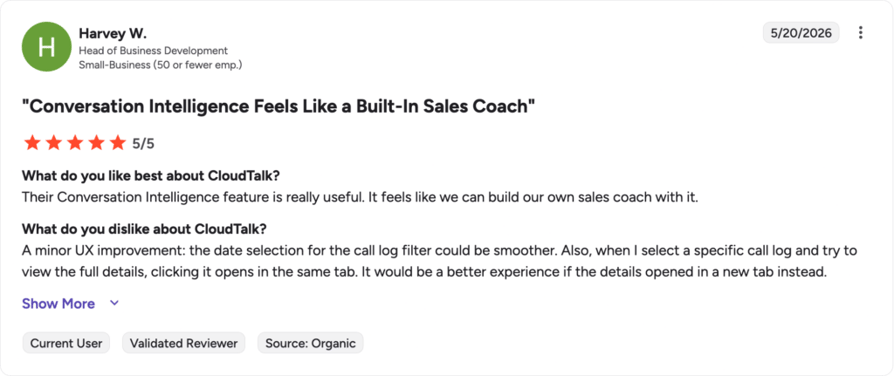
Genesys Cloud CX: Best for Large Enterprises Needing Full Omnichannel CCaaS
What Is Genesys Cloud CX?
Genesys Cloud CX is one of the most established enterprise contact center platforms available. It covers the entire contact center infrastructure, agent status management, omnichannel routing, workforce management, quality assurance, and AI automation, in a single system.
Unlike Replicant (a point solution for voice automation), Genesys replaces your entire CCaaS stack.
Why Genesys Cloud CX Is Better Than Replicant
For enterprises that need more than voice automation, teams that need AI, routing, WFM, and compliance in one platform, Genesys is the more complete answer. It also publishes its pricing, giving procurement teams actual numbers before a multi-year commitment.
Key advantages:
- Published pricing from $75/user/month
- Full omnichannel: voice, email, chat, social, messaging
- Built-in workforce management on CX 3+
- AI routing, virtual agents, and Agent Copilot on higher tiers
- G2 rating: 4.3/5 (3,000+ reviews)
What Is Genesys Cloud CX's Pricing?
- CX 1 (Voice only): $75/user/month
- CX 2 (Omnichannel): $115/user/month
- CX 3 (+ WFM): $155/user/month
- CX 4 (Full AI suite): $240/user/month
- Telecom billed separately (~$0.012–$0.015/minute)
See our full Genesys pricing guide or compare directly on our Genesys alternative page.
Bottom line: If your organization needs a full contact center platform rather than a point AI solution, Genesys offers published pricing, enterprise-scale reliability, and a complete feature set Replicant can't match.
Real Customer Review
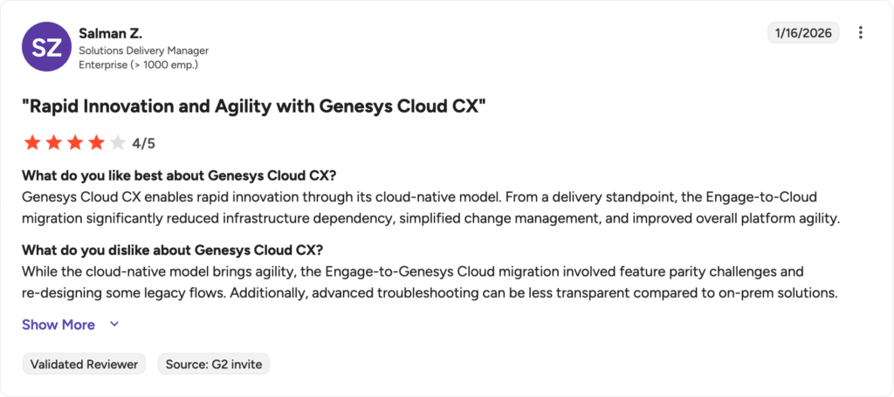
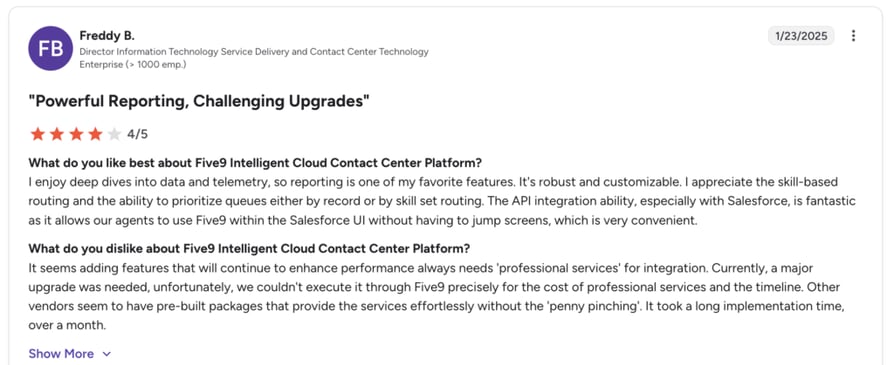
Five9: Best for Mid-to-Large Contact Centers Running High-Volume Inbound and Outbound
What Is Five9?
Five9 is a cloud contact center platform combining inbound and outbound voice automation with an AI layer, the Intelligent Virtual Agent (IVA), that handles common customer inquiries end-to-end. For organizations that need both a contact center platform and AI call automation, Five9 bundles both rather than requiring a separate AI deployment.
Teams evaluating tools for AI virtual receptionist and lead qualification workflows will find Five9's outbound dialing plus AI qualification automation covers ground Replicant doesn't address as directly.
Why Five9 Is Better Than Replicant
Five9 publishes base pricing and includes AI minutes per seat, a transparency advantage Replicant can't match. For teams with strong outbound dialing needs, Five9's voicemail drop capabilities and preview dialer functionality add outbound muscle Replicant isn't designed for.
Key advantages:
- Published entry pricing at $119–$159/user/month
- Integrated IVA for automated inbound resolution
- Power dialer and predictive dialer for outbound
- 3,000 AI minutes per seat included
- G2 rating: 4.0/5 (500+ reviews)
What Is Five9's Pricing?
- Digital (digital channels only): $119/user/month
- Core (voice): $159/user/month
- Plus, Pro, Enterprise (omnichannel): custom quote
- Advanced AI (IVA): usage-based add-on
- Minimum: 50 seats required
See our full Five9 pricing guide or explore the Five9 alternative comparison.
Bottom line: Five9 is a strong pick for mid-to-large contact centers that want a fully integrated platform with AI automation, particularly teams with significant outbound dialing alongside inbound AI resolution.
Real Customer Review
NICE CXone: Best for Enterprises Prioritizing AI-First Automation at Published Pricing
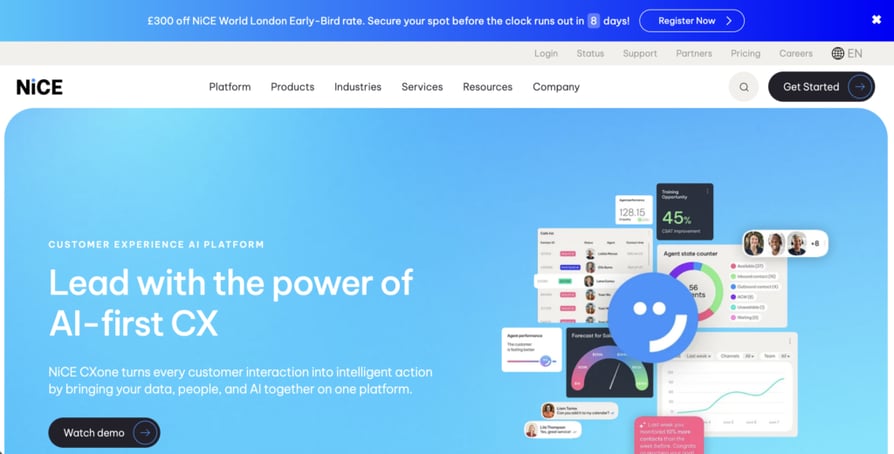
What Is NICE CXone?
NICE CXone (now CXone Mpower following NICE's 2025 Cognigy acquisition) is a comprehensive AI contact center platform with seven defined pricing tiers, ranging from digital-only deployments to full agentic AI automation. The Cognigy acquisition made NICE a direct competitor to Replicant in autonomous voice handling at enterprise scale, with the added advantage of a published price list.
Why NICE CXone Is Better Than Replicant
NICE CXone offers seven tiers with published rates, a structural transparency advantage over Replicant's fully opaque model. The post-Cognigy AI capability means enterprises no longer choose between deep conversational AI and a full CCaaS suite. NICE offers both.
Features that matter for the comparison:
- Call monitoring and QA tools across all tiers
- Sentiment analysis and conversation intelligence built in
- Published pricing from $71/user/month to $249/user/month
- Cognigy-powered agentic AI post-2025 acquisition
- G2 rating: 4.3/5 (1,700+ reviews)
What Is NICE CXone's Pricing?
- Digital Agent: $71/user/month
- Voice Agent: $94/user/month
- Omnichannel Agent: $110/user/month
- Essential Suite: $135/user/month
- Core Suite: $169/user/month
- Complete Suite: $209/user/month
- Ultimate Suite: $249/user/month + $0.25/session
AI routing and outbound campaign management use consumption-based pricing on top of seat price, factor these into your total cost. See our NICE CXone pricing guide or the NICE CXone alternative page for a direct comparison.
Bottom line: For enterprise teams that want Replicant-level conversational AI within a full CCaaS platform, at published, auditable pricing, NICE CXone is the most direct alternative to evaluate in 2026.
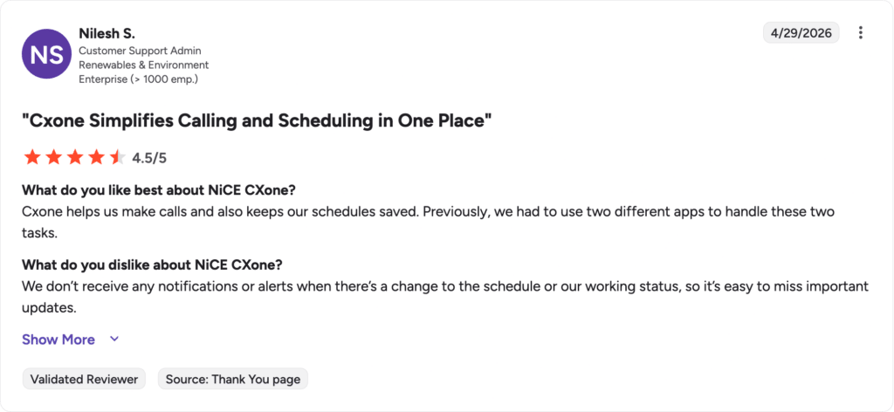
Real Customer Review
What Are Replicant AI's Best Features?
Understanding Replicant AI features requires understanding what the platform is genuinely built for, and where it reaches its limits. Here are the four features that drive the enterprise purchase decision.
The Thinking Machine: LLM-Based NLU
Replicant's core AI engine uses LLM-based natural language understanding to handle multi-turn conversations naturally, managing topic shifts, incomplete sentences, and simultaneous customer intents without breaking the call flow.
Where it could be better: Performance is directly proportional to training data quality and deployment configuration. Teams that don't invest in proper setup see containment rates well below platform averages, and with usage-based billing, lower containment means higher cost per resolved call.
Automated QA for 100% of Conversations
Most contact center QA programs sample 1–5% of calls. Replicant's Conversation Intelligence module reviews every interaction, AI-handled and human-handled, and scores each for compliance, quality, and customer experience.
The result is a single benchmark across the full call population, not a statistical sample. AI smart notes, call transcription, and transcript search all feed into this QA layer, giving supervisors queryable records of every conversation.
Where it could be better: Extracting actionable value from 100% QA requires analytical maturity. Teams without dedicated QA resources can find the data volume overwhelming without the right structure to act on it.
Natural Voice Quality and Multilingual Support
Replicant's AI agents use premium voice synthesis built around natural pacing and realistic intonation, not the mechanical quality of legacy IVR. The platform supports 6 languages on Professional and 35+ on Enterprise.
When evaluating Replicant AI pricing voice tiers specifically, the language ceiling on Professional is the most common surprise buyers encounter mid-deployment. Track your talk-listen ratio data during pilots, it's a reliable signal for whether your AI's voice quality is sustaining natural conversation or triggering escalation.
Where it could be better: The six-language ceiling on Professional is a real constraint for diverse customer bases. Enterprise is required for broader language coverage, which significantly changes the budget picture.
Replicare: All-Inclusive Delivery and Support
Replicare bundles deployment, maintenance, and ongoing performance optimization into a single flat annual fee. Rather than billing separately for every improvement cycle, Replicant's team is structurally incentivized to improve your containment rates.
For enterprise buyers used to vendor relationships where every optimization engagement costs extra, this model is a genuine structural advantage.
Where it could be better: Replicare creates vendor dependency that some IT and security teams find uncomfortable. Organizations that prefer to own their AI configuration internally will feel the limits of a managed-service delivery model.
What Are the Pros and Cons of Replicant AI?
Replicant AI: Pros and Cons
| Pros | Cons |
|---|---|
| Handles Tier 1 calls autonomously at enterprise scale | No published pricing, all quotes require sales engagement |
| Trained on 500M+ minutes of real contact center conversations | Implementation fees starting in the thousands of dollars according to industry estimates |
| Automated QA for 100% of conversations, AI and human | Usage-based billing creates unpredictable monthly cost variance |
| 100% risk-free money-back guarantee on implementation and platform fees | Language support capped at 6 on Professional tier |
| 6-week average deployment with Replicare all-inclusive support | Best suited for 100+ agent teams, entry point prohibitive for smaller orgs |
Is Replicant AI Worth It for Your Contact Center?
Replicant AI is a capable platform for a specific type of buyer. If your contact center handles tens of thousands of Tier 1 calls per month, has the budget for structured enterprise deployment, and operates in an industry where automation ROI is measurable against real headcount costs, Replicant can deliver on its core promise.
But the right fit depends entirely on where you sit in that profile.
Replicant makes sense if:
- You have 100+ agents and a significant monthly call volume (50,000+ calls)
- You're in healthcare, insurance, financial services, retail, or a similar high-frequency call industry
- PCI or HIPAA compliance is driving procurement
- You want a managed service model where the vendor owns ongoing optimization
Replicant is probably not the right fit if:
- You're a growing team under 100 agents looking for flexible, affordable AI calling
- You need published pricing before engaging sales
- Your call volumes don't justify six-figure annual AI automation investment
- You want to deploy in days, not weeks
- Predictable flat-rate monthly costs are a budget non-negotiable
For teams outside the enterprise automation profile, CloudTalk delivers a full AI calling platform with parallel dialer, callback automation, and AI conversation intelligence, at published pricing, with no implementation fee and a 14-day free trial.
Frequently asked questions
Replicant AI does not publish specific prices. All Replicant AI pricing is custom, based on call volume, use cases, required integrations, and contract length. Billing is usage-based (resolved calls or productive minutes), and implementation fees start in the thousands of dollars. Contact Replicant's sales team directly for a quote.
No. Replicant offers no free tier and no self-serve free trial. Quick Start is the lowest entry point, and all plans require a custom quote and implementation engagement before going live.
The main costs beyond the platform fee: one-time implementation fees, usage-based charges that vary month-to-month, PCI and HIPAA compliance locked to Enterprise, languages beyond 6 locked to Enterprise, and omnichannel automation (Chat/SMS) as a paid add-on at all tiers.
Yes, significantly for most team sizes. CloudTalk publishes flat per-user monthly pricing, charges no implementation fee, and includes AI features in its plans. Replicant's all-in cost for a typical enterprise deployment runs into six figures annually before you've automated a single call.
Replicant is an enterprise conversational AI platform focused on automating Tier 1 customer service calls for large contact centers, with custom pricing and a managed service delivery model. CloudTalk is a full AI-powered calling platform for sales and support teams at any scale, combining AI voice agents, inbound routing, outbound dialing, and conversation intelligence at published per-user pricing.
Generally, no. Replicant's pricing model, implementation requirements, and minimum deployment scale make it cost-prohibitive for small businesses. Platforms with self-serve onboarding, published pricing, and no implementation minimums are a better starting point.
Key variables: total monthly call volume, number of system integrations required, language requirements, compliance needs (PCI, HIPAA), contract length, and scope of Replicare delivery and support. Each can meaningfully shift the final contract value.
Yes, the main ones are implementation fees not always disclosed upfront, usage-based billing that scales unpredictably with volume, compliance and language features locked to Enterprise, omnichannel add-ons at all tiers, and annual renewal rate increases. Build all of these into your TCO calculation before signing.