

3
Reviews

26
Reviews


3,000+
Customers
Dialfire Review 2026:
Features, Pricing & User Feedback
Exploring Dialfire? Discover what real users say about call quality, features, and support—plus see how CloudTalk compares.
What is Dialfire?
Dialfire is a cloud-native contact-center platform built primarily for high-volume outbound teams. It runs 100% in the browser with no software install and is positioned around a usage-based pricing model — you pay per minute consumed and per platform feature activated, not per seat.
Its core hook is unlimited agents at no extra licensing cost, paired with a powerful predictive dialer claimed to deliver up to 3× more contacts than manual dialing. That makes it a magnet for BPOs, telemarketing agencies, and outbound-first sales orgs that benchmark strictly on cost-per-minute.
For technically capable admins who want to build bespoke campaign logic with low-code JavaScript and REST APIs, Dialfire is genuinely flexible. For everyone else, reviewers consistently flag it as a steeper, more DIY experience than modern alternatives.
What are Dialfire's Key Features?
- Predictive dialer with Answering Machine Detection (AMD) and multiple speed settings
- Preview dialing and call blending for inbound/outbound mixed teams
- Voice recording with 3-year storage included
- Real-time wallboards, dashboards, and customizable reports
- Integrations via Salesforce, HubSpot, Pipedrive, Zoho, MS Dynamics, Zapier, REST API + webhooks
- AI features: voice bots, agent assist, conversation summaries, scoring, and translations.
What Users Say About Dialfire
Based on 25+ verified reviews from G2, Capterra, and Trustpilot
😊 What Users Love
- Genuinely disruptive pricing for high-volume outbound — pay only for the minutes and modules you actually use
- Unlimited agents at no incremental licensing cost — scales with headcount without sticker shock
- Support team consistently praised as knowledgeable and fast on complex configuration questions
- Highly customizable: low-code JavaScript, REST APIs, and webhooks let technical teams build bespoke campaign logic
"It is really convenient, as you can just upload your leads to Dialfire. You can use Excel, CSV, etc. Plus the flexibility it gives when editing the columns, and you can just directly call after uploading. Basically a plug-and-play system: very easy to use and no extensive setup needed. I also really love their payment scheme, where you only pay for the functionality you use, which saves us a lot of money."
😤 What Users Hate
- UI feels dated and "overwhelming" on first use — multiple reviewers describe it as a step backward from other more polished tools.
- Complex CRM and IVR integrations require coding — no-code admins hit walls quickly
- No native mobile app, no SMS or WhatsApp — voice-only in an omnichannel world
- Automation can be "finicky" — small campaign logic changes often require manual rework
- Documentation is thin — admins lean heavily on support chat for basic setup
"Dialfire has so many hidden features that I really wish were documented! (…) Really complex implementations are hard if you do not know how to code. (…) That being said, the cost for us is worth it. (…) The way that contacts are utilized in the backend is also quite hard to deal with. (…) It also feels very dated in the app itself for the interface."
What Are People Talking about Dialfire on G2?
See what real users are saying about Dialfire's product on G2 — honest reviews, real experiences, and feedback from teams who have used it.

We ran into too many technical issues/bugs that we weren't able to get resolved."
Picture Framer/Website Manager
I recommend the Dialfire team work on technical glitches."
Information Technology and Services
There is a slight learning curve when doing the initial setup, it can be a bit overwhelming to someone who is inexperienced."
Company Name
 Dialfire2025 Winter Leader
Looking for a Dialfire Alternative?
See why 5,500+ businesses switched to CloudTalk for superior call quality and AI-powered features.
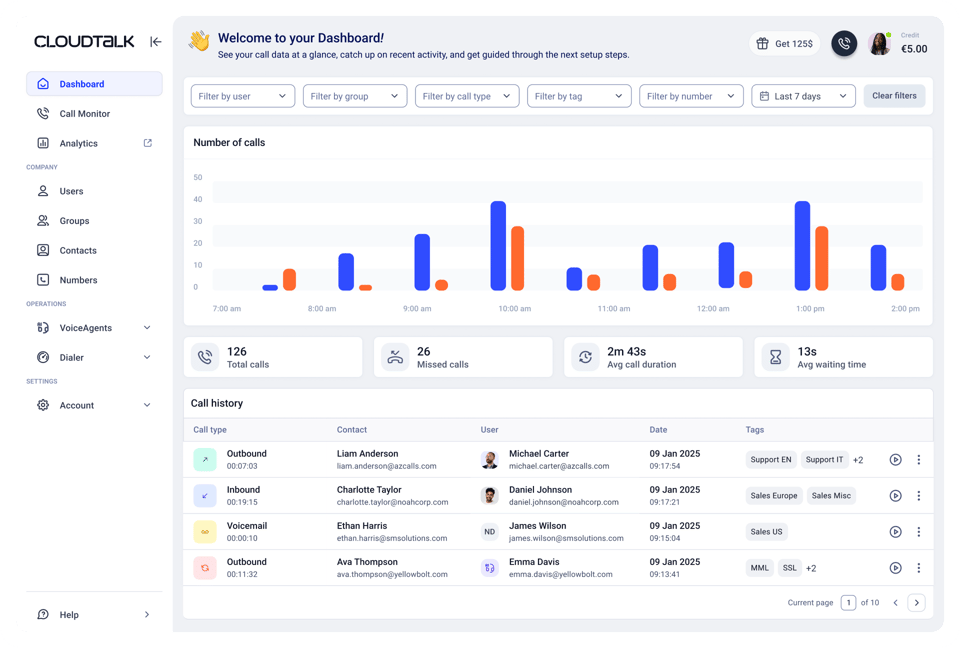
Top-rated on G2
Consistently rated highly on G2, CloudTalk helps teams ramp faster, avoid complexity, and rely on a phone system that works as expected from day one.
100+ integrations
Your CRM, helpdesk, and sales tools already talk to each other. CloudTalk just joins the conversation and makes it way more productive.
Coverage in 160+ countries
From next door to across the globe, CloudTalk keeps your calls clear, local, and ready to grow with your business.
CloudTalk vs Dialfire: Side-by-Side
See how CloudTalk delivers superior performance where it matters most
Why Choose CloudTalk Over Dialfire
The six capabilities Dialfire customers tell us they wish they'd had on day one.
Businesses That Switched to CloudTalk
Real results from real companies that made the move—and never looked back.
“In the old platform, there was no automatic ticket creation. We had to manually check the logs to see which calls were missed and whether they were followed up. It made it difficult to track exactly how many calls we missed or managed to handle.”
“Once we switched to CloudTalk, our missed calls dropped by 23%. That’s not just a number; that’s customers we’re able to connect with before it’s too late.”
Vendor Operations Manager at Aspire

“We had a lot of problems with contactability and reaching our leads. Reviewing calls required listening to full recordings manually, which was very time-consuming.”
"One of the biggest wins has been the ability to analyze team calls and identify patterns and areas for improvement. Now we have like a 30% more contact rate."
SDR Team Lead at TripleTen LATAM

“We were stuck at a 20–30% pickup rate with Aircall. With CloudTalk, we’ve hit 40–50%. That’s made all the difference.”
"We use the tag feature a lot to track where leads are in the funnel. And the dashboard helps each rep see where they’re at."
Chief Marketing Office at Velu

Frequently Asked Questions
Yes. Dialfire is fully cloud-native and runs in any modern browser — no software install required. Data is hosted exclusively within the European Union and built to GDPR / German data privacy standards. Note there is no native mobile app, so agents working off-desk are limited to a browser session on their device.
Dialfire is purely usage-based: roughly $0.0236 per minute for predictive outbound (US), with platform features billed as separate per-minute add-ons. There is no monthly seat license, no minimum commitment, and unlimited agents. That math wins on raw cost-per-minute for very high-volume outbound shops, but TCO can swing dramatically with call volume and feature stacking. CloudTalk uses a per-seat model with predictable monthly billing — easier for ops and finance teams to forecast, especially for mixed inbound/outbound or growing teams.
Dialfire's predictive dialer is a real strength — reviewers praise the ability to push through long contact lists with AMD and multiple speed settings, claiming up to 3× more contacts than manual dialing. The trade-offs: complex campaign logic often needs JavaScript or REST API work, automation tuning is described as "finicky," and there's no native mobile app for field reps. CloudTalk's AI Dialer offers comparable throughput (80+ live conversations per agent per day) with a no-code campaign builder and native mobile support.
Both connect to the major CRMs — Salesforce, HubSpot, Pipedrive, Zoho, and MS Dynamics. The difference is depth and effort. Dialfire's integrations rely heavily on Zapier and REST API + webhooks; complex field mapping and bi-directional sync typically require developer time, and reviewers flag sparse documentation. CloudTalk ships with native, real-time bi-directional integrations to 100+ tools — every call automatically logged, every ticket created, with documented field mappings out of the box.
Based on Dialfire's website and review platforms in Q1 2026, Dialfire is voice-only — there's no SMS or WhatsApp channel in the platform, and no native iOS or Android app was identified. For multichannel teams or reps that work outside the office, this is a meaningful gap. CloudTalk supports voice, SMS, and WhatsApp in the same workspace, plus native mobile apps for iOS and Android.
Dialfire reviewers describe a notable learning curve, with admins commonly relying on support chat to complete basic setup. CloudTalk is built around a structured onboarding journey with a drag-and-drop Call Flow Designer, prebuilt CRM connectors, and named CSMs on paid plans — most teams are live in a single afternoon and fully ramped within a week.
The most common reasons we hear: tired of waiting on developer time to maintain campaign logic and CRM sync, frustration with documentation gaps that keep ops dependent on support, and a need for omnichannel (SMS, WhatsApp, mobile) the voice-only Dialfire footprint can't deliver. Mid-market and enterprise buyers also weigh vendor scale — CloudTalk's published roadmap, security certifications (GDPR, SOC 2, HIPAA-aligned), and global support footprint reduce the long-term risk a small, bootstrapped vendor can introduce.


Hello 👋 My name is Emma. Still have questions?
Can’t find the answer you’re looking for? Please chat to our friendly team.
Ready to Experience Superior Call Quality?
Join 5,500+ businesses that trust CloudTalk for their sales and support calls. See why CloudTalk delivers better results than Dialfire.
Reviews
1,500+

Reviews
260+


Customers
5,500+