TL;DR
| Field | Our finding |
|---|---|
| One-line verdict | A real enterprise contact center automation platform with a strong compliance posture, sold entirely through a custom quote you won't see until you talk to sales. |
| Overall rating | 3.5/5. Good product, packaged for buyers who can commit before they can compare. |
| Best for | Large enterprise contact centers, especially regulated operations already running NiCE CXone. |
| Not good for | Small and mid-size teams, and anyone who needs to test before they commit. |
| Price and plans | Not published. The pricing URL redirects to a request form, verified 31 August 2026. Usage-based billing plus a one-time implementation fee, across Quick Start, Professional and Enterprise. Replicare is a flat-annual-fee delivery model, not a fourth tier. |
| Free tier or trial | None. Engagement starts with a scoped, sales-led pilot. |
| Setup time | Six weeks to deploy per Replicant; three to four months to peak performance per our own pricing research. |
| Standout pro | Certified NiCE DEVone partner for CXone Mpower since June 2025, plus a broad connector list. |
| Standout con | Commitment risk. Quick Start caps at 10 concurrent calls and Professional allows two integrations, so the tier you sign is your ceiling. |
| User sentiment | Individual reviews we read on G2 rate Replicant 4 and 4.5 out of 5 and praise the implementation support. We publish no aggregate score or review count, because we could not verify one. The reviews section explains why. |
| Compliance | SOC 2 Type 2, PCI DSS and HIPAA, described by Replicant as independently validated, plus GDPR and both NIST frameworks. PCI and HIPAA are Enterprise-only. |
| Choose CloudTalk instead when | You want published per-seat pricing and a free trial of the platform, with AI voice agents scoped in one call rather than a procurement cycle. |
Is Replicant AI Worth It? The Short Answer
Yes, Replicant AI is a good option for large teams that have high-volume calling, can wait a few weeks for implementation, and aren't worried about the budget.
Replicant AI At a Glance
Replicant has been building contact center automation since 2017, raised more than $110 million across four rounds from Stripes, Norwest and Salesforce Ventures, and holds a certified NiCE DEVone integration, so CXone Mpower customers skip the custom build.
The question that costs you money is whether your organization is the audience it's designed for. Replicant quotes every contract custom, bills on resolved calls or productive minutes, and charges an implementation fee that reportedly starts in the thousands before a pilot proves anything.
Our own pricing research puts a 300-agent healthcare deployment at $400,000 to $600,000+ a year. Past 500 agents, year one can reach seven figures. That trade makes sense for a carrier running claims calls across three regions. It makes no sense for a 30-agent team that wanted an AI layer on the queue it already has.
This review works through that decision:
- What Replicant is, and how the platform handles a live call
- Pricing, with worked scenarios at pilot, mid-enterprise and 500+ agent scale
- The feature set, and what each capability adds to implementation scope
- What Replicant customer reviews on Gartner Peer Insights and G2 actually report, praise and friction both
- Who it fits, and who it will disappoint
- Alternatives for teams outside the enterprise sweet spot
The Cost of AI
According to Gartner's January 2026 prediction on the cost of generative AI in customer service1, the cost per resolution will pass $3 by 2030, more than many B2C organizations currently pay offshore human agents. Gartner's Patrick Quinlan was blunt: full automation will be prohibitively expensive for most organizations.
See an AI voice agent handle your worst call before you sign anything
Replicant AI Scorecard: Our Ratings and the Rubric Behind Them
These Replicant AI ratings are from Replicant's own documentation, independent corporate and funding records, CloudTalk's published Replicant pricing research, individual customer reviews from G2, and analyst work from Gartner and Deloitte Digital.
For the wider field, our roundup of the best AI voice agents covers similar platforms you may want to read about.
Replicant Score
| Dimension | Rating | Why |
|---|---|---|
| Ease of setup | 3/5 | Six weeks is credible for one scoped use case, but peak performance takes three to four months and fees reportedly start in the thousands. |
| Call quality and resolution | 4/5 | Named-customer outcomes rather than category averages, though all vendor self-reported. |
| Pricing clarity | 1.5/5 | No published price, no pricing page, no trial. The tier structure is knowable; the cost is not. |
| Features and capabilities | 4.5/5 | Voice, chat and SMS automation plus a conversation intelligence layer, across seven use cases and seven verticals. |
| Integrations | 4.5/5 | The certified NiCE CXone Mpower integration is real and recent. Professional's two-integration limit is the catch. |
| Support and reputation | 4/5 | The individual G2 reviews we read single out patience and professionalism through a long evaluation and a hands-on implementation. We have no aggregate score to weigh those against. |
| Track record and delivery model | 4/5 | Founded 2017, more than $110 million raised, 100+ deployments claimed, named customers, and a published money-back guarantee. |
Replicant AI overall rating: 3.5/5. A well-built platform whose weakest point is not the product but the buying process around it.
What Is Replicant AI?
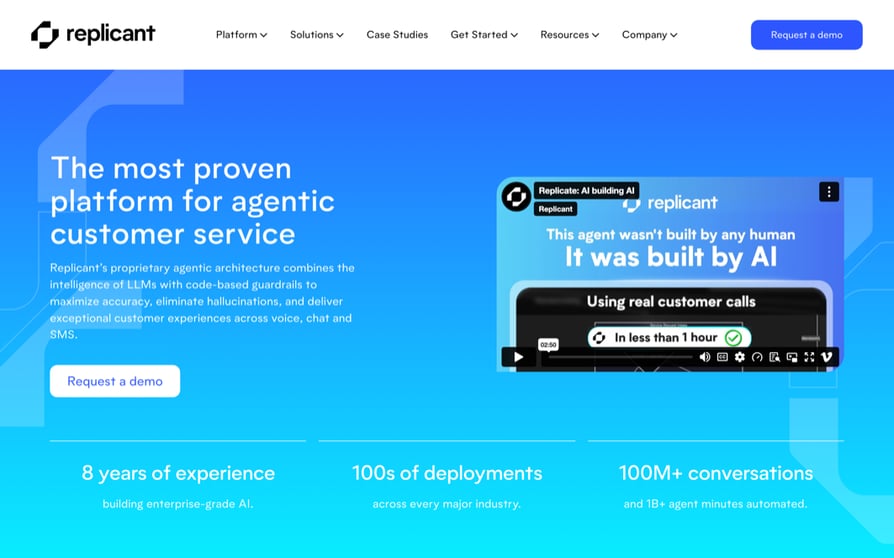
Replicant is an enterprise conversational AI platform for contact centers, founded in 2017 by Gadi Shamia and Benjamin Gleitzman and based in San Francisco. It automates service conversations across voice, chat and SMS, using intent detection and entity recognition to authenticate callers, resolve routine requests end to end, and hand the rest to a human with the context attached. Two pillars carry the platform: Conversation Automation resolves interactions, and Conversation Intelligence scores them.
Replicant sells to large enterprises in insurance, healthcare and retail that run high-volume service operations. That target market is the single most useful fact in this article, because it explains the pricing, the sales-led process and the implementation scope all at once. This was not built for small or mid-size teams, and it isn't priced as though it were.
Replicant Business Info
Replicant raised more than $110 million, per PR Newswire's release on the Series B and TechCrunch's April 2022 report, a $78 million round led by Stripes at a reported $550 million post-money valuation. No round has been announced since. Replicant publishes seven use cases, including appointment scheduling, FAQ handling, authentication, billing and call routing, plus seven verticals, and it names Fanatics, DoorDash, Sunrun, CAA Club Group and Southwest Medical Imaging among its customers.
Replicant's own pages put numbers on the scale: more than 100 million conversations handled, more than 1 billion agent minutes automated, and a stated ability to resolve up to 80% of customer service conversations, all read at source on 31 August 2026 and all vendor self-reported.
Define containment yourself before the contract defines it for you, because call deflection and a resolved issue look identical in a monthly report, and only one of them keeps the customer. Deployment counts move around too: Replicant's Replicare page says "100+" while its platform page says "100s of", so we use the lower, more specific figure.
More Data, Anyone?
Gartner's March 2025 prediction on agentic AI in customer service1 has agentic AI autonomously resolving 80% of common customer service issues without human intervention by 2029, driving a 30% reduction in operational costs.
Who Is Replicant AI Best Suited For?
- Large enterprises running high volume across voice, chat and SMS, with budget committed to a multi-year automation program. These buyers already know their tier-1 call mix: order status, billing questions, appointment changes, the same fifteen intents on repeat. They have the internal resources to scope a deployment, the call volume to make usage-based billing pay off, and a procurement cycle that expects a custom quote. Our Replicant AI pricing guide walks through what that commitment looks like at 300 agents and at 500+.
- Organizations already standardized on established contact center infrastructure, particularly NiCE CXone, that want a certified AI layer instead of a rip and replace. Replicant became a certified NiCE DEVone partner in June 2025, which means CXone Mpower customers deploy against a validated integration rather than funding custom development work. If you have spent years configuring a CCaaS platform, that certification removes the single biggest objection to adding voice AI on top.
Insurance carriers, healthcare systems and large retailers are Replicant's named target markets, and healthcare buyers in particular should weigh it against the field in our roundup of the best AI voice agents for healthcare.
Not at that scale yet?
How Does Replicant AI Work?
Replicant contact center automation works in three moves: understand the caller, resolve what it can, hand over what it can't. The automation layer was built for messy human speech rather than menu selections, so it works through colloquial phrasing, accents and technical vocabulary at conversational speed. Every vendor in this category states that goal, so test it on your own call recordings during a pilot.
Replicant's Conversation Handling
Replicant calls its core AI the Thinking Machine, and the name is trademarked rather than a nickname. The company describes a proprietary natural language understanding engine built on intent detection and entity recognition, one that reads context and replies within a second to hold life-like conversations over phone, SMS and chat. The design goal is a caller who explains a problem in their own words instead of pressing 3 for billing.
Two published claims matter when you're assessing call quality. Replicant reports inference accuracy above 96%, and says the engine handles multi-intent questions while picking out places, names and dates in context. A caller who says "I need to move my Tuesday appointment in Sacramento to sometime next week" is asking three things at once, and that sentence is where rigid menu trees fall apart. A shared intent library carries those resolutions across languages and channels, so a customer can start on the phone and finish over SMS.
Replicant also tells callers what they're talking to. The opening greeting states outright that the caller has reached a Thinking Machine, and CEO Gadi Shamia has described the system as something the company maintains and improves with collected data rather than software that ships once and stops changing. For regulated industries, that disclosure default removes a compliance argument before it starts.
One caution on all of it: most of this technical positioning comes from company material published between 2021 and 2023, and Replicant's newer announcements use broader language. Ask the sales team directly how the engine is built today, what the current accuracy benchmark measures, and how it performs on your caller base rather than on an average one.
Escalating a Call
Because Replicant integrates with the CRM and the contact center platform, it can authenticate a caller, resolve routine requests, and escalate the rest with the conversation already summarized. Escalation design matters more than the headline resolution rate, because that rate is an average and the escalation path is what happens on your worst call. The accuracy and limitations of voice AI are broadly the same across the category, so the real test is what a system does when it hits them. Four questions for any vendor here:
- What conditions force an escalation, and can we edit those rules ourselves?
- What exactly does the agent see at the moment of handoff?
- What happens when the AI is confident and wrong, and how would we spot it?
- How is a failed attempt logged, and does it count against the containment rate we're billed on?
Time to Deployment
Replicant call center automation is a project, not a signup, and it carries a one-time fee that reportedly starts in the thousands. Replicant advertises deployment in six weeks and calls it the fastest in the market, while our own pricing research puts three to four months on reaching peak performance.
Replicant's current marketing adds a third number that's easy to confuse with the other two: its platform page promises an agent built "in less than 1 hour". That's a testable agent, not a deployment your customers get routed to. Going live and working well are different milestones, and teams burn the pilot budget in the gap between them.
Key Features of Replicant AI
Conversation Automation
Conversation Automation is the pillar that resolves interactions, running voice, chat and SMS from one platform with consistent handling across all three. That helps when a customer switches channel mid-issue. Two commercial details shape the quote: chat and SMS are add-ons at every tier, and anything beyond six languages is Enterprise-only. Multilingual deployments are real, and Sunrun's published outcome covers English and Spanish payment calls, but if your caller base needs a seventh language you're making that call at contract stage.
Conversation Intelligence
Conversation Intelligence is Replicant's second pillar, and it scores every interaction rather than sampling a slice of them. That's how QA gets from anecdote to trend, and it's what turns call center analytics into something you can act on. What Replicant doesn't publish is how configurable the scoring is, or whether you can pull the raw interaction data out, so ask for both in a live session with your own calls.
Inbound and Outbound Use Cases
Replicant publishes seven use cases spanning both directions of the queue: authentication, intent gathering and routing, order status, returns, billing, FAQ handling and appointment scheduling. Outbound work sits in the same platform, which is why our pricing research models a pilot on scheduling plus outbound rather than inbound alone. For a buyer, the practical value is that one contract covers the repetitive inbound volume and the proactive campaigns that usually need a second tool.
The caution is scope creep. Every additional use case is configuration work, and each one lands inside an implementation you're already paying for. Pick the one or two intents with the highest volume and the lowest variation, prove containment there, and expand from a working baseline rather than launching seven at once.
Contact Center Integration
In Deloitte Digital's 2026 global contact center report2, leaders falling behind on AI named integration of technology, systems and tools as their biggest challenge at 72%, ahead of legacy systems at 58% and data security and compliance at 53%. That's what makes a certified integration worth paying for, because contact center integration work is where project timelines quietly go. Replicant's NiCE DEVone certification for CXone Mpower, announced 30 June 2025, means the connector cleared the platform vendor's own certification rather than being built by your engineers.
| Category | Published integrations |
|---|---|
| CCaaS | Ujet, Talkdesk, NICE inContact, Genesys, Five9, Amazon Connect, 8x8 |
| CRM | Zendesk, ServiceNow, Salesforce, Kustomer, Gladly |
| ERP and iPaaS | PeopleSoft, SAP, Mulesoft |
| POS | Stripe, Shopify |
| Telephony | Telnyx, Spectrum, Cisco, Avaya |
| Channels | Voice, chat and SMS from one platform, with chat and SMS as paid add-ons |
| Analytics | Per-conversation scoring across every interaction via Conversation Intelligence |
One small tell: the integrations page still lists NiCE under its legacy NICE inContact name.
Replicant Deployment Tech Needs
Replicant runs on guided delivery rather than a self-serve dashboard, by design. Replicare exists because enterprise buyers value having people configure and troubleshoot alongside them, and it prices that help as one flat annual fee instead of statements of work and change orders. Guided delivery is a legitimate reason to pick a vendor, not a consolation prize. The trade-off is that changes to conversation logic route through Replicant rather than an admin screen you control, so get the scope of "everything needed to deploy, maintain and continuously improve" in writing.
Want to see the feature list run on your own calls?
Replicant AI Pricing
Why Is There No Public Replicant AI Pricing?
Because it's expensive. There's no published Replicant AI pricing at any tier. Quotes are built from call volume, use cases, integrations and contract length, and billing is usage-based on resolved calls or productive minutes, on top of a one-time implementation fee.
Three plans exist: Quick Start, Professional and Enterprise. Replicare is often mistaken for a fourth, but it's a delivery model, described by Replicant as one flat annual fee covering everything needed to deploy, maintain and improve your AI agents. Replicant also publishes a money-back guarantee it says has never been used, worth asking to see in contract language.
If You're Interested...
Gartner's March 2026 prediction on customer service technology spend1 has more than half of customer service organizations doubling that spend by 2028 without an equivalent reduction in talent.
What Does a Replicant Deployment Actually Cost?
These profiles come from CloudTalk's published Replicant AI pricing guide, which models deployment cost rather than list prices.
| Deployment profile | What our research puts against it |
|---|---|
| 50-agent pilot, scheduling and outbound, 8,000 to 10,000 calls a month, one CCaaS integration | A meaningful implementation fee lands before value is proven. Negotiate the Professional upgrade path into the first contract. |
| 150-agent contact center automating order status, returns and FAQ | Our guide models this profile but attaches no dollar range to it, because the variables at this size swing too widely to publish one honestly. |
| 300-agent healthcare organization on Enterprise, HIPAA required, roughly 200,000 calls a month, 15+ languages | $400,000 to $600,000+ per year across implementation, platform and usage. |
| 500+ agents, three regions, full voice, chat and SMS stack, PCI compliance, 3M+ annual calls | Year one can reach seven figures. Replicare starts to make sense here, trading usage variability for predictability. |
What Should You Ask Before Signing a Usage-Priced Contract?
Opacity is the complaint people voice. Commitment risk is what costs money, and it cuts both ways: you can overbuy capacity you never consume, or land on a tier that turns out too small and find out at peak season. Take these to any usage-priced vendor and treat a vague answer as a finding:
- Can we see a live counter of billable usage, updated close to real time?
- Do we get alerts as we approach a committed cap, and at what thresholds?
- Is there a hard switch to allow or block spend past the limit?
- Is there a written ceiling on overage charges?
- What happens to unused committed volume at the end of the term?
Is Replicant AI Free?
No. There's no free tier and no self-serve trial, and engagement normally starts with a scoped pilot. If your process depends on getting hands on the product before a commercial conversation, that's a structural mismatch rather than a detail to negotiate.
Size the cost before anyone quotes you
What Buyers Say About Replicant AI
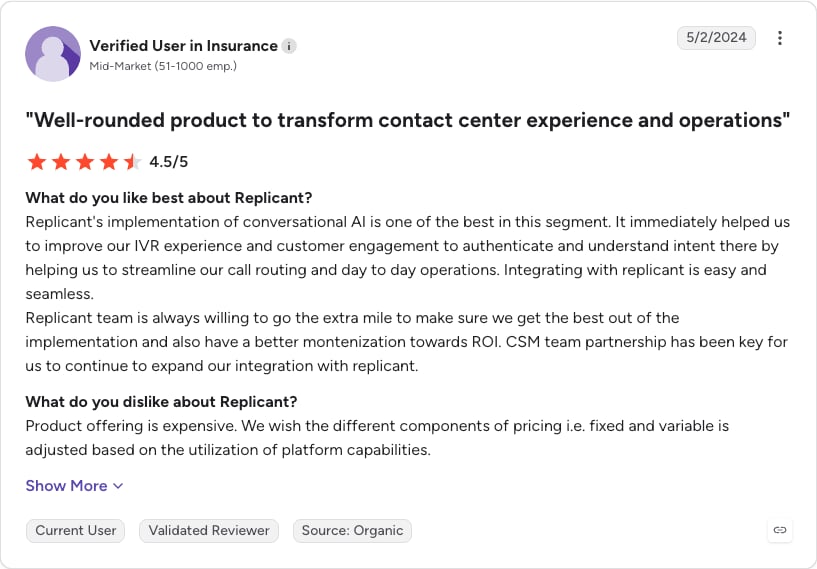
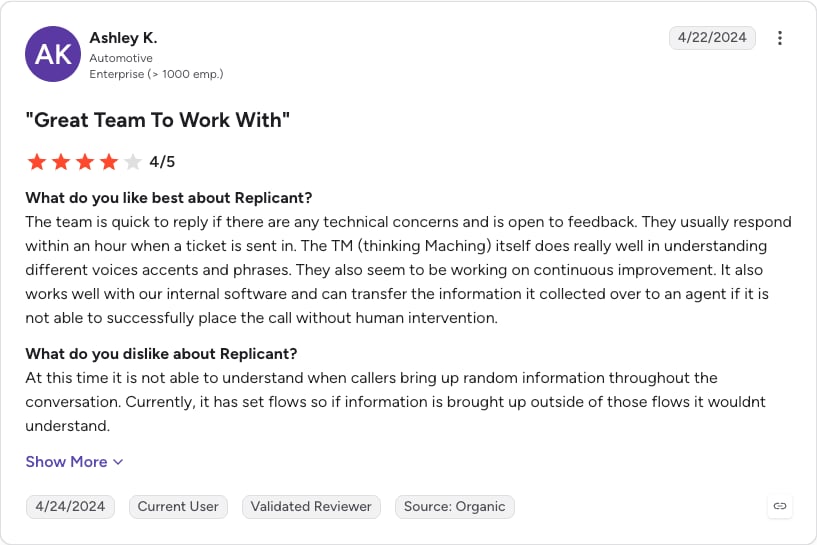
Anyone searching Replicant AI reviews 2026 lands on the same four places. Aggregate Replicant customer reviews live on Gartner Peer Insights, G2, Capterra and Software Advice, and this article links those platforms rather than reproducing numbers we haven't read. Our writers don't scrape review platforms, and we hold no cached Replicant review data, so we publish no rating or review count for Replicant here. Sending you to the source beats printing a figure we can't stand behind.
What Do Reviewers Praise?
- Patience through a long evaluation. One reviewer describes taking a long time to reach a decision and never being pushed, which matters when the purchase needs internal sign-off from several people.
- Hands-on implementation rather than a handover. Reviewers describe Replicant staying involved through the build, including custom reporting and self-service views set up for them.
- Cost per contact against a human baseline. The recurring value framing in reviews is not "cheap" but "cheaper per minute than staffing the same volume."
- A fit for teams new to conversational AI. Guided delivery reads as an asset for buyers without an in-house automation team.
Points of Friction
- Pricing you can't model before a sales call. Custom, usage-based and scale-dependent, with no published entry point.
- Real investment before value is proven. The implementation fee and the internal staffing both land ahead of the first resolved call.
- ROI that depends on containment holding. The business case works while the AI resolves; a few points of slippage moves the whole calculation.
- Language coverage as a contract-stage decision. Anything past six languages sits on Enterprise, which is an awkward discovery mid-deployment.
Is Replicant AI legit? Yes. PR Newswire and TechCrunch both confirmed the San Francisco headquarters and the $78 million Series B led by Stripes in April 2022, the customer list is named, and the NiCE DEVone certification was announced in June 2025. On pricing sentiment, our own published research found what you'd expect from a usage-priced contract: buyers who commit report real returns when containment holds, and value is deployment-specific enough that modeling your own scenario beats reading someone else's. Our AI voice agent ROI calculator runs that arithmetic on your own volume.
What We Could Not Verify
Two widely repeated claims didn't survive checking, and any Replicant AI honest review should say so. The first is a 65% automated order-placement success rate paired with a 50% cost reduction, which traces to a case study for a brand that has since wound down and appears nowhere on Replicant's site today. Its currently published outcomes are different figures, all vendor self-reported: Sunrun at a 50% call resolution rate on automated payment calls, CAA Club Group doubling call completion, Southwest Medical Imaging answering 20% more calls, and a published $1.5 million annual saving.
The second is the corporate trivia copied between directory pages: 200+ deployments, 6+ years in business, $113 million raised, roughly 170 employees. Replicant's own site says 100+ deployments and 8 years, press coverage says more than $110 million, and the headcount figure has no primary source at all.
When the ratings aren't there, run the test yourself
Replicant AI Review: 6 Must-Have Business Requirements
Six dimensions decide whether a voice AI platform survives contact with a real queue. Here's how Replicant reads against each, and what to test rather than take on trust.
Call Quality and Resolution
This is the strongest part of the product. Replicant publishes named-customer outcomes rather than category averages, and the engine is built for multi-intent, colloquial speech instead of menu selection. What you can't do from the outside is separate the platform's contribution from the configuration work that went with it. Bring twenty recordings of your hardest calls to the pilot, including the ones with background noise and interruptions, and measure resolution on those rather than on a scripted demo.
Usibility
Replicant is an enterprise deployment, not a dashboard you learn in an afternoon. Reviewers consistently describe the implementation as supportive and patient, which offsets genuine complexity, but the model is guided delivery: conversation logic changes route through Replicant rather than an admin screen your team controls. Ask exactly which changes your own people can make without a ticket, because that answer determines how fast you can iterate after go-live.
Developer and Integration Capabilities
The certified NiCE CXone Mpower connector is the headline, and the published list spans CCaaS, CRM, ERP, iPaaS, POS and telephony. The commercial catch sits in the tiers rather than the technology: Professional allows two integrations, so an authentication flow that touches a CRM, an order system and a payment processor is an Enterprise conversation. Verify depth, not just presence, for your specific stack, because a listed integration and a production-grade one are different things.
Language Support
Replicant runs multilingual deployments in production, and Sunrun's published outcome covers English and Spanish payment calls. Six languages is the practical ceiling below Enterprise. Coverage is also not the same as quality: ask for sample calls in each language you need, handled by the same configuration you'd be buying, and listen for how the engine copes with accents and code-switching rather than with clean studio speech.
Replicant AI Reviews: Customer Support Engagement
Support is the most consistently praised dimension in every set of reviews we read. Buyers describe professionalism through a long pre-sales evaluation and continued involvement after signing, including custom reporting built for them. Replicare formalizes that as a flat annual fee covering deployment, maintenance and improvement. Get the SLA structure for your expected contract size in writing, and ask what response times look like outside your own business hours if you run a follow-the-sun queue.
Reporting Visibility Do You Get
Conversation Intelligence scores every interaction rather than a sample, which is a real advantage over QA built on spot checks. Two things Replicant doesn't publish decide how useful that is: how configurable the scoring criteria are, and whether you can export raw interaction data into your own warehouse. Both are worth resolving before signing, because a scoring model you can't adjust or extract becomes someone else's definition of quality applied to your customers.
Who Should (and Should Not) Use Replicant AI?
Best Fit: Where Replicant Works
- Large enterprise contact centers with high, repetitive volume. Order status, billing, scheduling and authentication at hundreds of thousands of calls a month is where containment economics work.
- Organizations already on NiCE CXone. A certified Mpower integration removes the most expensive unknown in the project plan.
- Regulated operations in healthcare, insurance and financial services. PCI DSS and HIPAA handling plus published PII redaction make Replicant viable where most conversational AI vendors aren't. If healthcare is the entire use case, our guide to AI voice agents for healthcare covers the narrower field.
- Teams running a formal, requirements-first evaluation. If you already filter a shortlist on capability and take price second, a sales-led process is how enterprise software normally gets bought, not a red flag.
Poor Fit: When to Look Elsewhere
- Small and mid-size teams. Implementation fees in the thousands before any usage cost, with no published entry price, isn't a scale-down proposition.
- Anyone who wants to prove value before committing. Buyers routinely want to run real volume, see the numbers, then scale. No trial means committing in the opposite order.
- Teams that need predictable pricing. If finance needs a per-unit cost it can model before a vendor call, this process will frustrate everyone.
- Operations that can't staff an implementation. Six weeks to deploy still assumes your people are free for scoping, integration and testing.
Replicant AI: Industry and Use Case Fit
| Industry or use case | Fit assessment |
|---|---|
| Large insurance carriers: claims and policy inquiries | Strong. A named target vertical, with the authentication and compliance handling the work needs. |
| Large healthcare systems: scheduling, billing, status | Strong. HIPAA sits on Enterprise, and Southwest Medical Imaging is a named customer. |
| Large retail and ecommerce: order status and returns | Strong. High repetition and low variation is exactly where containment economics hold. |
| Organizations already running NiCE CXone | Strong. The certified DEVone integration is the clearest reason to shortlist Replicant over a rival. |
| Mid-size businesses without enterprise budgets | Weak. Pricing and implementation scope both assume a large deployment. |
| Teams needing fast, self-serve evaluation | Weak. Fully sales-led, with no public trial and no self-serve signup. |
| Budget-conscious teams wanting transparent pricing | Weak. Nothing is published at any tier, so every comparison starts with a sales call. |
One more reason to stress-test the business case: a Gartner survey of 321 customer service and support leaders1, conducted in October 2025, found that only 20% had cut agent headcount because of AI, while 55% reported stable staffing while handling higher volumes. If your model assumes headcount savings pay for the contract, budget for absorbed capacity instead.
Too small for Replicant, not ready to commit blind?
How Secure Is Replicant AI? Compliance and Data Privacy
This is the best-evidenced part of the page and a genuine strength. Replicant's own security page states SOC 2 Type 2, PCI DSS and HIPAA certifications, described as independently validated, alongside GDPR alignment and adherence to the NIST Cybersecurity Framework and AI Risk Management Framework. On the technical side it publishes Google Cloud hosting, AES-256 at rest and TLS 1.2+ in transit, role-based access control with MFA, automatic redaction of PII and payment data, and a commitment that customer data is never used to train public models. That last one is the question every legal team asks first, and it's the same bar any HIPAA-compliant call center has to clear. Note that PCI and HIPAA coverage sits on the Enterprise tier, so a regulated pilot on a lower tier isn't a route in.
What Should You Ask About Data Handling?
Certifications are the floor, not the answer. How secure your data is when using voice AI comes down to operational detail, and these are the questions that decide whether a regulated deployment gets approved:
- Where does recording start and stop, and who can change that setting?
- If a call is transferred outside the platform, does it stay traceable end to end?
- Who owns the phone numbers, and what happens to them if you leave?
- What's the retention policy for transcripts and recordings, and can you set it per region?
- Where does data reside, and can residency be pinned per market for GDPR purposes?
Pros and Cons of Replicant AI
Read the columns together rather than counting them. The pros are all product; the cons are all commercial. That distinction matters more than the tally when you're building a call center software shortlist, because product problems get fixed in a release and commercial ones get fixed in a renegotiation.
| Pros | Cons |
|---|---|
| Detailed compliance posture: SOC 2 Type 2, PCI DSS, HIPAA, GDPR, both NIST frameworks, no training on customer data | No published pricing at any tier, and no trial |
| Certified NiCE DEVone partner for CXone Mpower since June 2025, plus a broad connector list | Commitment risk both ways: Quick Start caps at 10 concurrent calls, Professional allows two integrations |
| Established and funded: founded 2017, more than $110 million raised, 100+ deployments claimed | Real implementation cost and time before value is proven |
| Voice, chat and SMS automation plus a conversation intelligence layer scoring every interaction | Chat and SMS are add-ons at every tier; PCI, HIPAA and languages beyond six are Enterprise-only |
| Guided delivery through Replicare, a flat annual fee positioned against change orders | ROI depends on containment holding at your volume, and every published outcome is vendor self-reported |
CloudTalk publishes what most of this category doesn't
Best 4 Replicant AI Alternatives in 2026
Most Replicant AI alternatives lists have a structural problem: several platforms named as competitors are also Replicant's distribution. Replicant integrates with Genesys, Five9 and NiCE, and it has been a certified NiCE DEVone partner for CXone Mpower since June 2025, so for a NiCE customer those two are as much a stack as a choice.
Two axes separate this field. The first is the channel spectrum: Replicant is voice-first and so is PolyAI, Sierra and Decagon both started in chat and added voice later, and NiCE is multichannel by inheritance. The second is whether you can read a price at all. Every cell below was verified at each vendor's own site on 31 August 2026, and where a vendor publishes no rate, the cell says so instead of repeating a third-party estimate.
| Alternative | Channel spectrum | Pricing model | Self-serve entry | Contact center integration | Deployment scale and best fit |
|---|---|---|---|---|---|
| CloudTalk | Voice-led, plus SMS and WhatsApp | Published: Starter $25, Essential $29, Expert $49 per user/month annually. AI Voice Agents always a paid add-on, from $99/month for 200 minutes | Yes for the platform: open sign-up, 14-day trial, published pricing. The AI add-on is scoped with sales | Native platform with 100+ integrations | SMB to mid-market. A different weight class, offering a Replicant evaluator a price you can read |
| PolyAI | Voice-first omnichannel, with chat, SMS and WhatsApp off the same agent | Per minute of voice agent usage. The model is published; no dollar figures are | Partly. Agent Studio sign-up is open; pricing is not | Layers onto your existing telephony and CCaaS | Enterprise. The closest like-for-like to Replicant |
| Sierra | Chat-origin multichannel. Voice is a full product, with 55+ languages and PCI-compliant payments, but it arrived after chat | Outcome-based by default, per resolved outcome, with consumption pricing for routing traffic. No rate card, no pricing page | No, sales only | Layers onto existing helpdesk and CRM | Large enterprise. The sharpest contrast with usage billing if you'd rather pay on results |
| Decagon | Chat-origin multichannel. Out of stealth June 2024 on chat; Decagon Voice launched 24 February 2025 | Per-conversation by default, a fixed rate on every incoming conversation, with per-resolution available. No rate card | No, demo only | Layers onto your existing helpdesk, CRM and telephony | Enterprise. Strongest where digital deflection is already the priority |
| NiCE CXone Mpower (AI Agents for Self-Service, previously Autopilot) | Multichannel, inheriting the platform's own omnichannel routing | The only list pricing here: $110 to $249 per agent per month across five suites. Whether the AI agent is included or costs extra is not published | No, quote only | Native, because it is the contact center | Enterprise. You aren't layering AI onto your contact center, you're buying the contact center |
Two things that table is telling you. Voice-first is now the minority position, three of five having started somewhere else. And only two of five publish a number: PolyAI, Sierra and Decagon each publish a pricing model with no rate attached. Third-party figures circulate for all three, none sourced, and we left them out rather than launder a guess into a table.
NiCE is a competitor and a channel at once. It closed its roughly $955 million acquisition of Cognigy in September 2025, which is why Cognigy has no separate row, and Replicant's DEVone integration runs on that same platform.
Why Choose CloudTalk Instead?
Choose CloudTalk instead of Replicant if you are a small-to-medium-sized sales and support operation that wants to know what it will pay upfront and if you need a comprehensive telephony tech stack that fully integrates with your AI voice agents. CloudTalk also has 160+ international numbers so you can have a local presence from...almost anywhere.
Replica delivers documented results for large enterprises willing to commit to a contract that can run into six or seven figures a year, and its hands-on delivery is a real asset for a team new to conversational AI.
Signature Capability
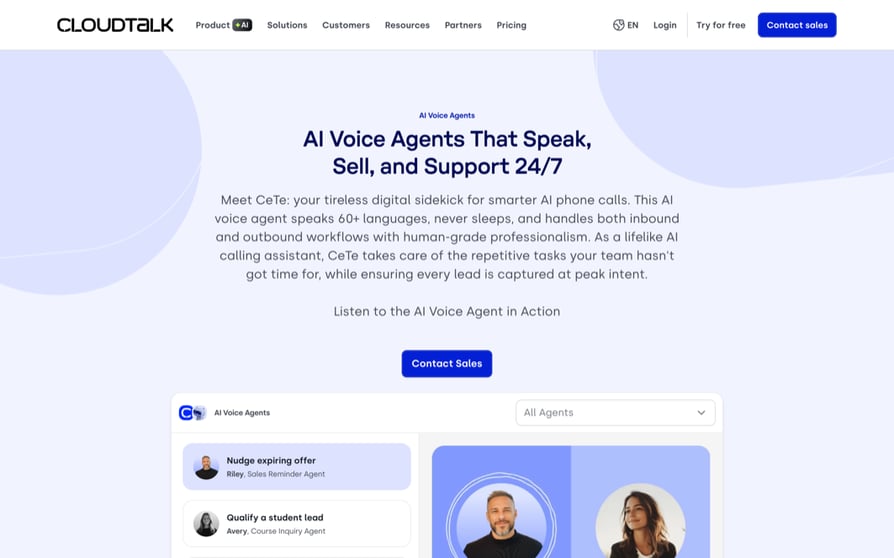
See CloudTalk’s AI Voice Agent in Action!
CeTe is an AI that talks like a human: no breaks, no training, no time off. It makes and answers calls, updates CRMs, books meetings, and loops in a human only when needed.
Press play to hear it. Want a wow moment? Get a free test call and try it live.

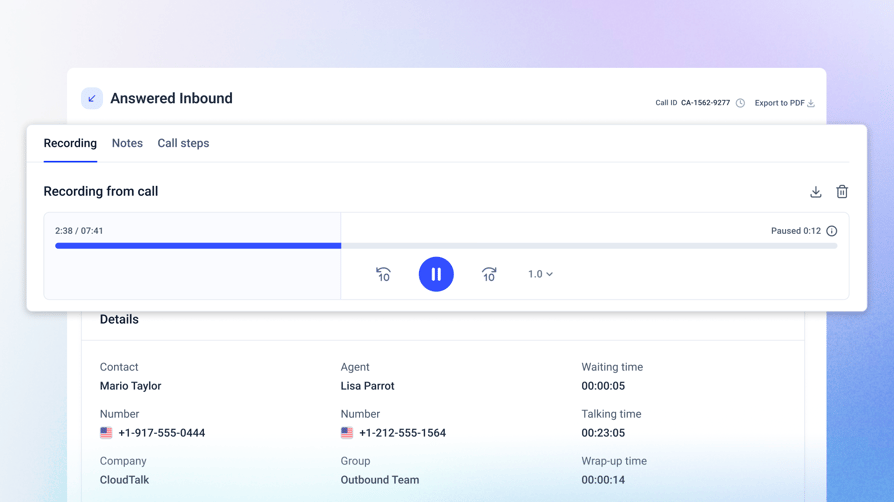
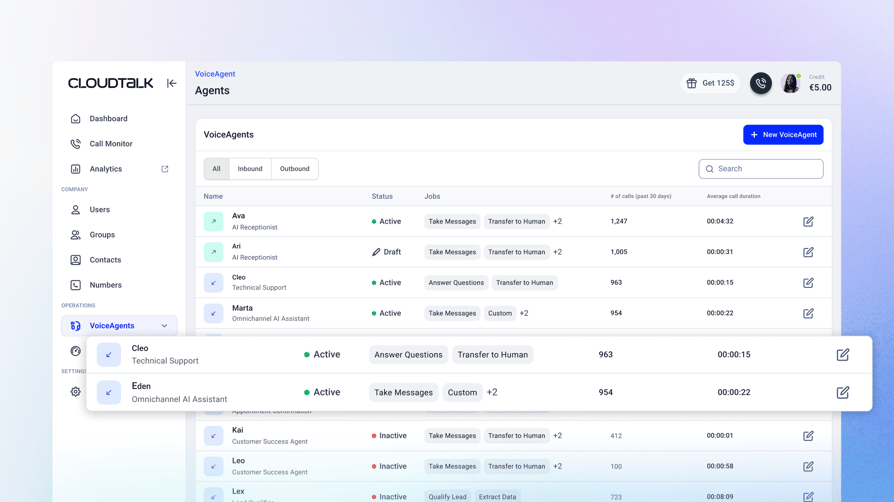
CloudTalk's AI Voice Agent holds a free-flowing two-way conversation rather than traditional IVR (Interactive Voice Response). It understands intent, asks follow-up questions, pulls answers from a knowledge base, executes actions in connected systems such as booking a meeting or creating a CRM record, and escalates to a human only when needed. It's a paid add-on rather than part of a plan, and CloudTalk's sales team sets it up with you.
Replicant vs CloudTalk: Feature and Capability Comparison
| Capability | Replicant | CloudTalk |
|---|---|---|
| Pricing transparency | None published. Pricing URL redirects to a request form | Published plans: Starter $25, Essential $29, Expert $49 per user/month |
| AI voice agent cost | Usage-based, custom-quoted, on top of implementation | A published paid add-on, never bundled into a plan, starting at $99/month for 200 minutes |
| Minimum commitment | A scoped pilot with a one-time implementation fee reportedly starting in the thousands, on a custom contract term | No minimum contract size. Run one AI agent on one use case and expand when it works |
| Trial | None | 14-day free trial of the CloudTalk platform. AI Voice Agents is added as a paid add-on with our team |
| Time to first call | Six weeks advertised, three to four months to peak performance | Same-day setup on a self-serve CloudTalk plan; the AI Voice Agents add-on is configured with our team |
| Channel coverage | Voice, chat and SMS, with chat and SMS as add-ons | Voice-led, plus SMS and WhatsApp messaging |
| Integrations | Broad connector list, two integrations on Professional | 100+ native integrations, from the Essential plan |
| Support model | Guided delivery. Conversation logic changes route through Replicant, with Replicare available as a flat annual fee | Self-serve admin with 24/7 support, and hands-on setup for the AI add-on |
| Compliance | SOC 2 Type 2, PCI DSS, HIPAA, GDPR, NIST CSF and AI RMF | SOC 2 Type 1 and Type 2, GDPR, and HIPAA compliant with BAA support |
| Scale fit | Large enterprise, hundreds of agents upward | SMB through mid-market, 5,500+ customers in 100+ countries |
Replicant vs CloudTalk: Pricing and Accessibility Compared
The gap isn't only the number, it's when you get to see it. Replicant's cost arrives after discovery, scoping and a quote, built from your call volume and use cases: our research puts a 300-agent healthcare deployment at $400,000 to $600,000+ a year and a 500+ agent rollout into seven figures in year one. CloudTalk publishes plan prices and the AI Voice Agents starting rate, so finance can build the business case the same afternoon the requirement lands.
That changes the evaluation clock more than the invoice. A team on CloudTalk can sign up, port a queue, run real calls for two weeks and decide, while an enterprise procurement cycle is still scheduling the second discovery call. Neither path is wrong. At 500 agents under PCI across three regions, the long path is the correct one. At 40 agents, spending a quarter to find out what something costs is the expensive option, whatever the eventual price turns out to be.
Where CloudTalk Fits Better
- You can model the cost before the call. Plan prices and the AI Voice Agents starting rate are both published, so finance builds the case without a vendor session.
- Evaluation takes days, not quarters. A 14-day free trial and numbers across 160+ countries mean you test the phone system on real calls before you scope the AI add-on.
- No minimum contract. Run one AI agent on one use case and expand when it works.
- Guidance is available, not absent. Support runs 24/7, and pre-built templates cover common jobs like appointment scheduling and lead qualification, with the rest of the AI voice agent use cases in the library.
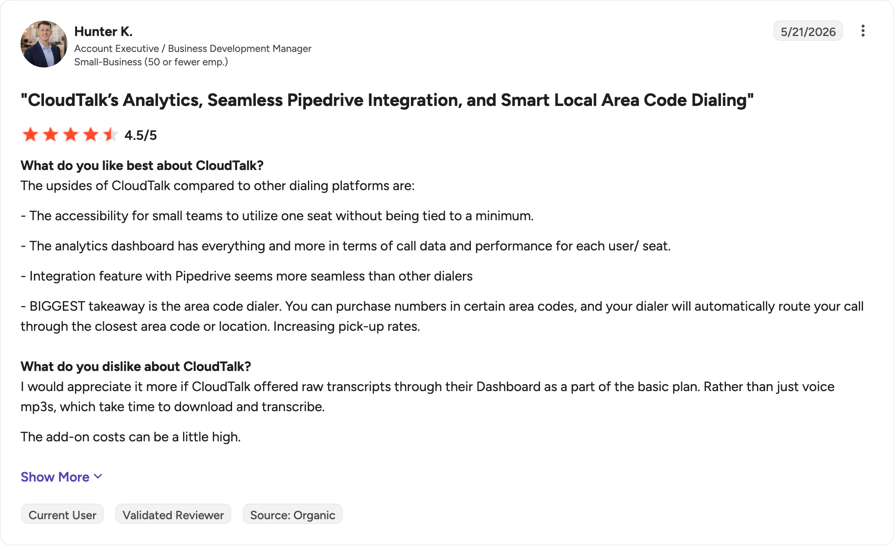
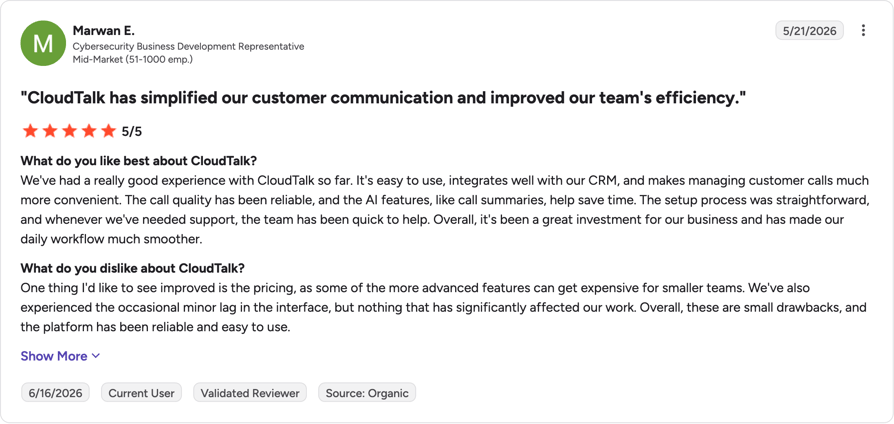
<strong>Customer story:</strong>
A high-volume services provider deflected nearly 40% of its inbound calls with CloudTalk's AI Voice Agent, which is the same containment job Replicant's enterprise contracts are sold on.
Replicant wins on scale, on its certified integration with a major incumbent platform, and on a compliance posture built for regulated volume. At 500 agents across three regions under PCI, this comparison isn't close.
Final Verdict: Should Replicant AI Be on Your Shortlist?
Replicant is a good product sold in a way that filters out most of the market. The platform is real, the compliance work is thorough, the NiCE certification is recent and meaningful, and the customer list isn't decorative. What you can't do is find out what it costs, or whether it works on your calls, without entering a sales process first.
Good Fit For
- Enterprises with high-volume, multi-channel service operations and a dedicated automation budget
- Insurance, healthcare and retail operations with routine requests suited to automation
- Teams already on NiCE CXone that want a certified AI layer
- Organizations able to staff a multi-month implementation from the inside
Not a Good Fit For
- Small and mid-size teams without enterprise budgets, who should start with CloudTalk instead
- Buyers who want to self-serve, test and see a real price before a sales conversation
- Anyone needing a fast, low-commitment deployment rather than a multi-year initiative
- Finance teams that need predictable per-unit costs rather than a scale-dependent quote
If you match the best-fit profile, shortlist Replicant and take the five pricing questions with you into the first call, then hold the answers up against published AI voice agent pricing to see what the opacity is actually costing you. If you don't match it, you're not the buyer this was built for, and no amount of product quality changes that.
Replicant facts marked as read at source were verified on 31 August 2026.
Put a number on it before the procurement cycle starts
Sources
- Gartner, January 2026: GenAI cost per resolution for customer service will exceed offshore human agent costs by 2030
- Gartner, March 2025: Agentic AI will autonomously resolve 80% of common customer service issues by 2029
- Deloitte Digital, 2026 global contact center survey
- Gartner, March 2026: Over 50% of customer service organizations will double their technology spend by 2028
- Gartner, December 2025 survey of 321 customer service and support leaders, conducted October 2025
Replicant AI Reviews: Frequently Asked Questions
The questions buyers ask most before a first call with Replicant: what it costs, who's behind it, who it fits, and how it compares.
Replicant AI is an enterprise conversational AI platform that automates contact center conversations across voice, chat and SMS. It works like a virtual agent layered on the contact center you already run.
No. Replicant is the San Francisco contact center automation company covered here. Replit is a browser-based coding platform, Replicate hosts models, and Replicant is also the name of an unrelated free Android operating system. The names collide; the products don't.
Replicant publishes no price at any tier, and its pricing URL redirects to a request form. Billing is usage-based on resolved calls or minutes, plus a one-time implementation fee. Our worked scenarios put a 300-agent healthcare deployment at $400,000 to $600,000+ a year, and a 500+ agent rollout into seven figures in year one.
Yes. Replicant was founded in 2017, is headquartered in San Francisco, and raised a $78 million Series B led by Stripes in April 2022, confirmed by both PR Newswire and TechCrunch. It names Fanatics, DoorDash and Sunrun among its customers.
Both published answers are accurate. TechCrunch's April 2022 coverage names four co-founders: Gadi Shamia, Andrew Abraham, Benjamin Gleitzman and Jack Abraham. Replicant's own about page names only two, Shamia as CEO and Gleitzman as CTO.
Usually not. Replicant is priced for large enterprise contact centers, with no published entry price, no free tier and implementation fees reportedly starting in the thousands. Below a few hundred agents, AI voice agents for SMB are a more realistic start.
The individual Replicant reviews 2026 buyers can read on G2 and Gartner Peer Insights are positive, praising patience through a long evaluation and hands-on implementation support. Friction shows up on the commercial side: opaque pricing, real upfront investment, and ROI that depends on containment holding at your volume. We publish no aggregate rating, because we could not verify one.
PolyAI, Sierra, Decagon, NiCE CXone Mpower and CloudTalk. PolyAI is the closest like-for-like: voice-first, enterprise, per-minute, no public rate card. NiCE is the CCaaS option and the only one publishing list prices.
They sell to different buyers. Replicant is an enterprise automation layer with custom usage-based pricing and no trial. CloudTalk publishes plans at $25, $29 and $49 per user per month, with AI Voice Agents as a paid add-on from $99/month, and a 14-day free trial of the platform.