OpenPhone (Quo) vs RingCentral 2026: Simplicity or Feature-Rich?
TL;DR
- RingCentral offers a broader business communications suite. It combines calling, video, messaging, advanced routing, contact center features, integrations, and enterprise security options.
- OpenPhone (Quo) focuses on simplicity, texting, and AI. It offers transparent pricing, shared numbers, unlimited US and Canada texting, and Sona AI across its plans.
Choose RingCentral for advanced calling, collaboration, and contact center workflows. Choose Quo for a simpler phone system with stronger texting and accessible AI.
This RingCentral vs. OpenPhone (Quo) comparison looks at 2026 pricing, features, integrations, security, usability, scalability, and user reviews to help you decide which platform fits your team better.
OpenPhone (Quo) vs. RingCentral Comparison At a Glance
Quo is built around simple pricing, business texting, and easy-to-manage phone features. RingCentral covers a broader set of business communications needs, including video, desk phones, international calling, and advanced routing. The table below breaks down the key differences across pricing, messaging, AI, calling, and platform capabilities.
| Dimension | OpenPhone (Quo) | RingCentral | Winner |
|---|---|---|---|
| Entry price (annual) | $15 per user/month on Starter | $20 per user/month on Core | Quo, for teams watching every seat on the bill |
| Month-to-month price | $19 per user/month | $30 per user/month | Quo, for teams that won't commit to annual billing yet |
| Business texting | Unlimited US and Canada messaging on every plan (fair use) | 25 texts per user/month on Core, 100 on Advanced, 200 on custom plans | Quo, for teams messaging customers in the US and Canada |
| Shared numbers | Up to 10 paid users per shared number on Starter, unlimited from Business | Share one phone number across multiple phones | Quo, for small teams working one shared line |
| AI cost structure | Sona included with 10 free calls a month; paid credit tiers from $25 to $199 a month | AI Assistant included; AI Receptionist from $39/month | Quo for low-volume AI call answering, RingCentral for included call notes plus paid conversation analytics |
| Video meetings | Not offered | Up to 300 participants on every plan | RingCentral, for teams replacing a separate video tool |
| Desk phones | Not offered | Cisco, Poly and Yealink | RingCentral, for offices and front desks |
| International reach | Local numbers in the US, Canada only, and Puerto Rico (only existing numbers) | 45 available countries | RingCentral, for teams with customers outside North America |
| Call routing depth | Phone menus from Business | Multi-level IVR on every plan; advanced queue routing from Advanced | RingCentral, for multi-department inbound routing |
| Security certifications | SOC 2 Type II, HIPAA with BAAs, GDPR, CCPA | ISO 27001, 27017, 27018 and 22301; SOC 2+ HIPAA report; SOC 3; HITRUST; C5 | RingCentral, for regulated or enterprise buyers |
| Uptime commitment | 99% claimed | 99.999% SLA | RingCentral, for buyers who need uptime in the contract |
OpenPhone (Quo) vs. RingCentral Features Comparison
The biggest differences show up in how each platform handles AI, calling, messaging, routing, and team collaboration. Here’s what each platform includes, where its feature set has limits, and which capabilities require a higher plan or an add-on.
What Are OpenPhone's (Quo's) Key Features?
Quo is built around shared numbers and team messaging. Its core features are designed for small teams that want everyone to work from the same phone numbers and text threads without managing a complex phone system.
What OpenPhone (Quo) Does Well
- Shared numbers and team inboxes: Multiple people can answer the same number, with shared threads, internal comments, and snippets.
- Unlimited business texting: Every plan includes unlimited US and Canada messaging under fair use.
- Built-in AI: Sona is available on every plan, with 1,000 free monthly credits and paid tiers for teams that need more AI call answering.
- HIPAA compliance: HIPAA compliance with BAAs is available from the Business plan, without requiring an enterprise contract.
Where OpenPhone (Quo) Falls Short
- No video calls: Quo doesn't have video calls in its platform, so you'll keep paying for a separate meeting tool.
- No desk phones: Quo runs on iOS, Android and desktop apps, and its own blog tells office teams that want physical handsets to look at an alternative.
- Local numbers limited to the US and Canada: Quo doesn't offer local international numbers, and it bills outbound international calls and texts by destination.
- Contact center features are limited: No power or parallel dialers appear on any plan, and Quo says it doesn't offer sales playbooks, AI CSAT or rep scorecards.
What Are RingCentral's Key Features?
RingCentral takes a broader approach. Its RingEX phone system combines calling with video and messaging, while RingCX adds dedicated contact center functionality for teams that need more advanced routing, analytics, and supervisor controls.
What RingCentral Does Well
- Advanced call routing: Multi-level IVR is available on every plan, with queue rules and supervisor controls on Advanced.
- Built-in video: Every plan includes video meetings for up to 300 participants.
- Desk phone support: RingCentral supports Cisco, HP Poly, and Yealink hardware, with rental options available.
- International coverage: RingCentral supports international numbers and broader global calling needs than Quo.
- Built-in AI: AI Assistant provides call transcription and real-time notes, with integrations for tools including ChatGPT, Claude, Gemini, and Copilot.
Where RingCentral Falls Short
- Core limits business texting: Enhanced Business SMS includes 25 texts per user per month on Core, rising to 100 on Advanced and 200 on the bundles.
- CRM integrations start on Advanced: Salesforce and Zendesk aren’t listed on Core, so teams that need those integrations have to move to Advanced at $25 per user/month billed annually.
- Advanced AI features cost extra: AI Receptionist is a $39 monthly add-on with 100 minutes, while AI Conversation Expert costs $60 per user/month on Core and Advanced.
- A shared SMS inbox costs extra: RingCentral’s Business SMS Booster adds a shared inbox, templates, and compliance tools for $25.
AI Features: Included vs. Add-On
Both Quo and RingCentral include AI with their base plans, but they focus on different use cases. Quo includes Sona, an AI voice agent, while RingCentral includes AI Assistant for call transcription and notes. RingCentral charges extra for AI call answering and conversation analytics.
| AI feature | OpenPhone (Quo) | RingCentral |
|---|---|---|
| AI call answering | Sona on every plan, with 1,000 free credits/month (10 calls) and paid tiers from $25/month | AI Receptionist from $39/month |
| Call transcripts & summaries | From Business for regular calls; Starter includes them for Sona-handled calls | Transcripts included on every plan through AI Assistant; summaries included in the AI Conversation Intelligence add-on from $60/user/mo |
| Conversation analytics | AI call tags from Scale | AI Conversation Expert: $60/user/month |
| How AI is priced | Usage-based: free credits, then $25–$199/month tiers | Feature-based: basic AI included, with call answering and analytics as add-ons |
OpenPhone (Quo) vs. RingCentral Pricing
Quo is more affordable at both the entry and month-to-month levels: $15 vs. $20 per user/month billed annually, and $19 vs. $30 month-to-month. Quo also publishes all three of its plans, while RingCentral moves its Customer Engagement bundles and accounts with more than 100 seats to quote-only pricing.
How Much Does OpenPhone (Quo) Cost?
Quo pricing has three plans billed per user, starting at $15 per user/month when billed annually. It also publishes monthly pricing for all three plans, with no quote-only tiers or published seat minimum. It also offers a 7-day free trial.
| Plan | Price | Key details |
|---|---|---|
| Starter | $19 per user/month, or $15 billed annually ($180/year) | One new or ported number per user, unlimited US and Canada calling and messaging subject to fair use, voicemail transcripts, Quo API, Sona, and email support. Shared numbers support up to 10 paid users. |
| Business | $33 per user/month, or $23 billed annually ($276/year) | Adds AI call summaries and transcripts, group calling, custom ring orders, call transfers, HubSpot and Salesforce, phone menus, analytics and reporting, automatic call recording, live chat support, unlimited paid users on shared numbers, and HIPAA compliance. |
| Scale | $47 per user/month, or $35 billed annually ($420/year) | Adds AI call tags, dedicated onboarding support, priority live chat and email, and inbound phone support. |
| Add-on or fee | Price |
|---|---|
| Additional phone numbers | $5/month each, billed annually |
| Sona automation credits | 1,000 credits/month included free; paid tiers from $25 to $199/month. Per-call overage falls from $1.00 to $0.45 depending on the tier. |
| Automated SMS via API, Zapier or Make | $0.01 per outgoing message segment |
| The Campaign Registry carrier review | $19.50 one-time |
| The Campaign Registry messaging fee | $1.50–$3/month |
| International calling and messaging | Billed by destination in credits; rates are not published on the pricing page |
How Much Does RingCentral Cost?
RingCentral pricing has two standard RingEX plans, starting at $20 per user/month (billed annually), while its Customer Engagement bundles are quote-based. Accounts with more than 100 seats are also quote-only. RingCentral offers a 14-day free trial for new subscribers.
| Plan | Price | Key details |
|---|---|---|
| Core | $30 per user/month, or $20 billed annually | Unlimited US and Canada calling, 25 business texts per user/month, 100 toll-free minutes, multi-level IVR, basic queues, on-demand recording, video meetings for up to 300 participants, 99.999% SLA, SSO, 24/7 support, and AI Assistant. |
| Advanced | $35 per user/month, or $25 billed annually | Adds 100 texts per user/month, 1,000 toll-free minutes, advanced queue and routing, automatic recording, whisper, barge and monitor, hot desking, Salesforce and Zendesk integrations, analytics, custom roles, and multi-site administration. |
| Customer Engagement Bundle with AIR | Quote-based | Adds AI Receptionist, 200 texts per user/month, and 10,000 toll-free minutes, SMS Booster, and Call Queues Booster. |
| AI Customer Engagement Bundle | Quote-based | Adds AI Conversation Expert on top of the AIR bundle, multi-level insights and reporting, advanced coaching features, and automated summaries. |
| Add-on or fee | Price |
|---|---|
| AI Receptionist | $39/month with 100 minutes as a RingEX add-on, or $49/month standalone. Additional minutes cost $0.50/minute. |
| AI Conversation Expert | $60/user/month |
| Business SMS Booster | $25 |
| Call Queues Booster | $35 |
| Additional local or toll-free numbers | $4.99/user/month |
| RingCX AI Contact Center | From $65/user/month billed annually |
RingCentral vs. OpenPhone (Quo) Integrations
RingCentral offers a much broader integration ecosystem, with hundreds of pre-built integrations compared with the 24 apps listed in Quo’s directory. Quo’s integration list is smaller, but its main CRM integrations are available at a lower plan price: HubSpot and Salesforce start at $23 per user/month on Business, compared with $25 on RingCentral Advanced, both billed annually.
What Does OpenPhone (Quo) Integrate With?
Quo lists 24 built-in apps and 7,000+ via Zapier, including Salesforce, HubSpot, Pipedrive, Zoho CRM, Attio, HighLevel, Jobber, Slack, Make, Pipedream, and Relay.app.
HubSpot and Salesforce require the Business plan. Quo also provides its API on every plan, with webhooks in beta and support for MCP.
What Does RingCentral Integrate With?
RingCentral offers a much larger integration library, claiming 500+ pre-built integrations.
Office 365, Google, Slack, Microsoft Teams calling, and RingCentral APIs are available on every plan. RingCentral also lists integrations with ChatGPT and Claude. CRM integrations such as Salesforce and Zendesk start on Advanced, while AI Receptionist can log leads to Salesforce, HubSpot, and Zoho.
Integration Capability Compared
| Integration capability | OpenPhone (Quo) | RingCentral |
|---|---|---|
| Total native integrations | 24 built-in apps listed; 7,000+ via Zapier | 500+ |
| CRM connectors | Salesforce, HubSpot, Pipedrive, Zoho CRM, Attio, HighLevel | Salesforce, Zendesk; HubSpot and Zoho for AI Receptionist lead logging |
| Plan required for CRM sync | Business, $23 per user/month billed annually | Advanced, $25 per user/month billed annually |
| API access | API on every plan; webhooks in beta; MCP support | APIs included on every plan |
| Productivity and automation | Slack, Zapier, Make, Pipedream, Relay.app, and workflow integrations | Office 365, Google, Slack, Microsoft Teams, Zapier, and other workflow integrations |
Security & Compliance: RingCentral vs. Quo
RingCentral covers a broader range of security and compliance frameworks, including ISO 27001, HITRUST, and Germany’s C5 attestation, which Quo does not claim. Quo still covers key requirements for many businesses, including SOC 2 Type II, HIPAA with BAAs, GDPR, and CCPA. Full HIPAA compliance is available on Quo’s Business and Scale plans.
| Security and compliance | OpenPhone (Quo) | RingCentral |
|---|---|---|
| GDPR | Stated, alongside CCPA | Named in RingCentral’s trust center |
| SOC 2 | SOC 2 Type II certified | SOC 2+ FINRA CSR, HIPAA Report; SOC 3 report also listed |
| HIPAA | HIPAA compliant; BAAs available on Business and Scale | HIPAA report listed; customer BAA available |
| PCI DSS | Stripe, its payment processor, is PCI Service Provider Level 1 certified | PCI DSS named in RingCentral’s trust center |
| ISO 27001 | AWS holds ISO 27001 certification; Aircall does not claim certification itself | ISO 27001, 27017 and 27018 listed |
| Public-sector frameworks | Not claimed | C5 attestation and Cyber Essentials Plus listed; FedRAMP not listed |
| Encryption | TLS 1.2+ in transit, AES-256 at rest | TLS and SRTP for voice, encryption at rest and in transit; end-to-end encryption for maximum privacy |
| Uptime commitment | 99.% claimed | 99.999% SLA on every plan |
Usability & Reliability: OpenPhone (Quo) vs. RingCentral
Quo keeps setup and day-to-day administration simpler, with no hardware required and a single app for calls and texts. RingCentral offers more admin controls, professional implementation, and a 99.999% uptime SLA on every plan.
| Dimension | OpenPhone (Quo) | RingCentral |
|---|---|---|
| Setup and trial | 7-day trial; Self-serve setup with no hardware required | 14-day trial for new subscribers; more configuration options |
| Onboarding | Self-serve on Starter and Business; dedicated onboarding on Scale | Free self-guided setup for small teams; fee-based professional services for large deployments |
| Admin configuration | Basic forwarding on every plan; phone menus, ring order, and transfers from Business | Multi-level IVR on every plan; advanced queue rules, custom roles, and multi-site admin from Advanced |
| Hardware | No hardware required; runs on iOS, Android, and desktop | Desk phones available, adding a hardware option to deployment |
| Scaling | Unlimited users on shared numbers from Business; no enterprise tier published | Pricing published up to 100 seats; larger accounts are quote-only; RingCX available for contact center teams |
| Published reliability | 99.% claimed | 99.999% uptime SLA on every plan |
| Support | Email on every plan, live chat from Business, and phone support from Scale | 24/7 support on every plan |
Quo vs. RingCentral Reviews on G2
Quo has a higher G2 rating and more reviews than RingCentral Contact Center. Quo scores 4.7/5 from 3,414+ reviews, while RingCentral Contact Center scores 4.1/5 from 241+ reviews.
Quo users often praise its ease of use, simple setup, responsive support, and call recording and transcription. Reviewers also highlight Sona, its AI receptionist, for answering calls and qualifying leads, as well as the clean interface across desktop and mobile.
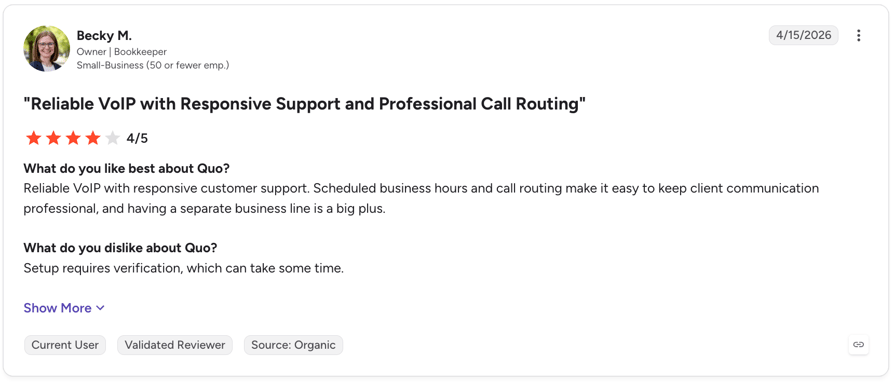
Common complaints include connection issues, app bugs and glitches, and missing collaboration features. Some reviewers also mention pricing clarity, including unexpected fees or features that require higher-tier plans. A few users report that Sona can sound artificial or lose context during calls.
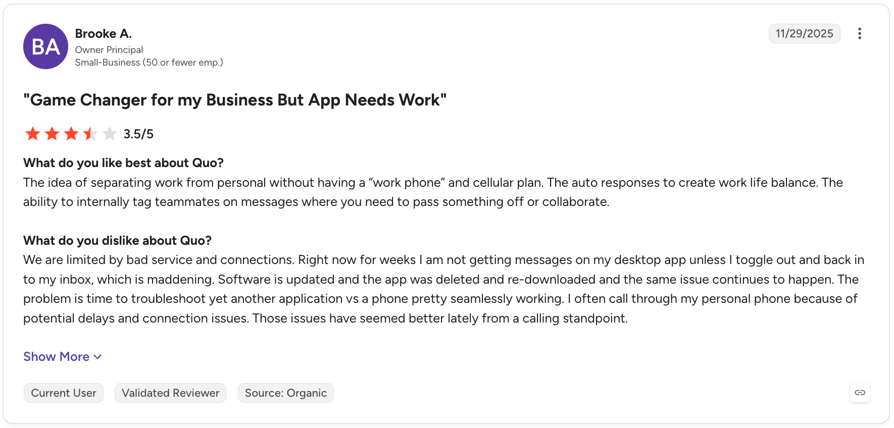
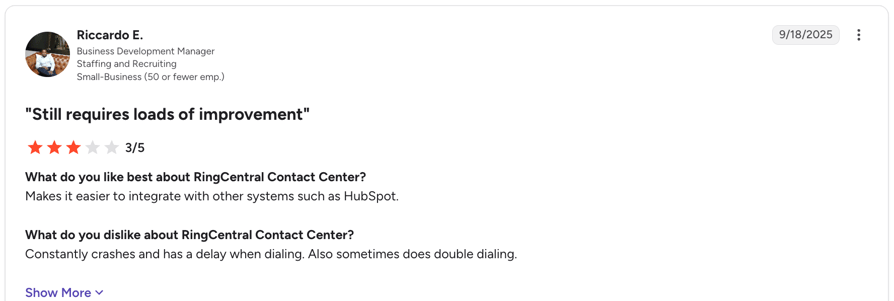
RingCentral users also frequently mention its user-friendly interface, intuitive setup, customer support, and overall flexibility. Reviewers highlight features such as AI-generated call notes, conversation history, and call analytics, which can help teams manage calls and follow-ups more efficiently.
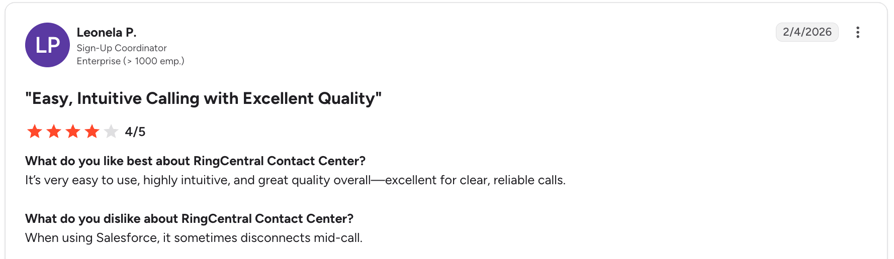
The most common complaints focus on call quality and connection issues, including lag and dropped connections. Some reviewers also mention reporting limitations, customization gaps, and slower support resolution for more complex issues.
In Short:
Both platforms get positive reviews for ease of use and support. Quo is often praised for its simple setup and interface, while RingCentral gets positive feedback for its AI and contact center features. Both also receive complaints about call quality and connection issues.
OpenPhone (Quo) vs. RingCentral Reviews on Reddit
Reddit discussions comparing Quo and RingCentral focus mainly on call quality, reliability, usability, and price. The feedback is mixed, with users highlighting different strengths and weaknesses for each platform.
Quo gets positive feedback for its simple interface, AI features, and ease of use, with some users saying they preferred it to RingCentral. However, reliability is a recurring concern. In one recent discussion, a former RingCentral user said they liked Quo’s UI and AI but eventually left because of reliability issues. Other users reported call delays and poor quality on LTE, 5G, and Wi-Fi. Quo’s support team attributed call quality largely to connection stability and available bandwidth.

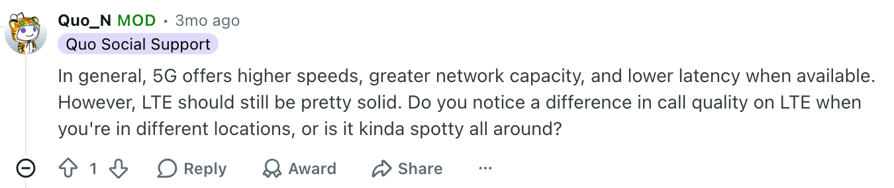
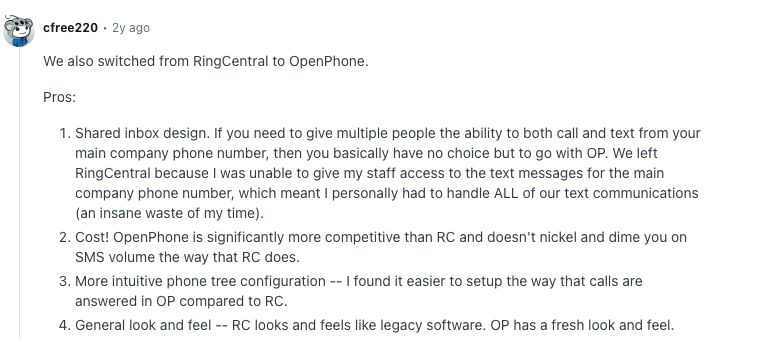
Some users describe RingCentral as more reliable for business calls, though more expensive and less intuitive than Quo. In another discussion, users who had switched from RingCentral to OpenPhone highlighted Quo’s lower cost, shared inbox, and easier setup, but also mentioned bugs and less reliable calls, particularly when using mobile data.
In Short:
Reddit users often prefer Quo for its simplicity, UI, and price, while RingCentral is sometimes favored for reliability. Call quality remains one of the main concerns raised about Quo.
OpenPhone (Quo) Pros & Cons vs. RingCentral Pros & Cons
Quo focuses on simplicity, transparent pricing, shared calling and texting, and accessible AI, while RingCentral offers broader calling, collaboration, contact center, and enterprise capabilities. The main trade-offs are ease of use and cost versus depth of features and deployment options.
OpenPhone (Quo) Pros & Cons
| Pros | Cons |
|---|---|
| Simple, self-serve setup with no hardware required | No video meetings or desk phone support |
| Lower starting price: $15/user/month annually or $19 monthly | Fewer advanced call center features, such as power dialing |
| Sona AI included on every plan, with 1,000 free credits per month | CRM integrations and phone menus start on Business |
| Unlimited US and Canada texting on every plan | Local numbers are limited to the US and Canada |
| Shared numbers and team inboxes make calling and texting easy to manage | International calling and messaging are billed by destination |
| API, Zapier, Make, and MCP support | Reliability is a concern in some user reviews, particularly on mobile connections |
| Transparent monthly and annual pricing across all three plans | Smaller integration and enterprise feature set than RingCentral |
RingCentral Pros & Cons
| Pros | Cons |
|---|---|
| Broader feature set for calling, video meetings, messaging, and contact centers | More complex setup and administration than Quo |
| Multi-level IVR, advanced routing, queues, and desk phone support | Higher starting price: $20/user/month annually or $30 monthly |
| Video meetings for up to 300 participants | CRM integrations start on Advanced at $25/user/month annually |
| 99.999% uptime SLA on every plan | Business texting is limited on Core |
| 24/7 support and professional implementation options | AI Receptionist and advanced conversation analytics cost extra |
| Large integration ecosystem and broad API capabilities | Larger deployments and some contact center capabilities require quote-based pricing |
| Extensive security and compliance coverage, including ISO 27001 and HITRUST | Some hardware and advanced features add to the overall cost |
Need advanced calling without the complexity?
Which Team Fits Which Platform?
Fit comes down to team size, how much of your customer contact runs on text, and whether you need a full communications stack or only a good phone. If you've outgrown Quo's feature list, RingCentral may be the best OpenPhone alternative for you, and if you're a small team paying for RingCentral features you don't use, Quo may be the best RingCentral alternative.
| OpenPhone (Quo) is the right fit for... | RingCentral is the right fit for... |
|---|---|
| Solo operators and small teams where one shared line covers the front office | Organizations with several departments that route inbound calls through menus and queues |
| Teams whose reps send more than 25 texts a month each | Offices, clinics and front desks that need physical handsets |
| Businesses whose customers sit in the US and Canada | Teams with customers or staff in more than one country |
| Budget owners who want to price the whole rollout from a public page | Buyers who need a contractual uptime SLA and 24/7 support |
| Small healthcare-adjacent practices that need a BAA without an enterprise contract | Regulated or enterprise buyers whose security review asks for ISO, HITRUST or SOC 2+ HIPAA reports |
| Low-volume teams that want AI call answering inside the plan price | Teams that want calling and video meetings from one vendor on one bill |
RingCentral vs. OpenPhone (Quo): The Verdict
If you're a small team that mostly texts, sells inside the US and Canada, and wants an AI agent without a new line item, Quo does the job for less. If you need video meetings, desk phones, multi-department routing or a signed uptime SLA, RingCentral covers ground that Quo doesn't try to. The right choice depends on the size and needs of your team.
Choose OpenPhone (Quo) if you…
- Run a small team and want a published price with no seat minimum.
- Text customers more often than you call them and don't want a monthly message cap.
- Want an AI agent to pick up overflow calls without buying an add-on.
- Serve customers mainly in the US and Canada.
- Need HIPAA compliance without paying enterprise-level prices.
- Want a phone system your team can set up and manage without hardware or professional implementation.
Choose RingCentral if you…
- Want calling, video meetings and messaging under one contract.
- Need desk phones at reception, in the office or on the shop floor.
- Route calls across several departments with multi-level menus and queues.
- Need a 99.999% uptime SLA and 24/7 support written into every plan.
- Serve customers across several countries and need international numbers.
- Answer to a compliance team that asks for ISO 27001, HITRUST or SOC 2+ HIPAA reports.
The bottom line:
Quo prioritizes simplicity, texting, and accessible AI, while RingCentral offers more advanced calling and contact center features. Your team size, workflows, and feature requirements should determine which fits better.

Get more than a small-team phone without the enterprise add-on menu.

Frequently Asked Questions
Yes, OpenPhone became Quo in September 2025. The product didn't change, only the name.
OpenPhone (Quo), on list price. Quo Starter costs $15 per user/month billed annually or $19 month-to-month, against $20 or $30 on RingCentral Core, so five users pay $75 a month on Quo and $100 on RingCentral before taxes and fees.
Yes, and Quo is more generous on texting. It includes unlimited US and Canada texting (fair use) and shared numbers on every plan, while RingCentral caps business texts at 25 per user/month on Core, and its pricing ladder only lifts that to 100 on Advanced. RingCentral's shared SMS inbox comes with its $25 Business SMS Booster.
Yes, if your team needs a simple phone system with texting and AI. Quo supports growing teams with shared numbers, CRM integrations, and team calling, but RingCentral offers more advanced routing, video, desk phones, and contact center features.
RingCentral covers more on both. It claims 500+ integrations, against 24 apps in Quo's directory, and it lists ISO 27001, HITRUST and a C5 attestation that Quo doesn't claim. Quo still offers HubSpot and Salesforce on its $23 Business plan, plus SOC 2 Type II and HIPAA with BAAs, which covers most small teams.
CloudTalk is a strong alternative if you're outgrowing Quo's feature list but don't want RingCentral's add-on menu. CloudTalk's plans start at $25/user/month on Starter, with IVR, skill-based routing and numbers in 160+ countries.