Aircall vs OpenPhone (Quo) 2026: Which Platform Fits Your Team?
TL;DR
- Aircall focuses on structured sales and support calling. It offers deeper dialing, routing, CRM integrations, analytics, and call-management tools for teams that handle a high volume of calls.
- OpenPhone (Quo) focuses on simplicity, texting, and AI. It offers transparent pricing, shared numbers, messaging automation, and Sona across its plans, making it suited to smaller teams with simpler workflows.
Choose Aircall for advanced call management and sales or support workflows. Choose Quo for a simpler business phone system with stronger texting and accessible AI.
This Aircall vs. OpenPhone (Quo) comparison looks at 2026 pricing, features, integrations, security, usability, scalability, and user reviews to help you decide which platform fits your team better.
Aircall vs. OpenPhone (Quo): Core Strengths of Each Platform
Aircall and OpenPhone (Quo) both offer business calling and messaging, but they target different needs. Aircall focuses on sales and support teams, while Quo emphasizes simplicity, texting, and AI for small teams.
Here’s where each platform stands out.
Where Aircall Shines
| Strength | Why it matters |
|---|---|
| Outbound dialing | Power Dialer and Voicemail Drop included, so reps can work a call list without a second tool bolted on. |
| Basic routing | IVR and click-to-dial are included in Essentials at $30 per license/month; smart routing and automated queue callback arrive on Professional. |
| CRM coverage | Aircall headlines 250+ native integrations, with Salesforce, HubSpot, Zendesk, Intercom, Pipedrive, Zoho and Microsoft Dynamics all named on its integrations page. |
| Reporting you can drill into | Analytics+ adds heatmaps, live team monitoring, agent deep-dives, unlimited history and scheduled exports for $15 per license/month. |
| Enterprise-ready support | Aircall’s Custom tier includes an SLA, single sign-on, custom onboarding, and API developer support for larger teams.. |
Where OpenPhone (Quo) Shines
| Strength | Why it matters |
|---|---|
| Low-cost entry for business phone numbers | Starter costs $15 per user/month when billed annually, or $19 month to month, with no published seat minimum. |
| AI calling included in every plan | Sona is included across all plans, with 1,000 free automation credits per month — roughly 10 calls based on Quo’s published rate of 100 credits per call. |
| Native texting automation | You can schedule messages, automate replies to texts, follow up on missed calls and voicemails, use snippets and group messaging, and generate AI-powered message responses. |
| Fully transparent pricing | All three plans have published monthly and annual prices, with no quote-only tier or mandatory sales call to see the cost. |
| Strong compliance for the price | Quo says it is SOC 2 Type II certified and HIPAA compliant, plus GDPR and CCPA coverage. |
Aircall vs. Quo (formerly OpenPhone)Comparison At a Glance
Aircall puts more emphasis on outbound dialing, routing, reporting, and integrations, while Quo focuses on lower entry costs, transparent pricing, texting, and accessible AI features. Use the table below to compare the areas that matter most for your team.
| Dimension | Aircall | OpenPhone (Quo) | Winner |
|---|---|---|---|
| Entry price (annual) | $30 per license/month | $15 per user/month | Quo, for teams watching the monthly bill |
| Real entry cost | $90/month, because of the 3-license minimum | $15/month for one user | Quo, for solo operators and teams under three people |
| Pricing transparency | Annual and monthly prices published | All three plans published monthly and annually | Tight |
| AI cost structure | 50 free AI Voice Agent minutes in all plans. AI Assist included from Professional, AI Assist Pro $49 | 1,000 free automation credits (10 calls) included on every plan | Quo for testing, Aircall for more complex needs |
| Texting and SMS automation | SMS and MMS included; Aircall asks teams to contact it for rates in the US, Canada, UK, Australia, France and Germany | Unlimited US and Canada messaging, scheduled texts, auto-replies, $0.01 per segment via API | Quo for US and Canadian teams |
| Security certifications | SOC 2 Type 2, GDPR, HIPAA; single sign-on on the Custom tier only | SOC 2 Type II, HIPAA with BAAs on Business and Scale, GDPR, CCPA | Quo for small teams that need a BAA |
| Outbound dialing | Power Dialer and Voicemail Drop on Professional | No dialer listed on Quo's pricing or feature pages | Aircall, for outbound sales teams working a list daily |
| IVR, routing and queuing | IVR on Essentials, smart routing and queue callback on Professional | Phone menus on Business; no queuing listed | Aircall for support teams routing inbound volume |
| Reporting depth | Advanced analytics on Professional, Analytics+ at $15 per license/month | Analytics and reporting on Business, with no deeper tier | Aircall for managers who report on agents' performance |
| Total integrations | 250+ by Aircall's own headline | No headline count published; 24 apps listed in the directory | Aircall for teams with a long software stack |
| Support | 24/5 claim on its security page and a 24/7 claim on its quality page; SLA on Custom only | Email on all plans, live chat from Business, phone Mon to Fri 8am to 5pm PT on Scale | Aircall for enterprise support, Quo for transparency |
| Uptime | 99.95% | 99% | Aircall |
OpenPhone vs. Aircall Features
Aircall and Quo cover the core business phone features, but they take different approaches to depth and complexity. Aircall adds more tools for dialing, routing, CRM workflows, and reporting as you move up the plans. Quo keeps the core experience simpler, with calling, texting, and AI built into the platform.
What Are Aircall's Key Features?
Aircall combines business calling with outbound tools, call routing, CRM integrations, AI, and reporting. Its feature set expands across the plans, with more advanced dialing, analytics, and enterprise capabilities available at higher tiers.
What Aircall Does Well
- Outbound dialing is native. Power Dialer and Voicemail Drop come with the $50 Professional plan, so reps work a list without a second tool in the stack.
- Routing starts on the entry plan. IVR and click-to-dial are included in Essentials at $30 per license/month, and smart routing plus manual and automated queue callback arrive on Professional.
- Salesforce and HubSpot are first-class. Salesforce CTI is a Professional feature, and Aircall sells a separate Salesforce Voice add-on that puts full call controls inside the Omni-Channel widget.
- AI Assist is a defined product, not a promise. It covers call summaries, topic recognition, talk-to-listen ratios, action items, sentiment analysis, call scoring and CRM logging, and it is included in Professional.
- Analytics go past the summary screen. Analytics+ adds heatmaps, live team monitoring, agent deep-dives, unlimited history and scheduled exports for $15 per license/month.
Where Aircall Falls Short
- The headline price is not the entry price. Essentials is $30 per license/month, but the 3-license minimum puts the real floor at $90 a month on annual billing.
- Single sign-on and the SLA are locked to the top tier. Both sit on the Custom plan, which carries a 25-license minimum, so a 20-seat team cannot buy either.
- Reporting depth and AI both carry surcharges. Analytics+ is $15 per license/month and AI Assist Pro is $49 per license/month on top of whatever plan you are on.
- There is no built-in video conferencing. Teams that need video meetings alongside their business phone system have to use a separate tool.
What Are OpenPhone's (Quo's) Key Features?
Quo focuses on shared business numbers, texting, AI, and simple automation. It keeps the core experience straightforward, while giving teams tools to automate calls and messages without the complexity of a full contact center.
What OpenPhone (Quo) Does Well
- Sona is included on every plan. Quo's AI agent handles calls with 1,000 free automation credits a month, and the paid credit ladder starts at a $0 tier rather than a subscription.
- Texting automation is native. Scheduled messages, auto-replies to texts, missed calls and voicemails, snippets, and group messaging.
- Automation runs through tools teams already use. Quo puts its API, Zapier and Make on every plan, has webhooks in beta, and prices automated SMS at $0.01 per outgoing message segment.
- Shared numbers scale with the team. Starter caps a shared number at 10 paid users; Business and above lift that cap and add group calling, custom ring orders and call transfers.
- Compliance goes further than the price suggests. Quo says it is SOC 2 Type II certified, HIPAA compliant with BAAs available on Business and Scale, and current with GDPR and CCPA.
Where OpenPhone (Quo) Falls Short
- There is no power dialer. Quo's pricing and feature comparison pages list no power dialer or predictive dialer, only a click-to-call feature.
- Call-center controls are more limited. Quo offers phone menus, but lacks the deeper IVR structures, manager-facing wallboards, and advanced queue controls found in platforms like Aircall.
- CRM workflows are less extensive. Quo supports common integrations, but may be less suited to complex setups that require deeper data and activity syncing.
- It can become limiting for larger teams. The simpler setup may not provide the structured call management, reporting, and administration that larger organizations require.
Feature-by-Feature Comparison
| Feature | Aircall | OpenPhone (Quo) |
|---|---|---|
| IVR and phone menus | Included from Essentials | Business plan and above |
| Call queuing and callback | Manual and automated queue callback on Professional | Available but not listed on any plan |
| Power dialer | Power Dialer and Voicemail Drop on Professional | Not listed on any plan |
| AI for live agent calls | AI Assist at $9 per license/month, included in Professional; AI Assist Pro at $49 | AI call summaries and transcripts from the Business plan |
| AI voice agent | Add-on: 50 free minutes per account each month, then $0.49/min up to 2,500 minutes | Sona included on every plan with 1,000 free automation credits a month |
| Texting automation | SMS and MMS included; rates quote-based | Scheduled texts, auto-replies, and $0.01 per segment via API, Zapier or Make |
| Apps | Web, macOS, Windows, iOS, Android and a Chrome extension | iOS, Android, Mac, Windows and web |
Aircall vs. OpenPhone Pricing
Aircall and Quo differ in both starting price and how their plans are structured. Aircall pricing starts at $30 per license/month with a three-license minimum, while OpenPhone (Quo) pricing starts at $15 per user/month when billed annually with no published seat minimum.
How Much Does Aircall Cost?
Aircall has three plans, billed per license. The published prices are based on annual billing, and every plan has a minimum number of licenses.
| Plan | Price | Key details |
|---|---|---|
| Essentials | $30 per license/month, billed annually | 3-license minimum, making $90/month the actual starting cost. Includes IVR, click-to-dial, call recording, SMS and MMS, API access, desktop and mobile softphones, unlimited simultaneous outbound calls, up to 3 teams, 1 number, and up to 6 months of analytics. |
| Professional | $50 per license/month, billed annually | 3-license minimum, making $150/month the actual starting cost. Adds Power Dialer, Voicemail Drop, Salesforce CTI, AI Assist, smart routing, manual and automated queue callback, advanced analytics, live monitoring, outbound campaigns, and unlimited teams. |
| Custom | Quote-based | 25-license minimum. Adds custom onboarding, API developer support, an SLA, and single sign-on. SSO and the SLA are not available on lower tiers. |
| Add-on | Price |
|---|---|
| AI Assist | $9 per license/month, included in Professional |
| AI Assist Pro | $49 per license/month |
| Analytics+ | $15 per license/month, applied across all Aircall licenses |
| Aircall for Salesforce Voice | $30 per license/month |
| AI Voice Agent bundles | $175 for 500 minutes; $725 for 2,500 minutes; custom bundles from $0.19/minute above 10,000 minutes |
| AI Voice Agent pay-as-you-go | $0.49/minute up to 2,500 minutes and $0.39/minute above that, with 50 free minutes per account each month |
| AI Messaging Agents | 100 free conversations per company, followed by pay-as-you-go or prepaid bundles of 1,000 ($220) and 10,000 ($1,300) conversations |
Aircall offers a 7-day free trial and does not offer a free plan. Its pricing page does not state whether a card is required to start the trial.
How Much Does OpenPhone (Quo) Cost?
Quo has three plans billed per user and publishes both monthly and annual pricing. None of the plans is quote-only, and Quo does not publish a seat minimum.
| Plan | Price | Key details |
|---|---|---|
| Starter | $19 per user/month, or $15 billed annually ($180/year) | One new or ported number per user, unlimited US and Canada calling and messaging subject to fair use, voicemail transcripts, Quo API, Sona, ChatGPT and Claude MCP, and email support. Shared numbers support up to 10 paid users. |
| Business | $33 per user/month, or $23 billed annually ($276/year) | Adds AI call summaries and transcripts, group calling, custom ring orders, call transfers, HubSpot and Salesforce, phone menus, analytics and reporting, automatic call recording, live chat support, unlimited paid users on shared numbers, and HIPAA compliance. |
| Scale | $47 per user/month, or $35 billed annually ($420/year) | Adds AI call tags, dedicated onboarding support, priority live chat and email, and inbound phone support . |
| Add-on or fee | Price |
|---|---|
| Additional phone numbers | $5/month each, billed annually |
| Sona automation credits | 1,000 credits/month included free; paid tiers from $25 to $199/month for 4,000 to 60,000 credits. Per-call overage falls from $1.00 to $0.45 depending on the tier. |
| Automated SMS via API, Zapier or Make | $0.01 per outgoing message segment |
| The Campaign Registry carrier review | $19.50 one-time |
| The Campaign Registry messaging fee | $1.50–$3/month |
| International calling and messaging | Billed by destination in credits; rates are not published on the pricing page |
Quo also offers a 7-day free trial.
Quo vs. Aircall Pricing Compared
| Pricing dimension | Aircall | OpenPhone (Quo) |
|---|---|---|
| Published pricing | Annual and monthly prices published for Essentials and Professional; Custom is quote-based | Monthly and annual prices published for all three plans; no quote-only tier |
| Entry price | $30 per license/month billed annually, or $40 month-to-month | $15 per user/month billed annually, or $19 month-to-month |
| Actual minimum cost | $90/month on Essentials because of the 3-license minimum | $15/month for one user |
| Seat minimum | 3 licenses on Essentials and Professional; 25 on Custom | No published minimum |
| Free trial | 7 days | 7 days |
| AI pricing | AI Assist is $9/license/month and included in Professional; AI Assist Pro is $49; AI Voice Agent starts with 50 free minutes, then $0.39–$0.49/minute or prepaid bundles | Sona included on every plan with 1,000 free credits/month; paid credit tiers from $25 to $199/month |
| Messaging costs | SMS and MMS included; rates for some countries require contacting Aircall | US and Canada calling/messaging included subject to fair use; automated SMS via API, Zapier or Make costs $0.01 per segment |
| Quote-only pricing | Custom | None published |
Aircall Integrations vs. OpenPhone (Quo) Integrations
The main difference is integration breadth. Aircall gives teams a much larger selection of native integrations, while Quo focuses on a smaller set of common CRM, productivity, and automation tools.
What Does Aircall Integrate With?
Aircall’s headline figure is 250+ native integrations, including Salesforce, HubSpot, Zoho, Pipedrive, Zendesk, Intercom, Shopify, Slack, Zapier, and Microsoft Dynamics.
Aircall also provides an API and webhooks. API access starts on Essentials, while API developer support is available on the Custom tier.
What Does OpenPhone (Quo) Integrate With?
Quo does not publish a headline integration count. Its directory listed 24 apps when checked, including Salesforce, HubSpot, Zoho CRM, Pipedrive, Attio, Jobber, Slack, Zapier, Make, and Webhooks.
HubSpot and Salesforce integrations require the Business plan. Quo also provides an API on all plans, with webhooks in beta and support for MCP.
Integration Capability Compared
| Integration capability | Aircall | OpenPhone (Quo) |
|---|---|---|
| Total native integrations | 250+ | 24 apps listed; no headline count published |
| CRM connectors | Salesforce, HubSpot, Zoho, Pipedrive, Microsoft Dynamics, Bullhorn | Salesforce, HubSpot, Zoho CRM, Pipedrive, Attio, HighLevel |
| Plan required for CRM sync | Salesforce CTI from Professional at $50/license/month | HubSpot and Salesforce from Business at $23/user/month annually |
| API and developer access | API and webhooks; developer support on Custom | API on all plans; webhooks in beta; MCP support |
| Workflow automation | Native integrations, Zapier, Slack, and webhooks | Zapier, Make, Pipedream, Relay.app, and webhooks |
Security & Compliance: Aircall vs. OpenPhone (Quo)
Aircall and Quo both cover core security requirements, including SOC 2, GDPR, and encryption. Quo also states that it is HIPAA-compliant and Aircall offers a contractual SLA on its Custom plan.
| Security and compliance | Aircall | OpenPhone (Quo) |
|---|---|---|
| GDPR | Stated: complies with GDPR obligations | Stated: stays current with GDPR and CCPA |
| SOC 2 | SOC 2 Type 2 compliant | SOC 2 Type II certified |
| HIPAA | Supports HIPAA use with a Business Associate Agreement (BAA) | HIPAA compliant; BAAs available on Business and Scale |
| PCI DSS | AWS, its hosting provider, holds PCI DSS certification | Stripe, its payment processor, is PCI Service Provider Level 1 certified |
| ISO 27001 | AWS holds ISO 27001 certification; Aircall does not claim certification itself | Not claimed |
| Public-sector frameworks | Not claimed for Aircall; AWS FedRAMP referenced | Not claimed |
| Encryption | TLS 1.2 in transit, AES-256 at rest, TLS and SRTP for voice | TLS 1.2+ in transit, AES-256 at rest |
| Uptime commitment | 99.95% published; contractual SLA on Custom | 99% |
Usability & Reliability: Aircall vs. OpenPhone (Quo)
Both Aircall and Quo are cloud-based and can be set up without dedicated hardware or an IT project. Aircall offers more configuration options for routing and call management, while Quo keeps administration simpler.
| Dimension | Aircall | OpenPhone (Quo) |
|---|---|---|
| Deployment model | Cloud SaaS with no on-premises option; web, macOS, Windows, iOS, Android, and Chrome extension | Cloud SaaS; iOS, Android, Mac, Windows, and web |
| Onboarding support | Dedicated onboarding managers for larger teams; custom onboarding on Custom | Dedicated onboarding support on Scale |
| Admin configuration | IVR and click-to-dial from Essentials; smart routing, queue callback, and live monitoring from Professional | Basic call forwarding on all plans; phone menus, custom ring orders, group calling, and transfers from Business |
| Published reliability | 99.95% uptime | 99% |
| Support channels | 24/5 listed on its security page and 24/7 on its quality page; SLA on Custom | Email on all plans, live chat from Business, and priority support plus phone support from Scale |
| Scaling to larger teams | Custom starts at 25 licenses and adds SSO, SLA, and API developer support | Unlimited paid users on shared numbers from Business; no enterprise tier published |
Aircall vs. OpenPhone (Quo) Reviews on G2
Quo has a higher G2 rating and more reviews than Aircall. Aircall scores 4.4/5 from 1,663+ reviews, while Quo scores 4.7/5 from 3,414+ reviews. That gives Quo roughly 1,750 more reviews behind its higher score.
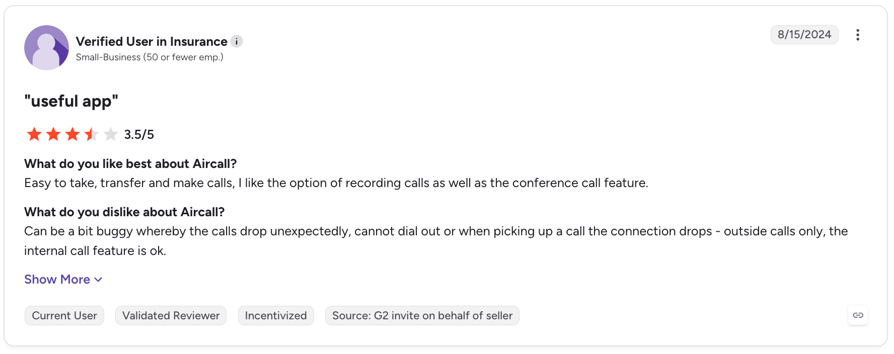
Aircall users often praise its ease of use, CRM and helpdesk integrations, reliability, and automatic call recording. Reviewers say setup is quick and the dashboard is easy to navigate, while analytics and live monitoring are useful for tracking agent performance.
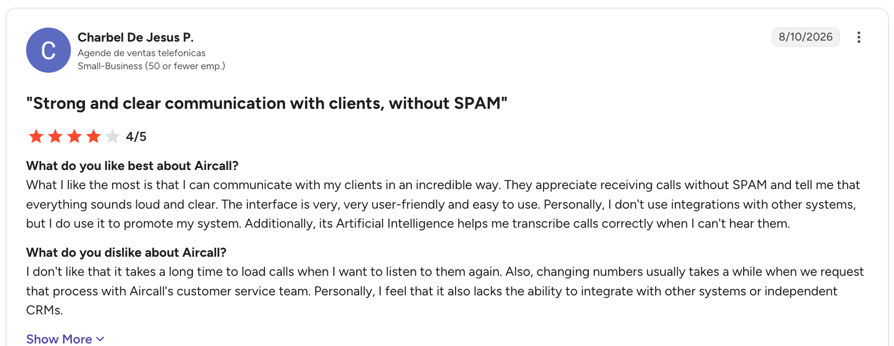
The most common complaints focus on call quality, including dropped calls, connection lag, and uneven call distribution. Some users also report slow loading when syncing call logs and missing features such as individual voicemail and better text handling.
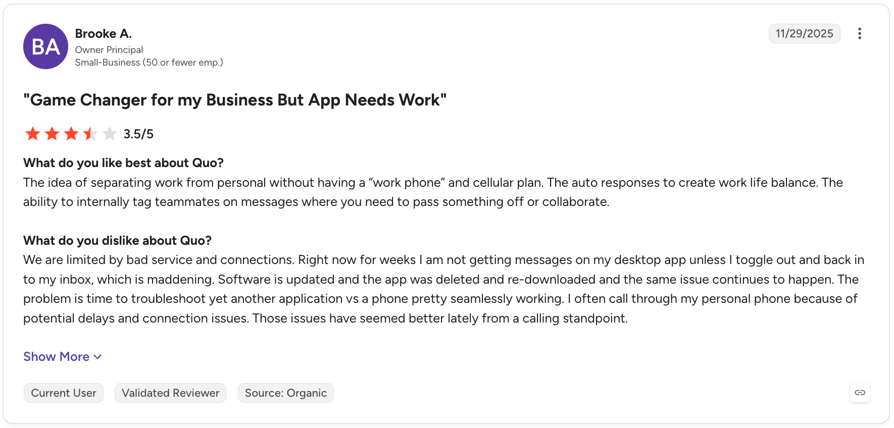
Quo gets similar praise for its ease of use, simple setup, responsive support, and call recording and transcription. Reviewers also highlight Sona, its AI receptionist, for answering calls and qualifying leads, while several mention the clean interface across desktop and mobile.
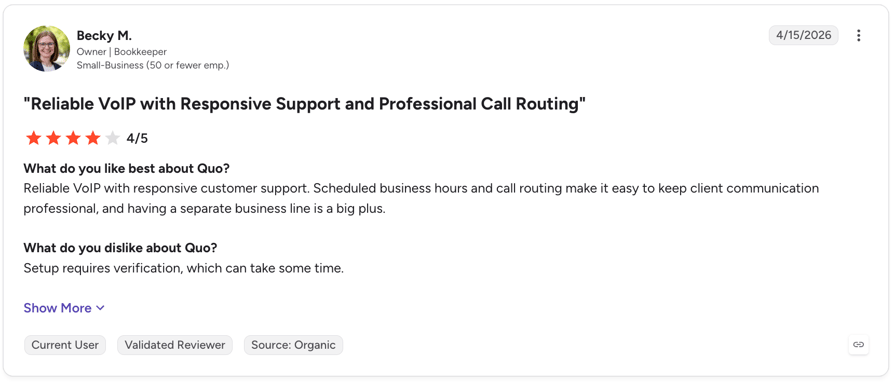
Common complaints include connection issues, app bugs and glitches, and missing collaboration features such as editing messages or assigning conversations. Some reviewers also criticize pricing clarity, mentioning unexpected fees or features that require higher-tier plans. A few note that Sona's AI voice can sound artificial or lose context during calls.
In Short:
Overall, the G2 reviews show different strengths. Aircall gets positive feedback for its integrations, reliability, analytics, and call management, while Quo is often praised for its simplicity, interface, support, and AI calling features. Both platforms also receive recurring complaints about call quality and connection reliability.
Aircall Pros & Cons vs. OpenPhone (Quo) Pros & Cons
Aircall and Quo are built around different priorities. Aircall offers more tools for structured call management, sales and support workflows, while Quo focuses on simplicity, texting, and accessible AI.
Aircall Pros & Cons
| Pros | Cons |
|---|---|
| Advanced call management with IVR, smart routing, queue callback, and live monitoring | 3-license minimum makes it less practical for solo users and very small teams |
| Strong sales and support workflows with Power Dialer, Voicemail Drop, and Salesforce CTI | Advanced features are spread across plans and add-ons |
| Large integration ecosystem covering CRM, helpdesk, and productivity tools | Enterprise features are locked to Custom, including SSO and SLA |
| Detailed analytics and team management for agent performance | More configuration and administration than simpler phone systems |
| Dedicated onboarding and support for larger teams | Texting and international usage can vary by country |
| Web, desktop, mobile, and Chrome support | No built-in video conferencing |
OpenPhone (Quo) Pros & Cons
| Pros | Cons |
|---|---|
| Simple setup and administration across desktop, mobile, and web | Fewer advanced call-center controls |
| Sona AI included across all plans | No power dialer or outbound campaign tools |
| Strong texting features with automation and AI assistance | Smaller integration ecosystem than Aircall |
| Easy shared-number and team calling | Some team features start on Business |
| Transparent pricing across all three plans | International calling and messaging are metered |
| API, Zapier, Make, and MCP support | Less suited to advanced contact-center workflows |


Which Team Fits Which Platform?
The right fit depends on how your team handles calls, texts, and customer workflows. Aircall is built around structured call management and sales and support operations, while Quo keeps things simpler with a stronger focus on texting, AI, and smaller-team workflows.
| Aircall is the right fit for... | OpenPhone (Quo) is the right fit for... |
|---|---|
| Outbound sales teams of three or more who work a call list every day | Solo operators and two-person teams who each need one number |
| Support teams routing inbound volume through menus, smart routing and queue callback | Teams whose customers mostly text, and who want scheduled messages and auto-replies |
| Managers who report on agent-level performance and need heatmaps and deep-dives | Teams that want an AI phone agent in the plan price rather than as a metered add-on |
| Companies standardizing on Salesforce who want call controls inside the CRM | Budget owners who need to price a rollout from a public page, without a sales call |
| Organizations heading past 25 seats that need SSO, an SLA and custom onboarding | Small healthcare-adjacent teams that need a BAA without an enterprise contract |
OpenPhone (Quo) vs. Aircall: The Verdict
Aircall and Quo suit different types of business phone setups. Aircall is geared toward teams that need deeper call management, sales and support workflows, analytics, and CRM integrations. Quo focuses on simpler administration, texting, and accessible AI features. The right choice depends on your team size, workflows, and how much call-management functionality you need.
Choose Aircall if you…
- Run a sales or support team that relies heavily on inbound or outbound calling.
- Need advanced call management, including IVR, smart routing, queue callback, and live monitoring.
- Want deeper sales and support workflows, with features such as Power Dialer, Voicemail Drop, and Salesforce CTI.
- Need detailed analytics to monitor agent and team performance.
- Rely on a broad range of CRM and helpdesk integrations.
- Need enterprise features such as SSO, a contractual SLA, and custom onboarding.
Choose OpenPhone (Quo) if you…
- Run a solo operation or small team and want a simpler business phone system.
- Handle a large share of customer communication by text and want built-in messaging automation.
- Want AI calling features without moving to a separate enterprise platform.
- Prefer transparent pricing with all three plans published online.
- Need simple shared-number and team calling rather than advanced contact-center controls.
- Want flexible automation through the API, Zapier, Make, and MCP.
The bottom line:
Aircall is built for more structured sales and support operations, while Quo prioritizes simplicity, texting, and accessible AI. Your team size, calling workflows, CRM requirements, and need for advanced call management should determine which platform fits better.
Frequently Asked Questions
Aircall competes with Quo (formerly OpenPhone), RingCentral, Dialpad, JustCall and Talkdesk, most of which we cover in our phone system reviews. They split into two camps: mobile-first phone apps sold per user with no seat minimum, and call-center platforms sold per license with dialing, queuing and reporting built in. Aircall sits in the second camp.
It depends on which gap you are filling. If OpenPhone (Quo) falls short on outbound dialing, call queuing or agent-level reporting, a call-center platform such as Aircall covers that ground, at a 3-license minimum and $30 per license/month. If the gap is international rates or a cheaper entry price, the shortlist looks completely different.
Yes. Aircall is an established VoIP provider that says it serves 23,000+ businesses, states SOC 2 Type 2 compliance and publishes 99.95% uptime on its own security page. Our Aircall review covers where that record holds up and where its published figures contradict each other.
OpenPhone (Quo) costs $19 per user/month on Starter month to month, or $15 billed annually. Business is $33 monthly or $23 annually, Scale is $47 or $35, and no seat minimum is published. US texting adds a one-time $19.50 carrier registration fee and $1.50 to $3 a month, as our OpenPhone pricing guide sets out.
Yes. OpenPhone became Quo on September 2025, and openphone.com now 301-redirects to quo.com. It is the same company and the same product under a new name, and the legal entity is still OpenPhone Technologies, Inc. Both names remain in active use, which is why this page writes it as OpenPhone (Quo).
To signal a move from business phone app to what the company calls an AI-driven front office. The name arrived on September 23, 2025 alongside $105 million in growth financing, $96 million of it from General Catalyst's Customer Value Fund and $9 million in equity from existing investors, per Quo's rebrand announcement.
OpenPhone (Quo), on list price and on real entry cost. Quo starts at $15 per user/month billed annually with no seat minimum, so one user costs $15. Aircall starts at $30 per license/month but needs three licenses, putting its real floor at $90 a month, as our Aircall pricing breakdown shows.
CloudTalk is a strong alternative if you want call-center tooling without Aircall's 3-license minimum or Quo's missing dialer. CloudTalk's plans start at $25/user/month on Starter, which includes IVR and skill-based call routing; Power Dialer is included on the Expert plan. If a mobile-first texting app is what you actually need, Quo is the closer fit.