Five9 vs RingCentral (2026): Which Contact Center Fits You?
TL;DR: Five9 vs RingCentral Comparison
| Question | Quick Answer |
|---|---|
| What is Five9? | A dedicated enterprise contact center: five dialer modes, native workforce management, deep compliance, and a 50-seat minimum on every plan. |
| What is RingCentral's contact center? | RingCX, an AI-first contact center from $65 per agent that sits on RingEX, plus a quote-only enterprise product built with NiCE. |
| Which is better, Five9 or RingCentral? | Neither wins overall. Five9 for 50+ agents and outbound volume, RingCX for teams under 50 that want phone, video, and contact center on one bill. |
| Which is cheaper? | RingCentral at the entry point: $65 versus $159 per seat, and no published seat floor. Five9's upper tiers are quote-only. |
| Which scale is each built for? | Five9 for 50 to 1,000+ agents. RingCX for roughly 10 to 50. Nearly half of RingCX's G2 reviewers run companies under 50 people. |
| How do their AI layers compare? | Five9 bundles governed AI into tiers with 3,000 minutes per seat. RingCX sells AI by tier or at $25 per agent per module. |
| Which integrates better with my CRM? | Both cover Salesforce, Dynamics 365, ServiceNow, and Zendesk. RingCX adds HubSpot natively. Five9 needs a connector for it. |
| Which is safer for regulated teams? | Five9 leans toward U.S. regulated industries (PCI DSS Level 1, HIPAA, TX-RAMP). RingCX leans international (ISO 27018, C5, data residency in five regions). |
| What do users say? | Five9 4.1/5 from 600+ G2 reviews, RingCX 4.4/5 from 100+. Five9 wins on partnership, RingCX on ease of setup and product direction. |
| Is there a third option? | Yes. CloudTalk is the best contact center alternative to Five9 and RingCentral, giving growing teams routing, dialers, and an AI agent in one calling platform from $25/user/month, without seat minimums for base plans. |
Five9 vs RingCentral is a comparison between two CCaaS (Contact Center as a Service) platforms built for different sizes of team. Five9 is a dedicated enterprise platform with predictive dialing, native workforce management, and a 50-seat minimum. RingCentral's RingCX is an AI-first contact center from $65 per agent, running on the RingEX phone system the rest of the company already uses.
So your choice should start with headcount. Five9 fits operations with 50 or more agents. RingCentral fits growing teams under that line, especially ones already on RingEX. Both, though, assume you're running a contact center with agents in seats and a rollout to manage. Teams that live on the phone without being one of those, or that want the AI agent and the phone system in a single product from one seat, get exactly that from CloudTalk, the third option here.
Whichever way you lean, you're choosing between two proven platforms. Five9 dates to 2001, serves 3,000+ customers, and holds 4.1/5 on G2 from 600+ reviews. RingCentral dates to 1999, and RingCX scores 4.4/5 on G2 from 100+ reviews. Neither is ultimately a wrong choice. The question you should be asking before you decide, however, is which one was built for a team your size.
Comparing Five9 and RingCentral for a Team Under 50?
What Should You Compare Five9 and RingCentral On?
Judge both platforms on what they publish, not on what their sales decks say about each other. Pricing pages, product pages, trust centers, and the reviews on G2, Gartner Peer Insights, and Capterra are enough to settle most of the decision. Where a vendor publishes nothing, treat "Not published" as an answer in itself. These five criteria decide the fit:
- Pricing you can budgetPublished tiers, seat minimums, billing terms, usage fees, and what the entry price actually includes.
- Scale fitThe team size each platform is built for, from its seat model and from who actually reviews it.
- Feature depth, not feature countDialer modes, workforce management, routing, digital channels, and the plan that unlocks each one.
- AI packaging and governanceWhat the AI does, how it's priced, and what each vendor publishes about keeping it honest.
- Integrations, security, and usabilityCRM coverage, UCaaS bundling, certifications, and what reviewers say about rollout and reliability.
What Are the Core Strengths of Five9 and RingCentral?
Neither platform is a weak product, so the honest way to compare them is to ask what each one does best. Five9 wins on depth. RingCentral wins on accessibility. Here's where each platform shines.
What Is Five9 and Where Does It Shine?
Five9 is a cloud contact center platform built for high-volume, blended operations. It's the platform banks, insurers, and collections floors pick when they need thousands of automated outbound attempts per shift, with recordings, scorecards, and geo-redundancy to match. It also runs as a contact center layer on Microsoft Teams, Zoom Phone, and RingCentral through its UC adapters. Here's what it does better than most:
Where Five9 Shines
| Strength | Why It Matters |
|---|---|
| Five dialer modes, compliance built in | Predictive, progressive, power, preview, and manual touch, with DNC lists and time-zone rules. Outbound floors get their pacing without a third-party dialer. |
| Native workforce management | Forecasting, scheduling, real-time adherence, quality scoring, and interaction analytics ship as Five9 WEM (Workforce Engagement Management), with Verint and Calabrio as options. |
| Tiers that scale with depth | Digital, Core, Plus, Pro, and Enterprise let a large operation pay only for the AI and WEM depth it uses, once it clears the seat floor. |
| Compliance depth for regulated industries | SOC 2 Type 2, ISO 27001, PCI DSS Level 1, HIPAA business associate, TX-RAMP Level 2. Five9 shows up in healthcare, finance, and collections for a reason. |
| A governance layer on its AI | A published AI trust framework, automated grading of AI calls, and secure tool calling in its latest release, so an agent that verifies a caller does it with real credentials. |
What Is RingCentral's Contact Center and Where Does It Shine?
RingCentral sells two contact centers. RingCX is its own AI-first product: voice plus 20+ digital channels, ACD, IVR, skills-based routing, and a dialer in one $65 seat. RingCentral Contact Center is the enterprise version, built with NiCE CXone and priced by quote. Both sit next to RingEX, so agents and the rest of the company share one directory, one vendor, and one bill. Here's where that pays off:
Where RingCentral Shines
| Strength | Why It Matters |
|---|---|
| Published pricing with a monthly option | Standard $65, Professional $95, Elite $145 per agent on annual billing, or $75, $110, and $165 monthly. You can budget before you talk to sales. |
| No published seat minimum | RingCentral doesn't publish a seat floor for RingCX, so a 15-agent team isn't priced out of the door the way it is at Five9. |
| AI woven through the platform | AI Receptionist, AVA Agent Assist, AI Quality Management, AI Supervisor Assist, and AI Workforce Management, unlocked by tier or as a $20 to $25 add-on. |
| One vendor for UCaaS and CCaaS | Agents and the rest of the company share RingEX presence, directory, and video, which removes the integration project a standalone CCaaS needs. |
| Fast rollout for smaller teams | G2 reviewers rate RingCX 8.6/10 for ease of setup against Five9's 8.1, and nearly half of them come from companies under 50 people. |
Five9 vs. RingCentral at a Glance: What Are the Key Differences?
Start with the row that matters most for your team. There's no winner column on purpose. Each row ends with the kind of team each option fits, because that's the decision you're actually making.
Five9 vs RingCentral: Key Differences
| Dimension | Five9 | RingCentral | Best Suited For |
|---|---|---|---|
| Pricing structure | 5 tiers, 2 published | 3 RingCX tiers, all published, plus a quote-only enterprise tier | Five9: operations used to negotiating a quote. RingCentral: teams that need the number before the call |
| Entry price | $119/user/mo (digital only), $159/user/mo (voice) | $65/user/mo (annual), $75/user/mo (monthly) | Five9: floors that use every tool in the seat. RingCentral: teams paying for 10 to 50 agents |
| Seat minimum | 50 seats, on the pricing page | Not published | Five9: 50+ agents from day one. RingCentral: smaller or seasonal teams |
| Outbound dialer depth | 5 modes with compliance tooling | 4 modes plus agentless | Five9: collections and outbound sales floors. RingCentral: mixed inbound and outbound teams |
| Workforce management | Native WEM plus Verint and Calabrio | AI WFM on Elite or $20/user/mo | Five9: scheduling 100+ agents. RingCentral: supervisors who need forecasting, not a WFM department |
| AI packaging | Included per tier, 3,000 minutes per bundled seat | By tier, or $25/user/mo per module | Five9: regulated AI use at volume. RingCentral: switching AI on one module at a time |
| Unified communications | Via adapters (Teams, Zoom Phone, RingCentral) | Native with RingEX | Five9: companies keeping their existing phone system. RingCentral: one-vendor IT teams |
| Compliance depth | SOC 2 Type 2, ISO 27001, PCI DSS L1, HIPAA, TX-RAMP | ISO 27001/27017/27018, SOC 2+, PCI DSS, HIPAA BAA | Five9: U.S. finance, healthcare, and government suppliers. RingCentral: international teams needing data residency |
| Ideal agent count | 50 to 1,000+ | Roughly 10 to 50 | Five9: enterprise and large mid-market. RingCentral: small business and lower mid-market |
| G2 rating | 4.1/5 from 600+ reviews | 4.4/5 from 100+ reviews (RingCX) | Five9: buyers who want a long track record. RingCentral: buyers who weight recent momentum |
Both vendors are here to stay:
Both Five9 and RingCentral are growing, which matters if you're signing a multi-year contract. Five9's own earnings figures show revenue up 10% year over year and subscription revenue up 14%. RingCentral's show 5.9% growth, with 13% of recurring revenue now coming from customers who pay for its AI products. Neither is going anywhere, so the choice comes down to fit, and the Five9 pricing guide and RingCentral pricing guide go deeper on each vendor's economics (or scroll further down the page as we've got some more interesting facts for you).
Five9 Features vs. RingCentral Features: Which Platform Does More?
Most Five9 vs RingCentral features comparisons go wrong because both tick the same boxes: ACD, IVR, skills-based routing, recording, dialers, digital channels, AI. The real difference between RingCentral vs Five9 is depth and packaging.
Here's what each does well, where each falls short, and how they line up feature by feature, with CloudTalk alongside for scale.
What Does Five9 Do Well, and Where Does It Fall Short?
Five9's feature set is built for complex operations. A voice seat includes the agent desktop, ACD, IVR, the dialer, recording, geo-redundancy, and queue reporting. The higher tiers add the AI and workforce depth a large floor uses daily.
Here's the honest breakdown:
What Five9 Does Well
- Outbound at scaleFive dialer modes with answering machine detection, DNC management, and time-zone rules, so a sales or collections floor runs thousands of attempts a shift and stays compliant.
- Workforce engagement in the boxForecasting, scheduling, adherence, quality management, and interaction analytics with 100% call transcription. No second vendor for 200 agents.
- Blended inbound and outboundActive blending moves agents between queues and lists as inbound volume changes, with geo-redundant failover behind it.
- Security for regulated workPCI DSS Level 1, HIPAA safeguards, encrypted recordings and transcripts at rest, two-factor authentication for privileged users.
Where Five9 Falls Short
- Most pricing is a sales conversationOnly Digital and Core publish a price. Plus, Pro, and Enterprise are "Contact Sales", and usage fees may apply on top.
- A 50-seat floorThe pricing page states a minimum of 50 seats, priced per concurrent user. A 20-agent team pays for licenses it can't fill.
- Stability and reporting complaints persistRecent G2 reviews still cite dropped calls and outages, dated dashboards, and paid custom work for reporting changes.
What Does RingCentral's RingCX Do Well, and Where Does It Fall Short?
RingCX packs a lot into its Standard seat: voice, video, 20+ digital channels including WhatsApp and Apple Messages, ACD, IVR, skills-based routing, screen recording, 250+ reports, and a dialer with preview, progressive, predictive, and agentless modes. The AI sits mostly on Professional and Elite.
Here's the split:
What RingCentral Does Well
- AI across the agent and supervisor deskAVA Agent Assist surfaces answers live, AI Quality Management scores 100% of interactions, and AI Supervisor Assist and AI WFM arrive on Elite.
- Published entry price with monthly billing$65 per agent annual or $75 monthly, with CRM integrations and unlimited domestic minutes included. A small team starts without a quote.
- One vendor for the whole companyRingCX agents share RingEX presence, directory, and video. It's the single biggest reason IT teams consolidate on RingCentral.
- Quick to stand up8.6/10 for ease of setup on G2, and the Dynamics 365 app promises deployment in hours, not weeks.
Where RingCentral Falls Short
- Lighter contact center depthG2's own summary notes RingCX lacks some of Five9's speech analytics and auto-dialing depth, and enterprise WFM lives in the quote-only Contact Center product.
- AI mostly behind tiersQuality management, interaction analytics, and supervisor assist each cost $25/user/mo on Standard, so the $65 headline grows fast for a team that wants coaching.
- Reporting and silo complaintsRecent RingCX reviews call reporting slow and hard to customize, and describe a hard line between the RingCX and RingEX sides of the account.
How Do Five9 and RingCentral Compare Feature by Feature?
Side by side, the two contact centers agree on more than they differ, right up until you read the plan names. CloudTalk sits alongside them because it covers a meaningful share of the same ground (routing, dialers, recording, analytics, AI agents), which is a fair test of whether you need a full CCaaS suite at all.
Feature-by-Feature Comparison
| Feature | Five9 | RingCentral (RingCX) | CloudTalk |
|---|---|---|---|
| Dialer modes | Predictive, progressive, power, preview, manual touch | Preview, progressive, predictive, agentless | Power, parallel, smart, and preview dialers + click-to-call straight from your CRM |
| Skills-based routing and IVR | Included on every voice seat | Included on Standard | Included from Essential (IVR and smart routing) |
| Workforce management | Native WEM, plus Verint and Calabrio | AI WFM on Elite or $20/user/mo | Not offered |
| Quality management | Native QM with 100% transcription | AI QM on Professional or $25/user/mo | Conversation Intelligence add-on, $9/user/mo |
| Digital channels | Chat, email, SMS, social, video | Voice plus 20+ digital channels | Voice, SMS, and WhatsApp |
| AI agents | Five9 AI Agents and IVA, per tier | AI Receptionist add-on, AIR Pro | AI Voice Agent from $99/month (200 minutes) |
| Blended inbound and outbound | Included with active blending | Included with call blending | Included |
| Video meetings | Via UC partners | Included with RingEX | Not offered |
| Uptime SLA | 99.999% | 99.999% | 99.999% |
| Free trial | Not published | Not published for RingCX | 14 days |
How to Read This Table Before You Pick
Every cell names the plan or add-on that unlocks the feature, because "included" rarely means included on the entry tier. Two rows decide most Five9 vs RingCentral choices: workforce management and AI packaging. If you schedule 100+ agents, Five9's native WEM earns its price. If you want AI coaching for a 20-person team, RingCX gets you there for $65 plus $25 per module. And if what you actually need is routing, dialers, recording, and CRM sync, CloudTalk covers them from $25/user/month without a suite around them.
How Do Five9 Genius AI and RingCentral RingSense Compare?
AI is where both cloud calling giants invest fastest and where the packaging differs most. Five9 sells Genius AI bundled into tiers with 3,000 AI minutes per seat. RingCentral spreads RingSense-powered features across RingCX tiers and $25 add-ons, with a separate AI Receptionist on the phone-system side. Here's what each layer actually does.
What Does Five9's AI Actually Do?
Five9 Genius AI covers AI Agents for voice, an Intelligent Virtual Agent for digital channels, Agent Assist, AI Summaries, AI Insights, and AI Knowledge, plus a GenAI Studio and a published trust and governance framework.
Its latest release added tool calling and what Five9 calls LLM blinding, so an agent can verify a caller or take a payment with real credentials instead of improvising. That governance layer is why Five9's AI shows up in collections, financial services, and healthcare.
Want to see how Five9's AI agent stacks up against the other platforms buyers shortlist? The video ranks the best AI voice agents for call centers, Five9 included, with what each costs and the watch-out nobody puts on the pricing page. For Five9, that watch-out is the same 50-seat minimum that shapes its whole price list.
What Does RingCentral's AI Actually Do?
RingCX's AI runs on RingSense: AVA Agent Assist and AI Quality Management on Professional, then AI Supervisor Assist, AI Interaction Analytics, and AI Workforce Management on Elite. Each is also sold on lower tiers at $25/user/mo, with WFM at $20.
The customer-facing agent is RingCentral's AI Receptionist (AIR), with AIR Pro handling multi-step calls. Our RingCentral AI Receptionist review covers the phone-system version, which starts at $39 a month as a RingEX add-on with 100 minutes.
How Do the Two AI Layers Compare?
Side by side, the difference is governance versus granularity. Five9 tells you how it keeps AI honest. RingCentral lets you buy it one module at a time. Neither publishes a per-minute price for its contact center AI agent.
AI and Automation Compared
| AI Capability | Five9 | RingCentral (RingCX) |
|---|---|---|
| Customer-facing AI agent | AI Agents (voice) and IVA (digital), per tier | AI Receptionist add-on, AIR Pro for agentic calls |
| Agent assist | AI Agent Assist, AI Summaries, AI Knowledge | AVA Agent Assist on Professional, or $25/user/mo |
| Quality management | Automated QM scoring on 100% of calls | AI QM on Professional, or $25/user/mo |
| Analytics | AI Insights dashboards and topic detection | AI Interaction Analytics on Elite, or $25/user/mo |
| AI minutes | 3,000 per bundled seat, plus usage | Not published |
| Governance | Published AI trust framework, LLM blinding, tool calling | Not published for RingCX |
What This Means for a Growing Team
Five9's AI is the more governed of the two, which is what a regulated 200-agent floor needs and more than a 15-agent support team will use. RingCX's AI is easier to switch on gradually, but four $25 modules on a $65 seat is a $165 agent. Budget the usage line before you sign either contract. Our guide to how much voice AI costs walks through what to ask for.
Which Scale Are You Building For?
Agent count and call volume predictability should guide this choice more than any feature. Five9 prices per concurrent seat with a 50-seat minimum and tiers built for hundreds of agents, so it only makes sense once you have the volume to keep those seats busy. RingCX publishes no seat floor, bills monthly if you want, and nearly half its G2 reviewers come from companies under 50 people. CloudTalk starts at one seat. Here's the scale each platform is really built for:
Which Scale Each Platform Is Built For
| Dimension | Five9 | RingCentral (RingCX) | CloudTalk |
|---|---|---|---|
| Minimum viable team | 50 seats | Not published | 1 seat (3 on Expert) |
| Ideal agent range | 50 to 1,000+ | About 10 to 50 | 1 to 200 |
| Billing flexibility | Not published, quote-led | Monthly or annual | Monthly or annual |
| Typical use cases | Collections, insurance, healthcare, large BPOs | Support and sales teams on RingEX, multi-site offices | SMB and mid-market sales and support, global teams |
| Pricing tier granularity | 5 tiers, 3 quote-only | 3 published tiers plus quote-only enterprise | 3 published plans plus add-ons |
What Is the Total Cost of Ownership for Five9 vs. RingCentral?
Neither platform's real cost is fully knowable from its pricing page. Five9 publishes two of five tiers and adds usage fees and named-seat WEM on top. RingCX publishes all three tiers, but AI modules, a one-year minimum on add-ons, and the RingEX seats the rest of the company needs change the math. That's why "which is better value, RingCX or Five9" has no clean answer, and why CloudTalk, which publishes every price it charges, is a useful yardstick.
Total Cost of Ownership Compared
| Dimension | Five9 | RingCentral (RingCX) | CloudTalk |
|---|---|---|---|
| Pricing transparency | 2 of 5 tiers published | 3 of 3 RingCX tiers published | All plans and add-ons published |
| Entry price | $159/user/mo for voice | $65/user/mo (annual) | $25/user/mo (annual) |
| Usage fees | May apply, per pricing page | Not published | Outbound bundles per plan, AI per minute |
| Professional services | Add-on, plus Technical Account Manager option | Partner add-ons, some with 20 to 50 user minimums | Self-serve setup, guided onboarding available |
| Contract flexibility | Not published | Monthly available, add-ons 1-year minimum | Monthly or annual |
Want the Whole Price on One Page?
Five9 Pricing vs. RingCentral Pricing: Which Costs Less?
Five9 vs RingCentral pricing comes down to one difference: Five9 sells five tiers and publishes two. RingCentral publishes all three RingCX tiers in monthly and annual terms and keeps its enterprise contact center on quote. CloudTalk's published plans give the two a useful yardstick.
How Much Does Five9 Cost?
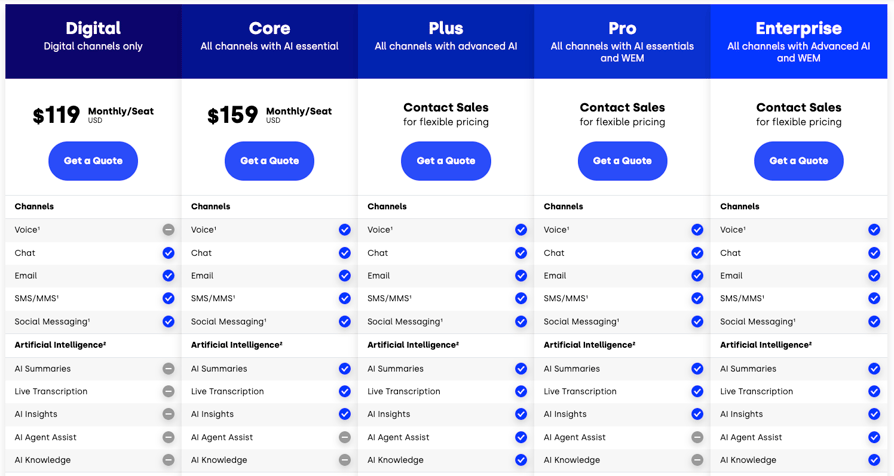
Five9's pricing page lists five tiers. Digital ($119) covers chat, email, SMS, and social only. Core ($159) adds voice and Five9's essential AI. Plus, Pro, and Enterprise are "Contact Sales for flexible pricing", adding advanced AI and WEM. Every price is per concurrent seat per month, and the footnote matters: usage-based pricing may apply, with a minimum of 50 seats.
Five9 Plans and Pricing
| Plan | Price | What You Get |
|---|---|---|
| Digital | $119/user/mo | Chat, email, SMS, and social channels, no voice |
| Core | $159/user/mo | All channels with essential AI, dialer, recording, ACD, IVR |
| Plus | Custom quote | All channels with advanced AI |
| Pro | Custom quote | All channels with essential AI and WEM |
| Enterprise | Custom quote | All channels with advanced AI and WEM |
The Catch With Five9 Pricing
The 50-seat floor is only where the math starts. Five9's dialer comes inside the voice seat, so it carries the same minimum. Workforce management is billed per named user on top, and AI runs on usage once the 3,000 minutes bundled with each seat are gone. For a 20-agent team, that's 30 seats it can't fill before a single add-on, with no free trial to test the fit and no published contract term to plan around.
How Much Does RingCentral RingCX Cost?
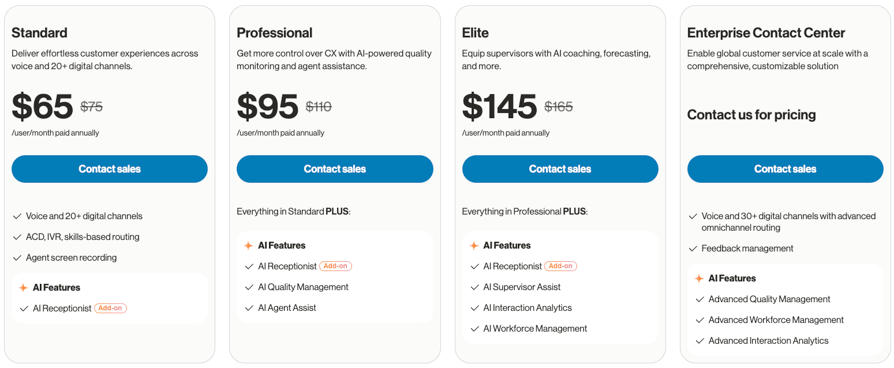
RingCX pricing splits into three tiers, each per agent per month, with a monthly option. Standard covers voice, 20+ digital channels, ACD, IVR, skills-based routing, and screen recording. Professional adds AI Quality Management and AI Agent Assist, and Elite adds AI Supervisor Assist, AI Interaction Analytics, and AI Workforce Management. Also, mind that RingCX enterprise contact center tier is quote-only.
RingCX Plans and Pricing
| Plan | Price | What You Get |
|---|---|---|
| Standard | $65/user/mo ($75 monthly) | Voice and 20+ digital channels, ACD, IVR, skills-based routing, screen recording |
| Professional | $95/user/mo ($110 monthly) | Standard plus AI Quality Management and AI Agent Assist |
| Elite | $145/user/mo ($165 monthly) | Professional plus AI Supervisor Assist, AI Interaction Analytics, AI Workforce Management |
| Enterprise Contact Center | Custom quote | Voice and 30+ digital channels, advanced omnichannel routing, QM, WFM, analytics |
The Catch With RingCentral Pricing
The $65 seat is real, but it only covers your agents. Everyone else stays on RingEX at $20 to $35 per user, so one company's calls run on two products and two sets of seats. The AI that makes RingCX stand out costs $25 per module on Standard, every add-on carries a one-year minimum, and the AI Receptionist comes on top. To contrast with Five9, for a 20-agent team that wants AI coaching, that means RIngCX Professional at $95 per agent on annual billing, before anyone outside the contact center even has a phone line.
How Do Five9 and RingCentral Pricing Compare Line by Line?
Put the two pricing pages next to each other and the pattern is clear: Five9 is built to be quoted, RingCX is built to be bought online. CloudTalk is alongside for the teams neither price list was written for.
Pricing Compared Line by Line
| Pricing Dimension | Five9 | RingCentral (RingCX) | CloudTalk |
|---|---|---|---|
| Entry price (voice) | $159/user/mo | $65/user/mo | $25/user/mo |
| Published tiers | 2 of 5 | 3 of 3 | 3 of 3 |
| Monthly billing | Not published | Yes, from $75/user/mo | Yes, from $34/user/mo |
| Seat minimum | 50 | Not published | 1 on base plans (3 on Expert) |
| AI agent pricing | 3,000 min per seat, then usage | Not published for RingCX ($39/month add-on on RingEX) | From $99/month for 200 minutes, first 50 minutes of AI receptionist free |
| Free trial | Not published | Not published for RingCX | 14 days |
Stop Guessing What the Seat Really Costs
Five9 Integrations vs. RingCentral Integrations: Which Connects Better?
Both platforms connect to the major CRMs. The difference is how they connect to the rest of your communications stack: Five9 plugs into someone else's phone system, RingCX comes with one. Here's what each supports today.
What Does Five9 Integrate With?
Five9 offers pre-built adapters for Salesforce, ServiceNow, Microsoft Dynamics 365, Oracle Service Cloud, NetSuite, and Zendesk, with HubSpot through a marketplace connector. On the UC side it integrates with Microsoft Teams, Zoom Phone, Nextiva, and RingCentral itself, sharing presence and click-to-call. Developers get CTI, configuration, reporting, and statistics APIs plus a CRM SDK, and the marketplace lists 55+ partner solutions.
What Does RingCentral Integrate With?
RingCX ships apps for Salesforce, HubSpot, ServiceNow, Zendesk, and Microsoft Dynamics 365, all included in the seat price. Its biggest integration is its own platform: RingCX agents share RingEX presence and directory out of the box. Microsoft Teams works through Direct Routing, but needs a RingEX subscription alongside. The App Gallery lists 500+ integrations, 50+ of them built for the contact center side.
How Do the Integrations Compare?
On CRM names, Five9 and RingCentral are close. The real differences are what each integration costs and how the phone system plugs in. Compare them side by side, along with how a lighter platform like CloudTalk connects the same CRMs from its Essential plan, without add-on adapters or a second product to wire in.
Integration Capability Compared
| Integration Capability | Five9 | RingCentral (RingCX) | CloudTalk |
|---|---|---|---|
| Major CRMs | Salesforce, ServiceNow, Dynamics 365, Oracle, NetSuite, Zendesk | Salesforce, HubSpot, ServiceNow, Zendesk, Dynamics 365 | HubSpot, Pipedrive, Zendesk, Zoho and 100+ more from Essential, Salesforce on Expert |
| Workforce management tools | Native WEM, Verint, Calabrio | Native AI WFM, Calabrio, Verint add-ons | Not offered |
| Native UCaaS bundling | Via adapters (Teams, Zoom Phone, RingCentral) | Native with RingEX | Microsoft Teams integration |
| Developer access | CTI, config, reporting, and stats APIs, CRM SDK | RingCentral developer platform, 500+ APIs | Open API and webhooks |
| Integration cost | CRM adapters listed as add-ons | Included in the seat | Included from Essential |
Security & Compliance: Is Five9 or RingCentral Safer for Regulated Teams?
Both vendors publish serious credentials. Five9's set leans toward regulated U.S. industries, RingCentral's toward international data handling. Here's what each states on its own trust pages.
How Secure Is Five9?
Five9's trust page reads like a checklist for finance and healthcare buyers, with one gap it names itself: FedRAMP is a stated goal, not a held authorization.
- CertificationsSOC 2 Type 2, ISO 27001 and 27017, PCI DSS Level 1 service provider, TX-RAMP Level 2, UK Cyber Essentials.
- Privacy regimesHIPAA as a business associate, GDPR, CCPA, PIPEDA, and UK DPA support, with EU data centers in Frankfurt and Amsterdam.
- EncryptionHTTPS, sFTP, and sRTP in transit, encrypted recordings and transcripts at rest.
- Access controlsPassword policies and two-factor authentication for privileged users. Agent SSO isn't described on the trust pages.
How Secure Is RingCentral?
RingCentral's trust center covers RingEX and RingCX together, with broader ISO coverage and data residency in five regions, and no FedRAMP listing for RingCX.
- CertificationsISO 27001, 27017, and 27018 for RingEX and RingCX, SOC 2+ and SOC 3, PCI DSS attestation for RingCX, C5 in Germany, Cyber Essentials Plus in the UK.
- Privacy regimesGDPR and the EU-U.S. Data Privacy Framework, with a HIPAA Business Associate Agreement on request. Agent Assist sits outside the BAA.
- EncryptionTLS and SRTP for voice, encryption at rest, end-to-end encrypted messaging, and E2EE calls in closed beta.
- Data residencyFacilities in the U.S., UK, Europe, Canada, and Australia, with the region set by your contracting entity.
How Do Security & Compliance Compare?
Line for line, Five9 wins on U.S. regulatory depth, RingCentral on international breadth. Both will pass a standard vendor security review.
Security and Compliance Compared
| Security & Compliance | Five9 | RingCentral (RingCX) |
|---|---|---|
| SOC 2 | Type 2 | SOC 2+ and SOC 3 |
| ISO 27001 | Yes, plus 27017 | Yes, plus 27017 and 27018 |
| PCI DSS | Level 1 service provider | Attestation of Compliance |
| HIPAA | Business associate safeguards | BAA available, Agent Assist excluded |
| GDPR | Yes, EU data centers | Yes, EU-U.S. DPF |
| FedRAMP | Not held, in progress | Not published |
| SSO and MFA | 2FA for privileged users | SSO and enforced MFA |
Usability & Reliability: Is Five9 or RingCentral Easier to Run?
Depth and ease pull in opposite directions. Five9 gives admins more to configure, and reviewers say so. RingCX is quicker to stand up, and reviewers say that too. Both promise 99.999% uptime, so reliability comes down to what users report, not what the SLA says.
How Easy Is Five9 to Run, and How Reliable Is It?
Five9 is praised for what agents see and criticized for what admins have to build. The dialer and the agent desktop get the love. The rollout and the uptime get the complaints.
- PraisedAn intuitive, web-based agent desktop that needs little training, a knowledgeable implementation team, and a dialer reviewers call one of the best on the market.
- CriticizedConfiguration depth means longer, more complex rollouts without dedicated implementation help, plus recurring reports of dropped calls and outages.
- UptimeA 99.999% SLA and a trailing twelve-month average availability of 99.997% at the time of writing, published on Five9's trust page.
How Easy Is RingCentral to Run, and How Reliable Is It?
RingCX earns its ease-of-use scores, with one caveat that comes up in nearly every critical review: reporting.
- PraisedOne workspace for every channel, live AI suggestions during calls, and fast implementation with responsive rollout support.
- CriticizedRouting setup often needs support, reporting is slow to customize, and the RingCX and RingEX sides of the account can feel like two products.
- UptimeA 99.999% availability guarantee across RingCentral products.
How Do Usability & Reliability Compare?
On G2's own scores, RingCX leads on setup and administration, Five9 on being a long-term partner. The deployment patterns behind those numbers tell the rest.
Usability and Reliability Compared
| Dimension | Five9 | RingCentral (RingCX) |
|---|---|---|
| Typical deployment | Weeks, with professional services | Days to weeks, apps deploy in hours |
| Admin configuration | Deep, often consultant-led | Moderate, routing setup needs support |
| G2 ease of setup | 8.1/10 | 8.6/10 |
| G2 ease of admin | 8.1/10 | 8.3/10 |
| Reported reliability | Drops and outages recur in reviews | Stable in reviews, complaints are about configuration |
What Do Five9 vs. RingCentral Reviews Say?
Peer review platforms tell you what the pricing pages don't. On G2, Five9 holds 4.1/5 from 600+ reviews and RingCX 4.4/5 from 100+, the bigger, older base behind Five9 and the higher score behind the younger product. Gartner Peer Insights rates Five9 4.5/5 from 950+ ratings and RingCX 4.4/5 from a handful. Capterra has both at 4.2/5. What matters in Five9 vs RingCentral reviews isn't the average, it's who's writing them and what they keep repeating.
How Do Five9 and RingCentral Compare on G2 (and How Does CloudTalk Fit In)?
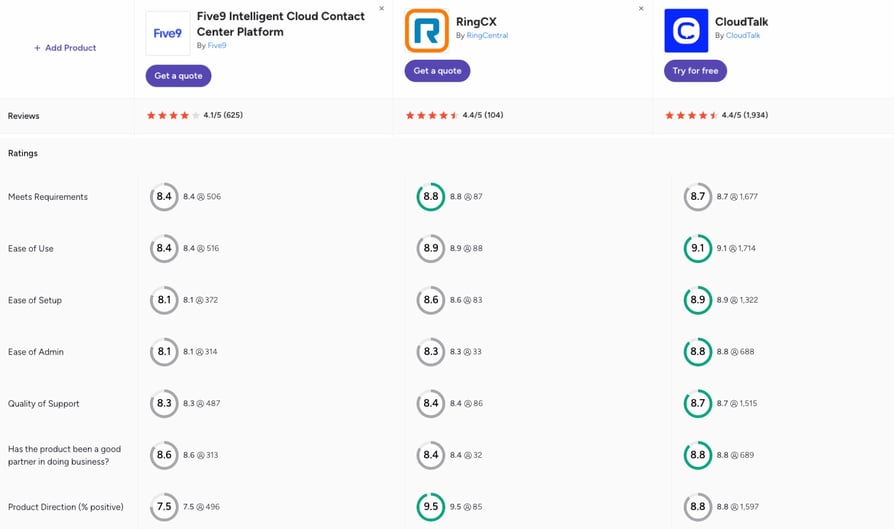
G2 scores all three platforms on the same seven dimensions, which makes it the quickest way to see where each one earns its keep. RingCX beats Five9 on six of the seven, while Five9 holds on as the better long-term partner. To give you a more complete picture, CloudTalk, rated 4.4/5 from 1,900+ reviews, leads on the five scores a team without its own IT department feels every day: ease of use, setup, admin, support, and partnership.
G2 Ratings Compared: Five9, RingCX, and CloudTalk
| Review Dimension | Five9 | RingCentral (RingCX) | CloudTalk |
|---|---|---|---|
| Overall rating | 4.1/5 (600+ reviews) | 4.4/5 (100+ reviews) | 4.4/5 (1,900+ reviews) |
| Meets requirements | 8.4 | 8.8 | 8.7 |
| Ease of use | 8.4 | 8.9 | 9.1 |
| Ease of setup | 8.1 | 8.6 | 8.9 |
| Ease of admin | 8.1 | 8.3 | 8.8 |
| Quality of support | 8.3 | 8.4 | 8.7 |
| Good partner in doing business | 8.6 | 8.4 | 8.8 |
| Product direction | 7.5 | 9.5 | 8.8 |
The reviewer mix explains most of the gap between Five9 and RingCX. Five9's reviewers are mostly mid-market and enterprise teams, which is why it scores as the steadier partner. RingCX's reviewers skew small-business, rate it easier to set up, and are far more upbeat about where the product is heading. CloudTalk's lead comes from the day-to-day scores, backed by a review base more than three times the size of Five9's.
What Do Real Users Say About Five9 on G2?
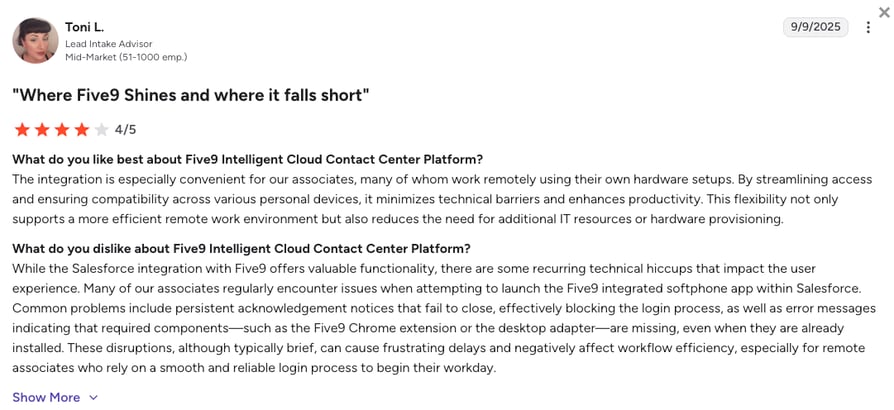
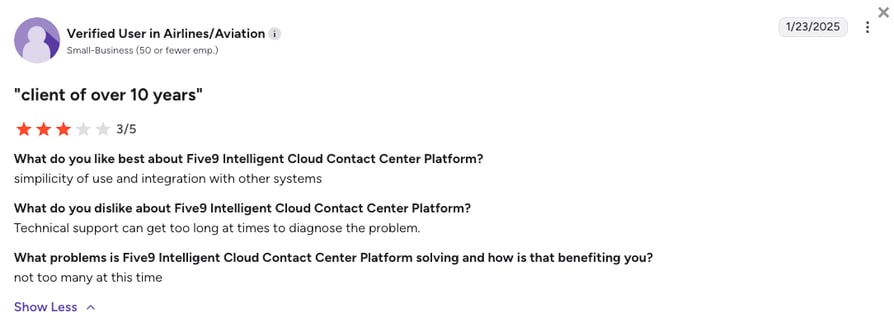
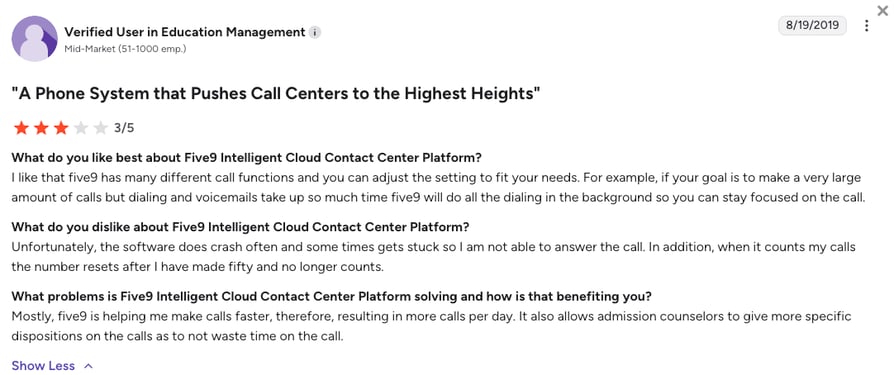
Five9 reviewers on G2 praise the web-based agent desktop, the Salesforce integration, and a support team that knows the product. The recurring recent complaints are dropped calls and outages, reporting that takes workarounds, and paid custom work for changes. The 50-seat minimum never appears as a complaint, because everyone reviewing has already cleared it.
What Do Real Users Say About RingCentral's RingCX Suite on G2?
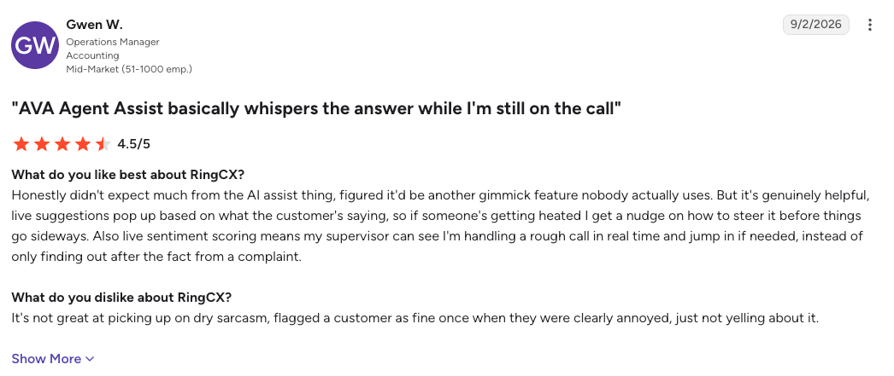
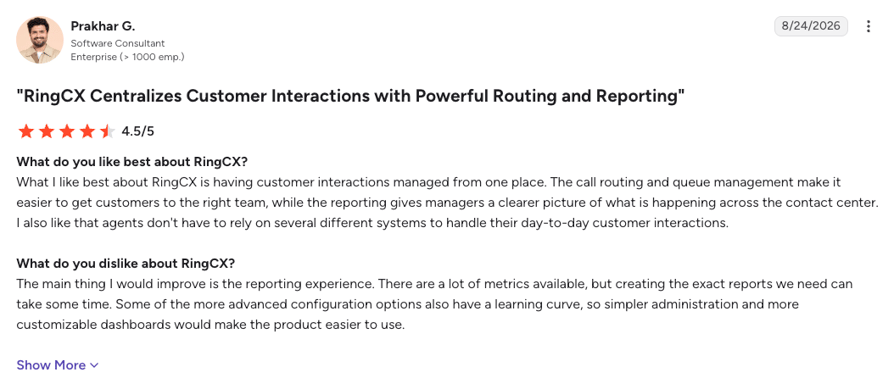
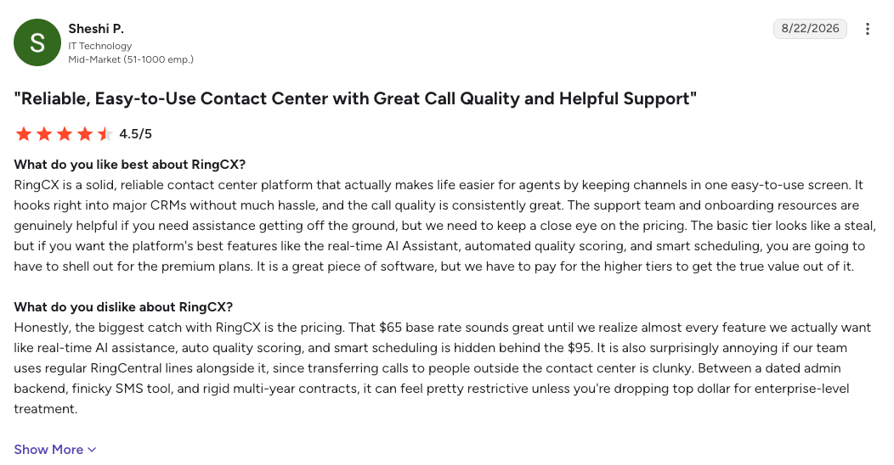
RingCX reviewers like having every channel in one workspace, AVA Agent Assist suggesting answers live, and a rollout measured in days. Their complaints are slow, hard-to-customize reporting, routing setup that needs support, and AI hidden behind higher tiers. RingCentral's wider base on RingEX adds the vendor-level themes: a dense admin portal, add-on charges, and slow tiered support.
What Do Redditors and Quora Users Say About Five9 and RingCentral?
Community threads add the unfiltered layer, and neither set of threads is about product quality. It's about fit.
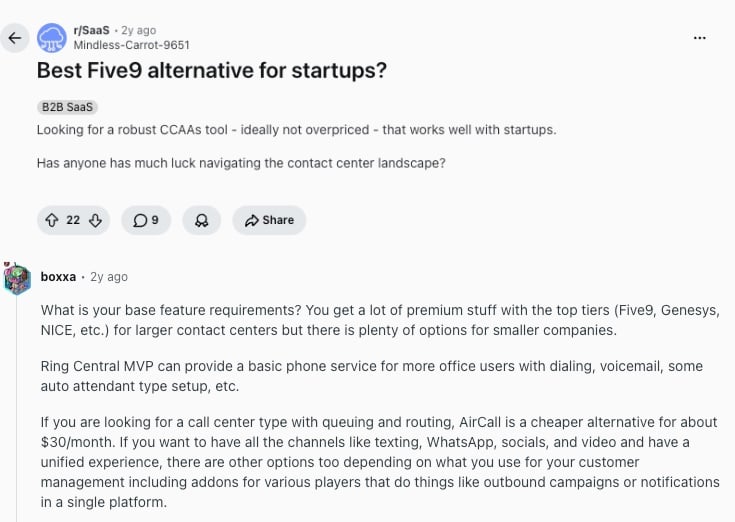
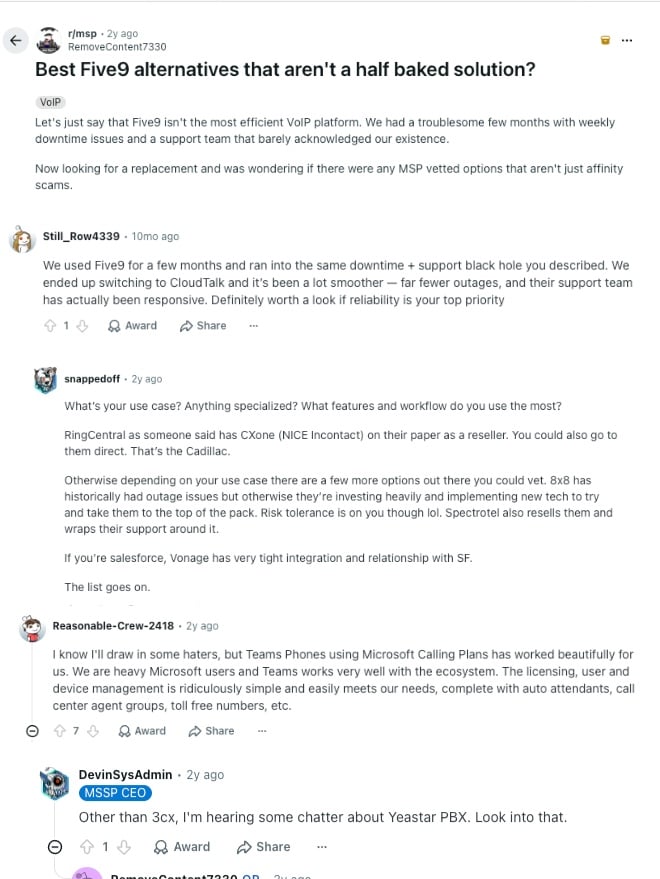
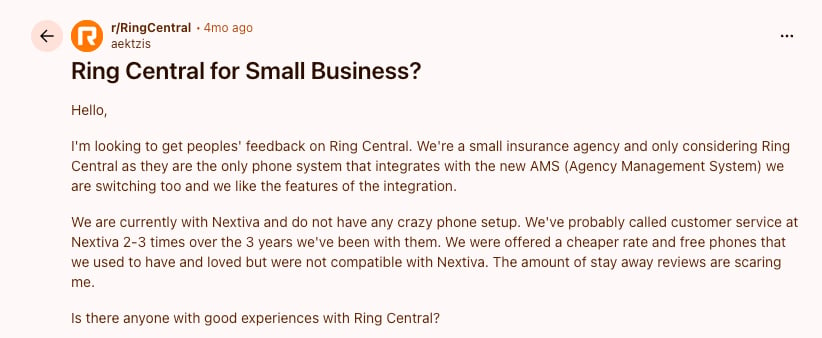
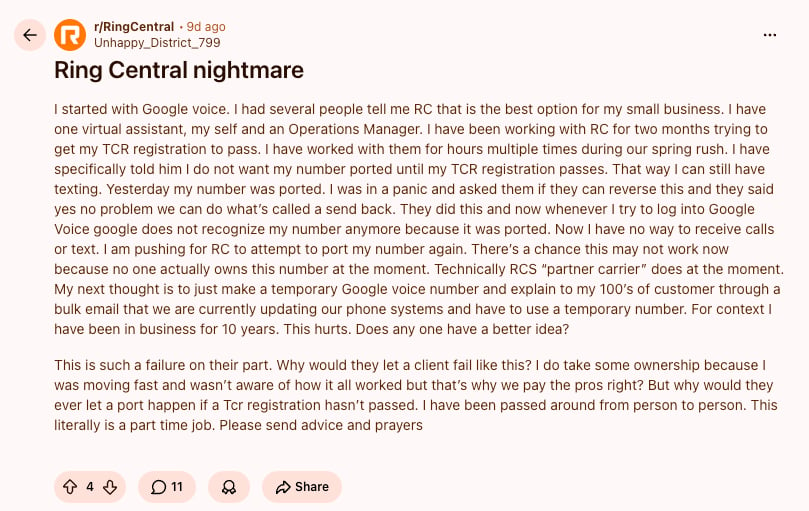
On Five9, r/SaaS founders ask for alternatives that don't start at 50 seats, r/msp admins want mature integrations over half-built ones, and r/callcentres agents talk about lag. On RingCentral, r/RingCentral threads center on porting problems and support runarounds, and small-business owners ask openly whether the platform is too much for them.
What Are the Main Pros & Cons of Five9 vs. RingCentral?
The short version, for anyone who scrolled: three pros and three honest cons per platform, each one checked against the vendor's live pages or recurring recent reviews.
What Are the Main Pros & Cons of Five9?
Five9's pros are about depth and trust at scale. Its cons are all about the price of entry.
Five9 Pros
- Deepest outbound and WEM toolingFive dialer modes, native forecasting and scheduling, and 100% call transcription for QM, all from one vendor.
- Built for regulated, high-volume floorsPCI DSS Level 1, HIPAA safeguards, TX-RAMP, geo-redundancy, and a governed AI layer.
- Strong support and implementationReviewers consistently rate the implementation team and support as knowledgeable, with 24/7 support on every tier.
Five9 Cons
- Quote-gated above CoreThree of five tiers are "Contact Sales", and usage fees may apply.
- 50-seat minimum, priced per concurrent seatSmall and mid-sized teams pay for seats they can't fill.
- Complex rollout and stability complaintsDeep configuration means longer projects, and recent reviews still report drops and dated reporting.
What Are the Main Pros & Cons of RingCentral?
RingCentral's pros are about access and simplicity. Its cons are about what the $65 seat doesn't include.
RingCentral Pros
- Published, flexible pricingThree RingCX tiers in monthly and annual terms, from $65 per agent, with CRM apps included.
- UCaaS and CCaaS from one vendorAgents and the rest of the company share RingEX presence, directory, and video.
- Fast to deploy, easy to use8.6/10 for ease of setup and 8.9/10 for ease of use on G2, with AI assistance agents actually notice.
RingCentral Cons
- Lighter contact center depthEnterprise WFM and 30+ channel routing live in the quote-only Contact Center product, not in RingCX.
- AI sold by tierFour $25 modules turn a $65 seat into a $165 one, and add-ons carry a one-year minimum.
- Reporting and silo complaintsRecent reviews call reporting slow to customize and describe RingCX and RingEX as two separate worlds.
Need Dialers, Routing, and AI Without a 50-Seat Contract?
Why Is CloudTalk the Best Alternative to Five9 and RingCentral for Growing Teams?
Five9 and RingCentral both assume you're running a contact center: agents in seats, supervisors on dashboards, an implementation with a start date. CloudTalk starts from the other end, with a calling platform a growing team switches on in an afternoon, and it beats both on the three things that decide most switches: the price you can read, the seat you can start with, and AI that's part of the phone system rather than a module on top.
What Is CloudTalk?
CloudTalk is an AI-powered, voice-first cloud call center platform for sales and support teams of up to 200. Skills-based routing, IVR, recording, analytics, and dialers come inside the platform, and the AI Receptionist answers on the same numbers and hands off to a human with context. It's what a team picks when an enterprise suite is more than it needs and a basic phone system is less.
Why Is CloudTalk a Strong Five9 and RingCentral Alternative?
Because it fixes the two problems Five9 and RingCentral leave open: Five9 prices you out below 50 seats, and RingCX makes you buy the contact center and the phone system separately. CloudTalk does neither, and it's honest about what it leaves out: workforce management, video meetings, and omnichannel routing across social channels. Need those for 200 agents? Five9 or RingCentral Contact Center is the right call.
- One seat to start, published pricesPlans from $25/user/month with a one-seat minimum, monthly or annual, and every add-on with a published price. No 50-seat floor, no quote to unlock the tier you need.
- Dialers and routing without a projectPower Dialer on Expert or as a $15/user/month add-on on any plan, Parallel Dialer as a $39/user/month add-on, Smart and Preview Dialers on Expert, and a drag-and-drop call flow designer an ops manager runs alone.
- AI inside the call flowCloudTalk's AI Voice Agent runs from $99/month for 200 minutes with 50 free on every account, speaks 60+ languages, and lands every call in the same reports as your human agents.
- Local presence in 160+ countriesLocal and toll-free international numbers, multi-carrier routing, and 100+ CRM and helpdesk integrations from Essential, with Salesforce on Expert.
How Does CloudTalk's AI Compare With Five9's and RingCentral's?
Five9 governs its AI for regulated floors. RingCentral sells its AI by tier. CloudTalk puts the AI agent inside the call flow, next to the IVR and skills-based routing, and prices it per minute from $99/month. Since RingCentral is the closer comparison for a smaller team, here's a two-minute head-to-head of CloudTalk against RingCentral's AI Receptionist: setup speed, CRM sync, languages, pricing, and global reach, scored round by round.
Signature Capability
See CloudTalk’s AI Voice Agent in Action!
CeTe is an AI that talks like a human: no breaks, no training, no time off. It makes and answers calls, updates CRMs, books meetings, and loops in a human only when needed.
Press play to hear it. Want a wow moment? Get a free test call and try it live.

What Are CloudTalk's Plans & Pricing?
CloudTalk pricing starts at $25/user/month (Starter, billed annually), with the following plans:
CloudTalk Plans and Pricing
| Plan | Price (annual billing) | Key Features |
|---|---|---|
| Starter | $25/user/month | Unlimited inbound and internal calls, 500 outbound minutes (regional calling bundle), call queues, transfers, click-to-call, automatic call recording (1-month retention) |
| Essential | $29/user/month | Everything in Starter + IVR and smart routing, 100+ CRM/helpdesk integrations, workflow automation, unlimited recording retention |
| Expert | $49/user/month | Everything in Essential + Power, Smart, and Preview Dialers, Salesforce integration, 24/7 phone support (3-seat min) |
| Conversation Intelligence (add-on) | $9/user/month | AI transcripts, call summaries, call scoring, sentiment analysis, and agent coaching insights |
| AI Receptionist (add-on) | From $99/month (200 min) | Inbound AI call answering, routing, logging. 50 free minutes on every account. Tiers up to $699/month (2,500 min) |
| AI Specialist (add-on) | From $349/month (1,000 min) | Sales-led custom AI voice agents for inbound and outbound workflows. Plans scale up to $1,249/month (5,000 min) |
What Are CloudTalk Customers Saying?
Mid-sized operations pick CloudTalk when the enterprise suite is more than they need and reliability still matters. Convergence, an IT team supporting 150 nursing homes, put it this way after switching:
Call quality was a thousand times better. Reliability was a hundred times better.
IT, Convergence

Which Team Fits Which Platform?
Fit depends on three things: how many agents you run, how predictable your call volume is, and whether you want a dedicated contact center platform or contact center plus UCaaS from one vendor. Not on which platform is better. Match your team to a column, and if neither describes you, more contact center alternatives exist for exactly that gap.
Which Team Fits Which Platform
| Five9 Is the Right Fit For... | RingCentral Is the Right Fit For... |
|---|---|
| Dedicated contact centers with 50 or more agents | Teams under 50 agents with fluctuating call volumes |
| Outbound-heavy operations that need predictive dialing and compliance tooling | Companies that want contact center, phone, video, and messaging from one vendor |
| Regulated industries such as financial services, insurance, and healthcare | Teams already on RingEX that want agents in the same directory |
| Operations that schedule and forecast hundreds of agents | Buyers who want monthly billing and a price before the sales call |
| Large BPOs running blended inbound and outbound at volume | Support teams that want AI coaching switched on one module at a time |
If Neither Column Describes Your Team
A team of 5 to 40 that lives on the phone usually finds Five9 too big to buy and RingCX more contact center than it needs. That's the gap CloudTalk fills, and the two alternatives pages go wider: the Five9 alternatives list covers the platforms that skip the seat minimum, and the RingCentral alternatives list covers the options for teams that don't want the UCaaS bundle.
Five9 vs. RingCentral: What's the Verdict?
The choice comes down to agent count, call volume predictability, and how much of a broader communications bundle you want. It doesn't come down to product quality, because both are well-reviewed at the job they're built for. Here's the decision, scenario by scenario.
Choose Five9 If You...
Five9 is the right call when scale, compliance, and outbound depth are the job:
- Run 50 or more agents today and expect to keep them busy
- Depend on outbound volume and need predictive dialing with DNC and time-zone compliance built in
- Work in a regulated industry that asks for PCI DSS Level 1, HIPAA safeguards, and a governed AI layer
- Schedule, forecast, and score hundreds of agents from one workforce suite
- Have an implementation budget and an IT team to own a multi-week rollout
Choose RingCentral If You...
RingCentral is the right call when simplicity, one vendor, and a published price matter more than depth:
- Run fewer than 50 agents and your volume moves with the season
- Already use RingEX, or want phone, video, messaging, and contact center on one bill
- Want a published price and a monthly option before you speak to sales
- Prefer to add AI coaching and quality scoring one $25 module at a time
- Value a rollout measured in days over the deepest workforce tooling
The Bottom Line
There's no overall winner between Five9 and RingCentral, and after every table and review, that's still the honest answer. Five9 is the stronger platform for a large, regulated, outbound-heavy operation. RingCX is the smarter buy for a growing team that wants its contact center on the same platform as the rest of the company. If neither scale or pricing model fits, because Five9 starts at 50 seats and RingCX still assumes a real agent headcount, CloudTalk gives you a lighter call center with skills-based routing, dialers, and an AI agent at published per-user pricing from one seat.
Join 5,500+ Businesses That Chose the Right-Sized Call Center
Frequently Asked Questions About Five9 vs. RingCentral
Direct answers to the questions buyers ask most when comparing Five9 and RingCentral.
Neither Five9 nor RingCentral is better overall. Five9 is the stronger platform for dedicated contact centers with 50 or more agents that need predictive dialing, native workforce management, and deep compliance tooling. RingCentral's RingCX is the better fit for teams under 50 agents that want a published price, monthly billing, and their contact center on the same platform as their phone system. The deciding factor is your scale, not the product.
RingCentral is the cheaper contact center, at least at the entry point. RingCX starts at $65 per agent per month on annual billing ($75 monthly), while Five9's voice seat starts at $159 per concurrent seat with a 50-seat minimum, which means a voice deployment of roughly $7,950 a month before usage. At enterprise scale the gap narrows, because Five9's upper tiers are quote-based and RingCX's AI modules add $25 per agent each. For a team that only needs calling, routing, and dialers, CloudTalk's $25/user/month plans undercut both.
Yes, any Five9 plan requires a strict 50-seat minimum. Five9's pricing page states that prices are per concurrent user, usage-based pricing may apply, and there's a minimum of 50 seats. That applies across the published Digital and Core tiers and the quote-based Plus, Pro, and Enterprise tiers. A 20-agent team would pay for 30 seats it can't fill, which is the main reason smaller teams look at RingCX or CloudTalk instead.
For outbound sales at scale, Five9 definitely beats RingCentral. It offers predictive, progressive, power, preview, and manual touch dialing with DNC lists, time-zone rules, and answering machine detection, which is why collections floors and insurance lead-engagement teams use it. RingCX covers preview, progressive, predictive, and agentless dialing and suits outbound teams under 50 agents. Ask both how numbers are rotated and monitored, because neither pricing page covers caller-ID reputation. For a sales team of 5 to 50, CloudTalk's power and parallel dialer cover the same ground from one seat.
Five9's AI is more governed, RingCX's is easier to switch on gradually. Five9 packages Genius AI (AI Agents, Agent Assist, Summaries, Insights, Knowledge) into tiers with 3,000 AI minutes per bundled seat and publishes an AI trust and governance framework. RingCentral spreads RingSense-powered features across RingCX tiers, with AI Quality Management and Agent Assist on Professional, Supervisor Assist, Interaction Analytics, and AI WFM on Elite, or $25 per agent per module. Neither publishes a per-minute rate for its contact center AI agent.
Both Five9 and RingCentral cover the major CRMs. Five9 offers pre-built adapters for Salesforce, ServiceNow, Microsoft Dynamics 365, Oracle, NetSuite, and Zendesk, with HubSpot through a marketplace connector, and integrates with Microsoft Teams, Zoom Phone, and RingCentral as phone systems. RingCX ships apps for Salesforce, HubSpot, ServiceNow, Zendesk, and Dynamics 365 in the seat price, and its strongest integration is with RingEX itself. If your CRM is HubSpot or Pipedrive, RingCX or CloudTalk connects natively where Five9 needs a connector.
RingCentral is easier to implement than Five9. G2 reviewers rate RingCX 8.6 out of 10 for ease of setup and 8.3 for ease of administration, against 8.1 and 8.1 for Five9, and RingCX's CRM apps advertise deployment in hours. Five9's depth means a longer, often consultant-led rollout, which reviewers accept as the price of workforce management and compliance tooling at scale. Both promise 99.999% uptime, though Five9 reviewers report more dropped calls and outages than RingCX reviewers do.
RingCentral Contact Center is built with NiCE CXone, so comparing Five9 and NiCE is close to comparing Five9 and RingCentral's enterprise product. RingCX, by contrast, is RingCentral's own AI-first contact center and a different, lighter platform. Genesys Cloud CX sits in the same enterprise tier as Five9 and NiCE, with the same omnichannel depth and the same implementation weight. For most teams under 50 agents, none of the three is the right size, and RingCX or CloudTalk is where the comparison ends up.
CloudTalk is the best Five9 alternative for growing sales and support teams, because it removes the 50-seat minimum and the quote-based tiers while keeping skills-based routing, dialers, recording, analytics, and an AI agent inside one platform from $25/user/month. Among Five9's closest competitors, RingCX, Talkdesk, Genesys, and NiCE CXone fit larger operations, and our full ranking of Five9 alternatives compares ten platforms by team size and use case.
CloudTalk is the best RingCentral alternative for teams that want the contact center features without the UCaaS bundle: published per-user pricing with dialers and CRM sync priced up front, an AI agent from $99/month, and local numbers in 160+ countries. RingCentral's biggest competitors at the enterprise end are Five9, NiCE CXone, and Genesys, and for phone-system buyers Nextiva, Dialpad, and Zoom Phone. Our recent ranking of RingCentral alternatives covers the top ten for sales, support, and international teams.