Conversation Intelligence for Financial Services & Insurance (2026 Guide)
TL;DR:
Conversation intelligence records, transcribes and analyzes insurance, banking and lending calls with AI, then flags what a person should check, from a missed disclosure to a risky promise. The outcome that matters: every call gets checked, instead of the 1% to 3% a QA team usually manages to hear.
Our shortlist of five tools, with what each is best for:
- CloudTalk: Agencies, brokers, lenders, fintech and mid-size service teams that want every call reviewed
- CallMiner Eureka: Large insurers, banks and collections operations analyzing interactions at scale
- Observe.AI: Contact centers that want automated QA plus live guidance during calls
- Genesys Cloud CX: Enterprise banks and insurers replacing the whole contact center stack
- Gong: Sales teams in wealth management, lending and B2B financial services
One insurance or lending call can carry a required disclosure, a complaint, a promise the agent shouldn't have made and the one claim detail the file needs. If you run QA, compliance or a contact center, you know how few of those calls anyone actually hears. ISG Research puts the share of interactions quality teams score at as little as 1% to 3%, even in centers that record every call1. Conversation intelligence for insurance and lending teams closes that gap: it reads every call and points your reviewers at the ones that need a person.
This guide covers what conversation intelligence for financial services checks, where it pays off first, what to set up before the first call gets analyzed, and how to test it in 30 days. For a sense of scale, Capitalo, a financial education provider, cut its daily call-quality review from two hours to 20 minutes, an 83.3% drop, once AI started transcribing and analyzing every German-language call.
What Is Conversation Intelligence in Financial Services and Insurance?
Conversation intelligence is software that records, transcribes and analyzes customer calls with AI, then flags what was said, how it was said and what should happen next. In insurance and financial services, its output is a compliance check, a QA score, a summary for the file and a signal for a person to act on.
If you want the plain definition first, our guide to what is conversation intelligence covers the basics. Here, the useful part is how it differs from three things it often gets confused with:
- Call recording: Recording stores the audio and leaves it there. Nobody reads it until an audit or a complaint forces someone to find the call and play it back in real time.
- Speech analytics: The older approach, built on keyword and phrase lists, with the same goal of finding what matters in calls. Conversation intelligence adds summaries, scoring and sentiment, so your team stops maintaining word lists by hand.
- Conversational AI: Conversational AI for financial services means chatbots and voice agents that hold the conversation with the customer. Conversation intelligence analyzes conversations after they happen, whoever held them.
Why Insurance and Financial Services Calls Need Their Own Approach
A missed step on a retail support call costs you a happy customer. On an insurance or lending call, it can cost you an audit finding. Four things set these calls apart:
- Required disclosures and suitability questions: A skipped risk warning on a loan call or an unasked eligibility question on a policy sale is a compliance issue, not a coaching note.
- Complaints and vulnerable customers: A caller who mentions a bereavement, a lost job or confusion about what they signed needs different handling, and the signal sits in their words.
- High-value outcomes in one call: A policy bound, a claim opened or a payment plan agreed all happen inside a single conversation.
- Long calls: A 25-minute first notice of loss call is too long for anyone to replay on a hunch.
Now put those calls next to a 1% to 3% review sample. Most of the risk on your lines is never heard. Banks and lenders face the same math, which is why conversation intelligence for banking starts from the same place: analyze every call, then send people to the ones that need them.
What Conversation Intelligence Checks on Every Call
Good call analytics solutions for insurance and lending teams look for the same seven things on every call. Here is what each one sounds like in practice.
| What It Checks | Example From a Call | Why It Matters |
|---|---|---|
| Required disclosures read | The recording notice and the cancellation period stated on a policy sale | Proves the script was followed, or shows exactly where it wasn't |
| Identity or eligibility questions asked | Date of birth and policy number confirmed before claim details are discussed | Keeps account details away from the wrong person |
| Risky or promissory language | "Don't worry, you're definitely covered for that" or "this rate is guaranteed" | Flags promises the policy or loan terms may not back up |
| Complaint or cancellation signals | "I want to make a complaint" or "I'd like to cancel my policy" | Starts the complaint process on time and gives retention a chance |
| Sentiment shifts | Calm at the start, frustrated once the new premium is quoted | Shows your reviewers which calls to open first |
| Objections and outcomes | "The premium went up again" right before a renewal is lost | Shows why policies lapse and applications stall |
| Next step agreed | "We'll call you Thursday with the adjuster's decision" | Puts the follow-up in the CRM instead of an agent's memory |
Scoring turns those checks into a decision. You build a scorecard from your own script or policy (did the agent read the disclosure, confirm identity, avoid a guarantee) and every call gets a pass or fail on each line. QA moves from a sample to 100% coverage, and your reviewers spend their hours on the calls that failed something. A person still reviews every flag: the score tells your QA lead where to listen, not what to conclude.
All of it rests on the transcript underneath. That's the step older speech analytics insurance tools struggled with, and it's why call transcription quality, with each speaker labelled correctly, matters more than any dashboard built on top of it.
Use Cases for Insurance, Banking, Lending and Collections
The checks stay the same. The calls they pay off on differ by line of business, so here is where each team usually starts.
Insurance: Sales, Service and Claims Calls
For conversation intelligence for insurance companies, three call types carry most of the value.
- On quote and renewal calls, it surfaces price objections and cross-sell openings, like a new driver in the household or a recent home purchase. On service calls, it catches complaint and cancellation signals before they turn into a lost policy.
- On first notice of loss and claim status calls, the summary captures the date of loss, location, parties and damage, so the adjuster opens a complete file. Life, P&C and health lines all fit this pattern, and conversation intelligence for health insurance adds eligibility checks and stricter handling of health details.
The same speech analytics for insurance call centers that tags a claim call also feeds the AI call analytics insurance leaders rely on to see which product lines draw the most complaints.
Banking, Lending and Mortgage
Application and eligibility calls are the obvious start: did the agent ask the income and affordability questions your policy requires, and did the customer hear the disclosures?
The same scorecard catches mis-selling risk, like a product pitched before the customer's needs were established. Complaint flags route unhappy borrowers to the right team on the same day. And because every call is transcribed, the voice of the customer stops being a quarterly survey and becomes a weekly read of what applicants actually ask about.
"Now, the AI summarizes the call, and I instantly see whether it's worth reviewing."
PA to the Managing Director, My Mortgage Finder

Collections and Customer Recovery
Collection calls are where tone and wording carry the most risk. Speech analytics for collections checks that agents use your required wording, flags raised voices or pressure language, and captures every promise to pay with its amount and date, so follow-ups don't depend on an agent's notes.
Complaint flags matter here too, since a recovery call that turns into a dispute needs a different owner. Which rules apply to your collection calls depends on your market and the debt type, so build the scorecard from your own compliance team's checklist rather than a vendor template.
Fraud Signals: Flags, Not Verdicts
Conversation intelligence can flag patterns for an investigator, such as the same claim details repeated across calls from different callers, or a story that changes between the first call and the second. That is where its job ends.
It does not decide that something is fraud, and some flags will be false: a stressed caller repeating themselves can look like a script. Route fraud flags to a trained person, and track how many turn out to be nothing so the rules stay useful.
Compliance, Privacy and Consent: What to Set Up First
Conversation intelligence compliance starts before the first call gets analyzed, because the tool works on recordings and every recording rule still applies. Run through this checklist with your compliance lead before the pilot:
- Consent: A recording announcement plays on every inbound and outbound call, in every language you serve.
- Retention: A retention period for recordings and transcripts is set in the system, not just written in a policy.
- Access: Who can listen, read and export is limited by role, so a sales agent can't open a claims file.
- Audit trail: You can show who played or exported a recording, or you know your vendor can't and you have a workaround.
- Sensitive data: Card numbers and health details are handled the way your policy allows, whether that's pausing the recording or keeping them off the call.
- Requests: A process exists for deletion and access requests from customers.
Then confirm which rules apply to your calls with primary sources. In the US, that means federal and state call-recording consent laws (some states, California and Florida among them, require every party to consent). In the EU and UK, it means the GDPR. Health insurers add HIPAA, and anyone taking card payments by phone adds PCI DSS. Collection and telemarketing calls carry their own rules on top.
What a tool can do is give you the means to follow your policy. In CloudTalk, transcripts and summaries serve as a record of every analyzed call, scorecards document whether required steps happened, user roles limit who sees what, and recording retention is set by you in the account settings. Agents can pause and resume a recording mid-call with a call command, for example while a customer reads out a card number.
What CloudTalk doesn't do today is redact sensitive data from recordings or transcripts automatically, so your process has to cover that. The platform's certifications are listed on CloudTalk’s security page, and for live coaching on top of after-call review, our guide to call center compliance monitoring covers the options.
What to Look For in a Conversation Intelligence Platform
Most feature lists look the same. These five criteria are the ones that actually change which tool you pick.
Transcript Accuracy Comes Before Sentiment
Every score and flag is only as good as the transcript underneath it. Check three things: whether speakers are labelled correctly (agent versus customer), how the tool handles accents, and whether it gets your domain words right, like premium, deductible, subrogation and APR. Ask each vendor to run 20 of your own recorded calls, not their demo set. Treat sentiment as a sorting signal that tells you where to look first. It isn't evidence on its own.
Scorecards Mapped to Your Policy
You need to score calls against your own script and required phrases, not a generic sales template. Ask how many scorecard templates you get per account, because a claims team and a sales team rarely share one. Ask who can edit a scorecard (admins only, or team leads too), and whether a change applies to new calls only or rescores old ones.
Fit With Your Phone System and CRM
A tool built into your cloud phone system captures every call by default. A bolt-on that connects to a legacy PBX depends on that connector staying up, and gaps in capture mean gaps in your audit record. Then check the CRM side: which systems sync, and which fields land there (summary, score, next step). Few tools integrate natively with insurance agency management systems, so ask about yours by name.
Retention, Access and Languages
Confirm you can set your own retention period for recordings and transcripts, and that access works by role rather than all or nothing. Then check transcription languages against the languages your customers actually speak, including the ones your QA team doesn't. That's how one supervisor can review calls in markets where nobody on the team speaks the language.
Cost and Contract
Pricing comes in two shapes: a per-seat add-on to a phone system you already pay for, or a platform fee plus seats on an annual contract. Ask about minimum seats, whether every agent needs a license or only the ones you analyze, and whether the price is monthly or locked into a year.
Conversation Intelligence Tools for Financial Services and Insurance
These five tools come up most often when insurance and financial services teams compare options. They solve different problems, so match the "best for" column to your situation before you compare prices.
Conversation Intelligence Tools for Financial Services and Insurance Compared
| Tool | Type | Best For | Pricing Model | Starting Price | G2 Rating |
|---|---|---|---|---|---|
| CloudTalk | Cloud phone system with built-in conversation intelligence | Agencies, brokers, lenders, fintech and mid-size service teams that want every call reviewed | Per-agent add-on to any phone plan, billed monthly | $9/agent/month, on a plan from $25/user/month | 4.4/5 |
| CallMiner Eureka | Enterprise conversation analytics | Large insurers, banks and collections operations analyzing interactions at scale | Custom quote | Contact sales | 4.5/5 (230 reviews) |
| Observe.AI | AI contact center platform for QA and agent assist | Contact centers that want automated QA plus live guidance during calls | Custom quote | Contact sales | 4.6/5 (255 reviews) |
| Genesys Cloud CX | Full contact center platform | Enterprise banks and insurers replacing the whole contact center stack | Per user, billed annually, plus AI usage tokens | From $75/user/month (CX 1) | 4.4/5 (1,558 reviews) |
| Gong | Revenue intelligence | Sales teams in wealth management, lending and B2B financial services | Platform fee plus per seat, annual contract | Contact sales | 4.7/5 (6,679 reviews) |
CloudTalk
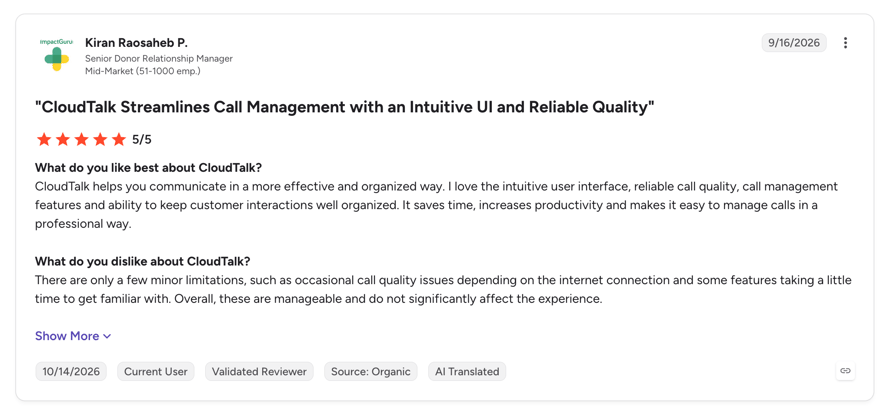
CloudTalk is a cloud phone system for sales and support teams, with conversation intelligence built into every call: transcripts with labelled speakers in 19 languages, AI summaries, topic tags, sentiment and QA scorecards, with notes pushed to HubSpot, Pipedrive and Zoho.
Best for agencies, brokers, lenders and mid-size service teams.
Skip it if you need live prompts during the call (analysis happens after it), conversation data in Salesforce, Dynamics or a core banking system, or trading-desk surveillance. Per-agent add-on with a 30-day trial, checked October 2026.
CallMiner
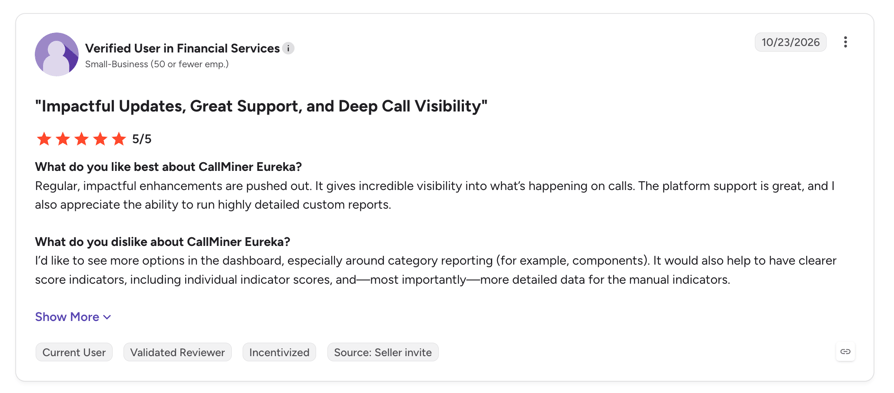
CallMiner Eureka is an enterprise conversation analytics platform with dedicated insurance and banking solutions.
Best for large insurers, banks and collections operations that need deep analysis across very high interaction volumes.
Skip it if you're a mid-size team that wants every call scored within weeks, since it's an analytics layer you connect to your contact center rather than a phone system. Custom pricing, checked October 2026.
Observe.AI
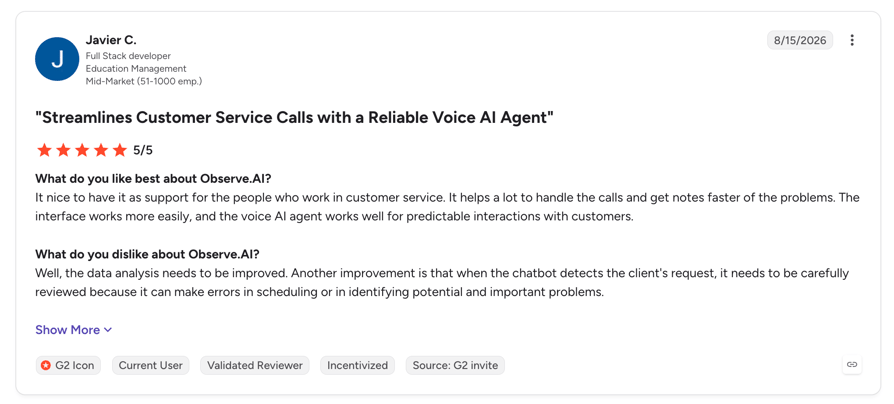
Observe.AI is an AI platform for contact centers, built around automated QA scoring and real-time agent assist.
Best for contact centers that want both after-call scoring and live guidance on screen while an agent is on the call, such as prompts for a missed disclosure.
Skip it if you're a small team that needs call review more than agent assist, or if you want your phone system and analytics from one vendor. Custom pricing, checked October 2026.
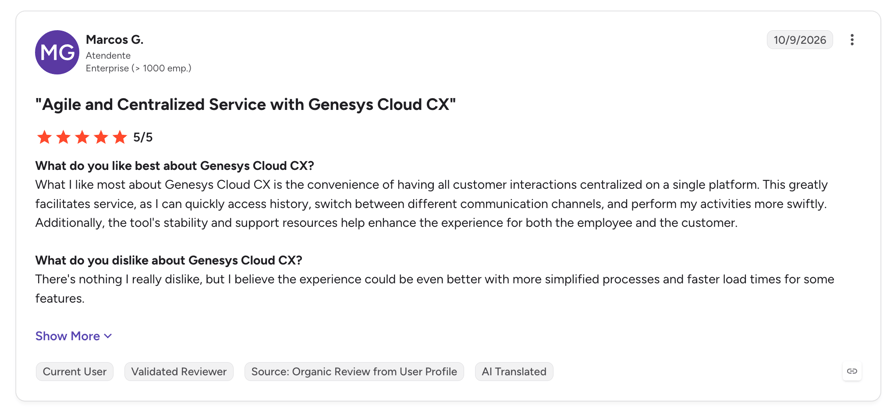
Genesys Cloud CX
Genesys Cloud CX is a full contact center platform with routing, workforce management and speech and text analytics, and it publishes banking-specific guidance.
Best for enterprise banks and insurers replacing their whole contact center stack.
Skip it if all you need is call review on top of the phone system you already have. Four tiers from $75 to $240 per user a month on annual billing, with AI usage metered through tokens. Check which tier includes the analytics you need. Checked October 2026.
Gong
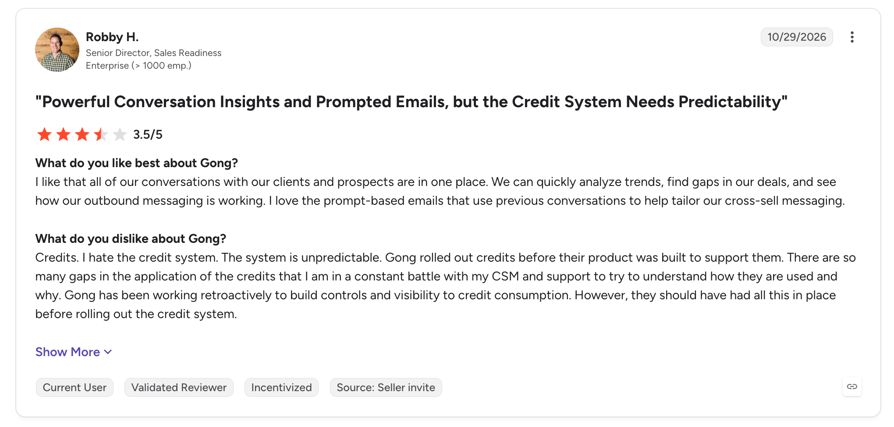
Gong is a revenue intelligence platform that analyzes sales calls, video meetings and emails, with a financial services offering.
Best for sales teams in wealth management, commercial lending and B2B fintech, where deals run across many meetings.
Skip it for claims, service or collections QA, since it's built around deals and forecasts rather than compliance scorecards. Pricing isn't published and is commonly reported as a platform fee plus per-seat licenses on an annual contract. Checked October 2026.
How to Start: A 30-Day Pilot and the KPIs to Track
You don't need a six-month program to find out whether conversation intelligence works for your team. For a team of 10 to 100 agents, four weeks is enough:
- Week 0, baseline and consent: Pull your current numbers from the same weeks of the prior period: share of calls reviewed, QA hours a week, disclosure misses found. Confirm the recording announcement and retention period, and tell agents what's being scored and why.
- Week 1, connect and build: Connect the phone system and CRM. Build one scorecard of five to eight lines from your script, test it on 20 past calls and fix the lines that misfire.
- Weeks 2 and 3, review flagged calls: Hold a fixed weekly review, same slot every week, where your QA lead works through the flagged calls. Log false flags and adjust the scorecard.
- Week 4, compare and decide: Put the pilot numbers next to the baseline. Expand to more teams, adjust the scorecard, or stop.
Track these across every use case:
- QA coverage: Share of calls scored
- Disclosure miss rate: Share of calls missing a required disclosure
- Complaint and escalation rate: Flagged complaints per 100 calls
- QA review hours: Hours a week spent reviewing calls
- After-call work: Time agents spend writing notes
Then add the one that matches your line of business: promise-to-pay rate for collections, claim file completeness for claims, renewal rate for insurance sales, or application completion for lending.
Pick three KPIs, not ten. Three numbers give you a clear answer in week 4, while ten give you a debate. Call reporting software gives you the coverage and volume numbers straight from your call log, so the comparison takes minutes.
The Bottom Line on Conversation Intelligence for Insurance and Finance
Conversation intelligence checks every call for the things a 1% to 3% sample misses: disclosures, identity questions, risky promises, complaints and the next step. It pays off first on claims files, disclosure checks on sales and lending calls, and collections. Set up consent, retention and role-based access before you start, and remember the tool doesn't make you compliant: your policy does. Then run a 30-day pilot with one scorecard and three KPIs against a baseline.
If your team runs on a cloud phone system, see how CloudTalk handles calls for financial services and insurance.
Sources:
- ISG Research (formerly Ventana Research), Contact Center Quality Processes Must Modernize for the Digital Era, 2022
Frequently Asked Questions About Conversation Intelligence for Insurance and Financial Services
Direct answers to the questions QA, compliance and contact center leads ask most.
The best AI depends on the job. For reviewing every call on a cloud phone system, CloudTalk fits mid-size teams. CallMiner and Genesys Cloud CX suit enterprise analytics, Observe.AI suits live agent guidance, and Gong suits sales teams; the shortlist above compares all five.
They're close relatives. Speech analytics is the older approach built on keyword and phrase lists, while conversation intelligence adds AI summaries, scoring and sentiment on top of the transcript. Both aim to find what matters in calls without anyone listening to all of them.
You need consent for the recording itself under the call-recording laws that apply to you, and privacy laws like the GDPR require you to tell people how their data is used. Many firms mention analysis in the recording announcement and privacy notice. Confirm the wording with your counsel, as this isn't legal advice.
No, it changes what QA staff spend their time on. Instead of listening to random calls, they review the ones that failed a check. Capitalo cut its daily call review from two hours to 20 minutes with the same team.
CloudTalk analyzes the calls that run through CloudTalk, so the lines you want reviewed need to move onto it. Larger accounts on annual contracts can keep their existing carrier and numbers by connecting them to CloudTalk over a SIP trunk. Enterprise analytics platforms often connect to existing recording systems, so ask each vendor what they support.
Switching on CloudTalk's Conversation Intelligence add-on is self-serve and needs minimal setup. Most of a rollout goes into building the scorecard and settling a weekly review routine, which is why a 30-day pilot is a realistic plan for a team of 10 to 100 agents. Enterprise platforms with custom integrations usually take longer.