


The AI Insurance Answering Service That Catches Every Claim and Quote
CloudTalk's insurance answering service picks up 24/7: the claim reported at 11 PM, the quote request during a client meeting, the billing question at lunch. The AI captures the details, splits claims from quotes, and routes what needs a licensed agent to one, on the number your policyholders already know.
- AI answers policyholder and prospect calls 24/7/365
- Captures claim and quote details, then routes by intent
- Never gives coverage advice; licensed agents get those calls
Trusted by 30,000+ sales & support professionals worldwide













The Basics
What Is an Insurance Answering Service?
An insurance answering service picks up the calls your front office can't: the first notice of loss that comes in after closing, the quote request that lands while every producer is in a meeting, the billing question during the lunch rush. You'll also see it called an answering service for insurance agents or an insurance agency answering service; the job is the same, and in a business where the caller who can't reach you dials the next agency, it decides who writes the policy.
Traditional services put a human operator on your line and bill you for their time. CloudTalk's AI phone answering service answers instantly in a natural voice, works from your agency's own information, and routes by intent: claims one way, quotes another, billing a third. During office hours it acts as overflow; after hours it's your AI receptionist, with IVR menus making sure an urgent claim always reaches a human. And if you're mapping the wider stack, our guide to the best AI tools for insurance agents covers what sits alongside the phone.
BUILT FOR INSURANCE AGENCIES
Key Features of an Answering Service for Insurance Agents
FNOL Captured on the First Call
Claims don't wait for office hours, and a policyholder standing in a flooded kitchen won't leave a voicemail. The AI takes the loss details calmly, in any hour, and knows which calls justify waking the on-call adjuster.
- AI Voice Agents: Answer every call 24/7, capture FNOL details like policy number, loss type, and location, and escalate urgent cases.
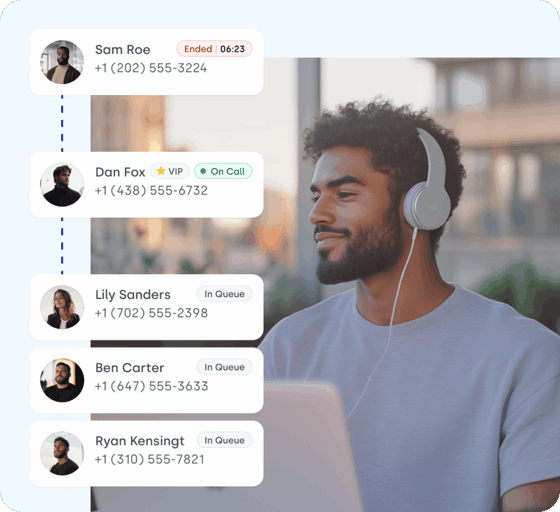
- Call Queuing: Keep callers moving during a claims surge instead of sending them to a busy signal.
- Automatic Callback: Return every missed call automatically, so no policyholder waits until Monday to report a loss.
Prospects Qualified Before You Pick Up
Quote requests decay fast: the shopper comparing agencies buys from whoever answers. The AI captures insurance type, current coverage, and timeline during the call, so your producers start the conversation already knowing the risk.
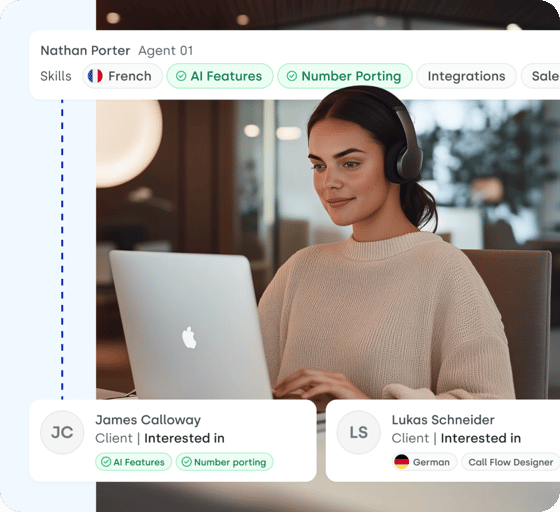
- Skill-Based Routing: Send each prospect to the right producer by line of business, language, or account.
- Workflow Automation: Fire the follow-up text and update the record the moment a call ends, so no quote request goes cold.
- AI Call Summaries: Every conversation lands as a structured summary, so your team sees what the caller needs and when.
Routine Calls Handled for You
Billing questions, certificate requests, and office-hours calls eat your service team's day. The AI answers them from your agency's knowledge base and hands over anything sensitive with the context already attached.
- Analytics Dashboard: See call volumes, missed-call rates, and answer times per office, line, and team in real time.
- Call Recording: Keep a secure, searchable record of every policyholder conversation, human or AI.
- Built-In Security: Encryption in transit and at rest, role-based permissions, and controls that support SOC 2, GDPR, and ISO 27001 compliance.

Signature Capability
See CloudTalk’s AI Voice Agent in Action!
CeTe is an AI that talks like a human: no breaks, no training, no time off. It makes and answers calls, updates CRMs, books meetings, and loops in a human only when needed.
Press play to hear it. Want a wow moment? Get a free test call and try it live.

What Changes When
AI Answers Your Agency's Phone


Every Policyholder
Call Answered
When a storm rolls through, every affected policyholder calls at once. The AI takes unlimited simultaneous calls, so a CAT event fills your claims queue instead of your voicemail.
~40% Fewer
Routine Calls
Billing questions, office hours, document requests, and status checks get resolved end-to-end. Autenti's support team saw AI handle around 40% of inbound calls, and your CSRs can expect the same relief.
20% Higher
Pickup Rate
Autenti also lifted pickup rates by 20% once AI covered their overflow. When every call connects, fewer shoppers get their quote from the agency down the street.
How MadRent Put AI on Lead Qualification, and Their Team on Sales
One Answering Service,
Every Kind of Agency
Independent
Agents
Every call answered while you're with a client, quotes qualified before you call back, and nothing lost between your cell phone and the office line.
P&C
Agencies
FNOL captured around the clock, claims routed separately from new business, and a call record behind every policyholder conversation.
Brokers
& MGAs
Carrier and producer calls reach the right desk by line of business, with structured summaries instead of sticky notes.
Claims
Teams
Status-check calls answered from your knowledge base, so adjusters work claims instead of repeating the same update all day.
AI Answering Service vs.
Traditional Insurance Answering Service
Most insurance answering services are staffed by operators who have never seen your book of business. They bill for their time, so the invoice grows exactly when a storm makes the phone ring. An AI answering service changes both halves of that trade: it answers every call at once, and it works from your agency's own information. Here's the honest comparison.
With a traditional live answering service
- Per-call or per-minute operator billing that spikes with claims
- Operators can't see your policies, book, or management system
- Messages relayed by hand for the morning shift to chase
- Staffing gaps at exactly the moment a CAT event hits
- Generic scripts with no insurance intake behind them
With CloudTalk's AI insurance answering service
- Answers 24/7/365, CAT events and renewals season included
- Unlimited simultaneous calls, so policyholders never hold
- Splits claims from quotes from billing, and routes by intent
- Flat per-minute pricing instead of per-operator billing
- Spanish and 70+ other languages on local numbers
A Missed Call Is a Lost Policy
The shopper comparing quotes buys from whoever answers, and the policyholder who can't report a claim remembers it at renewal. During hours, queues and callbacks keep callers moving. After hours, AI Voice Agents answer, capture, and escalate what can't wait.
Recover the Calls You Used to Lose
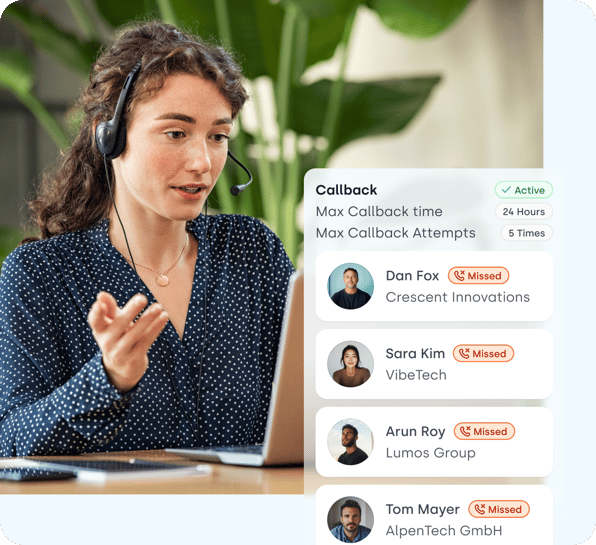
A missed call is invisible on a basic office line. CloudTalk flags every unanswered attempt, triggers automatic callbacks and follow-up texts, and puts missed-call reporting on one dashboard, so someone gets back to the caller before they get a quote somewhere else.
Customers used to wait over 20 minutes just to speak to an agent. Now, they get through in 3 to 4 minutes. We also went from missing 80% of calls to just 16%.

Claims Split from Quotes, Automatically
A first notice of loss, a new-quote request, and a billing question need three different desks. The AI detects intent, captures the right details for each, and syncs every call through 100+ integrations, so your producers open the conversation with the caller's context already on screen.
We reduced call prep time by 89%, from 60 seconds to 7 seconds per agent call.

One Line for Every Office and Every Language
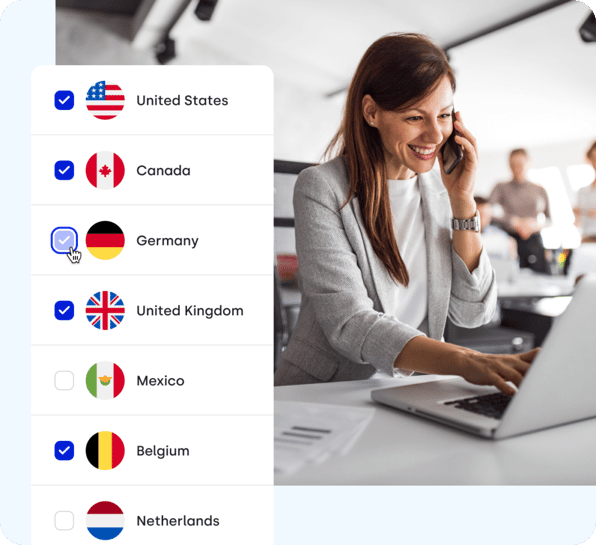
Your policyholders don't all speak English, and your offices don't all share one area code. Run local numbers in 160+ countries, show a familiar caller ID, and let the AI hold the whole conversation in the caller's language, Spanish included.
CloudTalk has truly been a trusted partner in driving our success across borders, and we highly recommend them to any global business looking for a reliable and hassle-free VoIP solution.
Insurance Answering Service Set Up in Minutes
Give the AI agent your agency's knowledge, test how it sounds, and go live.
CloudTalk is ready to help you set up your personalized AI agents.
Create Your Agent
Give your agent a name and choose which of 70+ available voices it'll speak with.
Assign Agent's Skills
Define the role: capture FNOL details, qualify quote requests, cover after-hours...
Share Your Knowledge
Give the AI your lines of business, hours, and FAQs so it answers like your best CSR.
Set Guardrails & Go Live
Rule out coverage advice, set routing for urgent claims, and listen to your AI agent's calls.
INSURANCE USE CASES
How Insurance Agencies Use
CloudTalk Day-to-Day
The calls that decide retention and new business rarely come at a convenient moment.
Here's where an insurance answering service earns its keep:
Policyholder Data Stays Protected.
Your Agency Stays Compliant.
Insurance calls carry PII, policy details, and payment information, so CloudTalk protects them with the security standards trusted by regulated industries and reliable 99.999% uptime, without the complexity of enterprise systems.



Decide AI's Introduction
Set the agent to introduce itself as AI at the start of every call. Callers get transparency from the first second, and you meet disclosure requirements in your market.
No Coverage Advice, Ever
Set guardrails so the AI captures and routes but never advises. Coverage questions and anything a license requires go straight to humans.
Protect Policyholder Data
Calls, recordings, and transcripts are encrypted and secured in transit and at rest; access is role-based, and your data isn't used to train external AI models.
Keep Your Line Running
With 99.999% uptime on carrier-grade infrastructure, the agency line gets answered on a quiet Tuesday the same as during a CAT event.
How to Choose an
Insurance Answering Service
Every provider promises to answer the phone.
The differences show up in what happens after someone picks up.
Six questions to ask before you sign with anyone, including us:
Generic reception takes messages; insurance intake detects intent and captures the right fields for each call type. Ask any provider what an FNOL record looks like when it reaches your team, and what a quote request looks like next to it. If the answer is "a message," you're buying a receptionist, not a system.
A service that queues callers during a CAT event isn't coverage. Human answering services staff a fixed number of operators, so the storm that triples your call volume triples their hold times. Unlimited simultaneous answering is the difference between a claims queue your team works through and a voicemail box that fills up overnight.
Notes should land in your CRM or management system automatically, attached to the right contact, the moment the call ends. If a CSR re-keys every message the next morning, you've bought a middleman, not a system, and you're paying twice: once for the service and once for the re-typing.
Coverage advice needs a license, so the escalation rules that send advisory calls to your producers should be yours to define, not the vendor's defaults. Ask where the line sits, who can move it, and what the AI says when a caller pushes past it. The right answer gives you the pen.
Recordings, transcripts, and summaries of every call give you a documentation trail when a dispute asks what was said, by whom, and when. A relayed message can't settle that question; a searchable record can. Make sure every call, human or AI, produces one.
Per-operator billing spikes exactly when call volume does, so the worst week of your year is also the most expensive. Flat per-minute AI pricing makes your worst week the same price per minute as your quietest, which is the whole point of having coverage you don't have to think about.
Integrations
Connect CloudTalk With the Tools
Your Agency Already Uses
Calls, recordings, transcripts, and AI summaries land on the right contact record automatically through 100+ ready-made integrations, including HubSpot, Salesforce, Pipedrive, and Zoho.
Running an agency management system like Applied Epic, EZLynx, or HawkSoft? Connect it through CloudTalk's open API, webhooks, or Zapier, and ask your onboarding specialist to map the setup before you commit.



Hear What Your Policyholders
Actually Call About
CloudTalk records, transcribes, and summarizes every conversation, human or AI. Sentiment analysis and topic tracking show you which questions repeat, which calls turn into policies, and where callers drop off, so you fix the phone experience with data instead of guesswork.
CloudTalk's Pricing
Our pricing is fully transparent with no hidden fees.
We offer separate add-ons, because we believe you should pay only for what you'll actually use.
Insurance Answering Service FAQs
An insurance answering service picks up your agency's calls when your team can't: after hours, during meetings, or when a storm has every policyholder dialing at once. Traditional services staff your line with human operators; an AI phone answering service answers instantly, captures claim and quote details, and routes each call by intent. You'll also see it called an answering service for insurance agents or an insurance agency answering service. The label matters less than the outcome: no policyholder call goes unanswered.
Traditional insurance answering services bill per call or per minute of operator time, so the invoice spikes exactly when a CAT event makes the phone ring. CloudTalk works differently: plans start at $25 per user/month, and AI Voice Agents run as an add-on billed at a flat per-minute rate that falls as your volume grows. You pay for minutes of coverage, not for an operator's shift, which is why AI answering usually costs a fraction of a live service at real agency call volumes.
For most agencies, yes. A live answering service gives you a human voice, but the operator can't see your book of business, bills for every minute, and relays messages by hand. CloudTalk's AI receptionist answers unlimited simultaneous calls 24/7, captures structured intake for claims and quotes, and logs every conversation automatically. If your volume is tiny and your calls are unusually sensitive, a human service can still make sense, and some agencies run both: AI first, humans for the exceptions.
Yes. The AI captures the FNOL details a claims intake would: policy number, what happened, when and where, and whether anyone was hurt. Urgent cases transfer to the on-call adjuster with everything already recorded; the rest land as structured records your claims team works through in the morning. What it doesn't do is adjudicate: the AI captures and routes, and decisions about the claim stay with your licensed staff.
No, by design. Coverage recommendations and policy advice require a license, so you set guardrails that keep the AI Voice Agent on the safe side of that line: it answers factual questions from your knowledge base, captures what the caller needs, and routes anything advisory to a licensed producer. That split is the point: the AI does the intake and availability, your licensed team does the judgment, and every handoff arrives with the context attached.
Yes. The AI asks the intake questions your producers would: insurance type (auto, home, life, business), current coverage status, what prompted the shopping, and timeline. It writes the answers to the record and routes the call by line of business through skill-based routing, so the right producer calls back already knowing the risk. Quote requests are the most perishable calls an agency gets; answering them instantly is where new-business numbers move first.
Yes. The AI handles calls in 70+ languages and accents, Spanish included, on local numbers in 160+ countries. For agencies serving multilingual communities that removes a real failure point: the policyholder who hangs up because nobody at the office speaks their language, or the claim that gets half-reported through a family member translating. Each office keeps its own number and routing, all reporting into the same dashboard.
Yes, by design. The agent introduces itself as an AI assistant at the start of the call rather than pretending to be your staff. In practice, a policyholder reporting a burst pipe at midnight cares far more that someone picked up and got the claim moving than about who answered. Disclosure also keeps your agency on the right side of call-recording and AI-disclosure rules in several states. You choose the voice and script, so the agent still sounds like your office, not a call center.
Yes. Port your existing number to CloudTalk and the AI answers on the number printed on your policy documents, business cards, and Google listing, with no downtime during the switch. Keep your old service active until the port completes so nothing slips through; carrier paperwork usually takes two to four weeks. Agencies with several offices can give each location its own number and routing, and compare them side by side on one dashboard.
CloudTalk connects natively to 100+ tools, including HubSpot, Salesforce, Pipedrive, and Zoho, so calls, recordings, and AI summaries land on the right record automatically. For agency management systems like Applied Epic, EZLynx, HawkSoft, or AMS360, the connection runs through CloudTalk's open API, webhooks, or Zapier rather than a native plug-in, so ask your onboarding specialist to map that setup against your exact stack before you commit. Knowledge-base answering and intent routing work out of the box either way.
It includes it. CloudTalk is a full cloud contact center: your CSRs and producers get insurance call center software with routing, queues, recording, and analytics, and the AI answering service runs on top of the same platform and numbers. That's the practical difference from bolting a separate answering vendor onto your existing insurance contact center software: one system, one call record, and nothing relayed between tools by hand.
Under an hour for a working agent. Create it, choose a voice, feed it your lines of business, hours, and FAQs, and set the routing rules in the call flow designer: what the AI resolves, what transfers to a licensed producer, what becomes a message. There's no hardware and no IT project, and you can test it on a spare number against real scenarios before pointing your agency line at it. Most agencies go live the same week, starting with after-hours claims coverage.


Hello 👋 My name is Emma. Still have questions?
Can't find the answer you're looking for? Please chat to our friendly team.
The Agency That Answers First
Writes the Policy
Shoppers get their quote from whoever picks up, and policyholders remember who answered at 11 PM. Start free and hear how your agency line sounds when every call gets answered.