Aircall vs RingCentral (2026): Features, AI & Real Costs Compared
TL;DR
Aircall and RingCentral aren't solving the same problem. Aircall is a voice-first call center built for outbound sales and support teams, with a purpose-built dialer and fast CRM integration. RingCentral is a unified communications platform covering voice, video, messaging, and collaboration for companies that want one vendor for everything. The right pick depends on scope, not on which product is better.
Aircall fits teams whose day is spent on the phone: 5 to 50 reps working a list, a support queue that needs to route cleanly, and a CRM that has to log every call without anyone typing. It starts at $30/licence/month with a three-licence minimum, carries 250+ integrations, and holds 4.4/5 on G2 from 1,642 reviews.
RingCentral fits companies replacing a phone system, a video tool, and a chat tool at once. RingEX starts at $20/user/month billed annually, bundles AI transcription and summaries into every tier at no extra cost, and holds 4.2/5 on G2 from 1,430 reviews. Its contact center product, RingCX, is sold separately from $65/agent/month.
Below we compare core strengths, features, total cost of ownership, pricing, integrations, security, usability, and what real users report on G2, Capterra, and Trustpilot, with every figure checked against both vendors' current pages. Or jump straight to the at-a-glance table and find the dimension that decides it for you.
Comparing Two Platforms and Still Not Seeing Your Use Case?
Aircall vs. RingCentral: Core Strengths of Each Platform
Both platforms handle business calling well, and both have been doing it for over a decade. They are built for different scopes: Aircall is a purpose-built sales and support call center, RingCentral is a full communications backbone for the whole company. Read the two tables below as parallel descriptions rather than as a run-up to a winner.
Where Aircall Shines
Where Aircall Shines
| Strength | Why It Matters |
|---|---|
| Purpose-built Power Dialer and click-to-call | Reps work a list without touching a keypad, and Voicemail Drop removes the repeated 20-second message. It sits on the Professional plan, and it is the reason outbound teams shortlist Aircall in the first place. |
| Fast setup, measured in an afternoon | Aircall markets onboarding your team “by the end of the day,” and reviewers back it: 9.2/10 for ease of use on G2, the highest score in this comparison. A small team can buy in the morning and be routing calls after lunch. |
| 250+ integrations with API access from the entry plan | Aircall raised its published count from 100+ to 250+, and unlike RingCentral it does not gate CRM connectors to a higher tier. Salesforce CTI is the exception – that sits on Professional and Voice is a separate purchase. |
| Live in-call coaching through AI Assist Pro | Live transcription, live prompts, and prebuilt playbooks for SPICED, BANT, MEDDIC, and PACTT, plus custom scorecards and PCI, PII, and PHI redaction. Nothing in this comparison prompts a rep mid-call the way this does. It costs $49/licence/month on top of any plan. |
| Numbers in 100+ countries and a clean agent interface | Enough international reach for most mid-market teams, wrapped in an interface most reps need no training for. The trade-off is that SMS only works in 13 of those countries. |
Where RingCentral Shines
Where RingCentral Shines
| Strength | Why It Matters |
|---|---|
| Voice, video, and team messaging from one vendor | Video meetings for 100 participants on Core and Advanced, 200 on Ultra, plus team chat, all on the same licence. Aircall has neither native video nor native team chat, so buying it means keeping a second vendor for both. |
| AI Assistant bundled into every RingEX plan at no extra cost | Transcription, closed captions, and meeting summaries from Core; real-time call notes from Advanced; AI writing and translation on Ultra. This is the clearest packaging difference in the comparison – on Aircall the equivalent starts as a $9/licence add-on. |
| A 99.999% uptime SLA and enterprise-grade compliance | ISO 27001, 27017, 27018, ISO 22301, SOC 2+ with FINRA and HIPAA extensions, SOC 3, HITRUST CSF, PCI DSS, C5 in Germany, and Cyber Essentials Plus in the UK. If procurement works from a certificate checklist, this is the deepest list here. |
| 24/7 support with no plan-tier gating | RingCentral publishes 24/7 hours for technical support across most country lines without tying it to a tier. Aircall publishes a 24/7 AI chat assistant and a knowledge base, but does not publish human support hours at all. |
| 500+ integrations and a separate contact center product | Double Aircall's count, spanning Salesforce, Microsoft Teams, HubSpot, Google Workspace, and Zendesk. And when a phone system stops being enough, RingCX adds omnichannel routing across 20+ digital channels without changing vendors. |
Neither list cancels the other out. The honest read of this aircall vs ringcentral comparison is that Aircall is deeper on the phone and RingCentral is broader across the stack, and that most buyers already know which of those two sentences describes their problem.
At a Glance: Aircall vs. RingCentral, Key Differences
Use this table to find what matters most for your use case, then jump to the section that covers it in detail.
Aircall vs RingCentral: Key Differences at a Glance
| Dimension | Aircall | RingCentral | Best Suited For |
|---|---|---|---|
| Primary use case | Voice-first call center for sales and support | Unified communications: voice, video, messaging | Outbound sales and support teams vs. whole-company communications rollouts |
| Entry price (annual billing) | $30/licence/month (Essentials) | $20/user/month (RingEX Core) | Budget-led buyers start with RingEX Core |
| Seat minimum | 3 licences on both self-serve plans, 25 on Custom | No published minimum on RingEX; RingCX requires 3 agents | One or two-person teams that can't justify a third seat |
| True minimum monthly spend | $90 (3 × $30) | $20 (1 × Core) | Founders and micro-teams testing a phone system |
| Dialer and sales tooling | Power Dialer and Voicemail Drop on Professional | No sales dialer on RingEX; dialers sit in RingCX | High-volume outbound teams working a list |
| Video conferencing | Not offered | 100 participants on Core and Advanced, 200 on Ultra | Companies consolidating a video tool into the phone bill |
| Team messaging | Not offered; Slack and Teams as integrations | Native team chat on every plan | Teams without an existing chat tool |
| AI packaging | AI Assist is a $9/licence add-on on Essentials, bundled on Professional; AI Assist Pro is $49/licence | AI Assistant bundled free in every RingEX tier; deeper AI sold as add-ons from $39 | Teams that want AI included rather than added on |
| Live in-call prompts and playbooks | AI Assist Pro, $49/licence/month | AI Assist for agents sits in the RingCX line, not RingEX | Sales managers coaching reps during live calls |
| SMS allowance | SMS and MMS included, but only in 13 countries | 25 / 100 / 200 segments per user per month by tier, US and Canada | SMS-heavy teams should price the Booster or look elsewhere |
| Country coverage | Numbers in 100+ countries | 100+ countries claimed; Global RingEX covers roughly 80 | Effectively a tie until you check your specific markets |
| G2 rating and review volume | 4.4/5 from 1,642 reviews | 4.2/5 from 1,430 reviews (RingEX); RingCX 4.4/5 from 93 | Similar sample sizes, different buyer populations |
The short read: Aircall wins the columns about dialing and coaching. RingCentral wins the columns about scope, entry cost, and bundled AI. Nothing in the table settles it on quality, because that isn't where these two differ.
Aircall Features vs. RingCentral Features
Aircall Features
Aircall consolidates what an outbound-focused team touches every day: a dialer, a unified inbox for calls and SMS, and a CRM sync that logs the conversation without a rep opening a notes field. Everything else on the platform is built around that loop. It spent the last year buying its way deeper into AI, acquiring the speech company Vogent in May 2026 and the revenue intelligence company Piper AI in June 2026.
What Aircall Does Well
- Purpose-built Power Dialer and click-to-callReps work through a list without dialing, with Voicemail Drop to skip the repeated greeting. Both sit on the Professional plan at $50/licence/month.
- Unified inbox for calls, voicemail, SMS, and MMSOne shared queue rather than a phone tab and a texting tab, with WhatsApp available as a $10/licence add-on.
- 250+ native integrations with API access on every tierHubSpot, Zendesk, Pipedrive, and Intercom connect on Essentials. Salesforce CTI is on Professional, and Aircall for Salesforce Voice is a separate per-licence purchase.
- AI Assist Pro for live coachingLive transcription, live prompts, playbook templates for SPICED, BANT, MEDDIC, and PACTT, custom scorecards, and automatic PCI, PII, and PHI redaction. $49/licence/month on top of any plan.
- AI Voice Agent with a free tier on every plan50 free minutes per account per month, then bundles from $175 for 500 minutes or pay-as-you-go at $0.49/minute up to 2,500 minutes. It advertises 23 languages.
Where Aircall Falls Short
- Conversation intelligence is gated behind a paid add-onAI Assist costs $9/licence/month on Essentials and is only bundled once you reach Professional at $50. RingCentral includes its equivalent free on every RingEX tier, which is the single sharpest packaging difference between the two.
- Three-licence minimum on both self-serve plansYou cannot buy one seat or two. The real entry invoice is $90/month, and the Custom tier jumps to a 25-licence minimum with no middle step.
- No published 24/7 human phone supportAircall publishes a 24/7 AI chat assistant, a knowledge base, and a Learning Lab, but does not publish human support hours or per-tier channels. A contractual SLA is Custom-tier only.
- No native video conferencing or team messagingAircall is voice, SMS, and WhatsApp. If your company needs meetings and internal chat, that is a second vendor and a second invoice.
- AI language coverage is narrower than the product footprintLive transcription is validated in 7 languages, with 17 more supported on a best-effort basis where accuracy is unverified and the prebuilt playbook templates are unavailable. Worth confirming your languages before assuming the AI layer applies.
RingCentral Features
RingCentral bundles voice, video, and messaging into a single platform, with AI features included across all plans rather than sold on top. The tiering is straightforward: Core, Advanced, and Ultra add analytics depth, recording automation, and AI reach as you climb. Anything resembling a contact center – omnichannel queues, workforce engagement, sales dialers – lives in RingCX, which is a separate purchase.
What RingCentral Does Well
- AI Assistant included in every RingEX plan at no additional costCall transcription, closed captioning, and meeting summaries from Core, real-time call notes from Advanced, and AI writing and translation on Ultra, under a 500 minute per user per month fair-use guideline.
- Native video conferencing and team messaging on the same licence100 participants on Core and Advanced, 200 on Ultra, plus native chat. This is the part of the stack Aircall does not have at all.
- 99.999% uptime SLA and a deep compliance stackISO 27001, 27017, 27018, ISO 22301, SOC 2+ with FINRA and HIPAA extensions, SOC 3, HITRUST CSF, PCI DSS, C5, and Cyber Essentials Plus.
- 24/7 support published across most country linesRingCentral does not tie technical support hours to a plan tier, which matters more than it sounds when something breaks on a Friday night.
- 500+ integrations and a contact center you can grow intoSalesforce, Microsoft Teams, HubSpot, Google Workspace, and Zendesk, plus open APIs. When calling volume outgrows a phone system, RingCX adds voice and 20+ digital channels from $65/agent/month.
Where RingCentral Falls Short
- No sales dialer in the phone system at allThere is no power, parallel, or predictive dialing mode in RingEX at any tier. Dialers live in the RingCX product line, so an outbound team on RingEX is dialing manually or paying for a second platform.
- SMS caps are low and enforced per user25 segments a month on Core, 100 on Advanced, 200 on Ultra, for US and Canada. A rep sending a handful of texts a day clears the Core allowance in the first week, and the Business SMS Booster is another $25.
- CRM integrations are gated to Advanced and aboveCore gets APIs, Microsoft 365, Google Workspace, Slack, and Teams Phone, but the CRM connectors most sales teams buy a phone system for start one tier up.
- Deeper AI is an add-on stack, not part of the planAI Receptionist starts at $39 with 100 minutes per licence per month aggregated across the account and no roll-over. Conversational Intelligence starts at $60. Both climb quickly at scale.
- Administration is genuinely heavy, and billing has surprisesG2 reviewers repeatedly cite trouble configuring extensions, queues, and permissions. Invoices also carry a Compliance and Administrative Cost Recovery Fee and e911 fees that RingCentral defines but does not publish amounts for – ask for a sample invoice before signing.
Feature-by-Feature Comparison
CloudTalk is included as a third column here because it covers nearly every row: dialer, native CRM sync, and conversation intelligence sit inside one product, which makes it a useful reference point rather than a detour.
Feature-by-Feature Comparison
| Feature | Aircall | RingCentral | CloudTalk |
|---|---|---|---|
| Power (sequential) dialer | Included on Professional | Not in RingEX; RingCX only | Included on Expert; $15/user/month add-on below |
| Parallel dialer | Not available at any tier | Not available in RingEX | Up to 5 lines per agent with voicemail detection, $39/user/month on any plan |
| Native CRM sync | HubSpot, Zendesk, Pipedrive from Essentials; Salesforce CTI on Professional | CRM integrations from Advanced and above | 95+ CRM, helpdesk, and ATS integrations from Essential, with two-way sync |
| AI call summaries and transcription | AI Assist: $9/licence add-on on Essentials, bundled on Professional | Bundled free in every RingEX tier, 500 min/user/month fair use | In the $9/user/month AI add-on, on any plan |
| Live in-call prompts and playbooks | AI Assist Pro, $49/licence/month | Agent AI Assist sits in RingCX, not RingEX | Not currently offered |
| AI call scoring | In AI Assist; custom-question scoring in AI Assist Pro | AI Quality Management in the RingCX line | In the $9/user/month AI add-on |
| Video conferencing | Not offered | 100 participants (Core, Advanced), 200 (Ultra) | Not offered; runs through integrations |
| Team messaging | Not offered | Native, on every plan | Not offered |
| SMS allowance | SMS and MMS included, 13 countries | 25 / 100 / 200 segments per user per month by tier | Included from Essential |
| IVR and call flow builder | IVR from Essentials; smart routing on Professional | IVR and auto-attendant on every plan; configuration widely called complex | Drag-and-drop Call Flow Designer on every plan |
| Call recording retention | Up to 1 year on Essentials; unlimited on Professional | On-demand at Core, automatic from Advanced; unlimited storage on Ultra | Unlimited from Essential |
| Analytics retention | Up to 6 months; unlimited with Analytics+ at $15/licence | 6 months in the Analytics Portal | Real-time analytics from Essential; wallboards and custom dashboards on Expert |
| Seat minimum | 3 licences | None published on RingEX; 3 agents on RingCX | 1 licence on entry plans; 3 on Expert |
| Support availability | 24/7 AI chat and knowledge base; human hours not published | 24/7 technical support, no tier gating stated | 24/7 multi-language support from Essential |
| Notable integrations | 250+ tools; API access on all tiers | 500+ tools including Microsoft Teams and Google Workspace | 95+ native, plus Zapier to roughly 5,000 apps |
| Local numbers | 100+ countries | 100+ countries claimed | 160+ countries |
Anyone weighing ringcentral vs aircall pricing features 2026 on a spec sheet will notice that the rows split cleanly. Aircall takes dialing and live coaching. RingCentral takes video, messaging, and bundled AI. Almost nothing overlaps.
Total Cost of Ownership: Aircall vs. RingCentral
Headline per-seat pricing decides very little here. Aircall looks more expensive at $30 against RingEX Core's $20, then closes the gap the moment you need CRM connectors, and reopens it the moment you need AI. RingCentral looks cheaper until the SMS Booster, the AI Receptionist, and the Conversational Intelligence line appear on the quote. Both platforms hide the real number in the second invoice, so the only fair comparison is a twelve-month total with the add-ons your team will actually switch on.
Total Cost of Ownership for a 10-Person Team
| Dimension | Aircall | RingCentral | CloudTalk |
|---|---|---|---|
| Base plan, 10 people | $300/month (Essentials) or $500 (Professional) | $200/month (Core), $250 (Advanced), $350 (Ultra) | $290/month (Essential) or $490 (Expert) |
| AI conversation intelligence | $90/month add-on on Essentials; bundled on Professional | $0 – AI Assistant is bundled in every tier | $9/user/month on any plan |
| Live coaching layer | AI Assist Pro, $490/month for 10 licences | Requires RingCX, from $650/month for 10 agents | Not currently offered |
| Analytics and retention | Analytics+ at $15/licence for unlimited retention, so $150/month | 6-month retention regardless of tier; Business Analytics Pro on Ultra | Real-time analytics from Essential; wallboards inside Expert |
| Dialer for outbound | Power Dialer inside Professional | Not purchasable on RingEX at any price | Power inside Expert; Parallel at $39/user/month |
| Other add-ons likely to appear | Salesforce Voice $30/licence, WhatsApp $10/licence, extra numbers $6 each | SMS Booster $25, Call Queues Booster $35, AI Receptionist from $39 | Extra numbers from $6; Salesforce included on Expert |
| Typical all-in, 10 people with AI and real reporting | $650/month (Professional + Analytics+) | $350–$600/month (Ultra, plus SMS Booster if you text) | $580/month (Expert + AI add-on, dialer and Salesforce included) |
| Increase from entry to fully featured | $300 → $1,140 with AI Assist Pro, roughly 3.8× | $200 → $850+ once RingCX or the AI add-ons are added, roughly 4.3× | $290 → $970 with Expert plus AI and Parallel Dialer, roughly 3.3× |
The Line Item Nobody Prices In
RingCentral's published fee documentation names a Compliance and Administrative Cost Recovery Fee and an e911 Service Fee on every invoice, but does not publish the dollar amounts for either. Third-party estimates circulate, and we won't repeat them here because we could not verify them against RingCentral's own material. Ask for a sample invoice with taxes and fees included before you sign, on any multi-year quote. Aircall does not publish comparable recovery fees.
The cost read: RingCentral is the cheaper starting point and stays cheaper for a team that mostly answers calls and runs meetings. Aircall costs more up front and earns it back only if you use the dialer and the coaching layer. If your requirement list includes both a dialer and bundled reporting, look at whichever platform puts them inside a plan rather than beside it.
Aircall Pricing vs RingCentral Pricing
Aircall Pricing
Aircall sells three plans, all with licence minimums. Our full ringcentral vs aircall which is better pricing breakdown goes through each tier line by line.
- Essentials – $30/licence/month billed annually, $40 billed monthly. Minimum three licences, so $90/month is the entry invoice. 250+ integrations with API access, IVR, call recording with up to one year of retention, click-to-dial, SMS and MMS, desktop and mobile softphones, unlimited simultaneous outbound calls. Capped at three teams, with up to six months of basic analytics.
- Professional – $50/licence/month annually, $70 monthly. Minimum three licences, so $150/month to start. Everything in Essentials plus Salesforce CTI, Power Dialer, Voicemail Drop, smart routing, live monitoring, mandatory call tagging, advanced analytics, and the full AI Assist set bundled rather than added on.
- Custom – quote-based. Minimum 25 licences. Everything in Professional plus custom onboarding, API developer support, a contractual SLA, unlimited analytics retention, and single sign-on.
Aircall Add-Ons Are Where the Quote Moves
AI Assist $9/licence/month (bundled from Professional) · AI Assist Pro $49/licence/month on top of any plan · Analytics+ $15/licence/month for unlimited retention · Aircall for Salesforce Voice $30/licence · WhatsApp in Aircall $10/licence/month · extra phone numbers $6 each per month. AI Voice Agent: 50 free minutes per account per month, then $175 for 500 minutes, $725 for 2,500, or pay-as-you-go at $0.49/minute up to 2,500 and $0.39 above, plus $0.015 per outbound call attempt. AI Messaging Agents: first 100 conversations free, then $0.35 each up to 1,000/month.
RingCentral Pricing
RingCentral prices two product lines separately, and conflating them is the most common mistake in a ringcentral vs aircall pricing comparison. RingEX is the business phone system. RingCX is the contact center.
RingEX (business phone system):
- Core – $20/user/month billed annually, $30 monthly. Unlimited US and Canada calling, voicemail-to-text, call queues, auto-attendant, video meetings for up to 100 participants, on-demand call recording, 25 SMS segments per user per month, AI Assistant with transcription and meeting summaries. APIs, Microsoft 365, Google Workspace, Slack, and Teams Phone. No CRM integrations at this tier.
- Advanced – $25/user/month annually, $35 monthly. Adds automatic call recording, advanced call monitoring, CRM integrations, Business Analytics Essentials, real-time AI call notes, and 100 SMS segments per user per month.
- Ultra – $35/user/month annually, $45 monthly. Adds 200-participant video, unlimited file and recording storage, Business Analytics Pro with device analytics, AI writing and translation, and 200 SMS segments per user per month.
RingCX (contact center):
- RingCX – from $65/agent/month, minimum three agents. Voice plus 20+ digital channels on one licence, skills-based routing, AI summaries, unlimited North American domestic minutes, 2,000 free IVR minutes per agent seat, and 5 GB of screen-recording storage per basic seat.
- Higher RingCX tiers – third-party sources list Professional and Elite tiers above the $65 entry, but RingCentral does not publish those figures on its own pages, so treat any number you see quoted for them as unconfirmed until sales puts it in writing.
Add-ons on the RingCentral side: AI Receptionist from $39/month, including 100 minutes per licence aggregated across the account with no roll-over, Conversational Intelligence from $60, Business SMS Booster at $25, and Call Queues Booster at $35, both billed per configured user. RingCentral advertises annual billing as saving up to 33% against monthly.
Pricing Compared Line by Line
Pricing Compared Line by Line
| Pricing Dimension | Aircall | RingCentral | CloudTalk |
|---|---|---|---|
| Lowest entry price | $30/licence/month (Essentials) | $20/user/month (RingEX Core) | $19/user/month |
| Seat minimum on the entry plan | 3 licences | None published | 1 licence |
| True minimum monthly spend | $90 | $20 | $19 |
| Seat minimum on the enterprise plan | 25 (Custom) | 3 agents on RingCX; RingEX custom above 100 users | 25 (Custom) |
| Monthly billing option | Yes, at roughly 33–40% more than annual | Yes; annual advertised as saving up to 33% | Yes, on every plan |
| AI included in the base price | No on Essentials ($9/licence add-on); yes from Professional | Yes, on every RingEX tier | No, always a $9/user/month add-on |
| Contact-center-specific pricing tier | None – the product is the call center | RingCX, from $65/agent/month, sold separately | None – Expert covers contact center features |
| Notable add-on costs | AI Assist Pro $49, Analytics+ $15, Salesforce Voice $30, WhatsApp $10 | AI Receptionist from $39, Conversational Intelligence from $60, SMS Booster $25, Queues Booster $35 | AI Conversation Intelligence $9, Power Dialer $15, Parallel Dialer $39 |
| SMS allowance | Included, 13 countries, no published per-user cap | 25 / 100 / 200 segments per user per month | Included from Essential |
| Published fees beyond the seat price | None published | Compliance and Administrative Cost Recovery Fee plus e911, amounts not published | None published |
A Note on Negotiating Either Quote
Neither vendor's list price is what a mid-size team ends up paying. Both discount, and both discount harder against a competing quote you can show them. Build a twelve-month total for each on one page – base plan, AI layer, analytics retention, dialer, extra numbers, and taxes and recovery fees – before either sales call. On RingCentral specifically, ask for the early termination terms in writing: annual contracts carry them, and the amount is not published.
For reference, CloudTalk pricing starts at $19/user/month with a one-licence minimum and publishes every rate, which makes it a useful third data point next to two platforms whose real cost depends on which product line and which add-ons get selected.
Aircall Integrations vs. RingCentral Integrations
Aircall Integrations
Aircall now publishes 250+ integrations, up from the 100+ figure most comparison pages still quote, and it does not gate them by plan: API access and the standard connector library are available from Essentials. The depth is aimed squarely at sales and support workflows – HubSpot, Zendesk, Pipedrive, Intercom, Front, and Slack all carry click-to-call inside the partner UI and log calls back automatically.
Salesforce is the exception worth pricing carefully. Salesforce CTI sits on the Professional plan, and Aircall for Salesforce Voice is a separate $30/licence purchase on top of that. We break down what each connector actually writes back in Aircall's Salesforce integration vs CloudTalk's and, for the other side of the stack, in Aircall HubSpot integration vs CloudTalk.
RingCentral Integrations
RingCentral publishes over 500 integrations, double Aircall's count, alongside open APIs at its developer portal. Named on its own integrations page: Salesforce, Microsoft Teams, HubSpot, Google Workspace, Zendesk, and AWS Marketplace. The Microsoft Teams integration is the standout – if your company already runs on Teams, RingCentral drops calling directly into it in a way Aircall does not attempt.
Two caveats. First, CRM integrations are gated to the Advanced tier and above, so the $20 Core plan does not connect to Salesforce or HubSpot at all – a real cost difference if you were pricing against Aircall's $30 Essentials, which does. Second, several enterprise tools commonly attributed to RingCentral in third-party comparisons, ServiceNow among them, are not listed on RingCentral's own integrations overview. We could not verify those, so we are not claiming them; ask sales to confirm your specific stack rather than trusting a comparison page, including this one.
Integration Capability Compared
Integration Capability Compared
| Integration Capability | Aircall | RingCentral | CloudTalk |
|---|---|---|---|
| Total native integrations | 250+ | 500+ | 95+, deep CRM focus |
| Plan that unlocks CRM integrations | Essentials, the entry plan | Advanced, one tier up from entry | Essential |
| Salesforce | CTI on Professional; Salesforce Voice a separate $30/licence | Native, from Advanced | Full CTI on Expert, plus a pre-built Support KPIs dashboard |
| HubSpot | Native from Essentials; sync depth not documented in detail | Native, from Advanced | Two-way sync, CTI, campaign result export |
| Helpdesk integrations | Zendesk, Intercom, Front, Help Scout | Zendesk and others through the 500+ library | Zendesk, Freshdesk, Intercom, Help Scout, Front, Gorgias |
| Unique enterprise tooling | Sales-stack depth rather than enterprise breadth | Microsoft Teams calling, Google Workspace, AWS Marketplace | Workflow Automation Designer, no developer required |
| Developer requirement | API on all tiers; developer support on Custom only | Open APIs; advanced flows commonly need IT involvement | Public API and webhooks; native integrations are an OAuth setup |
| AI summaries auto-logged to the CRM | AI Assist logs call data to the CRM | AI Assistant notes sync to call history; CRM write-back varies by connector | Dedicated CI Data Export for HubSpot, Salesforce, Pipedrive, and Zendesk |
The integrations read: RingCentral wins on raw count and on Microsoft-shop fit. Aircall wins on getting CRM connectors at the entry tier and on sales-workflow depth. If your stack is unusual, count matters. If your stack is a CRM and a helpdesk, depth matters more.
Security & Compliance: Aircall vs. RingCentral
If you are in healthcare, financial services, or anywhere with a legal team that reads vendor questionnaires, this section decides the deal before pricing does. It is also the one place where the two platforms are genuinely far apart, and not in the direction a call-center-versus-suite framing would predict.
Aircall Security & Compliance
- SOC 2 Type 2 certifiedStated outright on Aircall's security page, alongside regular third-party penetration testing and a bug bounty programme.
- Encryption in transit and at restTLS 1.2 in transit, AES-256 at rest, and SRTP on the calls themselves, with two-factor authentication available.
- GDPR compliant, with EU-US Data Privacy Framework commitmentsThe DPA covers the EU-US, Swiss-US, and UK extensions, with standard contractual clauses for other transfers. Aircall acts as a data processor and its DPA applies without anyone signing extra paperwork.
- ISO 27001: aligned, not certifiedAircall describes its programme as aligned with ISO 27001; the ISO certificate it cites belongs to AWS as its host. If procurement needs a certificate with Aircall's name on it, ask specifically.
- Single sign-on is gated to the 25-licence Custom tierAnd Aircall's own help documentation describes SAML SSO as currently available to a limited number of customers, requiring a support request. This stops a lot of mid-market security reviews.
- 99.95% uptime commitment, with the contractual SLA on Custom onlyData residency is AWS Oregon, Frankfurt, or Sydney, assigned by account region. We could not find any published HIPAA or BAA commitment on Aircall's security or legal pages – if you need one, get it confirmed in writing.
RingCentral Security & Compliance
- The deepest certification stack in this comparisonISO/IEC 27001, 27017, and 27018, ISO 22301 for business continuity, ISO 9001, SOC 2+ with FINRA CSR and HIPAA extensions, SOC 3, HITRUST CSF, PCI DSS attestation, C5 in Germany, and Cyber Essentials Plus in the UK.
- 99.999% uptime SLAPublished on the trust center and repeated on the RingEX product page. That is roughly five minutes of downtime a year against Aircall's 99.95%, which allows around four hours.
- End-to-end encryption on meetings, with calls and chat still in betaMeetings support E2EE today. RingCentral's own trust center describes E2EE for calls and team chat as available in closed beta, so do not treat end-to-end encrypted calling as generally available yet.
- EU data residency for European customersEU customers are deployed on Europe-resident infrastructure with data stored in Europe, including Analytics Portal data. Aircall's regional model is coarser.
- SSO available without an enterprise-only contractRingCentral lists single sign-on across Video, Phone, Message, and its identity layer. Per-tier gating is not published, so confirm it for your plan – but it is not framed as a 25-seat enterprise feature the way Aircall's is.
- Verify FedRAMP separately if it mattersRingCentral's blog describes RingCX as FedRAMP-authorized, but FedRAMP does not appear on the trust center compliance list. For a public-sector procurement, check the FedRAMP Marketplace directly rather than taking a blog post as evidence.
Security & Compliance Compared
Security and Compliance Compared
| Security & Compliance | Aircall | RingCentral |
|---|---|---|
| SOC 2 | Type 2 certified | SOC 2+ with FINRA CSR and HIPAA extensions, plus SOC 3 |
| ISO 27001 | Not certified; programme described as aligned, certificate belongs to AWS | Certified, plus 27017, 27018, 22301, and 9001 |
| GDPR | Compliant; DPA applies automatically, DPO registered with the French CNIL | Compliant; EU customers on Europe-resident infrastructure |
| HIPAA | No published HIPAA or BAA commitment found – confirm in writing | HIPAA extension inside its SOC 2+ report; HITRUST CSF certified |
| PCI DSS | Not published; PCI redaction available in AI Assist Pro | Attestation of Compliance published |
| Encryption standard | TLS 1.2 in transit, AES-256 at rest, SRTP on calls | Encrypted in transit and at rest; E2EE on meetings, closed beta for calls and chat |
| SSO / SAML | Listed on the 25-licence Custom tier, and described as limited availability | Listed across the platform; per-tier gating not published |
| Two-factor authentication | Available | Available |
| Data residency | AWS Oregon, Frankfurt, or Sydney, assigned by account region | EU-resident infrastructure for EU customers, including analytics data |
| Uptime commitment | 99.95%, contractual SLA on Custom only | 99.999% SLA |
The compliance read: RingCentral, clearly, and it is the least contested section in this comparison. Aircall clears the floor with SOC 2 Type 2 and GDPR, but the SSO gating and the absent HIPAA commitment are real obstacles for a regulated buyer.
Usability & Scalability: Aircall vs. RingCentral
Aircall Usability
Aircall's reputation for a clean, intuitive interface is well earned, and it is the strongest practical argument for buying it. Reps need close to no training: G2 scores it 9.2/10 for ease of use, the highest in this comparison, and Capterra puts ease of use at 4.4/5. Aircall markets onboarding a team by the end of the day, and small teams routinely report exactly that.
The cost of that design shows up later. Routing options are simpler because there are fewer of them, analytics stop at six months without the $15 Analytics+ add-on, Essentials caps you at three teams, and the outbound ceiling is fixed by the absence of any parallel or predictive dialing mode. Scaling down is the other constraint: the three-licence floor means a team that shrinks to two still pays for three, and reviewers consistently flag rigid contract terms and forced full-price renewals as the sharpest edge of the platform.
RingCentral Usability
RingCentral has far more configuration surface area, which is the direct consequence of covering voice, video, and messaging in one platform. That means a steeper initial rollout, usually IT-led, and more long-term flexibility once it is standing. G2 reviewers score it 8.6/10 for ease of use and 8.2/10 for ease of setup – both a clear step below Aircall – with recurring complaints about configuring extensions, call queues, auto-attendants, and permissions, and about finding the right setting in the admin portal.
What you get for that effort is a platform that does not run out. Departments beyond sales can be added on the same contract, multi-site routing is a design problem rather than a product limitation, and RingCX is there when calling volume outgrows a phone system. For a multi-site company with advanced routing and permission requirements, expect a project rather than an afternoon.
Usability & Scalability Compared
Usability and Scalability Compared
| Dimension | Aircall | RingCentral |
|---|---|---|
| First-day setup speed | Hours – among the fastest in the category | Days to weeks for multi-site or advanced routing |
| Agent UI learning curve (G2 ease of use) | 9.2/10 – very low | 8.6/10 – moderate |
| Admin configuration overhead (G2 ease of admin) | 8.7/10; shallow admin screens by design | 8.3/10; extensions, queues, and permissions cited as difficult |
| Scalability across departments | Sales and support only; Essentials caps at three teams | Whole company, plus RingCX for contact center scale |
| Fit for sales-specific workflows | Purpose-built: dialer, voicemail drop, call tagging, coaching | Weak on RingEX; sales tooling requires the RingCX line |
| Ability to scale down | Floor of 3 licences; reviewers report rigid offboarding | No RingEX minimum, but reducing licences mid-contract is a common complaint |
| Support during an incident | 24/7 AI chat; human hours not published; SLA on Custom only | 24/7 technical support on all plans; reviewers call tier-one scripted |
| Contract flexibility | Annual-first; monthly available at 33–40% more | Annual-first; early termination fees apply, amounts not published |
The usability read: Aircall for the first month, RingCentral for year three. That trade-off is real and it is the most honest way to describe the difference.
Aircall Reviews vs. RingCentral Reviews on G2
G2 is the most widely used peer review platform for B2B software, and it is where most buyers start. One caveat before reading the numbers: RingCentral's reviewer base spans a much broader range of use cases than Aircall's. RingEX draws general business-telephony buyers, with 7.0% enterprise and 34.9% mid-market respondents, while Aircall's base is 41.4% mid-market and near-absent from enterprise at 3.9%. RingCentral also splits its contact center reviews into a separate RingCX listing. Weigh direct comparisons with that in mind.
G2 Ratings Compared
G2 Ratings Compared
| Review Dimension | Aircall | RingCentral (RingEX) |
|---|---|---|
| Overall G2 rating | 4.4/5 | 4.2/5 |
| Number of G2 reviews | 1,642 | 1,430, plus 93 on the separate RingCX listing |
| Meets requirements | 8.8 | 8.8 |
| Ease of use | 9.2 | 8.6 |
| Ease of setup | 8.9 | 8.2 |
| Ease of admin | 8.7 | 8.3 |
| Quality of support | 8.6 | 8.0 |
| Product direction | 8.9 | 7.9 |
| Capterra | 4.2/5 from 465 reviews | 4.2/5 from 1,205 reviews |
| Trustpilot | 3.0/5 from 1,020 reviews | 2.0/5 from 1,831 reviews |
Aircall leads on every sub-score except meets requirements, where the two tie. The widest gaps are product direction (8.9 against 7.9) and quality of support (8.6 against 8.0), which is a useful signal given that RingCentral publishes 24/7 support and Aircall does not publish human hours at all. Trustpilot skews complaint-driven for both, so read the 3.0 against 2.0 as directional rather than decisive.
What Real Users Say About Aircall On G2
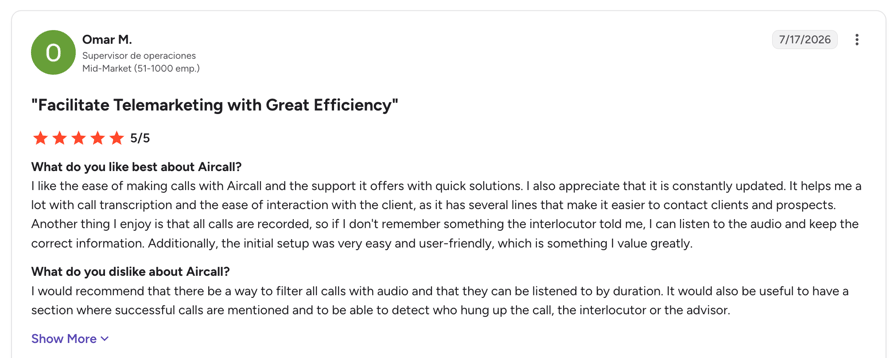
The pattern across Aircall's critical reviews is consistent: the product is liked, the price and the contract are not. Dropped calls, echo, and audio lag come up repeatedly on international routes and during high-volume periods, and offboarding is the single loudest theme. Our full aircall vs ringcentral comparison 2025 follow-up review goes deeper on what changed since.
What Real Users Say About RingCentral On G2
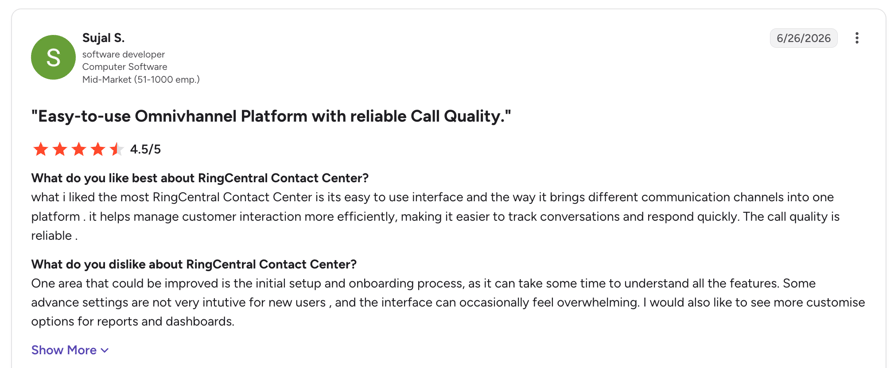
RingCentral's critical reviews cluster around billing and administration rather than the product itself: SMS add-ons that were not flagged during the sales process, difficulty reducing licence counts mid-contract, and admin screens that take longer to learn than expected. For a fuller picture, see our aircall vs ringcentral for smbs platform review.
Aircall Pros & Cons vs. RingCentral Pros & Cons
Aircall Pros & Cons
| Pros | Cons |
|---|---|
| Purpose-built Power Dialer, Voicemail Drop, and click-to-call for outbound teams | Three-licence minimum on both self-serve plans, so $90/month is the real entry price |
| Fastest first-day setup in this comparison, with 9.2/10 for ease of use on G2 | Conversation intelligence is a $9/licence add-on on Essentials and only bundled at $50 Professional |
| 250+ integrations with API access from the entry plan, including CRM connectors | No native video conferencing or team messaging, so a second vendor is required for both |
| AI Assist Pro delivers live prompts, playbooks, and custom scorecards mid-call | No published 24/7 human phone support, and the contractual SLA is Custom-tier only |
| AI Voice Agent with 50 free minutes per account per month on every plan | SAML SSO is gated to the 25-licence Custom tier and described as limited availability |
| Highest sub-scores in this comparison for setup, admin, support, and product direction | No published HIPAA or BAA commitment, and ISO 27001 is AWS's certificate rather than Aircall's |
RingCentral Pros & Cons
| Pros | Cons |
|---|---|
| Voice, video, and team messaging from one vendor on a single licence | No power, parallel, or predictive dialing in RingEX at any tier – dialers live in RingCX |
| AI Assistant bundled free into every RingEX plan rather than sold as an add-on | SMS caps of 25, 100, and 200 segments per user per month, with a $25 Booster to lift them |
| $20/user/month entry price with no published seat minimum on RingEX | CRM integrations are gated to Advanced and above, so the $20 Core plan does not connect to Salesforce or HubSpot |
| 99.999% uptime SLA and the deepest certification stack here: ISO 27001, SOC 2+, HITRUST, PCI DSS | Deeper AI is add-on priced: AI Receptionist from $39, Conversational Intelligence from $60 |
| 24/7 technical support published across most country lines with no tier gating | Compliance recovery and e911 fees appear on invoices with amounts never published |
| 500+ integrations plus RingCX when calling volume outgrows a phone system | Lowest scores in this comparison for setup (8.2), admin (8.3), support (8.0), and product direction (7.9) |
Want a Third Data Point Before You Commit?
Which Team Fits Which Platform?
Fit here comes down to a single question: does your team need a purpose-built sales and support call center, or a full communications suite for the whole company? Answer that and the rest follows.
Aircall vs RingCentral: Which Fits Your Team
| Aircall Is the Right Fit For… | RingCentral Is the Right Fit For… |
|---|---|
| Outbound sales teams of 5–50 reps who need a purpose-built dialer | Companies that want one vendor for voice, video, and team messaging |
| Support teams that want CRM integration working on the entry plan | IT-led rollouts across multiple sites, departments, and permission models |
| Teams that already have video and chat and don't want to pay for them twice | Teams that want AI transcription and summaries bundled into every plan rather than added on |
| Managers who need live in-call prompts and playbooks to coach reps | Regulated buyers who need ISO 27001, HITRUST, PCI DSS, or a 99.999% SLA on paper |
| Teams that need to be live this week with minimal training | Microsoft-first organisations that want calling inside Teams |
| Sales orgs where call tagging and dispositions drive the pipeline report | Businesses that expect to add a contact center later without changing vendors |
If you have landed here searching for the best ringcentral alternative because neither column describes you, that usually means you need call-center depth without a full UCaaS rollout, which is a real third category rather than a compromise.
Aircall vs. RingCentral: The Verdict
The choice between Aircall and RingCentral comes down to scope, not platform quality. Aircall is a call center that happens to be a phone system; RingCentral is a communications suite that happens to make calls. Both are mature, both are well reviewed, and buying the wrong one usually means buying the right product for someone else's problem.
Choose Aircall If You…
- Run outbound at volume and need a Power Dialer, Voicemail Drop, and call tagging inside the plan rather than in a separate product
- Want CRM connectors working on the entry tier instead of one tier up
- Need live coaching during calls, with prompts and playbooks a manager can build
- Already own video and team chat and don't want to pay for a second copy of either
- Need to be live this week with reps who get no training beyond a walkthrough
- Have at least three people, because the three-licence minimum is not negotiable
Choose RingCentral If You…
- Are replacing a phone system, a video tool, and a chat tool at the same time
- Want AI transcription and summaries included in the subscription rather than added to it
- Answer to a security review that works from a certificate checklist: ISO 27001, HITRUST, PCI DSS, SOC 2+
- Need a single seat or two, because RingEX publishes no seat minimum
- Run on Microsoft Teams and want calling inside it
- Expect to add omnichannel contact center capability later and would rather grow into RingCX than switch vendors
The Bottom Line
These two solve related but different problems. The deciding factor is whether you need a purpose-built call center or a full communications suite, not which product is better built. Aircall wins on dialing, coaching, and speed to first call. RingCentral wins on scope, entry price, bundled AI, and compliance depth. Score them against your own requirement list rather than against each other.
Not Sure Which of the Three Fits Your Team?
Sources:
- Aircall, pricing, security, and AI product pages
- RingCentral, RingEX plans and pricing, RingCX, and trust center compliance
- G2, Aircall vs RingEX head-to-head
- Capterra, Aircall reviews and RingCentral reviews
Frequently Asked Questions About Aircall vs RingCentral
Direct answers to the questions buyers ask most when comparing Aircall and RingCentral.
For outbound sales specifically, yes. Aircall's Professional plan includes a Power Dialer, Voicemail Drop, smart routing, and mandatory call tagging, and AI Assist Pro adds live prompts and playbooks for SPICED, BANT, MEDDIC, and PACTT at $49/licence/month. RingEX has no power, parallel, or predictive dialing mode at any tier – those live in the separate RingCX product from $65/agent/month. If your reps work a list, that gap decides it. If your sales team mostly answers inbound calls and joins video meetings, the advantage disappears.
On paper RingCentral, by a wide margin: it publishes a 99.999% uptime SLA against Aircall's 99.95% commitment, and Aircall's contractual SLA is available only on the 25-licence Custom tier. In reviews the picture is less clean. Aircall reviewers report dropped calls, echo, and audio lag, particularly on international routes and during high-volume periods. RingCentral reviewers complain more about billing and administration than about audio. Neither platform is a safe bet for a specific corridor without testing it – run a trial on the routes you actually call before committing.
Aircall, and the review data backs it rather than just the marketing. G2 scores Aircall 8.9/10 for ease of setup against RingCentral's 8.2, and 9.2 against 8.6 for ease of use. A small team can buy Aircall in the morning and be routing calls the same afternoon. RingCentral has more to configure because it covers more – extensions, queues, auto-attendants, permissions, video, and messaging – and reviewers consistently cite that admin surface as the hardest part of the rollout. For a multi-site deployment, plan an IT-led project rather than a self-serve setup.
RingCentral, if the team needs meetings and internal chat alongside calling. Video for up to 100 participants on Core and Advanced, 200 on Ultra, plus native team messaging, all on the same licence – Aircall offers neither, so a remote team on Aircall is also paying for Zoom or Google Meet and for Slack. Both ship full-featured iOS and Android apps and both work from a browser. The deciding question is whether you already own the video and chat tools you like, because if you do, RingCentral's bundling advantage turns into duplicate spend.
It's effectively a tie on the headline number: both advertise numbers in 100+ countries. The detail matters more. RingCentral's own support documentation shows Global RingEX covering roughly 80 countries, with international virtual toll-free reaching further and local porting available in around 60. Aircall covers 100+ countries for numbers but supports SMS in only 13, which is the constraint that catches multi-market teams out. For comparison, CloudTalk provisions local numbers in 160+ countries. Check your specific markets on each vendor's coverage list rather than trusting the headline.
RingCentral, clearly. It holds ISO 27001, 27017, and 27018, ISO 22301, SOC 2+ with FINRA CSR and HIPAA extensions, SOC 3, HITRUST CSF, PCI DSS attestation, C5 in Germany, and Cyber Essentials Plus in the UK, alongside EU data residency for European customers. Aircall holds SOC 2 Type 2 and is GDPR compliant with EU-US Data Privacy Framework commitments, but its ISO 27001 certificate belongs to AWS rather than to Aircall, its SAML SSO is gated to the 25-licence Custom tier, and we found no published HIPAA or BAA commitment on its security or legal pages. Get any HIPAA requirement confirmed in writing before signing with Aircall.
RingCentral has more integrations – over 500 against Aircall's 250+ – but Aircall gives you the CRM ones earlier. HubSpot, Zendesk, Pipedrive, and Intercom all connect on Aircall's $30 Essentials plan, while RingCentral gates CRM integrations to Advanced at $25/user/month, one tier above its $20 Core. Salesforce is the exception on both sides: Aircall puts CTI on Professional and sells Salesforce Voice as a separate $30/licence purchase. Several enterprise tools attributed to RingCentral in third-party comparisons, ServiceNow among them, are not listed on RingCentral's own integrations page, so confirm your specific stack with sales.
On cost alone, RingCentral: $20/user/month with no published seat minimum against Aircall's $30 with a mandatory three licences, which makes $90/month the real Aircall floor. A two-person team pays for three seats on Aircall and for two on RingEX. But small outbound sales teams often still pick Aircall, because the dialer, the tagging, and the entry-tier CRM connectors do work RingEX cannot do at any price. The honest split: if you answer calls, RingCentral is cheaper; if you make them in volume, Aircall earns the difference back.
Numbers, yes – porting is standard in both directions and neither vendor blocks it, though timelines depend on the carrier and the country rather than on the platform. Call flows and IVR trees do not migrate: they have to be rebuilt by hand, because the two products model routing differently. Call history and recordings export, but AI summaries and transcripts generally do not carry across. Plan the port in batches, run both systems in parallel while it completes, and rebuild routing before you point the last numbers over. Budget days for a simple setup and 30 to 90 for a complex multi-site one.
It depends which RingCentral you mean. In unified communications, the biggest competitors are Microsoft Teams Phone, Zoom Phone, 8x8, Nextiva, and GoTo Connect – Microsoft is the structural threat, because companies already paying for Teams question the second bill. In contact center, RingCX competes with Five9, Genesys, and Talkdesk. For sales and support teams specifically, Aircall, CloudTalk, Dialpad, and JustCall take deals RingCentral would otherwise win, usually on dialer depth rather than on price.
Yes, with two caveats. Aircall holds 4.4/5 on G2 from 1,642 reviews and 4.2/5 on Capterra from 465, and it scores highest in this comparison for ease of use, setup, admin, and product direction. The consistent criticisms are price and contract terms rather than the product: reviewers report forced full-price renewals, rigid offboarding, and difficulty reducing seats. Capterra rates value for money at 3.9/5, its weakest score. It's a good product with a commercial model that rewards reading the contract carefully.
Aircall's direct competitors are the SMB-first cloud phone systems built for sales and support: CloudTalk, JustCall, Dialpad, and OpenPhone. One tier up in scope sit the UCaaS suites – RingCentral, Nextiva, 8x8, GoTo Connect – which win when a company wants one vendor for everything. Above that, Five9 and Genesys take larger contact center deals. Most Aircall evaluations end up comparing against one name from the first group on dialer depth and one from the second on scope.
Aircall was founded in Paris in 2014 and remains French at the corporate and legal level, while operating with a dual French-American footprint and offices in New York. Its data processing agreement is governed by French law and French courts, and its Data Protection Officer is registered with the CNIL, France's data protection authority. For an EU buyer that is a practical advantage: the GDPR posture is native rather than retrofitted. Its 2026 acquisitions reflect the same split – Vogent in May and Piper AI in June, the latter announced from Paris and Seattle.
It depends which trade-off pushed you off the shortlist. If it was Aircall's three-seat minimum and paid AI add-on, look for a platform with a one-licence entry plan. If it was RingCentral's missing dialer and gated CRM connectors, look for one that ships both inside the plan. CloudTalk covers both: entry from $19/user/month with a one-licence minimum, a Power Dialer included on Expert and a Parallel Dialer available on any plan, 95+ CRM and helpdesk integrations from Essential, and AI conversation intelligence at a flat $9/user/month. Dialpad and JustCall are the other names worth a look on the same shelf.