The 10 Best AI Medical Receptionists for Healthcare Practices in 2026
TL;DR:
An AI medical receptionist answers patient calls, books and reschedules appointments, and routes urgent issues to staff, around the clock, without adding headcount. We compared 10 platforms on HIPAA compliance, call handling, EHR/scheduling, pricing, and real reviews. CloudTalk leads for clinics that want clear, reliable calls with a signed BAA and deep CRM/EHR sync.
The 10 tools we cover:
- 01CloudTalk - Best overall ai medical receptionist for clinics that need HIPAA-ready, high-quality calling
- 02Assort Health - Best for specialty practices with deep EHR needs
- 03Simbo AI - Best for hospitals and larger medical groups
- 04Arini - Best for dental practices
- 05Hyro - Best for enterprise health systems and digital front doors
- 06Dialzara - Best for solo and small clinics on a budget
- 07Synthflow - Best no-code AI voice builder
- 08Retell AI - Best developer-friendly AI voice with self-serve BAA
- 09Vapi AI - Best for fully custom voice workflows
- 10JustCall - Best for clinics that also run sales/outbound
We also cover a feature-by-feature compliance table, what real users say, and how to choose. Let's get into it.
Phones are still the front door to most medical practices, and too many patients never get in. By some industry estimates, the average medical group misses roughly 4 in 10 calls during business hours, and analyses of practice phone data suggest almost a quarter of calls go unanswered altogether. When patients can't get through, they don't wait, around 41% say they've switched providers at least partly because a practice was hard to reach by phone.
An AI receptionist for healthcare closes that gap. It answers every call, books and confirms appointments, and hands the tricky cases to a human, all while a signed BAA keeps you on the right side of HIPAA. Below we rank the best options for clinics in 2026, starting with the smaller specialists and the tools built specifically for medicine.
Never Miss a Patient Call Again
What Is the Best AI Medical Receptionist in 2026?
For most clinics, CloudTalk is the best ai medical receptionist in 2026. It pairs an AI voice agent that answers, books, and routes patient calls with the carrier-grade calling backbone practices actually need, on a 99.999% uptime SLA. Crucially for healthcare, CloudTalk is HIPAA-compliant, aligned with SOC 2 Type II and GDPR, and provides signed Business Associate Agreements (BAAs) that cover call recordings, transcripts, and text logs.
It also carries the reviews to back it up. On G2, CloudTalk holds a 4.4/5 rating across 1930 reviews, with users repeatedly citing call clarity, native CRM sync, and AI call analytics. For a deeper look at how AI voice fits clinical workflows, see our guide to use cases of AI voice agents in healthcare. That said, the right pick depends on your specialty, size, and EHR, which is exactly what this comparison sorts out.
Our Methodology: How We Chose the Best AI Medical Receptionist in 2026
Healthcare is a high-stakes buy, so we weighted the criteria that protect patients and practices first:
- Compliance: HIPAA support, availability of a signed BAA, and how patient data is stored and handled
- Call handling: inbound and outbound AI calls, warm transfers to staff, and escalation for urgent or complex issues
- Scheduling & EHR: real-time booking, EHR/practice-management integration, and patient identity verification
- Verified reviews: G2 and Capterra ratings plus real user discussion on Reddit and Quora
- Pricing & fit: transparent cost and a clear best-fit use case, from solo practices to health systems
We prioritized recurring, independent feedback over one-off reviews, and we cross-checked compliance claims against each vendor's own documentation. Because compliance terms and pricing change, confirm current details with any vendor before you sign.
Why Trust Our Software Reviews?
For nearly a decade, we've helped over 30,000 professionals choose and implement better communication tools. We've reviewed 200+ products, analyzed 5,500+ verified reviews from G2 and Capterra, and drawn insights from real user discussions on platforms like Reddit or Quora.
In the past year alone, we've published 1,000+ articles, all written and reviewed by humans, for humans, to provide reliable, data-backed insights you can trust.
Learn how we keep our content integrity and our software review methodology.
Comparison Table: 10 Best AI Medical Receptionists (Based on Real Reviews & Ratings)
Here is the quick-scan view of the best ai medical receptionist software in 2026. G2 ratings are shown as variables and should be refreshed before publish; tools without a meaningful G2 profile are marked accordingly.
AI Medical Receptionist Comparison
| Software | Best For | Key Healthcare Features | Starting Price | G2 Rating |
|---|---|---|---|---|
| CloudTalk | Clinics needing HIPAA-ready, high-quality calling | AI voice agent, signed BAA, CRM/EHR sync, analytics | From $19/user/mo | 4.4/5 |
| Assort Health | Specialty practices with deep EHR needs | Specialty-trained voice, 80+ EHR integrations | Custom (contact sales) | Not on G2 |
| Simbo AI | Hospitals and larger groups | Autonomous AI phone system, EHR automation | From ~$198/mo | Not on G2 |
| Arini | Dental practices | Dental-specific scheduling and call handling | Custom | Not on G2 |
| Hyro | Enterprise health systems | Conversational AI digital front door | Custom (enterprise) | Limited G2 profile |
| Dialzara | Solo and small clinics on a budget | Self-serve AI receptionist, fast setup | From $29/mo | Limited G2 profile |
| Synthflow | No-code AI voice building | Drag-and-drop flows, HIPAA on higher tier | Usage-based (~$0.09/min) | |
| Retell AI | Developer-friendly deployments | HIPAA on standard plans, self-serve BAA portal | Usage-based (from ~$0.07/min) | |
| Vapi AI | Fully custom voice workflows | Programmable voice APIs, HIPAA add-on | Usage-based (from ~$0.05/min) | |
| JustCall | Clinics that also run sales/outbound | Dialers, SMS, HIPAA on Business plan | From $19/user/mo | 4.3/5 |
Best AI Medical Receptionist: Top Honest 10 Picks
We ordered this list to surface specialized, healthcare-first tools before the larger generalists, so you see the closest fit for a clinic first.
1. CloudTalk: Best Overall AI Medical Receptionist
What Is CloudTalk?
CloudTalk is a cloud calling platform with a built-in AI voice agent, used by 5,500+ teams worldwide. For clinics, it works as a ai receptionist for medical practice that answers calls, books appointments, and routes urgent cases, backed by carrier-grade voice quality and a signed BAA.
What Are CloudTalk's Key Features?
- AI voice agent for appointment booking, FAQs, and call routing with context retention
- HIPAA-compliant workflows with signed BAA, SOC 2 Type II, and GDPR alignment
- Encryption in transit and at rest, with EU-based storage options
- Smart IVR and skill-based routing, plus warm transfer to staff
- CRM and EHR/helpdesk integrations for unified patient context
- Call recording, transcripts, and real-time analytics on a 99.999% uptime SLA
What Are CloudTalk's Pros and Cons?
Pros & Cons: CloudTalk
| Pros | Cons |
|---|---|
| HIPAA-compliant with signed BAA for healthcare customers | Deepest AI features sit on higher tiers |
| Reliable, clear call quality praised by reviewers | EHR workflows may need setup/integration planning |
| Strong CRM sync and analytics | Not a dental- or specialty-only tool out of the box |
How Much Does CloudTalk Cost?
From $25/user/month (billed annually), with HIPAA-compliant plans and BAA support on eligible tiers, plus a 14-day free trial. See pricing.
Flexible Pricing Plans to Scale with You
Compare our plans
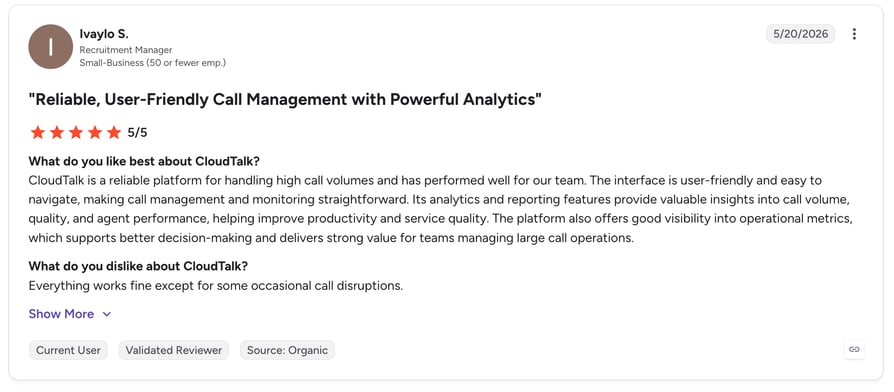
What are real users saying about CloudTalk?
Reviewers consistently highlight call clarity, easy CRM sync, and time saved on logging. The most common critique is that the most advanced AI features require a higher plan.
Use CloudTalk when you want one HIPAA-ready platform for patient calls, appointment automation, and analytics, need reliable audio and warm transfers to staff, and want a signed BAA without an enterprise-only contract. Don't use CloudTalk when you need a dentistry-only workflow out of the box or a purely pay-per-minute developer sandbox.

Answer Every Patient Call, 24/7

2. Assort Health: Best for Specialty Practices with Deep EHR Needs
What Is Assort Health?
Assort Health is an AI voice agent for patient access, trained on large volumes of medical interactions across many specialties, with bidirectional integration into 80+ EHR and practice-management systems. It positions itself as a specialty-aware patient-access AI voice agent.
Key Features and Pros & Cons
Pros & Cons: Assort Health
| Pros | Cons |
|---|---|
| Specialty-trained voice workflows and broad EHR coverage | Enterprise focus; less suited to solo practices |
| Built specifically for patient access in medicine | Custom pricing, less transparent for quick evaluation |
Use Assort when your specialty and EHR integration are the priority. Don't use Assort when you want quick self-serve setup or a broader calling platform. Confirm the signed BAA and data-handling terms before pilot.
3. Simbo AI: Best for Hospitals and Larger Medical Groups
What Is Simbo AI?
Simbo AI builds an autonomous AI phone system and ambient medical scribe aimed at medium-to-large hospitals, using generative AI for large-scale clinical automation. It's positioned as an enterprise ai healthcare receptionist.
Key Features and Pros & Cons
Pros & Cons: Simbo AI
| Pros | Cons |
|---|---|
| Purpose-built for hospital-scale phone automation | Heavier implementation than SMB tools |
| Ambient scribe and EHR automation options | Best value at larger volumes |
Use Simbo when you're at hospital scale and want autonomous phone automation. Don't use Simbo when you're a small clinic wanting a light, quick setup. Confirm BAA and PHI-handling terms directly.
Simbo AI vs. CloudTalk: Simbo targets enterprise hospital automation; CloudTalk is the more flexible, faster-to-launch choice for clinics and multi-site groups.
4. Arini: Best AI Receptionist for Dental Practices
What Is Arini?
Arini is an AI receptionist built specifically for dental practices, handling appointment calls and patient questions around the clock. If you run a dental office, it's worth shortlisting alongside other dental AI virtual receptionist tools.
Key Features and Pros & Cons
Pros & Cons: Arini
| Pros | Cons |
|---|---|
| Dental-specific scheduling and workflows | Narrow fit outside dentistry |
| Focused, purpose-built experience | Confirm integration with your broader medical EHR |
Use Arini when you're a dental office wanting a tool tuned to dentistry. Don't use Arini when you operate outside dentistry or rely on a broad medical EHR. Verify HIPAA and BAA terms early.
Arini vs. CloudTalk: Arini is dental-first; CloudTalk suits general medical and multi-specialty clinics that also need robust calling and analytics.
5. Hyro: Best for Enterprise Health Systems
What Is Hyro?
Hyro is a conversational AI platform for large health systems and hospitals, often deployed as a "digital front door" across phone and web. It's an enterprise-grade ai receptionist healthcare option.
Key Features and Pros & Cons
Pros & Cons: Hyro
| Pros | Cons |
|---|---|
| Built for enterprise health-system scale | Overkill for small and mid-size clinics |
| Omnichannel digital front door | Enterprise implementation and pricing |
Use Hyro when you're an enterprise health system needing omnichannel automation. Don't use Hyro when you're a single clinic wanting fast, affordable setup.
Hyro vs. CloudTalk: Hyro fits large systems; CloudTalk is the pragmatic choice for clinics and growing groups that want HIPAA-ready calling without an enterprise rollout.
Try a HIPAA-Ready AI Receptionist Free
6. Dialzara: Best for Solo and Small Clinics on a Budget
What Is Dialzara?
Dialzara is a self-serve AI receptionist for US small businesses, including small clinics, with fast setup and low entry pricing. It markets itself as an affordable ai receptionist for medical office use.
Key Features and Pros & Cons
Pros & Cons: Dialzara
| Pros | Cons |
|---|---|
| Low starting price and quick setup | Generalist, not medicine-specific |
| Self-serve with a free trial | Confirm HIPAA/BAA scope for PHI |
Use Dialzara when budget and speed matter most. Don't use Dialzara when you need specialty EHR workflows or enterprise controls. Confirm its BAA covers your PHI use before going live.
Dialzara vs. CloudTalk: Dialzara wins on entry price; CloudTalk adds carrier-grade calling, deeper analytics, and a healthcare-grade BAA as you scale.
7. Synthflow: Best No-Code AI Voice Builder
What Is Synthflow?
Synthflow is a no-code platform for building AI voice agents with a drag-and-drop flow builder, popular with teams that want to configure call logic themselves.
Key Features and Pros & Cons
Pros & Cons: Synthflow
| Pros | Cons |
|---|---|
| No-code flow builder, fast to prototype | HIPAA/BAA sits on a higher-cost tier |
| Usage-based pricing, no fixed monthly fee | You own the compliance configuration |
Use Synthflow when you want no-code control and are ready to pay for the HIPAA tier. Don't use Synthflow when you want a turnkey, medicine-specific setup. See Synthflow alternatives.
Synthflow vs. CloudTalk: Synthflow is a build-it-yourself toolkit; CloudTalk ships HIPAA-ready calling and analytics without you assembling the compliance layer.
8. Retell AI: Best Developer-Friendly AI Voice with Self-Serve BAA
What Is Retell AI?
Retell AI is a developer-focused voice platform that ships SOC 2 Type I/II, HIPAA, and GDPR coverage on standard plans, with a self-service BAA portal, notable for a compliance path that doesn't require an enterprise contract.
Key Features and Pros & Cons
Pros & Cons: Retell AI
| Pros | Cons |
|---|---|
| HIPAA on standard plans with self-serve BAA | Developer effort required to build the agent |
| Usage-based, low per-minute entry | Not a turnkey clinic product |
Use Retell when you have engineering support and want a self-serve BAA. Don't use Retell when you need a no-build, ready-made receptionist.
Retell AI vs. CloudTalk: Retell is a build-your-own API play; CloudTalk is the ready-to-run platform for clinics that don't want to maintain code.
9. Vapi AI: Best for Fully Custom Voice Workflows
What Is Vapi AI?
Vapi AI is a programmable voice platform for developers building fully custom call experiences, with HIPAA compliance available as a paid add-on that includes a BAA.
Key Features and Pros & Cons
Pros & Cons: Vapi AI
| Pros | Cons |
|---|---|
| Maximum flexibility via programmable APIs | HIPAA is a notable monthly add-on cost |
| Low per-minute base pricing | Requires developers to build and maintain |
Use Vapi when you need total control and have the team to build it. Don't use Vapi when you want turnkey compliance and setup. See Vapi AI alternatives.
Vapi AI vs. CloudTalk: Vapi is a developer canvas; CloudTalk is a finished, HIPAA-ready product your front desk can use on day one.
10. JustCall: Best for Clinics That Also Run Sales and Outbound
What Is JustCall?
JustCall is a cloud phone and SMS platform with strong dialing tools, offering HIPAA compliance on its Business plan for healthcare teams that also run outbound outreach.
Key Features and Pros & Cons
Pros & Cons: JustCall
| Pros | Cons |
|---|---|
| Powerful dialers and SMS for outreach | HIPAA only on Business plan (10-license minimum) |
| Broad CRM integrations | Custom pricing for the compliant tier |
Use JustCall when you need dialers plus SMS and can meet the Business-plan minimum. Don't use JustCall when you're a small clinic that only needs inbound reception.
JustCall vs. CloudTalk: both are strong calling platforms, but CloudTalk offers a signed BAA without a 10-seat minimum and is consistently rated higher for call quality.
See CloudTalk Handle a Real Patient Call
AI Medical Receptionist: Feature Comparison Table
This matrix compares the capabilities that matter most in healthcare. Compliance and features vary by plan and change often, so treat this as a starting point and confirm each item in writing with the vendor and in your signed BAA before you buy.
Feature Comparison: HIPAA, Call Handling, Scheduling
| Feature | CloudTalk | Assort Health | Retell AI | Synthflow | JustCall |
|---|---|---|---|---|---|
| HIPAA compliant | Yes | Yes | Yes (standard plans) | Yes (higher tier) | Yes (Business plan) |
| Signed BAA available | Yes | Confirm | Yes (self-serve) | Yes (higher tier) | Yes (Business plan) |
| PHI use for model training | Per BAA terms | Per BAA terms | Per BAA terms | Per BAA terms | Per BAA terms |
| Inbound AI calls | Yes | Yes | Yes | Yes | Yes |
| Outbound AI calls | Yes | Confirm | Yes | Yes | Yes |
| Warm call transfer | Yes | Yes | Configurable | Configurable | Yes |
| Emergency/urgent escalation | Configurable | Configurable | Configurable | Configurable | Configurable |
| Real-time scheduling | Via integration | Yes (native EHR) | Via integration | Via integration | Via integration |
| EHR integration | Via API/CRM | Yes (80+ EHRs) | Via API | Via API | Via API/CRM |
How to Choose the Right AI Medical Receptionist for Your Team
Once you have a shortlist of the best ai receptionist for healthcare in 2026, these are the factors that decide the fit.
1. Confirm HIPAA Compliance and a Signed BAA
Any tool touching patient data must offer a signed BAA and document how it encrypts and stores PHI. Ask whether call recordings and transcripts are covered, and whether PHI is ever used to train models. Our guide to a HIPAA-compliant virtual receptionist covers what to check.
2. Match It to Your Specialty and EHR
A dental office and an orthopedics group have different scripts and systems. Verify native scheduling and write-back to your specific EHR before you commit, especially if you need an ai receptionist for medical clinics across multiple specialties.
3. Check Call Handling and Human Escalation
The best systems escalate rather than guess. Confirm the AI can warm-transfer to staff, detect urgent situations, and hand off cleanly, so patients always reach a human when it matters.
4. Weigh Call Quality and Reliability
An AI receptionist is only as good as the line it runs on. Look for a published uptime SLA and clear audio; garbled or dropped calls undermine trust fast. This is where a purpose-built healthcare calling platform earns its keep.
5. Compare Total Cost, Not Just the Sticker Price
Usage-based tools can be cheap to start and pricey at volume; per-seat tools scale with staff. Factor in the HIPAA tier, add-ons, and minimum seats when you compare the best ai receptionist options for healthcare in 2026.
6. Run a Pilot Before You Roll Out
Test with real call scenarios: bookings, reschedules, insurance questions, and an emergency. A short pilot tells you more about fit than any feature list, and most vendors offer a trial or proof of concept.
Get a HIPAA-Ready AI Receptionist Set Up in Days
Quick Answers: What People Ask Most About AI Medical Receptionists
How much does an AI medical receptionist cost?
Most clinics pay one of two ways. Per-seat platforms start around $19-$29 per user per month, while usage-based AI voice tools charge roughly $0.05-$0.09 per minute plus provider costs. HIPAA compliance can add a higher tier or a monthly add-on. Budget for the compliant plan, not the headline price.
Are AI receptionists HIPAA compliant?
Some are, but not by default. A tool is only safe for PHI if the vendor signs a Business Associate Agreement and documents encryption and data handling. CloudTalk, for example, is HIPAA-compliant and provides signed BAAs. Always confirm the BAA in writing before handling patient data.
Is an AI receptionist worth it?
For most practices, yes. When 4 in 10 calls go unanswered and patients switch providers over it, an AI receptionist that captures every call and books appointments 24/7 usually pays for itself. It works best as a complement to staff, handling routine load so your team focuses on in-office care.
Will AI replace medical receptionists?
Not entirely. AI handles repeatable calls, booking, reminders, and FAQs, while humans manage complex, sensitive, or urgent situations. Most clinics use AI to remove call overload and reduce burnout, not to eliminate the front desk. The realistic outcome is a smaller, less stressed team doing higher-value work.
What People Say on Reddit & Quora About the Best AI Medical Receptionist
Practitioners in online communities are cautiously positive about an AI medical receptionist, with a few recurring themes:
- Accuracy on complex calls: users worry the AI may mishandle nuanced requests, and want it to escalate to a human rather than guess
- Human fallback: the loudest concern is patients being stuck with a bot; easy, fast transfer to staff is seen as non-negotiable
- Compliance: commenters stress signed BAAs, encryption, and clarity on whether PHI is used for training
- Patient trust: acceptance grows when the AI is clearly introduced and a human is always one step away
Put a HIPAA-Ready AI Receptionist to the Test
Conclusion: The Best AI Medical Receptionist by Practice Size
The right pick depends less on brand and more on your size, specialty, and compliance needs. Here's the short version.
Solo and Small Clinics
If budget and speed matter most, Dialzara offers a low-cost, self-serve start. When you want carrier-grade call quality and a signed BAA as you grow, CloudTalk is the stronger long-term home, and Arini is the pick for dental offices specifically.
Multi-Location Groups
Growing practices need reliable calling, EHR/CRM sync, and analytics across sites. CloudTalk fits best here as a HIPAA-ready healthcare calling platform, with Assort Health worth a look where deep specialty-EHR workflows are the priority.
Enterprise Health Systems
Hospitals and large systems that want an omnichannel digital front door should evaluate Hyro and Simbo AI, while developer-led teams can build compliant voice on Retell AI or Vapi AI. Whichever you choose, make the signed BAA and human-escalation path non-negotiable.
Ready to Stop Missing Patient Calls?
Frequently Asked Questions
Expect roughly $19-$29 per user per month for per-seat platforms, or about $0.05-$0.09 per minute for usage-based AI voice tools, plus any HIPAA tier or add-on. CloudTalk starts at $19/user/month with HIPAA and BAA on eligible plans.
They can be, but only when the vendor signs a BAA and documents encryption and data handling. Compliance is never automatic, so confirm it in writing before any tool touches patient data.
In this guide, CloudTalk, Retell AI, Vapi AI (add-on), Synthflow (higher tier), and JustCall (Business plan) offer HIPAA compliance with a BAA, and healthcare-specific tools like Assort, Simbo, Hyro, and Arini are built for regulated use. Always verify current terms directly.
Yes, provided it's used under a signed BAA with appropriate safeguards for PHI and clear patient handling. Legality hinges on compliance, not the technology itself, so document your vendor's HIPAA posture.
A small clinic can start under $100/month on a compliant plan; multi-site groups and hospitals scale into custom pricing based on call volume, seats, and integrations. Budget for the HIPAA tier and any per-minute usage.
Yes. With significant healthcare staffing shortages and high call-abandonment rates, adoption is rising quickly as practices look to answer every patient call without expanding the front desk.