CloudTalk is my pick of the best AI voice assistants in 2026 for voice-first teams that want the AI assistant, the phone system and CRM logging in one platform. Its AI Receptionist answers calls 24/7, keeps callers on the line during transfers, books appointments in Google Calendar, Outlook, Calendly and Cal.com, and speaks 70+ languages, with AI minutes from $99 a month for 200 minutes on top of a phone plan.
I spent a few weeks reviewing 30 AI voice assistants for business against vendor pricing pages, product docs and G2 data, and tested the ones with a self-serve trial on real calls. These are the 11 best:
- CloudTalk: best for teams that need voice, telephony and CRM in one platform, with book straight into Google Calendar, Outlook, Calendly and Cal.com (telephony platform)
- Dialpad: best for AI voice inside a unified communications platform (telephony platform)
- RingCentral: best for companies already on RingCentral UCaaS (telephony platform)
- Synthflow AI: best no-code builder for voice assistants (no-code builder)
- Retell AI: best for developer teams building low-latency voice assistants (developer platform)
- Vapi: best for developers who want full control over the voice stack (developer platform)
- Bland AI: best for large-scale outbound calling (developer platform)
- ElevenLabs Agents: best for voice quality and language coverage (voice platform)
- PolyAI: best for enterprises that need custom conversational voice AI (enterprise)
- Five9: best for large enterprise contact centers (enterprise)
- Fin by Intercom: best for chat-first support teams adding voice (support platform)
CloudTalk is voice-first and has no chat product. If your support runs on chat, look at Fin; if your engineers want to build the agent themselves, look at Vapi or Retell AI.
Here's the thing. AI is everywhere, and you're probably being bombarded with pressure to add AI agents to your AI Assistant/receptionist/intake workflow. It might be tempting to dump your human team and go full agentic AI just for the cost cuts, but between you and me, you risk a serious decrease in customer satisfaction if you do. Just look at the data:
According to Deloitte Digital's 2026 Global Contact Center Survey¹, 35% of contact centers already use agentic AI in their operations. Most customers haven't seen better service, though: in the same survey, more than half of consumers said service quality stayed the same or got worse in 2025.
The key, then, is to choose an AI provider that gives you the option to hand off to humans in the workflow, or work together with a live receptionist platform (like CloudTalk).
I picked the 11 tools below from five types of product, and the type decides most of those answers: phone systems with AI built in, a no-code builder, developer platforms, enterprise suites and a chat-first support agent. Pick the type first, then test two or three tools on your own calls.
Best AI Voice Assistants: Comparison Table
| Tool | Type | Best for | Telephony | CRM integrations | Entry price | G2 (reviews) |
|---|---|---|---|---|---|---|
| CloudTalk | Telephony platform (voice-first) | Teams that need voice, telephony and CRM in one platform | Full phone system, numbers in 160+ countries | HubSpot, Salesforce and 95+ standard integrations (from Essential) | 50 free AI minutes in month one, then $99/month for 200 minutes; phone plans from $25/user/month | 4.4/5 (1961+) |
| Dialpad | Telephony platform | AI voice inside a UC and contact center suite | Full phone system and contact center | Salesforce, HubSpot, Zendesk, Zoho, ServiceNow | AI agents: custom; phone plans from $15/user/month | 4.4/5 (700+, Dialpad Support listing) |
| RingCentral | Telephony platform | Companies already on RingCentral | RingEX phone system or your existing one | Salesforce, HubSpot, Zoho | $49/month for 100 minutes, then $0.50/minute | 4.2/5 (1,550+, RingEX listing) |
| Synthflow AI | No-code builder | Managed no-code rollouts | Agent numbers (native telephony or SIP) | HubSpot, Salesforce | Quote-based annual contract | 4.5/5 (1,000+) |
| Retell AI | Developer platform | Developer teams building voice agents | Agent numbers (Retell, Twilio, Telnyx or SIP) | Salesforce, HubSpot, Dynamics 365, GoHighLevel, Zoho | $0.07 to $0.31/minute | 4.8/5 (2,650+) |
| Vapi | Developer platform | Full control over the voice stack | Agent numbers (Vapi, SIP, Twilio, Vonage, Telnyx) | GoHighLevel native; others through the API | $0.05/minute hosting plus model, voice and carrier costs | 4.2/5 and 3.0/5 (two listings, 3 reviews each) |
| Bland AI | Developer platform | Large-scale outbound | Own telephony and agent numbers | Salesforce, HubSpot | $0.12 to $0.14/minute | 5/5 (just 11 reviews) |
| ElevenLabs Agents | Voice platform | Voice quality and languages | Through Twilio or SIP | Zendesk; Salesforce through app connectors | Free for 15 minutes; paid from $6/month | 4.5/5 (1,250+, main ElevenLabs listing) |
| PolyAI | Enterprise | Custom conversational voice AI | Its platform or your contact center | Salesforce, Zendesk | Quote | 5/5 (just 12 reviews) |
| Five9 | Enterprise contact center | Large contact centers | Full contact center | CRM adapters (names not listed on the pricing page) | Quote | 4.1/5 (645+) |
| Fin by Intercom | Chat-first support platform | Support teams adding voice | Connects to your telephony | Salesforce, HubSpot, Zendesk, Freshdesk | $1.99 per voice outcome (through sales) | 4.5/5 (3,950+) |
Why Get an AI Voice Assistant?
If you're shopping for an AI voice assistant, it's probably because of missed calls, the reason the teams we talk to give most often. The front desk is busy at 9 a.m., nobody answers after 6 p.m., and the caller books with whoever picks up first. Hiring another person covers one more shift, and a "press 1" menu makes callers wait longer. Deloitte Digital's 2026 survey (mentioned above) also found that fewer than 1 in 5 contact center leaders feel their current strategies are fully effective.
Those teams then ask the same four questions: Will it sound robotic? Will calls land in my CRM without Zapier or other middleware? Can it make outbound calls as well as answer them? What does a minute cost? Telephony platforms such as CloudTalk log calls in your CRM natively, developer platforms such as Bland AI are built to dial at volume, and prices run from about $0.07 a minute on developer platforms to $1.99 per resolved call on Fin.


Why Trust Our Reviews?
For nearly a decade, we've helped 30,000+ professionals find and implement smarter business communication tools. We've reviewed 200+ software tools across industries, analyzed 5,500+ verified customer reviews from platforms like G2, Capterra, Trustpilot and TrustRadius, and drawn insights from user discussions on Reddit and Quora.
In the past year alone, we published 1,000+ articles, each one written by humans for humans. Learn how we keep our content integrity and our software review methodology.
What Are AI Voice Assistants?
AI voice assistants are software that talks with callers on the phone in natural language, understands what they ask and acts on it: it answers a question, books an appointment, updates a CRM record or transfers the call to a person. Businesses use them to answer inbound calls and to make outbound calls.
Unlike an IVR menu, an AI voice assistant understands plain speech, so callers say what they need instead of pressing 1. "AI voice agent" and "AI voice assistant" describe the same kind of product; vendors pick the term they prefer. This guide covers business assistants for phone calls, not consumer assistants such as Siri or Alexa.
An AI phone assistant follows this process: Speech-to-text turns the caller's words into text, a large language model decides what to say or do, and text-to-speech reads the reply back in a synthetic voice. In between, the assistant can call tools: check a calendar, look up a contact, write to a CRM or start a transfer.
Vendors differ in how much of that stack you control. Developer platforms such as Vapi let you pick each layer and pay for each one. Telephony platforms make most of those choices for you and give you a finished assistant you configure instead of code.
Business deployments fall into two groups. Inbound assistants answer calls, route them, book appointments and take messages, often after hours. Outbound assistants dial for reminders, follow-ups and lead qualification. Some products only answer calls, and some are built to dial at volume, so check which direction a tool handles before you compare prices.
The quality differences show up in small moments: how fast the assistant replies, whether it stops talking when the caller cuts in, how it says a hard name and what it does when it can't help.
11 Best AI Voice Assistants in 2026
I reviewed every tool below on the same criteria: inbound or outbound, telephony, CRM connections, languages, real price and what's missing.
1. CloudTalk: Best AI Voice Assistant for Teams That Need Voice, Telephony and CRM in One Platform
What Is CloudTalk?
CloudTalk is a voice-first business phone system with AI voice agents built in. The AI Receptionist answers inbound calls, and the AI Specialist plan adds expert implementation for outbound and multi-step workflows; most teams we talk to start with inbound and add outbound later. It suits sales and support teams that want the assistant, call routing, numbers in 160+ countries and CRM logging from one vendor.
What Are the Key Features of CloudTalk's AI Voice Assistants?
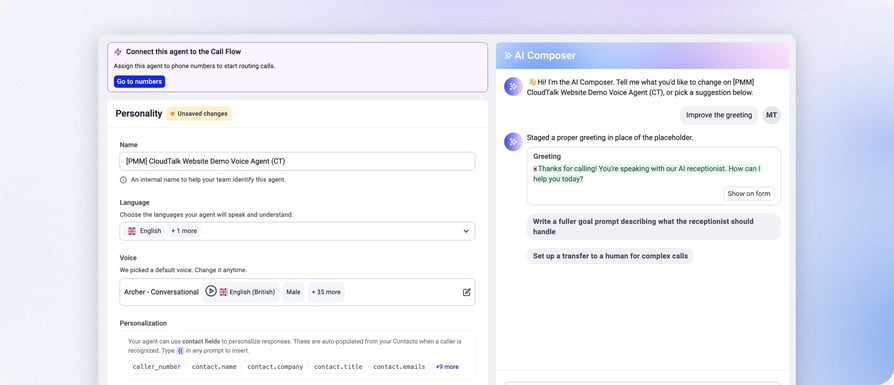
- The AI Receptionist answers calls 24/7 and routes callers by conversation instead of a keypad menu. Templates cover during-hours and after-hours reception, and AI Composer lets you edit an agent in plain words.
- Transfers to a person or group are safe transfers: the agent keeps the caller on the line until someone answers, and if nobody does, it offers to take a message.
- The Appointment Booking skill checks open slots in Google Calendar, Microsoft Outlook, Calendly and Cal.com, proposes times and books the appointment during the call.
- The phone system is part of the same platform: numbers in 160+ countries, plus IVR, skill-based routing, queues and ring groups from the Starter plan.
- The agent extracts call data and sends it to your CRM, helpdesk or automation tool by webhook. 95+ standard CRM, helpdesk and ATS integrations, including HubSpot, start on the Essential plan, with the Salesforce integration on Expert. When a known contact calls, their name and company fill into the agent's prompt from CloudTalk Contacts.
- Agents work in 70+ languages and detect the caller's language. You choose GPT, Claude or Gemini models, and the language decides whether ElevenLabs or Deepgram handles speech.
- Outbound calls start through the CloudTalk API, often from HubSpot, Zapier or Make, for follow-ups, reminders, confirmations and booking meetings.
The AI agents on our calls mean quotes don't get lost, and the client feels closer to us on a call, because most of them never come here physically.
Support Specialist, IDICO

What Is CloudTalk Missing?
- CloudTalk has no chat product. It covers calls, SMS and WhatsApp, so a team whose support runs on website chat will get more from Fin.
- Outbound takes more setup than inbound. The AI Receptionist starts from a template, while outbound calls need an API trigger or an automation tool, and multi-step work is what the AI Specialist plan's implementation service is for.
- Salon, clinic or field-service booking tools without a native connection need the webhook or the API.
- Each agent has one primary language plus optional secondary ones, and voice options vary by language. Test your own language and accent before you roll out.
- AI voice agents are an add-on billed separately from the phone plan, and the standard integrations start on Essential, not Starter.
What Is CloudTalk Best For?
CloudTalk fits voice-first sales and support teams that want an AI voice assistant, a phone system and CRM logging in one platform without engineers: covering after-hours calls, catching overflow when the line is busy, or booking inbound leads into a calendar. It isn't built for chat-first support, large enterprise contact center rollouts or teams that want to build their own voice stack.
How Much Do CloudTalk's AI Voice Assistants Cost?
CloudTalk's AI voice agents start at $0 for 50 minutes in your first month, then $99 a month for 200 minutes. The AI Specialist plan costs $349 a month for 1,000 minutes, and above 10,000 minutes a month, custom pricing goes as low as $0.15 per minute.
AI voice agents are an add-on: you buy them on top of a CloudTalk phone plan. Starter costs $25, Essential $29 and Expert $49 per user per month, billed annually.
Conversation Intelligence for your human agents' calls is an add-on: CI Basic at $9 or CI Plus at $19 per user per month. The 14-day trial includes 50 AI voice agent minutes.
AI Voice Assistant Cost
| Plan | Price | What's included | Overage |
|---|---|---|---|
| AI Receptionist (first month) | $0 | 50 minutes | n/a |
| AI Voice Agents | From $99/month | 200 minutes, white-glove onboarding | Charged from credit |
| AI Specialist | $349/month | 1,000 minutes, expert implementation and optimization, identity checks, payment handling, calendar sync, live and post-call analytics | Charged from credit |
| Custom | From $0.15/minute | Volume pricing above 10,000 minutes a month | Custom |
Flexible Pricing Plans to Scale with You
Compare our plans
What Do Customers Say About CloudTalk on G2 and Reddit?
CloudTalk's G2 reviews cover the whole platform, not only its AI voice agents. Reviewers praise reliable call quality and a clean interface, and the complaints are practical: a desktop call log that sometimes fails to load, manual contact imports and calling that stops when call credit runs out. Two first-page reviews mention AI features; one reviewer wrote on G2: "The AI reception feature is also valuable because it helps us capture leads even when we can’t answer the phone."
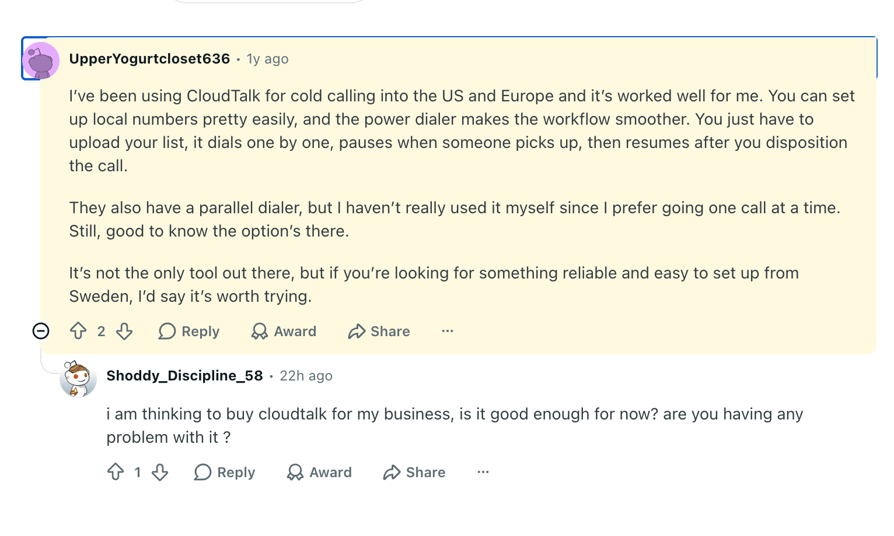
On Reddit, a user who cold-calls into the US and Europe said in r/agencies that local numbers were easy to set up and the power dialer made the workflow smoother. That comment is about calling, not the AI agents.
What Is CloudTalk's Rating on G2?
CloudTalk is currently rated 4.4/5 on G2 based on 1961+ reviews.
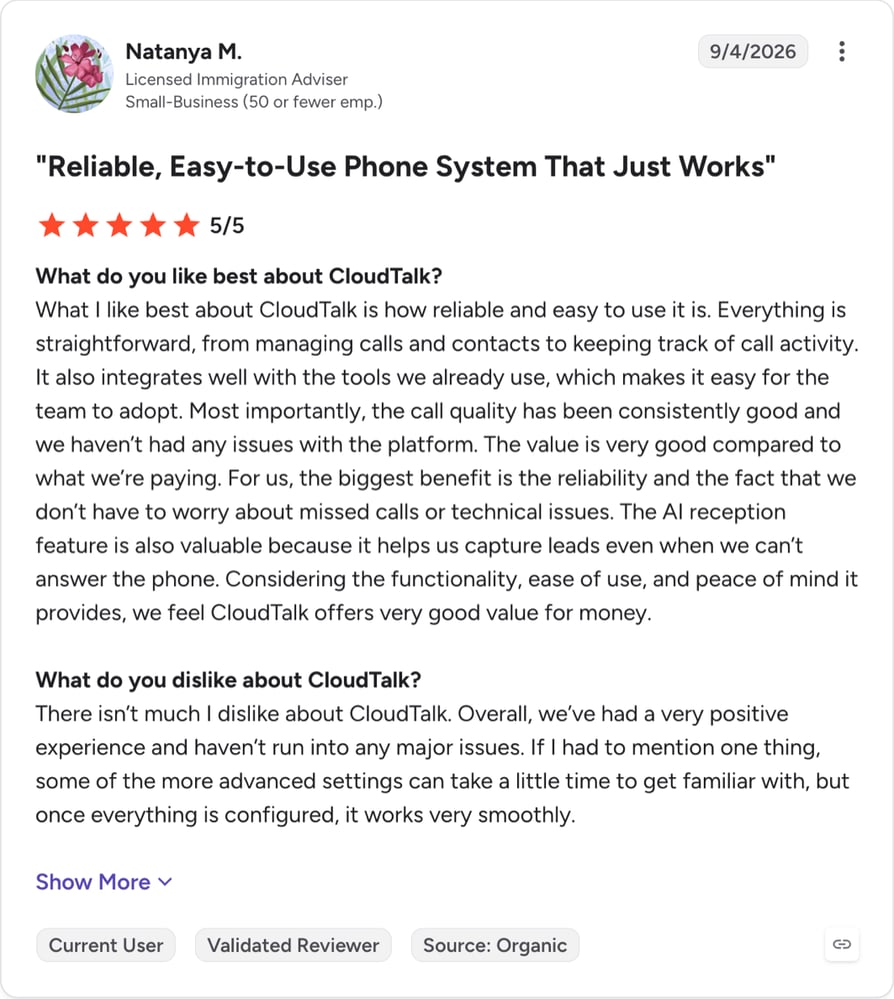
Pros and Cons of CloudTalk Based on G2 Reviews and Reddit
| Pros | Cons |
|---|---|
| Reliable call quality and a clean, easy interface | The desktop app's call log sometimes fails to load, so users switch to the web dashboard |
| AI reception captures leads when nobody can answer, and transcripts and summaries cut manual work | Contact import and list management take manual work |
| Integrations, recordings and analytics in one place, which helps sales coaching and call audits | Calling stops as soon as call credit runs out, and advanced settings take time to learn |
2. Dialpad: Best for Teams Wanting AI Voice Built Into a Unified Communications Platform
What Is Dialpad?
Dialpad is a unified communications and contact center platform, and its AI voice agents are now called Dialpad Resolve (formerly Dialpad AI Agents). It suits teams that already run Dialpad, or are buying phones and a contact center at the same time, and want AI agents in the same admin.
What Are the Key Features of Dialpad's AI Voice Assistants?
- Dialpad describes Resolve as voice and digital AI agents that understand intent, answer questions, take configured actions and trigger workflows.
- Resolve coordinates handoffs and escalations between AI agents and human agents.
- It runs on Dialpad's own phone system and contact center, so telephony is included.
- The App Marketplace connects to Salesforce, HubSpot, Zendesk, Zoho and ServiceNow, plus Google Workspace and Microsoft 365.
- Dialpad's AI help page lists its AI Agent in nine languages, including English, Spanish, French, German and Japanese.
What Is Dialpad Missing?
- You can't try the AI agents yourself. The phone system has a 14-day self-serve trial, but Resolve is sold through sales.
- Resolve pricing is quote-only, and the AI agents sit with the contact center offer rather than the entry phone plan.
- Dialpad's help pages document its newer agentic AI agents in English only so far, with other languages listed as coming soon.
What Is Dialpad Best For?
Dialpad fits mid-sized and larger teams that want AI voice agents, business phones and a contact center from one vendor, run by an IT or operations admin rather than developers. Teams that want published AI pricing and a self-serve trial can compare these Dialpad alternatives.
How Much Does Dialpad Cost?
Dialpad doesn't publish a price for Dialpad Resolve. According to Dialpad's pricing page, you buy a pool of AI Agent Credits, and a conversation is billable only when the AI retrieves information or takes an action such as scheduling, routing or an order lookup. The phone and contact center plans underneath have published prices, broken down plan by plan in our guide to Dialpad pricing.
| Plan | Price | What's included | Overage |
|---|---|---|---|
| Dialpad Resolve | Custom | Pool of AI Agent Credits | Billed per conversation where the AI does work |
| Connect Standard | $15/user/month annual ($27 monthly) | Business phone system | n/a |
| Connect Pro | $25/user/month annual ($35 monthly) | Business phone system | n/a |
| Support Essentials | From $80/user/month annual ($95 monthly) | Contact center | n/a |
| Support Advanced | $115/user/month annual ($135 monthly) | Contact center | n/a |
What Do Customers Say About Dialpad on G2 and Reddit?
Dialpad Resolve has no G2 listing, so the rating below is for Dialpad Support, the contact center product the AI agents sit in. Its reviews cover the contact center and AI Agent Assist for human reps rather than Resolve, and some review Dialpad's own support team. Reviewers like the real-time transcripts and agent assist; the complaints are call quality at busy times and a learning curve on routing.
What Is Dialpad's Rating on G2?
Dialpad Support is currently rated 4.4/5 on G2 based on 700+ reviews.
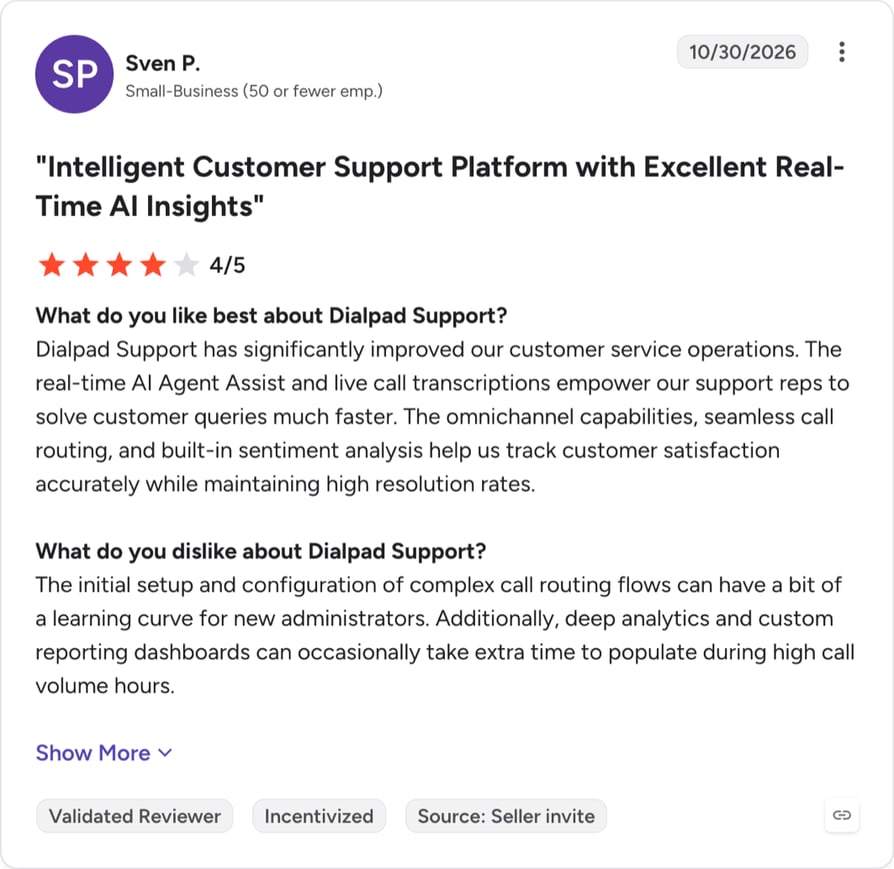
Pros and Cons of Dialpad Based on G2 Reviews and Reddit
| Pros | Cons |
|---|---|
| Real-time AI Agent Assist and live transcripts help reps answer faster | Inconsistent call quality and audio drops at busy times or on weak internet |
| Call history and interaction tracking make follow-ups easier | Slow replies from Dialpad's support team and a higher price than one reviewer hoped |
| Routing, omnichannel and sentiment analysis on one platform | Complex routing setup has a learning curve, and reporting slows at high volume |
3. RingCentral: Best for Companies Already on RingCentral UCaaS
What Is RingCentral?
RingCentral is a UCaaS provider, and RingCentral AI Receptionist (AIR) is its inbound AI voice assistant. AIR works on its own with your existing phone system or bundled with RingEX.
What Are the Key Features of RingCentral's AI Voice Assistants?
- AIR answers calls 24/7, handles FAQs, schedules appointments, captures leads and sends SMS follow-ups, and it now answers text messages too.
- It routes calls by names, locations and keywords and hands off to a person with a call summary.
- It offers multiple voices and languages and switches language during the call; RingCentral doesn't publish a language count.
- It updates CRMs including Salesforce, HubSpot and Zoho, connects to calendars and sends confirmation texts.
What Is RingCentral Missing?
- The entry plans include 100 minutes. After that, RingCentral charges $0.50 per minute, billed in 30-second increments.
- The standalone version is sold only in the US and Canada; in the UK, Australia and the EU, AIR is an add-on to a RingCentral phone plan.
- The product is a receptionist built for inbound calls; the pages we checked don't cover outbound AI calling.
What Is RingCentral Best For?
RingCentral AIR fits small businesses, and teams already on RingEX, that want an inbound AI receptionist at a low monthly entry price without changing phone systems. Teams that also need outbound AI calls can compare these RingCentral alternatives.
How Much Does RingCentral Cost?
RingCentral AI Receptionist pricing starts at $49 a month for 100 minutes, according to RingCentral's AI Receptionist pricing page. A month with 400 minutes of calls costs $49 plus 300 minutes at $0.50, or $199. Our RingCentral pricing guide covers the RingEX plans underneath.
| Plan | Price | What's included | Overage |
|---|---|---|---|
| AI Receptionist (standalone) | $49/month | 100 minutes | $0.50/minute, 30-second increments |
| AIR + RingEX Core | $39/month for AIR + $30/month for RingEX Core | 100 minutes plus a RingEX phone line | $0.50/minute, 30-second increments |
What Do Customers Say About RingCentral on G2 and Reddit?
RingCentral's ratings split by platform: 4.2/5 for RingEX on G2 against 2.0/5 from 1,800+ Trustpilot reviews, which cover RingCentral as a company. RingEX reviewers like the AI call summaries and HD call quality, and they flag summaries that miss tasks and a price that climbs with seats.
On Reddit, one AIR customer wrote in r/RingCentral that you can remove the add-on without charge only within the first 30 days or at renewal, a term they found in the documents they signed.
What Is RingCentral's Rating on G2?
RingCentral RingEX is currently rated 4.2/5 on G2 based on 1,550+ reviews.
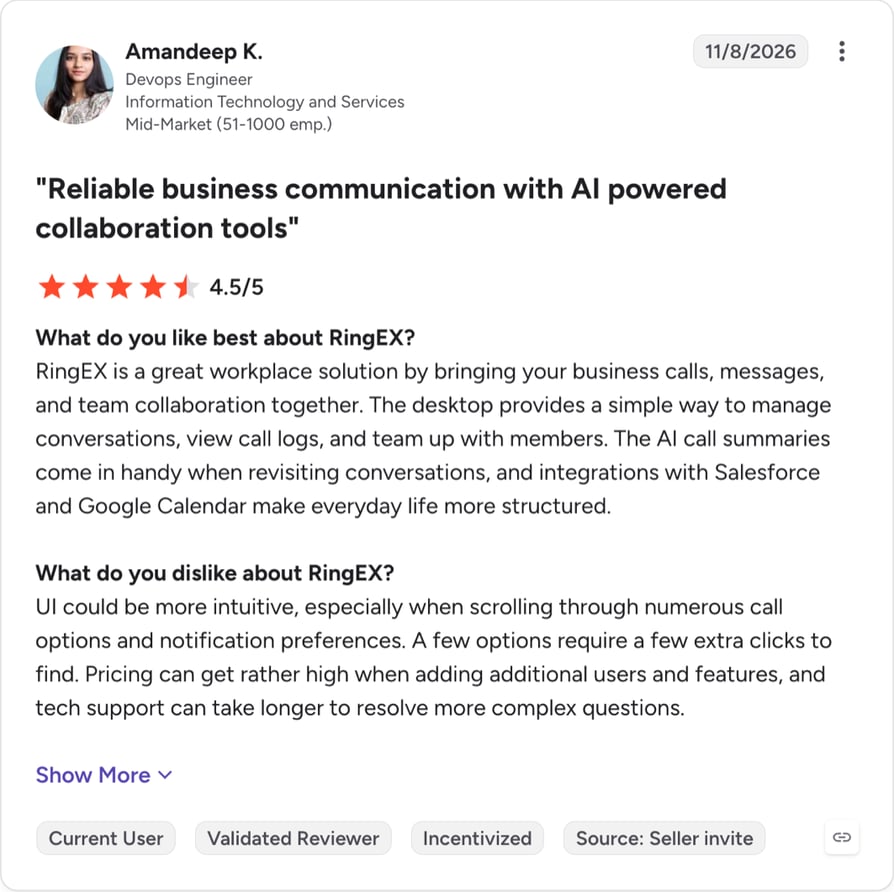
Pros and Cons of RingCentral Based on G2 Reviews and Reddit
| Pros | Cons |
|---|---|
| AI call summaries save time on follow-up | AI summaries sometimes miss tasks or need editing, and some teams barely use the AI |
| Calls, messaging and video in one app | The price climbs as you add seats and features |
| Consistent HD call quality | Settings feel buried, routing setup is slow and tech support can be slow |
4. Synthflow AI: Best No-Code Builder for Voice Assistants
What Is Synthflow AI?
Synthflow describes itself as "an enterprise conversational AI platform for AI voice agents, with telephony, integrations, security review, and launch support scoped into one contract." You build agents without code, and Synthflow sells the platform to mid-market and enterprise teams on an annual agreement.
What Are the Key Features of Synthflow AI's AI Voice Assistants?
- No-code agent building, with launch support included in the contract.
- Telephony through Synthflow Native Telephony, SIP trunking or approved enterprise telephony, so the agent gets its own numbers.
- Integrations with HubSpot, Salesforce, Cal.com, Five9, Zoom and Zapier, plus webhooks and an API.
- White-label workspaces for BPOs and software platforms.
- Synthflow's docs list about 35 languages, with a multilingual mode that switches between 10 of them, including English, Spanish, French and German.
What Is Synthflow AI Missing?
- Synthflow has no free plan, no trial and no per-minute rate, so you can't test it before a sales process.
- Every customer signs an annual contract, which is a big commitment for a small team.
- It gives the AI agent numbers but no phone system for your human team.
What Is Synthflow AI Best For?
Synthflow fits mid-market and enterprise teams, BPOs and software companies that want a managed, no-code voice agent rollout with white-label options and a vendor that handles launch. Smaller teams without an annual budget can compare these Synthflow alternatives.
How Much Does Synthflow AI Cost?
Synthflow pricing is quote-based. According to Synthflow's pricing page, it has "no free plan or trial and no rate by the minute"; customers sign an annual enterprise agreement that scopes telephony, integrations, security review and launch support. Our Synthflow pricing guide tracks how the model has changed.
What Do Customers Say About Synthflow AI on G2 and Reddit?
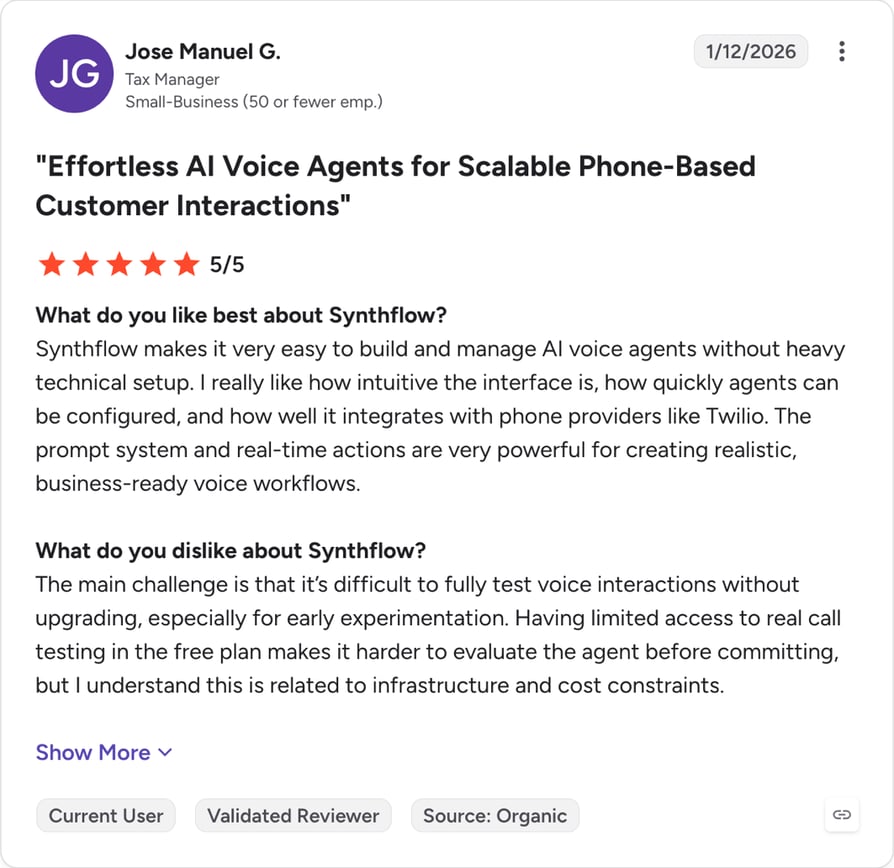
Synthflow's G2 reviewers like the guided no-code setup and natural voices; the complaints are testing that burns credit minutes, the cost of bringing your own phone system and limited support for international accents.
What Is Synthflow AI's Rating on G2?
Synthflow AI is currently rated 4.5/5 on G2 based on 1,000+ reviews.
Pros and Cons of Synthflow AI Based on G2 Reviews and Reddit
| Pros | Cons |
|---|---|
| Quick, guided no-code agent setup | Testing uses up credit minutes |
| Natural voices with low latency | Pricing, especially when you bring your own phone system |
| Ready-made integrations, including Twilio and CRMs through webhooks or the API | Limited support for international callers and accents, and limited advanced customization |
5. Retell AI: Best for Developer Teams Building Low-Latency Voice Assistants
What Is Retell AI?
Retell AI is a developer platform with a visual builder and an API, billed by the minute with no contract. It suits technical teams that want to build and tune their own voice agents and pay only for the minutes they use.
What Are the Key Features of Retell AI's AI Voice Assistants?
- Call transfer, appointment booking, a knowledge base, IVR navigation, batch calls, post-call analysis and AI QA.
- Telephony through Retell numbers, Twilio, Telnyx or your own carrier over SIP.
- Two-way contact sync with Salesforce, HubSpot, Dynamics 365, GoHighLevel and Zoho, plus tools for Zendesk and Cal.com.
- Branded caller ID and verified phone numbers that Retell sells to keep outbound calls from being flagged as spam.
- 50+ languages, depending on the voice and speech providers you pick, and 20 free concurrent calls on pay-as-you-go.
What Is Retell AI Missing?
- The per-minute price ranges from $0.07 to $0.31, and the model, voice and telephony you choose set where you land.
- Your team builds, tests and maintains the agent; there's no finished receptionist to switch on.
- Retell gives the agent numbers but no phone system for your human team.
What Is Retell AI Best For?
Retell AI fits product and engineering teams, and agencies, that want per-minute pricing, native CRM sync and full control over prompts and call flows without signing a contract. Our CloudTalk vs. Retell AI comparison covers teams that want a finished agent instead.
How Much Does Retell AI Cost?
Retell AI pricing starts at $0.07 per minute and goes up to $0.31, depending on the language model, voice and telephony you pick, according to Retell's pricing page. New accounts get $10 in free credits.
| Plan | Price | What's included | Overage |
|---|---|---|---|
| Pay-as-you-go | $0.07 to $0.31/minute | $10 free credits, 20 concurrent calls, no commitment | Pay per minute |
| Components (examples) | Voice infrastructure $0.055/minute; voices from $0.015/minute (ElevenLabs voices $0.04 to $0.10) | Priced per layer | Pay per minute |
| Enterprise | Custom | No cap on concurrent calls | Custom |
What Do Customers Say About Retell AI on G2 and Reddit?
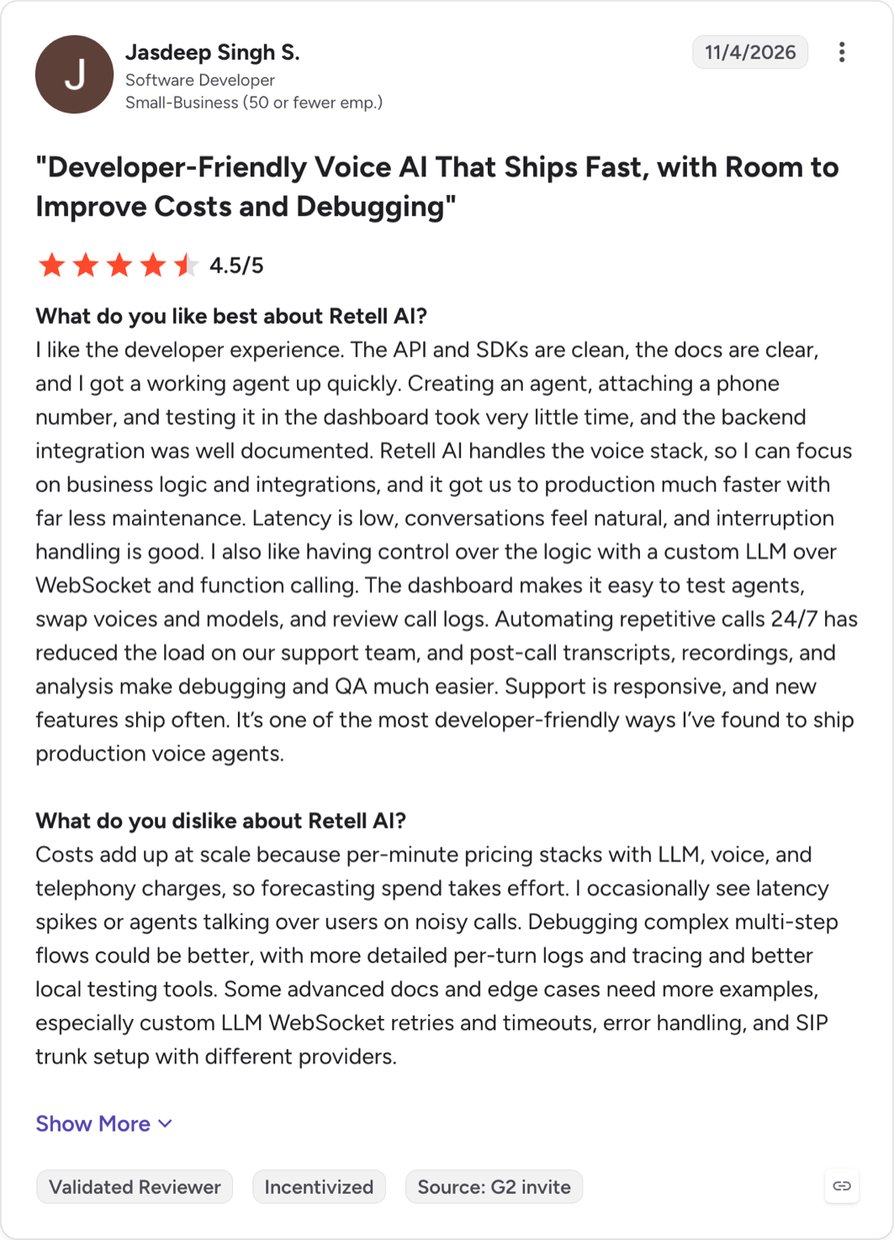
Retell AI's G2 reviewers are mostly developers. They like the API and how the agent handles interruptions, and they warn that model, voice and telephony charges stack and are hard to forecast. We left out three first-page reviews that G2 labels as written by a business partner or competitor.
What Is Retell AI's Rating on G2?
Retell AI is currently rated 4.8/5 on G2 based on 2,650+ reviews.
Pros and Cons of Retell AI Based on G2 Reviews and Reddit
| Pros | Cons |
|---|---|
| Developer-friendly API, SDKs and docs, so a working agent comes fast | Per-minute costs stack with model, voice and telephony charges and are hard to forecast |
| Natural conversations that handle interruptions well | Misreads callers when the conversation goes off script, so prompts need tuning |
| Quick setup, including HubSpot and telephony integrations | Thin debugging and logs for complex flows |
6. Vapi: Best for Developers Wanting Full Control Over the Voice Stack
What Is Vapi?
Vapi is an API-first developer platform where you choose the speech-to-text, language model and voice providers for each agent. It suits developers who want to control every layer and pay each provider at cost.
What Are the Key Features of Vapi's AI Voice Assistants?
- Pick a provider for each layer, such as Deepgram for transcription, OpenAI for the model and ElevenLabs for the voice, billed at cost.
- Telephony through Vapi phone numbers (one free, five on Core), Vapi SIP, or Twilio, Vonage and Telnyx.
- Multilingual agents with automatic language detection.
- Native tools for GoHighLevel, Google Calendar and Slack; other systems connect through API Request or function tools.
- A BAA and HIPAA-eligible data handling as a $2,000-a-month add-on.
What Is Vapi Missing?
- Your total per-minute cost adds Vapi's hosting fee, the model, voice, transcriber and carrier, so you need to price each layer.
- HubSpot, Salesforce and most other CRMs need custom API work.
- HIPAA coverage costs $2,000 a month on top of usage.
What Is Vapi Best For?
Vapi fits engineering teams that want to choose and swap every model in the stack, run their own telephony, and treat the voice agent as part of their product. Teams without developers to spare can compare these Vapi alternatives.
How Much Does Vapi Cost?
Vapi pricing starts at $0.05 per minute for hosting, with the model, voice and transcriber passed through at cost, according to Vapi's pricing page. Adding up the provider ranges on that page gives roughly $0.09 to $0.14 per inbound minute on Twilio.
| Plan | Price | What's included | Overage |
|---|---|---|---|
| Usage | $0.05/minute hosting + providers at cost | $5 free credits, 4 concurrent calls | Pay per minute |
| Core | $29/month | Success package, 5 Vapi numbers | Pay per minute |
| Pro | 10% of the Vapi hosting fee, $999/month minimum | Success package | Pay per minute |
| Premier | Custom | Success package | Custom |
| HIPAA add-on | $2,000/month | BAA, HIPAA-eligible data handling | n/a |
What Do Customers Say About Vapi on G2 and Reddit?
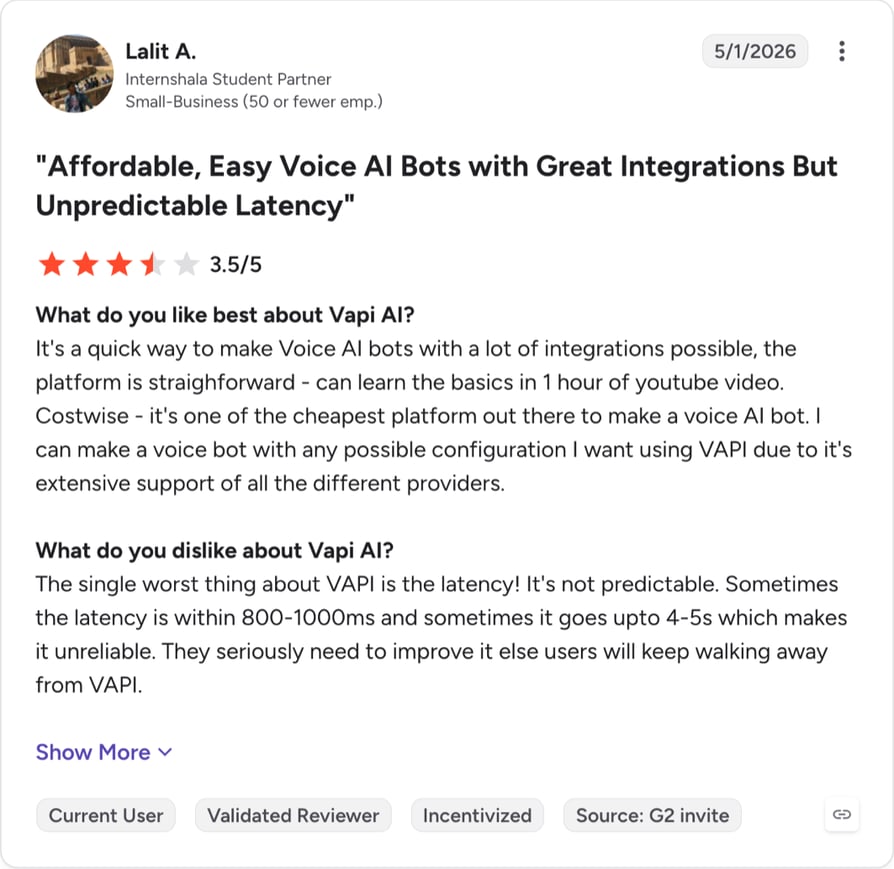
G2 has two Vapi listings with just 3 reviews each, so treat both ratings as a thin signal. Reviewers call it easy to start, and one calls it among the cheapest ways to build a voice bot. Two report unpredictable response delays, and one says the dashboard assumes developer knowledge.
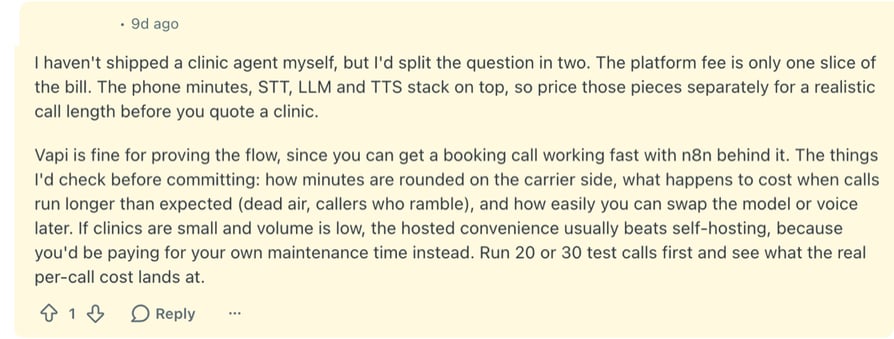
On r/AI_Agents, one developer warned that "the platform fee is only one slice of the bill," because phone minutes, speech-to-text, the model and the voice stack on top. Another pointed out that a clinic booking agent hears patient details, so Vapi's $2,000-a-month HIPAA add-on applies.
What Is Vapi's Rating on G2?
Vapi is rated 4.2/5 on its "Vapi AI" G2 listing and 3.0/5 on its "Vapi" G2 listing, each based on just 3 reviews.
Pros and Cons of Vapi Based on G2 Reviews and Reddit
| Pros | Cons |
|---|---|
| Easy setup; an agent runs without much code | Unpredictable response delays and text-to-speech lag |
| One of the cheapest ways to build a voice bot, according to one reviewer | The dashboard assumes developer knowledge |
| Developer API, debug interface and docs | One reviewer reports an overnight HIPAA price rise and no reply from support; mixed-language speech gets misread |
7. Bland AI: Best for Large-Scale Outbound Calling Automation
What Is Bland AI?
Bland says it "owns the full voice AI stack: telephony, speech-to-text, language model, text-to-speech, and pathway orchestration." It's a developer platform built for high call volumes, and it suits technical teams running large outbound and inbound programs.
What Are the Key Features of Bland AI's AI Voice Assistants?
- One all-in per-minute rate, with "no token charges, no model-provider pass-throughs."
- Built-in tools for Cal.com, Salesforce and Slack, a HubSpot app in the HubSpot Marketplace, custom API tools and the option to bring your own Twilio.
- 40+ languages out of the box, according to Bland's docs.
- Plan-based rate limits: 10 concurrent calls and 100 calls a day on Start, 50 concurrent and 2,000 a day on Build.
- Forward Deployed Engineers who build the first agent for enterprise customers.
What Is Bland AI Missing?
- Daily call caps on the lower plans limit volume until you pay the $299 monthly platform fee.
- It's API-first, so a non-technical team will need developer help beyond simple use cases.
- Outbound consent, disclosure and do-not-call compliance sit with you, as with any outbound tool.
What Is Bland AI Best For?
Bland AI fits technical teams running reminder, follow-up or qualification campaigns at volume that want one per-minute rate and their own call logic. Teams that want outbound AI calls without an API project can compare these Bland AI alternatives.
How Much Does Bland AI Cost?
Bland AI pricing starts at $0.14 per minute of talk time with no platform fee, according to Bland's pricing page. The Build plan lowers the rate to $0.12 per minute for a $299 monthly fee.
| Plan | Price | What's included | Overage |
|---|---|---|---|
| Start | $0.14/minute, $0 platform fee | No card required, an inbound number, 10 concurrent calls, 100 calls a day | Transfers $0.05/minute |
| Build | $0.12/minute + $299/month | 50 concurrent calls, 2,000 calls a day | Transfers $0.04/minute |
| Enterprise | Custom | Forward Deployed Engineers | Custom |
What Do Customers Say About Bland AI on G2 and Reddit?
Bland AI has just 11 G2 reviews, so read its 5/5 as a thin signal; we left out one more that G2 labels as written by a partner or competitor. Reviewers praise low latency and a responsive engineering team, and one says it took 2 to 4 weeks to learn to build complex use cases.
What Is Bland AI's Rating on G2?
Bland AI is currently rated 5/5 on G2 based on just 11 reviews.
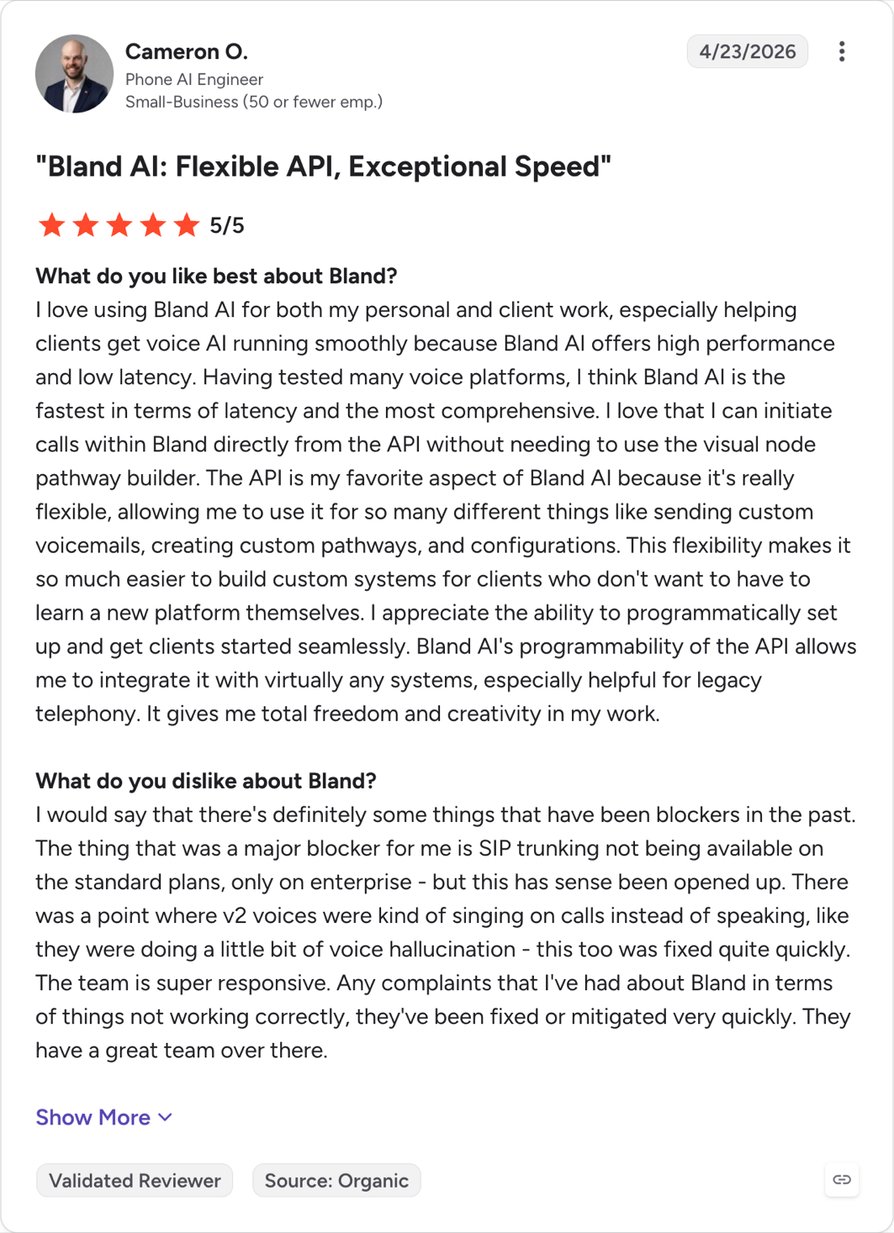
Pros and Cons of Bland AI Based on G2 Reviews and Reddit
| Pros | Cons |
|---|---|
| Very low latency, so calls feel natural | Hard to get started; one reviewer needed 2 to 4 weeks before building complex use cases |
| Pathways handle complex inbound and outbound scenarios predictably | Hard to see what happens under the hood, so tuning takes rounds of trial and error |
| Responsive engineering and support team | SIP trunking was enterprise-only at one point, and one reviewer hit voice glitches in an older version |
8. ElevenLabs Agents: Best for Voice Quality and Language Coverage
What Is ElevenLabs Agents?
ElevenLabs is a voice AI company, and its agents platform (ElevenAgents on its pricing page) adds an agent builder to its voice library. It suits teams that care most about how the agent sounds and how many languages it speaks.
What Are the Key Features of ElevenLabs Agents' AI Voice Assistants?
- 10,000+ voices to choose from, or voice cloning.
- Real-time language detection and switching across 90+ languages, according to ElevenLabs.
- A workflow builder, knowledge base and web widget.
- Telephony through Twilio or SIP; integrations include Zendesk and Stripe, with Salesforce and other apps through connectors.
What Is ElevenLabs Agents Missing?
- Telephony and CRM are integrations you set up yourself; there's no phone system.
- Each plan caps its minutes, so you'll move up a tier as volume grows.
- A HIPAA BAA is available only on Enterprise.
What Is ElevenLabs Agents Best For?
ElevenLabs Agents fits teams with some technical help that need a natural voice in many languages, such as multilingual support lines, and are happy to connect their own telephony.
How Much Does ElevenLabs Agents Cost?
ElevenLabs Agents pricing starts at $0 for 15 minutes of calls, and paid plans start at $6 a month for 75 minutes, according to ElevenLabs' agents pricing page (monthly billing). Our ElevenLabs pricing guide explains how the minute caps work for AI calling.
| Plan | Price | What's included |
|---|---|---|
| Free | $0/month | 15 minutes, 4 concurrent calls |
| Starter | $1 first month, then $6/month | 75 minutes |
| Creator | $11 first month, then $22/month | 275 minutes |
| Pro | $99/month | 1,238 minutes |
| Scale | $299/month | 3,738 minutes, 3 seats |
| Business | $990/month | 12,375 minutes |
| Enterprise | Custom | BAAs for HIPAA customers |
What Do Customers Say About ElevenLabs Agents on G2 and Reddit?
ElevenLabs Agents has no G2 listing of its own, and every first-page review on the main ElevenLabs listing is about text-to-speech and voiceovers, not phone agents. The themes below describe the voice engine the agents run on.
What Is ElevenLabs Agents' Rating on G2?
ElevenLabs is currently rated 4.5/5 on G2 based on 1,250+ reviews of its main listing.
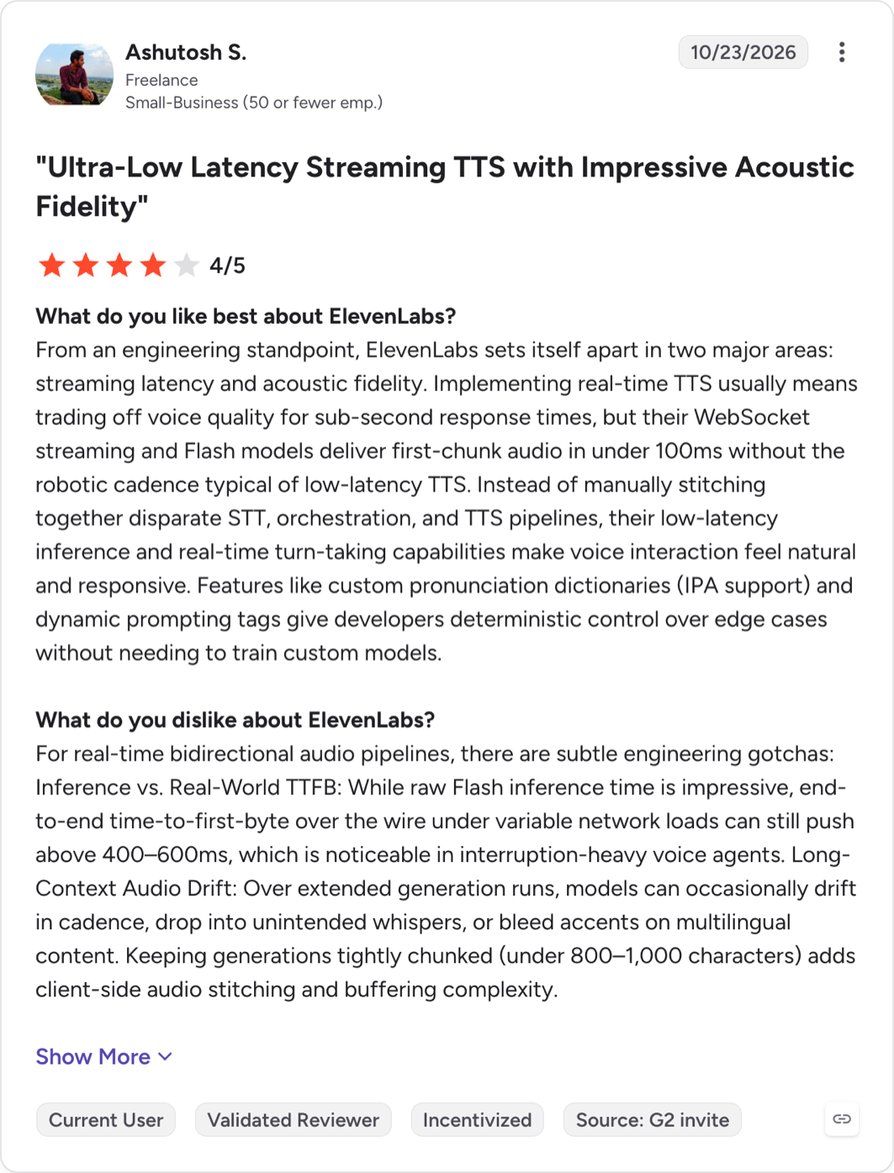
Pros and Cons of ElevenLabs Agents Based on G2 Reviews and Reddit
| Pros | Cons |
|---|---|
| Human-sounding voices with natural pauses and intonation | Credits run out fast when you iterate |
| Low-latency streaming API for real-time pipelines | Mispronounces jargon, acronyms and citations |
| Many voices and languages, with easy regeneration | One developer measured 400 to 600 ms end-to-end latency, enough to notice when callers interrupt |
9. PolyAI: Best for Enterprises Needing Custom Conversational Voice AI
What Is PolyAI?
PolyAI says it "builds dialog agents that handle your most critical enterprise conversations, resolving them without escalation." Its managed Agentic Dialog Platform is sold to enterprises through a demo and sales process, and it now also sells a self-serve model API.
What Are the Key Features of PolyAI's AI Voice Assistants?
- A managed platform with telephony and tooling, built with PolyAI's team.
- Contact center integrations with Genesys Cloud (bring your own carrier), Twilio and Amazon Connect.
- Handoff and knowledge integrations with Salesforce and Zendesk, and handoff into NICE CXone, Five9 and Webex.
- 45 languages as standard, according to PolyAI's FAQ.
- The new Dialog-RSN-1 API at 2 cents per connected minute, without telephony or orchestration.
What Is PolyAI Missing?
- The platform has no public price and no self-serve trial, so expect a sales cycle.
- The self-serve API is a model, not a finished voice assistant; telephony and orchestration aren't included.
- It isn't built for small teams.
What Is PolyAI Best For?
PolyAI fits large enterprises in high-volume service lines that want a vendor to design, build and run custom voice agents inside their existing contact center. Mid-sized teams that want a finished agent can compare these PolyAI alternatives.
How Much Does PolyAI Cost?
PolyAI pricing for the managed platform is quote-based. According to PolyAI's pricing page, the separate Dialog-RSN-1 API costs 2 cents per connected minute, with text tokens billed separately and telephony not included.
| Plan | Price | What's included | Overage |
|---|---|---|---|
| Agentic Dialog Platform | Quote | Managed voice agents, telephony, tooling | Set in the contract |
| Dialog-RSN-1 API | $0.02/connected minute + text tokens | Model API only | Pay per minute |
What Do Customers Say About PolyAI on G2 and Reddit?
PolyAI has just 12 G2 reviews, and only one is from the last year; the rest date from 2022 and 2023, and several read like customer case studies. Reviewers praise a human-like voice that callers respond to, and they mention slow moments and no voice analytics on caller requests.
What Is PolyAI's Rating on G2?
PolyAI is currently rated 5/5 on G2 based on just 12 reviews.
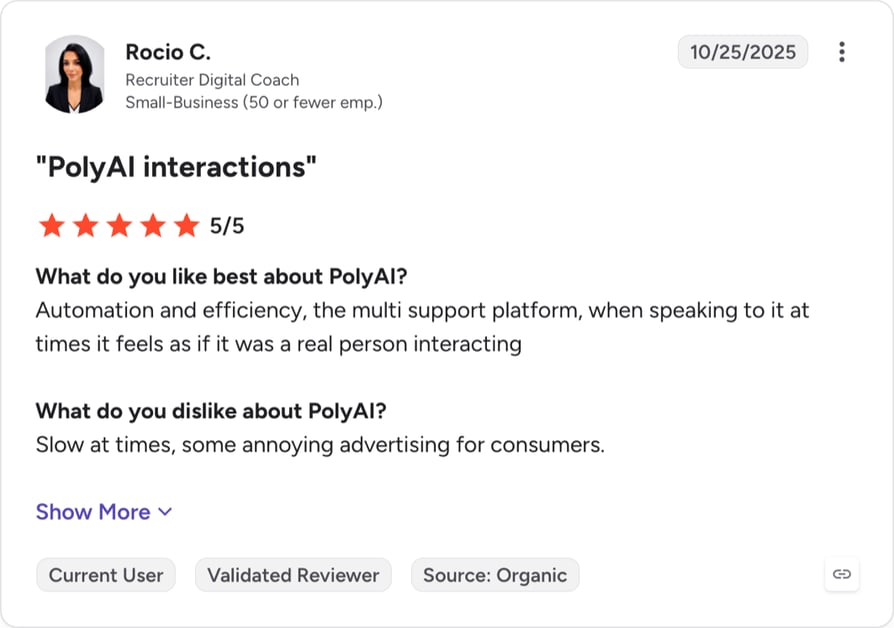
Pros and Cons of PolyAI Based on G2 Reviews and Reddit
| Pros | Cons |
|---|---|
| Human-like voice quality that callers respond to | Slow at times |
| Fast deployment with a supportive team | No voice analytics on caller requests |
| Takes call volume off staff, according to hospitality reviewers | Some callers who aren't used to AI find the assistant rude |
10. Five9: Best for Large Enterprise Contact Centers
What Is Five9?
Five9 is an enterprise cloud contact center with Intelligent Virtual Agents (IVA) and agentic AI. It suits large contact centers that want virtual agents inside the same platform as their human agents, dialers and analytics.
What Are the Key Features of Five9's AI Voice Assistants?
- IVA self-service across voice, web chat, SMS and WhatsApp, blending live and digital agents.
- Text-to-speech in more than 50 languages and speech recognition in more than 130 languages and dialects, according to Five9's IVA languages datasheet.
- Natural language engines including Google Dialogflow and Amazon Lex.
- A full contact center around the IVA: blended inbound and outbound, dialer, recording, workforce and quality management, AI Agent Assist and AI Summaries.
- CRM and UC adapters; Five9's pricing page doesn't name the CRMs.
What Is Five9 Missing?
- Everything except the digital-only bundle is quote-based.
- IVA is an add-on, and Five9 says "additional usage-based pricing may apply."
- There's no self-serve trial, and rollouts are enterprise projects.
What Is Five9 Best For?
Five9 fits large contact centers with hundreds of agents that want virtual agents, dialers and workforce tools from one enterprise vendor. Teams that want published prices and a faster rollout can compare these Five9 alternatives.
How Much Does Five9 Cost?
Five9 pricing is quote-based for voice. According to Five9's pricing page, the Digital bundle costs $119 per seat per month for digital channels only, other bundles need a quote, and IVA is an AI add-on with possible usage-based fees. Our Five9 pricing guide covers what buyers report paying for the voice bundles.
| Plan | Price | What's included | Overage |
|---|---|---|---|
| Digital | $119/seat/month | Digital channels only | n/a |
| Other bundles | Quote | Voice and blended contact center | Quote |
| IVA (AI add-on) | Quote | Intelligent Virtual Agent | Usage-based pricing may apply |
What Do Customers Say About Five9 on G2 and Reddit?
Five9's G2 rating covers its contact center platform, not IVA: none of the first-page reviews discuss its AI agents. Reviewers like having calls, email and chat in one place and skills-based routing, and they report complex administration and dropped calls. Five9 holds 3.6/5 from 700+ reviews on Trustpilot.
What Is Five9's Rating on G2?
Five9 is currently rated 4.1/5 on G2 based on 645+ reviews.
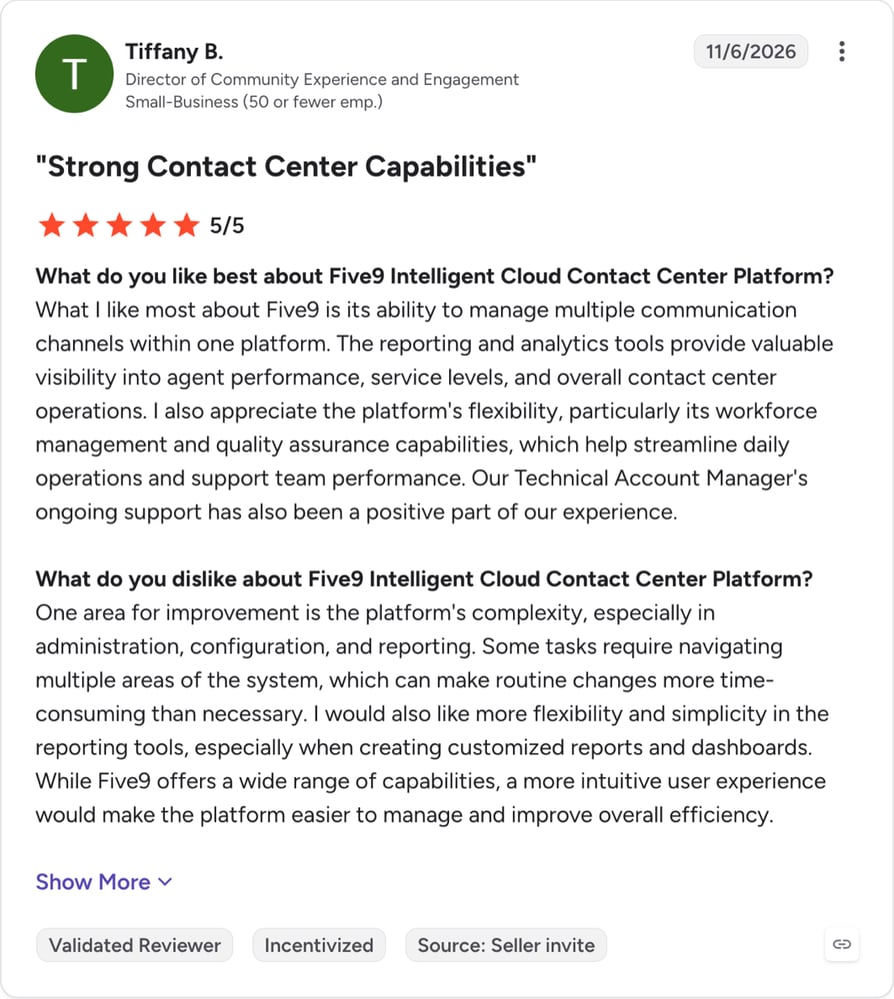
Pros and Cons of Five9 Based on G2 Reviews and Reddit
| Pros | Cons |
|---|---|
| Calls, email and chat managed in one platform | Complex administration, configuration and reporting |
| Skills-based routing and real-time agent monitoring | Dropped calls, lag and headset audio problems |
| Smooth onboarding for agents | Thin chat reporting on the supervisor dashboard |
11. Fin by Intercom: Best for Chat-First Support Teams Adding Voice
What Is Fin by Intercom?
Fin is Intercom's AI customer service agent, and Fin Voice puts the same agent on the phone. It suits support teams that already run Fin on chat or email and want one AI agent across channels.
What Are the Key Features of Fin's AI Voice Assistants?
- Fin Voice resolves calls end to end, according to Fin, with call routing, brand-specific deployments and outbound calling listed on its voice page.
- Fin works natively on the Intercom helpdesk or on other helpdesks, including Freshdesk, Salesforce, Zendesk and HubSpot.
- One agent covers voice, chat, email, social and Slack.
- Fin Voice connects to your existing telephony rather than providing a phone system.
What Is Fin Missing?
- Fin Voice is sold only through sales; the 14-day trial covers Fin's text agent.
- A voice outcome costs $1.99, twice the $0.99 text outcome.
- Your telephony comes from your carrier or contact center, and Fin doesn't publish a voice language list on the pages we checked.
What Is Fin Best For?
Fin fits support teams that already handle most tickets on chat and email with Fin or Intercom and want the same knowledge and workflows answering the phone.
How Much Does Fin Cost?
Fin Voice costs $1.99 per voice outcome through sales, according to Fin's pricing page. You pay only when Fin resolves the call, so your bill tracks resolutions rather than minutes. Our Fin pricing guide shows how outcome billing adds up at volume.
| Plan | Price | What's included | Overage |
|---|---|---|---|
| Fin Voice | $1.99/voice outcome | AI voice agent, through sales | Per outcome |
| Fin (text) | $0.99/outcome | Chat, email and other text channels | Per outcome |
| Intercom helpdesk | $19/seat/month | Helpdesk seat | n/a |
What Do Customers Say About Fin on G2 and Reddit?
Fin's G2 reviews describe the chat and support agent; none on the first page mention Fin Voice. Reviewers like how many simple tickets it resolves, and they report bugs, wrong answers and slow pickup of help-doc changes.
What Is Fin's Rating on G2?
Fin is currently rated 4.5/5 on G2 based on 3,950+ reviews.
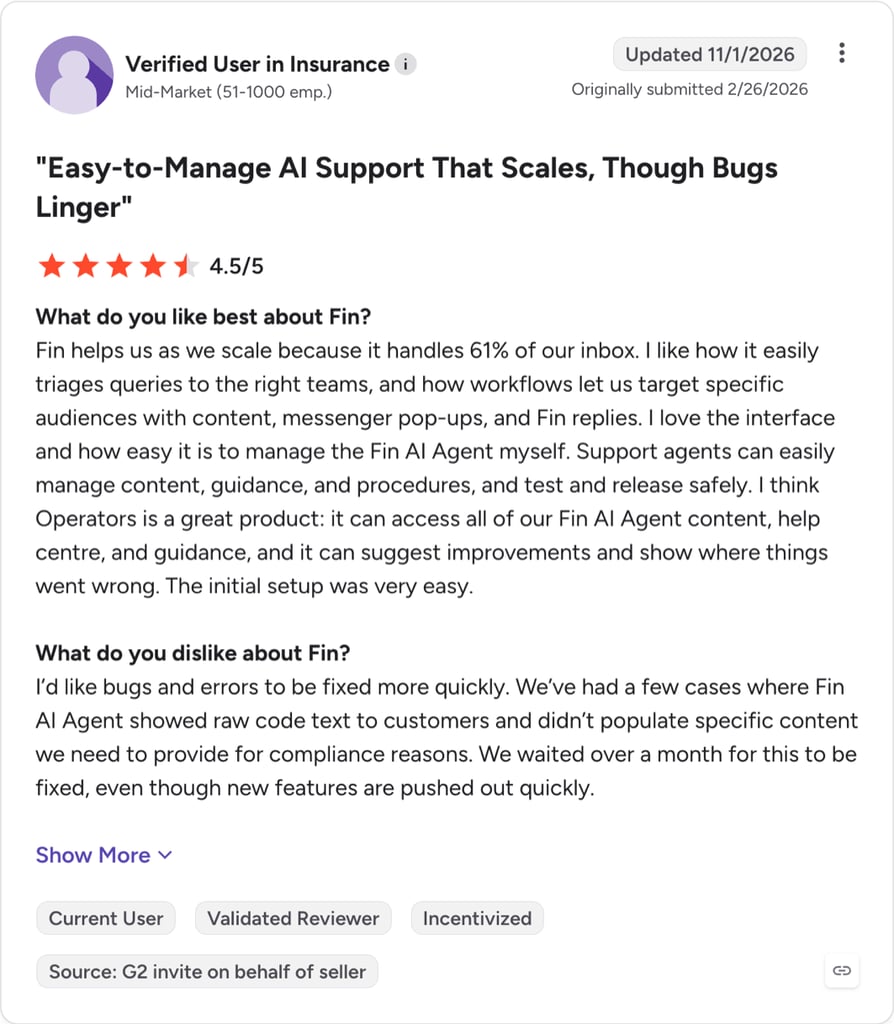
Pros and Cons of Fin Based on G2 Reviews and Reddit
| Pros | Cons |
|---|---|
| Resolves a large share of simple tickets (one team: 61% of its inbox) | Bugs and made-up answers, with slow fixes |
| Fast, accurate answers from help-center content | Slow to pick up help-doc changes, so it can repeat outdated answers |
| Easy to manage, with flexible workflows and routing | Repeats itself before a handoff, and complex or niche requests need more tuning |
How I Reviewed the Best AI Voice Assistants
I reviewed 30 AI voice assistants over a few weeks against vendor pricing pages, product docs and G2 data. I tested the six tools with a self-serve trial on real calls: CloudTalk, RingCentral AI Receptionist, Retell AI, Vapi, Bland AI and ElevenLabs Agents. Dialpad Resolve, Synthflow, PolyAI, Five9 and Fin Voice are sold through sales, so I reviewed those from their documentation.
Each tested tool got the same 10 calls:
- 01A new caller with a simple question.
- 02An interruption mid-sentence, to see whether the agent stops and listens.
- 03A hard name to spell back.
- 04A strong accent.
- 05A switch of language mid-call.
- 06A booking.
- 07A request the agent can't handle.
- 08A transfer to a person.
- 09An after-hours call.
- 10A CRM check afterwards: did the call, summary and fields land on the right record?
I scored every tool on six criteria, in this order: how natural it sounds on a real call; inbound and outbound support; telephony and CRM connections; languages; handoff and compliance; and how openly it publishes prices.
CloudTalk is our product. I ranked it #1 for voice-first teams and listed what it lacks in its own entry.
Which Type of AI Voice Assistant Do You Need?
You need a telephony platform with AI if a support or sales lead will run the assistant, a developer platform if engineers will build it, and an enterprise suite if you're rolling out across a large contact center. A no-code builder and a chat-first support platform cover two narrower cases.
Start with direction. Telephony platforms handle inbound reception best, and developer platforms such as Bland AI are built to dial thousands of numbers a day.
- Telephony platforms with AI (CloudTalk, Dialpad, RingCentral). The assistant lives inside the phone system, so numbers, routing, transfers and recording are already there, and setup is configuration rather than code. CloudTalk is voice-first: its AI voice agents sit on a phone system that covers calls, SMS and WhatsApp, with no chat channel.
- No-code builders (Synthflow). You design the agent visually instead of writing code. Synthflow now sells this as a managed enterprise contract with its own telephony, and it has no self-serve trial.
- Developer platforms (Retell AI, Vapi, Bland AI, ElevenLabs Agents). These cost the least per minute and give you the most control, but your team builds the agent, connects the CRM and maintains the prompts. If you searched for how to build a voice AI agent, start with Retell AI or Vapi.
- Omnichannel support platforms (Fin by Intercom). These are chat-first, with voice added, so one agent answers chat, email and phone from the same knowledge base.
- Enterprise suites (PolyAI, Five9). These bring scale, security reviews and custom builds, along with a sales cycle measured in months.
Four questions settle the type:
- Who will run the assistant day to day: a support lead or an engineer?
- Do you have developers with time to maintain an agent after launch?
- Will it answer calls, make them, or both?
- Do you need chat and email handled by the same agent?
Best AI Voice Assistants for Customer Support and Customer Service
For customer support, CloudTalk is the pick for voice-first small and mid-sized teams, Fin by Intercom for chat-first teams adding voice, and Five9 or PolyAI for large contact centers.
Salesforce's 2025 State of Service report² found that service teams estimate AI handles 30% of cases today and expect that share to reach 50% by 2027. The same report found reps who use AI spend 20% less time on routine cases, which frees up about four hours a week for harder work.
In support, the first job is usually overflow and after-hours calls. For that, an AI virtual receptionist needs instant answers from your knowledge base, a handoff that keeps context, a record of the call in your CRM or helpdesk, and the languages your customers speak.
- CloudTalk suits voice-first support teams. Its safe transfer keeps the caller on the line until an agent answers, and if nobody does, the AI takes a message. The agent sends extracted call data to your helpdesk or CRM by webhook.
- Fin by Intercom suits teams whose support already runs on chat and email. Fin Voice answers from the same knowledge and workflows, and you pay per resolved call.
- Five9 and PolyAI suit large operations. Five9 runs virtual agents inside its contact center; PolyAI hands calls off into Salesforce, Zendesk, NICE CXone or Five9.
- Dialpad and RingCentral suit teams already on those suites. RingCentral's AI Receptionist hands off with a call summary, and Dialpad Resolve coordinates handoffs between AI and human agents.
Customer story: Autenti, a SaaS company, now has ~30% of its calls picked up by AI voice agents. Read how Autenti cut its live support calls.
Whichever you pick, place a test call that the assistant can't answer and listen to what happens next.
Best AI Voice Assistants With CRM Integration
The top AI voice assistants with CRM integration are CloudTalk, Dialpad and RingCentral, which write to your CRM natively because the assistant sits inside the phone system. Among developer platforms, Retell AI has the widest native CRM sync.
Good CRM integration means three things happen without middleware: the assistant looks up the caller, logs the call with a summary, and fills the right fields on the right record. Ask each vendor whether that happens natively, through Zapier or Make, or through code your team writes.
| Tool | Named CRMs | How it connects |
|---|---|---|
| CloudTalk | HubSpot, Salesforce (Expert) and 95+ standard integrations from Essential | Native integrations; call data out by webhook; outbound triggers through the API, Zapier or Make |
| Dialpad | Salesforce, HubSpot, Zendesk, Zoho, ServiceNow | Native, through the App Marketplace (platform level) |
| RingCentral AIR | Salesforce, HubSpot, Zoho | Native CRM updates |
| Synthflow AI | HubSpot, Salesforce | Native connectors, Zapier, webhooks, API |
| Retell AI | Salesforce, HubSpot, Dynamics 365, GoHighLevel, Zoho | Native two-way contact sync |
| Vapi | GoHighLevel | Native tool; everything else through API or function tools |
| Bland AI | Salesforce, HubSpot | Built-in tools and a HubSpot Marketplace app; custom API tools |
| ElevenLabs Agents | Zendesk, Salesforce | Zendesk integration; Salesforce through app connectors |
| PolyAI | Salesforce, Zendesk | Knowledge and handoff integrations |
| Five9 | Not named on the pricing page | CRM adapters |
| Fin by Intercom | Salesforce, HubSpot, Zendesk, Freshdesk | Native helpdesk integrations |
On developer platforms, CRM sync is something you build and maintain. The same goes for niche booking tools on almost any platform: if your salon, clinic or field-service software has no native connector, plan for API work before you sign.
Best AI Voice Assistants for Enterprises
PolyAI and Five9 are the best AI voice assistants for enterprises: PolyAI for custom, managed voice agents, and Five9 for virtual agents inside a full contact center.
Enterprises need concurrency at scale, security reviews, SLAs, custom call logic and a vendor that can run a rollout across sites and languages. Expect a security questionnaire, a scoped pilot and a contract before the first live call.
- PolyAI builds and runs the agents with you and plugs into Genesys Cloud, Amazon Connect or Twilio.
- Five9 puts virtual agents next to dialers, workforce management and quality tools, with speech recognition in 130+ languages and dialects.
- Dialpad fits enterprises standardizing on one communications vendor, with Resolve alongside its phone and contact center plans.
- RingCentral fits enterprises already on RingEX, though AIR is priced and built as a receptionist.
Synthflow and Retell AI also sell enterprise contracts; Retell's enterprise plan removes the cap on concurrent calls.
Regulated teams should ask for a BAA that covers the whole pipeline, from telephony to the language model. CloudTalk is HIPAA compliant and offers BAAs, Vapi sells HIPAA coverage as a $2,000-a-month add-on, and ElevenLabs offers BAAs on Enterprise. Agree with your counsel whether and how the assistant tells callers they're speaking with AI.
CloudTalk fits mid-sized teams rather than enterprise contact center rollouts. Its AI Specialist plan adds expert implementation, custom pricing applies above 10,000 minutes a month, and CloudTalk's security page lists GDPR and CCPA compliance, ISO 27001 certification and SOC 2. A contact center that needs one AI agent across chat, email and voice, or a rollout across hundreds of seats, should look at Five9 or PolyAI.
Best AI Voice Assistants for Phones and Small Businesses
CloudTalk is the best AI phone assistant for small businesses that want the phone number, call routing and AI Receptionist from one vendor; RingCentral AI Receptionist has the lower monthly entry price ($49 for 100 minutes) if you want to keep your current phone system.
For a small business, the usual trigger is calls that ring out while staff are with customers or after closing time. To fix that, the assistant needs a phone number (new or ported), routing to the right person, a fallback that takes a message, appointment scheduling into your calendar and a trial you can run on your own line.
- CloudTalk combines a business phone system with the AI Receptionist. It books into Google Calendar or Outlook, keeps callers on the line during transfers, and the 14-day trial includes 50 AI minutes.
- RingCentral AI Receptionist works with the phone system you already have, from $49 a month for 100 minutes.
- Dialpad offers a 14-day trial of its phone system, but its AI agents go through sales.
Customer story: Luxury Flooring, a retail and e-commerce business, reports +2-3% more customers managed, thanks to its after-hours voice agent. Read the Luxury Flooring story.
If you get two or three calls a day, work out your minutes before you buy. At three calls of two minutes on 21 working days, you'd use about 126 minutes a month, which fits inside CloudTalk's 200-minute bundle and runs 26 minutes past RingCentral's 100. Per-minute tools such as Bland AI (from $0.14 a minute) cost less at that volume, but someone has to build the agent and connect a calendar.
Synthflow is out of reach for most small businesses: it has no trial and sells only annual enterprise contracts. Whatever you choose, check one thing on your first test call: does the call show up in your CRM?
How Much Do AI Voice Assistants Cost?
AI voice assistants cost from about $0.07 a minute on developer platforms to $1.99 per resolved call on Fin, with bundles such as CloudTalk's $99 for 200 minutes and RingCentral's $49 for 100 minutes in between. Enterprise suites quote each deal.
Estimate your minutes before you compare prices: calls per day × average call length in minutes × working days in a month. Ten two-minute calls a day over 21 working days comes to 420 minutes. Then check what each vendor bills for, because the units differ; our breakdown of voice AI cost goes deeper on each model.
| Billing model | Tools | Entry price | What to watch |
|---|---|---|---|
| Per minute | Retell AI, Vapi, Bland AI | $0.05 to $0.31/minute | Model, voice and carrier fees; transfer minutes |
| Bundled minutes | CloudTalk, RingCentral, ElevenLabs Agents | $0 to $99/month for the first bundle | Overage rate once the bundle runs out |
| Per outcome | Fin by Intercom | $1.99/voice outcome | What counts as an outcome |
| Per AI conversation | Dialpad Resolve | Custom credit pool | Which conversations are billable |
| Annual contract | Synthflow AI | Quote | Commitment length |
| Enterprise quote | PolyAI, Five9 | Quote | Usage fees on top of seats |
At 420 minutes a month, the published prices work out like this. RingCentral's standalone AIR costs $49 plus 320 minutes at $0.50, or $209. Bland's Start plan costs about $59 before transfer minutes. Retell AI lands between about $29 and $130, depending on the model and voice. ElevenLabs needs the Pro plan at $99, which includes 1,238 minutes. CloudTalk's $99 bundle covers 200 minutes, and the rest comes out of credit at the rate set for your bundle.
Watch for these extra costs:
- Overage rates once included minutes run out.
- Model and voice fees on per-minute platforms.
- Telephony from a separate carrier.
- Compliance add-ons such as Vapi's $2,000-a-month HIPAA package.
- Phone system seats for the human agents who take transfers.
Ask each vendor for a quote at your estimated volume, with overage included, before you shortlist on headline price.
How to Choose an AI Voice Assistant for Your Business
Choose an AI voice assistant by settling direction first, then who will build it, then testing your shortlist on your own calls.
- 01Inbound, outbound or both. Receptionist products answer calls. Outbound campaigns need a tool built to dial, plus consent processes; the split between inbound and outbound calls decides which type you shop for.
- 02Developers or not. Without engineering time, choose a telephony platform or a managed vendor. With it, a developer platform costs less per minute.
- 03Telephony included. Check whether the tool only gives the AI agent a number or also gives your team a phone system for transfers.
- 01Your CRM, and how it connects. Ask whether call data lands natively, through Zapier or Make, or through the API. Name your booking tool too.
- 01Languages and accents. Vendors count languages in different ways, so the numbers aren't comparable. Call the assistant in your own language and accent, and ask whether it switches language mid-call.
- 01Handoff and compliance. Check what happens when nobody answers a transfer. For outbound calls, check consent, AI disclosure, do-not-call lists and whether your numbers get labeled as spam. In the US, the FCC ruled in February 2024 that calls made with AI-generated voices are "artificial" under the Telephone Consumer Protection Act (TCPA), so they need the called person's prior express consent (FCC Declaratory Ruling FCC 24-17); ask your counsel how that applies to you. Healthcare teams need a BAA that covers the whole pipeline.
- 02Price at your volume. Use the minute estimate from the cost section and ask for overage rates in writing.
- 03A trial with the 10-call test. Run the 10 calls from the method section on your own number and check every CRM entry afterwards.
Conclusion: Which Is the Best AI Voice Assistant for You?
CloudTalk is the best AI voice assistant for voice-first sales and support teams that want the AI Receptionist, the phone system and CRM logging from one vendor, with AI minutes from $99 a month for 200 minutes on top of a phone plan. RingCentral AI Receptionist fits teams that want to keep their current phone system, from $49 a month for 100 minutes, and Dialpad fits teams already running Dialpad.
Fin by Intercom fits support teams that already run on chat and email, at $1.99 per resolved voice call. Retell AI and Vapi fit engineering teams that want to build their own agent at per-minute rates, and Bland AI fits technical teams running outbound campaigns at volume. PolyAI and Five9 fit large contact centers ready for a quote-based enterprise rollout.
Sources:
- 01Deloitte Digital
- 02Salesforce
FAQs About AI Voice Assistants
AI voice assistants are software that answers and makes phone calls in natural language, understands what callers ask and acts on it: answering a question, booking an appointment, updating a CRM record or transferring the call. This guide covers business assistants for AI phone calls, not consumer smart speakers such as Siri or Alexa.
The best AI voice assistants are CloudTalk for voice-first teams that want telephony and CRM in one platform, Synthflow for managed no-code rollouts, Vapi or Retell AI for developers, and PolyAI or Five9 for enterprises. If your human team also needs a phone system, shortlist from the best AI phone systems for businesses.
There's no technical difference: both talk with callers in natural language and take actions such as booking or transferring a call. Vendors often say "agent" for outbound or multi-step work and "assistant" for answering calls. Both differ from an IVR, which plays a keypad menu; an AI IVR adds speech recognition to that menu.
For customer service, CloudTalk fits voice-first small and mid-sized teams, Fin by Intercom fits chat-first teams adding phone support, and Five9 or PolyAI fit large contact centers. Good AI for customer service calls keeps the caller on the line during a handoff and sends a call summary to your helpdesk.
CloudTalk connects to HubSpot and 95+ standard integrations from the Essential plan, with Salesforce on Expert. Dialpad, RingCentral, Synthflow, Retell AI and Bland AI all name Salesforce and HubSpot. On Vapi, you build most CRM sync yourself. Ask whether each phone-to-CRM integration is native or runs through Zapier.
PolyAI and Five9 are the best AI voice assistants for enterprises. PolyAI designs and runs custom voice agents inside Genesys Cloud, Amazon Connect or Twilio, while Five9 puts virtual agents next to its dialers and workforce tools. Expect a security review, a scoped pilot and a sales cycle of months before the AI call center software goes live.
CloudTalk is the best AI phone assistant for a small business that wants the number, call routing and AI Receptionist from one vendor. RingCentral AI Receptionist costs less to start, $49 a month for 100 minutes, if you keep your phone system. On your first test call, check that the AI phone answering service logs the call in your CRM.
AI voice assistants cost from about $0.07 a minute on developer platforms to $1.99 per resolved call on Fin. CloudTalk's AI voice agents start at $99 a month for 200 minutes on top of a phone plan, and RingCentral charges $49 for 100 minutes. Compare a full monthly quote at your volume, the same way you'd price a virtual receptionist.
Yes. CloudTalk, Retell AI, Vapi, Bland AI and Five9 can all place outbound calls for reminders, follow-ups and qualification, and CloudTalk starts them through its API, often from HubSpot, Zapier or Make. In the US, the FCC treats AI-generated voices as "artificial" under the TCPA, so AI outbound calling needs prior express consent; ask your counsel.
An AI voice assistant is HIPAA compliant only when every vendor that handles patient data signs a BAA: telephony, speech-to-text, the language model and the voice. CloudTalk is HIPAA compliant and offers BAAs, Vapi sells HIPAA coverage as a $2,000-a-month add-on, and ElevenLabs offers BAAs on Enterprise. Ask which parts each BAA covers, as you would for HIPAA-compliant VoIP.
ElevenLabs Agents lists 90+ languages, Retell AI 50+, PolyAI 45 and CloudTalk 70+, with automatic detection of the caller's language. Vendors count languages differently, so call the assistant in your own language and accent and ask whether it switches mid-call. If it can't, plan multilingual customer support handoffs to people who speak it.
Run the 10-call test on a trial with your own number: a simple question, an interruption, a hard name, an accent, a language switch, a booking, a request it can't handle, a transfer, an after-hours call and a CRM check. On the transfer, listen for how a call transfer should work, then check every CRM record.