10 Best AI Revenue Operations Software for SaaS Teams in 2026
TL;DR: 10 Best AI Revenue Operations Software for SaaS Teams at a Glance
| # | Tool | Best For | Starting Price |
|---|---|---|---|
| 1 | CloudTalk | Getting every sales and support call into the CRM, with AI voice agents on the line | $25/user/month |
| 2 | Velaris | Post-sales revenue: renewals, churn risk, and expansion | Custom quote |
| 3 | Nektar | Capturing complete GTM activity data in Salesforce | Custom quote |
| 4 | Demodesk | AI meeting capture and automatic CRM updates for mid-market teams | EUR 25/user/month (about $28) |
| 5 | DealHub | Quote-to-revenue: CPQ, contracts, and billing | Custom quote |
| 6 | Creatio | No-code AI CRM and RevOps workflow automation | $40/user/month |
| 7 | Avoma | Conversation and revenue intelligence with CRM auto-sync | $19/seat/month |
| 8 | Topo | AI-native outbound prospecting and sequencing | Custom quote |
| 9 | Enginy | All-in-one outbound GTM: prospecting, enrichment, outreach | Custom quote |
| 10 | Mindtickle | Revenue enablement and rep coaching | Custom quote |
Revenue operations software exists because sales, marketing, and customer success run on different data, and the gaps between them cost deals. Salesforce puts the average sales team on eight standalone tools, with 42% of reps overwhelmed by them, and reps spend 60% of their week on work other than selling.¹ Somewhere in that pile of tabs, a follow-up goes missing and the forecast turns into a guess.
So we asked ten RevOps software brands, CloudTalk included, the same four questions: what the tool is, its five key features, its pricing, and one concrete SaaS revenue problem it fixes. Only 7% of sales teams reach 90% forecast accuracy, according to Gartner,² so start with the tables, then read the breakdowns that match your gap.
Ten Tools Answered Four Questions. See How CloudTalk Answers Them on a Live Call.
What Is the Best Revenue Operations Software in 2026?
The best revenue operations software in 2026 depends on where your revenue process leaks the most data. The ten tools appear in the order the brands replied, so if you're looking for the best AI platforms for revenue operations, pick by the problem:
- Calls that never reach the CRM: CloudTalk logs, summarizes, and scores every call.
- Incomplete activity data in Salesforce or HubSpot: Nektar captures it at the source, Avoma and Demodesk fill deal fields from the call.
- Renewals and churn you can't forecast: Velaris watches post-sales signals and flags revenue at risk.
- Deals waiting days for a discount approval: DealHub routes and approves compliant quotes in real time.
- Pipeline workflows still run in spreadsheets: Creatio puts no-code workflows and an AI agent on the opportunity record.
- Outbound ops eating a full headcount: Topo and Enginy build, enrich, and sequence the list for you.
- Reps who know the playbook but don't run it: Mindtickle coaches the behavior, deal by deal.
Our Methodology: How We Built This List of RevOps Tools
We sent the same four questions to ten revenue operations software brands and built each section from the brand's own answers. Every tool had to provide:
- Tool overview: what the tool is, in under 50 words.
- Key features: the five most important features, each with a short description.
- Pricing: plan names and the price per user per month, billed annually.
- One concrete RevOps problem: a specific inefficiency and the feature that fixes it, not just "AI".
- Order: tools appear in the order the brands replied. CloudTalk goes first as the host, so the numbering isn't a ranking.
The last question is what makes the list useful. A feature list tells you what a tool has. A named problem tells you whether it fixes yours. The answers came from Ranudi Jayasinghe (Velaris), Bhaswati Bhattacharyya (Nektar), Veronika Wax (Demodesk), Akshaya Seshagiri (DealHub), Hanna Yakhahoyeva (Creatio), Vaishali Badgujar (Avoma), Pierre Dondin (Topo), Andrea Lopez (Enginy), and Rakshith Mootera (Mindtickle), with CloudTalk's own from our marketing team.
Comparison Table: 10 Best AI RevOps Tools at a Glance
If you only have five minutes, this table is the page: the top features each brand named, its starting price, and the one RevOps problem it says it solves, all from the brands' own form answers.
10 Best AI RevOps Tools Compared
| Tool | Key Features | Starting Price | RevOps Problem It Solves |
|---|---|---|---|
| CloudTalk | AI voice agents, AI Conversation Intelligence, CRM sync (HubSpot, Pipedrive, Salesforce) | $25/user/mo | Calls that never reach the CRM: summaries, tags, and scores sync automatically |
| Velaris | Customer health scores, AI Copilot, AI agents | Custom quote | Unreliable renewal and churn forecasting: the Risk Agent flags accounts early |
| Nektar | Opportunity matching, meeting intelligence, engagement scoring | Custom quote | Only 20 to 30% of GTM activity reaches the CRM (Nektar's figure): automated capture writes it to Salesforce |
| Demodesk | All-channel call capture, AI CRM Concierge, AI Coach | EUR 25/user/mo (about $28) | AI that stops at insights: Demodesk updates the CRM and coaches after every call |
| DealHub | AI-powered CPQ, Digital DealRoom, contract lifecycle management | Custom quote | Multi-day deal desk approvals: conditional routing approves compliant quotes in real time |
| Creatio | Revenue intelligence and forecasting, lead and opportunity scoring, Next-Best-Action agent | $40/user/mo, plus $15/user/mo per CRM app | At-risk deals tracked in spreadsheets: the agent surfaces the next step on the record |
| Avoma | AI Meeting Assistant, two-way CRM sync, conversation intelligence | $19/seat/mo | Stale deal fields after calls: two-way sync fills stage, next steps, and stakeholders |
| Topo | Source (list building), Sequence, AI Variables | Custom quote (usage plus members) | Outbound ops eating a headcount: Source builds the list, Sequence loads and assigns it |
| Enginy | List building, data enrichment, multi-channel sequences | Custom quote | Sellers spending about 70% of their time not selling (Enginy's figure): find, enrich, and reach in one platform |
| Mindtickle | ElevateOS agents, AI role play, conversation intelligence | Custom quote | The Know-Do Gap: role play builds the skill, in-call coaching fixes the behavior |
Best Revenue Operations Software: 10 Tools for SaaS Teams
For each tool you'll find what it is, the five features the brand named, what it costs, and the RevOps problem it fixes, so you can tell in a minute whether it belongs on your shortlist. Where a brand's own wording says it best, we kept it in quotation marks. CloudTalk goes first as host and answered the same four questions.
1. CloudTalk: Best for Getting Every Call Into the CRM, With AI on the Line
What Is CloudTalk?
CloudTalk is an AI-powered, voice-first business phone system for small-business to mid-market sales and support teams, with local numbers in 160+ countries, two-way CRM sync, the AI Sales Dialer, and AI voice agents on one platform.
Where the nine tools below read activity out of your CRM, CloudTalk creates it on the phone: who called, what was said, how it went, and what happens next, logged without a rep typing a word.
What Are CloudTalk's Key Features?
- CRM integrations that log calls on their ownHubSpot, Pipedrive, Zoho, and 100+ other tools from Essential, Salesforce on Expert.
- AI Conversation IntelligenceTranscripts, summaries, sentiment, and AI call scoring, pushed into HubSpot, Pipedrive, and Zoho, from $9/user/month on any plan.
- AI voice agentsA no-code AI Receptionist that answers, routes, and books from $99/month (200 minutes), and an AI Specialist for inbound and outbound workflows.
- AI Sales DialerThe Power Dialer (included on Expert, or $15/user/month on any plan) and the Parallel Dialer ($39/user/month, up to five lines), fed by CRM lists.
- Call analytics and workflow automationReal-time dashboards per agent and number, plus workflow automation from Essential that turns a call outcome into a task or ticket.
How Much Does CloudTalk Cost?
CloudTalk pricing starts at $25/user/month (billed annually), with the following plans and AI add-ons:
CloudTalk Plans and Pricing
| Plan | Price | What You Get |
|---|---|---|
| Starter | $25/user/mo | Unlimited inbound and internal calls, unlimited US and Canada calling or 500 EU/UK outbound minutes, click-to-call, call queues and transfers, call recording with 1-month retention |
| Essential | $29/user/mo | Adds IVR and smart routing, 100+ CRM and helpdesk integrations (HubSpot, Pipedrive, Zoho), workflow automation, unlimited recording retention |
| Expert | $49/user/mo | Adds the Salesforce integration, the Power Dialer with preview mode, the Smart Dialer, and 24/7 phone support |
| AI Conversation Intelligence | $9/user/mo | Transcripts, summaries, sentiment, AI call scoring, and CRM push, on any plan |
| AI Conversation Intelligence Plus | $19/user/mo | Everything in the standard tier, plus per-team scoring and summary templates, custom topics, and AI-drafted follow-up emails |
| AI Receptionist | From $99/month | 200 minutes of inbound AI answering, routing, and booking, with bundles up to 2,500 minutes |
| AI Specialist | From $349/month | 1,000 minutes of inbound and outbound AI workflows with a solutions consultant, with bigger bundles and a custom tier above |
How Does CloudTalk Solve Calls That Never Reach the CRM?
Your reps finish a call, then log it by hand (or don't), so RevOps forecasts from notes that are late, thin, or missing. CloudTalk makes the phone system the logger: the CRM integration creates the activity as the call ends, AI Conversation Intelligence writes the summary and the score, and an automation opens the follow-up task. The rep's only job is the conversation. Pipedrive's own sales teams run it this way.
Pipedrive: 100% of Calls Logged in the CRM, No Manual Entry
Pipedrive's SDRs used to spend ten minutes after a good call making sure it showed up in the CRM. With CloudTalk's native Pipedrive integration, 100% of call activity now logs automatically, and top SDRs make 270+ calls a month with full talk-time visibility, so managers coach from transcripts rather than chasing notes.
See Your Own Calls Land in the CRM, Automatically
2. Velaris: Best for Post-Sales Revenue and Customer Success Teams
What Is Velaris?
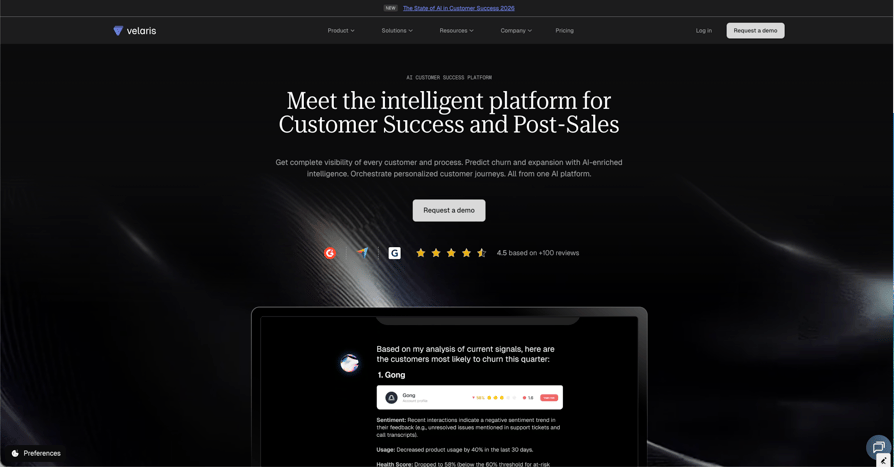
Ask Velaris to describe itself in 50 words and you get "an AI-native customer success platform built for managing post-sales revenue". Translated for a RevOps lead: one place to track customer health, onboarding, renewals, risk, and expansion, with a Copilot and AI agents doing the proactive work so the team scales without adding admin.
What Are Velaris's Key Features?
- Customer health scoresProduct, engagement, support, and relationship data in one account view.
- AI CopilotDashboards, account summaries, and insights on request, in natural language.
- AI agentsRisk detection, onboarding, renewals, handoffs, and follow-ups automated.
- Lifecycle automationPlaybooks for onboarding, adoption, renewals, and expansion.
- Customer intelligenceCalls, emails, and tickets analyzed for risks and opportunities.
How Much Does Velaris Cost?
Velaris's pricing is only available on request, so budget for a custom quote based on your team and account volume.
How Does Velaris Solve Unreliable Renewal and Churn Forecasting?
When we asked for the one RevOps inefficiency it fixes, Velaris picked renewal and churn forecasting, which goes wrong because the signals sit in five places: CRM data, support tickets, product usage, calls, and emails. Its Risk Agent watches all five and flags emerging churn risk early, so RevOps sees revenue at risk weeks before the renewal date.
3. Nektar: Best for Capturing Complete GTM Activity Data in Salesforce
What Is Nektar?
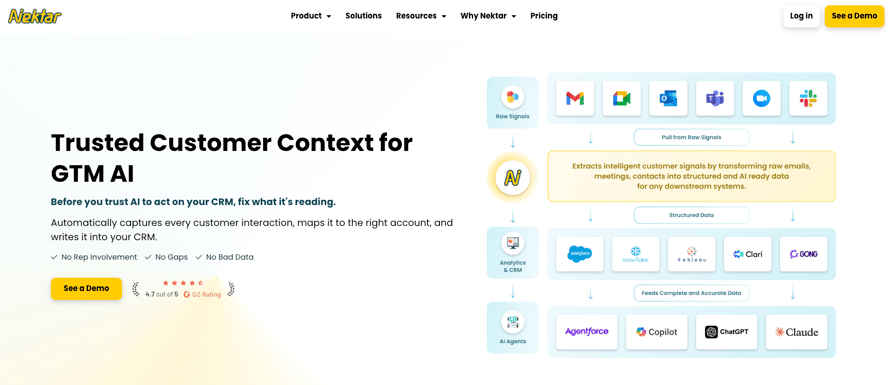
Nektar is a GTM telemetry platform, its own term for capturing every customer interaction (emails, meetings, calls, Slack) and delivering clean, structured data to your CRM, data warehouse, and AI tools with no manual entry. Its pitch to enterprises is complete buying committees and institutional knowledge that survives when people leave.
What Are Nektar's Key Features?
- Opportunity matchingActivity attributed to the right opportunity by machine learning, with accuracy Nektar reports above 90%.
- Meeting intelligenceActual attendees captured from Zoom and Teams without recording, status written to Salesforce.
- Engagement scoringYour own scoring formulas written straight to Salesforce fields.
- Multi-user attributionEvery activity credited to each internal user and external contact present.
- Self-healing CRM dataDuplicates, contact-role errors, and stale fields fixed after the fact.
How Much Does Nektar Cost?
Nektar's pricing is quote-based, per user per month, in two packages: Bloom for smaller revenue teams and Harvest for mature ones. A Data Backfill add-on costs $8 per user for every month of historical calendar and inbox data you want captured.
How Does Nektar Solve the CRM Activity Gap?
Nektar's answer to the problem question was the most detailed we received. If your pipeline reviews turn into arguments about what actually happened on an account, the cause is capture: by Nektar's own estimate only 20 to 30% of real GTM activity ever reaches Salesforce. Its fix is to capture every touchpoint at the source, map it to the right contact and opportunity with machine learning, write structured fields back into Salesforce, and keep correcting the records afterwards, so the CRM itself becomes the source of truth.
4. Demodesk: Best for AI Meeting Capture and Automatic CRM Updates for Mid-Market Teams
What Is Demodesk?
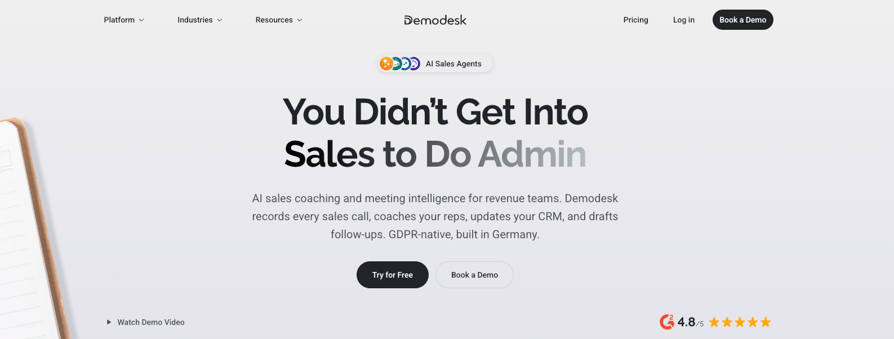
Demodesk is an AI meeting assistant for sales teams. It records every customer conversation (video, phone, dialer, in person), then updates the CRM, coaches reps, drafts follow-ups, and flags deal risk on its own. It's built in Munich, GDPR-native, with EUR pricing aimed at mid-market revenue teams.
What Are Demodesk's Key Features?
- All-channel captureVideo, phone, dialer, in-person, and field conversations transcribed in 98 languages.
- AI CRM ConciergeCRM fields filled after every call, with a human approving before anything syncs.
- AI CoachEvery call scored against your methodology with custom scorecards.
- AI Deal InsightsDeal risk and momentum flagged from what was said on calls.
- Open platform (MCP and AI Crew)Connect Claude, Copilot, or your own agents to the conversation record.
How Much Does Demodesk Cost?
Demodesk's pricing starts at EUR 25/user/month, roughly $28 at current exchange rates, with these plans:
Demodesk Plans and Pricing
| Plan | Price | What You Get |
|---|---|---|
| Capture | EUR 25/user/mo (about $28) | Recording and transcription across every channel, up to 30 licenses |
| Coaching & AI | EUR 49/user/mo (about $55) | Adds AI Coach, AI Deal Insights, the CRM Concierge, and the open agent platform |
| Enterprise | Custom | Required at 30+ licenses |
How Does Demodesk Solve AI That Stops at Insights?
Asked for the inefficiency it fixes, Demodesk pointed at its own category: "most RevOps AI stops at insights", so reps still update the CRM and managers still coach by hand. If your call recorder produces great summaries and your CRM still looks the same, that's the gap. Demodesk captures the conversation and then does the work, filling the CRM with human approval, scoring the call, drafting the follow-up, and raising deal alerts, so SaaS teams sell instead of doing admin.
5. DealHub: Best for Quote-to-Revenue (CPQ, CLM, Billing)
What Is DealHub?
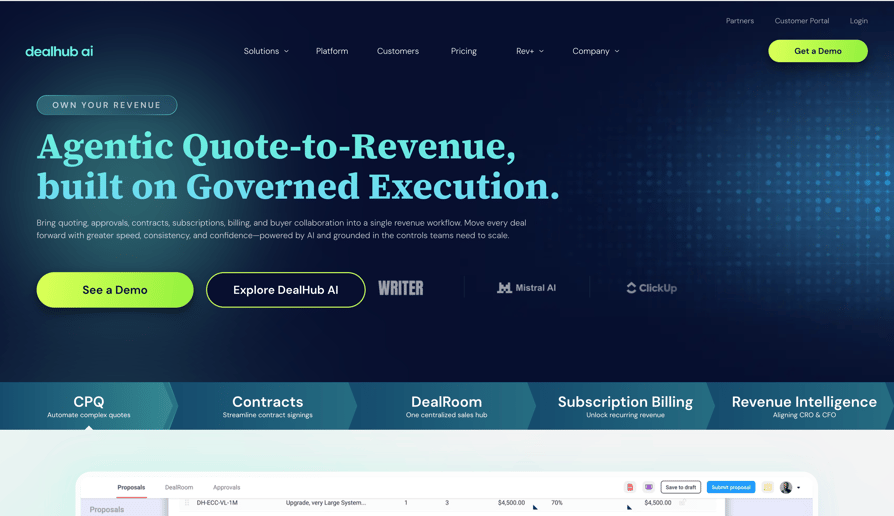
DealHub is a quote-to-revenue platform, "agentic" in its own words, that brings AI-powered CPQ, contract lifecycle management (CLM), digital DealRooms, subscription management, and billing into one no-code revenue engine, so revenue teams can automate complex pricing, speed up approvals, and govern deal execution.
What Are DealHub's Key Features?
- AI-powered CPQGuided selling, adaptive pricing, and enforced discount controls.
- Digital DealRoomA buyer portal with quotes, collateral, and engagement tracking.
- Contract lifecycle managementGeneration, redlining, and native eSignatures inside the deal workflow.
- Subscription and billing managementUsage-based pricing, amendments, co-terming, and revenue recognition automated.
- No-code engine and CRM integrationDrag-and-drop rules synced both ways with Salesforce, HubSpot, and Dynamics.
How Much Does DealHub Cost?
DealHub's pricing is only available by custom quote, scoped per organization across CPQ, CLM, DealRooms, and billing.
How Does DealHub Solve Slow Deal Desk Approvals?
DealHub's chosen inefficiency is the deal desk: "slow, multi-day approval bottlenecks caused by ungoverned sales discounting". If a quote with a 15% discount sits in someone's inbox for three days, that's the one. Its approval workflows live inside the CPQ rules engine, so a quote that crosses a threshold routes instantly to the right approver and a compliant quote gets approved in real time without joining a queue.
6. Creatio: Best for No-Code AI CRM and RevOps Workflow Automation
What Is Creatio?
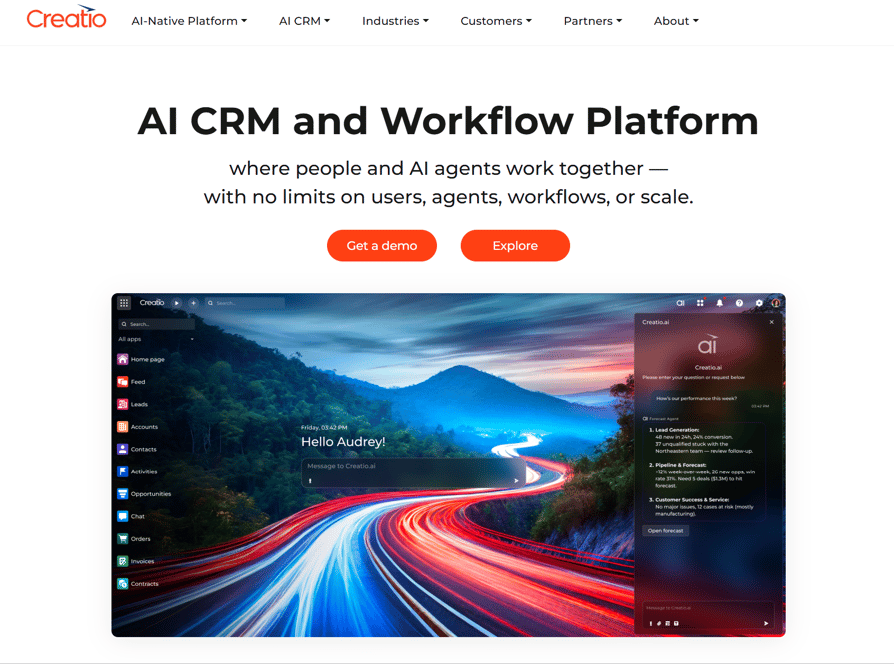
Creatio is an AI CRM and workflow platform that unifies sales, marketing, and service in one system, with AI agents embedded in the core. Two things it made sure we'd mention: no-code, so you build the workflows and agents yourself, and no per-seat cap on the Unlimited plan as usage scales.
What Are Creatio's Key Features?
- Revenue intelligence and forecastingReal-time pipeline monitoring with AI risk detection and explained forecast changes.
- Lead and opportunity scoringDeals ranked by likelihood to convert, based on historical data.
- Next-Best-Action agentThe most effective next step recommended on every deal.
- No-code workflow designerRevOps workflows, approvals, and routing rules built without developers.
- Unlimited planUsers, agents, and workflows scale with no extra per-seat cost.
How Much Does Creatio Cost?
Creatio's pricing starts at $40/user/month (billed annually) for the platform, with the CRM apps priced on top:
Creatio Plans and Pricing
| Plan | Price | What You Get |
|---|---|---|
| Growth | $40/user/mo | The core platform for growing teams |
| Enterprise | $75/user/mo | Adds enterprise-grade governance and scale |
| Unlimited | Custom | Unlimited users, AI agents, and workflows at a flat rate |
| Sales, Marketing, Service apps | $15/user/mo each | Added on top of the platform plan, one or more as needed |
How Does Creatio Solve Manual Deal-Risk Tracking?
Creatio went after the side spreadsheet of deals that "feel" at risk, kept by hand because the CRM doesn't say which deals are slipping. Its Next-Best-Action agent watches pipeline data in real time and surfaces the recommended next step directly on the opportunity record, before the deal stalls.
7. Avoma: Best for Conversation and Revenue Intelligence With CRM Auto-Sync
What Is Avoma?
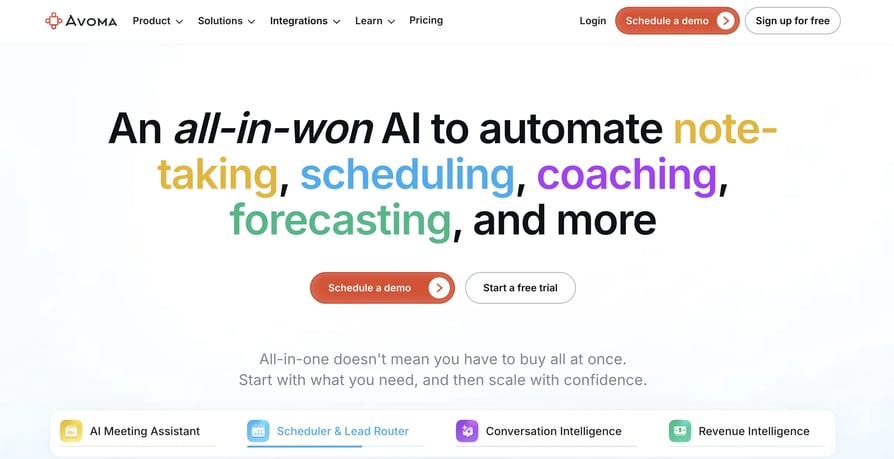
Avoma is an AI-powered revenue intelligence platform that combines meeting recording, conversation intelligence, and CRM automation. It's built for RevOps and sales teams that want pipeline data and forecasts grounded in real buyer behavior rather than rep-reported updates.
What Are Avoma's Key Features?
- AI Meeting AssistantCalls recorded, transcribed, summarized, and pushed into the CRM.
- Two-way CRM syncDeal stage, next steps, and stakeholders updated from call and email activity.
- Conversation intelligenceTalk patterns, sentiment, and objections analyzed for coaching and risk.
- Deal scoring (revenue intelligence)Active deals scored on engagement to flag stalled ones.
- AI scorecards and coachingReps evaluated against custom criteria from real conversations.
How Much Does Avoma Cost?
Avoma's pricing starts at $19 per recorder seat/month (billed annually), with viewers and collaborators free:
Avoma Plans and Pricing
| Plan | Price | What You Get |
|---|---|---|
| Startup | $19/seat/mo | AI Meeting Assistant for small teams |
| Organization | $29/seat/mo | AI Meeting Assistant for growing teams |
| Enterprise | $39/seat/mo | AI Meeting Assistant with enterprise controls, billed annually only |
| Conversation Intelligence add-on | $29/seat/mo | Talk patterns, sentiment, objections, scorecards |
| Revenue Intelligence add-on | $29/seat/mo | Deal scoring, pipeline views, forecasting |
| Lead Router add-on | $19/seat/mo | Routes inbound leads to the right rep |
How Does Avoma Solve Stale Deal Fields After Calls?
Avoma's inefficiency is the one most RevOps leads will recognize first: reps skip the CRM update after a call, so Monday's forecast runs on stale stages. Its two-way CRM sync fills deal stage, next steps, and stakeholders straight from the transcript, closing the gap with no extra work for the rep.
8. Topo: Best for AI-Native Outbound Prospecting and Sequencing
What Is Topo?
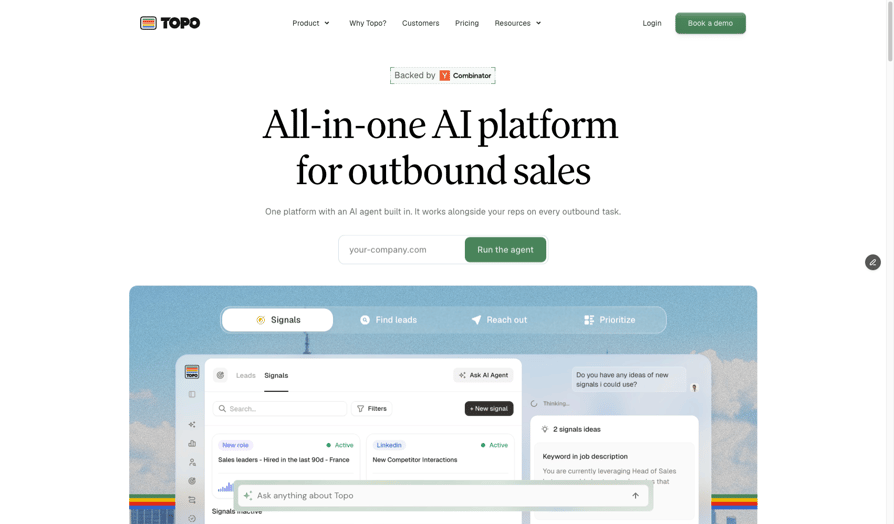
Topo's own word for the outbound stack is plumbing, and it wants to be the thing that handles it: an AI-native outbound platform that unifies list building, multi-channel sequencing, and personalization for B2B sales teams. It finds the right leads, prioritizes real buying signals, and writes on-brand copy at scale.
What Are Topo's Key Features?
- SourceLead and account lists built and enriched in the platform, no data vendor.
- SequenceParallel email and LinkedIn cadences, DM steps triggered only after an accepted invite.
- AI VariablesPersonalization grounded in real prospect data, capped at two per sequence.
- Signal detectionDated buying signals (hires, funding, LinkedIn activity) for true openers.
- SendBuilt-in deliverability infrastructure that protects domain reputation.
How Much Does Topo Cost?
Topo's pricing is custom, based on usage plus the number of members, so you'll need to contact the team for a quote.
How Does Topo Solve Outbound Ops That Eat a Headcount?
Topo's problem is the hidden headcount in outbound: someone building lists, warming mailboxes, loading sequences, and assigning reps by hand. Its Source module builds and enriches the list, Sequence loads it and assigns the reps, and Send runs the cadences on its own infrastructure, so outbound operations become one flow.
9. Enginy: Best for All-in-One Outbound GTM (Prospecting, Enrichment, Outreach)
What Is Enginy?
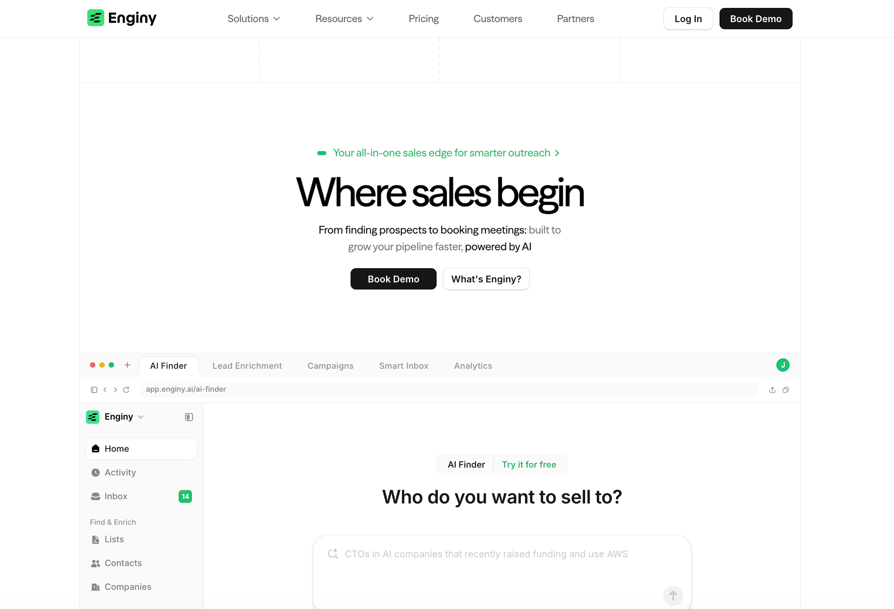
Enginy is an AI-native, end-to-end GTM platform that combines prospect discovery, data enrichment, and AI-powered multi-channel outreach in one place. Its stated mission is to "free sellers to reach their full potential" by removing the tool sprawl that keeps B2B sellers from selling.
What Are Enginy's Key Features?
- List building and prospect discoveryThe right people and companies found without leaving the platform.
- Data enrichment with post-enrichment cleaningMulti-source contact and company data, cleaned after it lands.
- Multi-channel outreach and engagement sequencesCoordinated sequences across channels from one list.
- AnalyticsPerformance insights on what the outreach produces.
- CRM integration and automationThe CRM kept in step with the platform.
How Much Does Enginy Cost?
Enginy's pricing is tailored to each customer, so there's no public price list.
How Does Enginy Solve Sellers Spending Most of Their Time Not Selling?
For Enginy the inefficiency is time: by its estimate, sellers spend around 70% of their week on tasks that aren't selling. If your reps' calendars are full and their call counts are low, that's where the hours go. Its answer is one platform for finding, enriching, and reaching prospects, usable without technical expertise and with intent signals built in.
10. Mindtickle: Best for Revenue Enablement and Rep Coaching
What Is Mindtickle?
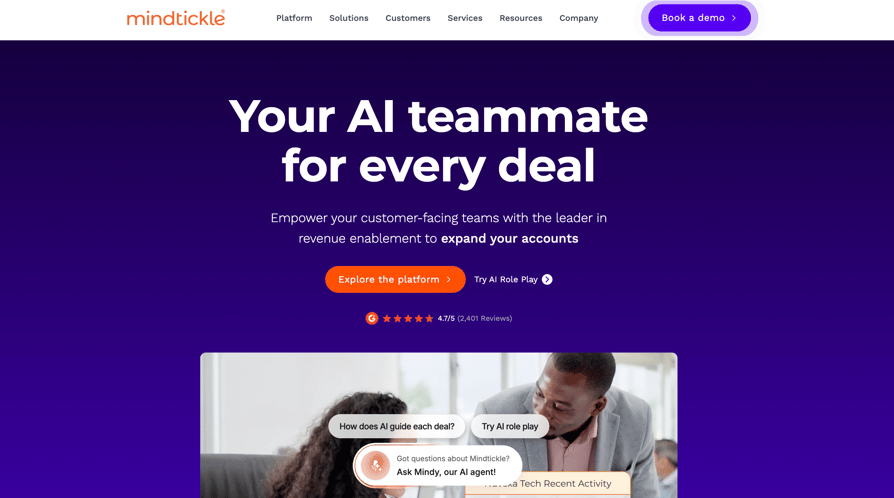
Mindtickle's pitch fits in one line: an AI-powered revenue enablement platform built on ElevateOS that closes the gap between what sellers know and what they do. Agents coach reps, guide live deals, and engage buyers, and on G2 Mindtickle tops the Sales Training and Onboarding category with a 4.7/5 score from 2,000+ reviews.
What Are Mindtickle's Key Features?
- ElevateOS agentsSix AI agents that coach reps, guide live deals, and act in the flow of work.
- AI role playReps practice with an AI buyer and get scored feedback every attempt.
- Digital Sales RoomsA shared hub where buyers and sellers track a mutual action plan.
- Behaviour IntelligenceThe specific seller behaviors driving deals won or lost.
- Conversation intelligenceLive calls turned into coaching moments tied to the Ideal Rep Profile.
How Much Does Mindtickle Cost?
Mindtickle's pricing is customized per company, so expect a quote based on seats and the agents you want.
How Does Mindtickle Solve the Know-Do Gap?
Mindtickle gave the inefficiency a name: the "Know-Do Gap", where reps ace the certification and still skip discovery on live calls. Its ElevateOS agents close it in two steps: AI role play builds the skill before the call, then in-call conversation intelligence and Behaviour Intelligence coach the exact behavior to fix, deal by deal rather than in a quarterly training.
Every Tool Above Depends on Clean Activity Data. CloudTalk Creates It.
Feature Comparison: How These Revenue Operations Platforms Compare
Before you book ten demos, run your must-haves down this matrix. The brands only sent us their top five features, so we checked each vendor's own product, pricing, and integration pages and marked what we could confirm there, and nothing we couldn't.
RevOps Feature Matrix: 10 Tools Across 9 Capabilities
| Feature | CloudTalk | Velaris | Nektar | Demodesk | DealHub | Creatio | Avoma | Topo | Enginy | Mindtickle |
|---|---|---|---|---|---|---|---|---|---|---|
| Native CRM sync (HubSpot, Salesforce) | HubSpot, Pipedrive, Zoho from Essential, Salesforce on Expert | HubSpot, Salesforce | Salesforce, HubSpot, Dynamics | Salesforce, HubSpot, Pipedrive | Salesforce, HubSpot, Dynamics 365 | Is a CRM itself | Salesforce, HubSpot | HubSpot, Salesforce | HubSpot, Salesforce, Pipedrive, Zoho, Dynamics | Salesforce, Dynamics |
| Data enrichment | Not confirmed | Not confirmed | Not confirmed | Not confirmed | Not confirmed | |||||
| CRM data hygiene and deduplication | Not confirmed | Not confirmed | Not confirmed | Not confirmed | Not confirmed | Not confirmed | Not confirmed | |||
| Pipeline visibility | Call analytics only | Account dashboards | Quote and deal-desk view | Opportunity view | ||||||
| AI revenue forecasting | Churn prediction only | Not confirmed | Not confirmed | |||||||
| Deal risk detection | Call-level signals | Account risk | ||||||||
| Conversation intelligence and call summaries | Add-on | Via integrations | Meeting data, no recording | Via Gong | Meeting summaries (Teams) | |||||
| Workflow automation | From Essential | Rule-based | Via Make, webhooks, API | Sequences only | Sequences only | |||||
| AI agents | AI voice agents |
Where CloudTalk's Deal-Risk Signals Come From
CloudTalk scores the call rather than the deal, which is still where the early warnings live: sentiment and talk ratio per call, AI call scoring against your own questions, and on the Plus tier custom topics such as a pricing objection or a competitor's name flagged on every call, plus summary templates that fill a MEDDIC or BANT field from the transcript. Synced to HubSpot, Pipedrive, or Zoho, those become the deal signals your forecasting tool reads.
What Is RevOps Software (and How Is It Different From Sales Ops)?
RevOps software (revenue operations software) brings sales, marketing, and customer success data into one view, so a SaaS team can see the whole pipeline, forecast from real activity, and automate the handoffs between teams. A revenue operations platform collects activity from your CRM, calls, email, and meetings, keeps it clean, turns it into pipeline and forecast views, and triggers workflows such as lead routing or renewal alerts.
SaaS teams feel this more than most because revenue doesn't stop at the signature. Renewals, expansion, and usage-based billing all sit after the deal, which is why post-sales tools like Velaris and quote-to-revenue tools like DealHub belong on this list next to the pipeline tools, and why a trial-to-paid handoff that nobody owns is the kind of leak this page keeps coming back to.
RevOps vs. sales ops comes down to scope. Sales ops supports one team: quotas, territories, CRM admin, and the sales tool stack. Revenue operations covers the whole customer lifecycle, from first marketing touch to renewal, and owns the data the three teams share. The shift is already underway: Gartner found that sales ops leaders now spend 73% of their time supporting non-sales functions, up from 39% in 2019,³ which is RevOps work under a sales ops title.
That scope is why a RevOps tech stack rarely means one product. Gartner predicted that 75% of the highest-growth companies would run a RevOps model by 2025,⁴ usually with a CRM in the middle and revenue operations tools plugged in to capture activity, surface risk, and run workflows. The ten platforms above each cover a different slice of that stack.
How AI Is Changing RevOps in 2026
AI revenue operations has moved from a slide to a line item. Salesforce finds 87% of sales organizations now use AI for prospecting, forecasting, lead scoring, or drafting emails.¹ The catch sits in the next number: BCG's survey of 398 revenue leaders found 90% report meaningful AI use, yet only 6% have autonomous AI completing an end-to-end workflow.⁵ Here's where the best AI tools for revenue operations are closing that gap.
AI Forecasting and Deal Risk Detection
AI forecasting replaces the Friday pipeline review with a model that reads activity. Gartner puts the median sales team at 70 to 79% forecast accuracy,² which is why Avoma, Nektar, and Creatio score deals on real engagement (meetings held, emails answered) and flag the ones going quiet. The RevOps AI win is earlier bad news: a deal flagged three weeks before the close date can still be saved.
Conversation Intelligence and Automatic Call Summaries
Conversation intelligence turns the call itself into CRM data: the platform transcribes the conversation, summarizes it, tags objections, scores it, and pushes the result to the CRM. Demodesk, Avoma, and Mindtickle do this for meetings, and CloudTalk does it for phone calls with AI Conversation Intelligence.
Capitalo's sales ops team shows what that does to the workload once it runs every day.
Capitalo: Call Quality Analysis Cut From 2 Hours to 20 Minutes a Day
After expanding into Germany, Capitalo had two reps and no German-speaking supervisor, so nobody could review the calls. With CloudTalk's AI Conversation Intelligence analyzing every call, the sales ops team cut call quality analysis from 2 hours to 20 minutes a day and reduced wrongly targeted leads by 24%.
Data Enrichment and CRM Hygiene
Dirty CRM data is the quiet tax on every AI feature. Salesforce reports that 51% of sales leaders using AI say disconnected systems are slowing their AI initiatives, and 46% of sales pros working with agents say data quality hurts their sales.¹ Nektar and Creatio fix records after the fact, while Topo and Enginy enrich contacts before a rep touches them. An AI forecast is only as good as the activity underneath it.
AI Agents Automating Repetitive RevOps Workflows
AI agents are the 2026 step up from workflow rules, and the top RevOps automation tools with AI now ship them as standard. The difference is simple: a rule waits for you to define every branch, while an agent watches for a trigger (a deal going quiet, a renewal 60 days out, a missed call) and acts on it, updating the record, drafting the follow-up, or taking the call. Velaris runs risk and renewal agents, Creatio puts one on the opportunity record, and CloudTalk's AI voice agents pick up inbound calls before a person does.
For RevOps, the phone is the agent use case with the fastest payback, because inbound calls are the activity most likely to go unlogged. An AI voice agent answers the lead call, asks the qualifying questions, books the meeting or hands over to a rep, and logs the whole thing to the CRM. The call that used to be a voicemail and a sticky note becomes a record with a transcript.
Signature Capability
See CloudTalk’s AI Voice Agent in Action!
CeTe is an AI that talks like a human: no breaks, no training, no time off. It makes and answers calls, updates CRMs, books meetings, and loops in a human only when needed.
Press play to hear it. Want a wow moment? Get a free test call and try it live.

How to Choose the Right RevOps Platform for Your SaaS Team?
Choosing a revenue operations platform starts with the leak, and the feature list comes second. Run the four checks below against your own stack before you book a single demo.
Start With the Problem the Tool Has to Fix
Write down the one number you can't trust today: the forecast, the lead response time, the share of calls logged, the days a quote waits for approval. Gartner found that 44% of sales leaders name poor data quality as a barrier to analytics success,⁷ so for most teams the first number is a data one. A team that can't see which deals are being worked needs sales tracking software and activity capture, a team drowning in approvals needs routing, and no amount of AI forecasting fixes either one.
Key Features to Look for in Revenue Operations Software
Once the problem is clear, these are the five capabilities worth testing in a trial:
- Native CRM sync that writes, not only readsActivity, stage, and next steps updated in HubSpot or Salesforce without a rep.
- Activity capture at the sourceCalls, meetings, and email captured automatically, with summaries and scores attached.
- Risk and forecast signals built on engagementDeal scores based on meetings held and replies received, with a reason for every change.
- Workflow and lead routing automationTriggers that assign, reassign, and follow up on their own.
- Agents with a human in the loopAn approval step before anything syncs, and a clean handoff to a person when the AI isn't sure.
Check Which Plan Unlocks the Integration You Need
Pricing pages hide the RevOps features behind tiers and add-ons. Avoma's deal scoring lives in a $29/seat/month add-on, Creatio charges $15/user/month per CRM app, Demodesk needs its Enterprise plan at 30+ licenses, and CloudTalk puts the Salesforce integration on Expert while HubSpot, Pipedrive, and Zoho start on Essential. Price the plan that includes your integration, then compare across vendors.
Plan for Coaching, Not Only Reporting
RevOps software that only reports leaves the fix to the manager, and the data says the fix is where the money is: Gartner finds sales organizations that give reps AI-enabled next best actions are 2.6 times more likely to achieve commercial growth.⁸ Mindtickle's role play, Demodesk's AI Coach, CloudTalk's call scoring, and the sales coaching software and sales enablement platforms we've ranked all pair data with a next step, and Hiredly shows what that looks like in practice.
Hiredly Cut Deal Cycles From 2 Months to 2 Weeks
The Malaysian recruitment group logged outbound calls by hand, with no recordings to coach from. With CloudTalk syncing calls, transcripts, and activity to its CRM, plus automatic lead reassignment when a consultant goes quiet, Hiredly reached 100% lead follow-up and cut closing from over two months to two weeks.
Bring Your Leakiest Workflow to a 30-Minute Demo
Quick Answers: What People Ask Most About RevOps Tools
Short answers to the questions that come up most often around revenue operations tools, for when you need the definition rather than the tour.
What Are the Four Pillars of Revenue Operations?
The four pillars of revenue operations are operations, enablement, insights, and tools. Operations covers the handoffs between sales, marketing, and customer success, enablement covers training and coaching, insights covers the data and forecasts, and tools covers the stack that ties the other three together, usually a CRM plus the revenue operations tools compared above.
What Are Revenue Operations in SaaS?
Revenue operations in SaaS is the function that aligns sales, marketing, and customer success around one revenue number, from first lead to renewal. Because SaaS revenue is recurring, RevOps spends as much time on churn and net revenue retention as on new bookings, which is why post-sales tools such as Velaris sit next to pipeline tools such as Avoma.
What Does RevOps Software Automate?
RevOps software automates the work between conversations: logging calls and meetings to the CRM, updating deal stages and next steps, scoring and routing leads, flagging at-risk deals and renewals, approving quotes, and drafting follow-ups. The newest tools add AI agents that act on those triggers, and conversation analytics software that turns the calls themselves into data.
Every Quick Answer Above Starts With Complete Activity Data
Conclusion: The Right RevOps Tech Stack for Each SaaS Stage
Ten tools solve ten different problems, and the pattern across them is simple: the best RevOps tools for 2026 fix the data gap you have today, and the best revenue operations software for SaaS teams is rarely a single product. McKinsey finds nearly nine in ten organizations now use AI regularly, with revenue gains showing up most often in marketing and sales,⁹ which is where these stacks sit. They're built from the brands' own answers, so treat them as a starting shortlist.
Best RevOps Tech Stack for Early-Stage SaaS Startups
Capture first, forecast later. CloudTalk on Essential ($29/user/month) logs every call to HubSpot or Pipedrive with a summary attached, Avoma Startup ($19/seat/month) does the same for meetings, and Topo joins once outbound list-building eats a founder's week.
Best RevOps Tech Stack for Scaling SaaS Teams
The data exists, the trust doesn't. Nektar or Avoma's Revenue Intelligence add-on scores deals on real engagement, Demodesk keeps the CRM honest with human approval, CloudTalk on Expert ($49/user/month) adds Salesforce and the Power Dialer, and Mindtickle comes in when managers can't coach by ear anymore.
Best RevOps Tech Stack for Enterprise SaaS
Revenue leaks at the edges of the deal. DealHub governs quote-to-revenue, Velaris watches renewals and expansion, Nektar keeps Salesforce activity complete, Creatio's Unlimited plan runs the workflows without per-seat caps, and CloudTalk's Custom plan and AI Specialist put AI agents and humans on the same phone lines. All of them quote per company, so bring the problem statement to the call.
Whatever the stage, the cheapest RevOps improvement most SaaS teams can make this quarter is to stop logging calls by hand. Bring your busiest call type to a demo below and see how much of that work CloudTalk takes off your team.
Join 5,500+ Businesses Logging Every Call Automatically
Sources:
- Salesforce, State of Sales, 7th Edition (2026)
- Gartner, The Role of Artificial Intelligence in Sales
- Gartner, Survey Finds Sales Operations Teams Dedicate Most of Their Time to Non-Sales Functions (2023)
- Gartner, Revenue Operations Strategy Guide
- BCG, The 2027 Revenue Agenda: Moving the AI Focus from Productivity to Proof of Value (2026)
- Gartner, Survey Finds AI Saves Sellers Nearly Five Hours per Week (2026)
- Gartner, Survey Finds Sales Analytics Has Less Influence on Sales Performance Than Expected (2024)
- Gartner, Survey Finds Sales Organizations That Provide AI-Enabled Next Best Actions Are 2.6 Times More Likely to Achieve Commercial Growth (2026)
- McKinsey, The State of AI in 2026: On the Road to ROI (2026)
Frequently Asked Questions About Revenue Operations Software
Quick answers on what RevOps software is, what it costs, and how to build a SaaS RevOps tech stack around it.
Revenue operations software is the set of tools that collects, cleans, and acts on revenue data across sales, marketing, and customer success, usually on top of a CRM such as HubSpot or Salesforce. It captures activity from calls, meetings, and email, scores pipeline and renewal risk, and automates handoffs, which is why a business phone system that logs every call is often the first piece SaaS teams add.
The best AI revenue operations software in 2026 depends on the problem you need fixed: CloudTalk for calls that never reach the CRM, Nektar and Avoma for incomplete Salesforce activity, Velaris for renewal risk, DealHub for slow quote approvals, Creatio for no-code workflows, Topo and Enginy for outbound ops, and Mindtickle for rep coaching. There's no overall number one, and the CRM you pair them with matters as much as the pick.
A SaaS RevOps tech stack should include a CRM as the system of record, an activity capture layer for calls, meetings, and email, a conversation or revenue intelligence tool for scoring and forecasting, workflow and lead routing automation, and, past a certain size, quote-to-revenue and post-sales platforms. Early-stage teams cover the first three with CloudTalk and Avoma, while enterprises add DealHub, Velaris, and Nektar.
Revenue operations software costs about $19 to $75 per user per month on public plans, and most specialist platforms quote per company. On this list CloudTalk starts at $25/user/month (see the CloudTalk pricing page for plan details), Avoma at $19 per recorder seat, Demodesk at EUR 25/user/month, and Creatio at $40/user/month plus $15 per CRM app. Budget for add-ons, since that's where forecasting and call scoring usually sit.
CloudTalk fits into a RevOps tech stack as the phone system for revenue operations, the layer that creates clean call data for everything else. It logs every call to HubSpot, Pipedrive, Zoho, or Salesforce, adds summaries and scores with AI Conversation Intelligence, and answers inbound calls with AI voice agents. Forecasting tools such as Avoma or Nektar then read that activity rather than waiting on a rep's notes.