Talkie AI Pricing in 2026: What It Really Costs
Talkie AI pricing isn't published anywhere, so every number comes out of a sales call. This guide covers what drives the quote and what the same job costs at the vendors that print their rates.
How Much Does Talkie AI Cost?
Talkie AI costs whatever your sales call lands on. Talkie.ai publishes no price list and no named tiers, and its pricing page doesn't exist — every route to a number ends at a demo booking form. Is Talkie AI free? No, and there's no trial either.
The company publishes the shape of the deal but not the size of it. Pricing is quote-based and positioned against usage-based billing, so you aren't buying minutes. Engagements open with a two to three month pilot, then move to a longer contract whose length is never stated. Go-live takes about three weeks.
Talkie AI Pricing Plans at a Glance
| What Talkie.ai Offers | Best For | Starting Price | Add-Ons | Free Trial |
|---|---|---|---|---|
| Pilot program (2 to 3 months) | Practices that want to test before committing | Quote only, not published | Not published | No free trial, no self-serve signup |
| Longer-term contract (post-pilot) | Practices continuing after the pilot | Quote only, not published | Not published | Not applicable |
| Small, medium, large and enterprise practice offers | Four organization-size segments Talkie sells into separately | Quote only, not published | Not published | Not applicable |
Those three rows are sales motions, not priced tiers, and each ends at the same missing number. So the rest of this guide gives you something else to reason with: what the same job costs at the best AI voice agents that publish a rate.
In a Nutshell
Talkie AI has no published pricing: no plan names, no per-seat or per-minute rate, and no self-serve signup. Every number comes from a sales call, moving through a two to three month pilot and then an undisclosed longer-term contract.
Talkie sells the same product differently to four organization sizes, so the quote you get depends on how big your practice looks to their sales team, not on a fixed rate card.

CloudTalk publishes every plan price and AI minute rate, so you can budget before you book.

Which Talkie AI Are You Pricing?
Three unrelated products share the "Talkie" name and the same search results. Check which one you're pricing before you compare anything.
| Product | What It Is | How It's Priced |
|---|---|---|
| Talkie.ai (talkie.ai) | AI medical receptionist that answers patient calls for healthcare practices. The subject of this guide. | Quote only, no public price |
| Talkie: Soulful AI (talkie-ai.com) | Consumer AI companion chat app, a character.ai rival | Free tier plus a paid in-app subscription |
| Talkie / TalkieHQ | Team audio and video meeting tool | Free tier plus a paid plan listed by directories at $10 per user per month |
Almost everyone searching "talkie ai" wants the companion app, not the medical receptionist: it accounts for roughly 13,600 of the 13,800 US searches that land on talkie.ai each month. If you found a $9.99 price for "Talkie AI," you found the chat app. CloudTalk's Talkie.ai review covers the mix-up in detail.
What Talkie AI's Pricing Model Actually Is
Talkie AI's pricing model is quote-based enterprise sales: a discovery call, a scoped proposal, a pilot, then a contract. For a product that has to touch an EHR, that's defensible. It's also why you can't shortlist this vendor on a spreadsheet. Talkie.ai's one commercial claim is that its pricing is "structured to ensure both predictable costs and flexibility," which reads as positioning when there's no number to check it against.
Is Talkie AI priced per user, per minute, or per call?
Talkie AI is priced per quote, not per user, per minute or per call. Three pricing models compete in this category, and Talkie sits in the one that gives you least to work with.
- Per minute. You pay for talk time. Vapi publishes $0.05 per minute and Retell AI $0.07 to $0.31. Cheap to start, unpredictable at volume.
- Per seat plus usage. You pay per user for the phone system and separately for AI minutes. CloudTalk publishes both, including its AI voice agent pricing, so you can build the budget before booking anything.
- Quote-scoped. One negotiated figure covering software, configuration and support. Talkie.ai sits here, alongside Synthflow, though Synthflow at least publishes a floor.
Talkie warns buyers that "costs are hard to control due to usage-based pricing," so the quote is almost certainly a committed bundle rather than a meter. It still doesn't tell you what the bundle costs, or what happens when you go past it.
Which seven variables move a Talkie AI quote?
Talkie sells by organization size, feature set and integration requirements, which is a reliable guide to how a proposal gets built. Expect the quote to be priced on:
- Number of users or providers on the account
- Practice or organization size (Talkie sells four distinct size tiers)
- Call volume and minutes consumed
- Which skills are switched on, from scheduling and refills to intake and recall
- EHR and phone-system integration requirements
- Feature complexity, including multilingual coverage and custom workflows
- Level of ongoing technical support
Bring your own numbers for the first three. Walk in without a call-volume figure and the vendor will pick one, scoped to the top of the range.
What happens after the Talkie AI pilot?
Talkie.ai's own FAQ puts it plainly: "There's a pilot period of 2-3 months, after which practices usually transition to a longer term contract." Multi-location groups are told to "pilot at one site, expand from there." The pilot de-risks your first quarter, but the pilot price and the contract price are two different numbers, and only the first comes up in the first call. Ask for both, in writing, before the pilot starts.
What's Included at Every Tier
There's no published tier ladder, so "included" here means the standard bundle Talkie.ai describes, broadly the same ground the leading AI medical receptionist tools cover. A Talkie AI subscription is scoped around four things.
Patient-facing skills. Scheduling, refill requests, new-patient intake, FAQ automation, waitlist management, recall, reminders, and voicemail replacement that writes back into the EHR, across phone, SMS and website chat.
Integrations. EHR and practice-management connectors for athenahealth, ModMed, Elation Health and eMedicalPractice. None carry a published cost, and Talkie doesn't say whether integration work is bundled or billed.
Compliance. HIPAA, plus a completed SOC 2 Type II audit, bundled rather than sold on top.
Deployment and support. Talkie's team does the configuration, prompting and testing, and support is standard rather than a premium tier. You can't buy any of it without a sales conversation.
Every CloudTalk plan lists what's included, with AI Voice Agents priced separately as an add-on.
What Comparable AI Voice Agents Publish
Since the Talkie.ai column is blank, what helps is knowing what everyone else charges. Every figure below comes from the vendor's own pricing page, checked in August 2026.
| Vendor | Pricing Model | Published Entry Point | Healthcare Compliance | Where the Price Lives |
|---|---|---|---|---|
| Talkie.ai | Quote only, not usage-based | None published | HIPAA and SOC 2 Type II, bundled | Sales call only |
| CloudTalk | Per seat, plus a usage-based AI Voice Agent add-on | $25/user/month; AI Receptionist from $99/month for 200 minutes | HIPAA compliant | Public pricing page |
| Retell AI | Pay as you go, per minute | $0.07 to $0.31 per minute, $0 to start, $10 free credits | Not published as a priced tier | Public pricing page |
| Vapi | Per minute plus paid add-ons | $0.05 per minute, 10 concurrent lines included | HIPAA sold as a $2,000/month add-on | Public pricing page |
| Synthflow AI | Annual enterprise contract | From $30,000 per year | Scoped per contract | Floor published, remainder scoped |
The gap between five cents a minute and $30,000 a year measures how much of the build you do yourself and how much compliance the vendor absorbs, not how good the software is. Keep that in mind when a Talkie.ai proposal looks expensive next to a per-minute platform, and see how the category ranks in CloudTalk's guide to the best AI voice agents for healthcare.
What Are Talkie AI's Best Features?
Judging a quote-only product means judging what the quote is buying. Three things carry most of the value, and a DIY platform would bill you for all of them separately.
- Specialty-tuned skills, published across eleven specialties, rather than generic call answering with a healthcare label on it.
- Native EHR write-back, the hardest part of any healthcare voice deployment and the part most likely to blow a DIY budget.
- Bundled HIPAA and SOC 2 Type II, plus a three-week done-for-you build with no internal project to staff.
Buy a general-purpose voice agent instead and that configuration work becomes yours, so map your call reasons against the common use cases for AI voice agents before deciding how much depth you're paying for.
Where Talkie AI could be better:
According to a March 2026 MGMA Stat poll of 294 medical practice leaders1, the most time-consuming phone work in a practice is eligibility and prior authorization at 45%, ahead of scheduling at 31%.
Talkie covers the scheduling half well and doesn't claim to touch prior auth, so if eligibility is your bottleneck, a front-desk agent won't move your biggest number whatever it costs. The ROI claims need a second look too: Talkie promises cost reduction of "up to 60%" in one place and 65% in another, and neither figure comes with a calculation.
What Will Talkie AI Actually Cost?
There's no unit price to multiply, so nothing here can produce a Talkie AI monthly total. These scenarios model the same workload at vendors that do publish, so you walk into the demo with a defensible range.
| Scenario | Monthly Volume | Talkie AI | Per-Minute Benchmark (Vapi / Retell) | CloudTalk (Published) |
|---|---|---|---|---|
| A. Solo practitioner | 1 to 2 seats, ~300 calls, ~600 minutes | Quote required; the pilot is the only entry point | 600 min × $0.05 to $0.07 = $30 to $42. Add Vapi's HIPAA add-on at $2,000 and the same volume becomes ~$2,030 to $2,042 | 1 × $25 + AI Receptionist at $299 for 1,000 minutes = $25 + $299 |
| B. Small practice, 3 to 5 providers | 5 seats, ~1,000 calls, ~2,000 minutes | Quote required. Synthflow's published $30,000/year floor (~$2,500/month) is the reference for enterprise-scoped healthcare voice AI | 2,000 min × $0.05 to $0.07 = $100 to $140 raw, before compliance | 5 × $25 + AI Receptionist at $699 for 2,500 minutes = 5 seats + $699 |
| C. Growing group, 10 to 20 seats | 15 seats, ~3,700 calls, ~7,500 minutes | Quote required; "pilot at one site, expand from there" | 7,500 min × $0.05 to $0.07 = $375 to $525, plus concurrency beyond 10 lines at $10/line and HIPAA at $2,000, so ~$2,400 to $2,600 | 15 × $29 + AI Specialist at $1,249 for 5,000 minutes, with the balance on a custom volume band |
| D. Multi-site organization | 50+ seats, 10,000+ minutes | Quote required | Volume-based per-minute pricing, negotiated | Custom volume pricing from $0.15/minute above 10,000 minutes |
Two things fall out of that math, and both are worth raising in the sales call.
At low volume, compliance is the cost driver, not minutes. At 600 minutes a month the talk time costs $30 and the HIPAA wrapper costs $2,000. Before you call a Talkie quote expensive, subtract what you'd otherwise pay to make the same product HIPAA-safe.
The pilot-to-contract step is the budget surprise. What you pay during the pilot isn't what you'll pay in month four, and nothing published tells you the difference. Get the post-pilot figure and the contract length up front, and run your own volume through an AI voice agent ROI calculator so the vendor isn't the only one in the room with arithmetic.
Is an AI receptionist cheaper than a front-desk hire?
This is the comparison most practice managers are running, and no vendor answers it with real arithmetic. In Deloitte's September 2025 survey of 100 US health care technology executives2, 98% expected at least 10% cost savings from AI within two to three years, and 37% expected more than 20%. That's the bar any Talkie AI quote has to clear, and it's set by expectation rather than outcome. Where savings do land, they come from call deflection more often than from cutting a role.
Deloitte also found that 87% of the organizations still on the sidelines of agentic AI are small and mid-sized, and only 13% of them expect savings above 20%, against 59% of early adopters. The most cautious buyers are the least convinced of the payoff, and they are exactly the group a quote-gated vendor serves worst.
CloudTalk (SaaS & IT services): CloudTalk's own team put an AI prequalification agent on long-tail leads and measured 17x ROI, the kind of before-and-after number a vendor quote should be held to.
Are There Hidden Costs in Talkie AI?
"Hidden" is the wrong word when nothing is disclosed in the first place. The better question is which cost categories are unresolved, and what each should answer for in the proposal.
| Cost Category | Talkie.ai Status | What to Ask Before You Sign |
|---|---|---|
| Implementation and setup | Not priced, but scoped. Talkie configures, prompts and tests the agent, go-live in ~3 weeks | Is implementation bundled into the subscription or invoiced separately? |
| EHR and practice-management integration | Named connectors, no published cost | Is my EHR in scope at no extra charge, and what happens if it isn't on the list? |
| Minute or call overage | No published caps or bands | What volume does the quote assume, and what's the rate above it? |
| Additional users or providers | No published unit of any kind | Does adding a provider or a location change the price mid-contract? |
| Optional skills and modules | Skills are listed, none are priced | Which skills are in the quote, and which cost more to switch on? |
| Premium support | Presented as standard, not tiered | Is support included for the contract term, or only during onboarding? |
| HIPAA and SOC 2 Type II | Included, not priced separately | Confirm in writing; competitors charge up to $2,000 a month for the same |
| Post-pilot contract | Length and price never disclosed | What's the term, the renewal price and the exit clause? |
| API access | No public API pricing or developer docs | Can we export our own call data, and at what cost? |
Some third-party pages claim Talkie AI charges a one-time setup fee, though none of them cite a source. Nothing on talkie.ai confirms it either way, so ask rather than assume.
Vapi is the useful benchmark, because it puts a public number on the thing Talkie bundles: HIPAA at $2,000 per month and Zero Data Retention at $1,000 per month, on top of $0.05 per minute. For a small practice that's a 40x multiple on the call cost. Every HIPAA-compliant VoIP provider carries that cost somewhere; the only question is whether it's itemized on a page or buried in a quote.
See what a healthcare phone setup really costs, add-ons included, before anyone signs anything.
What Are the Pros and Cons of Talkie AI?
| Pros | Cons |
|---|---|
| Configuration, prompting, testing and EHR integration are done by Talkie's team, not yours | No public pricing, no published unit, and no free trial or self-serve signup |
| Roughly three weeks from signature to go-live | Independent budget modelling is impossible before a sales call |
| Two to three month pilot before any longer commitment | Post-pilot contract length and price are never disclosed |
| HIPAA and SOC 2 Type II bundled rather than sold as add-ons | Very thin independent review base: 10 G2 reviews, and one Capterra review that describes a different product |
| Not billed per minute, so a volume spike doesn't spike the invoice | Healthcare only, so it can't serve the rest of your phone estate |
If you run a single site, weigh those cons against a general-purpose AI voice agent for a small business, where the rate is published up front and the healthcare depth is shallower.
What Do Customers Say About Talkie AI's Pricing?
Start with the sample size, because it changes how you read everything else. Talkie.ai has 10 reviews on G2 and a 4.9/5 average, plus a single Capterra review that scores 5/5 but describes character and story creation, which is the companion app rather than the medical receptionist. A 4.9 built on 10 reviews is too thin to read as market consensus.
One of Talkie.ai's 10 G2 reviews, from a small-business Chief Revenue Officer, backing the 4.9/5 average verified live on 2026-08-07:
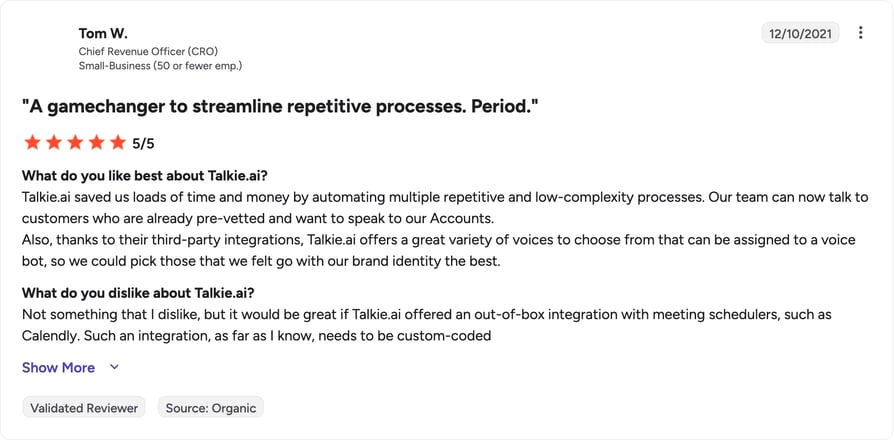
Pricing opacity is the recurring criticism, and it's the one thing any buyer can verify without a login: there's no number to check. For a practice manager who has to bring a figure to a partner meeting, booking a demo to find out whether a vendor is even in range is a real procurement cost, and it's a common reason buyers start shortlisting Talkie AI alternatives before they've evaluated the product.
Support is what the money buys, and also what you depend on. The G2 reviews credit the consultants who configure and test the agent, which fits Talkie doing the build rather than shipping you a toolkit. The same reviews describe difficulty adding phone numbers to outbound campaigns and an unclear database-management interface, both resolved by that support team. Day-to-day changes may run through the vendor rather than your own staff, so price the admin time in.
Value is credited mostly by higher-volume practices. The named testimonials come from practices handling 1,000 to 3,700 calls a month, and they're vendor-published rather than independent: one, from Jimmy Kallikadan, CEO of Health + Glow, says the practice "was also able to let go of our answering service, so we actually saved money too," quoted on a Talkie.ai case-study page.
Which Alternatives Are Better and Cheaper Than Talkie AI?
1. CloudTalk: Best for practices that need a full phone system as well as an AI agent
What Is CloudTalk?
CloudTalk is a cloud-based VoIP phone system that replaces on-premise PBX hardware and runs in a browser or an app. Healthcare providers run it as a healthcare call center for patient intake, scheduling and follow-up calls, with HIPAA compliance, call masking and recording consent in place.
Why Is CloudTalk Better Than Talkie AI?
- You can budget before you call sales. CloudTalk publishes plan prices and AI Voice Agent rates, so you can model the cost and get it approved before booking a demo.
- It covers the whole phone estate. Virtual numbers in 160+ countries, IVR, call queues, recording and transfers, with the AI agent on the same infrastructure.
- The AI Voice Agent handles inbound and outbound, answering routine questions, booking and confirming appointments and escalating to a human when needed, 24/7. A healthcare intake template ships with it.
- You can start small. A 14-day free trial and a published entry price mean the first evaluation costs nothing.
What Does CloudTalk Cost?
- Starter: $25 per user per month, including IVR and skill and condition-based call routing
- Essential: $29 per user per month, adding the 95+ integrations, API and data sync, and Smart Dialer
- Expert: $49 per user per month, where Power Dialer is included rather than bought
- Custom: contact sales
- AI Voice Agents are always a paid add-on, never bundled into a plan. AI Receptionist starts at $99 per month for 200 minutes (first 50 free), AI Specialist at $349 per month for 1,000 minutes, and custom volume pricing at $0.15 per minute above 10,000 minutes.
- Other add-ons, all paid separately: AI Conversation Intelligence at $9 per user per month, Power Dialer at $15 per user per month on Starter and Essential, Parallel Dialer at $39 per user per month
- G2: 4.4/5 from 1930+ reviews. Trustpilot: 380+ reviews
One of CloudTalk's recent G2 reviews:
Convergence (Healthcare & Wellness): Convergence scaled recruiting calls across 150 nursing homes on CloudTalk, the multi-site volume a front-desk-only tool can't absorb.
Where Could CloudTalk Be Better?
CloudTalk is industry-agnostic, so there's no native athenahealth or ModMed connector. EHR write-back runs through the API, webhooks or Zapier, which is engineering work Talkie does for you.
2. Retell AI: Best for teams that want transparent per-minute pricing
What Is Retell AI?
Retell AI is a developer platform for building and running voice agents on a pay-as-you-go basis. Retell publishes every component of its rate card, so you can model a bill before committing.
Why Is Retell AI Better Than Talkie AI?
- Every rate is on the page. You know your cost per call before you build anything.
- You start at zero. No annual contract, $10 in free credits, 20 free concurrent calls.
- Cost scales with usage, not with a negotiated commitment. Low-volume practices aren't priced as if they were groups.
What Does Retell AI Cost?
- $0.07 to $0.31 per minute for voice agents, plus $0.002 and up per message for chat agents
- Component breakdown: LLM at $0.04/min, voice infrastructure at $0.055/min, text-to-speech at $0.015/min
- $0 to start, $10 in free credits, no annual contract; enterprise is custom-priced
- G2: 4.8/5 from 2,638 reviews
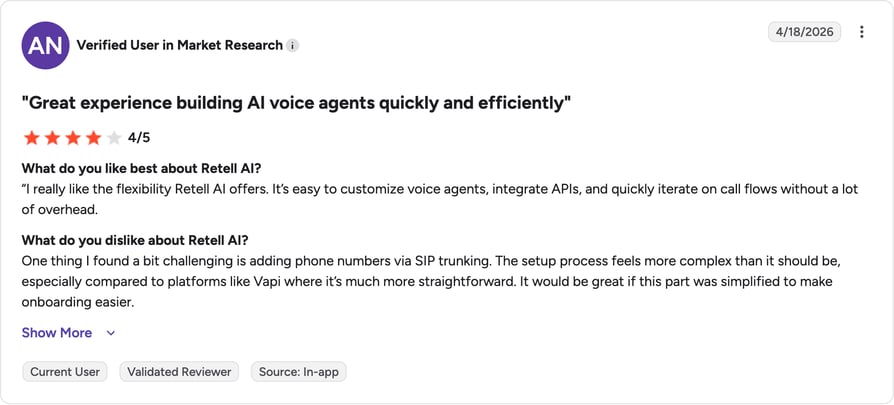
One of Retell AI's G2 reviews:
Where Could Retell AI Be Better?
You build and maintain the agent yourself, and Retell publishes no healthcare compliance tier. For a practice with no technical owner the transparent rate card can be a false economy, because per-minute economics only work if the agent is good at reducing average handle time, which is now your tuning job.
3. Synthflow AI: Best for no-code teams with budget who want a managed build
What Is Synthflow AI?
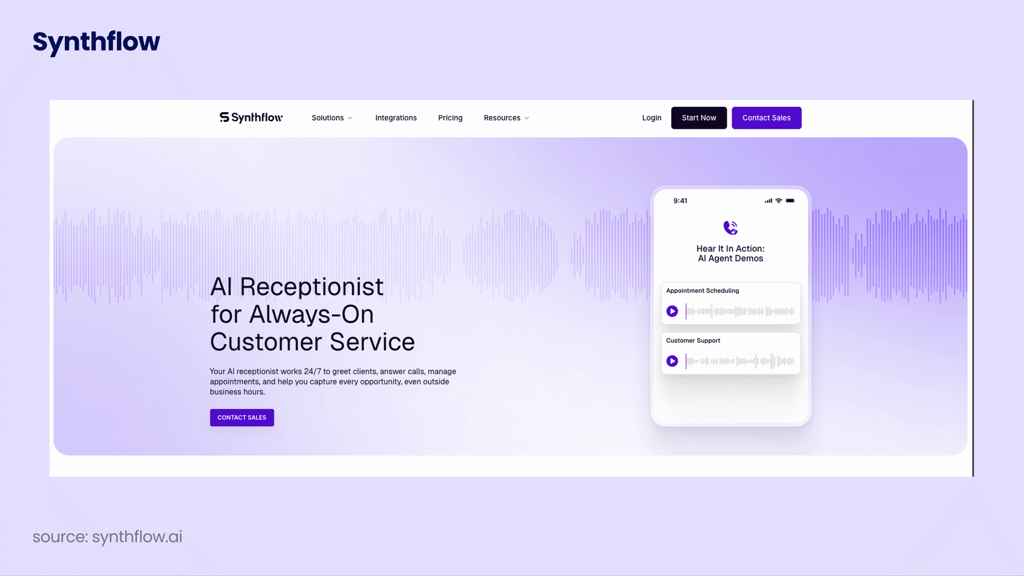
Synthflow AI is a no-code voice agent platform sold on enterprise contracts, aimed at teams that want a managed build without writing code. It reports handling over 65 million voice calls a month across 30+ countries.
Why Is Synthflow AI Better Than Talkie AI?
- It publishes its floor. You learn in ten seconds whether you're in the market, which is more than Talkie tells you.
- No-code build rather than healthcare-only. Broader use cases if your phone problem extends past the front desk, such as lead qualification.
- Scoping criteria are stated up front: call volume, concurrency, telephony setup and integrations.
What Does Synthflow AI Cost?
- Enterprise contracts start at $30,000 annually, roughly $2,500 per month, with the rest scoped per contract
- 4.5/5 on G2 from 1,000+ reviews, and 4.1/5 on Trustpilot from 200+ reviews
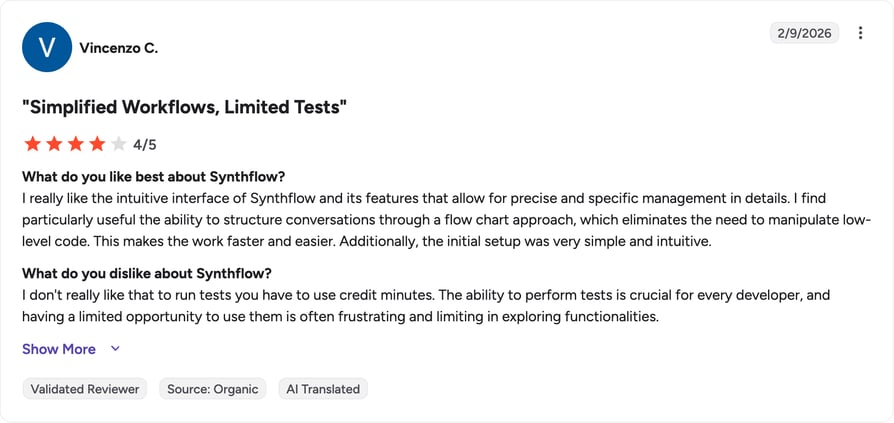
One of Synthflow's G2 reviews:
Where Could Synthflow AI Be Better?
A $30,000 annual floor rules out most solo and small practices before the conversation starts, and no-code rather than healthcare-specific means no native EHR depth.
4. Vapi: Best for developer teams building their own healthcare voice agent
What Is Vapi?
Vapi is a developer platform for building voice agents, with the lowest published headline rate in this comparison and the clearest public illustration of what healthcare compliance costs when a vendor prices it separately.
Why Is Vapi Better Than Talkie AI?
- The lowest published call rate here, at five cents a minute.
- Compliance is itemized rather than bundled, so you see exactly what you're paying for it.
- Concurrency is priced on the page, which most vendors in this category leave to a sales call.
What Does Vapi Cost?
- Calls at $0.05 per minute, SMS and chat at $0.005 per message
- 10 concurrent lines included, then $10 per line per month
- HIPAA add-on: $2,000 per month; Zero Data Retention add-on: $1,000 per month
- Models and voices billed at cost, or $0 if you bring your own API key; enterprise is volume-priced
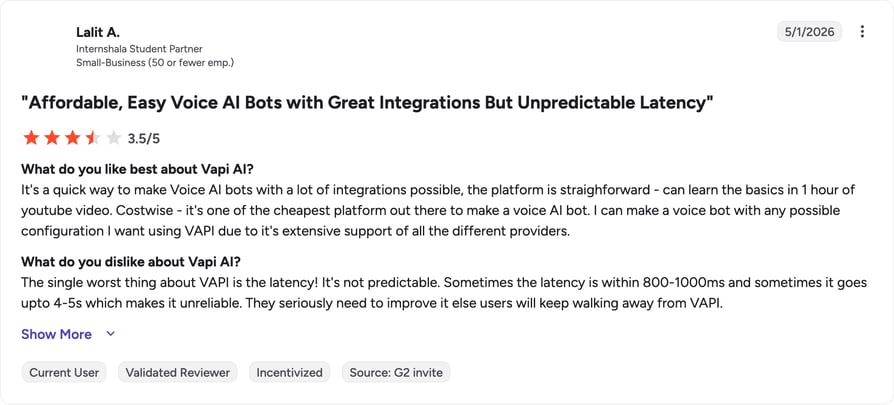
- G2: 4.2/5 from 3 reviews. That's a thin sample, similar to Talkie's own review base
One of Vapi's G2 reviews:
Where Could Vapi Be Better?
The HIPAA add-on costs 40 times the call rate for a small practice, which turns the cheapest option on paper into one of the more expensive ones in healthcare. Check the HIPAA call center requirements you have to meet before assuming an add-on covers them.
Run CloudTalk against a week of real patient calls before you commit to any vendor's quote.
Is Talkie AI Worth It? Who Should Buy It?
Buy Talkie.ai if you're a multi-provider practice on athenahealth, ModMed, Elation Health or eMedicalPractice, your phone problem is scheduling and intake rather than eligibility work, and you want compliance and configuration handled for you. The quote may well be justified even though you can't see it in advance.
Look elsewhere if you need a price before a sales call, you're a solo or two-provider practice, your EHR isn't on the supported list, or you need the agent to sit inside a wider phone system for healthcare that also handles outbound and non-clinical lines.
When the pricing makes sense, and when it stops. At 1,000 to 3,700 calls a month, where Talkie's published customer volumes sit, a committed bundle beats a per-minute meter, and bundled HIPAA and SOC 2 Type II coverage is worth real money against Vapi's $2,000 compliance line. Below roughly 1,000 calls a month, a quote scoped for a group is hard to justify against a published entry price. Either way, watch the pilot-to-contract step.
The wider context supports buying a voice agent of some kind. But it doesn't make the case for an agent whose price you can't see. If you need a number this quarter, price a transparent alternative alongside it and hold the Talkie quote against that.
Walk through the plans, AI minutes and healthcare setup with someone who knows both sides.
Talkie AI Pricing FAQ
Talkie AI's cost isn't published. There are no plan names, no per-seat or per-minute rate, and no pricing page, so a sales call is the only way to get a number. If you need a figure this week, price a virtual receptionist for healthcare that lists its rates instead.
Talkie AI pricing is calculated per quote, scoped on user count, practice size, call volume, which skills you switch on, EHR integrations and support level. Talkie positions against per-minute billing, so expect a committed bundle. Bring your own healthcare call center benchmarks or the vendor will pick the numbers for you.
Talkie AI offers no free plan and no free trial. There's no self-serve signup anywhere on the site; the entry point is a paid pilot of two to three months, arranged through sales. CloudTalk runs a 14-day free trial you can start without speaking to anyone.
Setup fees with Talkie AI are undisclosed rather than confirmed. Talkie configures and tests the agent itself and markets "no hidden fees," but no implementation, overage or integration price is published, so get each one in writing. Vendors that publish call center software for healthcare pricing let you check first.
Talkie AI doesn't say. Connectors for athenahealth, ModMed, Elation Health and eMedicalPractice are named, but none carries a published cost and Talkie never states whether integration work is bundled. CloudTalk lists its 95+ integrations from the Essential plan up, so you know before you buy.
Talkie AI is HIPAA compliant and has completed a SOC 2 Type II audit, both bundled rather than sold on top. That's worth real money, since Vapi charges $2,000 a month for HIPAA above its per-minute rate. Compare it with the other HIPAA-compliant telehealth platforms you're considering before calling a quote expensive.
Talkie AI takes about three weeks to go live, with Talkie's team handling configuration, prompting and testing rather than handing you a builder. A two to three month pilot follows before any longer contract. Narrower jobs like AI appointment scheduling can be live considerably faster elsewhere.
For a small practice, Talkie AI is worth it only if the pilot proves it, because you can't model the cost beforehand. Below roughly 1,000 calls a month, a quote scoped for a group is hard to justify. Price a published alternative alongside it and check the real use cases of AI voice agents in healthcare you'd actually automate.
CloudTalk publishes its pricing and Talkie AI doesn't, which is most of the comparison. CloudTalk's plans start at $25 per user per month, with AI Voice Agents always a paid add-on from $99 a month for 200 minutes. Talkie prices every deal privately, after a demo.