

1,500+
Reviews

260+
Reviews


4,000+
Customers
Google Voice Review 2026:
Features, Pricing & User Feedback
Exploring Google Voice for Business? Discover what real users say about call quality, features, and support—plus see how CloudTalk compares.
What is Google Voice?
Google Voice for Business is a cloud-based phone system built into the Google Workspace ecosystem.
It offers an AI-powered communication hub for small and mid-size businesses as well as mid-market enterprises that are already standardized on Google Workspace.
As a subscriber, you'll get native integration with Gmail, Google Calendar, Google Drive, and Gemini AI — offering call summaries, transcription, and automated note-taking without requiring third-party add-ons.
For lean teams that need a phone solution up and running quickly within their existing Workspace environment, Google Voice covers the basics well.
However, scaling teams scale with high-volume outbound calling needing CRM integrations outside the Google stack will find Google Voice limiting.
What are Google Voice's Key Features?
- Cloud-based calling via browser and mobile app (iOS & Android) — no dedicated desktop app
- Voicemail transcription and Gemini-powered "Take Notes for Me" call summaries
- Call Queuing and Ring Group Management (Standard and Premier plans)
- SIP Link support for connecting existing PSTN carrier contracts
- Interactive Voice Response (IVR) and basic call routing
- BigQuery integration for advanced reporting (Premier plan only)
- HIPAA-compliant configuration available
- Native Google Workspace integration (Gmail, Calendar, Drive, Meet)
What Do Users Say About Google Voice?
Based on 300+ verified reviews from G2, Capterra, and Trustpilot
😊 What Do Users Love About Google Voice?
- Near-zero learning curve for teams already using Gmail, Calendar, and Meet
- Fast, frictionless setup — most small businesses are live within hours
- Gemini "Take Notes for Me" summaries are searchable across the entire Workspace environment
- SIP Link flexibility allows gradual migration without breaking existing carrier contracts
- Competitive base pricing with no user minimums on the Starter plan
"Simple, easy to use, convenient to have an online phone number. I really like being able to respond to texts via a desktop computer, I can type way faster than I can text! We used it for our business, every day, for many years it did the trick for us."

😤 What Do Users Hate About Google Voice?
- No native integration with Salesforce, HubSpot, or Zendesk — requires manual logging or third-party middleware
- No toll-free or vanity number support — a significant gap for retail and service brands
- No dedicated desktop app; calls are browser-tab-dependent (missed calls if tab closes or browser crashes)
- SMS spam filters described as "aggressive" — legitimate business texts regularly dropped
- Number porting delays of 7–10+ days with limited human support available
- No power dialer or parallel dialer — outbound throughput is severely limited for sales teams
"There is a complete lack of features that you would get with paid services. Not auto-replies. Not even a built-in contact list. Also, it is very buggy. I experienced many dropped calls or calls that did not go through."
What Are People Saying About Google Voice on G2?
See what real users are saying about Google Voice on G2 — honest reviews, real experiences, and feedback from teams who have used it.

"I sometimes do not get calls that come through and will only get notifed through email that I missed a call. I also do not like the automated voice that answers people that call. I wish I could customize that or turn it off. Their mobile app is also sometimes not the most reliable. For example, today, I had about 5 missed calls in the morning, which I realized because I was sent email notifications, yet my app does not display them. It seems to happen more with spam calls and not real customer calls though. I just wish it would give more information as to why that happens."
Managing Partner/Creative Director

"What I dislike about Google Voice are: You cannot personalize your IVR the way you want it; No free call recording; No area code option for New York state location. Not even 1-800 number option to choose"
Executive Management Assistant

"The biggest drawback is the notifications. I'm not notified every time I receive a message, which can be frustrating because you have to constantly check your phone so that you don't miss anything."
Help Desk Agent
 Google Voice
 2025 Winter Leader
Looking for a Google Voice Alternative?
See why 5,500+ companies have switched to CloudTalk for clearer call quality and AI automation.





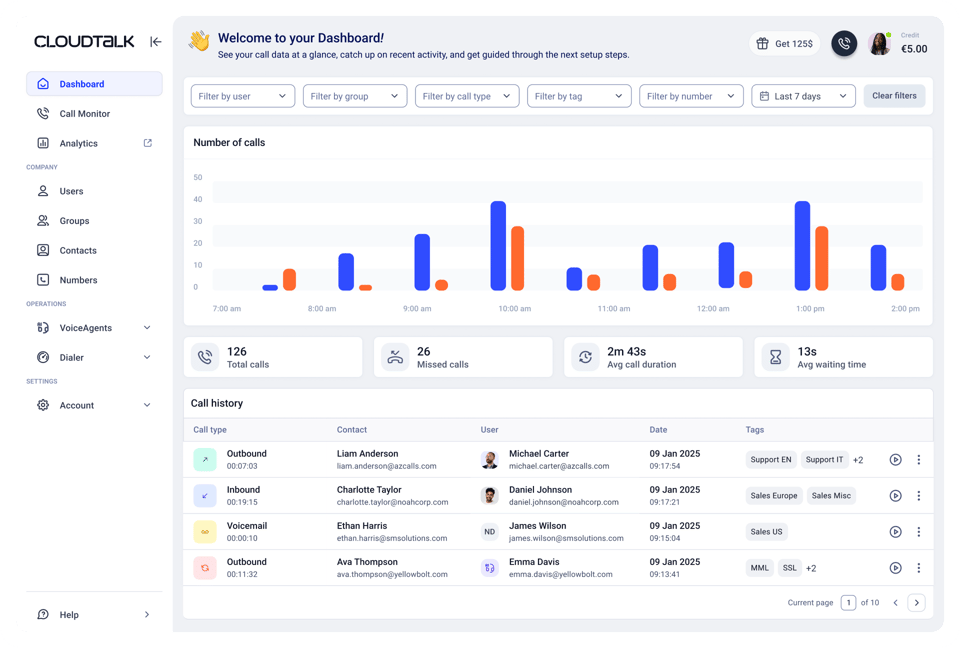
Top-rated on G2
Consistently rated highly on G2, CloudTalk helps teams ramp faster, avoid complexity, and rely on a phone system that works as expected from day one.
100+ integrations
Your CRM, helpdesk, and sales tools already talk to each other. CloudTalk just joins the conversation and makes it way more productive.
Coverage in 160+ countries
From next door to across the globe, CloudTalk keeps your calls clear, local, and ready to grow with your business.
CloudTalk vs Google Voice: Side-by-Side
See how CloudTalk delivers superior performance where it matters most
Why Choose CloudTalk Over Google Voice
CloudTalk delivers better, more accurate performance during every call
Businesses That Switched to CloudTalk
Real results from real companies that made the move—and never looked back.
"Thanks to CloudTalk, we managed to greatly improve our team’s cost and efficiency. The script feature allows us to lead the calls in a much more systematic way, as well as all the action buttons to trigger actions directly into our backend."
Global Supply Groowth at Glovo

“We were stuck at a 20–30% pickup rate with Aircall. With CloudTalk, we’ve hit 40–50%. That’s made all the difference.”
Chief Marketing Office at Velu
Frequently Asked Questions About Google Voice and CloudTalk
Yes. Google Voice is a fully cloud-based VoIP phone system that operates through a browser or mobile app. There is no dedicated desktop application, which means desktop users must keep a browser tab open to receive calls.
Google Voice can work well for very small teams (under 10 users) that are already fully embedded in Google Workspace and have minimal outbound calling needs. However, the Starter plan caps at 10 users, lacks toll-free numbers, and offers no outbound dialing tools. For small businesses with growth ambitions, these limitations tend to surface quickly.
No. Google Voice has no power dialer, no parallel dialer, and no voicemail drop. For outbound sales teams doing cold calling at volume, Google Voice is not a viable platform. CloudTalk's sales dialer suite — including Smart Dialer and Parallel Dialer — is purpose-built for this use case.
Google Voice plans start at $10/user/month, but that figure excludes the required Google Workspace subscription (starting at ~$7/user/month), making the real entry cost approximately $17/user/month. There is no annual billing discount. CloudTalk's pricing includes features like call recording, IVR, and analytics built in, without the mandatory ecosystem dependency. For a full Google Voice pricing breakdown, see our Google Voice pricing guide.
CloudTalk, decisively. Google Voice does not offer native bidirectional integration with Salesforce, HubSpot, or Zendesk. All non-Workspace CRM logging requires manual entry or third-party middleware. CloudTalk syncs in real-time with HubSpot, Salesforce, Zendesk, Zoho CRM, Pipedrive, and 100+ other tools automatically.
Google Voice introduced improved ring group management and call queuing in late 2025, which resolved some historical deficiencies. However, conditional routing logic remains limited compared to enterprise-grade platforms. CloudTalk's Call Flow Designer supports 20+ routing conditions — skills-based routing, VIP queues, callback, caller-based routing, and more — with no caps on complexity.
The most common reasons are: lack of native CRM integration outside Google's ecosystem, no outbound dialing tools for sales teams, no toll-free number support, SMS reliability issues, and limited human support during number porting. Teams that outgrow Google Voice's Workspace-centric model typically switch to CloudTalk for its sales dialer, AI Conversation Intelligence, and global number coverage.


Hello 👋 My name is Emma. Still have questions?
Can’t find the answer you’re looking for? Please chat with our friendly team.
Ready to Experience Superior Call Quality?
Join 5,500+ businesses that trust CloudTalk for their sales and support calls. See why CloudTalk delivers better results than Google Voice.



Reviews
1,500+

Reviews
260+


Customers
5,500+