Aircall vs Vonage (2026): Pricing, Features & Key Differences
TL;DR
Aircall and Vonage are not competing for the same buyer. Aircall is a voice-first call center built for sales and support teams who live in a CRM. Vonage Business Communications is a company-wide communications suite with calling, video for up to 200 participants, and team messaging on one licence. The right pick depends on scope, not on which product is better made.
Aircall fits teams whose day is the phone. It starts at $30/licence/month billed annually with a three-licence minimum, ships 250+ integrations with CRM connectors on the entry plan, includes call recording from Essentials, and adds a Power Dialer and Voicemail Drop on Professional at $50. It holds 4.4/5 on G2 from 1,644 reviews and scores 9.2/10 for ease of use.
Vonage fits companies replacing a phone system, a video tool, and a chat tool at once. The Mobile plan starts at $19.99/line/month, Premium at $29.99 adds video and integrations, and Advanced at $39.99 adds call recording. Prices fall as your line count rises. It holds 4.3/5 on G2 from 503 reviews and 4.0/5 on Capterra from 321.
Below we compare core strengths, features, total cost of ownership, pricing, integrations, security, usability, and what real users report on G2 and Capterra, with every figure checked against both vendors' current pages. Or jump straight to the at-a-glance table and find the row that decides it for you.
Both platforms serve calling teams well, and they serve different ones. Aircall is a purpose-built sales and support phone with deep native CRM integrations, call coaching, and fast number provisioning. Vonage Business Communications is a broader unified-communications suite with built-in video for up to 200 participants, native team messaging, and a lower headline price. Which one wins depends on your use case, not on a universal ranking.
Aircall suits teams whose revenue depends on the phone. If your reps work a list, log every conversation to Salesforce or HubSpot, and get coached on recordings, Aircall puts all of that inside one product and gets you live in an afternoon. It holds 4.4/5 on G2 from 1,644 reviews, with the highest ease-of-use score in this comparison.
Vonage suits companies buying communications rather than a call center. If you need a phone, a meeting room, and a chat tool on one invoice for everyone in the business, Vonage does that from $19.99 a line with no seat minimum, and gets cheaper per extension as you scale. It holds 4.3/5 on G2 from 503 reviews and 4.0/5 on Capterra from 321.
This aircall vs vonage 2026 comparison covers core strengths, features, total cost of ownership, aircall vs vonage pricing tier by tier, integrations, security and compliance, usability, and what real users report on G2 and Capterra. Every figure is checked against both vendors' current pages, and we flag the places where a vendor publishes nothing rather than filling the gap with a guess. Start with the at-a-glance table if you already know which dimension decides it.
Comparing Two Platforms and Still Not Seeing Your Use Case?
Aircall vs. Vonage: Core Strengths of Each Platform
Both platforms handle business calling well and both have been doing it for over a decade. They solve the problem at different scopes: Aircall is a purpose-built sales and support phone, Vonage is a communications backbone for the whole company. Read the two tables below as parallel descriptions rather than a run-up to a winner.
Where Aircall Shines
Where Aircall Shines
| Strength | Why It Matters |
|---|---|
| CRM integrations on the entry plan | HubSpot, Zendesk, Pipedrive, and Intercom connect on the $30 Essentials plan, with click-to-call inside the partner UI and calls logged automatically. Vonage puts its App Center on Premium, one tier up. |
| A purpose-built Power Dialer and Voicemail Drop | Reps work a list without touching a keypad, and Voicemail Drop removes the repeated 20-second message. It sits on Professional, and Vonage Business Communications has no equivalent at any tier. |
| Call recording from the cheapest plan | Recording is included on Essentials with up to a year of retention, and unlimited on Professional. On Vonage, recording is on-demand, capped at 15 hours a month, and only appears on the $39.99 Advanced plan. |
| Setup measured in an afternoon | G2 scores Aircall 9.2/10 for ease of use and 8.9 for ease of setup, both ahead of Vonage. A small team can buy in the morning and route calls after lunch, with almost no rep training. |
| 250+ integrations with API access on every tier | Aircall raised its published count from 100+ to 250+, against roughly 20 in the Vonage App Center. For a sales stack built from a CRM, a helpdesk, and three point tools, that gap is the whole decision. |
Where Vonage Shines
Where Vonage Shines
| Strength | Why It Matters |
|---|---|
| A $19.99 entry price with no seat minimum | One line, $19.99 a month. Aircall's three-licence floor makes $90 the smallest invoice it will write, so a two-person business pays four and a half times more to start. |
| Video for up to 200 participants, plus team messaging | Unlimited video meetings and native chat land on the same licence from Premium. Aircall offers neither at any price, so buying it means keeping a second vendor for both. |
| Prices that fall as you add lines | Vonage publishes seat bands: Mobile drops from $19.99 to $17.99 per extension at larger sizes, Premium from $29.99 to $24.99, Advanced from $39.99 to $34.99. Aircall charges the same per licence whether you buy 3 or 300. |
| A broad, independently audited certification list | Vonage publishes ISO 27001, PCI DSS, SOC, HITRUST, and CSA STAR across its product lines. Aircall holds SOC 2 Type 2, but its ISO 27001 certificate belongs to AWS as its host rather than to Aircall. |
| Single sign-on without an enterprise contract | SSO ships on the Premium plan at $29.99. On Aircall it is gated to the 25-licence Custom tier and documented as limited availability, which stalls a lot of mid-market security reviews. |
Neither list cancels the other out. The honest read of this vonage aircall comparison is that Aircall is deeper on the phone and Vonage is broader across the stack, and most buyers already know which of those two sentences describes their problem.
At a Glance: Aircall vs. Vonage, Key Differences
Use this table to find what matters most for your use case, then jump to the section that covers it in detail.
Aircall vs Vonage: Key Differences at a Glance
| Dimension | Aircall | Vonage (VBC) | Best Suited For |
|---|---|---|---|
| Primary use case | Voice-first call center for sales and support | Unified communications: voice, video, messaging | Sales and support teams living in a CRM vs. whole-company communications |
| Entry price | $30/licence/month (Essentials, annual) | $19.99/line/month (Mobile) | Budget-led buyers start with Vonage Mobile |
| Seat minimum and true entry invoice | 3 licences, so $90/month minimum | None published, so $19.99/month minimum | Solo operators and two-person teams |
| What the entry tier actually includes | 250+ integrations, IVR, call recording, SMS, unlimited outbound | Calling, SMS/MMS, voicemail. No integrations, video, recording or SSO | Teams that need a working system on day one, not a phone line |
| Call recording | Included from Essentials; unlimited retention on Professional | Advanced tier only, on-demand, capped at 15 hours/month | Any team that reviews or must retain calls |
| Dialer and sales tooling | Power Dialer and Voicemail Drop on Professional | Not offered in VBC at any tier | Outbound teams working a list |
| Video conferencing | Not offered | Unlimited meetings, up to 200 participants, from Premium | Companies folding a video tool into the phone bill |
| Team messaging | Not offered; Slack and Teams as integrations | Native team messaging from Premium | Teams without an existing chat tool |
| Integration count | 250+, with API access on every tier | 20+ in the VBC App Center, from Premium | Sales stacks built from several connected tools |
| Volume discounting | Flat per licence at every size | Published seat bands: price per extension falls as lines rise | Companies deploying 50 lines or more |
| G2 rating and review volume | 4.4/5 from 1,644 reviews | 4.3/5 from 503 reviews | Similar scores, very different sample sizes |
The short read: Aircall wins the rows about dialing, recording, and integrations. Vonage wins the rows about entry cost, scope, video, and volume discounting. Nothing in the table settles it on quality, because that is not where these two differ.
Aircall Features vs. Vonage Features
Aircall Features
Aircall consolidates what an outbound-focused team touches every day: a dialer, a shared inbox for calls and SMS, and a CRM sync that logs the conversation without a rep opening a notes field. Everything else is built around that loop, and the platform spent the last year buying deeper into AI, acquiring the speech company Vogent in May 2026 and the revenue intelligence company Piper AI in June 2026.
What Aircall Does Well
- Purpose-built Power Dialer and click-to-callReps work through a list without dialing, with Voicemail Drop to skip the repeated greeting. Both sit on Professional at $50/licence/month.
- Call recording included from the entry planUp to a year of retention on Essentials and unlimited on Professional, against Vonage's 15 hours a month on its top tier.
- 250+ native integrations with API access on every tierHubSpot, Zendesk, Pipedrive, and Intercom connect on Essentials. Salesforce CTI sits on Professional, and Aircall for Salesforce Voice is a separate per-licence purchase.
- AI Assist Pro for live coachingLive transcription, live prompts, playbook templates for SPICED, BANT, MEDDIC, and PACTT, custom scorecards, and automatic PCI, PII, and PHI redaction. $49/licence/month on top of any plan.
- AI Voice Agent with a free tier on every plan50 free minutes per account per month, then bundles from $175 for 500 minutes or pay-as-you-go at $0.49/minute up to 2,500 minutes.
Where Aircall Falls Short
- Three-licence minimum on both self-serve plansYou cannot buy one seat or two. The real entry invoice is $90/month against Vonage's $19.99, and Custom jumps to a 25-licence minimum with no middle step.
- No native video conferencing or team messagingAircall is voice, SMS, and WhatsApp. If your company needs meetings and internal chat, that is a second vendor and a second invoice, which Vonage folds into one licence.
- Conversation intelligence is a paid add-on below ProfessionalAI Assist costs $9/licence/month on Essentials and is only bundled once you reach the $50 tier. Analytics retention stops at six months unless you add Analytics+ at $15/licence.
- SMS works in only 13 countriesNumbers are available in 100+ countries, but texting is not. Multi-market teams routinely discover this after signing, and there is no add-on that fixes it.
- Reviewers report rigid contracts and call quality dipsCapterra rates Aircall's value for money 3.9/5, its weakest sub-score, and reviewers cite forced full-price renewals, difficulty reducing seats, and dropped calls or echo on international routes.
Vonage Features
Vonage Business Communications bundles voice, video, and messaging with a lower headline price and a plan ladder that gates by capability rather than by volume. Mobile is a phone line. Premium turns it into a communications platform. Advanced adds the recording and voicemail transcription most teams assume they were already buying. Anything resembling a contact center lives in Vonage Contact Center, a separate product.
What Vonage Does Well
- Unlimited video meetings for up to 200 participantsFrom the Premium plan, on the same licence as calling. That participant ceiling is higher than most bundled video in this category, and Aircall has no answer to it.
- An entry price of $19.99 with no published seat minimumA single line costs $19.99 a month, so a founder or a two-person business can start without buying seats nobody sits in.
- Published volume pricing rather than a negotiationPer-extension rates fall as line counts rise: Mobile from $19.99 to $17.99, Premium from $29.99 to $24.99, Advanced from $39.99 to $34.99.
- Native team messaging and desk phone supportBoth land on Premium, so a company replacing a legacy PBX keeps its handsets and drops its chat tool at the same time.
- Single sign-on from the middle tierSSO ships on Premium at $29.99, where Aircall reserves it for a 25-licence enterprise contract. For a mid-market security review, that is a meaningful difference.
Where Vonage Falls Short
- The Mobile plan is a phone line, not a phone systemAt $19.99 you get calling, SMS/MMS, and voicemail. No integrations, no video, no call recording, no team messaging, no SSO, and no desk phone support. The headline price buys less than most buyers assume.
- Call recording is capped at 15 hours a month, on the top tierOn-demand recording arrives only on Advanced at $39.99, and 15 hours is roughly 45 minutes a working day across the whole allowance. Aircall includes recording at $30 with a year of retention.
- No dialer of any kindThere is no power, parallel, or predictive dialing mode in VBC at any tier. An outbound team on Vonage is dialing manually or paying for Vonage Contact Center as a second product.
- Roughly 20 integrations, and only from PremiumThe VBC App Center is an order of magnitude smaller than Aircall's library, and the $19.99 plan does not reach it at all. Check your specific CRM before assuming a connector exists.
- Annual cancellation fees run up to the total contract priceVonage requires a one-year minimum on new annual accounts and states that cancelling one can cost up to the full remaining contract value. Monthly plans carry no early termination fee, and cost more.
Feature-by-Feature Comparison
CloudTalk is included as a third column because it covers nearly every row: dialer, native CRM sync, recording, and call flow design sit inside one product, which makes it a useful reference point rather than a detour. Anyone scanning aircall vs vonage features on a spec sheet will notice how cleanly the rows split.
Feature-by-Feature Comparison
| Feature | Aircall | Vonage (VBC) | CloudTalk |
|---|---|---|---|
| Power (sequential) dialer | Included on Professional | Not offered at any tier | Included on Expert |
| Parallel dialer | Not available at any tier | Not available at any tier | Up to 5 lines per agent with voicemail detection |
| Call recording | From Essentials; up to 1 year, unlimited on Professional | Advanced only, on-demand, 15 hours per month | Unlimited from Essential |
| Native CRM sync | HubSpot, Zendesk, Pipedrive from Essentials; Salesforce CTI on Professional | App Center from Premium, roughly 20 integrations | 95+ CRM, helpdesk and ATS integrations from Essential, two-way sync |
| AI transcription and call summaries | AI Assist: $9/licence add-on on Essentials, bundled on Professional | Visual voicemail transcription on Advanced; no call-level AI summaries published | In the $9/user/month AI add-on, on any plan |
| Live in-call prompts and playbooks | AI Assist Pro, $49/licence/month | Not offered in VBC | Not currently offered |
| Video conferencing | Not offered | Unlimited, up to 200 participants, from Premium | Not offered; runs through integrations |
| Team messaging | Not offered | Native, from Premium | Not offered |
| IVR and call flow builder | IVR from Essentials; smart routing on Professional | Call groups from Advanced; virtual receptionist across tiers | Drag-and-drop Call Flow Designer on every plan |
| SMS coverage | SMS and MMS included, but only in 13 countries | SMS and MMS from the Mobile plan | Included from Essential |
| Seat minimum | 3 licences; 25 on Custom | None published | 1 licence on entry plans |
| Local numbers | 100+ countries | Numbers across North America, Europe and APAC; check your markets | 160+ countries |
Total Cost of Ownership: Aircall vs. Vonage
Headline per-seat pricing decides very little here. Vonage looks $10 cheaper at $19.99 against Aircall's $30, until you notice that the $19.99 plan has no integrations, no recording, and no video, so most teams comparing like for like are really comparing Aircall Essentials against Vonage Premium or Advanced. Do that and the gap closes to nothing, or reverses. The only fair comparison is a twelve-month total built on the tier that actually carries the features you need.
Total Cost of Ownership for a 10-Person Team
| Dimension | Aircall | Vonage (VBC) | CloudTalk |
|---|---|---|---|
| Headline entry price | $30/licence/month | $19.99/line/month | $25/user/month |
| What the entry tier excludes | Dialer, Salesforce CTI, AI Assist, unlimited analytics retention | Integrations, video, recording, team messaging, SSO, desk phones | Dialers and advanced routing, which sit on Expert |
| Cheapest tier with recording and CRM sync | Essentials, $30 (Salesforce CTI needs Professional at $50) | Advanced, $39.99 | Essential, $29 |
| Base plan, 10 people | $300/month (Essentials) or $500 (Professional) | $199.90 (Mobile), $299.90 (Premium), $399.90 (Advanced) | $290/month (Essential) or $490 (Expert) |
| AI conversation intelligence | $90/month add-on on Essentials; bundled on Professional | Not offered in VBC at any price | $9/user/month on any plan |
| Other add-ons likely to appear | AI Assist Pro $49, Analytics+ $15, Salesforce Voice $30, WhatsApp $10, numbers $6 | Vonage Contact Center for any dialing or omnichannel work, priced separately | Extra numbers from $6; Salesforce included on Expert |
| Typical all-in, 10 people with recording, CRM and reporting | $650/month (Professional plus Analytics+) | $400/month (Advanced), but with no dialer and no call AI | $580/month (Expert plus AI, dialer and Salesforce included) |
| Contract flexibility | Annual-first; monthly available at roughly 33% more | 1-year minimum on new annual accounts; cancellation up to the full contract value | Monthly or annual on every plan |
The Line Item Nobody Prices In
Vonage's own terms state that new annual accounts carry a one-year minimum and that cancelling one early can cost up to the total remaining contract price. Monthly plans carry no early termination fee but cost more per line. Aircall does not publish comparable termination language, though reviewers report forced full-price renewals and difficulty reducing licence counts. On either platform, get the exit terms in writing before you sign the entry terms.
The cost read: Vonage is genuinely cheaper for a team that answers calls and runs meetings, and cheaper still at 50 lines or more where the seat bands kick in. Aircall costs more and earns it back only if you use the dialer, the recording, and the integrations. Anyone modelling vonage vs aircall pricing on entry tiers alone is comparing two different products.
Aircall Pricing vs Vonage Pricing
Aircall Pricing
Aircall sells three plans, all with licence minimums, and the minimum is the part most buyers miss.
- Essentials : $30/licence/month billed annually, $40 monthly. Minimum three licences, so $90/month is the entry invoice. 250+ integrations with API access, IVR, call recording with up to one year of retention, click-to-dial, SMS and MMS, desktop and mobile softphones, unlimited simultaneous outbound calls, and 50 free AI Voice Agent minutes a month. Capped at three teams, with up to six months of basic analytics.
- Professional : $50/licence/month annually, $70 monthly. Minimum three licences, so $150/month to start. Everything in Essentials plus Salesforce CTI, Power Dialer, Voicemail Drop, smart routing, live monitoring, mandatory call tagging, advanced analytics, and AI Assist bundled rather than added on.
- Custom : quote-based. Minimum 25 licences. Everything in Professional plus custom onboarding, API developer support, a contractual SLA, unlimited analytics retention, and single sign-on.
Aircall Add-Ons Are Where the Quote Moves
AI Assist $9/licence/month (bundled from Professional) · AI Assist Pro $49/licence/month on top of any plan · Analytics+ $15/licence/month for unlimited retention · Aircall for Salesforce Voice $30/licence · WhatsApp in Aircall $10/licence/month · extra phone numbers $6 each per month. AI Voice Agent: 50 free minutes per account per month, then $175 for 500 minutes, $725 for 2,500, or pay-as-you-go at $0.49/minute.
Vonage Pricing
Vonage Business Communications prices per line, and the rate drops as your line count rises. The figures below are the small-business band; medium and enterprise bands run $2 to $5 lower per extension. This is separate from Vonage Contact Center and the Communications APIs, which are priced on their own pages.
- Mobile : $19.99/line/month, falling to $17.99 per extension at larger sizes. Desktop and mobile apps, unlimited domestic calling, SMS and MMS, and voicemail. No integrations, no video, no call recording, no team messaging, no SSO, no desk phone support.
- Premium : $29.99/line/month, falling to $24.99 at enterprise scale. Everything in Mobile plus desk phone support, unlimited video meetings for up to 200 participants, team messaging, the VBC App Center with roughly 20 integrations, and single sign-on.
- Advanced : $39.99/line/month, falling to $34.99 at enterprise scale. Everything in Premium plus on-demand call recording capped at 15 hours a month, visual voicemail with transcription, and call groups.
Two Things to Confirm Before You Sign With Vonage
First, the promotional price is not the list price. Vonage runs recurring discounts of around 30% off the first months, and the rates above are list. Ask which price applies from month 13. Second, the contract: new annual accounts carry a one-year minimum, and Vonage states that early cancellation can cost up to the total contract price. Monthly billing avoids that and costs more.
Pricing Compared Line by Line
Pricing Compared Line by Line
| Pricing Dimension | Aircall | Vonage (VBC) | CloudTalk |
|---|---|---|---|
| Lowest entry price | $30/licence/month | $19.99/line/month | $25/user/month |
| Seat minimum on the entry plan | 3 licences | None published | 1 licence |
| True minimum monthly spend | $90 | $19.99 | $25 |
| Call recording included at entry | Yes, up to 1 year retention | No, Advanced tier only and capped at 15 hours/month | Yes, unlimited from Essential |
| Tier that unlocks CRM integrations | Essentials, the entry plan | Premium, one tier up from entry | Essential |
| Video conferencing included | Not offered at any price | Yes, from Premium, up to 200 participants | Not offered; runs through integrations |
| Volume discounting published | No, flat per licence | Yes, three published seat bands | Custom pricing above 25 users |
| Contract terms | Annual-first, monthly at roughly 33% more; no published termination fee | 1-year minimum on annual; cancellation up to full contract value | Monthly or annual, published on every plan |
| Notable add-on costs | AI Assist Pro $49, Analytics+ $15, Salesforce Voice $30, WhatsApp $10 | Vonage Contact Center for dialing or omnichannel, quoted separately | AI Conversation Intelligence $9/user/month |
For reference, CloudTalk pricing starts at $25/user/month with a one-licence minimum and publishes every rate, which makes it a useful third data point next to two platforms whose real cost depends entirely on which tier you land on.
Aircall Integrations vs. Vonage Integrations
Aircall Integrations
Aircall publishes 250+ integrations, up from the 100+ figure most comparison pages still quote, and it does not gate them by plan: API access and the standard connector library are available from Essentials. The depth is aimed at sales and support workflows, with HubSpot, Zendesk, Pipedrive, Intercom, Front, and Slack all carrying click-to-call inside the partner UI and logging calls back automatically.
Salesforce is the exception worth pricing carefully. Salesforce CTI sits on Professional, and Aircall for Salesforce Voice is a separate $30/licence purchase on top of that.
Vonage Integrations
Vonage Business Communications routes integrations through the VBC App Center, which Vonage's own pricing page describes as carrying roughly 20+ integrations, and which is available from the Premium plan upward. Salesforce, Microsoft Teams, and Google Workspace are the headline connectors, and the Microsoft Teams tie-in is genuinely useful for a company already standardised on Microsoft.
Two caveats. The $19.99 Mobile plan reaches none of it, so any comparison against Aircall Essentials should use Premium at $29.99 as the real starting point. And Vonage does not publish per-connector sync depth, so if two-way CRM write-back matters to you, ask what actually lands on the record rather than assuming parity with Aircall. This is the sharpest difference in any aircall vs vonage integrations assessment.
Integration Capability Compared
Integration Capability Compared
| Integration Capability | Aircall | Vonage (VBC) | CloudTalk |
|---|---|---|---|
| Total native integrations | 250+ | 20+ in the VBC App Center | 95+, deep CRM focus |
| Plan that unlocks integrations | Essentials, the entry plan | Premium, one tier up from entry | Essential |
| Salesforce | CTI on Professional; Salesforce Voice a separate $30/licence | Named in the App Center; sync depth not published | Full CTI on Expert, plus a pre-built Support KPIs dashboard |
| HubSpot | Native from Essentials | Not named on the pricing page; confirm with sales | Two-way sync, CTI, campaign result export |
| Microsoft and Google tooling | Slack and Teams available as integrations | Microsoft Teams and Google Workspace, a genuine strength | Microsoft Teams and Google Workspace supported |
| Helpdesk integrations | Zendesk, Intercom, Front, Help Scout | Limited; check the App Center for your tool | Zendesk, Freshdesk, Intercom, Help Scout, Front, Gorgias |
| Developer requirement | API on all tiers; developer support on Custom only | Vonage's APIs are a separate product line with its own pricing | Public API and webhooks; native integrations are an OAuth setup |
The integrations read: Aircall, decisively, and it is the least contested section here. Vonage wins only if your stack is Microsoft Teams and Google Workspace and nothing else.
Security & Compliance: Aircall vs. Vonage
If you are in healthcare, financial services, or anywhere with a legal team that reads vendor questionnaires, this section decides the deal before pricing does.
Vonage Security & Compliance
- A broad published certification listVonage states it maintains ISO 27001, PCI DSS, SOC, HITRUST, and CSA STAR across its product lines, independently tested and audited by third parties.
- Certifications are listed by company, not by productVonage does not publish which certification applies to Vonage Business Communications specifically, as opposed to the APIs or Contact Center. Ask for the certification scope covering VBC in writing.
- Single sign-on from the Premium planSSO ships at $29.99 rather than being reserved for an enterprise contract, which clears one of the most common mid-market procurement blockers.
- SOC 2 Type II confirmed for Network APIsVonage announced SOC 2 Type II compliance for its Network APIs specifically. Whether the same attestation covers VBC is not stated publicly.
- No published uptime SLA percentage for VBCWe could not find a numeric uptime commitment for Business Communications on Vonage's own pages. If uptime is contractual for you, get the number from sales rather than from a comparison page.
Aircall Security & Compliance
- SOC 2 Type 2 certifiedStated outright on Aircall's security page, alongside regular third-party penetration testing and a bug bounty programme.
- Encryption in transit and at restTLS 1.2 in transit, AES-256 at rest, and SRTP on the calls themselves, with two-factor authentication available.
- GDPR compliant, with EU-US Data Privacy Framework commitmentsThe DPA covers the EU-US, Swiss-US, and UK extensions, and Aircall's Data Protection Officer is registered with the French CNIL.
- ISO 27001: aligned, not certifiedAircall describes its programme as aligned with ISO 27001; the certificate it cites belongs to AWS as its host. If procurement needs a certificate with Aircall's name on it, ask specifically.
- Single sign-on is gated to the 25-licence Custom tierAircall's own help documentation describes SAML SSO as available to a limited number of customers and requiring a support request. This stops a lot of mid-market security reviews.
- 99.95% uptime commitment, contractual SLA on Custom onlyData residency is AWS Oregon, Frankfurt, or Sydney, assigned by account region. We could not find a published HIPAA or BAA commitment on Aircall's security or legal pages.
Security & Compliance Compared
Security and Compliance Compared
| Security & Compliance | Aircall | Vonage |
|---|---|---|
| SOC 2 | Type 2 certified, stated for the platform | SOC listed; Type II confirmed for Network APIs, VBC scope not stated |
| ISO 27001 | Not certified; programme aligned, certificate belongs to AWS | Listed across product lines |
| HITRUST and CSA STAR | Not published | Both listed |
| PCI DSS | Not published; PCI redaction available in AI Assist Pro | Listed |
| GDPR | Compliant; DPA applies automatically, DPO registered with the CNIL | Covered in the privacy policy; specifics not detailed on the security page |
| HIPAA and BAA | No published commitment found; confirm in writing | Not stated on the security overview; HITRUST listed. Confirm scope |
| Encryption standard | TLS 1.2 in transit, AES-256 at rest, SRTP on calls | Not detailed on the security overview page |
| SSO / SAML | 25-licence Custom tier, described as limited availability | Included from the Premium plan at $29.99 |
| Uptime commitment | 99.95%, contractual SLA on Custom only | No numeric SLA published for VBC |
The compliance read: Vonage on breadth of certifications and on SSO availability, Aircall on specificity. Vonage lists more credentials but does not map them to VBC; Aircall names fewer but says exactly what covers the product. Both leave HIPAA unresolved on their public pages, so a healthcare buyer has a question to ask either way.
Usability & Scalability: Aircall vs. Vonage
Aircall Usability
Aircall's reputation for a clean interface is well earned and it is the strongest practical argument for buying it. G2 scores it 9.2/10 for ease of use and 8.9 for ease of setup, both ahead of Vonage, and small teams routinely report being live the same day.
The cost of that design shows up later. Routing options are simpler because there are fewer of them, analytics stop at six months without the $15 Analytics+ add-on, Essentials caps you at three teams, and there is no parallel or predictive dialing mode. Scaling down is the other constraint: the three-licence floor means a team that shrinks to two still pays for three, and reviewers consistently flag rigid renewals as the sharpest edge of the platform.
Vonage Usability
Vonage covers more surface area, and the admin experience reflects it. G2 puts ease of use at 8.9 and ease of setup at 8.7, both respectable and both below Aircall. Capterra is harsher: 4.0/5 overall from 321 reviews, with customer service at 3.7 and value for money at 3.8, its two weakest sub-scores.
The recurring complaints are specific and worth testing for. Reviewers on both platforms report dropped calls, missed call notifications, calls going straight to voicemail rather than ringing through, app crashes, and SMS that fails to deliver. Support responsiveness is the other consistent theme. None of that is universal, and Vonage's 4.3/5 on G2 says most customers do not hit it, but any serious aircall vs vonage call quality assessment should include a trial on your own routes rather than a reading of average scores.
Usability & Scalability Compared
Usability and Scalability Compared
| Dimension | Aircall | Vonage (VBC) |
|---|---|---|
| First-day setup speed | Hours, among the fastest in the category | Days for a multi-site or desk-phone rollout |
| Ease of use (G2) | 9.2/10 | 8.9/10 |
| Ease of setup (G2) | 8.9/10 | 8.7/10 |
| Meets requirements (G2) | 8.8/10 | 9.0/10 |
| Conference calling (G2) | 8.2/10 | 9.1/10 |
| Reported call quality issues | Dropped calls and echo on international routes | Dropped calls, missed notifications, calls going to voicemail, SMS delivery failures |
| Support satisfaction | 8.6/10 on G2; human support hours not published | 8.7/10 on G2, but 3.7/5 for customer service on Capterra |
| Ability to scale down | Floor of 3 licences; reviewers report rigid offboarding | No seat floor, but annual cancellation can cost the full contract value |
| Scalability across departments | Sales and support only; Essentials caps at three teams | Whole company, plus Vonage Contact Center for contact center scale |
The usability read: Aircall for the first month, Vonage for the company-wide rollout. That trade-off is real and it is the most honest way to describe the difference.
Vonage Reviews vs. Aircall Reviews on G2 and Capterra
G2 and Capterra are the two most widely used peer review platforms for business software. One caveat before reading the numbers: Aircall's G2 sample is more than three times larger than Vonage's, at 1,644 reviews against 503, so treat small gaps in the sub-scores as noise rather than signal. Anyone researching aircall vs vonage reviews should weigh sample size alongside the score itself.
G2 and Capterra Ratings Compared
Ratings Compared
| Review Dimension | Aircall | Vonage (VBC) |
|---|---|---|
| Overall G2 rating | 4.4/5 | 4.3/5 |
| Number of G2 reviews | 1,644 | 503 |
| Meets requirements | 8.8 | 9.0 |
| Ease of use | 9.2 | 8.9 |
| Ease of setup | 8.9 | 8.7 |
| Quality of support | 8.6 | 8.7 |
| Conference calling | 8.2 | 9.1 |
| Capterra overall | 4.2/5 from 465 reviews | 4.0/5 from 321 reviews |
| Capterra value for money | 3.9/5 | 3.8/5 |
| Capterra customer service | Not separately reported here | 3.7/5, its weakest sub-score |
Aircall leads on ease of use, setup, and overall score on both platforms. Vonage leads on meets requirements and conference calling, which is exactly what you would expect from a broader suite with real video behind it. Neither gap is large enough to decide a purchase on its own.
What Real Users Say About Aircall
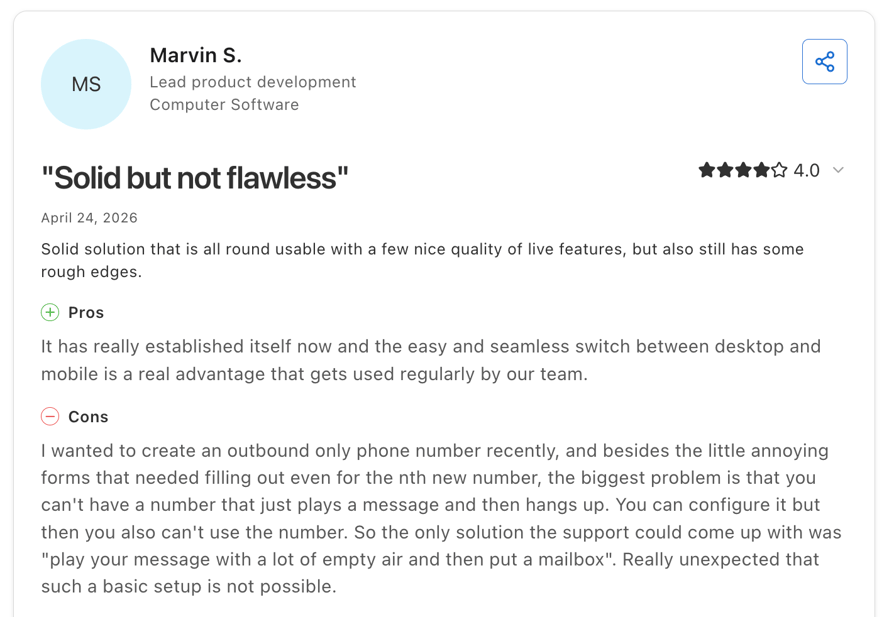
The pattern across Aircall's critical reviews is consistent: the product is liked, the price and the contract are not. Dropped calls, echo, and audio lag come up on international routes and during high-volume periods, and offboarding is the loudest theme, with reviewers describing forced full-price renewals and difficulty reducing seats. Capterra's 3.9/5 for value for money is its weakest score.
What Real Users Say About Vonage
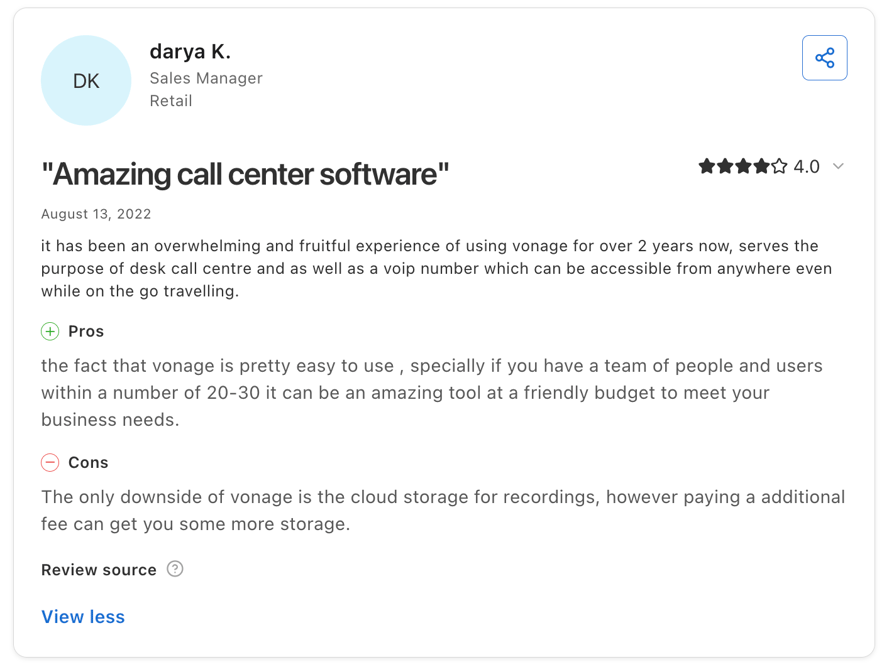
Vonage's critical reviews cluster around reliability rather than packaging. Capterra reviewers report dropped calls, missed call notifications, incoming calls going straight to voicemail, app crashes, and SMS that fails to deliver, alongside inconsistent support response times. Several small-business reviewers also describe it as expensive relative to competitors, which is notable for a platform with a $19.99 entry price and reflects how much sits above that tier.
Vonage Pros & Cons vs. Aircall Pros & Cons
Vonage Pros & Cons
| Pros | Cons |
|---|---|
| $19.99 entry price with no published seat minimum, so one line is a valid purchase | The $19.99 Mobile plan has no integrations, no video, no recording, no messaging and no SSO |
| Unlimited video for up to 200 participants and native team messaging from Premium | Call recording is on-demand, capped at 15 hours a month, and only on the $39.99 Advanced tier |
| Published seat bands, so the per-extension price falls as the deployment grows | No dialer of any kind, so outbound teams need Vonage Contact Center as a second product |
| Broad certification list including ISO 27001, PCI DSS, HITRUST and CSA STAR | Roughly 20 integrations in the App Center, and none at all on the entry plan |
| Single sign-on and desk phone support from the middle tier rather than an enterprise contract | Annual contracts carry a one-year minimum and cancellation can cost the full contract value |
Aircall Pros & Cons
| Pros | Cons |
|---|---|
| 250+ integrations with CRM connectors and API access on the entry plan | Three-licence minimum on both self-serve plans, so $90/month is the real entry price |
| Call recording included from Essentials, with unlimited retention on Professional | No native video conferencing or team messaging, so both need a second vendor |
| Purpose-built Power Dialer, Voicemail Drop and call tagging for outbound teams | AI Assist is a $9/licence add-on below Professional, and Analytics+ costs $15 for full retention |
| Highest ease of use and ease of setup scores in this comparison, at 9.2 and 8.9 on G2 | SMS works in only 13 countries despite numbers in 100+ |
| AI Assist Pro delivers live prompts, playbooks and custom scorecards mid-call | SAML SSO is gated to the 25-licence Custom tier, and no HIPAA or BAA commitment is published |
Want a Third Data Point Before You Commit?
Which Team Fits Which Platform?
Fit here comes down to a single question: does your team need a purpose-built sales and support phone, or a company-wide communications suite with video and messaging? Answer that and the rest follows. This is the practical version of aircall vs vonage for small business: the same product can be the obvious choice or the obvious mistake depending on which of those two sentences you just nodded at.
Aircall vs Vonage: Which Fits Your Team
| Aircall Is the Right Fit For… | Vonage Is the Right Fit For… |
|---|---|
| Sales and support teams living inside Salesforce, HubSpot or Zendesk | Companies wanting one vendor for phone, video and team messaging |
| Outbound teams that need a dialer and voicemail drop inside the plan | Solo operators and two-person businesses that cannot justify three licences |
| Teams that record and review calls as a matter of routine | Businesses deploying 50 lines or more, where the seat bands cut the per-user rate |
| Teams that already own video and chat and don't want to pay for them twice | Companies keeping desk phones through a PBX replacement |
| Teams that need to be live this week with minimal rep training | Mid-market buyers whose security review requires SSO without an enterprise contract |
| Sales orgs where call tagging and dispositions drive the pipeline report | Microsoft-first organisations that want calling alongside Teams and Google Workspace |
Vonage vs. Aircall: The Verdict
The choice comes down to scope and to how much tiered feature-gating you can tolerate, not to platform quality. Aircall gates AI and analytics retention behind add-ons; Vonage gates integrations, video, and recording behind tiers. Both are mature, both are well reviewed, and buying the wrong one usually means buying the right product for someone else's problem.
Choose Vonage If You…
- Are replacing a phone system, a video tool, and a chat tool at the same time
- Need one or two lines, because Aircall's three-licence minimum makes $90 its smallest invoice
- Are deploying 50 lines or more and want published volume pricing rather than a negotiation
- Need single sign-on without signing a 25-seat enterprise contract
- Are keeping desk phones and want native support for them rather than a softphone-only platform
Choose Aircall If You…
- Run outbound at volume and need a Power Dialer and Voicemail Drop inside the plan
- Want CRM connectors working on the entry tier rather than one tier up
- Record calls as routine and cannot work inside a 15-hour monthly cap
- Run a stack of more than three connected tools and need a library of 250+ integrations
- Need live coaching during calls, with prompts and playbooks a manager can build
- Already own video and team chat and don't want to pay for a second copy of either
- Need to be live this week with reps who get no training beyond a walkthrough
- Have at least three people, because the three-licence minimum is not negotiable
The Bottom Line
These two solve related but different problems. Aircall wins on dialing, recording, integrations, and speed to first call. Vonage wins on entry price, video, volume discounting, and single sign-on availability. If your team spends its day on outbound calls, Aircall's higher price buys capability Vonage does not sell at any tier. If your company needs a phone, a meeting room, and a chat tool on one invoice, Vonage does that for less and Aircall does not do it at all.
Not Sure Which of the Three Fits Your Team?

Sources:
- Aircall, pricing and security pages
- Vonage, Business Communications pricing and security pages
- G2, Aircall vs Vonage Business Communications head-to-head
- Capterra, Aircall reviews and Vonage Business Communications reviews
Frequently Asked Questions About Aircall vs Vonage
Direct answers to the questions buyers ask most when comparing Aircall and Vonage.
For sales and support teams, yes. Aircall gives you 250+ integrations and call recording on its $30 entry plan, plus a Power Dialer on Professional that Vonage Business Communications does not offer at any tier. For a company that needs phone, video, and team chat on one licence, Vonage is better and cheaper. Neither is better in the abstract, which is why is aircall better than vonage is the wrong question to start with. Ask what your team does all day first.
Mobile is $19.99 per line per month, Premium $29.99, and Advanced $39.99, with no published seat minimum. Rates fall at larger line counts, to $17.99, $24.99, and $34.99 per extension respectively. Those are list prices; Vonage runs recurring promotional discounts, so confirm which rate applies after the promotional period ends. Vonage Contact Center and the Communications APIs are priced separately.
Yes, from the Premium plan at $29.99 per line, with unlimited meetings for up to 200 participants on the same licence as calling. The $19.99 Mobile plan does not include video at all. Aircall offers no native video conferencing at any price, so a team that needs meetings on Aircall is also paying for Zoom or Google Meet.
Nothing hidden, but plenty that is easy to miss. The three-licence minimum makes $90 the real entry invoice rather than $30. AI Assist costs $9 per licence below Professional, Analytics+ is $15 for unlimited retention, Aircall for Salesforce Voice is $30 per licence, WhatsApp is $10, and extra numbers are $6 each. Aircall does not publish regulatory recovery fees, which some competitors do add.
Aircall, and it is not close. Vonage Business Communications has no dialer of any kind, so reps dial manually or the company buys Vonage Contact Center as a second product. Aircall ships a Power Dialer and Voicemail Drop on Professional, call tagging that feeds the pipeline report, CRM connectors on the entry plan, and AI Assist Pro for live coaching at $49 per licence. On aircall vs vonage business communications for outbound specifically, the gap is structural rather than a matter of degree.
No to both, and this is the single most important thing to understand about Vonage pricing. The $19.99 Mobile plan includes calling, SMS and MMS, and voicemail, and nothing else: no integrations, no video, no recording, no team messaging, no SSO. Integrations start at Premium ($29.99) and call recording at Advanced ($39.99), where it is on-demand and capped at 15 hours a month. Aircall includes both on its $30 entry plan.
No. Aircall has no native team chat and no native video. It integrates with Slack and Microsoft Teams instead, which works well if you already run one of those and costs you a second subscription if you do not. Vonage includes native team messaging from the Premium plan. For a company with no existing chat tool, that is a genuine saving rather than a feature-list detail.
It depends what pushed you off it. If it was the missing dialer and the thin integration library, look at platforms that ship both inside the plan, which is where CloudTalk, Aircall, and Dialpad sit. If it was the video and messaging you wanted but the reliability complaints you found, RingCentral and Microsoft Teams Phone are the closest scope-for-scope swaps. Among alternatives to vonage, the right one follows from which half of the product you were actually buying. Nextiva, 8x8, and GoTo Connect round out the list of companies like Vonage on scope.
If the three-licence minimum or the paid AI add-on is what stopped you, look for a platform with a one-licence entry plan and AI priced flat. CloudTalk, JustCall, and Dialpad are the direct comparisons on that shelf, and all three are credible alternatives to Aircall for a sales or support team. If you need company-wide video and chat instead, the alternative to Aircall you actually want is a UCaaS suite like Vonage or RingCentral, not another call center tool.
On the specific gaps this comparison surfaces, CloudTalk closes several of them: a one-licence minimum against Aircall's three, unlimited call recording from the entry plan against Vonage's 15-hour cap on its top tier, native CRM sync from Essential, a drag-and-drop call flow builder on every plan, and AI conversation intelligence at a flat $9 per user. Whether that makes it better than Vonage for you depends on whether you need video, which CloudTalk does not offer natively. Plans start at $25/user/month.