Ruby Receptionist Pricing Summary
Ruby sells live receptionist answering in monthly minute bundles, metered rather than per seat, across four public plans:
- 01Call Ruby 50, $250 a month for 50 receptionist minutes
- 02Call Ruby 100, $395 a month for 100 minutes
- 03Call Ruby 200, $720 a month for 200 minutes, the tier Ruby markets as most popular
- 04Call Ruby 500, $1,725 a month for 500 minutes
Above 2,500 minutes ($7,875 a month) Ruby stops publishing rates and moves you to a quote. Every plan carries the same feature set, so what you are buying is volume.
Three factors cause the price to rapidly increase. Ruby bills in 60-second increments rounded up, so a ten-second call costs a minute. Any live-answered call of 10 seconds or longer is billable, including robocalls and wrong numbers. Overage is charged in arrears at the end of the month, with no spend cap and no auto-pause.
There is no free trial. New customers get a 21-day money-back guarantee and a 30-day rolling contract with no annual lock-in.

Try 50 Minutes of CloudTalk's Receptionist Free

How Much Does Ruby Receptionist Cost Per Month?
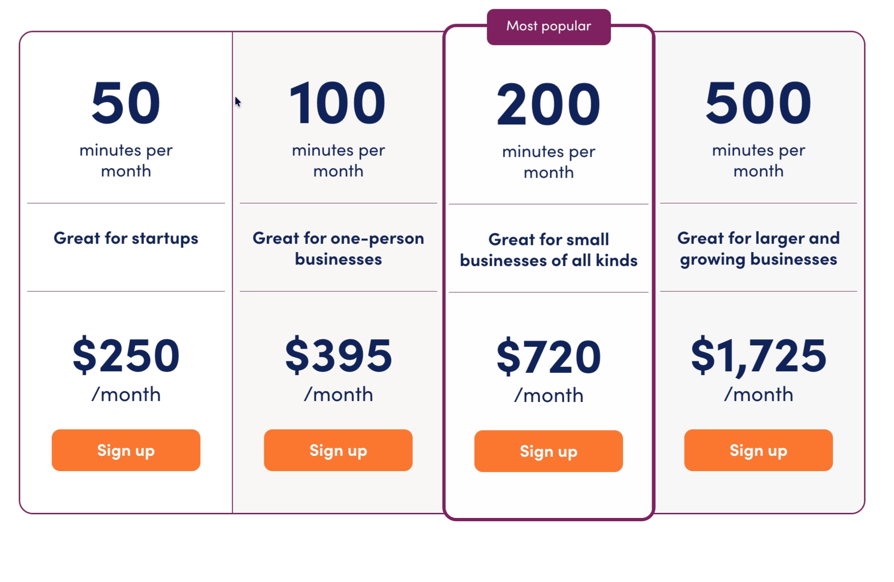
Ruby sells a live virtual receptionist service in monthly minute bundles. Its four public plans run from $250 a month for 50 receptionist minutes to $1,725 for 500. There's no free plan and no free trial, only a money-back guarantee first-time customers claim inside 21 days.
Ruby receptionist pricing per month is metered, not per seat, and every plan carries the same feature set, so what you're buying is volume. Go over your bundle and Ruby bills the overage in arrears at $3.30 to $5.40 a minute. Contracts roll every 30 days, with no annual prepay discount.
| Plan | Best For | Starting Price | Add-Ons | Free Trial |
|---|---|---|---|---|
| Call Ruby 50 | Solo practices, roughly 25 calls a month | $250/month | Bundled chat from $114.40/month | No. 21-day money-back guarantee, first-time customers only |
| Call Ruby 100 | Small offices, 40 to 85 calls a month | $395/month | Same | No |
| Call Ruby 200 | Most popular tier, around 100 calls a month | $720/month | Same | No |
| Call Ruby 500 | Multi-location or high-volume lines | $1,725/month | Same | No |
| Chat Ruby (standalone) | Live chat without call answering | $143/month for 10 chats | Sold alone or bundled at 20% off | No |
| Call Ruby 2,500+ | Enterprise call volumes | $7,875/month, then quote-based | Contact Ruby | No |
Sources: Ruby's plans and pricing page and Ruby's billing plan guide, both checked on 28 August 2026.
Price the alternative first
What Pricing Plans Does Ruby Receptionist Offer?
Ruby offers three receptionist plans:
- Call Ruby is live phone answering billed in receptionist minutes
- Chat Ruby is live web chat billed per chat
- and bundled chat is that same chat service attached to a receptionist plan at a 20% discount.
You'll also see Ruby described as a Ruby virtual assistant, which isn't wrong (the receptionists do schedule appointments and collect payments), but every task comes out of the same minute bundle.
Most guides stop at Ruby's public pricing page, which shows four receptionist plans. Ruby's help centre publishes ten, with the overage rate for every one of them.
Ruby Receptionist Pricing Plans 2026: All 10 Tiers and Their Overage Rates
| Plan | Included minutes | Monthly price | Overage per minute | Effective in-bundle rate | Ruby's recommended usage |
|---|---|---|---|---|---|
| Call Ruby 50 | 50 | $250 | $5.40 | $5.00 | 0 to 76 min |
| Call Ruby 100 | 100 | $395 | $4.50 | $3.95 | 77 to 172 min |
| Call Ruby 200 | 200 | $720 | $4.40 | $3.60 | 173 to 311 min |
| Call Ruby 350 | 350 | $1,210 | $4.25 | $3.46 | 312 to 471 min |
| Call Ruby 500 | 500 | $1,725 | $4.00 | $3.45 | 472 to 706 min |
| Call Ruby 750 | 750 | $2,550 | $3.85 | $3.40 | 707 to 957 min |
| Call Ruby 1,000 | 1,000 | $3,350 | $3.65 | $3.35 | 958 to 1,436 min |
| Call Ruby 1,500 | 1,500 | $4,945 | $3.50 | $3.30 | 1,437 to 1,915 min |
| Call Ruby 2,000 | 2,000 | $6,400 | $3.40 | $3.20 | 1,916 to 2,433 min |
| Call Ruby 2,500 | 2,500 | $7,875 | $3.30 | $3.15 | 2,434+ min |
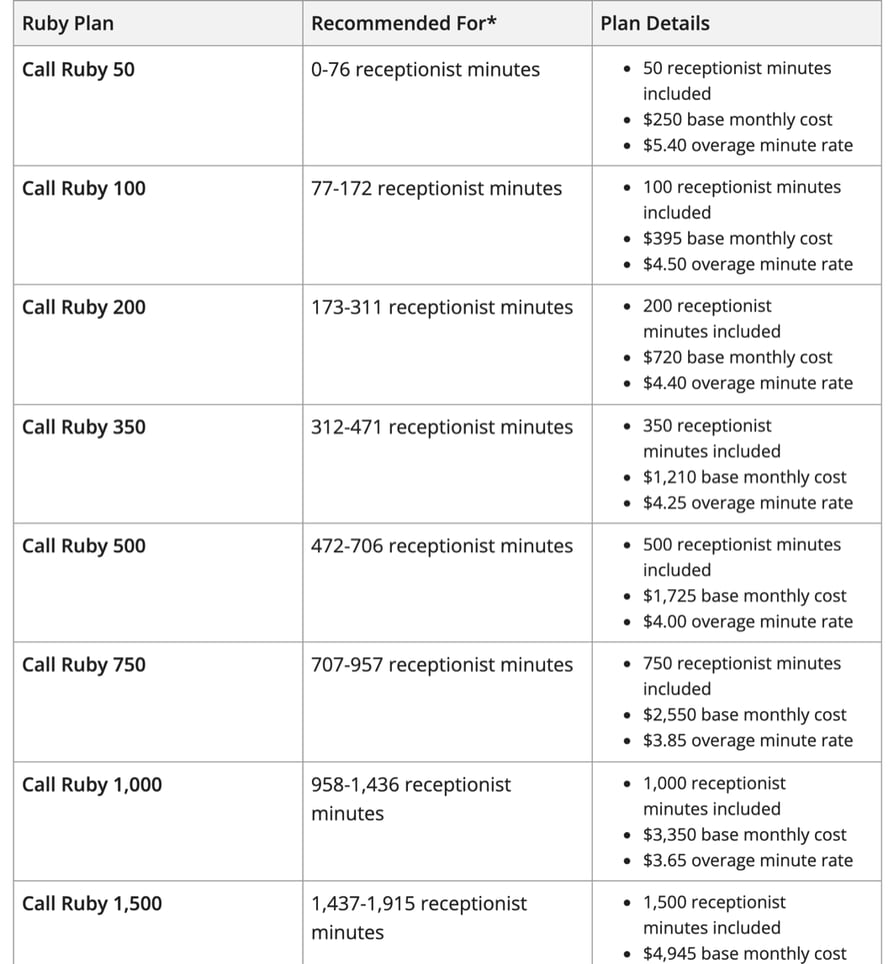
Above 2,500 minutes Ruby stops publishing and moves you to a quote.
On every tier, there's an overage fee if you go over your minutes. Ruby receptionist pricing per minute is $3.60 inside the Call Ruby 200 bundle and $4.40 outside it.
Chat Ruby Pricing, Standalone and Bundled
| Plan | Included chats | Standalone price | Standalone overage | Bundled price (20% off) | Bundled overage |
|---|---|---|---|---|---|
| Chat Ruby 10 | 10 | $143/month | $12.25/chat | $114.40/month | $9.80/chat |
| Chat Ruby 30 | 30 | $335/month | $11.10/chat | $268/month | $8.88/chat |
| Chat Ruby 50 | 50 | $520/month | $10.60/chat | $416/month | $8.48/chat |
| Chat Ruby 100 | 100 | $945/month | $9.45/chat | $756/month | $7.56/chat |
To save on Chat, beware: on Chat Ruby 10 the $12.25 overage undercuts the $14.30 you paid per chat inside the bundle, so buying the smallest tier and paying overage is usually the safer bet. Ruby's marketing page renders that bundled tier as roughly $115 and its billing documentation says $114.40, so model with $114.40.
Ruby Receptionist Features: Plan-Wide
Every receptionist plan includes:
- 24/7/365 Answering: Full coverage after-hours, on weekends, and during holidays.
- Bilingual Support: Dedicated 24/7 English and Spanish call handling.
- Flexible Mobility: Outbound call assistance, customizable call forwarding, and the ability to call or text directly from your business number.
- Robocall Filtering: Block spam automatically so only real leads get through.
- AI-Powered Analytics: Call transcripts, sentiment analysis, and AI-supported call flows.
- Online Portal: Track activity, view real-time status updates, and access messages anywhere.
- Voicemail Solutions: Advanced voicemail management with automated text transcription.
- Lead Qualification & Intake: Capture and vet new leads the moment they call.
- Scheduling & Payments: Direct appointment booking and secure payment collection over the phone.
- HIPAA Compliance: Built-in compliance protocols for healthcare and sensitive industries.
- Telecom Hosting & Savings
- Full Number Hosting: Host local or toll-free numbers and cut traditional telecom bills.
- Custom Call Workflows: Tailor receptionist scripts to match your brand's voice.
The only difference between plans is the number of minutes included (and the price of course), features remain the same.
Where Ruby's Upgrade Break-Even Points Fall
Ruby's "recommended usage" bands are the break-even points, and they check out to the dollar. At 76 minutes on Call Ruby 50 you'd pay $250 plus 26 overage minutes at $5.40, which is $390.40, still under Call Ruby 100's $395. At 77 minutes you'd pay $395.80 and you've crossed the line. Call Ruby 100 stops being cheaper at 173 minutes, Call Ruby 200 at 312. Sizing your plan from your real average rather than your worst month is the biggest lever you have on the bill.
What Is Ruby's Call Ruby 50 Plan?
Call Ruby 50 is the entry tier: 50 receptionist minutes a month of live, US-based answering on a 30-day rolling contract with no annual commitment. By Ruby's own estimate, a typical inbound call uses around two receptionist minutes, so that covers roughly 25 calls.
Ruby's Call Ruby 50 Plan Cost
Ruby charges $250 on day one of the billing period. Past 50 minutes, Every extra minute costs $5.40, billed in arrears on your next invoice.
What's Included in Ruby's Call Ruby 50 Plan?
Everything Ruby sells on the receptionist side. The feature list above applies from here up without changing. The only thing this tier buys you is the 50 minutes.
Ruby's Call Ruby 50 Plan: Who Is It Best For?
Call Ruby 50 suits solo attorneys, single-chair practices, contractors, and anyone whose phone rings under about 25 times a month. It's also where to start if you don't know your volume yet: new customers get a 90-day calibration window to move up or down freely, and the rules tighten once it closes.
What You Need to Know About Ruby's Call Ruby 50 Plan:
At $5.00 a minute in-bundle this is the most expensive minute Ruby sells, and a 50-minute ceiling is easy to hit. Anything you don't use disappears at month end; there's no rollover on minutes or chats. Two quiet months running and you've paid $500 for service you never consumed. Skip this tier above about 76 minutes, where Call Ruby 100 is cheaper anyway.
Available Add-ons on Call Ruby 50
| Add-on | Price | All-in monthly total with Call Ruby 50 |
|---|---|---|
| Bundled Chat Ruby 10 | $114.40/month, $9.80 per extra chat | $364.40 |
| Bundled Chat Ruby 30 | $268/month, $8.88 per extra chat | $518 |
| Bundled Chat Ruby 50 | $416/month, $8.48 per extra chat | $666 |
Chat is the only paid add-on Ruby sells. There's no per-feature upsell menu, which is a genuine advantage over per-call services that charge separately for appointment booking and CRM logging.
With Ruby 50 minutes = $250. With CloudTalk 50 minutes = Free
What Is Ruby's Call Ruby 100 Plan?
Call Ruby 100 doubles the bundle to 100 receptionist minutes a month, roughly 50 calls at Ruby's two-minute average, on the same rolling terms. Most one-location businesses land here once the phone becomes a real channel rather than an interruption.
Cost of Ruby's Call Ruby 100 Plan
Ruby's Call Ruby 100 plan costs $395 a month, or $3.95 per included minute, with overage at $4.50. The jump from Call Ruby 50 costs $145 for 50 extra minutes, which is why the break-even sits at 77 minutes rather than 50: below that, paying overage on the smaller plan is cheaper.
What's Included in Ruby's Call Ruby 100 Plan?
Everything in Call Ruby 50, at a better rate: $3.95 an included minute against $5.00. Ruby doesn't unlock features as you climb, only the number of calls your bundle absorbs before the meter charges you more.
Ruby's Call Ruby 100 Plan: Who Is It Best For?
Call Ruby 100 fits small firms taking 40 to 85 calls a month: a two-to-five-person law office, a dental practice with a busy new-patient line, a growing home-services company. It's also the move for anyone whose Call Ruby 50 invoices have shown overage two months running.
What You Need to Know About Ruby's Call Ruby 100 Plan:
Unused minutes still expire every billing period, with no partial credit. Watch the upgrade mechanics if you're moving up from Call Ruby 50 after your first 90 days. An upgrade outside the calibration window commits you to the current period plus at least two more. Downgrading then takes three consecutive periods on the new tier before Ruby will move you. Look elsewhere if your volume is seasonal enough that you'd want to move with it.
Available Add-Ons on Call Ruby 100
Call Ruby 100 takes the same single add-on, bundled chat, priced as on every tier. Adding Bundled Chat Ruby 10 takes the all-in monthly total to $509.40; Bundled Chat Ruby 30 takes it to $663.
What Is Ruby's Call Ruby 200 Plan?
Call Ruby 200 is Ruby's most popular tier and the one buyers benchmark everything else against: 200 receptionist minutes a month, about 100 calls. If you've seen a single figure quoted for Ruby virtual receptionist pricing in 2026, it was almost certainly this one.
Ruby's Call Ruby 200 Plan Cost
Ruby's Call Ruby 200 plan costs $720 a month: $3.60 per included minute, $7.20 per typical call, $216 an hour, and $4.40 for every minute past the bundle. Annualised, that's $8,640 before tax and the card surcharge.
What's Included in Ruby's Call Ruby 200 Plan?
Everything in Call Ruby 100, plus another 100 minutes at a slightly better rate. Bilingual 24/7 answering, intake, appointment scheduling, transfers and the usage portal all ship on the $250 plan too.
Ruby's Call Ruby 200 Plan: Who Is It Best For?
Call Ruby 200 fits established small businesses running a real front-desk workload, around 100 inbound calls a month, where a missed call has revenue attached. At $7.20 a call the maths works if your average job is worth a few hundred dollars, and falls apart if callers are mostly asking for directions.
What You Need to Know About Ruby's Call Ruby 200 Plan:
Two hundred minutes is only 100 calls, and a campaign or a seasonal rush can add 30% without warning. The volume risk is entirely yours: Ruby's job is to answer, and every call it answers is another line on your invoice, whether the caller was a customer or a wrong number. Unused minutes, as ever, don't carry over.
Add-Ons Available on Call Ruby 200
Call Ruby 200's only add-on is bundled chat. Adding Bundled Chat Ruby 30, the usual pairing at this volume, takes the all-in monthly total to $988; Bundled Chat Ruby 50 takes it to $1,136.
What Is Ruby's Call Ruby 500 Plan?
Call Ruby 500 is the largest tier Ruby prints publicly: 500 receptionist minutes a month, roughly 250 calls. Six more published tiers run above it to 2,500 minutes, and past that Ruby quotes individually.
Call Ruby 500 Plan Cost
Ruby's Call Ruby 500 plan costs $1,725 a month: $3.45 per included minute, $6.90 per typical call, $4.00 per overage minute. That's $20,700 a year, the same budget conversation as a part-time hire.
What's Included in Ruby's Call Ruby 500 Plan?
Everything in Call Ruby 200, plus 300 more minutes at the best rates available without a sales call. That's a 4% improvement per minute, and no new features.
Ruby's Call Ruby 500 Plan: Who Is It Best For?
Call Ruby 500 suits multi-location practices, busy intake lines, and businesses where the phone is the main sales channel. At this volume coverage matters more than the per-minute rate, because answering high call volume across nights and weekends is hard to staff internally.
What You Need to Know About Ruby's Call Ruby 500 Plan:
Overage is still $0.55 above your in-bundle rate, and the volume discounts above this tier are thin: Call Ruby 2,500 only moves the effective minute from $3.45 to $3.15, a 9% improvement for five times the commitment. Rollover doesn't exist here either, and a quiet month writes off more at this tier: 100 unused minutes is $345 gone. Price a hybrid setup, where AI or an in-house team absorbs routine calls and Ruby handles the rest, before signing for another year of the same.
Add-Ons Available on Call Ruby 500
Call Ruby 500 gets the same chat menu. Bundled Chat Ruby 50 takes the all-in monthly total to $2,141, and Bundled Chat Ruby 100 takes it to $2,481.
Call Ruby 50 vs. Call Ruby 100 vs. Call Ruby 200 vs. Call Ruby 500: Key Differences
Prices, included minutes and overage rates are in the 10-tier table above. It leaves out the per-call economics and the terms, which are what separate these four:
| Call Ruby 50 | Call Ruby 100 | Call Ruby 200 | Call Ruby 500 | |
|---|---|---|---|---|
| Approx. calls covered | ~25 | ~50 | ~100 | ~250 |
| Cost per typical call | $10.00 | $7.90 | $7.20 | $6.90 |
| Features, rollover, contract | Identical on all four: every feature included, no rollover, 30 days rolling | |||
| Upgrade past 90 days | Commits you to 2 extra billing cycles on all four |
Same features, different meter
What Will Ruby Receptionist Actually Cost?
Call Ruby 200 costs $720 for 200 minutes. That's $3.60 a minute, or $216 for a single hour of receptionist time. According to the U.S. Bureau of Labor Statistics' Occupational Outlook Handbook, the median receptionist in the United States earned $38,010 a year, or $18.27 an hour, in 20251. Annualised, Call Ruby 200 costs $8,640 and buys 40 hours of talk time across the entire year: roughly 23% of a median receptionist's pay for about 2% of the hours.
That comparison is arithmetically correct and it is also incomplete. Ruby bills only active talk time, covers all 168 hours in a week rather than 40, and carries no payroll tax, benefits, PTO, recruiting, training, desk, sick cover or idle time. A salaried receptionist is paid for every hour nobody calls.
Ruby's pitch is that you pay only for the minutes someone is on the line; price per hour was never the comparison it was built to win. Your own volume decides whether that trade works, and it's the same arithmetic behind how much voice AI costs per minute.
Scenario A: Solo Practice, About 25 Calls a Month
| Line item | Calculation | Cost |
|---|---|---|
| Call Ruby 50 base | 50 minutes included | $250.00 |
| Overage | 25 calls x 2 min = 50 min, none over | $0.00 |
| Credit card surcharge | 3% of $250 | $7.50 |
| All-in monthly total | $257.50 |
That's about $10.30 per answered call. Now the quiet month, where the bundle model bites hardest: 15 calls instead of 25 uses 30 minutes, and you still pay $250. Twenty minutes, worth $100 at your own in-bundle rate, expire unused. Two soft months a year and you've spent $200 on nothing, because Ruby doesn't roll minutes forward.
Scenario B: Established Small Business, About 100 Calls a Month
| Line item | Calculation | Cost |
|---|---|---|
| Call Ruby 200 base | 200 minutes included | $720.00 |
| Overage, normal month | 100 calls x 2 min = 200 min, none over | $0.00 |
| Card surcharge, normal month | 3% of $720 | $21.60 |
| All-in normal-month total | $741.60 | |
| Overage, busy month | 120 calls = 240 min, 40 over x $4.40 | $176.00 |
| Card surcharge, busy month | 3% of $896 | $26.88 |
| All-in busy-month total | $922.88 |
Staying put and paying the overage is still right here: Call Ruby 350 would cost $1,210, or $314 more than riding out a 120-call month on the smaller plan.
Scenario C: Seasonal Spike, About 160 Calls a Month
| Line item | Calculation | Cost |
|---|---|---|
| Option 1: stay on Call Ruby 200 | $720 + (120 min x $4.40) | $1,248.00 |
| Option 2: upgrade to Call Ruby 350 | Flat base | $1,210.00 |
| Apparent saving from upgrading | $38.00 | |
| Real three-month cost of upgrading | 3 x $1,210 | $3,630.00 |
| Real three-month cost of staying | 3 x $720 base | $2,160.00 |
That's the trap in Ruby's contract mechanics, and it lives in the terms of use rather than on the pricing page. Upgrading outside your first 90 days commits you to the current period plus at least two more, and you can't downgrade until you've completed three consecutive periods on the new tier. A one-month spike can cost three months of a higher base, so unless the spike lasts a quarter, absorb it as overage.
Scenario D: Figure in Robocalls
Ruby bills any live-answered call of 10 seconds or longer, and that explicitly includes robocalls, solicitations, hang-ups and wrong numbers. A Pew Research Center survey of 9,397 U.S. adults, published in July 2025, found that 68% of Americans get scam phone calls at least weekly and 31% get them daily2. Your business line is not exempt.
| Line item | Calculation | Cost |
|---|---|---|
| Call Ruby 200 base | 100 real calls = 200 min | $720.00 |
| Junk calls | 30 calls x ~25 sec, each rounded up to 1 full minute = 30 min | |
| Overage | 30 min x $4.40 | $132.00 |
| All-in monthly total | $852.00 |
Junk calls add $132 a month, an 18% uplift on the base plan, for zero business value. The fix costs nothing but you have to know to ask: Ruby's robocall filtering is complimentary and opt-in, and filtered robocalls consume no receptionist minutes. That setting is the cheapest defence you have against AI robocalls on a published business line.
How Many Jobs Does Ruby Have to Win Back to Pay for Itself?
Ruby pays for itself once the extra work it recovers covers the monthly bill. The formula:
Recovered jobs needed per month = Ruby monthly cost ÷ (average job value x gross margin)
With illustrative figures: at $720 a month, a business with a $500 average job and a 40% gross margin clears $200 per job, so Ruby pays for itself at 3.6 jobs, call it four a month. Substitute your own ticket and margin. If four extra booked jobs sounds easy, the price is fine; if it sounds like a stretch, the plan is too big for you.
Human Receptionists: Your Jobs are Safe
Gartner predicts that by 2027, half of the organizations that expected to significantly cut their customer service workforce will abandon plans to completely replace their human receptionists, and its March 2025 poll of 163 service leaders found 95% intend to keep human agents3, ideally working with AI agents to increase efficicency.
Hidden Costs in Ruby Receptionist's Pricing
Ruby's fee schedule is clean: no setup fee, no onboarding charge, no customization fee, and no premium for nights, weekends or holidays. The bill gets away from people at the meter, not at the fee schedule. Per-minute billing does that in any phone answering service, so it pays to know exactly what Ruby counts.
What Counts as a Billable Minute?
Ruby bills in 60-second increments, rounded up to the next 60-second mark. Its own billing documentation gives the example: a ten-second call bills as 60 seconds. Two guides currently ranking for this search put the increment at 30 seconds. It isn't, and on a busy line that difference shows up on the invoice.
| What happens on the call | Billed? |
|---|---|
| Time from the moment the receptionist picks up | Yes |
| Time the caller spends on hold | Yes |
| Post-call wrap-up, while the receptionist finishes your message | Yes |
| Outbound call assists, including writing the follow-up email to you | Yes |
| Robocalls, solicitations, hang-ups and wrong numbers, if answered live for 10+ seconds | Yes |
| Talk time after the call is transferred to you or to voicemail | No |
| Calls shorter than 10 seconds | No |
| Calls outside your live answering hours, and after-hours voicemail | No |
| Calls you make through the Ruby app, and calls to Ruby's own support | No |
Rounding is worth a fifth of the bill on a short-call line. Take 100 calls averaging a true one minute forty seconds: real talk time is 166.7 minutes, but Ruby bills 200, a 20% uplift before a single overage minute. It's an industry norm rather than a trick, but leave it out of your estimate and your estimate is wrong.
Going Over Your Minutes
Ruby bills the overage in arrears on your next invoice at your plan's published rate, between $3.30 and $5.40 a minute. Three things to know before you sign:
- Ruby won't bump you to a higher plan automatically; your rate stays your rate.
- Overage always costs more per minute than the bundle it's topping up, on every tier.
- There's no spend cap and no auto-pause. Ruby keeps answering, and keeps billing, until you stop forwarding your line.
Usage Visibility
Yes. Ruby publishes a real-time usage counter at my.call-ruby.com and sends automatic email alerts at 85% and 100% of your bundle. The honest limitation is that visibility isn't control: knowing you've hit 100% doesn't stop the meter, and there's no setting that will.
The Fees That Aren't in the Plan Price
| Cost | Amount | When it applies |
|---|---|---|
| Credit card processing surcharge | 3.0% of the payment | Every card payment. Not charged on debit card, ACH or check |
| Late fee | $10, plus 1.5% monthly interest (18% a year) | 30 days after the due date |
| Sales and telecom taxes | Varies by service address | Billed as separate line items; Ruby is taxed as a telecoms and answering service in some jurisdictions |
| Collections and attorney fees | Actual cost | If unpaid fees are referred out |
The card surcharge catches people. On Call Ruby 200 it's $21.60 a month, $259.20 a year, and it disappears entirely if you pay by ACH or check.
Can You Start Small and Scale?
Partly. Ruby's terms of use set the contract at 30 days, rolling, with no annual lock-in and no prepay discount either way. New customers get a 90-day calibration window to move up or down freely, and that's the window to do all your experimenting in.
After 90 days it tightens. An upgrade commits you to the current period plus at least two more, and a downgrade requires three consecutive periods on the same level first. Service can't be suspended temporarily; Ruby's alternative is an unpriced "Platform Only" tier you have to ask for. All payments are non-refundable, with no credit for a partially used period.
Predictable beats cheap
What Do Customers Say About Ruby's Pricing?
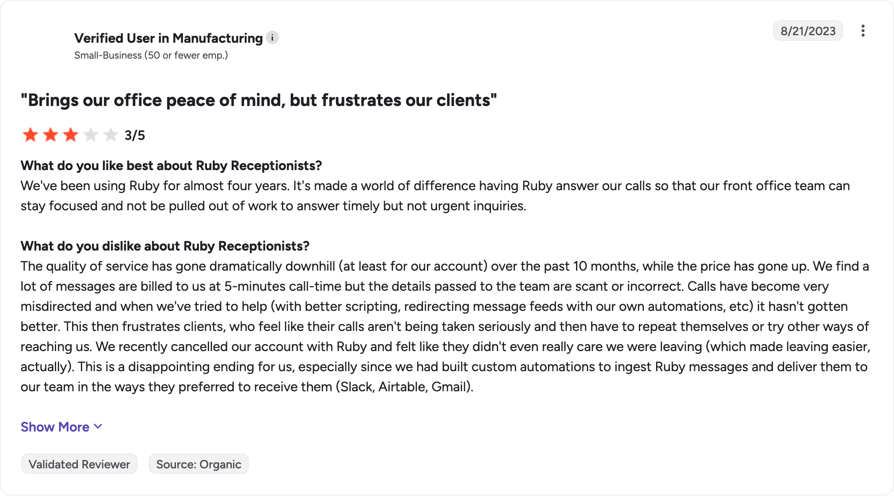
The themes below come from Ruby's own published statements and documented policies, so you can check every one of them at the source. The review card underneath shows what that pricing looked like to one customer: a small business in manufacturing, rating Ruby 3 out of 5 on G2 in August 2023, who describes messages billed at five minutes of call time while the price went up. Ruby's profiles on G2 and Trustpilot are public if you want the wider picture.
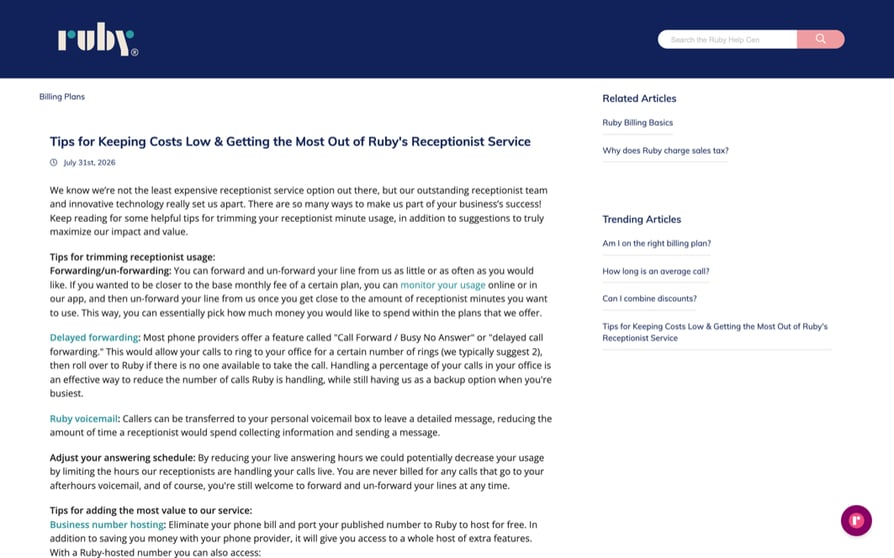
- Ruby concedes the price point in writing. Its help centre opens an article on keeping costs down with: "We know we're not the least expensive receptionist service option out there, but our outstanding receptionist team and innovative technology really set us apart." That tells you what Ruby thinks it's selling: quality of answering, not cost per minute.
- The fee transparency is real; the usage predictability isn't. There is no surprise fee to find in Ruby's schedule, which is more than most of this category can say. What moves a Ruby invoice is call volume, and reading the contract more carefully doesn't fix that.
- Ruby publishes its own cost-control playbook. The same article recommends un-forwarding your line when you can cover it, delayed forwarding so calls ring in-office for two rings first, routing more calls to voicemail, and shortening your live answering hours. A provider documenting four ways to consume less of its product tells you the meter takes managing. The advice works, and it doubles as a description of the problem. It's also where the arithmetic starts pointing at AI call answering, where the per-minute cost is low enough that steering the meter matters less.
Better and Cheaper Alternatives to Ruby Receptionist
Ruby's model is human minutes with no rollover and no ceiling. The three alternatives below either change the billing unit, cut the per-minute price, or hand routine calls to a conversational virtual receptionist instead of a person. A fourth name on this shortlist, AnswerConnect, publishes no US pricing at all. Its pricing URL returns a 404 and its plans page is a quote form carrying no dollar figure, so there's nothing to compare until you've spoken to a salesperson.
CloudTalk: Best for Teams That Want 24/7 Answering Plus a Real Business Phone System
Signature Capability
See CloudTalk’s AI Voice Agent in Action!
CeTe is an AI that talks like a human: no breaks, no training, no time off. It makes and answers calls, updates CRMs, books meetings, and loops in a human only when needed.
Press play to hear it. Want a wow moment? Get a free test call and try it live.

What Is CloudTalk?
CloudTalk is global AI business calling software built for SMB growth, used by 5,500+ businesses across 100+ countries. It pairs a cloud phone system, with virtual numbers in 160+ countries, interactive voice response (IVR), call queues and recording, with an AI Voice Agent that handles calls on its own.
Why Is CloudTalk Better Than Ruby Receptionist?
- Predictable Pricing: CloudTalk keeps your bill predictable with fixed per-user seat pricing and pre-purchased AI minute bundles—so you never face unexpected fees for late-night call handling.
- A Complete Phone System: While Ruby only answers calls, CloudTalk provides both call answering and a complete phone infrastructure—equipping your team with lines, smart routing, call queues, and analytics.
-
- Zero Voicemails: Handles after-hours and overflow calls around the clock.
- Automated Handling: Answers routine questions, schedules and confirms appointments, qualifies leads, takes messages, and escalates urgent calls to the right team.
- Fast & Multilingual: Supports 60+ languages with ultra-low latency (under 800ms). You can preview the AI virtual receptionist voice before purchasing.
Risk-Free Trial Test CloudTalk with a free trial—an option Ruby doesn't offer.
Customer story: Autenti. The SaaS and IT services company now has AI voice agents handling roughly 30% of its inbound support calls. Read the Autenti story.
What Does CloudTalk Cost?
- Starter: $25/user/month, billed annually. Call Flow Designer, Branded Caller ID, Number Porting, Click-to-Call, call history, local numbers in 160+ countries..
- Essential: $29/user/month. Adds IVR and skill or condition-based routing, call recording, group reporting, 100+ integrations, helpdesk and ATS integrations, API access.
- Expert: $49/user/month. Adds the Smart Dialer, Power Dialer, Preview Dialer, Live call monitoring, Real-time analytics, Agent Status.
- Custom: contact sales.
- AI Voice Agents are always a paid add-on, never bundled into a plan: from $99/month for 200 minutes, first 50 minutes free in month one, volume discounts at scale.
- AI Conversation Intelligence is also always an add-on, at $9/user/month billed annually.
- G2 rating: 4.4/5, from 1939+ reviews.
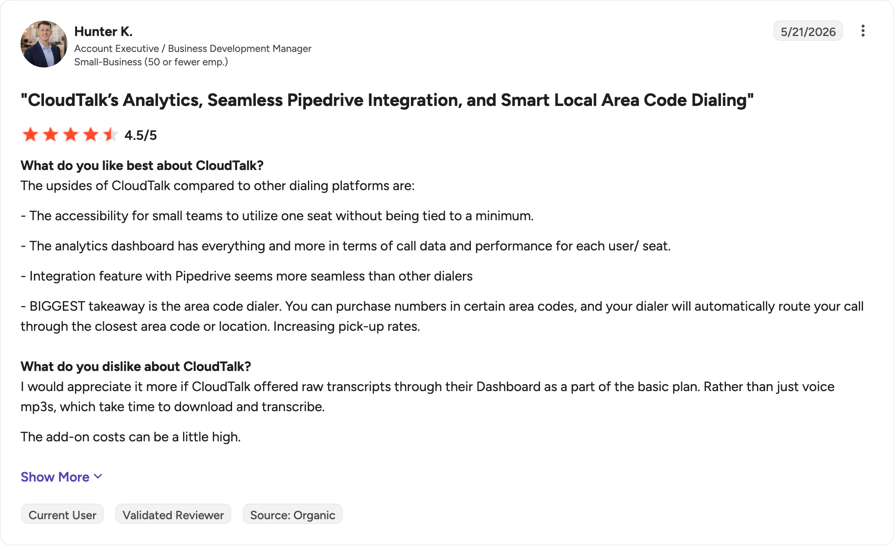
A small-business G2 reviewer, rated 4.5 out of 5, May 2026. What they liked: "The accessibility for small teams to utilize one seat without being tied to a minimum." What they didn't: "I would appreciate it more if CloudTalk offered raw transcripts through their Dashboard as a part of the basic plan." Read the full review on G2
CloudTalk pricing starts at $25/user/month. See all plans.
CloudTalk Pricing vs. Ruby Receptionist Pricing
At the 200-minute mark, Ruby's Call Ruby 200 is $720 a month. CloudTalk's AI Voice Agent bundle covers the same 200 minutes from $99 a month, on top of a seat from $25/user/month.
That gap isn't like for like: a trained human answering your phone against an AI agent. They ultimately service different needs. An AI receptionist ensures you don't miss any calls, and integrates notes in your CRM. But the idea has always been that for more complicated and sensitive issues, a human is the ultimate contact.
For most businesses the workable setup is a split: AI takes the routine calls, the after-hours overflow and the wrong numbers, and people take the ones that need a person.
Abby Connect: Best for the Same Human Coverage at a Lower Minute Price
What Is Abby Connect?
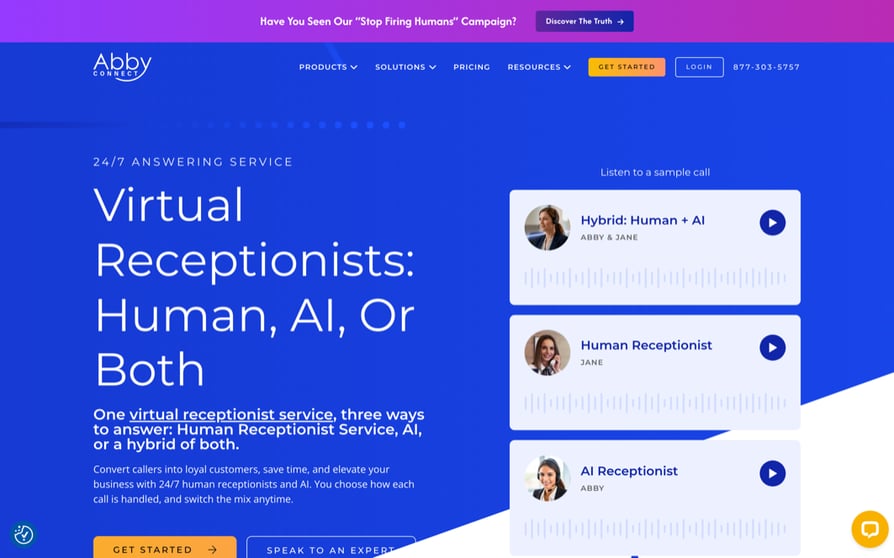
Abby Connect is a US-based call answering virtual receptionist service selling what Ruby sells, human answering in monthly minute bundles, with an AI layer that can share a call with a human.
Why Is Abby Connect Better Than Ruby Receptionist?
- Abby Connect undercuts Ruby at every equivalent bundle size, by $85 at 50 minutes and $345 at 500.
- AI minutes count half: one Abby Minute equals one human minute or two AI minutes, so a 200-minute bundle stretches to 400 AI-answered minutes.
- Every plan comes with a free trial, which Ruby doesn't offer.
What Does Abby Connect Cost?
- Starter: 50 Abby Minutes, $165/month, against Ruby's $250.
- Essential: 100 Abby Minutes, $329/month, against Ruby's $395.
- Professional: 200 Abby Minutes, $599/month, against Ruby's $720, or $1,452 a year cheaper.
- Growth: 500 Abby Minutes, $1,380/month, against Ruby's $1,725. Enterprise is custom.
- No setup fee, month-to-month. Abby doesn't publish its per-plan overage rate, a real gap when you're modelling a busy month.
Prices taken from Abby Connect's public pricing page, checked on 28 August 2026.
Smith.ai: Best for Buyers Who Want Humans but Hate the Per-Minute Meter
What Is Smith.ai?
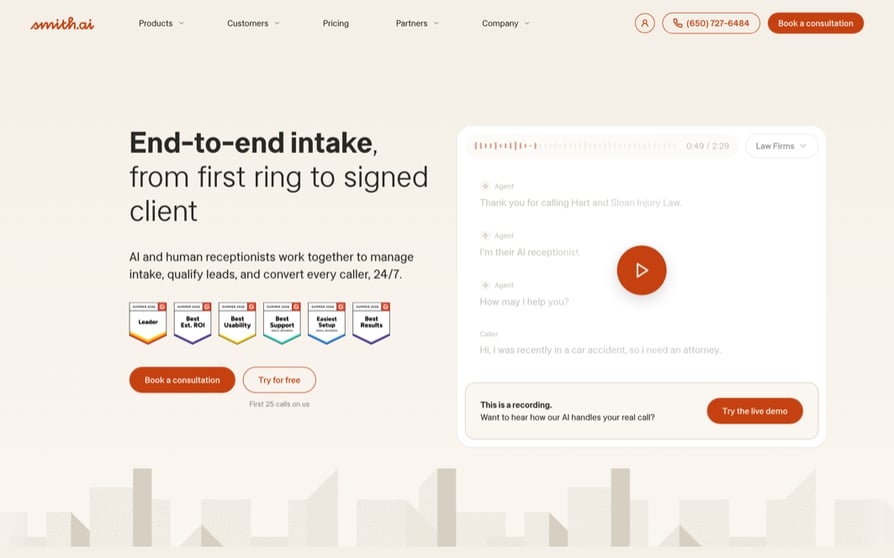
Smith.ai is a North American virtual receptionist and intake service that bills per call rather than per minute, which changes the risk on a long conversation. Our breakdown of Smith.ai pricing goes through the tiers in more detail.
Why Is Smith.ai Better Than Ruby Receptionist?
- Smith.ai charges the same for a 12-minute intake call as for a 90-second one, so call length stops being a budget variable.
- Smith.ai's pricing page states there's no charge for spam, where Ruby bills receptionist minutes for robocalls and wrong numbers.
- There's a 30-day money-back guarantee refunding plan and add-on fees up to $1,000, and a 10% discount for a 12-month subscription.
What Does Smith.ai Cost?
- Starter: 30 calls, $300/month, $11.50 per extra call.
- Basic: 90 calls, $810/month, $10.50 per extra call.
- Pro: 300 calls, $2,100/month, $8.50 per extra call. Enterprise is quote-based.
- Add-ons are priced per call and stack fast: appointment booking, complex routing and extended intake at $1.50 each, a dedicated Spanish line and payments at $1.00, notifications, follow-ups and conflict checks at $0.50.
Prices taken from Smith.ai's public pricing page, checked on 28 August 2026.
Smith.ai vs Ruby receptionist pricing comes down to how long your calls run. At 30 short calls a month, Ruby's Call Ruby 50 plus overage is about $304 against Smith.ai's $300. At 90 calls, Ruby's Call Ruby 200 is $720 against Smith.ai's $810, so Ruby wins. But if your calls routinely run five minutes or more, per-call billing is the cheaper structure, and the add-on menu is what to watch instead.
Ruby Answering Service Cost vs. the Alternatives at 200 Minutes
| Provider | 200-minute equivalent | Monthly cost | Billing unit | Contract |
|---|---|---|---|---|
| Ruby | Call Ruby 200 | $720 | Per minute, rounded up to 60 seconds | 30-day rolling |
| Abby Connect | Professional, 200 Abby Minutes | $599 | Per minute, AI at half rate | Month-to-month |
| Smith.ai | Basic, 90 calls (~180 min at Ruby's 2-minute average) | $810 | Per call | Month-to-month |
| CloudTalk | AI Voice Agent bundle, 200 minutes | From $99, plus a seat from $25/user/month | Per AI minute, plus per seat | Monthly or annual, no seat minimum |
| AnswerConnect | Not publicly priced | Quote only | Not published | Not published |
Test the AI half yourself
What Are the Pros and Cons of Ruby Receptionist?
Every argument for and against Ruby receptionist pricing comes back to one design choice: Ruby sells a person's time by the minute and puts no ceiling on what you can spend. Weigh them against what an AI receptionist does differently before you size a plan.
| Pros | Cons |
|---|---|
| Every feature ships on every plan, so you're choosing volume, not a feature tier | Costs more per minute than Abby Connect at every equivalent bundle size |
| 24/7 answering including nights, weekends and holidays at no premium | Unused minutes and chats never roll over |
| No setup, onboarding, activation or customization fees | Overage always costs more per minute than the bundle it tops up |
| 30-day rolling contract with no annual lock-in | No free trial, and the money-back guarantee is first-time customers only |
| Real-time usage counter plus 85% and 100% email alerts | No spend cap and no auto-pause, so the meter only stops when you un-forward your line |
| Free opt-in robocall filtering that consumes no minutes | Robocalls, hang-ups and wrong numbers are billed if answered live for 10+ seconds |
| Real, US-based human receptionists with bilingual coverage | Upgrading after 90 days commits you to two extra billing cycles |
Is Ruby Receptionist Worth It? Who Should Buy It?
Ruby is worth it when three things are true at once: your calls are worth real money, your volume is predictable enough to size a plan, and you can't cover nights and weekends with the people you have. Then price per hour stops being the right lens. A single recovered job, at the illustrative $200 gross margin used earlier, covers more than a quarter of Call Ruby 200.
It stops being worth it in a few recognisable cases. A call mix weighted toward routine questions, directions and vendor calls means you're paying a premium human rate for work no human needs to do. Volume that swings hard month to month runs into no rollover, uncapped overage and a three-cycle downgrade wait, which catch you coming and going. And above roughly 500 minutes a month, the per-minute improvements flatten while the bill keeps climbing, so a hybrid setup starts paying for itself.
If you came looking for the official Ruby receptionist pricing for 2026 hoping the numbers would be smaller, they won't be, and Ruby has said as much itself. You can still change the shape of the spend. If what worries you is after-hours overflow, wrong numbers and routine questions, an after-hours AI virtual receptionist handles those at a fraction of a human minute and hands the rest to your team.
CloudTalk's AI Voice Agent starts at $99 a month for 200 minutes as an add-on, with a phone system underneath it from $25/user/month and a 14-day free trial to test the call flow first.
Customer story: Booking Host. The hospitality company now answers more than 90% of the calls that reach it. Read the Booking Host story.
Keep Ruby for the calls that need a person, and stop paying $4.40 a minute for the ones that don't.
See your real call mix priced
Sources:
- 1. U.S. Bureau of Labor Statistics
- 2. Pew Research Center
- 3. Gartner
Ruby Receptionist Pricing: Frequently Asked Questions
The questions buyers ask before signing a Ruby contract, answered from Ruby's own published terms and pricing.
Ruby Receptionists costs $250 a month for 50 receptionist minutes and $7,875 for 2,500, across ten published tiers. Features are identical on every plan, so you're buying volume, which is unusual even by answering service pricing standards.
Ruby's per-minute pricing bills a prepaid bundle of minutes, with anything past it charged in arrears. Time rounds up to the next 60 seconds, so a 10-second call costs a full minute. Model that before you compare AI voice agent pricing.
Ruby keeps answering and bills the extra on your next invoice, at $3.30 to $5.40 a minute depending on your tier. There's no spend cap and no auto-pause, so price after-hours call handling before you sign.
Ruby charges no setup, onboarding or customization fee, and no premium for nights, weekends or holidays, so 24/7 customer service is included. What catches people is the 3% card surcharge, 60-second rounding and arrears overage.
Call Ruby 100, at $395 a month for roughly 50 calls, fits most small businesses. Below 77 minutes, Ruby's own maths says stay on Call Ruby 50. Under about 25 calls, an AI virtual receptionist for small business costs less.
Ruby is worth it when a missed call carries real revenue and you can't staff nights and weekends. At $720 a month you need roughly four recovered jobs to break even on a $200 margin, and an AI voice agent ROI calculator will test your own figures.
Ruby charges $720 a month for 200 human minutes. CloudTalk charges per seat, from $25/user/month, with AI answering as a separate $99 add-on for 200 minutes, which is how an AI phone answering service lands cheaper per call.
On price, yes: CloudTalk's AI Voice Agents add-on starts at $99 a month for 200 minutes against Ruby's $720, plus a seat from $25/user/month. It's software rather than a person, so a VoIP virtual receptionist suits routine calls best.