10 Best Voiceflow Alternatives in 2026: Tested & Compared
TL;DR: 10 Best Voiceflow Alternatives
| # | Platform | Best for | Starting Price (annual billing) | Free Trial |
|---|---|---|---|---|
| 1 | CloudTalk | SMB sales & support teams needing full VoIP + AI voice agents | $25/user/mo | 14 days |
| 2 | Retell AI | Developer teams building production voice agents | $0.07/min | Free tier |
| 3 | Synthflow | Non-technical teams needing no-code AI voice agents | $0.09/min | Free trial |
| 4 | Bland AI | Enterprise teams running high-volume outbound calls | $0.11/min | Free tier |
| 5 | Botpress | Multi-channel chat + voice agent teams | Free/$89 per mo | Free plan |
| 6 | Vapi AI | Developer-first teams wanting API-level voice control | $0.05/min | $10 credit |
| 7 | Dialpad | AI-native unified comms with built-in transcription | $15/user/mo | 14 days |
| 8 | LiveKit | Engineering teams building custom real-time voice infrastructure | Free/$50 per mo | Free tier |
| 9 | Intercom (Fin) | Support teams wanting AI helpdesk + voice combined | $0.99 per outcome | Free trial |
| 10 | Rasa | Enterprises needing self-hosted, compliance-first AI | Free/Custom | Free OSS |
Why Teams Are Searching for a Voiceflow Alternative
Voiceflow is one of the most popular no-code platforms for building conversational AI agents. But as teams move from prototyping to production, voiceflow competitors are capturing teams that need more predictable pricing, native telephony, and enterprise-grade scalability.
Based on verified G2 reviews and community feedback, scaling teams consistently hit Voiceflow's ceiling due to five primary pain points:
5 Main Cons of Voiceflow: Based on Real User Reviews
- Credits Run Out Mid-ConversationVoice calls consume 10 credits per minute vs 1 credit for text. When credits run out, AI agents stop responding immediately with no grace period.
- Seat Pricing Punishes CollaborationEvery additional editor costs $50/month on top of the base plan. A 5-person team on Business ($150/mo) pays $350/month before a single credit is consumed.
- External Telephony Required for Voice CallsDespite the name, Voiceflow does not include telephony. Making actual phone calls requires a separate Twilio or Vonage account — adding both cost and setup complexity.
- Limited Analytics for Production DeploymentsVoiceflow's analytics are minimal. Users can see transcripts but cannot easily track resolution rates, sentiment trends, or agent performance at scale.
- Complex Setup for Production DeploymentsBuilding a prototype is genuinely easy. Deploying a reliable, production-grade voice agent is a different matter. Production deployment requires custom coding, webhook management, and external tool integrations that the no-code interface cannot handle.
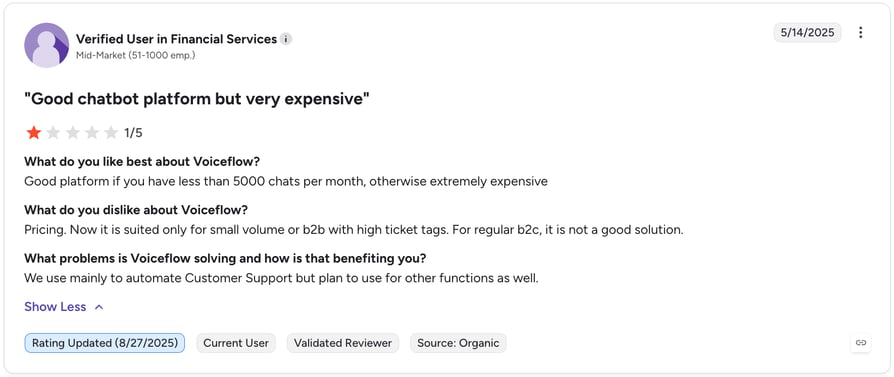
- Voiceflow user review on G2:
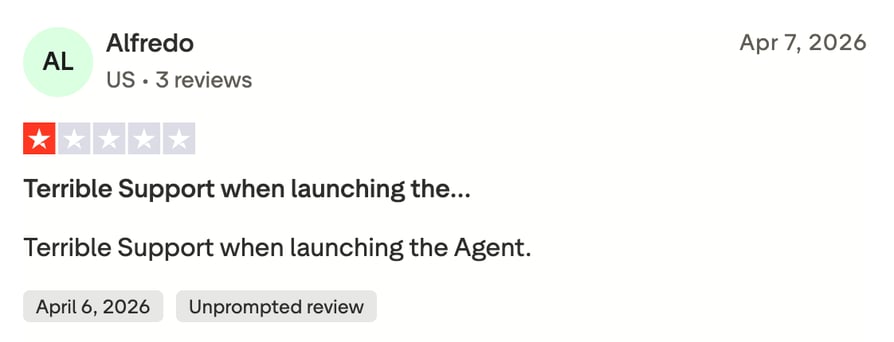
- Voiceflow user review on Trustpilot:
What Is the Best Alternative to Voiceflow?
CloudTalk is the best alternative to Voiceflow for sales and customer support teams that need AI-powered phone calls without the complexity, credit unpredictability, or telephony setup that Voiceflow requires. Unlike Voiceflow — which is a design tool that needs external providers to make actual calls — CloudTalk is a complete VoIP platform with built-in AI voice agents, owned telephony infrastructure across 160+ countries, and CRM integrations included in base plans. It starts at $25/user/month with no seat minimum and a 14-day free trial — no credit card required.
As your team scales, CloudTalk lets you upgrade with smart AI tools like Power and Parallel dialers or AI voice agents, to speed up your daily outreach without touching a telephony API. AI pricing (AI Receptionist starts at $99/mo, 200 min included).
Why Users Consider CloudTalk the Best Voiceflow Alternative
5 Main Reasons Teams Switch from Voiceflow to CloudTalk
- Telephony Included — No Twilio Setup RequiredCloudTalk owns its calling infrastructure across 160+ countries. Voiceflow requires a separate Twilio or Vonage account just to make real calls, adding setup complexity and per-minute carrier fees on top of credit costs.
- Predictable Per-User Pricing — No Credit AnxietyCloudTalk starts at $25/user/month with no hidden usage meters. Voiceflow's credit system means your costs vary with every conversation — voice calls consume credits 10x faster than text, making monthly invoices genuinely hard to forecast.
- AI Features As Add-ons — Pick What You LikeCall transcription, sentiment analysis, AI summaries, and call scoring are available as add-ons, meaning you can pick only the features you like (at $9/user/mo). Voiceflow's LLM features are credit-gated — every AI model call draws down your monthly allocation.
- 100+ Native CRM IntegrationsCloudTalk natively connects to HubSpot, Salesforce, Pipedrive, and 100+ other tools with automatic bidirectional sync. Voiceflow requires API configuration or Zapier workarounds.
- G2 Spring 2026 Leader — 4.4/5/5 from 1,800+ Verified ReviewsCloudTalk is a G2 Spring 2026 Leader for Contact Center Software. Voiceflow has 65+ reviews. More independently validated social proof for enterprise procurement teams.
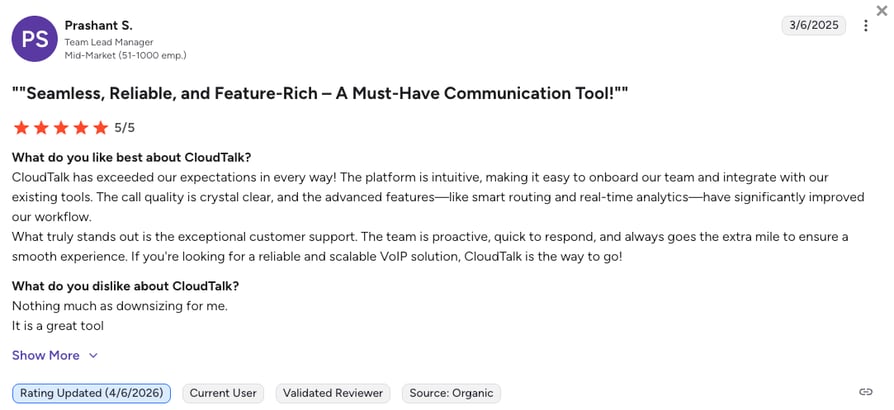
- CloudTalk user review on G2:
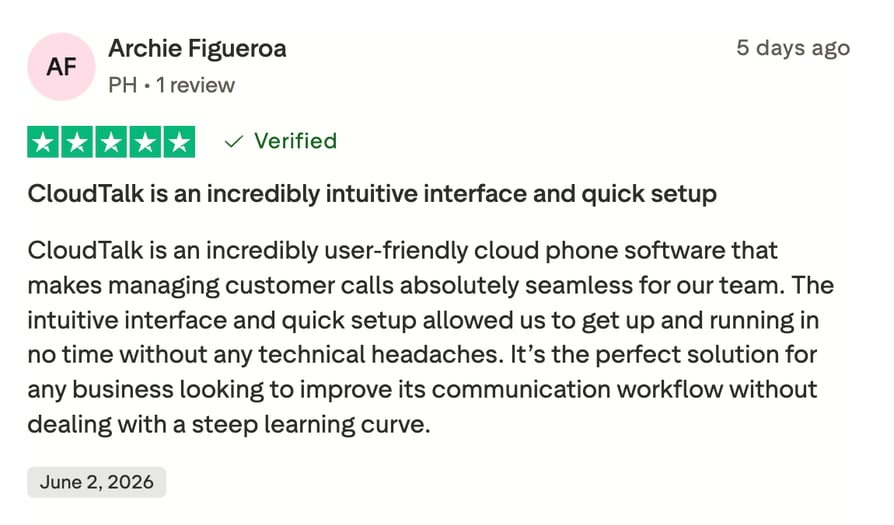
- CloudTalk user review on Trustpilot:
Know what you're getting yourself into. CloudTalk offers everything transparently.
Start your 14-day free trial and decide later.
How We Evaluated These Voiceflow Alternatives
Finding genuine Voiceflow alternatives for AI-powered calls requires going beyond feature checklists. We spent hands-on time with each platform and reviewed verified user feedback from trusted websites such as G2, Trustpilot, and community forums like Reddit and Quora.
We prioritized tools that solve the primary bottlenecks reported by users: call drops and manual data entry.
Our selection criteria and testing methodology:
- Hands-on testing: Core calling and agent-building features, including live voice calls, flow creation, and production deployment scenarios.
- Pricing transparency: Advertised price vs real all-in cost including telephony, credits, extra seats, and add-ons.
- G2 and Trustpilot review analysis: Honest and unbiased community feedback from verified accounts on trusted reviewing websites.
- AI and automation depth: What is included in base plans vs what is credit-gated or paid add-on.
- Telephony integration: Does the platform include calling infrastructure or require external providers?
- CRM integration depth: Particularly HubSpot, Salesforce, and Pipedrive native sync vs API-only.
- Customer support responsiveness: 24/7 availability, response time, and onboarding quality.
- Migration ease from Voiceflow: How complex is moving existing flows, agents, and integrations?
Why Trust CloudTalk?
Quick Comparison: Top Voiceflow Alternatives for AI-Powered Calls at a Glance
Before diving into the detailed breakdowns, here is how all 10 voiceflow alternatives for AI-powered calls stack up at their entry-level pricing:
Voiceflow vs Top Alternatives: Head-to-Head
| Feature | Voiceflow | CloudTalk | Retell AI | Synthflow | Dialpad |
|---|---|---|---|---|---|
| Starting Price | Free / $60/editor/mo | $25/user/mo | $0.07/min | $375/mo | $15/user/mo |
| Telephony Included |  Requires Twilio/Vonage Requires Twilio/Vonage |  160+ countries 160+ countries | | | |
| No-Code Builder | | | Developer-first | | |
| CRM Integrations | API/Zapier only | 100+ native | via webhook | 200+ native | Pro plan+ |
| Predictable Pricing | Credit-based, variable | AI voice bundled | Per-minute | Monthly flat | Flat per-user |
| 24/7 Support | Enterprise only | All plans | Community | Scale plan only | Pro plan+ |
| Free Trial | 7-day Pro trial | 14 days | Free tier | Free trial | 14 days |
Voiceflow's Hidden Cost:
Voiceflow's $60/editor/month base plan doesn't include telephony. A 5-person team on Business ($150/mo) pays $350/month in seat fees before making a single call — then add an external VoIP software, and LLM credit costs on top. Alternatives like CloudTalk include telephony, AI features, and CRM integrations at $25/user/month all-in.
Take CloudTalk for a free 14-day ride!
1. CloudTalk — The #1 Voiceflow Alternative for SMB Sales & Support Teams
What Is CloudTalk?
CloudTalk is a cloud-based VoIP and AI voice agent platform built for sales and support teams that need reliable global calling without the complexity of assembling a multi-vendor AI stack. Used by 5,500+ businesses worldwide, including Nokia, Revolut, and DHL, it combines owned telephony infrastructure across 160+ countries with built-in AI features — starting at $25/user/month with no seat minimum.
Why Is CloudTalk a Strong Voiceflow Alternative?
- Complete calling platform — not just an agent builder. CloudTalk handles inbound and outbound calls, IVR routing, power dialing, and AI voice agents in one product. Voiceflow is a design canvas that needs external telephony to make calls.
- Owned infrastructure in 160+ countries — vs Voiceflow's external VoIP provider dependency. No extra setup, no extra carrier fees, no per-call credit drain on top of platform costs.
- Transparent flat pricing from $25/user/month — no credits, no usage meters, no per-editor surprises. What you pay is what you forecast. The AI features are available as add-ons at $9/user/mo.
- AI features for all purposes — transcription, sentiment analysis, summaries, call scoring, and other useful tools that can automate your workflows.
- 100+ native CRM integrations — HubSpot, Salesforce, Pipedrive, with automatic call logging. Voiceflow requires API configuration or Zapier.
- Users rated CloudTalk among their favorite business calling on G2 — 4.4/5/5 from 1,800+ verified reviews vs Voiceflow's 65+.
What Are the Pros & Cons of CloudTalk?
| Pros | Cons |
|---|---|
| Complete VoIP + AI in one platform: No Twilio, no credit system, no external telephony setup. | Not a visual conversation design tool: Teams wanting a Voiceflow-style canvas for chatbot design should also evaluate Botpress. |
| Transparent flat per-user pricing: Predictable monthly costs regardless of call volume. | No native video conferencing: Requires external integration like Zoom. |
| 160+ countries, 99.999% uptime SLA: Enterprise-grade reliability without enterprise pricing. | |
| 100+ native CRM integrations: Automatic call logging with HubSpot, Salesforce, Pipedrive. | |
| 24/7 live support on all plans: Not gated behind an enterprise tier. |
CloudTalk vs Voiceflow on telephony:
Voiceflow requires a separate telephony system to make actual phone calls, adding setup complexity and per-minute carrier fees. CloudTalk includes owned telephony infrastructure in 160+ countries and international numbers across the globe — your AI agents can answer and make calls from day one without touching a third-party API.
What Are CloudTalk's Plans & Pricing?
CloudTalk pricing starts at $25/user/month, and the platform offers the following plans:
Flexible Pricing Plans to Scale with You
Compare our plans
- Starter - $25/user/month
- Essential - $29/user/month
- Expert - $49/user/month
- Custom - Quote-based pricing, ideal for enterprises
CloudTalk's AI Voice Pricing
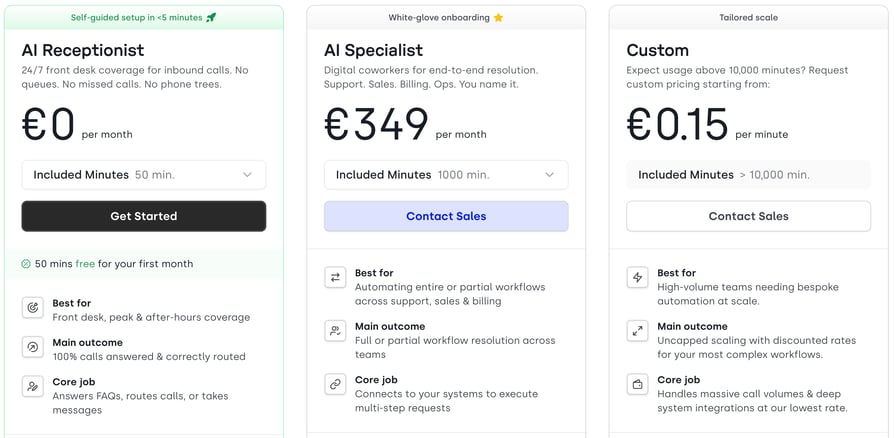
- AI Receptionist - Handles inbound calls 24/7, answers FAQs, routes callers to the right department, and takes messages — so no call goes unanswered, even outside business hours.
- AI Specialist - Automates complex, multi-step workflows across sales, support, and billing — from processing payments and handling invoices to outbound follow-ups and appointment rescheduling.
- Custom - A fully tailored AI Voice Agent plan built around your specific call volumes, workflows, and business requirements.
What Are Users Saying About CloudTalk?
CloudTalk customers consistently describe the platform as significantly easier to manage in production than assembling a multi-vendor AI stack. Based on verified G2 reviews, the biggest wins are call quality, reliability, CRM sync speed, and the support team's responsiveness.
- Reliable connections and clear audio: Users highlight that CloudTalk's audio quality is consistently clear across international calls — a common pain point when routing through third-party carriers like Twilio.
- CRM automation that actually works: Teams cite the automatic call logging into HubSpot and Salesforce as a key reason they stay — "no more manual data entry after every call."
- Fast setup, no IT involvement: Admins frequently mention going live in under a day without requiring developer support.
- Support that responds: 24/7 availability is cited in over 150 G2 reviews as a meaningful differentiator vs platforms where support takes 48+ hours.
CloudTalk's current G2 rating is 4.4/5/5, out of 1,750+ verified user reviews.
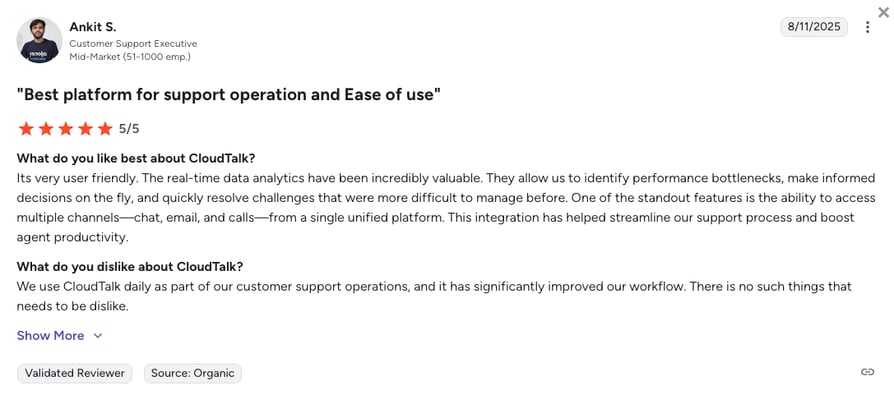
CloudTalk's current Trustpilot rating is 4/5, out of 660+ verified user reviews.
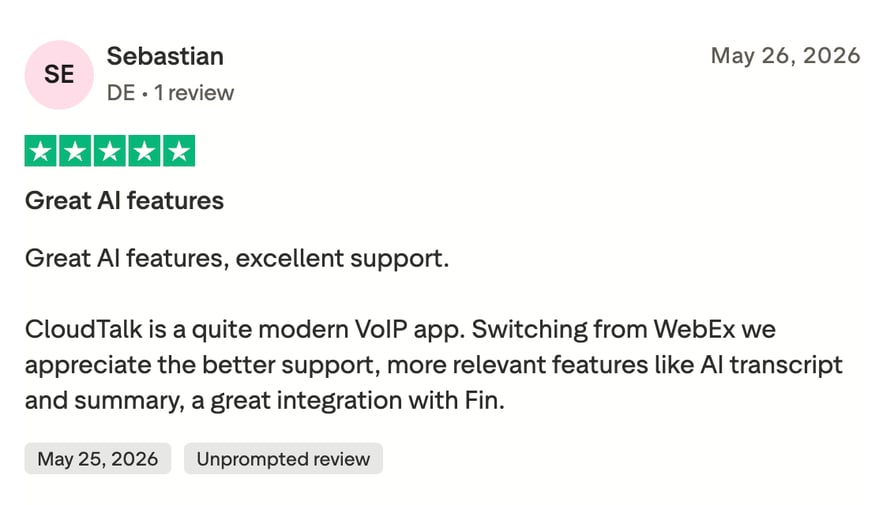
CloudTalk's Reddit has a growing community with many active users and positive feedback.

Join 5,500+ satisfied customers and elevate your business with CloudTalk's VoIP solution.
2. Retell AI — Best for Developer Teams Building Production Voice Agents
What Is Retell AI?
Retell AI is a developer-first voice agent infrastructure platform that powers 30M+ calls per month for 3,000+ businesses, including many large companies. Unlike Voiceflow's design-first approach, Retell is built for shipping production-ready agents fast — with sub-700ms latency, a visual Conversation Flow Builder, and a full developer SDK in the same product.
Why Is Retell AI a Strong Voiceflow Alternative?
- Highest-rated voice AI on G2 — 4.8/5 across 1,700+ verified reviews, more than 26x Voiceflow's review volume.
- Telephony included — no Twilio setup. Retell handles the full voice stack including STT, LLM, TTS, and telephony.
- Sub-700ms latency — faster than Voiceflow's Twilio-dependent routing, which adds additional network hops.
- No credit system — pay-as-you-go at $0.07/min base rate, predictable at scale.
What Are the Pros & Cons of Retell AI?
| Pros | Cons |
|---|---|
| 4.8/5 G2 rating — highest-rated voice AI platform in this comparison | Developer-first — requires engineering resources for setup and maintenance |
| Sub-700ms latency and telephony included — no Twilio setup required | Real all-in costs $0.13–$0.31/min once LLM and voice stack are added |
| Pay-as-you-go pricing — no subscriptions, no credit system | Limited pre-built templates vs Voiceflow's template library |
What Are Retell AI's Plans & Pricing?
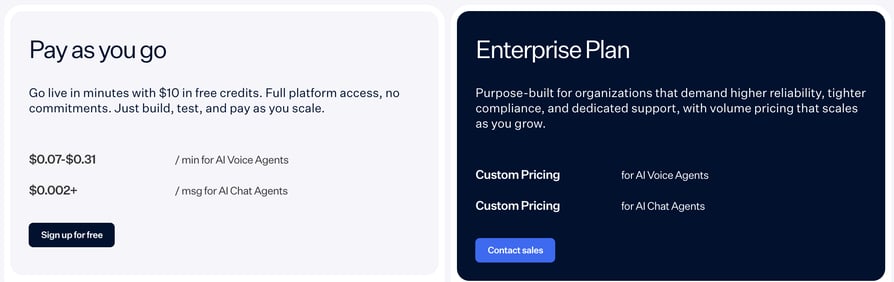
Retell AI’s pricing offers a pay-as-you-go model, starting from $0.07/min (platform fee only). Real all-in cost with LLM, STT, TTS, and telephony typically $0.13–$0.31/min depending on model choice. Enterprise volume discounts from $3,000+/month. Free tier with $10 credits to start.
How G2 Users Rate Retell AI?
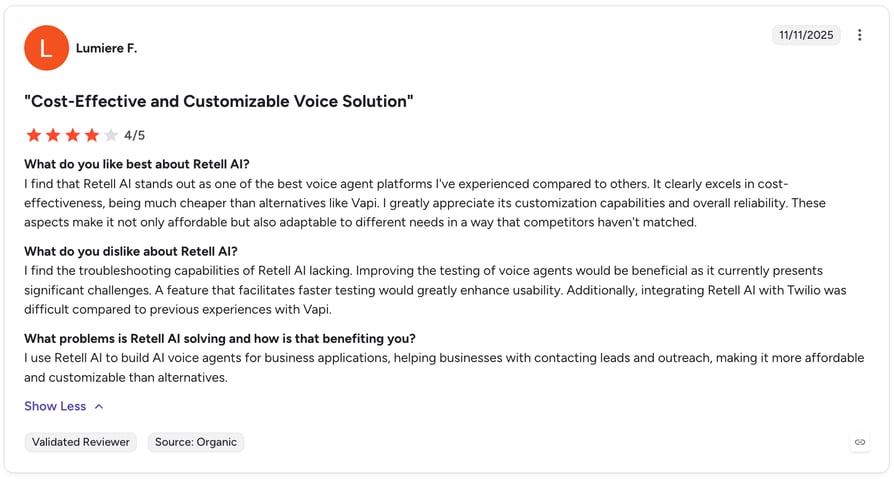
Retell AI's current G2 rating is 4.8/5, out of 1,700+ verified user reviews.
3. Synthflow — Best No-Code Voiceflow Alternative for Non-Technical Teams
What Is Synthflow?
Synthflow is a no-code AI voice agent platform with the most polished drag-and-drop builder outside of Voiceflow. It includes built-in telephony — unlike Voiceflow — and is best known for its white-label capabilities and agency-first feature set. Best suited for agencies and non-technical teams deploying AI calling agents without developer involvement.
Why Is Synthflow a Strong Voiceflow Alternative?
- Built-in telephony — no Twilio required. Unlike Voiceflow, Synthflow handles the full voice stack including phone calls out of the box.
- White-label ready — agencies can fully rebrand the platform for client deployments.
- 200+ integrations — HubSpot, GoHighLevel, Salesforce, Zapier natively.
- 4.5/5 G2 rating, G2 Spring 2026 Best Estimated ROI badge.
What Are the Pros & Cons of Synthflow?
| Pros | Cons |
|---|---|
| No-code builder with telephony included — solves Voiceflow's main gap | Entry point jumped from $29/mo to $375/mo — significant cost increase vs Voiceflow |
| White-label ready for agency resellers | Real costs 2–3x advertised once LLM and voice API keys are factored in |
| 4.5/5 G2 rating, G2 Spring 2026 Best Estimated ROI | Stability issues reported on lower tiers — off-script handling can loop or fail |
What Are Synthflow's Plans & Pricing?
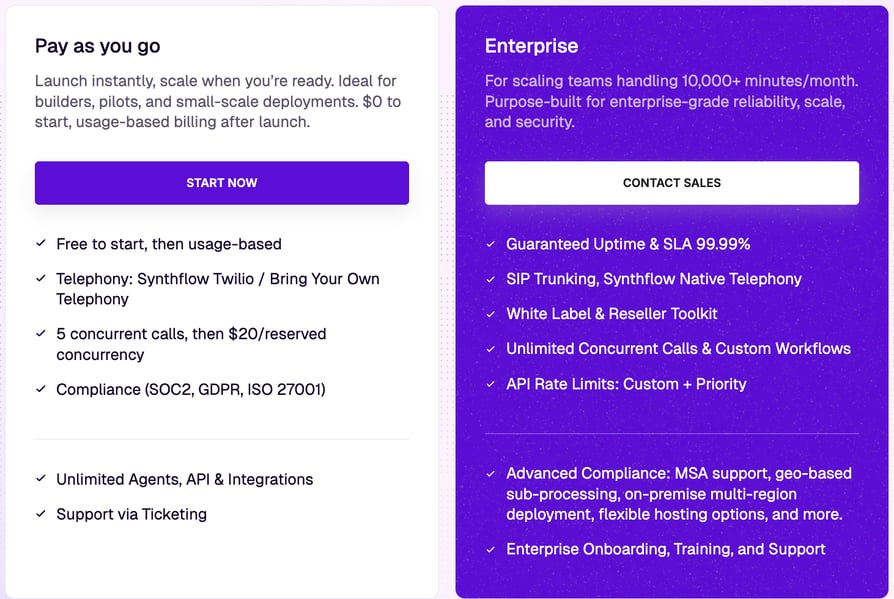
Synthflow pricing starts at Free to start (usage-based), with the following main plans:
- Pay as you go - Free to start, then usage-based billing
- Enterprise - Custom pricing
How G2 Users Rate Synthflow?
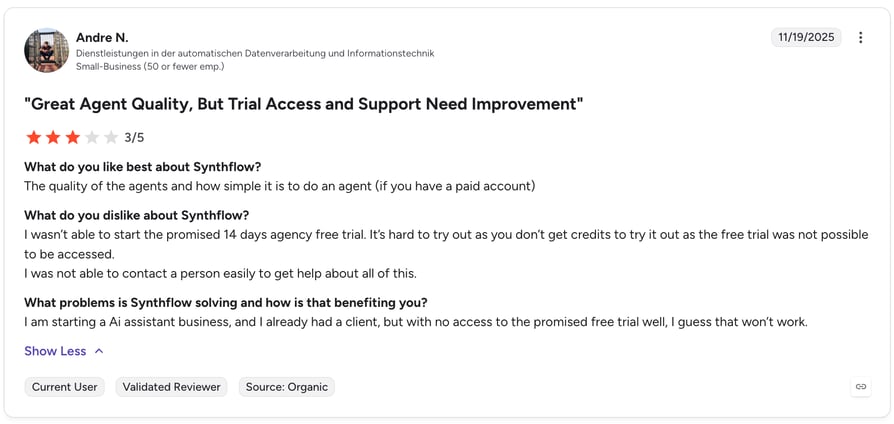
Synthflow's current G2 rating is 4.5/5, out of hundreds of verified user reviews.
4. Bland AI — Best for High-Volume Enterprise Outbound Calls
What Is Bland AI?
Bland AI is a developer-first voice AI infrastructure platform built for enterprise teams running high-volume outbound campaigns. Unlike Voiceflow's chat-first roots, Bland is telephone-native — it handles up to 1 million concurrent calls with proprietary models trained specifically for phone conversations. Customers include Samsara, Snapchat, and Gallup.
Why Is Bland AI a Strong Voiceflow Alternative?
- Bundled per-minute pricing — $0.09–$0.14/min all-in (STT + LLM + TTS + telephony). No credits, no external API bills, no Twilio setup.
- 1 million concurrent call capacity — enterprise-scale outbound without infrastructure limits.
- Proprietary LLMs trained on phone conversation data — better performance for common outbound scenarios.
- SOC 2 Type II, HIPAA, GDPR on standard plans.
What Are the Pros & Cons of Bland AI?
| Pros | Cons |
|---|---|
| Bundled flat per-minute rate — most predictable cost model for high-volume outbound | No no-code builder — all configuration requires developer resources |
| 1M concurrent call capacity — enterprise-scale without infrastructure discussion | Latency averages 800ms–2s — slower than Retell AI (~620ms) |
| SOC 2, HIPAA, GDPR on all standard plans | Limited G2 reviews — harder to independently validate before committing |
What Are Bland AI's Plans & Pricing?
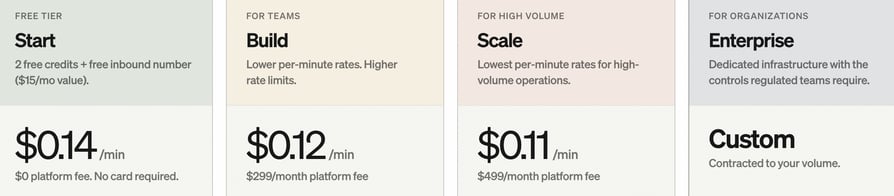
Bland AI pricing is structured around usage tiers:
- Start - Free platform, $0.14/min
- Build - $0.12/min (2,000 calls/day)
- Scale - $0.11/min
- Enterprise - Custom rate
How G2 Users Rate Bland AI?
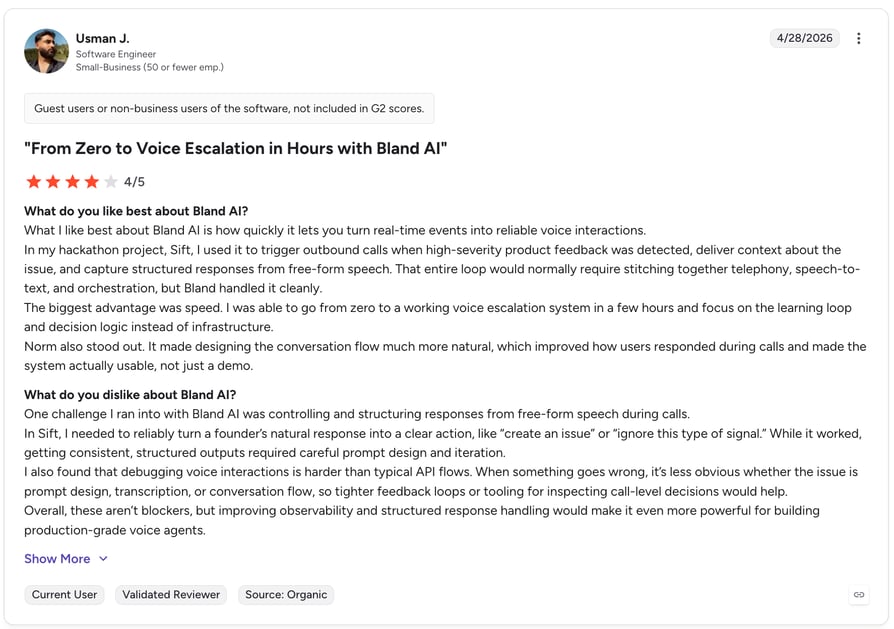
Bland AI currently has 11 reviews on G2 with only positive user feedback.
5. Botpress — Best Open-Source Multi-Channel Voiceflow Alternative
What Is Botpress?
Botpress is an open-source AI agent and chatbot platform trusted by teams in 190+ countries. It offers a visual Agent Studio for building multi-channel agents across web chat, WhatsApp, Telegram, SMS, and voice — making it the closest feature-for-feature alternative to Voiceflow's multi-channel canvas. As of May 2026, AI spend is bundled into paid plans and unlimited bots are included on every paid tier.
Why Is Botpress a Strong Voiceflow Alternative?
- Multi-channel deployment — chat, voice, WhatsApp, SMS, and web from one visual canvas, matching Voiceflow's breadth.
- AI spend bundled — no separate credit system or LLM billing on paid plans as of May 2026.
- Self-hostable on Enterprise — data sovereignty without Voiceflow's cloud-only constraint.
- Unlimited bots on all paid plans as of May 2026 update.
What Are the Pros & Cons of Botpress?
| Pros | Cons |
|---|---|
| Open-source and self-hostable — data sovereignty without cloud dependency | Voice calling still requires external telephony — similar limitation to Voiceflow |
| 4.5/5 G2 rating across 460+ verified reviews | Team plan starts at $495/mo — significant jump from Plus ($89/mo) |
| AI spend bundled, unlimited bots on paid plans as of May 2026 | Less polished voice-specific experience than Retell AI or Synthflow |
What Are Botpress's Plans & Pricing?

Botpress pricing starts at Free (Pay-as-you-go), with the following plans:
- Free - $0/month + AI usage
- Plus - $150/month (AI spend bundled)
- Team - $750/month
- Enterprise - Custom pricing
How G2 Users Rate Botpress?
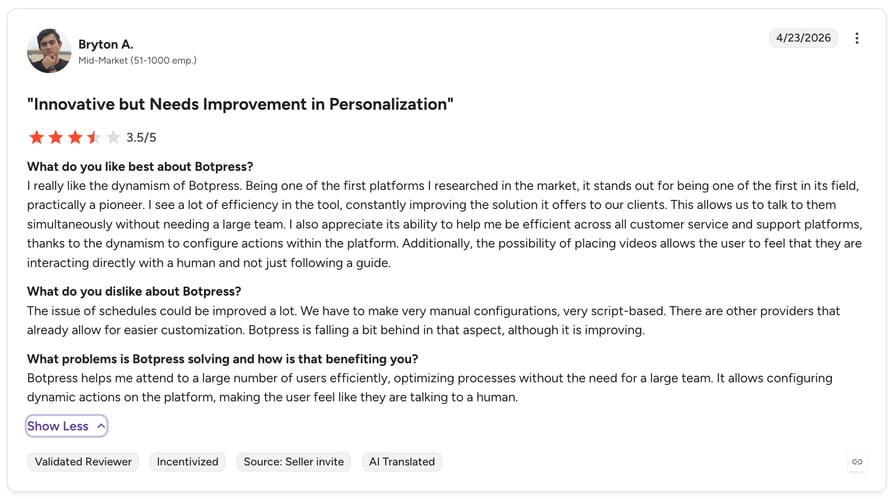
Botpress's current G2 rating is 4.5/5, out of 460+ verified user reviews.
6. Vapi AI — Best for Developer Teams Wanting API-Level Voice Control
What Is Vapi AI?
Vapi AI is a developer-centric voice agent orchestration platform. Unlike Voiceflow's pre-integrated stack, Vapi exposes granular control over every component — you choose your own speech-to-text, LLM, text-to-speech, and telephony provider. This gives engineering teams maximum flexibility at the cost of higher operational overhead. The $0.05/min headline is a platform fee only — real all-in costs typically land between $0.25 and $0.33/min.
Why Is Vapi AI a Strong Voiceflow Alternative?
- BYOK flexibility — swap any component (STT, LLM, TTS, telephony) without changing the platform.
- $0.05/min platform fee — lowest published orchestration fee in the category.
- Squads feature — chain multiple specialized agents within one call flow.
- Active developer community and comprehensive API documentation.
What Are the Pros & Cons of Vapi AI?
| Pros | Cons |
|---|---|
| Maximum component flexibility — swap any provider in the stack | Real all-in cost $0.25–$0.33/min when full stack is included |
| Lowest platform fee at $0.05/min | Developer-only — no no-code interface comparable to Voiceflow |
| Startup grant program available for eligible voice AI startups | High operational overhead — managing multiple separate billing relationships |
What Are Vapi AI's Plans & Pricing?
Vapi AI pricing is pay-as-you-go:
- Pay-as-you-go - $0.05/min platform fee (STT, LLM, TTS, telephony billed separately)
- Enterprise - Custom pricing
- $10 in free credits to start
How Do G2 Users Rate Vapi AI?
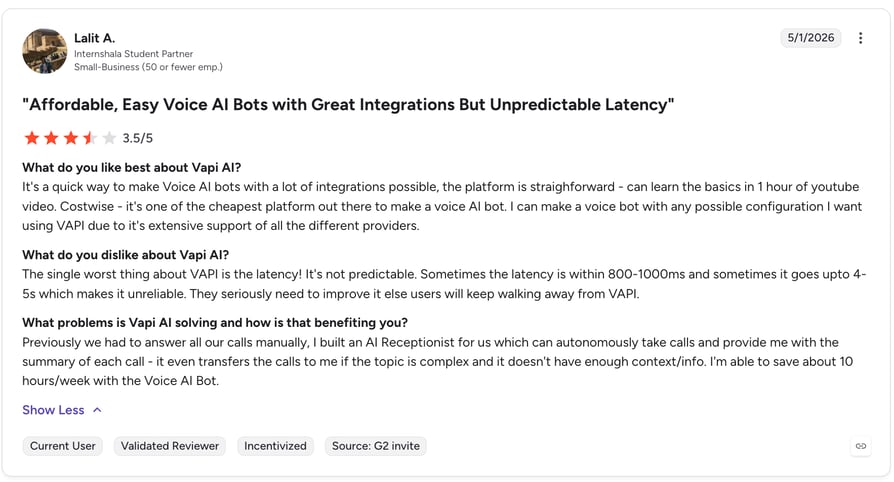
Vapi AI has a 4.2/5 G2 rating with only 3 verified user reviews.
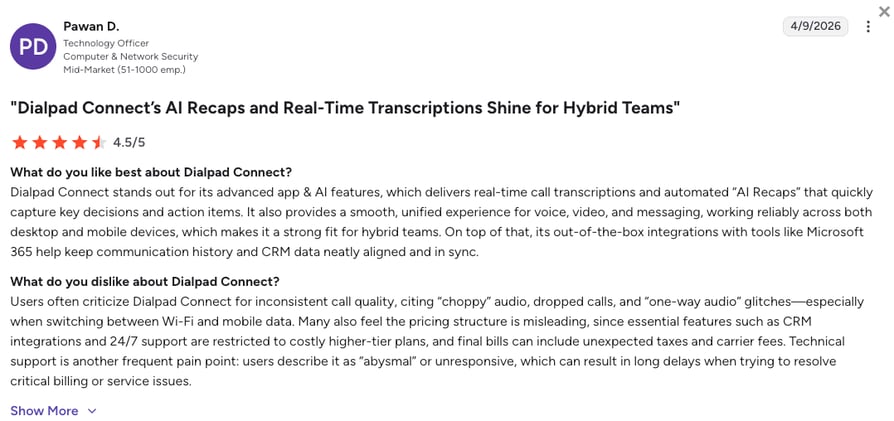
7. Dialpad — Best AI-Native Unified Communications Voiceflow Alternative
What Is Dialpad?
Dialpad is an AI-native unified communications platform combining voice, video, and messaging with a proprietary LLM — DialpadGPT — trained on over 6 billion minutes of business conversations. Unlike Voiceflow, which focuses on agent design, Dialpad augments human agents with real-time AI assistance: live transcription, coaching prompts, and automated post-call summaries included on every plan.
Why Is Dialpad a Strong Voiceflow Alternative?
- AI features included on every plan from $15/user/month — no credits, no add-ons.
- DialpadGPT trained on 6B+ business call minutes — more contextually tuned than generic LLMs.
- 4.4/5 G2 rating across 5,500+ verified reviews — among the largest review bases in this comparison.
- Telephony included — no external provider setup required.
What Are the Pros & Cons of Dialpad?
| Pros | Cons |
|---|---|
| AI features included in every plan — no separate purchase or credits | Contact center features start at $95/user/month — separate product |
| 5,500+ G2 reviews — most validated platform after CloudTalk in this list | CRM integrations gated behind Pro plan ($25/user/month) |
| DialpadGPT is contextually tuned for business conversations | SMS capped at 250 messages/account with overage charges |
What Are Dialpad's Plans & Pricing?
Dialpad pricing starts at $15/user/month (billed annually), with the following plans:
- Standard - $15/user/month
- Pro - $25/user/month (adds CRM integrations)
- Enterprise - Custom (100-user minimum)
Note: Dialpad offers individual pricing for AI Agents, Support, Sales, and Connect services.
How G2 Users Rate Dialpad?
Dialpad's current G2 rating is 4.4/5, out of 5,500+ verified user reviews.
8. LiveKit — Best Infrastructure-Level Voiceflow Alternative
What Is LiveKit?
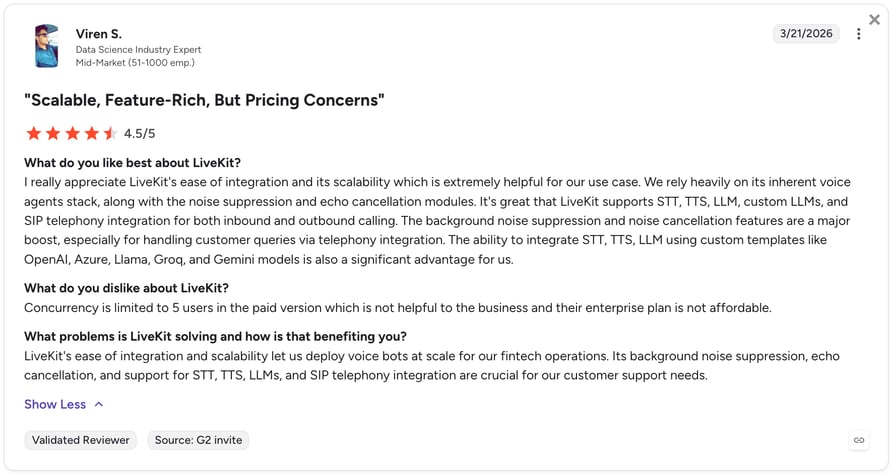
LiveKit is an open-source real-time communications infrastructure platform. At $0.01/min for cloud agents — 7x cheaper than Retell AI and 14x cheaper than Bland AI at base rates — it is the lowest-cost option for engineering teams building custom voice infrastructure. LLM costs are passed through at provider cost with no markup.
Why Is LiveKit a Strong Voiceflow Alternative?
- Lowest published infrastructure cost — $0.01/min, LLM costs passed at provider rate with no markup.
- Open-source — full codebase transparency, self-hostable, no vendor lock-in.
- WebRTC-native — sub-200ms audio delivery in optimal conditions.
- Composable — plug in any STT, LLM, TTS provider without platform restrictions.
What Are the Pros & Cons of LiveKit?
| Pros | Cons |
|---|---|
| $0.01/min — cheapest infrastructure cost in this comparison | Not a turnkey product — requires significant engineering to build an agent |
| Open-source with full self-hosting capability | No no-code interface — not comparable to Voiceflow for non-technical users |
| No markup on LLM/STT/TTS provider costs | No built-in telephony — phone calls require an additional PSTN provider |
What Are LiveKit's Plans & Pricing?

LiveKit pricing:
- Build - Available for free
- Ship - Starting at $50/mo
- Scale - Starting at $500/mo
- Enterprise - Custom pricing
How G2 Users Rate LiveKit?
LiveKit's presence on G2 is quite low, therefore, it currently sits on just 1 user review.
9. Intercom (Fin) — Best for Support Teams Wanting AI Helpdesk + Voice
What Is Intercom Fin?
Fin is Intercom's AI agent product — an autonomous resolution engine for customer support. Unlike Voiceflow's builder-first approach, Fin is a pre-built support AI that resolves customer questions autonomously across chat, email, and voice using your existing Intercom knowledge base. It charges per successful outcome ($0.99/resolved conversation) rather than per message, credit, or editor seat.
Why Is Intercom Fin a Strong Voiceflow Alternative?
- Outcome-based pricing — $0.99 per resolved conversation. You only pay when Fin actually solves a customer problem, vs Voiceflow's credits that deduct regardless of outcome.
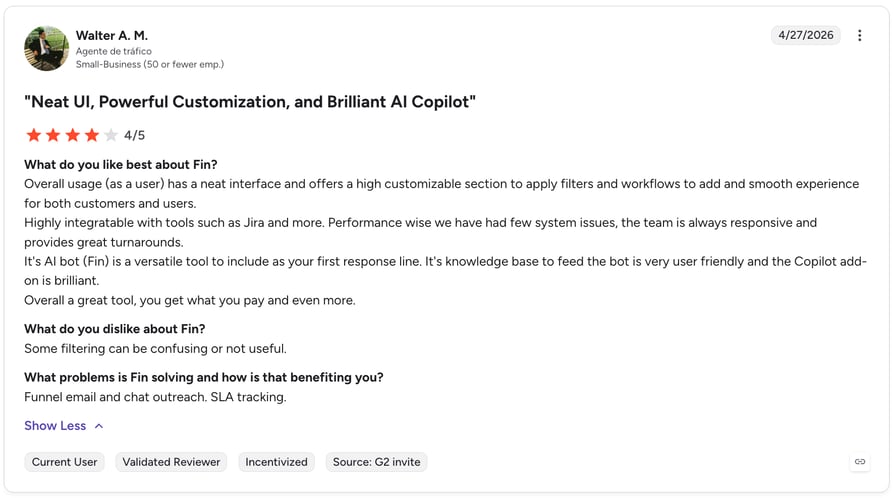
- 4.5/5 G2 rating across 3,820+ verified reviews — largest review base in this comparison.
- Resolves 50%+ of support tickets autonomously with zero agent involvement.
- No separate platform to build — plugs directly into existing Intercom setup.
What Are the Pros & Cons of Intercom Fin?
| Pros | Cons |
|---|---|
| Outcome-based pricing — pay only for successful resolutions | Requires existing Intercom subscription — significant additional platform cost |
| 3,820+ G2 reviews, 4.5/5 — most independently validated platform in this list | Primarily support-focused — not suitable for sales outbound or complex voice agent flows |
| Resolves 50%+ of tickets autonomously in verified deployments | Costs scale with resolution volume — unpredictable for high-ticket-volume deployments |
What Are Intercom Fin's Plans & Pricing?
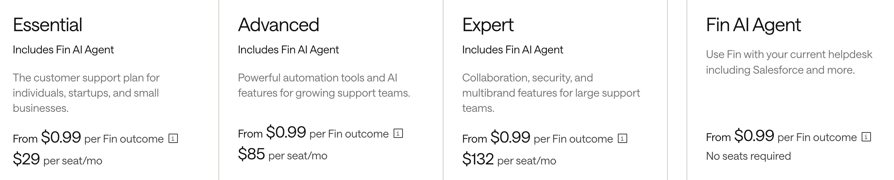
Intercom Fin pricing:
- Pay per outcome - $0.99 per resolved conversation
- Requires active Intercom subscription (base plans from $39/month)
- Enterprise - Custom pricing with volume discounts
How G2 Users Rate Intercom Fin?
Intercom Fin's current G2 rating is 4.5/5, out of 3,820+ verified user reviews.
10. Rasa — Best Self-Hosted Enterprise Voiceflow Alternative
What Is Rasa?
Rasa is the leading open-source conversational AI framework for enterprise organizations that cannot send conversation data to external cloud providers. Unlike Voiceflow's cloud-only SaaS, Rasa deploys entirely within your own infrastructure from day one — making it the only platform in this comparison that offers true on-premise AI agent deployment without an enterprise contract.
Why Is Rasa a Strong Voiceflow Alternative?
- True on-premise deployment — data never leaves your infrastructure. The only platform in this list offering this without enterprise negotiation.
- CALM dialogue manager — separates LLM understanding from business logic execution, more reliable than prompt-engineering-only approaches.
- Native voice with built-in telephony connectors — Twilio, Jambonz, AudioCodes, and Genesys without third-party setup.
- Free open-source tier — evaluate without any vendor commitment.
What Are the Pros & Cons of Rasa?
| Pros | Cons |
|---|---|
| Only platform with true on-premise AI agent deployment | Steep technical learning curve — requires developer resources and NLU expertise |
| Open-source free tier — evaluate without any vendor commitment | Very small G2 review base — harder to independently validate |
| CALM architecture more reliable than pure prompt engineering | Less polished no-code experience than Voiceflow or Botpress |
What Are Rasa's Plans & Pricing?
Rasa pricing:
- Free Developer Edition - Free Rasa license that can be used locally or in production
- Enterprise - Full access to Rasa Platform & Premium Support
- Rasa Pro - AI native conversational AI framework for developers to flexibly build, integrate, monitor, and deploy AI Assistants.
- Business Plan - no-code user interface for business users that want to build, analyze, and optimize AI Assistants.
How Do G2 Users Rate Rasa?
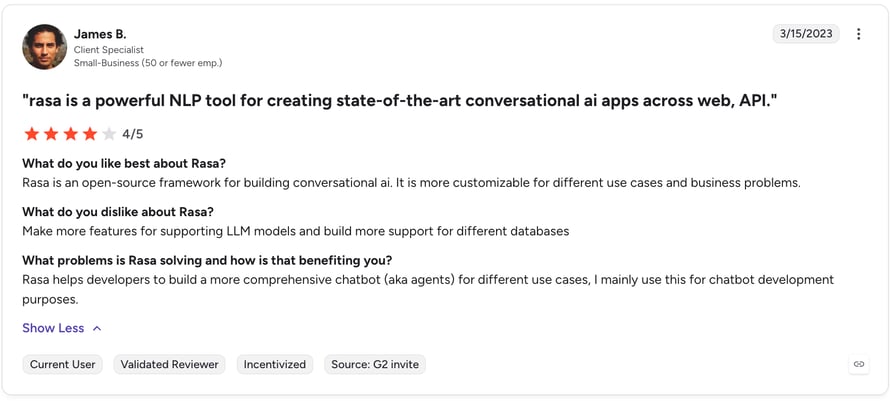
Rasa currently has only 11 reviews on G2 with a 4.5/5 star rating.
Voiceflow Pricing vs. Alternatives: What You're Really Paying
Voiceflow's advertised $60/editor/month Pro plan looks manageable on paper, but seat fees, telephony add-ons, and credit overages cause total costs to scale aggressively — especially for voice-heavy deployments.
Here is how Voiceflow's true cost compares directly to CloudTalk:
| Scenario | Voiceflow Cost | CloudTalk Cost |
|---|---|---|
| Base entry cost (single user) | $60/editor/mo + external VoIP software | $25/user/mo (telephony included) + optional AI add-ons |
| 5-person team on Business plan | $350/mo in seat fees alone (before credits or telephony) | $25 × 5 per month |
| Voice call cost | 10 credits/min + additional VoIP costs | Included in plan — no per-minute metering |
| 24/7 live support | Enterprise plan only | Available |
Hesitate no more. Try CloudTalk's free 14-day trial and see for yourself.
Voiceflow Alternatives by Feature: Which Platform Wins at What?
If you are leaving Voiceflow because a specific capability is lacking, here is which platform wins at each key need:
| Feature Need | Best Alternative | Why It Wins Over Voiceflow |
|---|---|---|
| Telephony included (no Twilio) | CloudTalk | Owned infrastructure in 160+ countries, no carrier setup required |
| Production-grade voice latency | Retell AI | Sub-700ms — fastest measured response time in this comparison |
| No-code agent builder | Synthflow or CloudTalk | Both offer drag-and-drop builders with telephony included |
| HubSpot / Salesforce deep sync | CloudTalk | 100+ native integrations, automatic call logging |
| Multi-channel chat + voice canvas | Botpress | Web, WhatsApp, SMS, and voice from one open-source visual builder |
| High-volume outbound (enterprise) | Bland AI | 1M concurrent calls, flat-bundled per-minute rate |
| On-premise / self-hosted deployment | Rasa | The only platform in this list with true on-premise from day one |
| Outcome-based support AI | Intercom Fin | $0.99 per resolved conversation — pay only when the AI actually solves the problem |
What Users Are Really Saying About Voiceflow Alternatives
We went beyond our own testing to surface what real users say about Voiceflow and its alternatives across three major discussion platforms. Here is the consensus.
- Credit exhaustion is the #1 driver for switching: Users hit voice credit ceilings mid-deployment and cannot afford the unpredictability in production customer-facing applications.
- Telephony complexity is the #2 frustration: Teams expected voice to work out of the box, not require a separate Twilio account setup and per-minute carrier billing on top of credits.
- CloudTalk is the most recommended alternative for sales and support calling: Cited for transparent pricing, CRM integration, and 24/7 support on all plans.
- Retell AI is the go-to for developers: Praised for latency, documentation, and production reliability.
- Synthflow is the agency recommendation: White-label and no-code, but the recent price increase from $29/mo to $375/mo has created friction in the community.
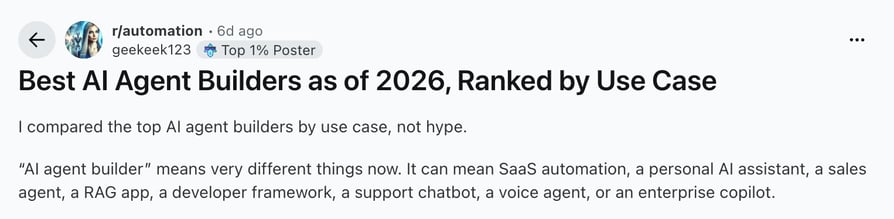
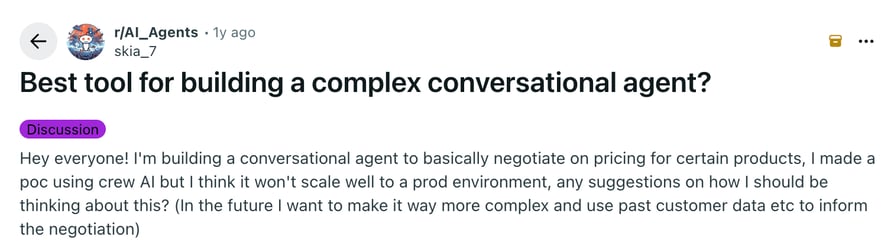
What Redditors Are Saying About Voiceflow Alternatives
Reddit is a huge community-driven platform with many relevant topics. Here is what some of the discussions regarding Voiceflow alternatives mention:

What Quora Users Are Asking About Voiceflow
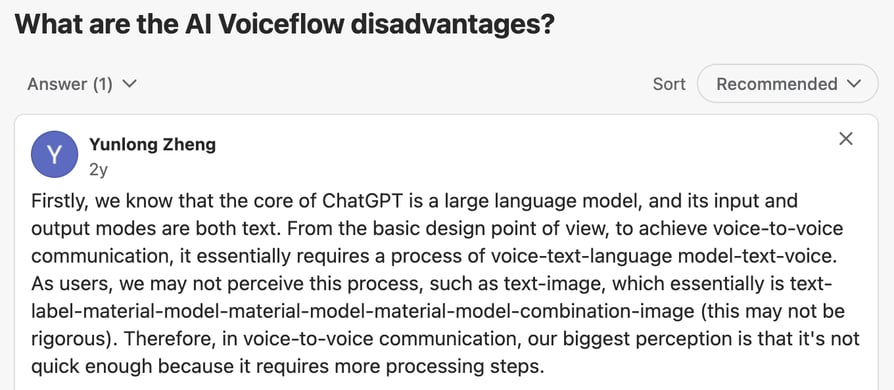
Quora's Q&A format surfaces business-owner and manager-level questions — typically decision-makers in the evaluation stage. Here are the recurring themes:
CloudTalk vs. Voiceflow: A Detailed Feature Comparison
When choosing between CloudTalk vs Voiceflow, the main differences come down to telephony inclusion, pricing model, AI features, CRM depth, and support accessibility. Here is the direct, side-by-side comparison.
| Category | CloudTalk | Voiceflow | Winner |
|---|---|---|---|
| Starting Price (annual billing) | $25/user/mo | Free / $60/editor/mo | CloudTalk |
| Telephony Included | Yes — 160+ countries owned | No — requires Twilio or Vonage | CloudTalk |
| Pricing Model | Flat per-user — predictable | Credits + seat fees — variable | CloudTalk |
| AI Features Included | Transcription, sentiment, summaries, scoring | LLM-based agents (credit-gated) | CloudTalk |
| CRM Integrations | 100+ native (HubSpot, Salesforce, Pipedrive) | API / Zapier only | CloudTalk |
| No-Code Builder | Visual Call Flow Designer | Drag-and-drop canvas (best in class for chat) | Voiceflow for chat; CloudTalk for calling |
| 24/7 Customer Support | Available | Enterprise only | CloudTalk |
| Seat Minimum | 1 user — no minimum | 1 editor + $50/mo per additional editor | CloudTalk |
| Smart Dialers | Power, Preview, Parallel | Not available | CloudTalk |
| G2 Rating | 4.4/5/5 (1,750+ reviews) | 4.7/5 (65+ reviews) | CloudTalk (by volume) |
| Free Trial | 14 days | Free tier + 7-day Pro trial | Tie |
How to Choose the Right Voiceflow Alternative for Your Team
When choosing the right alternative of Voiceflow, think about your specific business bottlenecks — not just the feature sets. Based on search trends and community questions from platforms like Reddit and Quora, here is how to match your unique use case to the right platform:
1. Do You Need Native Telephony or Are You Building a Chatbot?
If your primary use case is voice calling, you need a platform with built-in telephony. Voiceflow, Botpress, and Rasa all require external providers for real phone calls. CloudTalk, Retell AI, Synthflow, Bland AI, and Dialpad all include telephony. Buying a chatbot builder and bolting on Twilio adds cost, complexity, and a failure point you do not need.
- Top Picks for AI phone calls: CloudTalk (full VoIP + AI) or Retell AI (developer-grade voice agents).
2. How Important Is Pricing Predictability?
Credit-based pricing (Voiceflow) means your monthly invoice varies with every conversation. Per-user pricing (CloudTalk, Dialpad) is entirely predictable regardless of call volume. Per-minute pricing (Retell AI, Vapi AI, Bland AI) is predictable if your volume is stable but variable during campaigns.
- Top Picks for predictable pricing: CloudTalk (flat per-user) or Dialpad (flat per-user with AI included).
3. Does Your Team Have Developer Resources?
Retell AI, Vapi AI, LiveKit, and Rasa require engineering resources for setup and maintenance. CloudTalk, Synthflow, Botpress, and Dialpad are accessible to non-technical admins. If you do not have dedicated engineering, eliminate developer-first platforms from your shortlist early.
- Top Picks for non-technical teams: CloudTalk or Synthflow.
4. How Deep Does Your CRM Integration Need to Be?
If your workflow depends on call data appearing in HubSpot or Salesforce automatically after every call, CloudTalk and Dialpad offer the deepest native bidirectional sync. Test your specific CRM integration during the free trial — it is easier to identify gaps before you commit.
- Top Picks for CRM integration: CloudTalk (100+ native integrations including HubSpot and Salesforce) or Dialpad (HubSpot and Salesforce on Pro plan).
5. What Are Your Support Expectations?
CloudTalk and Intercom Fin offer 24/7 support on all plans. Dialpad gates 24/7 behind Pro. Retell AI and Vapi AI have developer community support. Voiceflow provides live support on Enterprise only. For production voice agents handling real customer calls, a platform outage at peak time requires immediate resolution — not a 48-hour email queue.
- Top Pick for support: CloudTalk — 24/7 live support on every plan, no enterprise gate.
6. Overall, What Is the Best Voiceflow Alternative Worth Switching To?
If your goal is to deploy AI-powered phone calls without credit ceilings, Twilio setup, or seat fee surprises, CloudTalk is the premier choice. It delivers the strongest overall combination of owned telephony, AI conversation intelligence, CRM automation, and transparent pricing — without requiring developer resources or managing multiple API subscriptions.
- Top Pick: CloudTalk stands out as the definitive upgrade for growing businesses that need production-grade AI voice calling without enterprise-level complexity or costs.
Ready to try the best alternative to Voiceflow?
Frequently Asked Questions
About Voiceflow Alternatives
Find answers to the most common questions teams have when evaluating Voiceflow and its alternatives.
The best conversational AI platform depends on your use case. For sales and support teams needing AI phone calls with transparent pricing, CloudTalk leads with 1,750+ G2 reviews and built-in telephony. For developer teams building custom voice agents, Retell AI (4.8/5, 1,700+ G2 reviews) is the top-rated pure voice AI platform. For multi-channel chatbot plus voice deployment, Botpress and Voiceflow are the strongest visual builders.
Voiceflow is a no-code visual platform for designing and prototyping conversational AI agents across chat and voice channels. Founded in 2019, it provides a drag-and-drop canvas for building chatbots and IVR flows using external LLMs. It is best suited for product teams and developers building prototypes — voice calling requires a separate Twilio or Vonage integration, and production deployment often needs developer involvement beyond the no-code canvas.
Voiceflow has a free Starter plan (100 credits, 2 agents), a Pro plan at $60/editor/month, and a Business plan at $150/editor/month. Each plan includes one editor; additional editors cost $50/month each. Voice calls consume 10 credits per minute vs 1 credit per text message, making voice-heavy deployments significantly more expensive than the base plan price suggests. Annual billing saves approximately 10%. See our full Voiceflow pricing guide for a detailed breakdown.
LiveKit is the cheapest at $0.01/min for cloud infrastructure, but requires significant engineering to deploy. Botpress offers a genuinely functional free plan with unlimited bots. For production business calling with telephony included, CloudTalk starts at $25/user/month all-in, no carrier fees, no credit consumption, no surprise overages.
CloudTalk offers 100+ native CRM integrations, including HubSpot, Salesforce, Pipedrive, and Zendesk, with automatic bidirectional data sync. Voiceflow's integrations are primarily API-based, requiring custom configuration or Zapier. For teams where automatic call logging to CRM after every call is critical, CloudTalk's native integration depth is unmatched in this comparison.
Rasa is best for enterprises needing on-premise deployment and full data sovereignty. Bland AI handles up to 1 million concurrent calls for high-volume outbound. CloudTalk serves enterprise contact centers up to 200+ seats with transparent per-user pricing and no seat minimums. For regulated industries like healthcare and finance, Rasa (on-premise, HIPAA) and Bland AI (SOC 2, HIPAA, GDPR) are the strongest compliance-first options.
Voiceflow is worth it for product teams prototyping conversational AI agents, where the visual canvas accelerates design iteration. It is less worth it for production voice calling deployments where credit predictability, telephony inclusion, and 24/7 support matter. If your primary use case is multi-channel chatbot design with occasional voice, Voiceflow's canvas is best-in-class. If your primary use case is AI phone calls at scale, start with CloudTalk or Retell AI instead.
Voiceflow supports multiple LLMs, including GPT-4, GPT-3.5, and Claude, on paid plans. The free Starter tier is limited to GPT-3.5 (ChatGPT). Enterprise plans allow users to bring their own LLM — including open-source models like Llama. Each LLM interaction consumes credits from your monthly allocation, with more advanced models consuming more credits per conversation turn.
Before migrating your team, always test the platform on your actual call flows in your specific environment. Here is how the top platforms compare:
CloudTalk: 14 days, full feature access, no credit card
Dialpad: 14 days
Retell AI: Free tier with $10 credits
Botpress: Free plan (permanent)
Voiceflow: Free Starter tier (100 credits), 7-day Pro trial