
10 Best CallRail Alternatives: TL;DR Comparison Table
| # | Tool | Best For | Starting Price (annual billing) | G2 Rating |
|---|---|---|---|---|
| 1 | CloudTalk | SMB and mid-market teams that want AI lead capture built into a real phone system | $25/user/mo | 4.4/5 |
| 2 | RingCentral | Mid-market teams needing enterprise-grade UCaaS with call tracking bolted on | $20/user/mo (Core) | 4.2/5 |
| 3 | Nextiva | Growing teams that want AI-assisted call handling bundled with unified comms | $15/user/mo (Core) | 4.5/5 |
| 4 | Aircall | SMB sales teams needing quick CRM sync and call tagging | $30/user/mo (3-seat min) | 4.4/5 |
| 5 | Dialpad | AI-first teams that want built-in transcription and call summaries | $15/user/mo (Standard) | 4.4/5 |
| 6 | CallTrackingMetrics (CTM) | Marketing agencies needing multi-channel attribution and conversation intelligence | $65/mo (Marketing Lite) | 4.5/5 |
| 7 | WhatConverts | Marketers who just want clean ad-to-call-to-lead attribution | $30/mo (Call Tracking) | 4.9/5 |
| 8 | Invoca | Enterprise marketing teams needing AI-driven revenue attribution at scale | Custom (quote-only) | 4.5/5 |
| 9 | Synthflow | Agencies building white-label AI voice agents for clients | $29/mo (Starter, 50 min) | 4.5/5 |
| 10 | Retell AI | Engineering teams building custom AI voice agents from scratch | ~$0.13-0.31/min (PAYG) | 4.8/5 |
Skip the Reading. See It Live.
Why Are Teams Searching for a CallRail Alternative?
CallRail built its name on Dynamic Number Insertion, and for pure marketing attribution it still does that job well. Teams researching CallRail competitors rarely question whether CallRail can tell them a call happened. They start looking elsewhere once they realize tracking a call and acting on it are two very different jobs, and CallRail only does the first one.
Who Is CallRail Ideal for?
If website-to-call attribution is genuinely the only problem you need solved, CallRail is a great tool for it. Its Dynamic Number Insertion and native Google Ads and GA4 integrations are still some of the deepest in the category, purpose-built for marketing attribution in a way CloudTalk isn't. For teams that need a phone system that can pick up, qualify, and route the lead, CloudTalk's AI Receptionist and Conversation Intelligence handle the other half of the job.
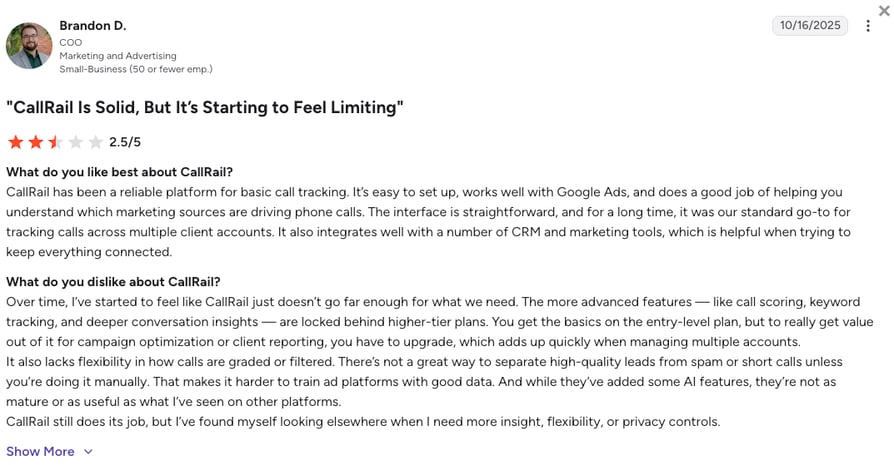
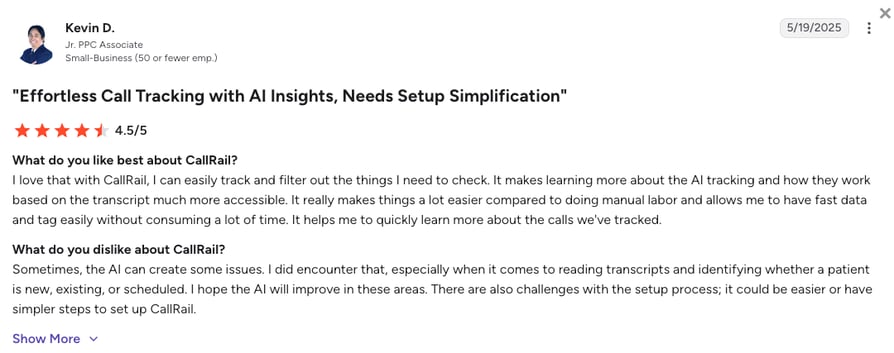
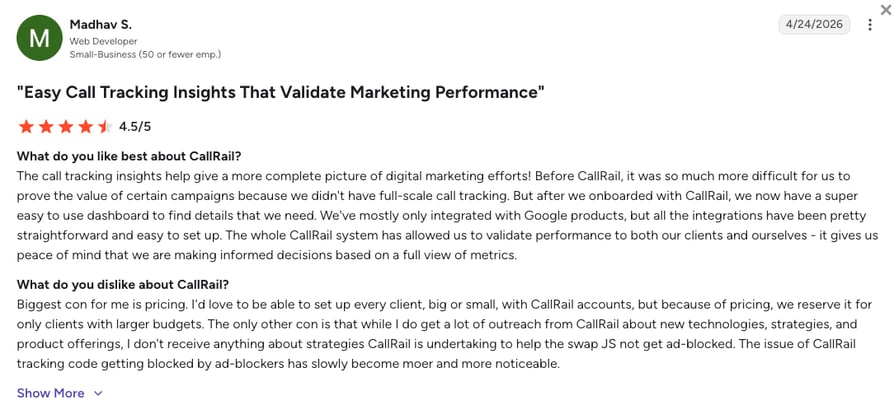
Based on verified reviews on G2 (where CallRail scores 4.5/5 across 1,800+ reviews, mostly logged in G2's Inbound Call Tracking category rather than VoIP or Contact Center), plus active threads on Reddit and Quora, here are the five structural problems that send CallRail users looking for an alternative.
5 Main Cons of CallRail That Make Businesses Look for an Alternative
- Every plan is metered, so the real bill keeps climbingCallRail's Lead Tracking plan starts at $50/mo for 5 numbers and 250 minutes, but additional numbers run $3 each and extra local minutes run $0.06 each, on top of the base fee. Agencies and lead-gen teams running seasonal spikes routinely blow past the included usage, and none of it is refundable.
- Conversation intelligence is locked three tiers up, at $150/moCall summaries, sentiment analysis, and coaching tools only unlock on the $150/mo Lead Conversion plan, three tiers above the $50/mo entry point. The $95/mo tier only adds form tracking, not AI call analysis. That's a $100/mo jump just to get an AI read on your own calls.
- CallRail tracks the call. It can't pick it upCallRail's platform sits upstream of the conversation: it tells you which ad drove the call and hands you a recording. It doesn't answer, triage, or qualify the caller. A new Voice Assist add-on (from $95/mo, on top of a Lead Tracking base plan) is CallRail's first step toward that job, but it's a bolted-on extra, not a native phone system with dialers and CRM sync built in.
- CRM sync is one-directional logging, not two-way automationCallRail pushes call data into HubSpot or Salesforce, but reps still work inside a separate dialer or phone tool to actually call the lead back. There's no native outbound dialer, no click-to-dial from the CRM record, and no automated follow-up sequencing tied to the call outcome.
- No dialer, no seats, no way to scale a sales motionCallRail is priced and built around tracking numbers and minutes, not agents. There's no Power Dialer, no Smart Dialer, and no seat-based routing for a growing outbound or support team. Once a lead-gen business needs to staff up a real calling operation, CallRail isn't built for that job.
What Is the Best Alternative to CallRail?
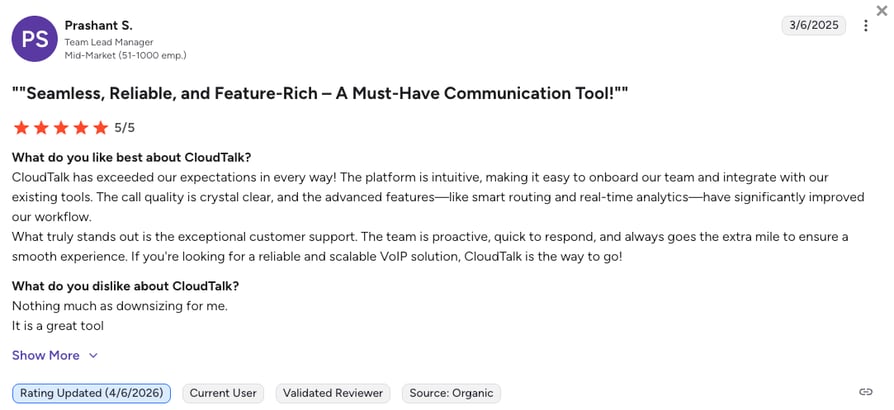
CloudTalk is the best CallRail alternative for growing sales and support teams that want to do something with the call, not just log it. Plans start at $25/user/mo (Starter), with no seat minimum until Expert (3-seat minimum), backed by a 99.999% uptime SLA.
Why Do Teams Consider CloudTalk the Best CallRail Alternative?
The gap CallRail leaves open is everything that happens after the call rings. CloudTalk closes it with a three-part stack: an AI Receptionist that answers 24/7, an AI Voice Agent that qualifies leads and books meetings, and Conversation Intelligence that mines every call for sentiment, topics, and searchable transcripts pushed straight into your CRM.
Unlike CallRail's per-account, metered pricing, CloudTalk charges a flat per-user rate at each tier. CRM integrations, dialers, and call recording (1-month retention on Starter, unlimited from Essential) are part of a real phone system, not add-ons bolted onto a tracking dashboard.
5 Main Pros of CloudTalk and Why Businesses Switch from CallRail
- An AI Receptionist that answers before the caller hangs upCallRail can tell you a call rang and went unanswered. CloudTalk's AI Receptionist picks it up 24/7, in 60+ languages, and with 50 free minutes on every plan to try it out and paid tiers from $99/mo. After-hours call loss drops sharply once something is actually answering the phone.
- Conversation Intelligence at $9/user/mo, not $150/mo per accountCloudTalk's Conversation Intelligence add-on auto-summarizes every call with sentiment, topic detection, and searchable transcripts pushed right to your CRM, including HubSpot, Salesforce, or Pipedrive. CallRail gates the same category of feature behind its $150/mo Lead Conversion tier.
- A real outbound dialer, not just a tracking numberCloudTalk includes auto dialing modes like Power Dialer on Expert (or as a $15/user/mo add-on on any plan) and a $39/user/mo Parallel Dialer add-on for sales teams that need to work a list, not just receive calls. CallRail has no native dialer at all.
- True two-way CRM sync, not one-directional loggingCloudTalk connects to 100+ CRM and helpdesk tools from the Essential plan, syncing calls, transcripts, and contact data both ways. Reps dial from the CRM record and the outcome writes itself back, instead of a tracking dashboard pushing data in one direction.
- Transparent per-user pricing instead of metered per-account feesCloudTalk charges a flat per-user rate at each tier. There's no per-minute overage on local calls, no per-number add-on fee, and no surprise usage bill at the end of the month, exactly the complaint that shows up repeatedly in CallRail's own G2 reviews.
Test the Full Stack for 14 Days. No Contract Needed.
How We Chose the Best CallRail Alternatives and Competitors
To build this list of CallRail competitors, we reviewed pricing pages, technical documentation, and unfiltered user reviews across G2, Reddit, and Quora. Because CallRail buyers span pure call-tracking specialists, AI-first phone systems, and raw AI voice APIs, we evaluated all three categories against the same six benchmarks.
We evaluated every platform against six benchmarks that matter most to teams switching away from CallRail.
- Call Stability & ReliabilityWe checked uptime SLAs, verified user reports of dropped calls, and how each platform handles high-volume seasonal spikes.
- Total Cost of OwnershipWe compared true entry cost, per-minute and per-number overage fees, seat or account minimums, and whether AI features are bundled or gated.
- CRM & Helpdesk Integration DepthWe looked at whether call data logs one direction into a CRM or syncs both ways with dialers and automation attached.
- Global Coverage & Number AvailabilityWe prioritized platforms with virtual numbers across multiple countries, not just US and Canada tracking numbers.
- Support Quality & AvailabilityWe tested whether support is available 24/7 and how quickly billing or usage disputes get resolved.
- AI & Automation CapabilitiesWe assessed whether AI call summaries, sentiment analysis, and voice agents are bundled, priced per-minute, or locked behind a top-tier plan.
The Top 10 Alternatives to CallRail for 2026
In this part, we'll take a detailed look at 10 best alternatives to CallRail software. Before we do that, though, here's how CallRail stacks up against a call-tracking specialist, a broader marketing platform, and an AI-first business phone system, the three shapes most CallRail alternatives take.
CallRail vs. CloudTalk vs. Invoca vs. WhatConverts vs. RingCentral
| Feature | CallRail | CloudTalk | Invoca | WhatConverts | RingCentral |
|---|---|---|---|---|---|
| Starting Price | $50/mo (per account) | $25/user/mo | Custom (quote-only) | $30/mo (per account) | $20/user/mo |
| Seats/Accounts Minimum | None (per account) | None (3 on Expert) | None (per account) | None (per account) | None |
| Free Trial |  (14 days) (14 days) | (14 days) |  (demo only) (demo only) | (14 days) | |
| Dynamic Number Insertion | | (Not a core focus) | | | |
| Call Recording | Included, all plans | From the start (automatic) | Included, all plans | Included, all plans | Advanced+ ($25/user/mo) |
| Conversation Intelligence | Lead Conversion tier only ($150/mo) | $9/user/mo add-on | Signal AI add-on (custom) | Not offered | AI assistant (Engage+) |
| Native Outbound Dialer | | Power Dialer (Expert, or $15/mo add-on), Parallel ($39/mo add-on) | | | |
| CRM Integrations | HubSpot, Salesforce (native) | 100+ tools from Essential, Salesforce on Expert | Salesforce, HubSpot (premium tiers) | HubSpot, Salesforce, Zoho | 300+ integrations (Advanced+) |
| AI Voice Receptionist/Agent | Voice Assist add-on (from $95/mo) | AI Receptionist (50 free min, then $99+/mo) | AI Voice Agent (new, custom pricing) | Not offered | Not offered |
| Country/Number Coverage | US, Canada, UK, Australia | Numbers for 160+ countries | US-centric, enterprise custom | US-centric | ~100 countries (Ultra) |
| Customer Support | Chat and email; phone on higher tiers | 24/7 (phone on Expert) | 24/7 platform availability, dedicated CSM | Email and chat support | 24/7 (higher tiers) |
The CallRail Cost Trap: What $50 Actually Gets You
CallRail's Lead Tracking plan looks affordable at $50/mo, but it only includes 5 numbers and 250 minutes. Add a 6th number ($3), go over on local minutes ($0.06 each), and the bill creeps past $50 fast. Want AI call summaries and sentiment analysis? That is not on the $95/mo tier, it is on Lead Conversion at $150/mo, three tiers up. For an agency running multiple client accounts with seasonal call spikes, the advertised $50/mo can realistically land closer to $150 to $195/mo once usage and AI analysis are added in.
Beyond Tracking: A Phone System That Answers
1. CloudTalk: Best CallRail Alternative for AI-Powered Lead Capture
What Is CloudTalk?
CloudTalk is an AI-powered business phone system built for SMB and mid-market sales and support teams. It gives lead-gen businesses, agencies, and marketing-adjacent sales teams a full contact center feature set, not just a tracking dashboard, without an enterprise contract.
Unlike CallRail, which stops at telling you a call happened, CloudTalk answers it. The AI Receptionist, AI Voice Agent, and Conversation Intelligence work on top of a real phone system with dialers, CRM sync, and virtual numbers in 160+ countries.
Why Is CloudTalk a Strong CallRail Alternative?
- An AI Receptionist and AI Voice Agent that pick up where tracking endsCloudTalk's AI Receptionist answers inbound calls 24/7 with 50 free minutes on every plan, and the AI Voice Agent qualifies leads and books meetings on complex, multi-step calls. CallRail's tracking numbers ring through to a human or voicemail, nothing else.
- Conversation Intelligence at $9/user/mo, not gated behind a $150/mo tierCloudTalk's AI call summaries, topic detection, and sentiment analysis are a $9/user/mo add-on on any plan. CallRail only unlocks the same category of feature on its $150/mo Lead Conversion tier.
- A native outbound dialer for teams that need to call leads backCloudTalk includes Power Dialer on Expert (or a $15/user/mo add-on on any plan). Pair it up with the Parallel Dialer add-on at $39/mo and dial up to 10 leads at once. CallRail has no dialer at all, so reps still need a second tool just to call a tracked lead back.
What Are the Pros & Cons of CloudTalk?
| Pros | Cons |
|---|---|
| Unlimited domestic calling from Essential, no per-minute overage on local calls | Marketing attribution and DNI aren't a core focus |
| 100+ CRM integrations from Essential (Salesforce on Expert) | No native video meetings or omnichannel inbox |
| AI Receptionist with 50 free minutes on every plan | Power Dialer only on Expert (3-seat min), or a $15/user/mo add-on elsewhere |
| Numbers for 160+ countries, 99.999% uptime SLA | |
| Free 14-day trial, no credit card required |
What Are CloudTalk's Plans & Pricing?
CloudTalk pricing starts at $25/user/mo (Starter, billed annually), with the following plans:
CloudTalk Pricing Plans
| Plan | Price | Key Features |
|---|---|---|
| Starter | $25/user/mo | Unlimited inbound, regional outbound bundles, call queues, call recording (1-month retention), click-to-call |
| Essential | $29/user/mo | Everything in Starter + 100+ CRM integrations, IVR, skill-based routing, unlimited recording retention |
| Expert | $49/user/mo | Everything in Essential + Salesforce deep-sync, Smart Dialer, Preview Dialer, Power Dialer, phone support (3-seat min) |
| Conversation Intelligence (add-on) | $9/user/mo | AI call summaries, topic detection, sentiment analysis (any plan) |
| AI Receptionist | 50 free min, then $99-$699/mo | Inbound AI voice agent for FAQs, routing, and after-hours triage; no-code setup |
| AI Voice Agent (Specialist) | From $349/mo (1,000 min) | Sales-led, inbound and outbound, complex lead qualification and booking workflows |
AI Add-On Pricing at a Glance
Conversation Intelligence: $9/user/mo. AI Receptionist: 50 free min, then from $99/mo. AI Voice Agent: from $349/mo. Power Dialer: included on Expert or $15/user/mo add-on. Salesforce deep-sync: Expert plan.
What Are CloudTalk's Customers Saying?
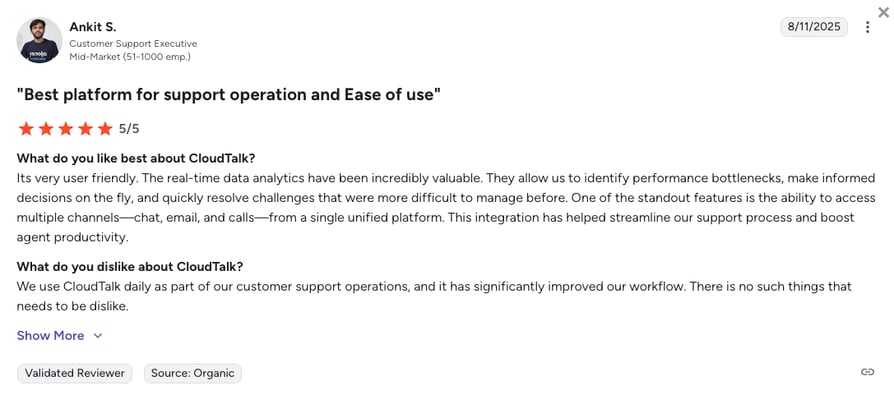
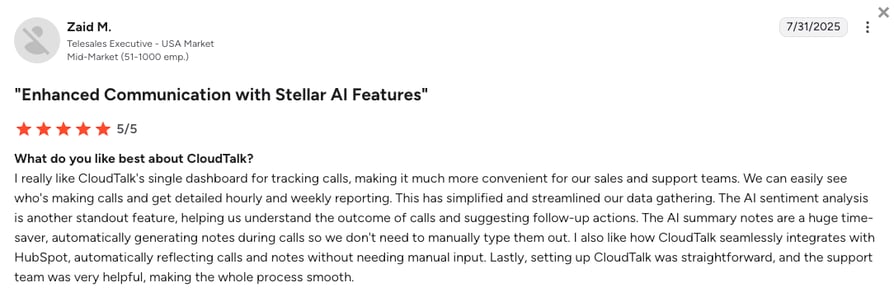
CloudTalk users consistently highlight the AI Receptionist and Conversation Intelligence as the reason they switched from a pure tracking tool. Reviewers on G2 call out fast setup and CRM sync that logs calls automatically. The most common frustration is that Salesforce deep-sync sits on the Expert plan.
One AI Case Study Is Worth a Thousand Words
Case study proof beats sentiment. A U.S.-based, high-volume services provider used CloudTalk's AI Voice Agent to triage inbound calls before they reach a human, the same kind of high call-volume, lead-heavy inbound line a CallRail customer runs. Their Head of Strategy breaks down what changed:
How Do G2 Users Rate CloudTalk?
CloudTalk's current G2 rating is 4.4/5, across 1,800+ verified reviews.
See Why 5,500+ Teams Chose CloudTalk over CallRail
2. RingCentral: Best for Mid-Market Teams Needing Enterprise-Grade UCaaS
What Is RingCentral?
RingCentral (marketed as RingEX) is an enterprise-grade UCaaS (Unified Communications as a Service) platform built for mid-market and large teams that need voice, video, messaging, and hundreds of integrations under one admin console.
RingCentral isn't a call-tracking tool, but it shows up in CallRail searches because marketing-adjacent teams often ask whether a full UCaaS platform can replace a tracking dashboard entirely. RingCentral's AI writing assistant and AI Receptionist add-on cover some of that ground, but neither does DNI-based attribution.
Why Is RingCentral a Strong CallRail Alternative?
- 300+ integrations across Salesforce, HubSpot, and ServiceNowRingCentral's Advanced plan opens up 300+ integrations, well past CallRail's native HubSpot and Salesforce connections.
- Native video meetings for up to 200 participantsRingCentral bundles video meetings on every plan. CallRail has no video product at all, so teams that also run client calls or webinars need a separate tool either way.
- Enterprise-grade uptime and complianceRingCentral publishes a 99.999% uptime SLA and supports HIPAA and SOC 2. CallRail doesn't publish equivalent SLA figures.
What Are the Pros & Cons of RingCentral?
| Pros | Cons |
|---|---|
| 300+ integrations on Advanced | No Dynamic Number Insertion or ad-attribution features |
| Native video meetings (up to 200 participants) | Higher entry price ($20/user/mo) than most tracking tools |
| Enterprise-grade uptime and compliance | Call recording gated to Advanced ($25/user/mo) |
What Are RingCentral's Plans & Pricing?
RingCentral pricing starts at $20/user/mo (Core, annual billing), with the following plans:
RingCentral (RingEX) Pricing Plans
| Plan | Price | Key Features |
|---|---|---|
| Core | $20/user/mo | Unlimited calling, video meetings (100 participants), team messaging, IVR, AI writing assistant |
| Advanced | $25/user/mo | Everything in Core + call recording, 300+ integrations (Salesforce, HubSpot), auto call notes |
| Ultra | $35/user/mo | Everything in Advanced + unlimited storage, advanced analytics, device analytics |
The RingCentral Complexity Tax
RingCentral is powerful, but none of it is built for marketing attribution. Admin permissions, ring group configuration, and a $25/user/mo Advanced tier just to get call recording add real setup time for a team whose actual problem is knowing which ad drove the call.
What Are RingCentral's Customers Saying?
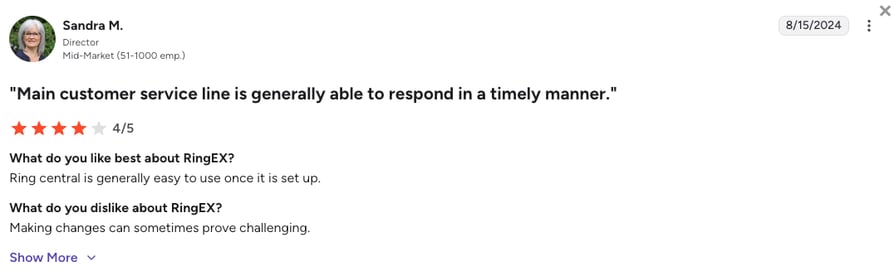
RingCentral reviewers on G2 praise the feature depth, integration library, and enterprise reliability. Recurring complaints focus on onboarding complexity and admin console friction, since none of that setup effort buys any call-tracking or attribution capability.
How Do G2 Users Rate RingCentral?
RingCentral's current G2 rating is 4.2/5, based on 1,400+ verified reviews.
3. Nextiva: Best for Growing Teams That Want AI-Assisted Call Handling Bundled with Unified Comms
What Is Nextiva?
Nextiva is a unified communications platform built for growing SMB and mid-market teams that want voice, an AI assistant, and basic analytics in one subscription.
Nextiva shows up in CallRail comparisons ('what is the difference between Nextiva and CallRail?' is an actual question people often ask on Google) because both get pitched as ways to understand caller intent. Nextiva's AI assistant summarizes calls, but it doesn't do source-level attribution the way CallRail does.
Why Is Nextiva a Strong CallRail Alternative?
- An AI assistant bundled from the Engage tier, not a $150/mo add-onNextiva's Engage plan ($25/user/mo) includes an AI assistant for call summaries. CallRail charges $150/mo for the same category of feature, and that's per account, on top of the base tracking fee.
- Unified voice, video, and messaging in one platformNextiva bundles voice, video, and team messaging so a growing team isn't stitching together a phone tool, a tracking dashboard, and a separate chat app.
- A path to a full contact center on Power Suite CXNextiva's top tier ($75/user/mo) adds omnichannel contact center features and workforce management, a scale path CallRail's tracking-only product doesn't offer.
What Are the Pros & Cons of Nextiva?
| Pros | Cons |
|---|---|
| AI assistant bundled from Engage ($25/user/mo) | No Dynamic Number Insertion or ad-platform attribution |
| Unified voice, video, and messaging | Call recording and CRM sync gated to Engage tier |
| Clear scale path to full contact center on Power Suite CX | AI assistant is general-purpose, not sentiment/topic-specific |
What Are Nextiva's Plans & Pricing?
Nextiva pricing starts at $15/user/mo (Core, annual billing), and it offers the following plans:
Nextiva Pricing Plans
| Plan | Price | Key Features |
|---|---|---|
| Core | $15/user/mo | Unlimited calling, 100 SMS/user, voicemail transcription, basic analytics |
| Engage | $25/user/mo | Everything in Core + call recording, CRM integrations, 500 SMS/user, AI assistant |
| Power Suite CX | $75/user/mo | Full omnichannel contact center with AI, workforce management, advanced routing |
The Nextiva Engage Jump
Nextiva's $15/mo Core tier looks like the headline price, but call recording, CRM integrations, and the AI assistant all sit on Engage at $25/user/mo, a 67% jump. Compare that against a real attribution need before assuming Core covers it.
What Are Nextiva's Customers Saying?
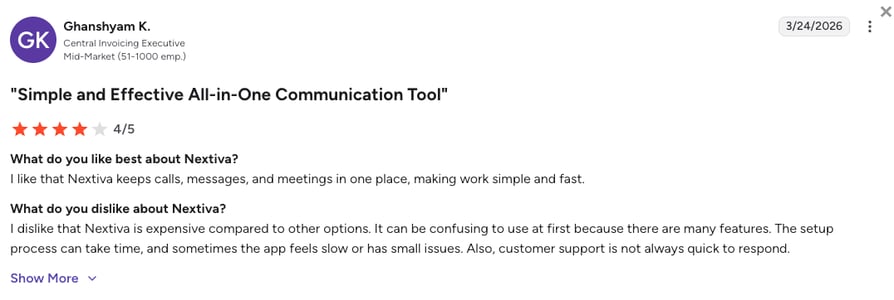
Nextiva users on G2 praise the all-in-one bundling of voice, video, and messaging, plus responsive support. Recurring complaints point to a steep learning curve for the admin console and occasional mobile app lag.
How Do G2 Users Rate Nextiva?
Nextiva's current G2 rating is 4.5/5, based on 3,500+ verified reviews.
4. Aircall: Best for SMB Sales Teams Needing Quick CRM Sync and Call Tagging
What Is Aircall?
Aircall is a cloud call center built for SMB sales and support teams that live inside a CRM. It's one of the tools that shows up directly in CallRail comparison searches.
Aircall integrates with CallRail for teams that want to keep both, but most searchers asking that question are really looking for a single platform that both tags calls and lets reps dial from the CRM record, which is where Aircall (or CloudTalk) replaces the pairing entirely.
Why Is Aircall a Strong CallRail Alternative?
- Native click-to-dial from inside the CRMAircall's call tagging and call insights live directly in HubSpot, Salesforce, and Pipedrive, so reps dial and log in the same window instead of tabbing to a tracking dashboard.
- 200+ marketplace integrationsAircall connects to 200+ apps on its marketplace, covering helpdesk and CRM tools CallRail doesn't natively touch.
- Built-in coaching and call whisper featuresAircall includes live call whisper and coaching tools for sales teams, a workflow CallRail's attribution-first product doesn't attempt.
What Are the Pros & Cons of Aircall?
| Pros | Cons |
|---|---|
| Native CRM click-to-dial (HubSpot, Salesforce, Pipedrive) | No Dynamic Number Insertion or ad-platform attribution |
| 200+ marketplace integrations | 3-seat minimum at $30/user/mo |
| Built-in coaching and call whisper tools | Advanced analytics cost extra |
What Are Aircall's Plans & Pricing?
Aircall pricing starts at $30/user/mo (annual billing, 3-seat minimum), and it lets you choose from the following plans:
Aircall Pricing Plans
| Plan | Price | Key Features |
|---|---|---|
| Essentials | $30/user/mo | Unlimited calls in the US and Canada, click-to-dial, CRM integrations, basic analytics |
| Professional | $50/user/mo | Everything in Essentials + advanced analytics, call whisper and coaching, Salesforce integration |
| Custom | Custom pricing | Advanced security, dedicated support, custom onboarding |
The Aircall Seat Minimum
Aircall's $30/user/mo price only applies once you commit to 3 seats. A 2-person team pays for a seat it doesn't need just to get in the door, and CallRail doesn't have that constraint since it charges per account, not per agent.
What Are Aircall's Customers Saying?
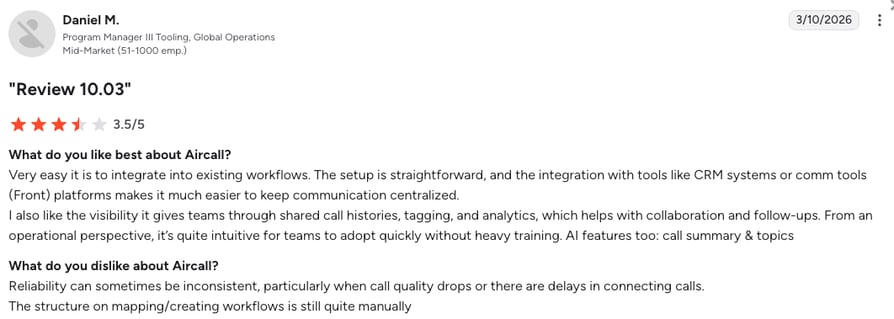
Aircall reviewers on G2 highlight fast setup and clean CRM tagging. Recurring complaints mention call quality drops on weaker connections and support response times slowing down as account size grows.
How Do G2 Users Rate Aircall?
Aircall's current G2 rating is 4.4/5, based on 1,600+ verified reviews.
5. Dialpad: Best for AI-First Teams That Want Built-In Transcription and Call Summaries
What Is Dialpad?
Dialpad (Dialpad Connect) is an AI-first business phone system built for teams that want live transcription and call summaries bundled in from the entry tier, not sold as an add-on.
Dialpad appears in CallRail alternative searches because its AI transcription is the closest thing to Conversation Intelligence that ships standard rather than gated behind a top tier.
Why Is Dialpad a Strong CallRail Alternative?
- AI transcription and call summaries bundled from the Standard planDialpad includes AI-generated transcripts and summaries starting at $15/user/mo. CallRail charges $150/mo per account for a comparable feature set.
- Native Google Workspace integrationDialpad integrates deeply with Google Workspace, a natural fit for teams already living in Gmail and Google Calendar.
- Unlimited calling and SMS from the entry tierDialpad's Standard plan bundles unlimited calling, SMS, and voicemail without the per-minute overage structure CallRail uses.
What Are the Pros & Cons of Dialpad?
| Pros | Cons |
|---|---|
| AI transcription and summaries from Standard ($15/user/mo) | No Dynamic Number Insertion or ad-platform attribution |
| Native Google Workspace integration | CRM integrations (Salesforce, HubSpot) require Pro tier |
| Unlimited calling and SMS, no per-minute overages | International numbers gated to Pro |
What Are Dialpad's Plans & Pricing?
Dialpad pricing starts at $15/user/mo (Standard, annual billing), with the following tiers available:
Dialpad Connect Pricing Plans
| Plan | Price | Key Features |
|---|---|---|
| Standard | $15/user/mo | Unlimited calling, AI transcription, AI call summaries, SMS, voicemail |
| Pro | $25/user/mo | Everything in Standard + call recording, CRM integrations (Salesforce, HubSpot), international numbers |
| Enterprise | Custom pricing | Advanced admin controls, SLAs, dedicated support |
The Dialpad CRM Gap
Dialpad's AI transcription looks like a Conversation Intelligence substitute, but CRM integrations, the piece that actually pushes that data into a sales workflow, only unlock on Pro at $25/user/mo. That's a real jump for a team evaluating the $15/mo headline price.
What Are Dialpad's Customers Saying?
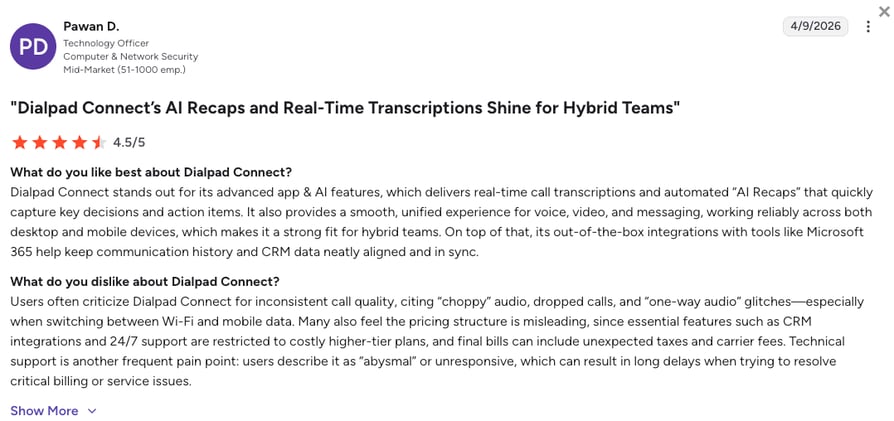
Dialpad users on G2 praise the accuracy of AI transcription and the clean Google Workspace integration. Recurring complaints focus on call quality on congested networks and CRM integrations feeling like an afterthought outside Pro.
How Do G2 Users Rate Dialpad?
Dialpad's current G2 rating is 4.4/5, based on 4,100+ verified reviews, the largest review base of any tool on this list.
6. CallTrackingMetrics (CTM): Best for Marketing Agencies Needing Multi-Channel Attribution and Conversation Intelligence
What Is CallTrackingMetrics (CTM)?
CallTrackingMetrics, rebranded simply as CTM, is a conversation analytics platform built for agencies and marketing teams that need call tracking, form tracking, and a lightweight sales softphone in one plan.
CTM is CallRail's closest direct peer: both do Dynamic Number Insertion, both sell agency sub-accounts, and both sit in G2's Inbound Call Tracking category rather than VoIP.
Why Is CTM a Strong CallRail Alternative?
- AskAI conversation analysis bundled into Marketing Pro, not a separate top tierCTM's $149/mo Marketing Pro plan includes AskAI custom call analysis and 3,000 transcribed minutes. CallRail needs its $150/mo Lead Conversion tier for a comparable feature set, but CTM bundles agency sub-accounts and white-label options at the same price point.
- A built-in softphone for outbound and inbound sales workCTM's Sales Engage plan ($274/mo) adds a customizable VOIP softphone with Smart Dialer and skills-based routing, a genuine step past pure call tracking that CallRail doesn't offer at any tier.
- Deep agency-friendly billing and sub-account structureCTM supports unlimited sub-accounts with custom billing on its higher tiers, built specifically for agencies managing multiple client campaigns from one login.
What Are the Pros & Cons of CTM?
| Pros | Cons |
|---|---|
| AskAI conversation analysis on Marketing Pro ($149/mo) | Pricing climbs fast, Sales Engage runs $274/mo plus usage |
| Built-in softphone and Smart Dialer on Sales Engage | Setup and report customization have a learning curve |
| Agency sub-accounts and white-label billing | No native AI voice receptionist or outbound voice agent |
What Are CTM's Plans & Pricing?
CTM pricing starts at $65/mo (Marketing Lite, annual billing, plus usage), with the following tiers available:
CTM (CallTrackingMetrics) Pricing Plans
| Plan | Price | Key Features |
|---|---|---|
| Marketing Lite | $65/mo | Call and text attribution, standard recording and IVR, manual scoring, Google Ads/GA4 integration |
| Marketing Pro | $149/mo | Everything in Lite + form tracking, AskAI call analysis, agency sub-accounts, HIPAA/GDPR compliance |
| Sales Engage | $274/mo | Everything in Pro + softphone, Smart Dialer, skills-based routing, live coaching tools |
CTM's Enterprise Tier Starts at $1,999/mo
CTM's published tiers stop at Sales Engage. Anything past that is Enterprise, quoted from $1,999/mo plus usage. For a growing team, that's a steep jump with no published middle ground between Sales Engage and Enterprise.
What Are CTM's Customers Saying?
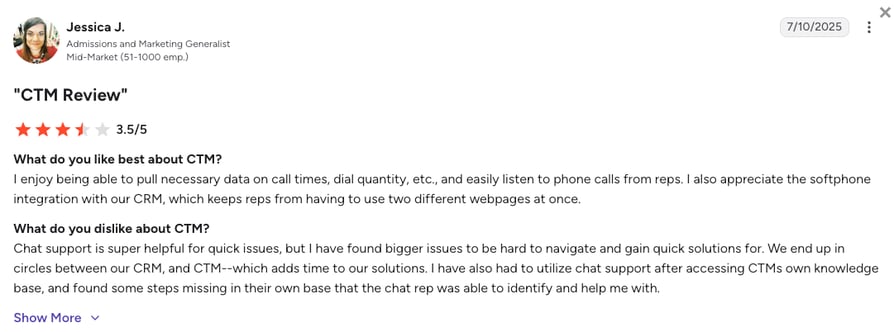
CTM reviewers on G2 praise ease of use and responsive customer support for attribution setup. Recurring complaints mention a steeper learning curve for newcomers and difficulty reaching support outside US business hours.
How Do G2 Users Rate CTM?
CTM's current G2 rating is 4.5/5, based on 750+ verified reviews.
7. WhatConverts: Best for Marketers Who Just Want Clean Ad-to-Call-to-Lead Attribution
What Is WhatConverts?
WhatConverts is a lead tracking platform built for marketers who want a single, no-frills view of which calls, forms, chats, and transactions each ad or keyword actually produced. It's also one of the best CallRail alternatives for direct ROI and form tracking.
WhatConverts skips the agency and sales-softphone features CTM and CallRail layer on top, staying focused on one job: clean attribution reporting without enterprise bloat.
Why Is WhatConverts a Strong CallRail Alternative?
- Forms, chats, and transactions tracked alongside calls from the entry tierWhatConverts' $30/mo Call Tracking plan already tracks calls and texts. Adding forms and chats only requires Plus at $60/mo, well under CallRail's $95/mo tier for the same form-tracking capability.
- A simpler, less cluttered reporting dashboardReviewers consistently point to WhatConverts' dashboard as easier to read than CallRail's, with less enterprise-oriented navigation to dig through for a straightforward attribution answer.
- HIPAA compliance available from the Pro tierWhatConverts adds HIPAA compliance on its $100/mo Pro plan, useful for healthcare-adjacent lead-gen advertisers without needing an enterprise contract.
What Are the Pros & Cons of WhatConverts?
| Pros | Cons |
|---|---|
| Forms and chat tracking from Plus ($60/mo) | No AI conversation intelligence or call summaries |
| Simpler, easier-to-read reporting dashboard | No native outbound dialer or sales softphone |
| HIPAA compliance available from Pro ($100/mo) | Included call volume (148 calls) is modest before overage |
What Are WhatConverts' Plans & Pricing?
WhatConverts pricing starts at $30/mo (Call Tracking, includes a $30 usage credit), and it offers the following plans:
WhatConverts Pricing Plans
| Plan | Price | Key Features |
|---|---|---|
| Call Tracking | $30/mo | Call and text tracking, dynamic number insertion, call recording, API access |
| Plus | $60/mo | Everything in Call Tracking + form and chat tracking, campaign and keyword reporting |
| Pro | $100/mo | Everything in Plus + call flows, custom report builder, HIPAA compliance |
| Elite | $160/mo | Everything in Pro + customer journey mapping, multi-click attribution, lead intelligence |
WhatConverts Has No AI Layer
WhatConverts is a genuinely clean attribution tool, but there's no AI call summary, sentiment analysis, or voice agent anywhere in its 4 tiers. Teams that want attribution AND an AI read on the conversation itself need to pair it with another tool, or replace both with one platform.
What Are WhatConverts' Customers Saying?
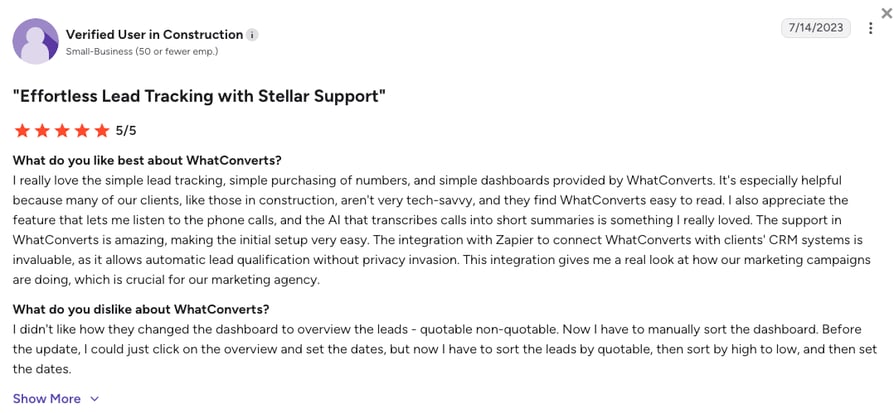
WhatConverts reviewers on G2 consistently praise responsive customer support and an easy setup process. A recurring theme in critical reviews is a learning curve around the reporting tools despite the platform's overall simplicity.
How Do G2 Users Rate WhatConverts?
WhatConverts' current G2 rating is 4.9/5, the highest of any tool on this list. However, with only 300+ verified reviews, WhatConvert's reviewer base is noticeably smaller than CallRail's or CloudTalk's.
8. Invoca: Best for Enterprise Marketing Teams Needing AI-Driven Revenue Attribution at Scale
What Is Invoca?
Invoca is an enterprise revenue execution platform built for large brands and multi-location businesses that need AI-driven call attribution at high volume. The platform serves as a popular pick for enterprise-level marketing teams needing deep conversation analysis.
Why Is Invoca a Strong CallRail Alternative?
- Signal AI Studio for custom conversation models at scaleInvoca's Signal AI add-on lets enterprise teams build custom AI models to detect caller intent, topics, and outcomes, well past CallRail's standard call summary feature.
- Native integrations with enterprise ad platformsInvoca connects to Search Ads 360, The Trade Desk, TikTok, and Adobe Ad Cloud on its higher tiers, a broader enterprise media stack than CallRail natively supports.
- PreSense for real-time digital-to-contact-center handoffInvoca's PreSense feature passes a caller's digital journey data directly to contact center agents in real time, a capability built for large, multi-location support operations.
What Are the Pros & Cons of Invoca?
| Pros | Cons |
|---|---|
| Signal AI Studio for custom conversation models | No public pricing, quote-only for every tier |
| Native Search Ads 360, TikTok, and Adobe Ad Cloud integrations | Built for enterprise scale, likely overkill for SMB |
| PreSense real-time digital-to-agent handoff | No native outbound dialer or AI voice agent |
What Are Invoca's Plans & Pricing?
Invoca pricing is quote-only across every tier, and it offers the following plans:
Invoca Pricing Plans
| Plan | Price | Key Features |
|---|---|---|
| Pro | Custom (quote-only) | 6,000 annual numbers, 5 custom Signals, dynamic number tracking, IVR, offline conversion import |
| Enterprise | Custom (quote-only) | Everything in Pro + 12,000 numbers, 50 custom Signals, enhanced digital data capture, SSO |
| Elite | Custom (quote-only) | Everything in Enterprise + 18,000 numbers, 100 custom Signals, PreSense, SIP integration |
Invoca Publishes No Public Pricing
Every Invoca tier is 'Get Your Quote.' That's normal for enterprise software, but it means a smaller team can't compare costs without a sales call, unlike CallRail's published $50 to $195/mo tiers or CloudTalk's published per-user rates.
What Are Invoca's Customers Saying?
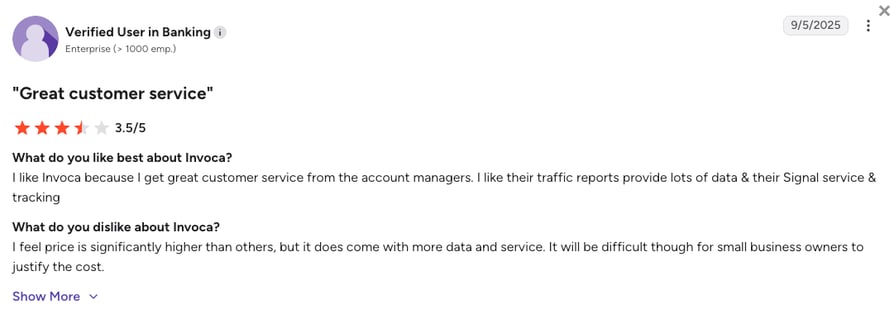
Invoca reviewers on G2 consistently praise call attribution accuracy and conversation intelligence depth for enterprise media budgets. The most common complaint is a real learning curve, with reporting configuration flagged as the biggest time investment.
How Do G2 Users Rate Invoca?
Invoca's current G2 rating is 4.5/5, based on 950+ verified reviews, and it has held the top G2 score in Enterprise Inbound Call Tracking for multiple years running.
9. Synthflow: Best for Agencies Building White-Label AI Voice Agents for Clients
What Is Synthflow?
Synthflow is a no-code AI voice agent platform built for marketing agencies and no-code builders creating client-facing voice agents, with deep GoHighLevel integration for agency workflows.
Synthflow represents a different shopping path into this list: buyers asking 'should I skip CallRail and let AI qualify leads?' land on pure AI voice specialists like Synthflow instead of a tracking-first tool.
Why Is Synthflow a Strong CallRail Alternative?
- Purpose-built AI voice agents, not attribution with AI bolted onSynthflow's entire product is voice agents that answer, qualify, and route calls. CallRail's new Voice Assist add-on is a recent bolt-on; Synthflow has been AI-voice-first from day one.
- Native GoHighLevel integration for agency client managementSynthflow's Pro tier connects directly to GoHighLevel, a workflow agencies managing multiple client accounts already run their operations through.
- White-label and multi-client management on the Agency tierSynthflow's top tier is built specifically for agencies reselling AI voice agents under their own brand across multiple clients.
What Are the Pros & Cons of Synthflow?
| Pros | Cons |
|---|---|
| Purpose-built AI voice agents, not a tracking bolt-on | Steep tier jump from $29/mo Starter to $450/mo Pro |
| Native GoHighLevel integration for agencies | No native call tracking or ad-attribution features |
| White-label and multi-client management on Agency tier | Overage billed per minute across voice, LLM, and telephony |
What Are Synthflow's Plans & Pricing?
Synthflow pricing starts at $29/mo (Starter, monthly billing, 50 minutes), and it offers the following plans:
Synthflow Pricing Plans
| Plan | Price | Key Features |
|---|---|---|
| Starter | $29/mo | 50 minutes, 1 assistant, basic integrations |
| Pro | $450/mo | 2,000 minutes, custom actions, GoHighLevel integration |
| Growth | $900/mo | 4,000 minutes, advanced workflows |
| Agency | $1,400/mo | 6,000 minutes, white-label, multi-client management |
The Synthflow Starter-to-Pro Cliff
Synthflow's $29/mo Starter plan includes just 50 minutes. The next tier up jumps straight to $450/mo with no middle option, a steep cliff for a team that outgrows the free-trial-sized entry plan but isn't ready for agency-scale volume.
What Are Synthflow's Customers Saying?
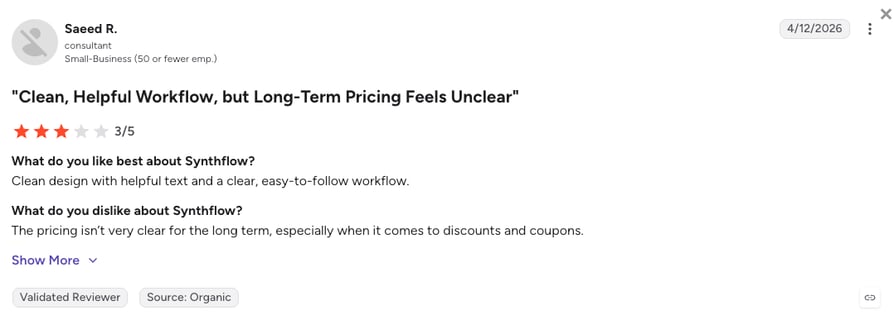
Synthflow users on G2 praise the no-code builder and GoHighLevel integration for agency use cases. Recurring complaints center on the steep jump from Starter to Pro pricing and per-minute overage costs stacking up at volume.
How Do G2 Users Rate Synthflow?
Synthflow's current G2 rating is 4.5/5, based on 1,000+ verified reviews.
10. Retell AI: Best for Engineering Teams Building Custom AI Voice Agents from Scratch
What Is Retell AI?
Retell AI is a developer-first voice AI infrastructure platform built for engineering teams that want to build custom, low-latency voice agents from raw building blocks rather than a packaged product.
Retell AI is the most technical option on this list. It's a strong pick for a team with engineering resources; it's the wrong pick for a marketer who just wants CallRail's tracking replaced with something that also talks.
Why Is Retell AI a Strong CallRail Alternative?
- Low-latency proprietary voice engine built for real-time turn-takingRetell AI's core infrastructure is optimized for natural, low-latency conversation, a genuine technical edge for teams building a custom voice product rather than adopting a packaged tool.
- Bring-your-own LLM flexibilityRetell AI lets engineering teams choose the underlying model (GPT-4o, Claude, and others), scaling cost and capability independently of the voice and telephony layers.
- Enterprise volume discounts down to roughly $0.05/minAt scale, Retell AI's enterprise pricing drops meaningfully below its standard PAYG rate, appealing for a high-volume, engineering-led deployment.
What Are the Pros & Cons of Retell AI?
| Pros | Cons |
|---|---|
| Low-latency, proprietary voice engine | Requires engineering resources to build and maintain |
| Bring-your-own LLM flexibility | No native call tracking or ad-attribution features |
| Enterprise volume discounts at scale | Per-minute, multi-component pricing is hard to forecast |
What Are Retell AI's Plans & Pricing?
Retell AI pricing is pay-as-you-go, starting at roughly $0.13 to $0.31 per minute all-in, and it offers the following components:
Retell AI Pricing Components
| Plan | Price | Key Features |
|---|---|---|
| Voice engine | ~$0.07-0.08/min | Retell's proprietary low-latency conversational engine |
| LLM | ~$0.006-0.50/min | Scales with model choice (GPT-4o, Claude, and others) |
| Telephony | ~$0.015/min | Twilio-based SIP; 20 free concurrent lines, then $8/mo extra |
| Enterprise | Custom (~$0.05/min) | Volume discounts, dedicated support, SLAs |
Retell AI Has No Attribution Layer
Retell AI builds the voice agent. It doesn't track which ad or keyword drove the call in the first place, the entire reason most CallRail buyers are on this page. Teams need a separate attribution source, or a platform like CloudTalk that pairs AI voice with a phone system CRM data actually flows through.
What Are Retell AI's Customers Saying?
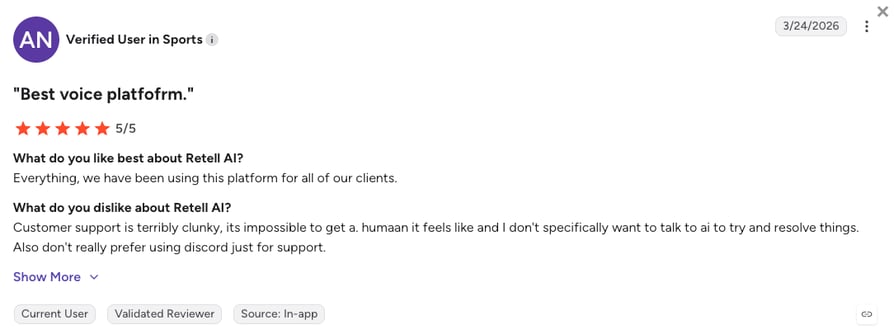
Retell AI has one of the strongest review bases of any pure-play voice AI tool. Reviewers on G2 praise conversation latency and developer documentation. Recurring complaints mention the need for ongoing engineering maintenance as usage scales.
How Do G2 Users Rate Retell AI?
Retell AI's current G2 rating is 4.8/5, based on 2,600+ verified reviews.
What Real Users Are Saying about CallRail and Its Alternatives
Pricing pages tell you what a tool does. Real user posts tell you whether it works as advertised. We combed through active threads on Reddit, Quora, and G2 to see what teams shopping for CallRail alternatives actually recommend.
What Redditors Are Saying about CallRail Alternatives
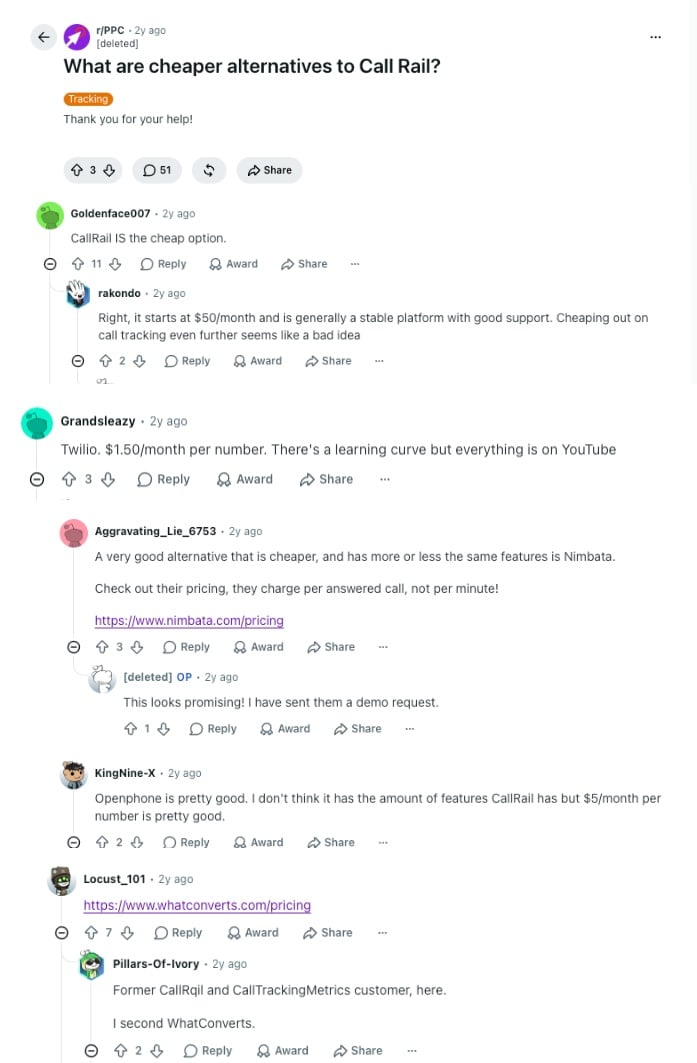
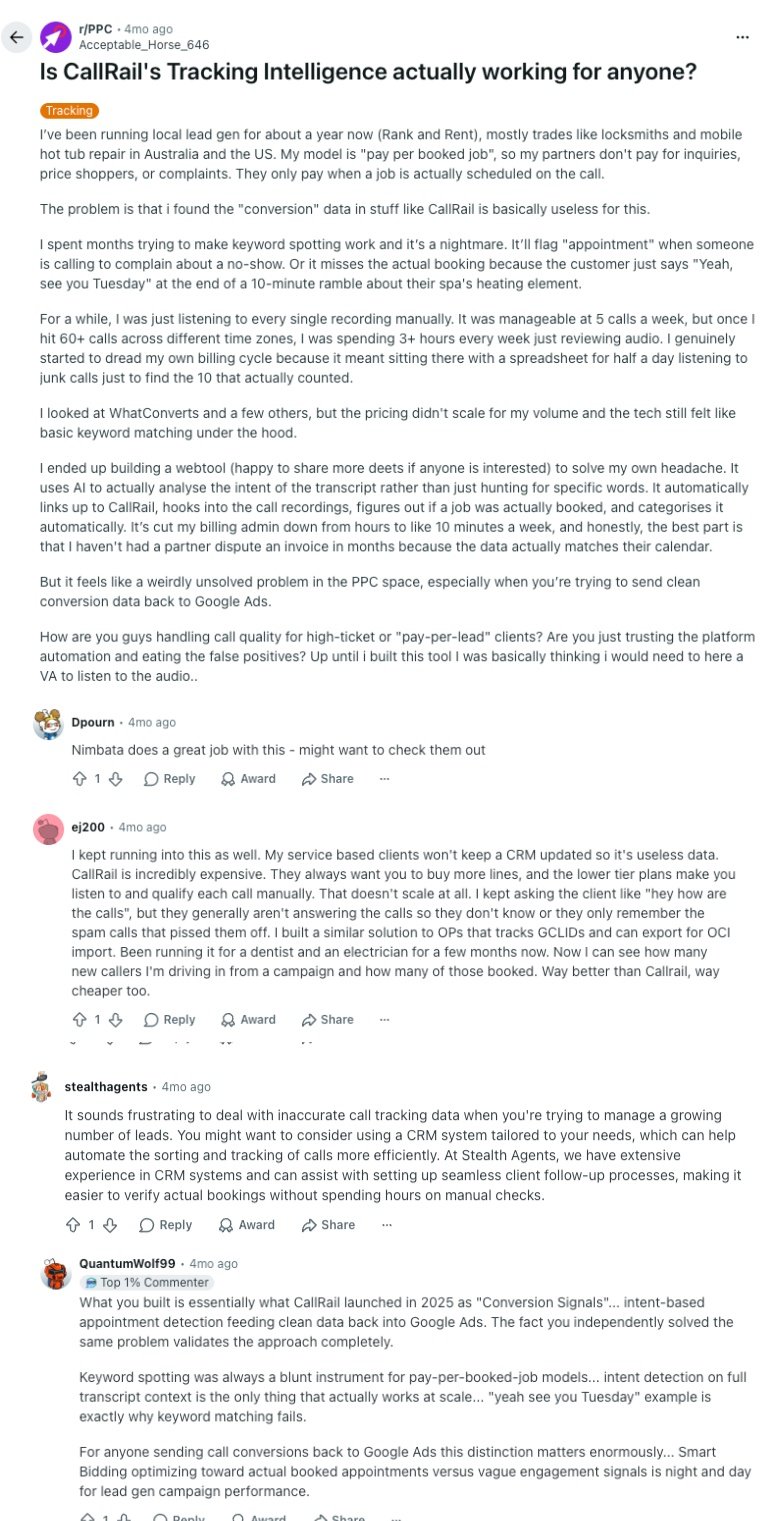
Two active threads in r/PPC shape most of the current Reddit conversation about CallRail. One debates whether cheaper tracking tools exist at all. The other digs into whether CallRail's AI conversation intelligence actually works in practice.
- Is CallRail actually the cheap option? In a thread asking for cheaper alternatives to CallRail, one top comment argued flatly that "CallRail IS the cheap option" at $50/mo, while another pointed to Twilio's $1.50/mo per number for teams willing to build it themselves, and others named WhatConverts and Nimbata as lighter-weight picks. Nobody in the thread mentioned a tool that also answers the phone. That's the gap CloudTalk fills for teams that need a full business phone system with AI layered in, not just a cheaper tracking number.
- Does CallRail's Conversation Intelligence hold up? A detailed post in r/PPC described months of manual call review because CallRail's keyword-spotting kept flagging complaints as bookings and missing real conversions buried in a 10-minute ramble. The poster ended up building their own AI tool to classify calls by intent rather than keywords. That's exactly the job CloudTalk's Conversation Intelligence add-on is built for, reading full transcripts for sentiment and outcome instead of just spotting words.
What Quora Users Are Asking about CallRail Alternatives
The Quora conversation skips feature checklists and asks two practical questions: which platform actually integrates with the CRM and helpdesk a team already runs, and which AI tools people reach for day to day. CallRail rarely comes up by name in either.
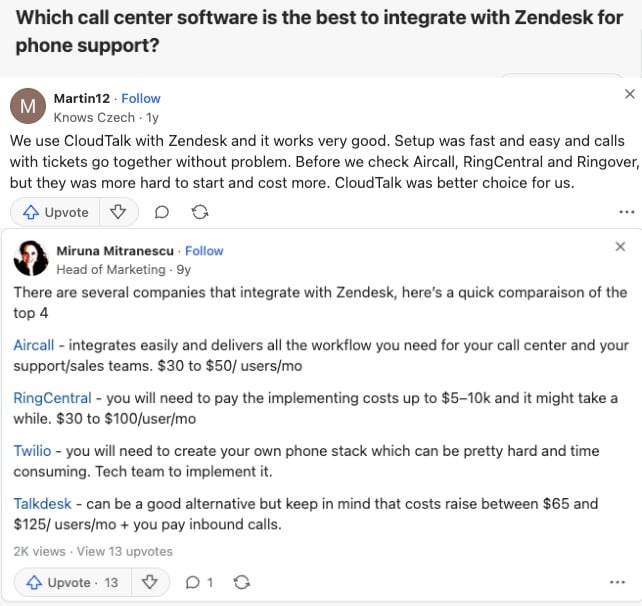
- Best call center software for Zendesk integration: Asked which call center software integrates best with Zendesk, one Quora user with direct experience wrote that they use CloudTalk with Zendesk and setup was fast, with calls and tickets syncing without issue, adding that Aircall, RingCentral, and Ringover were "more hard to start and cost more." A separate answer laid out a full price comparison: Aircall $30 to $50/user/mo, RingCentral $30 to $100/user/mo plus $5,000 to $10,000 in implementation costs, and Talkdesk $65 to $125/user/mo. CallRail wasn't in the conversation at all, since none of these buyers were solving an attribution problem.
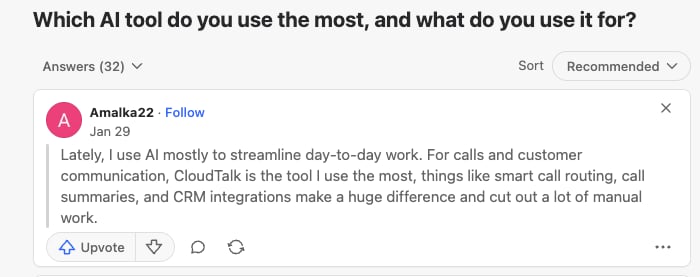
- Which AI tool do you actually use day to day? In a broad thread about favorite AI tools, one answer named CloudTalk specifically for "calls and customer communication," citing smart call routing, call summaries, and CRM integrations as cutting out a lot of manual work. That's the AI-for-calls use case CallRail's Voice Assist add-on is only just starting to address.
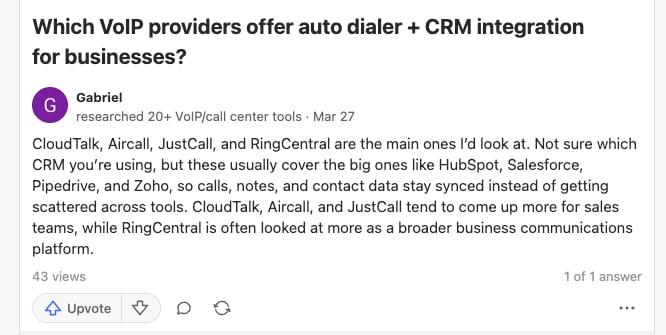
- Best auto dialer with CRM integration: A researcher who reviewed 20+ VoIP and call center tools named CloudTalk, Aircall, JustCall, and RingCentral as the main options for pairing an auto dialer with CRM sync, noting they cover HubSpot, Salesforce, Pipedrive, and Zoho so calls and contact data stay synced. None of the pure attribution or AI-voice-API tools on this list made that shortlist, since dialers aren't their product.
How CloudTalk, CallRail, WhatConverts, and Aircall Compare on G2
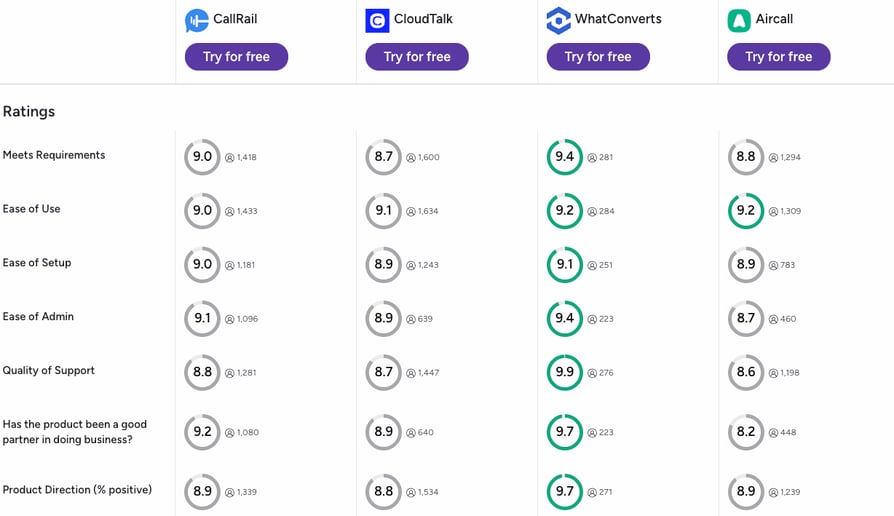
G2's side-by-side comparison of CallRail, CloudTalk, WhatConverts, and Aircall puts real review data in one view. CloudTalk doesn't top a single category here, and the honest read is that CallRail and Aircall both hold their own on volume too.
- Meets requirements: CallRail scores 9.0 (1,418 responses), CloudTalk sits at 8.7 (1,600), Aircall at 8.8 (1,294), and WhatConverts leads at 9.4, though from a much thinner base of 281 responses.
- Ease of use and setup: All four tools cluster tightly between 8.9 and 9.2. CloudTalk edges CallRail slightly on ease of use (9.1 vs. 9.0), while CallRail edges CloudTalk on ease of setup (9.0 vs. 8.9).
- Review volume tells its own story: WhatConverts' scores are the highest on the grid, but they're based on roughly 220 to 280 responses per category. CallRail and CloudTalk both carry 1,000+ responses per category, a much larger sample backing up a slightly lower average.
CloudTalk vs. CallRail: Final Head-to-Head Comparison
CallRail answers the question of where a call came from. CloudTalk answers the call itself. The real question isn't which is cheaper. It's whether the job is tracking a conversation or having one.
CloudTalk vs. CallRail: Head-to-Head
| Feature | CloudTalk | CallRail | Winner |
|---|---|---|---|
| Starting Price | $25/user/mo | $50/mo (per account) | Tie (different pricing models) |
| Free Trial | 14 days, no credit card | 14 days, no credit card | Tie |
| Minimum Agents/Accounts | 1 (3 on Expert) | None (per account, not per seat) | Tie |
| Dynamic Number Insertion | Not a core focus | Native, core product | CallRail |
| Marketing/Ad Platform Integrations | Not a core focus | Native Google Ads, GA4, Microsoft Ads | CallRail |
| CRM Integrations | 100+ from Essential, two-way sync | HubSpot, Salesforce (one-directional logging) | CloudTalk |
| Auto Call Recording | From Starter (1-month retention) | Included, all plans | Tie |
| Outbound Dialers | Power Dialer (Expert or $15/mo add-on), Parallel ($39/mo add-on) | None | CloudTalk |
| AI Features | AI Receptionist, AI Voice Agent, Conversation Intelligence | Voice Assist add-on (from $95/mo), Conversation Intelligence (Lead Conversion, $150/mo) | CloudTalk |
| Global Coverage | Numbers for 160+ countries | US, Canada, UK, Australia | CloudTalk |
| Transparent Pricing | Flat per-user rate at each tier | Per-account plus metered usage overages | CloudTalk |
| Customer Support | 24/7 (phone on Expert) | Chat and email; phone on higher tiers | CloudTalk |
| G2 Rating | 4.4/5 (1,800+ reviews) | 4.5/5 (1,800+ reviews) | CallRail |
CallRail's Real Edge Is Attribution, Not the Phone Call
CallRail's most defensible structural strength is Dynamic Number Insertion and native ad-platform integrations, built for marketing attribution in a way CloudTalk isn't. If that's the whole job, CallRail is a reasonable pick. If the job also includes answering, qualifying, and dialing, CallRail's own product roadmap (its new Voice Assist add-on) suggests even CallRail knows that gap exists.
How to Choose the Right CallRail Alternative for Your Business
The right CallRail alternative depends on whether you need pure attribution, a full phone system, or a custom AI voice build. Here's how the best fit changes by scenario.
What's Better Than CallRail for Teams That Also Need to Answer the Phone?
CloudTalk is better than CallRail if your team also needs to answer phones. It pairs an AI Receptionist (50 free minutes, then from $99/mo) with a real outbound dialer and 100+ CRM integrations from Essential. CallRail can tell you a call happened; CloudTalk answers it, qualifies it, and logs it.
Which CallRail Alternative Is Best for Marketing Agencies Managing Multiple Client Accounts?
CallTrackingMetrics (CTM) is the best CallRail alternative for marketing agencies with multiple clients. Its sub-account structure and white-label billing on Marketing Pro ($149/mo) and up are designed for agencies running attribution across many client campaigns at once, a use case CloudTalk and pure phone systems don't target.
What's the Best CallRail Alternative for Simple Ad-to-Call Attribution Only?
WhatConverts is great for simple attribution, starting at $30/mo with a cleaner, less cluttered dashboard than CallRail's. If website-to-call attribution genuinely is the entire job, WhatConverts or CallRail itself, not a phone system, is the honest answer.
Which CallRail Alternative Is Best for Enterprise-Scale Revenue Attribution?
Invoca is built for large, multi-location brands running high call volume across enterprise ad platforms like Search Ads 360 and The Trade Desk. Pricing is quote-only, so it's a fit for teams with the budget and scale to justify a custom enterprise contract.
What's the Best CallRail Alternative for Building a Custom AI Voice Agent?
Retell AI and Synthflow serve different builders. Retell AI suits engineering teams building a fully custom voice product with their own LLM choice. Synthflow suits agencies that want a no-code builder with native GoHighLevel integration for reselling voice agents to clients.
What Is the Best CallRail Alternative for Ecommerce Lead Capture?
CloudTalk is the best CallRail alternative for ecommerce lead generation. The AI Voice Agent for ecommerce handles order status and returns questions around the clock, with Shopify, HubSpot, and Zendesk sync from Essential. CallRail can tell an ecommerce team which ad drove a call, but it can't answer that call at 2 a.m.
What Is the Best CallRail Alternative for Growing Teams?
CloudTalk is the best CallRail alternative for small business teams looking for productivity features accelerating their growth. Plans scale from $25/user/mo (Starter, no seat minimum) to Expert with Power Dialer, Salesforce deep-sync, and phone support. As you grow, you unlock 100+ CRM integrations from Essential, an AI Receptionist with 50 free minutes on every plan, and virtual numbers in 160+ countries. Pricing stays predictable per user instead of climbing with metered usage, and the free 14-day trial lets you test the full stack before paying.
Start Your CloudTalk Free Trial in Under 2 Minutes
Ready to Make the Switch from CallRail?
CallRail still works if attribution is the whole job. Its Dynamic Number Insertion and ad-platform integrations are mature and well-reviewed. The moment your team needs to answer, qualify, or dial back a tracked lead, those limits stop being minor and start costing revenue.
CloudTalk is where lead-gen teams land next. It closes the specific gap CallRail leaves open: an AI Receptionist that answers 24/7, Conversation Intelligence at $9/user/mo instead of a $150/mo per-account tier, and a real outbound dialer for calling leads back. Setup takes hours, not weeks, and the free 14-day trial doesn't ask for a card.
Here's what you get if you switch from CallRail to CloudTalk:
- An AI Receptionist answers what tracking numbers leave ringing50 free minutes on every plan, then from $99/mo, so after-hours and overflow calls get answered instead of logged as missed.
- AI reads every call for a fraction of CallRail's per-account feeConversation Intelligence at $9/user/mo delivers sentiment, topics, and searchable transcripts, versus CallRail's $150/mo Lead Conversion tier.
- A real dialer closes the loop on every tracked leadPower Dialer on Expert (or a $15/user/mo add-on) lets reps call a lead back from the same platform that logged it.
- Pricing stays predictable per user, not metered per accountNo per-number or per-minute overage stacking up a surprise bill at the end of the month.
- Selling to any market feels localVirtual numbers in 160+ countries at 99.999% uptime mean international leads hear a local number.
Join 5,500+ Businesses That Already Made the Switch
Frequently Asked Questions about CallRail Alternatives
Answers to the top questions teams ask when moving from CallRail to a modern lead capture platform.
CallRail is a call tracking and marketing attribution platform. It uses Dynamic Number Insertion to tie inbound calls, texts, and form submissions back to the specific ad or keyword that drove them, mainly for marketing teams and agencies in verticals like auto, legal, and home services.
No, CallRail isn't really a VoIP (Voice over Internet Protocol) system. CallRail issues tracking numbers and forwards calls, but it isn't a full business phone system with dialers, seat-based routing, or call center features. Teams that need both attribution and a real phone system usually pair CallRail with a VoIP platform or replace both with one tool that does both, like CloudTalk.
Yes, CallRail records calls and call recording is included on every plan starting at $50/mo. AI call summaries and sentiment analysis, however, only unlock on the $150/mo Lead Conversion tier, three tiers above the entry plan.
CallRail' pricing starts with the Lead Tracking plan at $50/mo, Lead Tracking Complete at $95/mo, Lead Conversion at $150/mo, and Lead Conversion Complete at $195/mo, all priced per account plus usage, not per user.
CallRail is worth for teams whose only need is knowing which ad or keyword drove a call. For teams that also need to answer, qualify, or dial leads back, a platform like CloudTalk covers more of the job in one subscription.
CloudTalk is the best CallRail alternative for teams that want AI lead capture built into a real phone system, with an AI Receptionist, AI Voice Agent, and Conversation Intelligence add-on. For pure attribution, CallTrackingMetrics or WhatConverts are the closer like-for-like swaps.
CallRail's closest competitors are CallTrackingMetrics (CTM), WhatConverts, and Invoca, all pure call-tracking specialists. Broader alternatives include AI-enabled business phone systems like CloudTalk, RingCentral, Nextiva, Aircall, and Dialpad, plus AI voice specialists like Synthflo, Vapi, and Retell AI.
Nextiva is a unified communications platform with voice, video, messaging, and an AI assistant. CallRail is a call tracking platform with no video or messaging product. Nextiva helps a team communicate, while CallRail tells a team where a call came from.
CallRail is still a strong choice for multi-location call tracking, but not the only one. Invoca is built specifically for large, multi-location enterprise brands, while CallTrackingMetrics offers agency-friendly sub-accounts for managing several locations under one login.
For a small business that also needs to make outbound calls, WhatConverts (from $30/mo) is the simplest pure-tracking pick, while CloudTalk adds a native Power Dialer and CRM sync for teams ready to call leads back, not just track them.
WhatConverts starts cheaper ($30/mo vs. CallRail's $50/mo) with a simpler dashboard, but it has no AI conversation intelligence or voice layer at any tier. CallRail's Lead Conversion tier adds AI call summaries WhatConverts doesn't offer.
Invoca targets enterprise-scale, multi-location brands with custom AI conversation models and no public pricing. CallRail publishes transparent tiers from $50 to $195/mo and fits SMB and mid-market lead-gen teams better than Invoca's enterprise-only model.
Yes, Aircall and CallRail can integrate, but many teams asking this question are really looking for one platform that both tags calls and lets reps dial from the CRM record. Aircall and CloudTalk both replace that pairing with native CRM click-to-dial built in.
For a small business looking for a CallRail alternative, CloudTalk ($25/user/mo) covers phone, CRM sync, and AI in one plan with no seat minimum until Expert. WhatConverts ($30/mo) is the lighter pick for teams that only need attribution, not a full phone system.
CallRail's main benefits are Dynamic Number Insertion for ad attribution, native Google Ads and GA4 integrations, and call recording included on every plan. Its main limits are metered per-account pricing and no native way to answer, qualify, or dial a tracked lead back.
Choosing the best call tracking software depends on the job. CallTrackingMetrics and WhatConverts are the strongest pure call tracking specialists. For teams that also need a phone system with AI Receptionist and outbound dialers built in, CloudTalk covers more of the job in one subscription.
Most teams port their tracking numbers to the new provider, re-point their DNI or forwarding numbers on the website, and run both platforms in parallel for one billing cycle before canceling CallRail. Platforms like CloudTalk that also handle CRM sync and AI call answering typically fold the migration into onboarding rather than leaving it fully self-serve.