9 Best AI Call Center Software Solutions for 2026: Features, Pricing & How to Choose
TL;DR:
Determining the best AI call center software depends on your business scale. We reviewed the 9 most widely used platforms for 2026 and compared them by pricing and real-world fit. Based on our analysis, CloudTalk is the best AI call center software for SMB sales teams, while Talkdesk and Genesys lead the market for complex enterprise-level CX automation.
Here’s a quick overview of the best AI call center software providers:
- 01CloudTalk — best for SMB sales and support teams
- 02RingCentral — best for all-in-one business communications
- 03HubSpot — SMBs, medium, and enterprises that need to transcribe calls, analyze conversations with an existing CRM
- 04Talkdesk — best for enterprise contact centers
- 05Dialpad — best for AI-assisted calling with simple setup
- 06NiCE (formerly NiCe CXone) — best for large teams focused on QA and workforce management
- 07Five9 — best for enterprise outbound and omnichannel operations
- 08Genesys — best for complex, high-scale contact center environments
- 09Avaya — best for traditional enterprise call centers
The guide also explains how much AI calling software costs, what features matter most in an AI-powered call center, and which automated call center software add-ons are actually worth paying for as your call volume grows.
Over 80% of call centers plan to, or are already using AI to enhance customer experiences. Experts currently expect 10% of all interactions to be fully automated. So, which AI call center software should you choose to handle yours?
Since ChatGPT entered the public eye in the early 2020s, companies of all shapes and sizes have been caught up in a rat race to develop and leverage the best AI tools possible. Automated call center solutions are notable examples.
Playing a significant role in their clients’ inbound and outbound operations, AI call center companies are uniquely poised to deliver meaningful tools combining AI, NLP, and 3rd party integrations to speed up sales, save agents time, and improve support.
In this article, we’ll discuss the 9 best AI call center providers, breaking down their offerings and prices, all in an effort to help you choose the best software for your business. Keep reading to learn more!
Start Using Time the Smart Way
Why Trust CloudTalk?
What Is the Best AI Call Center Software? Top 9 Solutions for 2026
When evaluating the best ai agent for call centers, prioritize platforms that offer natively integrated voice bots capable of handling complex, multi-turn conversations without human intervention.
Not all AI call center tools solve the same problems.
After the quick overview below, check out the individual breakdowns of each AI call center solution on our list, and get a better picture of how each platform actually performs and what it brings to YOUR table.
AI Call Center Software Comparison Table
Before we dive into the individual reviews, this AI call center software comparison table gives you a quick, side-by-side snapshot of the top platforms, so you can shortlist faster before reading the full breakdowns.
Best AI Call Center Software Solutions in 2026
| AI Software | Best for | Starting Price (annual billing) | G2 Rating |
|---|---|---|---|
| CloudTalk | SMBs and mid-market teams that want scalable AI voice agents for high inbound call volume | $25/user/mo | 4.4/5 |
| RingCentral | Teams wanting contact center + broader communications suite | From $20/user/mo | 4.3/5 |
| HubSpot | SMBs, medium, and enterprises that need to transcribe calls, analyze conversations with an existing CRM | $20/user/mo | 4.4/5 |
| Talkdesk | Enterprise contact centers needing advanced CX automation | From $85/user/mo | 4.4/5 |
| Dialpad | Teams that want voice + contact center with built-in AI assistance | From $15/user/mo | 4.4/5 |
| NiCE | Larger ops that want workforce + QA + omnichannel depth | From $110/user/mo | 4.4/5 |
| Five9 | Enterprise outbound/inbound with strong routing + virtual agents | From $119/user/mo | 4.1/5 |
| Genesys Cloud CX | Enterprise omnichannel with large-scale routing | From $75/user/mo | 4.4/5 |
| Avaya | Organizations already in the Avaya ecosystem (often custom-fit) | From $20/user/mo | 4.2/5 |
1. CloudTalk
CloudTalk is an AI-powered calling software and an AI voice agent solution that helps 5,500+ businesses boost customer experience and conversions—cutting redial attempts and abandoned calls, slashing call-handling time without losing conversion quality, and bundling real-time AI coaching to elevate agent performance.
How They Use AI:
CloudTalk leverages AI for Conversational Intelligence, AI Voice Agents, real-time analytics, and automated workflows—making it one of the best-suited and best-priced AI call-center systems for SMBs. It can also auto-generate multilingual call summaries in seconds (more than 5 languages), delivering the highest automation rates and biggest cost-savings while enabling agents to focus on strategic tasks.
Competitive Advantages:
- Competitive Pricing: Starts at $25 per user/month, with additional numbers for just $6.
- Global Reach: Offers international, toll-free, and local numbers across 160+ countries.
- AI-Powered: Empowers teams with automation, analytics, and AI-driven insights. Wide
- Ecosystem: Offers 70+ features and 35+ most popular integrations.
Flagship Features:
- Conversational Intelligence
- Real-Time Dashboard
- Call Flow Designer
- Power Dialer
- AI-Powered Analytics
- Auto-Generated Multilingual Call Summaries (+5 languages)
- AI Voice Agents
Pricing: Starts at $25/user/month.
G2 rating: 4.4/5 (1,600 + reviews)
Try the Best AI-Powered Call Center Software for Free
2. RingCentral
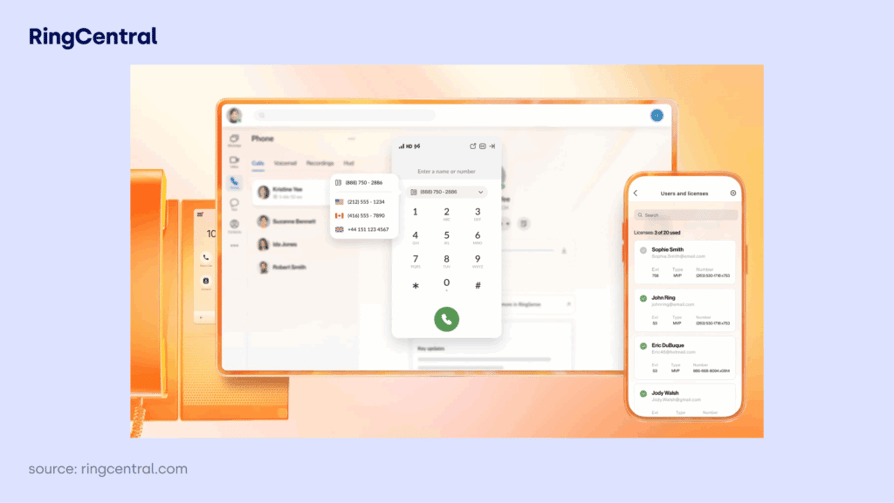
RingCentral is an AI-powered communications platform for teams of all sizes, helping 5,000,000+ businesses enhance their customer interactions with automation and real-time AI assistance.
How They Use AI:
RingCentral integrates AI for real-time transcriptions, AI-powered translations, and intelligent call summaries to improve productivity and multilingual communication.
Competitive Advantages:
- Competitive Pricing: Packages start at just $20 per user/month with basic features.
- Easy Calling: Intuitive design lets agents start calling immediately with no training. AI
- Transcriptions: Supports multilingual AI-driven call transcriptions.
- HD Calls: Stable, stutter-free performance for clear communication.
Flagship Features:
- Live Transcriptions & Summaries
- Team Messaging
- AI Translations
- Business SMS
- AI Analytics
Limitations:
- Customer Service: On average, it takes the team multiple hours to respond to a ticket.
- Global Reach: Only offers international and toll-free numbers in 100+ countries. App
- Performance: Slow, unresponsive design and complex troubleshooting. Limited
- Features: Provides a comparatively barebones experience to other solutions.
Pricing: Starts at $20/user/month
G2 rating: 4.3/5 (2,800+ reviews)
Recommended Reads
3. Hubspot
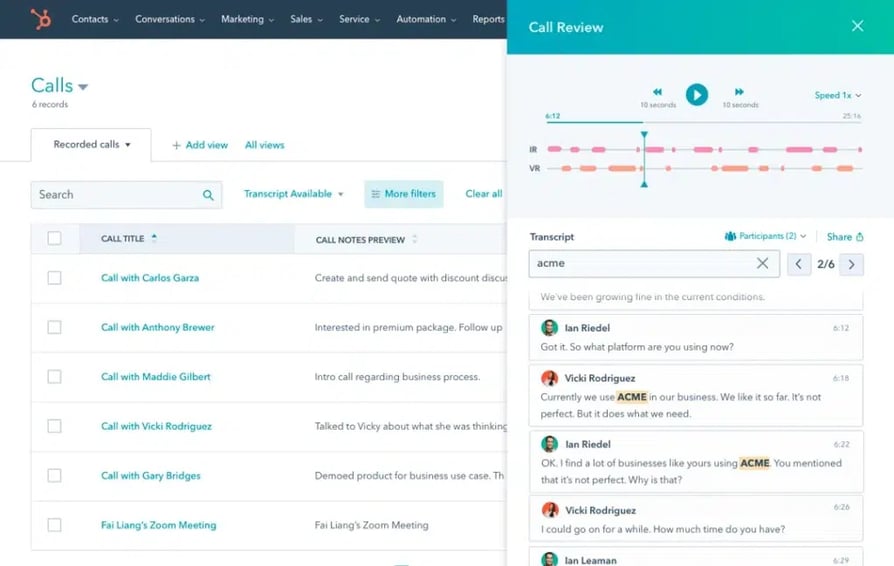
HubSpot Conversation Intelligence is an AI-powered tool that helps sales and support teams analyze calls, extract insights, and improve performance through data-driven coaching. Instead of focusing on call center infrastructure, it enhances how teams understand and act on customer conversations.
How They Use AI:
HubSpot uses AI to automatically transcribe calls, analyze conversations, and highlight key moments such as objections, questions, and competitor mentions. These insights help teams identify patterns, improve messaging, and optimize sales and support workflows over time.
Competitive Advantages:
- CRM Integration: Fully connected to HubSpot CRM, linking conversations to deals and contacts
- Real-Time Insights: Surfaces trends and coaching opportunities from call data
- Ease of Use: Simple setup compared to enterprise-heavy call center platforms
- Workflow Automation: Connects insights to follow-ups, tasks, and pipeline updates
Flagship Features:
- AI call transcription and conversation analysis
- Keyword tracking and topic detection
- Deal and contact-level conversation insights
- Call recording and performance tracking
Limitations:
- Not a full contact center platform (no ACD or telephony infrastructure)
- Advanced features depend on higher-tier HubSpot plans
- Less suited for large-scale enterprise call center operations
Pricing: Starts at $20/user/month
G2 rating: 4.4/5 (13,700+ reviews)
4. Talkdesk
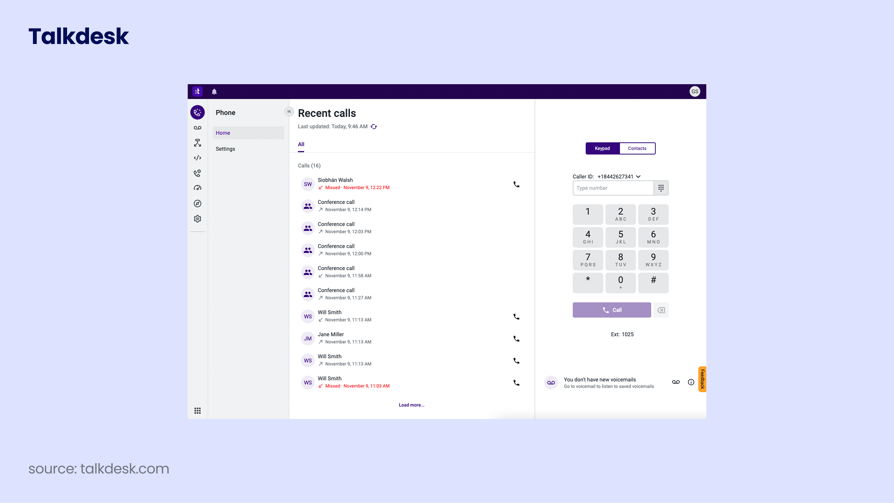
Talkdesk is a global AI-driven contact center designed for enterprise sales and support teams. It offers AI-driven call distribution that automatically matches customers with the right expert, while enhancing CX with automation, predictive analytics, and AI-powered agent assistance.
How They Use AI:
Talkdesk utilizes AI for self-service automation, real-time coaching, and predictive analytics to streamline agent workflows and improve customer engagement.
Competitive Advantages:
- HD Calls: Stable, stutter-free performance for clear customer communication. Wide
- Ecosystem: Offers 115+ solutions and integrations for CRMs, Helpdesks, etc. Intuitive
- UX: Easy to pick up and start using, regardless of technical expertise. In-Depth AI
- Analytics: Advanced AI-driven reporting for operational efficiency.
Flagship Features:
- Custom Integration
- Builder Self-Service Automation
- AI Business Intelligence
- Custom IVR Flows
- AI Coaching
Limitations:
- Prohibitive Pricing: A steep price tag that may be too much for most SMBs.
- Opaque Contracts: Users cite difficult-to-cancel subscriptions and hidden fees. App
- Performance: Slow, unresponsive design and complex troubleshooting. Limited
- Customizability: Features don’t allow for complex custom setups.
Pricing: Starts at $85/user/month
G2 rating: 4.4/5 (2,400+ reviews)
Recommended Reads
5. Dialpad
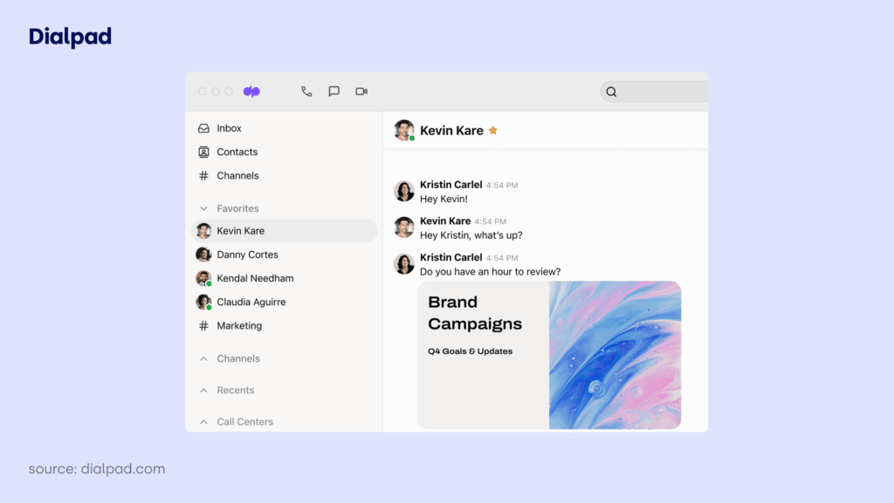
Dialpad is an AI-powered business phone solution for customer-facing teams, enabling automation in call handling, analytics, and agent assistance.
How They Use AI:
Dialpad provides AI-driven call transcriptions, live sentiment analysis, and AI coaching, empowering teams to work more efficiently and improve service quality.
Competitive Advantages:
- Competitive Pricing: Packages start at just $15 per user/month with basic features.
- Easy Calling: Intuitive design lets agents start calling immediately with no training.
- Multilanguage AI: AI-powered transcriptions enable seamless communication. Quality
- Support: Customer support teams are quick to respond with helpful advice.
Flagship Features:
- Real-Time AI Call Transcriptions
- Multi-Level Auto Attendant
- Self-Service AI Automation
- AI Coaching
- AI-Powered Analytics
Limitations:
- Call Quality: Frequent delays, choppiness, and dropped calls may impact customers.
- Global Reach: Only offers international and toll-free numbers in 25 countries. App
- Performance: Slow, unresponsive design and complex troubleshooting. Limited
- Customizability: Features don’t allow for complex setups.
Pricing: Starts at $15/user/month
G2 rating: 4.4/5 (4,500+ reviews)
6. NiCE
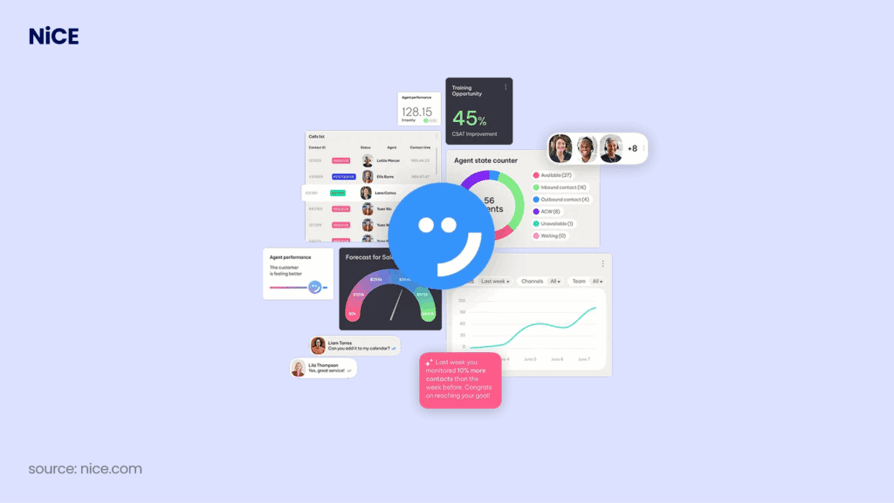
NiCE (formerly known as Nice CXone) is an AI-powered cloud contact center platform for enterprises and mid-sized businesses. It helps teams optimize customer interactions with automation, NLP, and predictive analytics.
How They Use AI:
Nice CXone leverages AI-driven automation, sentiment analysis, and predictive analytics to streamline operations, enhance customer insights, and improve agent performance.
Competitive Advantages:
- Seamless Integrations: Connects with Salesforce, Zendesk, ServiceNow, and more.
- Mobile-Friendly: Dedicated iOS and Android apps empower agents on the go.
- Global Reach: Supports local phone numbers in 100+ countries.
- Advanced AI Analytics: Real-time insights optimize agent performance.
Flagship Features:
- Conversational AI & Sentiment Analysis
- Automatic Call Distribution (ACD)
- AI Call Recording & Transcription
- Quality Management
- Predictive Analytics
Limitations:
- Limited Customization: Fewer advanced configuration options than some competitors.
- Feature Gaps: Lacks built-in auto-attendant and other specialized call tools.
- Pricing Transparency: Costs are available only upon request.
Pricing: Starts at $110/user/month
G2 rating: 4.3/5 (1,700+ reviews)
Recommended Reads
7. Five9
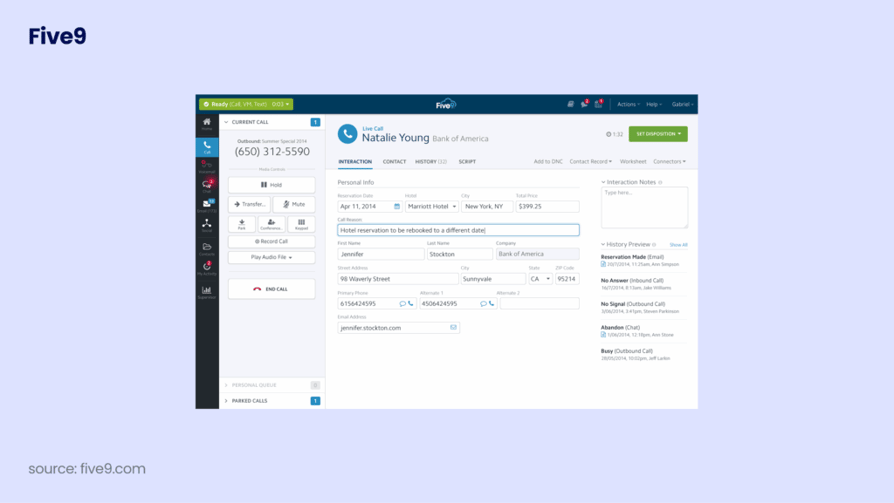
Five9 is an AI-driven cloud contact center solution built for enterprise-sized sales and support teams. It pairs robust AI features with true omnichannel capabilities—voice, chat, and social—while leveraging automation and AI analytics to enhance customer engagement and agent efficiency.
How They Use AI:
Five9 utilizes AI-powered speech analytics, predictive dialing, and virtual agents to optimize workflows, reduce handling time, and improve customer satisfaction.
Competitive Advantages:
- AI-Powered Automation: Enhances efficiency with intelligent workflows and virtual assistants.
- Predictive Dialing: AI-driven dialing increases connection rates and reduces agent idle time.
- Speech Analytics: Extracts insights from customer conversations for compliance and performance tracking.
- Omnichannel Support: AI integrates across voice, chat, email, and social platforms.
Flagship Features:
- AI Speech Analytics
- Predictive Dialing
- Agent Call Scripting
- Call Conferencing
- AI-Powered Virtual Agents
Limitations:
- High Pricing: More expensive than some competitors, making it less ideal for SMBs.
- Integration Complexity: Some users report difficulties integrating with third-party software.
- Customization Limits: Lacks deep customization options for AI-driven workflows.
Pricing: Starts at $119/user/month
G2 rating: 4.1/5 (500+ reviews)
8. Genesys Cloud CX
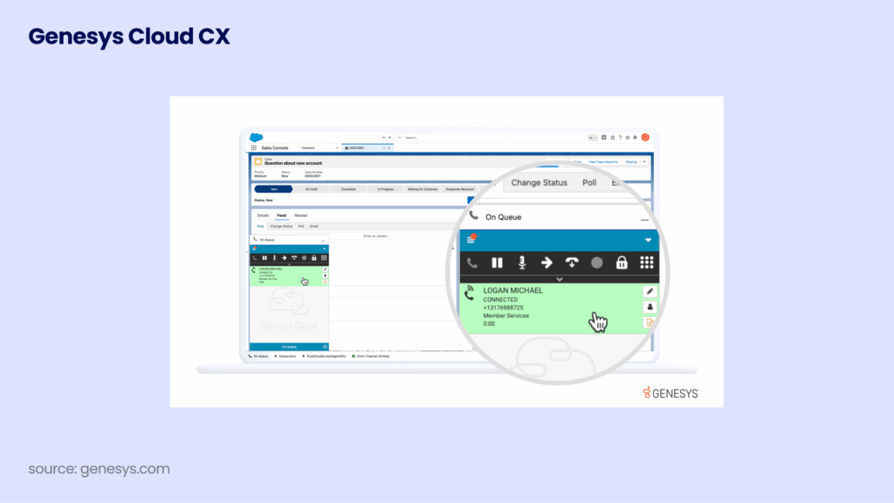
Genesys is an AI-powered cloud contact center platform designed to enhance customer interactions with predictive routing, omnichannel engagement, and workforce automation.
How They Use AI:
Genesys utilizes AI-powered predictive routing, real-time analytics, and AI-driven workforce engagement tools to improve customer service efficiency, capabilities often implemented through specialized AI services that help organizations deploy intelligent automation at scale.
Competitive Advantages:
- Predictive Routing: AI connects customers with the best available agent. Seamless Integrations: Easily connects with third-party software.
- AI Analytics: Real-time AI-powered insights optimize decision-making.
- Omnichannel AI Support: AI-driven customer interactions across multiple channels.
Flagship Features:
- Predictive AI Routing
- Real-Time AI Analytics
- Workforce AI Engagement
- AI-Powered Omnichannel Capabilities
- Seamless Integrations
Limitations:
- Complex Setup: Can be challenging for first-time users.
- Pricing Transparency: Complicated cost structures make budgeting difficult.
Pricing: Starts at $75/user/month
G2 rating: 4.4/5 (1,300+ reviews)
Recommended Reads
9. Avaya Cloud Office
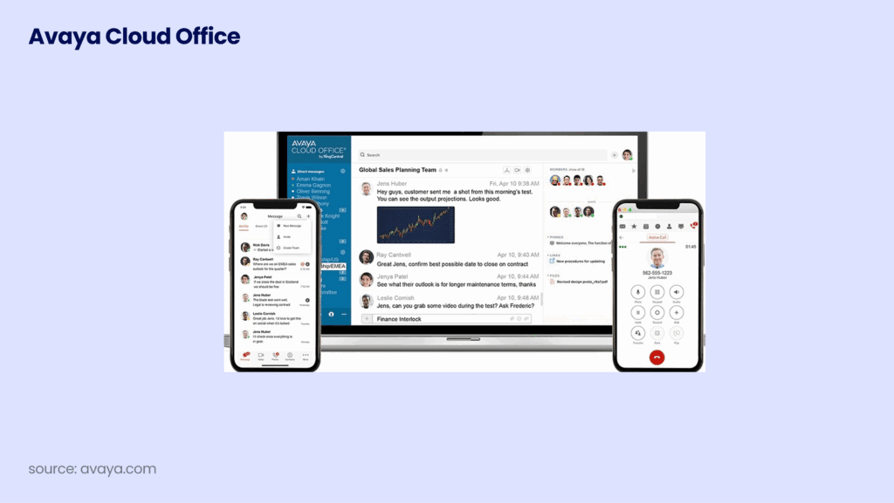
Avaya is an AI-powered cloud contact center for remote teams designed to enhance collaboration, efficiency, and customer engagement through intelligent automation.
How They Use AI:
Avaya integrates AI-driven automation, speech analytics, and virtual assistants to streamline agent workflows, improve efficiency, and optimize customer support.
Competitive Advantages:
- Omnichannel AI Experience: High-quality interactions across digital and voice channels.
- AI-Powered Automation: Reduces costs and improves workflows with automation.
- AI-Driven Analytics: Extracts insights into customer behavior for strategic decisions.
- Scalability: Easily adapts to growing service needs.
Flagship Features:
- Smart AI Dialer
- AI Call Recording & Transcription
- Speech-to-Text AI
- AI Coaching & Barging
- AI-Powered Analytics
Limitations:
- Outdated UI: Many users find the interface difficult to navigate.
- Limited AI Customization: Lacks advanced AI-driven workflow automation.
- Global Reach: Offers international numbers in only 40 countries.
Pricing: Starts at $20/user/month
G2 rating: 4.2/5 (Only 40+ reviews)
Recommended Reads
What Is AI Call Center Software & Why Does It Matter?
As the name suggests, AI call center software is an umbrella term for Voice over Internet Protocol (VoIP) solutions that leverage various AI technologies across their tools in order to amplify the benefits they can offer their customers. Modern ai call center solutions have evolved beyond simple IVRs to include sentiment analysis and real-time coaching that scales with your business.
Contact center AI solutions make heavy use of Natural Language Processing (NLP) to process and analyze customer calls for vital information that might otherwise go unnoticed. Features like Sentiment Analysis and Topic Extraction belong here.
However, the use cases don’t end there. Simpler tools, like AI Call Recording and Transcription, combined with Semantic Search, help speed up more redundant tasks in a call center. It also allows agents to focus on more meaningful efforts, like driving revenue.
On the other side of the spectrum, there are more complex solutions, including AI Co-Pilots and AI Phone Agents. Theypromise to empower call center employees with personalized guidance and coaching and handle a portion of real customer interactions independently.
Naturally, these solutions don’t just target AI calls but can be extrapolated to all customer interactions handled via call center software, including SMS messages, live chats, emails, and even faxes, in certain situations.
Benefits of Using AI Call Center Software
AI call center software is worth it when it changes how your team works day-to-day—not when it just gives you “more dashboards.” The biggest win is momentum: less waiting, less rework, and fewer calls that die because someone missed a detail.
Here’s what you actually get when you use AI calling software in a real team environment:
- Faster Response Times: AI-powered chatbots and virtual agents can handle up to 80% of routine inquiries instantly, reducing customer wait times and freeing up human agents for more complex issues.
- Cost Savings: AI automation can cut costs by up to 30% (McKinsey) by reducing the number of agents needed—handling repetitive tasks while preserving customer experience through more focused, high-value interactions. To estimate what that saving looks like for your specific team size and call volume, use our AI voice agent ROI calculator for a personalized projection.
- Elastic Cloud Infrastructure: The best virtual call center software eliminates on-premise hardware entirely. It leverages cloud-native scaling to handle infinite concurrent calls, ensuring your remote team remains reachable during global traffic spikes without any infrastructure lag
- 24/7 Availability: AI voice agents handle high inbound call volume around the clock: a critical capability for enterprise call centers that can't afford queue spikes, missed calls, or staffing gaps during peak hours.
- More Output from the Same Team Size: The point isn’t “replace humans.” It’s that automation removes the time-wasters (notes, tagging, logging, basic questions), so the same team can handle more meaningful conversations.
- Improved Customer Satisfaction: AI-driven sentiment analysis helps detect frustration or dissatisfaction in real-time, allowing call centers to intervene before an issue escalates.
- Higher Sales & Conversions: AI telemarketing tools leverage predictive analytics to identify high-intent leads, boosting sales conversions by up to 50%.
- Better Compliance & Security: Automated call monitoring ensures adherence to regulations like GDPR and TCPA, reducing legal risks for businesses.
- Shorter Ramp Time for New Agents: New hires learn faster when they can rely on consistent call notes, searchable examples, and in-call guidance instead of guessing or asking a manager every five minutes.
- Seamless Omnichannel Support: AI can analyze and respond to queries across multiple channels—voice, chat, email, and SMS—ensuring a consistent customer experience.
- Personalized Interactions: AI-powered CRM integrations provide agents with real-time insights into customer history, increasing engagement and personalization.
- More consistent customer experience: AI-supported workflows reduce “depends who you got” outcomes. Customers get clearer answers, smoother handoffs, and fewer repeat questions. The result? A much improved CX.
- Reduced Agent Burnout: Automating mundane tasks like call summaries and data entry allows agents to focus on more meaningful work, improving job satisfaction.
- Better Decisions without Manual QA Overload: Instead of sampling a handful of calls, you can spot trends across all conversations—what customers complain about, what objections block sales, and where calls go off track.
If you’re choosing an AI powered call center, this is the bar: your agents should feel less rushed and your leaders should get answers faster—without adding admin work.
Pro tip:
If your team is doing lots of outbound, prioritize anything that reduces “dead time” (manual dialing, note-taking, CRM updates). CloudTalk tends to show its value fastest in those workflows because the dialer + AI summaries + logging work together like one loop.
AI Call Center Software Features to Look For
The best AI call center platform is the one that saves your team time without breaking your customer experience. In practice, that means it should handle the repetitive parts automatically, help agents during live calls, and give you clear answers about what’s working (and what isn’t).
Here’s what to look for when you’re comparing AI-powered call center software:
- Fast “time-to-value” setup: You should be able to go from “we bought it” to “agents are using it” without weeks of back-and-forth. If basic call flows, routing, and integrations require heavy professional services, your ROI starts late.
- Clean call routing and simple self-service: The platform should reduce “wrong transfers,” repeat questions, and long holds by routing callers to the right place and offering self-service for simple tasks.
- Live help for agents (not just reports after the fact): Look for real-time prompts like next-best actions, call summaries, and reminders, so your agents don’t scramble for notes or forget key steps mid-call.
- Searchable call knowledge (so you stop re-listening): You want to find “every call where pricing came up” or “all calls mentioning cancellation” in seconds—without listening to 30 recordings.
- Automation that actually saves work: The best automated call center software offers AI voice agents, virtual receptionists, or AI dialers to handle repetitive calls and cut dead time, so your agents can focus more on real conversations. After all, using AI in a call center is not about replacing people, but rather about giving them back time for the work that actually needs a human.
- Reliable integrations with your daily tools: If your CRM/helpdesk isn’t supported well, agents will bounce between tabs, and your data will stay messy. Prioritize platforms with strong native integrations (not only workarounds). For example, CloudTalk lets you connect seamlessly to 100+ popular CRMs, and many more via API.
- Clear permissions + compliance basics built-in: Role-based access, encryption, and audit trails matter when call recordings, transcripts, and customer details live in one place.
When these features are solid, you feel it immediately: fewer missed details, fewer “what happened on that call?” moments, and less admin work after every interaction.
Pro tip:
If you want a practical baseline, look for a tool where AI can (1) summarize calls, (2) surface patterns across calls, and (3) automate follow-ups into your CRM. CloudTalk’s Conversation Intelligence suite is built around that exact “save time + keep context” workflow.
AI Call Center Software Pricing & Cost Breakdown
TL:DR;
AI call center pricing is predictable once you split it into (1) base seats, (2) usage, and (3) paid AI layers.
In this quick section, you’ll learn:
- 01what’s included vs. billed extra
- 02the hidden costs that show up after rollout
- 03which add-ons are worth paying for because they save real time
AI call center pricing becomes more predictable once you separate three things: the base license, usage costs, and in 2026, even paid AI layers.
Most teams get surprised because they compare only the “per user” price and ignore what happens after rollout.
What you’re usually paying for (the simple AI call center pricing breakdown):
- Base seat price (per user or per concurrent user): This is your “access to the platform” cost. It can be low for entry plans and jump quickly for contact-center-grade plans. For example, CloudTalk starts at $25/user/month.
- Telephony usage: With most providers, expect charges for minutes (or overages), SMS, carrier fees, and extra virtual numbers also often sit outside the headline price.
- AI/analytics layer: Some vendors bundle AI into higher tiers; others sell it as add-ons (recording intelligence, coaching, virtual agents, advanced analytics).
- Implementation + onboarding (sometimes): Especially for enterprise platforms, the real cost may include setup, consulting, and training.
- Scale multipliers: More channels, more storage, more teams, more regions = more cost.
The Hidden Costs of AI Call Center Software to Watch out For (the Stuff that Breaks Budgets)
Hidden costs are charges you didn’t plan for because they show up only after you try to use the platform “for real.”
Common AI-powered Call Center hidden costs include:
- Minimum seat commitments or long contract terms (you pay for capacity you’re not using yet)
- Paid recording storage/retention upgrades (cost grows with volume)
- Extra fees for key integrations (CRM/helpdesk connectors or advanced API access)
- “Nice-to-have” features that become mandatory (quality management, workforce tools, advanced reporting)
- Professional services required for basic workflows (you can’t launch without help)
Pro tip:
The easiest way to avoid hidden AI call center software costs is to ask for a full “year-one estimate” that includes storage, integrations, and the AI features you actually want, not just the base plan.
Popular AI Call Center Software Add-Ons (not Why You Need Them)
Unlike the hidden costs we discussed above, AI call center add-ons aren’t “gotchas”. Instead, they’re optional upgrades you choose on purpose to get bigger outcomes. The key is only paying extra for add-ons that remove a real bottleneck.
If you want add-ons that are usually worth it long-term, these are three high-impact examples (and why teams keep them):
- Conversation Intelligence: Worth it when you need to understand patterns across calls (why deals stall, why customers churn, what objections repeat). It turns “we think…” into “we know…,” and saves hours of manual QA/re-listening.
- AI Voice Agents: Worth it when a big share of your calls are predictable: confirmations, FAQs, routing, qualification, basic status updates. The value isn’t “cool AI”—it’s shorter queues and fewer interrupts for your human team.
- AI Sales Dialer: Worth it when outbound volume matters. For example, the best dialers reduce the slow parts of outbound (ring time, voicemails, no-answers) so reps spend more minutes in real conversations, not waiting. Over time, this often beats hiring more SDRs just to “increase activity.”
If you frame add-ons around outcomes (time saved, conversations gained, faster decisions), pricing becomes much easier to justify...or reject for that matter.
Bottom line:
Think of add-ons as “time savers,” not “nice extras.” If your reps lose about an hour a day to ringing, voicemails, and writing notes, a parallel dialer plus AI summaries can win a lot of that back, so they talk to more people without staying late.
How to Pick the Right AI Call Center Software
With so many AI call center solutions available, selecting the right one depends on your business needs, customer volume, and AI capabilities. Here’s a step-by-step guide to help you decide:
- Identify Your AI Needs: Consider the specific AI tools you need—whether it’s sentiment analysis, AI-powered transcriptions, predictive routing, or AI-driven agent assistance. The right solution should align with your call center’s pain points.
- Check Automation & Efficiency Features: Look for automation tools like AI call routing, virtual assistants, and self-service options to reduce agent workload and improve response times.
- Evaluate AI-Powered Analytics & Insights: AI-driven reporting and real-time analytics can help you track agent performance, customer satisfaction, and business trends for smarter decision-making.
- Ensure Omnichannel AI Support: The best AI solutions integrate voice, chat, email, and SMS interactions seamlessly. Look for platforms that offer AI-driven responses across multiple customer touchpoints.
- Consider Ease of Integration: Your call center software should connect effortlessly with CRM, helpdesk, and third-party applications. Check for native integrations with tools like Salesforce, Zendesk, or ServiceNow.
- Assess Pricing & Scalability: Compare pricing plans and ensure the software scales with your business. Some platforms charge per user, while others offer AI-powered features as add-ons.
- Review AI Call Quality & Performance: AI-driven voice capabilities should provide high-quality, lag-free communication. Test for issues like call choppiness, transcription accuracy, and NLP effectiveness.
- Look for Compliance & Security Features: AI call centers should comply with regulations like GDPR and TCPA while offering call encryption, fraud detection, and automated compliance monitoring.
- Test Customer Support & Reliability: Choose a provider known for responsive customer support. AI-enhanced solutions should also offer self-service troubleshooting and proactive issue resolution.
- Take Advantage of Free Trials & Demos: Before committing, test out different AI call center platforms with free trials to see how well they meet your needs and integrate with your workflow.
Unlock Your Call Center’s Power with AI
As shown in this article, AI clearly provides the opportunity to take your call center to the next level. Whether sales or support, advanced tools, such as the ones mentioned in this article can save you time, money, and headaches while helping you earn more revenue.
And although each of the providers showcased can help, there’s only one that’ll meet all your needs if you’re looking to build and scale an international, remote-friendly SMB.

Your AI Journey Starts Here

Frequently asked questions
The AI platforms that support both inbound and outbound workflows best are the ones that combine routing + dialing + shared reporting in one system. In your list, CloudTalk, Talkdesk, Five9, Genesys, Dialpad, NICE, RingCentral, and Avaya can all support inbound and outbound—but they vary a lot in how “native” outbound feels.
What to check before you decide:
- Outbound dialing options: especially power/parallel dialing modes (if outbound is core)
- Inbound routing: skills-based routing, IVR, callback handling
- One set of analytics: shared dashboards for both inbound + outbound outcomes
- One conversation record: calls, notes, and follow-ups living in the same place
If outbound is a big part of your motion, CloudTalk is often a strong fit for SMBs because it’s built around daily calling workflows. At the same time, CloudTalk’s next-gen AI Voice Agents are the best way to fight call spikes that your inbound support teams struggle with most.
For SMBs in 2026, the best AI call center software is CloudTalk — it combines AI Voice Agents, Conversation Intelligence, Power Dialer, and 100+ native CRM integrations starting at $19/user/month with no minimum seats. Alternatives: Dialpad ($15/user/mo) for AI-first transcription, and RingCentral ($20/user/mo) for SMBs needing voice + meetings + chat in one app.
Train agents, monitor AI analytics, and update workflows regularly to optimize AI call center technology for better efficiency and engagement.
AI call center software boosts efficiency, lowers costs, improves customer satisfaction, and enables automation for faster, smarter service.
AI is used for predictive routing, virtual agents, sentiment analysis, automation, and analytics to enhance customer service and agent productivity.
For SMB sales teams, CloudTalk is the strongest pick because it's built around outbound execution: AI Power Dialer, automatic call notes, CRM logging, and live AI coaching. It increases live conversations per rep without adding admin work. Dialpad is a solid alternative for sales teams prioritizing real-time AI transcription.
Pricing varies, but contact center AI pricing typically starts at $15–$50 per user/month, with enterprise plans offering advanced AI capabilities.
The most affordable AI tools for outbound call centers in 2026 are usually the platforms with low starting seats and strong dialing efficiency. Based on public starting prices in your lineup, Dialpad and CloudTalk are typically the lowest-entry options, while enterprise tools climb quickly.
To keep outbound truly affordable, look for:
- A dialer that reduces idle time (less waiting, more conversations)
- Automatic summaries + CRM logging (less admin per call)
- Pricing that scales predictably (no surprise “minimum seats”)
If you’re cost-sensitive but outbound-heavy, CloudTalk is often the “cheap in practice” option because dialing + automation reduces the cost per booked meeting, not just the license cost.
AI won’t replace call center agents entirely but will enhance efficiency by automating routine tasks, allowing agents to focus on complex issues.
AI can reduce the number of agents you need by taking repetitive work off human plates—before, during, and after calls. It doesn’t “magically replace” your team, however. Instead, it removes the tasks that soak up hours and don’t require human judgment.
Where AI usually makes the biggest dent:
- Deflecting simple calls (FAQs, confirmations, routing) with virtual agents
- Shortening handle time (live help + faster access to context)
- Cutting after-call work (auto summaries, tagging, CRM updates)
- Improving first-contact resolution (better routing + better agent context)
If you want this outcome, don’t buy AI “because AI.” Buy it to remove one concrete queue-driver (repetitive questions, long notes, or slow outbound). That’s where tools like CloudTalk AI Voice Agents + Conversation Intelligence can pay off fast.
In industries like automotive, CloudTalk’s AI Voice Agent excels at handling inbound service calls—scheduling appointments, confirming bookings, and answering routine service inquiries. This reduces wait times while letting agents focus on more complex cases.
The AI call center platforms that offer real-time call center coaching and performance insights are the ones that combine live assistance with analytics you can act on. In your set, CloudTalk, Talkdesk, Dialpad, NICE, Five9, and Genesys are commonly positioned for coaching + performance visibility.
Look for these “real-time” signals (not just reports later):
- Live transcripts or live call hints
- Alerts when a call is going off-track (long silence, negative sentiment, -repeated objections)
- Supervisor visibility (barge/whisper/monitor) when it matters
- Trends across calls (what top performers do differently)
The secure cloud-based call center platforms that offer AI-powered automation are the mainstream CCaaS vendors that combine permissions, encryption, and compliance controls with automation features.
In your list, that broadly includes CloudTalk, Genesys, Five9, NICE, Talkdesk, and RingCentral (and typically Dialpad and Avaya as well), but security depth and compliance tooling vary by plan and deployment.
The best virtual call center is CloudTalk for SMBs seeking rapid deployment and AI automation, while Genesys Cloud CX or Talkdesk lead for large-scale enterprise virtual infrastructure.
For enterprise call centers with high inbound call volume, Genesys Cloud CX, Five9, and Talkdesk lead on scale and CX automation. CloudTalk's AI voice agents cover the same core inbound automatio, qualifying calls, routing by intent, and handling FAQs, at a significantly lower cost, making it the best entry point for mid-market teams growing toward enterprise call volumes.