A safari operator selling into North America missed 168 calls in five months. Every one of them was somebody ready to book. Once that operator got the data, you can bet they went looking for an AI voice agent for travel agencies.
If you run a travel agency or a tour company, or you're pricing an AI receptionist for hotels, resorts, venues and clubs, you know why a number like that happens. Nobody was free to pick up. According to the American Hotel & Lodging Association's February 2026 Front Desk Feedback survey of 246 hoteliers, more than half of properties report being somewhat or severely understaffed.
Nearly 40% of SMBs lose sales to missed calls. A voice agent on the main line answers those calls instead. This guide covers 5 best AI voice agents for travel agencies, plus their key use cases to help you find the right fit for your business.
TL;DR – Best AI Voice Agents for Travel Agencies
- 01CloudTalk: Best for handling travel inquiries, booking calls, and customer support.
- 02PolyAI: Best for managing high volumes of customer calls with natural conversations.
- 03Synthflow: Best for building no-code AI voice agents to automate routine calls.
- 04Amazon Connect: Best for travel agencies that need scalable, customizable contact center solutions.
- 05ElevenLabs Agents: Best for creating natural-sounding, multilingual AI voice agents.

Book a demo of CloudTalk

Quick Answers: What Travel and Hospitality Teams Ask About AI Voice Agents
What is an AI voice agent for a travel or hospitality business?
An AI voice agent for hospitality is software that picks up the phone and holds a real conversation instead of reading out a menu. It answers questions about rates, hours and availability, collects the caller's details, takes a message, and routes or escalates when it hits its limit. It runs around the clock and takes as many calls at once as arrive.
Can an AI voice agent take a booking, or only take a message?
Both, depending on the tier you buy. CloudTalk's AI Receptionist captures the request and writes it to your system, which is what a front desk needs for venue tours, callbacks and rate inquiries. Calendar sync and automated rescheduling belong to the AI Specialist tier, which finishes the job inside your booking system instead of handing it to a human.
Will it answer calls in the caller's language and from a local number?
Yes on both, and they're separate purchases. CloudTalk's AI voice agents understand and answer in 60+ languages and accents on either tier. The local number is a telephony question rather than an AI one: buy or port a national number in any of 160+ countries, then point the agent at it. Call rates to mobile numbers vary by destination, so check the ones you dial.
How much does an AI voice agent cost for a small travel or hospitality operator?
Every new account gets its first 50 minutes free. After that, CloudTalk's AI Receptionist starts at $99/month for 200 minutes and AI Specialist at $349/month for 1,000 minutes. Both are add-ons to a base subscription, which starts at $25/user/month on Starter. Above 10,000 minutes a month, custom volume pricing goes as low as $0.15 per minute.
What Is an AI Voice Agent for Travel and Hospitality?
An AI voice agent is software that answers your phone, talks to the caller, and does something useful with what it hears. Our explainer on what is an AI voice agent covers the underlying technology; this section covers what it means for a property or an agency.
The line that matters is routing versus conversing. An IVR (interactive voice response) menu routes: it hands the caller a list and makes them guess which option matches their problem, which is why phone menus lose 15–20% of callers before they reach anyone. An AI voice agent asks what the caller wants and works from the answer.
CloudTalk sells this in two tiers. AI Receptionist covers the front desk: 24/7 inbound coverage, FAQ answering, contact capture, message taking and routing without phone trees, on calls that run 30–120 seconds. AI Specialist connects to your systems to execute multi-step requests, so calls run 2–10 minutes or more and end with something resolved.
The shift is not travel-specific. According to Salesforce's seventh-edition State of Service report, based on a survey of 6,500 service professionals, 30% of service cases were resolved by AI in 2025 and that is expected to reach 50% by 2027.
Top 5 AI Voice Agent Software for Travel Agencies
This is the shortlist, scored against six criteria the 11 operators in this dataset actually weighted: conversation quality, whether the agent comes with a phone system or expects you to bring one, how much travel and hospitality depth is already built, how deep the CRM and booking-system sync goes, how long until it takes a real call, and whether you can price it without a sales call.
Those six are a choice, and a different buyer would pick different ones. An enterprise hotel group with a CX team would weight conversation quality above time to live and reorder this table. Read the profiles rather than the total. And if what you want is to hand the phone to people rather than automate it, compare a phone answering service for small business before you buy any agent.
Best AI Voice Agent Software for Travel Agencies: Scoring Table
| Platform | Conv. quality | Phone system | Travel depth | CRM/booking sync | Time to live | Pricing clarity | Total (/30) |
|---|---|---|---|---|---|---|---|
| CloudTalk | 4 | 5 | 3 | 4 | 5 | 5 | 26 |
| PolyAI | 5 | 3 | 5 | 4 | 2 | 1 | 20 |
| Synthflow | 4 | 2 | 2 | 3 | 5 | 2 | 18 |
| Amazon Connect | 2 | 4 | 2 | 3 | 1 | 4 | 16 |
| ElevenLabs Agents | 5 | 1 | 1 | 2 | 3 | 4 | 16 |
1. CloudTalk
Best for: travel and hospitality teams that need the AI and the phone system to be the same product.
What It Is
CloudTalk is a business calling platform with the AI voice agent built inside the calling layer rather than bolted on top. The agent that answers a rate inquiry also routes it, transfers it with the caller's name attached, and runs on a local number in 160+ countries. It suits agencies, tour operators and single-property or small-group hospitality teams who are replacing manual dialing or a legacy phone system at the same time as buying AI.
Category Scores for CloudTalk
| Criterion | Score (/5) |
|---|---|
| Conversation quality | 4 |
| Phone system included | 5 |
| Travel and hospitality depth | 3 |
| CRM and booking-system sync | 4 |
| Time to live | 5 |
| Pricing transparency | 5 |
Travel depth scores 3, and that is the honest ceiling. There is no hospitality-specific product, no native property management system integration and no guest-context layer of the kind PolyAI ships. What CloudTalk brings to a property is general-purpose calling infrastructure configured for it, not software built for hotels.
Three Capabilities That Decide This for Travel Teams
Unlimited Concurrent Calls on the Number Guests Already Dial
Concurrency is not capped by how many people are free to answer, so the fourth simultaneous caller at 10am gets the same greeting as the first, and the 2am caller gets one at all. The agent runs on your existing number rather than a second line, and CloudTalk ports existing numbers with zero downtime, which matters when the number is printed on ten years of brochures and booking confirmations.
Local Presence in the Markets You Sell Into
Answer rate collapses when the number looks foreign. CloudTalk sells national numbers in 160+ countries, so an operator selling into North America from East Africa or into Switzerland from three countries can present a number the caller recognises. The AI add-on runs on any of those numbers on either tier, and the agent detects the caller's language and answers in it across 60+ languages and accents.
Post-Call Capture Into the CRM Without Middleware
Every agent call produces a transcript, an AI summary, a disposition and a contact record written back to the connected system with reportable tags. Eight of the 11 operators in this dataset raised broken integration as the problem, usually because notes and outcomes lived in a tool the CRM never saw. Native connectors mean no Zapier layer in between, and the recording is attached for QA and dispute resolution.
Key Features of CloudTalk for Travel and Hospitality
- No-code agent wizard with a knowledge base built from your own rate, hours and policy content
- Unlimited concurrent calls with human handoff and context transfer built into the AI add-on
- Call Flow Designer with 19 actions, branching logic, condition-based routing and live edits mid-call
- 60+ languages and accents on either tier, with national numbers in 160+ countries
- Transcript, AI summary, disposition and CRM write-back on every agent call
- Outbound agent campaigns, plus Smart, Power and Parallel Dialers for human reps
Travel and Hospitality Fit
- Fully covers: use cases 1, 2, 3, 5, 6, 7 and 9 — peak-hour volume, language and local presence, after hours, CRM logging, phone-menu replacement, inquiry callbacks, and booking capture
- Partly covers: use case 4, where Branded Caller ID and number reputation help but no vendor can guarantee carrier behaviour, and use case 8, where outbound agent campaigns work a backlog but reps cannot share a pot
- Needs a scoped build: the AI Specialist half of use case 9, where a live two-way booking flow into a property management system is API or Professional Services work
Key Integrations for CloudTalk
- CRM: Salesforce, HubSpot (Certified), Pipedrive, Zoho CRM, Microsoft Dynamics, Odoo CRM
- Support: Zendesk, Intercom, Freshdesk, Help Scout
- Other: Salesloft, Outreach, Gong, Bullhorn, Monday, Shopify, Microsoft Teams, plus Zapier reaching roughly 5,000 downstream apps
- Not native: no property management system, and neither Calendly, WooCommerce nor Amelia. Connecting one is a scoped build through the API or Professional Services
What Are the Pros and Cons of CloudTalk?
| Pros | Cons |
|---|---|
| AI and telephony in one product, so routing, transfer and local numbers are native rather than assembled | No native property management system integration, so guest context is a scoped build |
| Self-serve setup in under five minutes with 50 free minutes on a live line | No predictive or shared-pot dialer, which was a deal-breaker for one operator in this set |
| Published price ladder from $99/month, no setup or onboarding fees | Mid-call lookup from a custom CRM object needs Professional Services scoping |
| National numbers in 160+ countries with zero-downtime porting | No one-to-one onboarding on the self-serve Receptionist tier |
What Is the Pricing of CloudTalk?
- First 50 minutes: free, for every new account
- AI Receptionist: from $99/month for 200 minutes
- AI Specialist: from $349/month for 1,000 minutes, contact sales
- Above 10,000 minutes a month: custom volume pricing as low as $0.15 per minute
- Base subscription, required: Starter $25/user/month, Essential $29/user/month, Expert $49/user/month
- No setup or onboarding fees. The AI agent is always an add-on to a subscription, never bundled into one
Hear It on an Inbound Booking Inquiry
Demo call · 1:53
A guest asks about a sea-view room in July. Nobody's at the desk.
Transcript
AI agent: Thanks for calling Casa Marimar. How can I help you?
Caller: Oh, hey, yeah, I'm looking at coming down the first week in July. There's two of us. Do you have anything with a sea view available?
AI agent: Great. July is high season, so our Sea View Double is 240 euros per night with breakfast included. Would that work for you?
Caller: That should be OK. What time could we check in? We're getting in around lunchtime. Is that OK?
AI agent: Check-in starts at 15:00, so you'd need to wait a bit after lunch. But we can store your luggage for free if you want to explore Sitges first.
Caller: All right. And can I cancel if our plans change?
AI agent: Sure, you can cancel free up to 48 hours before you arrive. After that, we'd charge the first night.
Caller: Okay, awesome. Do you need any of my information?
AI agent: Not right now. Just let me know when you're ready to book and we can get those details sorted. Do you want to go ahead and reserve those dates?
Caller: I have to sort some things out. Can you put a hold on that and have someone call me back?
AI agent: I can take a message and have someone follow up with you about holding those dates. What's the best way for them to reach you?
Caller: My phone number. Sorry.
AI agent: Yeah, your phone number. No worries, take your time.
Caller: OK, cool. My number is [phone number].
AI agent: Got it. I'll let the team know you're interested. Yes, I've got your number and your message about the Sea View Double for early July. Someone will follow up with you soon.
Caller: Okay, well, thank you.
AI agent: Have a great day.
What Do Customers Say About CloudTalk?
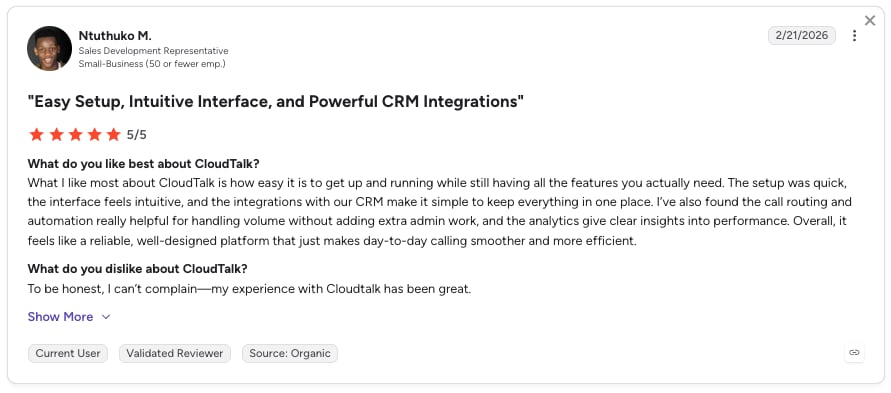
CloudTalk's current G2 rating is 4.4/5, out of 1941+ verified user reviews.
When to Use CloudTalk
- Your inquiries arrive across time zones and an unanswered call at 2am is a booking somebody else takes by 9am.
- Your team is already on Aircall, Zoom Phone or an old PBX and dialling numbers individually, and you want the AI and the dialing inside the same calling layer.
- You need calls, notes and outcomes landing in HubSpot or Salesforce without middleware in between.
- You need a local number in a market where you have no office, and your callers will not pick up an unfamiliar country code.
- You want to test on a real line this week rather than scope a project, and prove it on 50 free minutes before committing.
2. PolyAI
Best for: large hotel groups and contact centres with dedicated CX resource and an enterprise budget.
What It Is
PolyAI builds enterprise voice assistants that sit on top of a contact centre's existing telephony rather than replacing it, and it has the deepest hospitality footprint of any pure-AI vendor on this list. PolyAI states its assistants answer calls for Marriott, Caesars, Whitbread and Hopper. It suits multi-property groups and central reservations lines handling thousands of calls a day, where caller experience is the brand.
Category Scores for PolyAI
| Criterion | Score (/5) |
|---|---|
| Conversation quality | 5 |
| Phone system included | 3 |
| Travel and hospitality depth | 5 |
| CRM and booking-system sync | 4 |
| Time to live | 2 |
| Pricing transparency | 1 |
Pricing transparency scores 1 because there is no published rate card, no free trial and no self-serve tier. Every deal is scoped on call volume, use cases and integration complexity, which means you cannot compare PolyAI against anything else on this page without booking a call first.
Key Features of PolyAI
- Guest-led conversation handling that absorbs interruptions, topic switches and open-ended questions without falling back to a menu
- Proprietary name-recognition technology, which PolyAI states understands callers' names around 95% of the time
- Reservation handling across multiple room types, availability and loyalty tiers, including taking payment details on the call
- Integration into an existing hotel PBX rather than replacement of the phone system
- Central updates deployed across hundreds of sites at once for multi-property estates
- Automatic language detection with responses in the caller's language across markets
Travel and Hospitality Fit
- Fully covers: use cases 1, 3, 6 and 9 — peak-hour volume, after hours, phone-menu replacement, and booking and reservation handling, which is where its published results sit
- Partly covers: use case 2, since the assistant answers in the caller's language but the local number is still your telephony provider's job, and use case 5, where it writes to connected systems within a scoped integration
- Does not cover: use cases 4, 7 and 8, which are outbound problems. PolyAI is built for the inbound line
Key Integrations for PolyAI
- Telephony: integrates with most hotel PBX systems, and is listed as an app integration by Mitel
- Booking: PolyAI has published an OpenTable integration for taking reservations over the phone
- Property and guest data: PolyAI states out-of-the-box and custom integrations with property management systems and CRMs, though it does not publish a named connector list, so confirm your specific PMS in scoping
- Compliance: ISO 27001, SOC 2, PCI DSS and GDPR
What Are the Pros and Cons of PolyAI?
| Pros | Cons |
|---|---|
| Best-in-class conversation quality, with reviewers repeatedly saying callers cannot tell it is not a person | No published pricing, no free trial and no self-serve entry point |
| Genuine hospitality depth, with named hotel and casino groups and published reservation results | Deployment is a scoped project measured in weeks, not a wizard measured in minutes |
| Sits on your existing PBX, so an enterprise estate does not have to change phone systems | Not a phone system itself, so number provisioning and routing stay someone else's problem |
| Central control across hundreds of sites from one place | Thin public review pool, which makes independent verification harder |
What Is the Pricing of PolyAI?
- Contact sales only. PolyAI publishes no rate card, and that is worth knowing before you build a shortlist around it
- Model: per-minute usage inside an enterprise contract, scoped on call volume, number of use cases, integration complexity and ongoing optimisation
- No free trial and no self-serve tier, so there is no way to hear it on your own line before a sales process
What Do Customers Say About PolyAI?
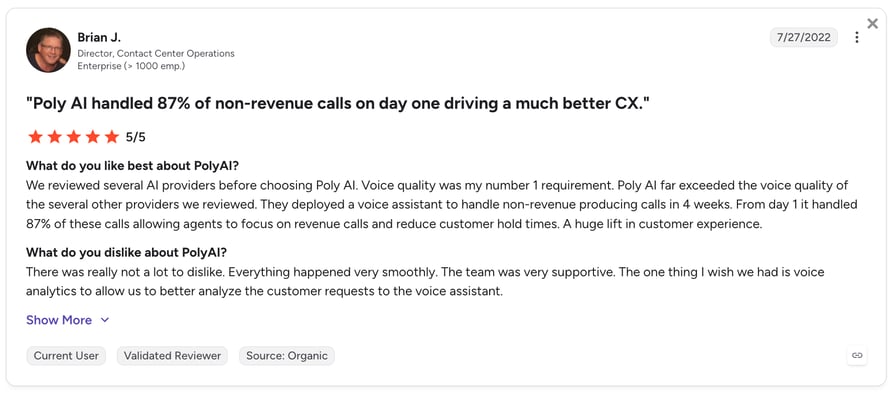
G2 rating: 5.0/5 (12 reviews) · Read PolyAI reviews on G2. Treat the score with the sample size in mind. One verified reviewer, a software developer at an ecommerce company, praises how well it automates client calls and singles out voice quality that avoids sounding robotic. On Gartner Peer Insights the recurring criticism is different: overall cost, and limited visibility into implementation timelines when changes are requested.
CloudTalk vs PolyAI
CloudTalk vs PolyAI
| Dimension | CloudTalk | PolyAI |
|---|---|---|
| Telephony | Native cloud phone system, numbers in 160+ countries | Sits on your existing PBX |
| Hospitality depth | General-purpose, configured per property | Purpose-built, named hotel and casino groups |
| Outbound campaigns | Outbound agent campaigns plus dialers | Inbound focus |
| Time to live | Under five minutes, self-serve | Weeks, scoped deployment |
| Pricing | Published ladder from $99/month plus a base plan | Custom quote only |
| Best for (travel) | Agencies and single-site or small-group operators | Multi-property groups with a CX team |
When to Use PolyAI
- You run a central reservations line taking thousands of calls a day and containment percentage is the metric your board asks about.
- Your estate has an enterprise PBX you are not replacing, and the AI has to fit around it.
- Caller experience is the brand, and a guest noticing they are talking to a machine is a commercial problem in itself.
- You have hundreds of properties and need one change deployed across all of them at once.
When Not to Use PolyAI
- You need to hear the agent on your own line this week rather than enter a scoping process.
- Your problem is outbound: calling back new inquiries, working a backlog, or recovering answer rates on flagged numbers.
- You are also replacing the phone system, and want the numbers, routing and agent from one vendor.
- You need to compare costs across a shortlist before committing to a sales conversation.
3. Synthflow
Best for: single-site US operators comfortable assembling their own flow and their own telephony.
What It Is
Synthflow is a no-code voice agent builder with a drag-and-drop flow designer, aimed at small teams and agencies that want something running without an engineer. For a travel operator it is the fastest path from an idea to a working inbound agent, provided your callers are in a market Synthflow serves directly.
Category Scores for Synthflow
| Criterion | Score (/5) |
|---|---|
| Conversation quality | 4 |
| Phone system included | 2 |
| Travel and hospitality depth | 2 |
| CRM and booking-system sync | 3 |
| Time to live | 5 |
| Pricing transparency | 2 |
Phone system scores 2 for a reason specific to this vertical. Synthflow provides numbers directly in the US, Canada and Australia only. Every other market, including all of Europe, runs through a bring-your-own Twilio account, which for an operator whose whole problem is local presence in the markets it sells into is a structural gap rather than a configuration step.
Key Features of Synthflow
- No-code drag-and-drop flow designer with unlimited agents on the pay-as-you-go plan
- Inbound and outbound calling with knowledge bases built from PDFs, documents and URLs
- Component-level pricing controls, letting you choose the language model and bring your own telephony
- Five concurrent calls included, with extra concurrency sold per slot
- White-label and sub-account tooling for agencies reselling agents to clients
- SOC 2, GDPR and ISO 27001 compliance on the standard plan
Travel and Hospitality Fit
- Fully covers: use cases 1, 3 and 7 — peak-hour overflow, after-hours cover and inquiry callbacks, all within the concurrency you pay for
- Partly covers: use case 9, where booking capture works but a live two-way flow into a booking system is yours to build, and use case 5, where CRM sync runs through connectors you wire up
- Does not cover: use case 2 outside its three direct number markets, and use case 4, which needs carrier-level number reputation work
Key Integrations for Synthflow
- Native: GoHighLevel and Zapier, which reaches most downstream marketing and CRM tools
- Telephony: Synthflow-managed numbers at $1.50/month each in the US, Canada and Australia, or bring your own Twilio account for everywhere else
- Custom: CRM, calendar, webhook and API connections, configured rather than pre-packaged
- Not native: no property management system connector, so guest context is a build here too
What Are the Pros and Cons of Synthflow?
| Pros | Cons |
|---|---|
| Genuinely fast to a working agent with no engineering involvement | Direct numbers in the US, Canada and Australia only |
| No platform fee on pay-as-you-go, so a pilot costs only what it uses | Layered billing makes the real per-minute rate hard to forecast |
| Component-level pricing gives real control over model and telephony choices | Legacy fixed tiers retired for new customers, so Enterprise is now sales-led |
| Strong voice quality and a large, active review base | No hospitality-specific templates or guest-context layer |
What Is the Pricing of Synthflow?
- Pay-as-you-go: no platform fee, five concurrent calls included, billed on usage
- Voice engine: around $0.09 per minute, with the language model at roughly $0.02 to $0.05 per minute on top
- Real all-in rate: independent breakdowns put it between roughly $0.11 and $0.24 per minute depending on configuration
- Extras: phone numbers $1.50/month each, additional concurrency $20 per slot per month, white-label toolkit $2,000/month
- Enterprise: sales-led and scoped, reported to start around $30,000 a year. Legacy Pro, Growth and Agency tiers are no longer available to new customers
Our breakdown of Synthflow pricing works through the component math in full.
What Do Customers Say About Synthflow?
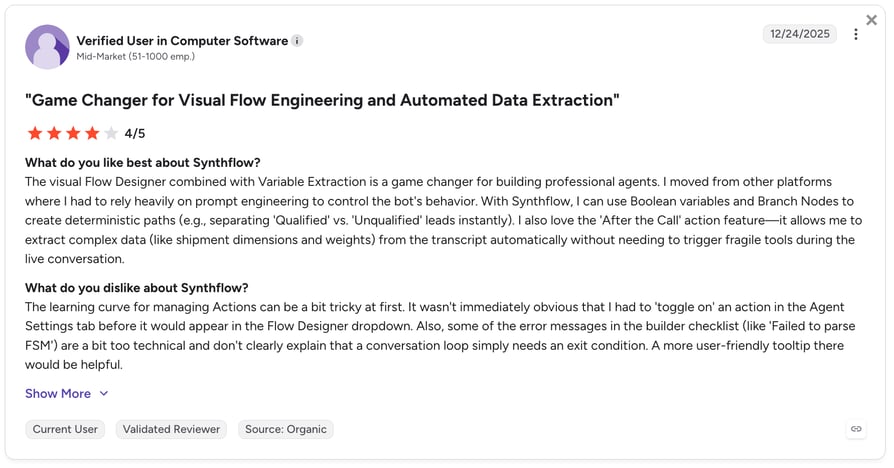
G2 rating: 4.5/5 (999 reviews) · Read Synthflow reviews on G2. Reviewers consistently praise how lifelike and fast the agent sounds in real time, and how quickly the builder gets something live. The recurring complaint is the one that matters most here: a European reviewer flags that no Spanish or other European numbers are available out of the box, and calls it a deal-breaker for calling local prospects.
CloudTalk vs Synthflow
CloudTalk vs Synthflow
| Dimension | CloudTalk | Synthflow |
|---|---|---|
| Telephony | Native, numbers in 160+ countries | Direct numbers in US, Canada, Australia; BYO Twilio elsewhere |
| Hospitality depth | General-purpose, configured per property | General-purpose, flows built by hand |
| Outbound campaigns | Outbound agent campaigns plus dialers | Outbound flows you build |
| Time to live | Under five minutes, self-serve | Same day, no-code builder |
| Pricing | Bundled minutes at a flat monthly price | Component-based per minute, plus add-ons |
| Best for (travel) | Operators selling into multiple markets | Single-site US operators building their own flow |
When to Use Synthflow
- Your callers are in the US, Canada or Australia and a local number is not the problem you are solving.
- You want to build and change the call flow yourself, visually, without waiting on anyone.
- You are running a short pilot and want a plan with no platform fee attached to it.
- You are an agency building agents for several clients and need white-label and sub-account tooling.
When Not to Use Synthflow
- You sell into European or other markets where you need a local number the caller recognises.
- You need a forecastable monthly bill rather than a rate assembled from four components.
- You are replacing the phone system as well as adding AI, and do not want to run a separate Twilio account.
- You want human agents and AI agents working the same numbers, routing and reporting.
4. Amazon Connect
Best for: teams with engineering capacity who want to own the build and can absorb a tuning cycle.
What It Is
Amazon Connect is AWS's cloud contact centre, with agentic AI included in the platform price and consumption billing instead of seat licences. The one Won travel deal in this dataset was running it, so this profile has first-hand evidence behind it rather than vendor material. It suits operators with in-house engineering who would rather build the contact centre and the agent than buy them assembled.
Category Scores for Amazon Connect
| Criterion | Score (/5) |
|---|---|
| Conversation quality | 2 |
| Phone system included | 4 |
| Travel and hospitality depth | 2 |
| CRM and booking-system sync | 3 |
| Time to live | 1 |
| Pricing transparency | 4 |
Time to live scores 1 because getting there is an engineering project rather than a configuration exercise. The operator running it in this dataset reported a question-to-answer delay of 10 to 15 seconds at first, tuned down to 3 to 4 over time. That tuning cycle is the cost of the low per-minute rate.
Key Features of Amazon Connect
- Consumption pricing per connected minute with no seat licences and no long-term commitment
- Agentic AI included in the platform price rather than sold as an add-on
- Contact flow builder with skill-based routing, queueing and IVR
- Workforce management and analytics in the same console as the calling
- Native access to the wider AWS stack, including Lex, Lambda and S3, for custom logic
- Everything configurable inside your own VPC, including routing logic and workflows
Travel and Hospitality Fit
- Fully covers, with a build: use cases 1, 3, 5 and 6 — concurrency, after-hours cover, CRM logging and conversational routing are all achievable, and all are things you assemble
- Partly covers: use cases 2, 7, 8 and 9, all technically possible on AWS and none of them shipped ready for a travel workflow
- Does not cover: use case 4 as a managed service. Number reputation and remediation are your responsibility
Key Integrations for Amazon Connect
- AWS services: Lex, Lambda, S3 and the rest of the stack, which is where most of the custom logic ends up living
- CRM and helpdesk: reviewers report Salesforce, Zendesk and ServiceNow integrations in production
- Everything else: open APIs, so booking systems and property management systems connect through work your team does
- Not native: no packaged hospitality or booking connectors of any kind
What Are the Pros and Cons of Amazon Connect?
| Pros | Cons |
|---|---|
| Lowest published per-minute rate on this list, with no seat licences | Setup is complex without existing AWS experience, per recurring reviewer feedback |
| Agentic AI included in the platform price rather than billed separately | Voice was described as metallic and robotic by the operator in this dataset |
| Scales without renegotiating licences, and runs inside your own AWS account | Latency needed a tuning cycle to come down from 10-15 seconds to 3-4 |
| Workforce management and analytics in the same place as the calling | Agent interface is basic, and the platform rate excludes standard telephony |
What Is the Pricing of Amazon Connect?
- Voice: $0.038 per connected minute, as reported by the operator running it in this dataset
- Model: pay-as-you-go on usage, with no seat licences, no up-front fees and no required long-term commitment
- Not included: standard telephony charges sit on top of the platform rate, so the headline figure is not your bill
- Also budget for: engineering time, which is the real cost line on this option
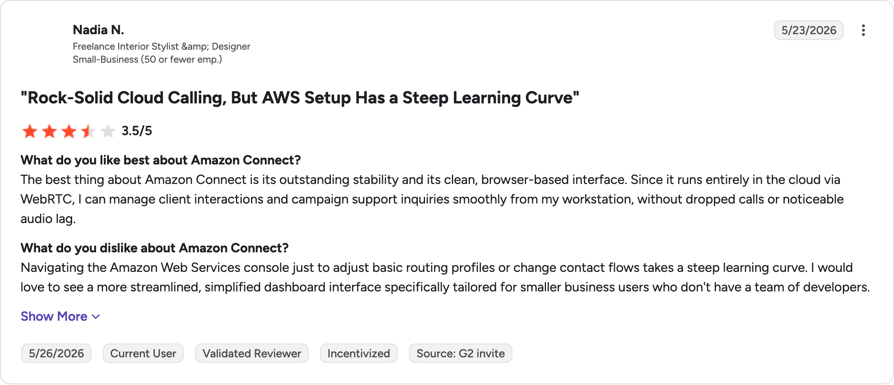
What Do Customers Say About Amazon Connect?
G2 rating: 4.4/5 (68 reviews) · Read Amazon Connect reviews on G2. Reviewers credit the scalability, the pay-as-you-go model and how far the AWS stack lets you extend it. The recurring criticism is consistent across sites: it feels complex to set up and manage without deep AWS experience, and advanced features need extra configuration or third-party tools.
CloudTalk vs Amazon Connect
CloudTalk vs Amazon Connect
| Dimension | CloudTalk | Amazon Connect |
|---|---|---|
| Telephony | Managed cloud phone system | Cloud contact centre you configure in AWS |
| Hospitality depth | General-purpose, configured per property | Nothing packaged; you build the workflow |
| Outbound campaigns | Outbound agent campaigns plus dialers | Build-your-own |
| Time to live | Under five minutes, self-serve | An engineering project with a tuning cycle |
| Pricing | Bundled minutes at a flat monthly price | $0.038 per voice minute plus telephony and build time |
| Best for (travel) | Teams without engineering capacity | Teams with engineers who want to own the stack |
When to Use Amazon Connect
- You have in-house engineers and per-minute cost at volume is the number that decides the purchase.
- You are already an AWS shop and want the contact centre inside the same account and billing relationship.
- Your call flows are unusual enough that no packaged product fits, and you would rather build exactly what you need.
- You want workforce management, analytics and the agent in one console you control.
When Not to Use Amazon Connect
- Nobody on your team writes code, and there is no budget for an implementation partner.
- You need the agent answering the overnight line in days rather than after a build and tuning cycle.
- Naturalness on a booking call is what you are testing for, and a tuning period is not acceptable in the meantime.
- You want packaged CRM connectors rather than integrations your team maintains.
5. ElevenLabs Agents
Best for: teams who care most about how the agent sounds and have someone to assemble the rest.
What It Is
ElevenLabs Agents is a conversational layer built on the voice models that set the category benchmark, to the point that several other platforms on this list use its voices underneath. It suits travel product teams embedding voice into something they already run, and operators whose single biggest objection to all of this is that guests will hear a robot.
Category Scores for ElevenLabs Agents
| Criterion | Score (/5) |
|---|---|
| Conversation quality | 5 |
| Phone system included | 1 |
| Travel and hospitality depth | 1 |
| CRM and booking-system sync | 2 |
| Time to live | 3 |
| Pricing transparency | 4 |
Phone system and travel depth both score 1, and they are the same problem. ElevenLabs has no telephony of its own and nothing built for hospitality, so a hotel buying it is buying one component of a system it then has to assemble around numbers, routing and a CRM.
Key Features of ElevenLabs Agents
- Category-leading voice realism, with expressive control and low-latency streaming
- Workflow builder and knowledge base on every paid tier, including the entry plan
- Automatic in-conversation language switching across the languages the agent supports
- Connects to SIP trunking, Twilio, Genesys and a long list of other telephony providers
- Bring your own language model, billed separately from the voice minutes
- A 95% discount on billing for silence longer than 10 seconds on voice-only calls
Travel and Hospitality Fit
- Covers, once you supply telephony: use cases 1, 3 and 9 — concurrency within your plan limits, after-hours answering and booking capture
- Partly covers: use case 2, where the agent handles the language half convincingly but the local number is entirely your telephony provider's job
- Does not cover: use cases 4, 5, 6, 7 and 8 without you building the CRM, routing and campaign layers around it
Key Integrations for ElevenLabs Agents
- Telephony: SIP trunking, Twilio, Genesys and a wide range of other providers, all supplied and billed by you
- Language model: your choice, billed separately from voice minutes
- Everything else: API and tool connections, so CRM, calendar and booking links are built rather than switched on
- Not native: no CRM, property management system or booking connectors out of the box
What Are the Pros and Cons of ElevenLabs Agents?
| Pros | Cons |
|---|---|
| The most natural-sounding voice on this list, by a clear margin | No telephony of its own, so numbers and routing are a separate vendor |
| Published per-minute rates and a free tier for testing the voice | Language model and telephony billed on top, so three invoices per agent |
| Silence discount meaningfully reduces the bill on real conversations | Burst pricing doubles the per-minute rate when you exceed concurrency |
| Workflow builder and knowledge base available from the entry tier | Nothing built for hospitality, so all guest context is your build |
What Is the Pricing of ElevenLabs Agents?
- Free: $0/month, 15 call minutes, 4 concurrent calls, no commercial licence
- Starter: $6/month, 75 minutes, 6 concurrent calls
- Creator: $22/month, 275 minutes, 10 concurrent calls
- Pro: $99/month, 1,238 minutes, 20 concurrent calls
- Scale: $299/month, 3,738 minutes, 30 concurrent calls
- Business: $990/month, 12,375 minutes, 40 concurrent calls
- Overage: $0.08 per additional minute, doubling to $0.16 as burst pricing above your concurrency limit. The language model and telephony are billed separately on top of every tier
Our guide to ElevenLabs pricing works through what those tiers cost once the rest of the stack is added.
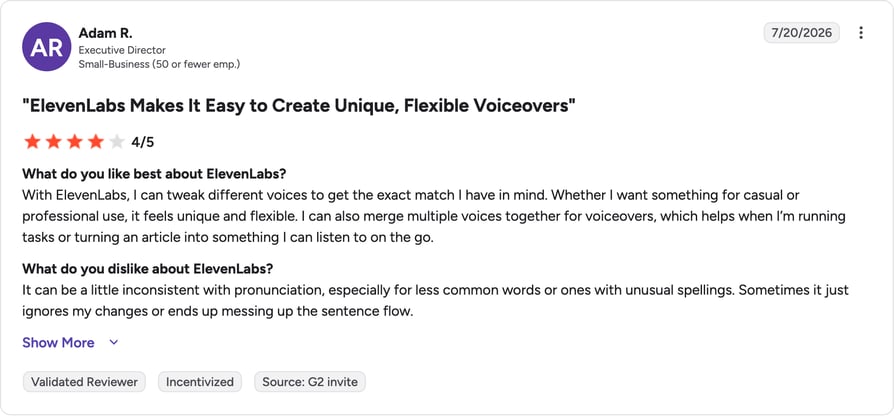
What Do Customers Say About ElevenLabs Agents?
G2 rating: 4.5/5 (1,184 reviews) · Read ElevenLabs reviews on G2. Reviewers single out voice realism and how easy the interface is to navigate, with multiple languages and voices called out as a strength. The recurring caveat is that it does not always fit a specific workflow without configuration work, which is the same gap this profile describes.
CloudTalk vs ElevenLabs Agents
CloudTalk vs ElevenLabs Agents
| Dimension | CloudTalk | ElevenLabs Agents |
|---|---|---|
| Telephony | Native, numbers in 160+ countries | None; bring SIP, Twilio or another provider |
| Hospitality depth | General-purpose, configured per property | None packaged |
| Outbound campaigns | Outbound agent campaigns plus dialers | Build-your-own |
| Time to live | Under five minutes, self-serve | Fast to a voice, longer to a working phone line |
| Pricing | Bundled minutes at a flat monthly price | Bundled minutes plus separate LLM and telephony bills |
| Best for (travel) | Operators buying a working phone line | Product teams embedding voice in their own stack |
When to Use ElevenLabs Agents
- Voice quality is the objection you have to clear before anyone internally will approve this.
- You are embedding voice into a product you already run rather than buying a phone system.
- You already have telephony you are happy with and want to add the best-sounding agent on top of it.
- You want to hear the voice before spending anything, on a free tier with a handful of minutes.
When Not to Use ElevenLabs Agents
- You need the numbers, the routing and the agent from one vendor on one invoice.
- Your problem is that calls and outcomes never reach the CRM, which is a layer this does not supply.
- You need local presence in the markets you sell into, which depends entirely on the telephony you add.
- Nobody on your team is going to assemble and maintain a multi-vendor stack.
Also worth evaluating: Retell AI and Vapi both come up repeatedly in wider voice-agent evaluations, but no travel or hospitality buyer in this dataset named either, so they get a mention rather than a profile.
If your search was narrower than a platform shortlist, we rank the after-hours AI virtual receptionist options and the bilingual virtual receptionist options separately.
Which use case applies to you
Find your situation in the left column, then read that section first.
Which AI Voice Agent Use Case Applies to You
| If this sounds like you | Use case to read | AIVA tier | Typical setup time |
|---|---|---|---|
| Calls queue the moment three people ring at once, and abandonment is above target | 1. Peak-hour volume | AI Receptionist | Under 5 minutes, self-serve |
| Callers hang up on an unfamiliar number, or you need a specific country code | 2. Language and local presence | Either | Under 5 minutes, plus number provisioning or porting |
| Inquiries land overnight or at the weekend and get answered the next business day | 3. After hours and overnight | AI Receptionist | Under 5 minutes, self-serve |
| Your answer rate fell off a cliff after carriers flagged your outbound numbers | 4. Spam and answer-rate recovery | AI Specialist (Outbound) | Under 10 minutes for the agent; number remediation runs longer |
| Notes, outcomes and messages never make it into the CRM | 5. CRM and booking-system logging | Either | Under 10 minutes for native CRMs; 1–2 weeks for custom system work |
| Agents answer with no name, booking reference or history on screen | 6. Phone-menu replacement | AI Receptionist | Under 5 minutes, plus call-flow build |
| Web inquiries sit in the CRM for hours before anyone dials them | 7. Inquiry callbacks | AI Specialist (Outbound) | 1–2 weeks for the CRM trigger build |
| You have thousands of old inquiries nobody has time to call | 8. Inquiry backlog | AI Specialist (Outbound) | 1–2 weeks with Professional Services |
| The front desk spends its day on reschedules and general questions | 9. Bookings and appointments | Either, tier-dependent | Under 10 minutes for capture; 1–2 weeks for system integrations |
9 Ways Travel and Hospitality Teams Use AI Voice Agents
1. Handling Peak-Hour Call Volume Without Putting Callers on Hold
A tour-booking marketplace had no routing system, so calls started waiting the moment more than three people rang at once.
What the agent does on a peak-hour call:
- Answers every simultaneous call, because concurrency isn't capped by desks
- Answers the routine questions outright: rates, availability, hours, cancellation policy
- Captures the caller's details and inquiry into a record before the call ends
- Escalates to a human with the context attached when the request needs one
This is the AI Receptionist tier, self-serve: a no-code wizard, setup in under 5 minutes, a knowledge base built from what your front desk already sends people. Unlimited concurrent calls means the fourth caller doesn't wait.
The number to watch: call abandonment rate, off your call analytics dashboard. Price it first: last month's inbound volume, times your abandonment rate, times the share of those callers who would have booked. According to Deloitte's 2026 Summer Travel Survey of 4,003 Americans, budgets for the longest trip rose 17% to $4,049, so each abandoned call costs more than it did last year.
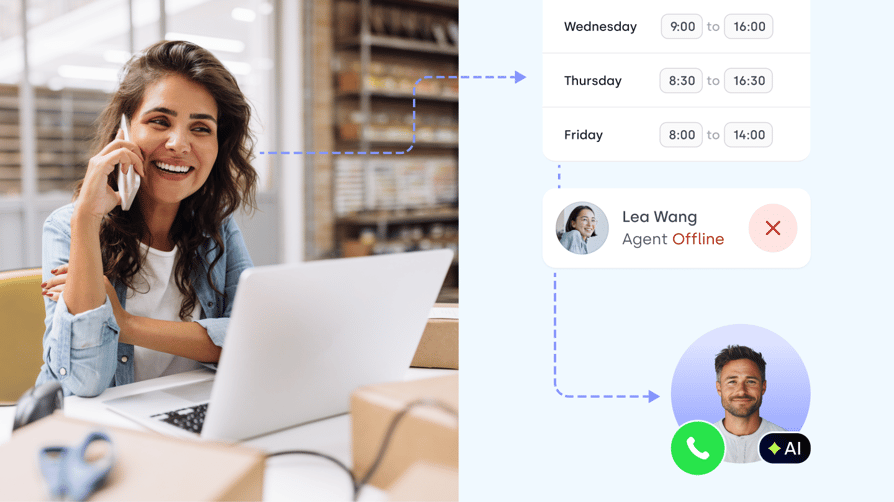
What this looked like for a real operator. The tour-booking marketplace measured 13–15% abandonment against a 7–9% target, with manual QA and no routing layer, so nobody could see which callers were lost.
2. Answering in the Caller's Language, From a Local Number
A resort operator in Switzerland needed Swiss country-code numbers for staff spread across several countries. A safari operator sells 89% of its business into North America, six to nine hours behind. Both problems look like language and geography; both are answer rate.
What the agent does:
- Detects the caller's language and answers in it, across 60+ languages and accents
- Presents a local number for the market you sell into, so the call doesn't read as foreign
- Captures the inquiry in the caller's own language and writes it to your system
- Hands off to a human who speaks that language, and takes a message when nobody's on shift
In CloudTalk this is two purchases that behave like one: the AI add-on on either tier, plus one of CloudTalk's international phone numbers in any of 160+ countries. Check rates first, because calls to mobile numbers vary a lot by destination.
The number to watch: answer rate by market. Track it per number, or a strong home market will hide a weak one.
What this looked like for a real operator. The resort operator was replacing Swisscom landlines and company SIM cards, and flagged the cost of calls to Swiss mobile numbers as a deal breaker in its own right.
Multilingual AI voice agents for hotels
For a property with international guests, multilingual coverage decides whether a booking gets captured or the caller hangs up. The agent answers in the guest's language on the first ring, which matters most on the calls nobody at the desk could have taken: a Spanish-speaking guest at 3am, a German inquiry on a Sunday. If your real need is two languages rather than nine, we compare the options for a bilingual virtual receptionist separately.
3. Covering After Hours, Weekends and the Overnight Gap
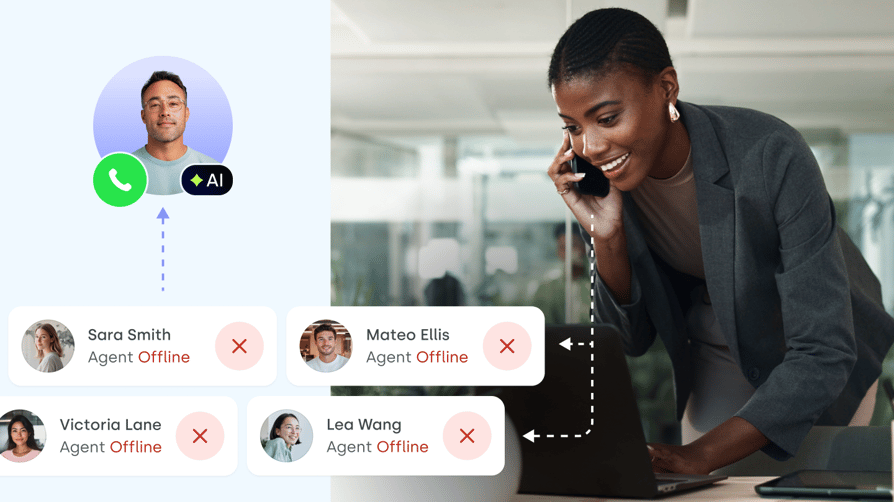
Peak volume is a bad hour. The overnight gap is a structural hole, and it's the more urgent buy. A country club wanted the front desk covered at night; a safari operator wanted the six-to-nine-hour gap between its office and its customers closed.
What the agent does:
- Answers on the first ring at 2am, on Sundays and through public holidays
- Handles rates, availability, directions, check-in times and cancellation terms
- Captures the request and the number, so the morning shift starts with a worked list
- Escalates genuine emergencies to an on-call number if you define one
An AI receptionist for hotels and resorts is the cheapest fix here because it needs no build: point your after-hours routing at the agent, upload the knowledge base, set business-hours conditions. Compare that with hiring. According to the American Hotel & Lodging Association's 2025 Front Desk Feedback survey, front desk roles were the second most commonly reported staffing shortage in US hotels, at 26%, behind only housekeeping. A 24x7 AI voice agent for hotels competes against a role you can't fill, not a person you'd let go. For a wider shortlist, see our round-up of the best after-hours AI virtual receptionist options.
The number to watch: after-hours inquiry capture rate, the share of out-of-hours calls that end with a usable record instead of a voicemail.
What this looked like for a real operator. A safari operator selling into North America counted 168 missed calls across five months and called it a substantial loss in sales value. The company sleeps while its customers shop.
See how CloudTalk covers the overnight gap on your existing number. Start free with 50 minutes.
4. Recovering Answer Rates When Your Numbers Get Flagged as Spam
One operator watched its answer rate fall from 40% to 9% after carriers flagged its numbers. Another called spam flagging "priority number one by far" while running a 2% connection rate across a 300-rep outbound motion.
Start with the honest part. No vendor can guarantee carrier behavior. Nobody can promise your numbers stay unflagged or promise a specific answer-rate lift. CloudTalk's spam and robocall shield protects staff from inbound spam; it does not stop a carrier labeling your own outbound numbers.
What you can do about it:
- Put your company name on the outbound call with Branded Caller ID, from $0.07 per call
- Manage number reputation: spread volume, review per-number answer rates weekly, retire burned numbers
- Sign calls with STIR/SHAKEN and register numbers through anti-spam registration
- For US numbers, add SPAM Remediation, a CloudTalk-managed service with carrier-level registration, live monitoring and remediation, priced custom
One scope limit: SPAM Remediation covers US numbers only. If your flagged numbers are UK or EU, the caller ID and reputation work still applies, but the managed service doesn't.
The number to watch: connection rate per number, weekly. It's the earliest signal a number is burning.
What this looked like for a real operator. One operator in this set was down to 64 answered calls across five agents in a full working day. The dialing worked fine; the numbers were the problem.
5. Getting Every Call, Note and Outcome Into Your CRM or Booking System
This is where the most deals in this dataset died: eight of the 11 raised broken integration. An events and ticketing business lost sight of its whole deal cycle because WhatsApp threads never logged into HubSpot. A resort operator wanted property management system (PMS) caller context on screen while the call was live.
What the agent does:
- Answers, transcribes and summarizes the call
- Writes the contact, inquiry and outcome to the CRM record afterward, with reportable tags
- Attaches the recording and transcript, so QA and dispute resolution have something to look at
- Flags the calls a human needs to pick up rather than leaving them in a general queue
CloudTalk has 100+ integrations, including certified HubSpot, plus Salesforce, Pipedrive, Zoho CRM, Microsoft Dynamics, Zendesk and Freshdesk. Post-call capture is standard; pulling live data from a custom CRM object mid-call is a scoped Professional Services build, and no PMS is native to CloudTalk.
The number to watch: the share of calls ending with a complete CRM record. Below 95% and your reporting is fiction.
What this looked like for a real operator. The events and ticketing business closed Lost partly on this gap. The calls happened; the record of them didn't, so every pipeline review was guesswork.
6. Replacing the Phone Menu With a Conversation That Routes Properly
Operators here described agents picking up with no booking reference, no caller name and no history on screen. The menu routed the call without doing anything useful with it, and it shed callers on the way.
What the agent does instead:
- Asks the caller what they need in their own words instead of reading four options
- Answers the request outright when it's routine, keeping it off a human queue
- Routes on what the caller said rather than which button they guessed
- Transfers with the context attached, so whoever picks up knows the name and the reason
You build this in the Call Flow Designer, a visual drag-and-drop builder for incoming call flows with 19 actions, branching logic, condition-based routing and live edits that don't interrupt calls. It's on all plans, and IVR and condition-based routing start on Starter. Handoff from the AI agent to a live agent is part of the AI add-on, so escalation is native. For a wider view, see our guide to call routing software.
The number to watch: transfer accuracy and menu abandonment, tracked together, because a menu can look efficient while shedding the callers it confused.
What this looked like for a real operator. For the tour-booking marketplace, replacing the menu was never the goal. Getting the right call to the right person, with the details already captured, was.
7. Calling New Inquiries Back Before a Competitor Does
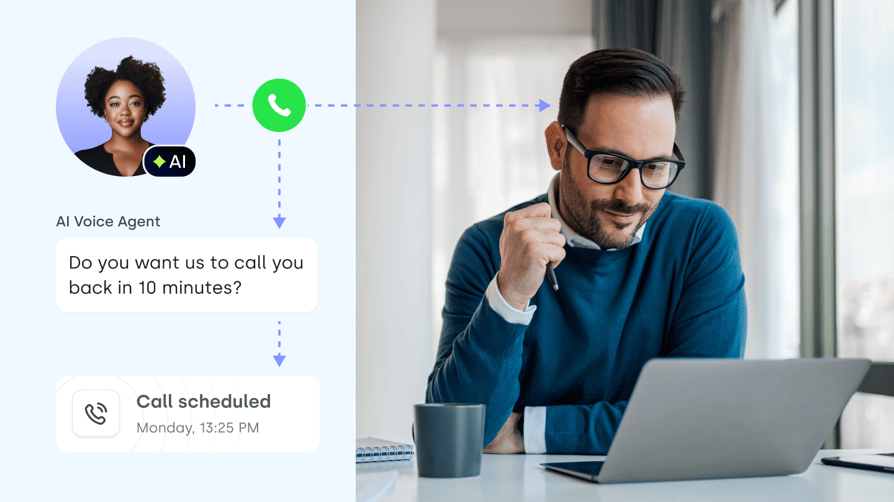
A multi-site practice wanted every inquiry called automatically the moment it landed in the CRM, qualified on that call, then handed to sales pre-qualified. Speed to lead is brutal in travel: the guest who filled in your form at 11pm fills in two more before bed.
What the agent does:
- Fires on a new CRM record or form submission and dials within seconds
- Confirms the inquiry, asks your qualifying questions, captures the answers into the record
- Books the next step, or hands a warm caller straight to a human
- Dispositions the ones that don't answer and schedules the retry
This is the AI Specialist (Outbound) tier, because the trigger reads your CRM and the call writes back to it. Basic intake can be live in under 10 minutes; a custom trigger is a 1–2 week Professional Services build. According to Skift's 2026 Data + AI Summit report, 82% of AI-generated hotel recommendations draw on OTAs and editorial media while only 6% of hotels surface in AI results, so the inquiry that reaches you directly is worth protecting.
The number to watch: speed to first call, in minutes from inquiry to dial. Anything measured in hours is a competitor's booking.
What this looked like for a real operator. For the multi-site practice, automatic callback was the condition of the deal rather than a nice-to-have. No callback trigger, no purchase.
8. Working Through an Inquiry Backlog Nobody Has Time to Call
A hospitality and venues group sat on a 4,000–5,000 inquiry backlog while making 3,000 dials a day at a 5–6% connect rate. One buyer described it as "a hundred manual dials to only a couple of people".
CloudTalk does not offer a predictive or central-pot dialer that works a shared list, detects human versus voicemail, and routes live calls to whichever rep is free. That was the core requirement of one deal here and the reason we turned it down. If that's what you need, this isn't the product.
What CloudTalk does with a backlog is run outbound agent campaigns:
- The AI agent works the list itself, so dialing doesn't compete with your reps' time
- It has the opening conversation and confirms whether the inquiry is still live
- It books the next step or dispositions the record, so the list shrinks either way
- It hands genuine interest to a human with the context already in the CRM
If you want reps working the same list, the dialer family sits alongside the agent: Smart Dialer starts on Essential, Power Dialer is included on Expert and an add-on on Starter and Essential, and Parallel Dialer is always an add-on.
The number to watch: backlog cleared per week. Not dials made. A dial that reaches nobody clears nothing.
What this looked like for a real operator. That deal closed Lost. What the group wanted underneath the agent was a predictive dialer we don't build, and saying so earlier would have saved everyone the evaluation.
9. Taking and Changing Bookings, Tours and Appointments Over the Phone
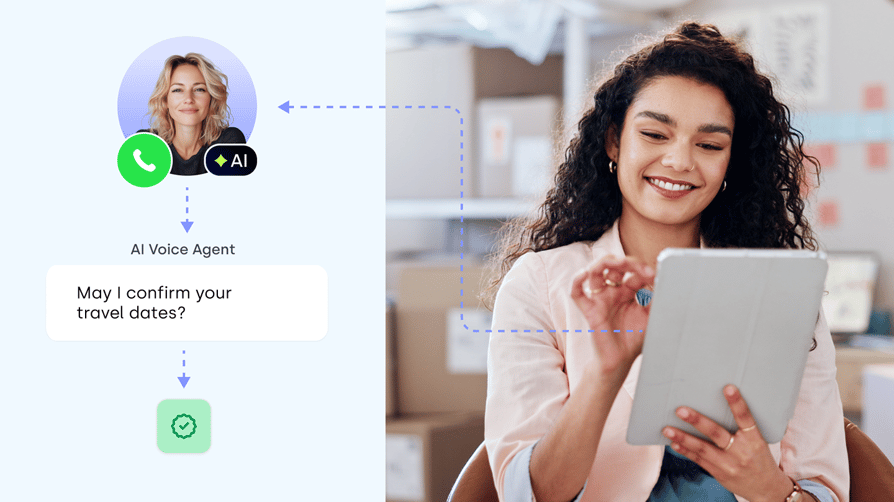
A driving-school franchise took 20 calls an hour, mostly general questions and reschedules, tying up two to three agents. A hospitality group wanted venue tours booked into a calendar without a human touching the request. If you've been searching for an AI voice agent for appointment booking, this is it.
What the agent does, and where the tier line falls:
- On AI Receptionist, the agent takes the booking or reschedule request, captures the detail, and writes it to your system for a human to confirm
- On AI Specialist, calendar sync and automated rescheduling come with the tier
- Either way, the agent answers the general questions that make up most of those 20 calls an hour, which is where front-desk time comes back
- Appointment scheduling via SMS links is listed as coming soon, so don't build a launch plan around an automatic text confirmation
For an AI voice agent for hotel bookings, take Receptionist first for capture, then Specialist once the booking-system work is scoped. No PMS is native to CloudTalk today, so a live two-way booking flow into one is an API or Professional Services project. If scheduling is your whole reason for reading this, our round-up of the best AI virtual receptionist for appointment scheduling tools compares them.
The number to watch: the share of booking and reschedule requests completed without a human touching them.
What this looked like for a real operator. The driving-school franchise wanted full coverage without adding people. The hospitality group wanted venue tours booked straight into a calendar, which is the requirement that pushes an operator from Receptionist to Specialist.
Point an agent at your reschedule calls and hear how it handles them. Your first 50 minutes are free, no credit card required.
Where CloudTalk Sits Among AI Voice Agent Platforms
Most AI voice agent platforms are a voice layer that assumes you already have a phone system you like. Travel and hospitality teams usually don't, because the phone system is part of what they're replacing. CloudTalk is the phone system and the agent in one product, so the agent that answers a booking inquiry also routes it, transfers it with context, and runs on a local number in 160+ countries.
The gap shows up in the price too. The enterprise AI platforms in this category start well above what a single-site operator will spend: Synthflow states that enterprise contracts start at $30,000 annually, with no self-serve tier. A hotel or travel agency testing its first agent can start on 50 free minutes instead. And if what you want is to hand the phone to people rather than automate it, compare a phone answering service for small business before you buy any agent.
How CloudTalk Compares to What Travel Teams Are Already Using
Before you compare AI vendors, compare against the system you already pay for. This table is the starting point: the phone systems these 11 operators were running when they went looking for something better. If yours is in this list, the gap they hit is probably the one you're hitting.
CloudTalk vs the Phone Systems Travel Teams Already Run
| Platform | What travel teams told us it does well | Where it fell short for them | Best for |
|---|---|---|---|
| CloudTalk | Operators wanted the AI agent and the phone system to be the same product, so the agent that answers also routes, transfers with context and runs on a local number in 160+ countries, with calls and outcomes landing in the CRM | Property management and booking systems aren't native integrations, so connecting them is API or Professional Services work, and mid-call lookup from a custom object is a scoped build. There's no predictive or shared-pot dialer | Travel and hospitality teams replacing manual dialing or a legacy phone system who want AI inside the calling layer |
| Aircall | Operators valued the clean interface and native CRM and helpdesk integrations that sync conversations automatically, with reliable call quality. Aircall states 23,000+ companies use it and now markets its own AI assistants | Operators in this set were dialing numbers individually and wanted the outbound and AI capability inside the same calling layer rather than alongside it | Small teams that want a simple, well-integrated cloud phone system with a short learning curve |
| Kixie | Operators credited Kixie as a fast sales dialer with local presence dialing and multi-touch cadences, and it now ships AI Insights reporting | One operator described Kixie as "always on fire" in reliability terms, and Kixie is built around an outbound sales motion rather than inbound front-desk coverage or after-hours capture | Outbound sales teams that live in a dialer and a CRM |
| Zoom Phone | Operators already had it, everyone already knew Zoom, and it puts the phone in the same platform as meetings and chat | The complaint was the workflow, verbatim: "We've got Zoom as our phone system. It sucks. You have to dial everything individually." Structurally, contact-center capability and the AI agents sit in a separate Zoom product line, so the AI and the phone are different purchases | Organizations already standardized on Zoom that want one vendor for meetings and telephony |
| 8x8 | Operators recognized 8x8 as an established enterprise unified communications and contact center platform with broad global coverage | One operator reported that "8x8 can't deliver on certain functionalities"; the gap was specific missing capability rather than general quality | Larger organizations that need a single enterprise UCaaS and CCaaS platform |
| Ringover | Operators valued Ringover as a straightforward, well-priced European calling platform with automatic CRM logging and AI call analysis | Ringover is positioned for sales and recruitment motions rather than hospitality front-desk coverage: no guest-context layer, no PMS story, and no AI agent that owns the whole inbound call | Sales and recruitment teams that want a simple, affordable calling platform with CRM logging |
| Amazon Connect | The operator running it got real capability and real cost control: consumption pricing at $0.038 per voice minute with no seat licenses, agentic AI in the platform price, plus workforce management and analytics in the same place | Operators reported a question-to-answer delay of 10–15 seconds, later tuned down to 3–4, and described the voice as having a "metallic robotic" quality. Getting there was an engineering project, and the platform rate excludes standard telephony | Teams with engineering capacity who want to build the contact center and the agent themselves on AWS |
| Glia | A deep, purpose-built platform for its market, with agentic workflows that let frontline teams run complex processes from one screen. Glia states 700+ financial institutions use it | It's built for banking, not hospitality. There's no travel or hospitality product, no guest or booking context, and no PMS path | Banks and credit unions that want AI purpose-built for financial services workflows |
Notice what's missing from the middle column. None of these operators complained that their phone system couldn't make calls. They complained that the AI, the dialing and the CRM lived in three different places.
Integrations: Your CRM, PMS and Booking System
Broken integration is the most common reason a deal in this dataset died, so this section splits native from custom. A list that blurs the two costs you a week in technical validation.
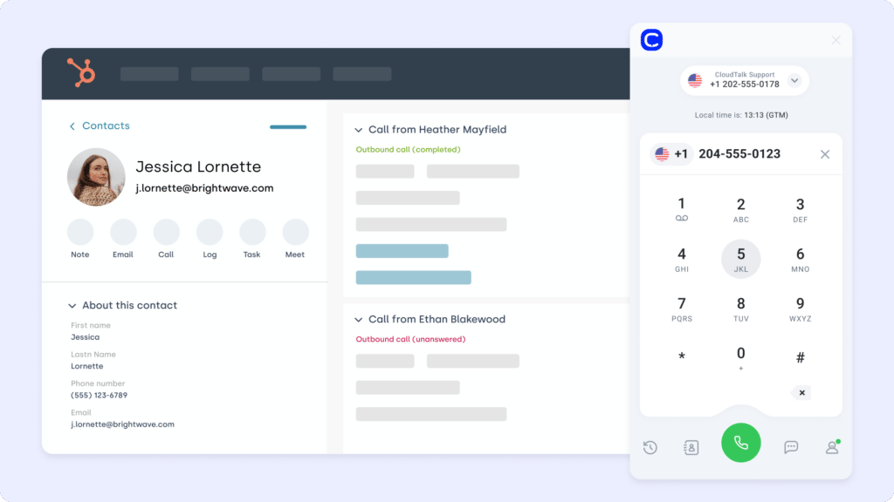
CloudTalk has 100+ native CRM integrations. On the CRM side: Salesforce, HubSpot (Certified), Pipedrive, Zoho CRM, Microsoft Dynamics and Odoo CRM. On the support side: Zendesk, Intercom, Freshdesk and Help Scout. Plus Salesloft, Outreach, Gong, Bullhorn, Monday, Shopify, Microsoft Teams and Zapier, which reaches roughly 5,000 downstream apps.
No property management system is a native CloudTalk integration. Nor are Calendly, WooCommerce or Amelia. If your guest context lives in a PMS, connecting it is a scoped build through the API or Professional Services, so budget for it rather than assume it.
On what two-way sync covers today: post-call capture is the standard behavior, so the transcript, the AI summary, the contact record, the outcome and the tags get written to the connected system after the call ends. Pulling live data from a custom CRM object mid-call, so the agent can quote a specific booking back to the caller, is a Professional Services build. One operator here is still waiting on exactly that before putting every agent live, which is why it's stated rather than buried.
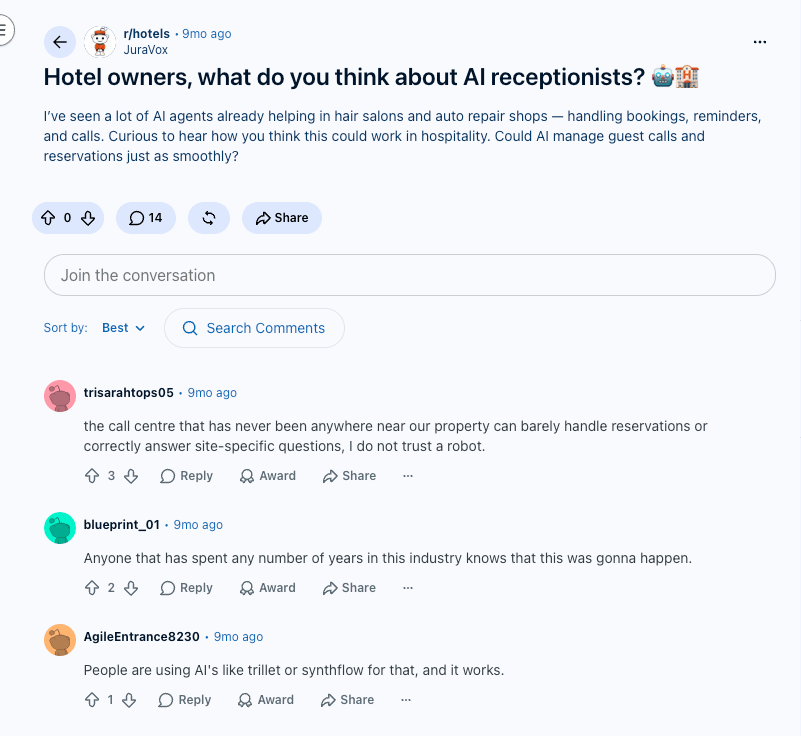
What Hospitality Teams Say on Reddit About AI Answering Their Calls
There is a lot of skepticism on the threads about replacing human receptionists with AI voice agents. And we agree. Your human hospitality employees shouldn't be replaced, but they can be greatly aided by an AI receptionist, especially for clients who call out of hours, since the AI takes notes on the call so reps will know exactly who called and what they called about.
There's also the frustration people feel when they talk to a poorly configured robot.
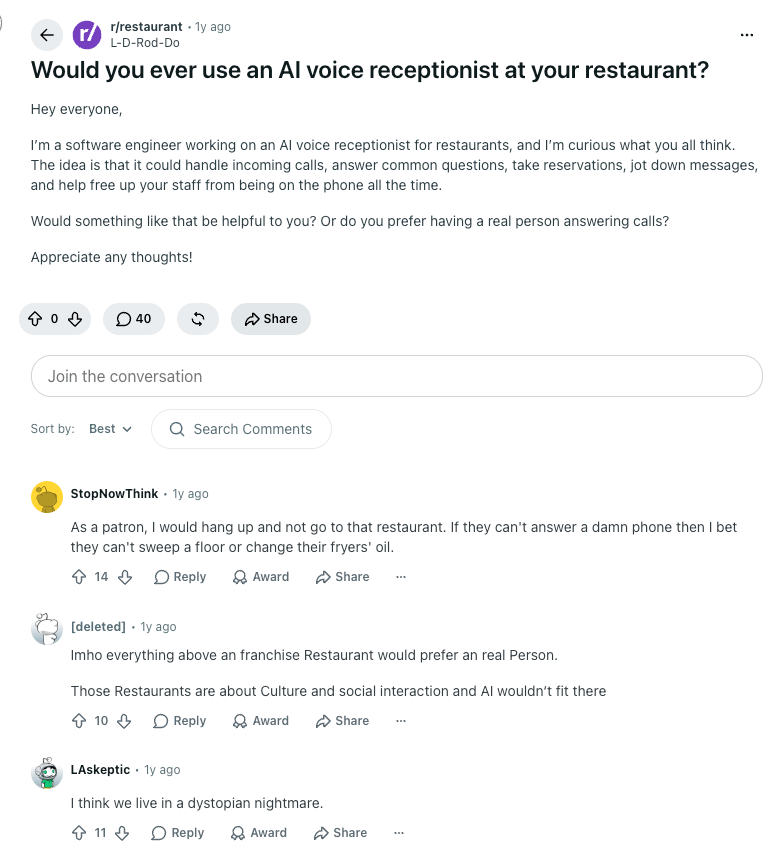
However, one thread points out that, sure, AI voice agents on their own aren't any good, but if they're connected to a proper call flow and telephony stack, that's when they can really be a benefit.
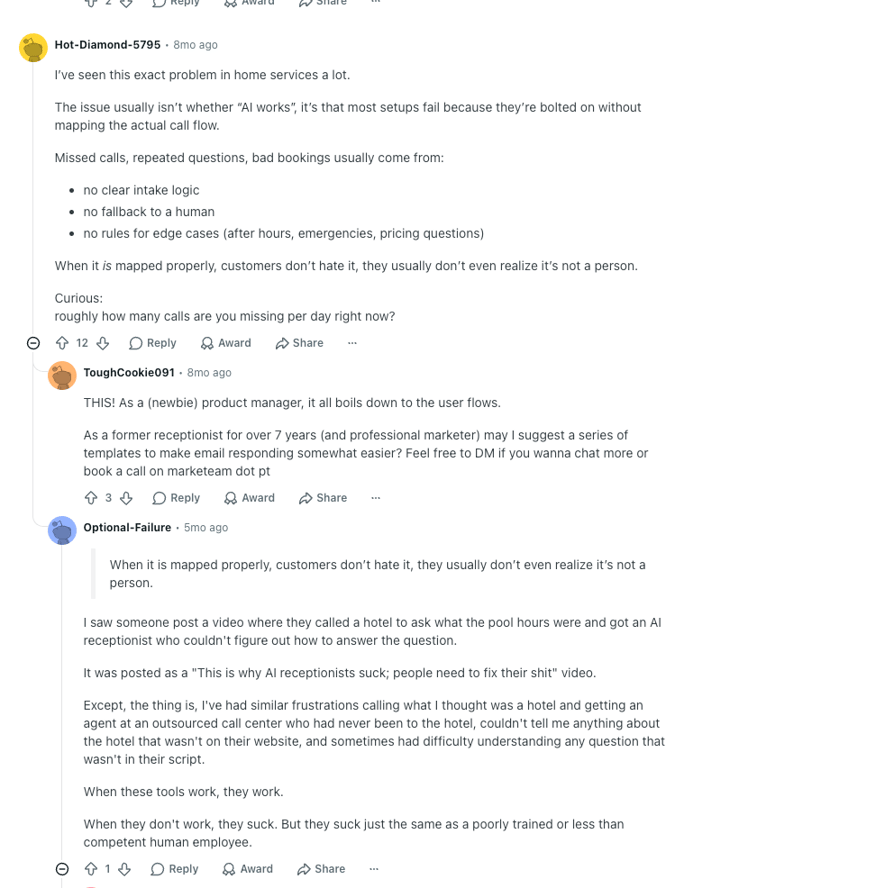
CloudTalk's AI Receptionist is fully integrated into your workflows, and hands the call to a human rep when needed.
Moving Off Landlines, PBX and Legacy Hospitality Phone Systems
Seven of the 11 operators from the discovery calls were on a stack that couldn't support what they wanted next: Swisscom landlines with company SIM cards in one case, Zoom Phone in another, an old PBX in others.
The sequence runs like this. Port the numbers first, so the line guests dial keeps working. Rebuild the call flow next, which is where most of the thinking goes: business hours, who rings first, what happens when nobody picks up, and where the AI agent sits in that chain. Then load the agent's knowledge base and run it on one call type. Then widen.
Porting deserves its own paragraph, because four of the 11 named it a must-have. An established hotel or agency won't give up the number printed on 10 years of material. Number porting needs the same two documents wherever you are: a signed Letter of Authorization, which downloads inside the request itself, and an invoice from your current provider dated within the last 30 days showing both the number and the account holder. Some countries want more. Spain also requires a CIF/NIF matching the legal entity on both documents, plus an address inside the number's own area code.
The time it takes to port a number? Spanish local numbers run about 12 business days, US numbers 10 to 14, Swiss numbers 22, and UK numbers anywhere from 15 to 30. Fees are $30 per request plus $2 to $30 per number by country and type.
Most of it doesn't change. The number guests already call stays, and so do the desk phones if you want to keep using them, the person who picks up when a caller asks for a human, and the front-desk routine on a normal Tuesday. Migration replaces the layer underneath the phone, not the way your team works a shift.
Benefits of an AI Receptionist for Hotels and Travel Staff
Every Call Answered, Including the Ones You Are Currently Missing
The first benefit is arithmetic rather than experience: calls that used to hit voicemail now end with a record. Because the agent takes unlimited concurrent calls, the fourth simultaneous caller gets the same answer as the first, and the 2am caller gets one at all. For an operator missing calls at that rate, every one of them now ends with a record instead of nothing.
Front Desk Staff Freed From Repetitive Questions
Most inbound volume at a property or an agency is a short list of questions asked over and over: rates, availability, check-in times, directions, cancellation terms. CloudTalk's AI voice agents handle 40–60% of call volume automatically, with up to 60% of calls resolved without ringing a human desk. What the desk gets back isn't idle time. It's the attention to give the guest standing in front of them.
Coverage Across Time Zones Without Night Shifts
Night coverage is expensive when it's least productive: one person paid to be awake for six calls. The agent covers the overnight window at a per-minute cost, so coverage stops being a headcount decision. The American Hotel & Lodging Association's February 2026 survey of 246 hoteliers found more than half of properties somewhat or severely understaffed, which is the constraint a night shift runs into first.
Consistent Service Quality at Peak and Off-Peak
A human front desk at 9am on a Monday and at 11pm on a Saturday are different services, and guests notice. The agent answers the same way at both, from the same knowledge base, with the same routing rules and escalation path. That matters most on the calls that decide a booking, because a caller comparing three properties is comparing the answer they got, not the hour they got it.
Call Data That Finally Shows You What Is Happening
"Reporting is a nightmare" was a verbatim complaint in this dataset, and four of the 11 raised visibility as a problem. Every agent call produces a transcript, an AI summary, a disposition and a CRM record, which turns the phone from a black box into a reportable channel in your call analytics: what callers ask for, when they call, what the agent resolved, and what it escalated.
AI Voice Agent Pricing for Travel and Hospitality
Here are the full details for AI voice agent pricing:
- First 50 minutes: free, for every new account
- AI Receptionist: from $99/month for 200 minutes
- AI Specialist: from $349/month for 1,000 minutes, contact sales
- Above 10,000 minutes a month: custom volume pricing as low as $0.15 per minute
- Base subscription, required: Starter $25/user/month, Essential $29/user/month, Expert $49/user/month
- No setup or onboarding fees
AI Voice Agents are always an add-on to a subscription plan, never bundled into one. If you're comparing an affordable AI voice agent for hotels across vendors, normalize that first: plan price plus minutes, not one or the other.
Four pricing models turn up in this market: per-minute billing that moves with your volume, bundled minute tiers like the ladder above, seat-based pricing where you pay per user whether or not the phone rings, and enterprise deals with no rate card and a floor that can sit at $30,000 a year.
Then there are the costs that surprise people. Minute overages are the main one, which is why you size the bundle against last month's real call minutes. Some vendors charge extra for their newest models. Per-destination rates are not uniform either: calls to mobile numbers in some countries are expensive enough to change the decision on their own, which a resort operator here flagged. AI extras bill separately too, like AI Conversation Intelligence at $9/user/month, an add-on rather than something included in a plan.
Run the cost-versus-headcount sum yourself. Take the fully loaded monthly cost of one front-desk or reservations seat in your market, including employer taxes and holiday cover. Against that, put $99 plus one Starter seat at $25, then divide your monthly after-hours and overflow minutes by 200 for the number of bundles you need. The comparison isn't AI versus a person; it's AI versus the shift you currently leave uncovered.
CloudTalk plans start at $25/user/month, with the AI agent as an add-on on top. See all plans.
What an AI Voice Agent Will Not Do For You
Two of the five lost deals in this vertical died on capability gaps we could have set expectations about earlier. So, five limitations, unsoftened.
- It won't work a shared list like a predictive dialer. CloudTalk does not offer a predictive or central-pot dialer that dials a shared list, detects human versus voicemail, and routes live calls to whichever agent is free. Outbound agent campaigns are a different mechanism. If shared-pot dialing is your core requirement, buy something else.
- It won't look up live data from a custom system mid-call out of the box. Post-call capture into your CRM is standard. Reading a specific booking out of a custom object while the caller is still on the line needs Professional Services scoping, and no property management system is a native integration today.
- It won't guarantee your numbers stay unflagged. The inbound spam shield stops spam reaching your staff. It does nothing about carriers labeling your own outbound numbers, and no vendor can promise otherwise. Answer-rate recovery means caller ID, number reputation practice and remediation, and remediation covers US numbers only.
- It won't sound exactly like your best receptionist. Buyers in this vertical have described competing agents as "metallic robotic", with noticeable question-to-answer delays. Latency and naturalness have improved, and they're still worth testing on a recording rather than taking on trust.
- It won't be better than the knowledge base you give it. The answers the agent gives are the content you uploaded, so an agent trained on a stale rate sheet will quote a stale rate back to a guest. Call recording and consent stay your legal responsibility, not the vendor's, though CloudTalk gives you GDPR-compliant call handling to work with.
Setting Up Your First AI Voice Agent: A Practical Order of Operations
According to Canary Technologies' 2026 survey of more than 400 hotel technology decision-makers, 82% expect AI use to increase across their organization within the year and 85% expect to spend at least 5% of their IT budget on AI tools. Your peers are already doing this, so the question is the order.
- Start with one call type. After-hours missed calls is the lowest-risk place to begin, because the alternative is voicemail and the bar you have to clear is very low.
- Load the real business context. Rates, hours, locations, cancellation policy, parking, check-in times, and the questions the front desk actually gets. Start with the last 20 emails your team answered.
- Define escalation before go-live. Decide which calls always reach a human, whose phone rings, and what the agent says while it transfers. Settle this before the first live call, not after the first complaint.
- Run it on a real line with the free minutes. Point your after-hours routing at it, then listen to every recording in the first 72 hours. You'll rewrite the knowledge base twice in that window, which is the point.
- Review weekly for a month, then widen. Watch capture rate and escalation rate. When both hold steady, add the second call type.
Most of the work in that list is content rather than configuration, which is usually the surprise.
Conclusion
Three things to take away. First, find your use case before you shortlist a vendor: peak-hour queuing, the overnight gap, flagged numbers and an unworked backlog are four different problems, and the fit table near the top maps each to a tier. Second, once the use case is clear the tier follows: if the agent needs to answer, capture and route, that's AI Receptionist; if it needs to read from or write to your booking system while the caller is still talking, that's AI Specialist. Third, test the thing you're actually worried about, which for most operators is whether guests will tolerate it.
That last one costs nothing to find out. Point your after-hours line at an agent, spend the 50 free minutes, and listen to what your callers hear at 2am now.
Try it on your own line with 50 free minutes
Prefer to see it first? Book a demo.
AI Voice Agents for Travel and Hospitality: Frequently Asked Questions
Yes, and this is the clearest difference from a human desk. The agent takes unlimited concurrent calls, so there is no busy signal and no hold queue no matter how many people ring at once. One tour operator in our deal data found calls started waiting as soon as more than three callers arrived together, because concurrency was capped by how many people were free. The tenth simultaneous caller gets the same greeting as the first.
No, and be wary of any vendor who says otherwise. CloudTalk's spam and robocall shield is inbound protection: it stops spam reaching your staff. It does not stop carriers labeling your own outbound numbers, and no vendor can guarantee carrier behavior or promise a specific answer-rate lift. What you can control is number reputation: Branded Caller ID from $0.07 per call, STIR/SHAKEN signing, retiring burned numbers, and SPAM Remediation for US numbers only.
Not natively. No property management system is a native CloudTalk integration today, and neither are Calendly, WooCommerce or Amelia. Connecting one is a scoped build through the API or Professional Services, so budget for it rather than assume it. What is native covers the CRM and helpdesk side, including Salesforce, HubSpot (Certified), Pipedrive, Zoho CRM, Microsoft Dynamics, Zendesk and Freshdesk.
Yes. CloudTalk ports existing numbers with zero downtime, and porting is supported across a long list of countries. Four of the 11 operators behind this article named it a must-have: an established hotel or agency will not give up the number printed on a decade of brochures and booking confirmations. Port first, then rebuild the call flow behind it, so the line your guests dial keeps working throughout the move.
It depends on the tier. AI Receptionist is self-serve and quick: a no-code wizard, under five minutes to a working agent, a knowledge base assembled from content your front desk already sends people. AI Specialist takes one to two weeks, because Professional Services scopes the connections and builds the workflows the agent executes. No one-to-one onboarding comes with the self-serve Receptionist tier, so plan to configure it yourself.
It hands off. The agent recognizes the limits of what it knows and escalates to a human, passing the context so whoever picks up already has the caller's name and reason for calling. Human handoff is part of the AI add-on, so escalation is native rather than a workaround. Define your escalation rules before go-live: which calls always reach a person, whose phone rings, and what the agent says while it transfers.
Yes, on the AI Specialist (Outbound) tier. The agent fires on a new CRM record or form submission, dials within seconds, confirms the inquiry, asks your qualifying questions, writes the answers back to the record, then either books the next step or passes a warm caller to a human. Basic intake runs in under 10 minutes; a custom CRM trigger is a one-to-two-week build.
More than 60 languages and accents, on either tier. The caveat matters more than the number: recognition accuracy varies by language and by accent, so test with a recording of your actual guest mix rather than your own voice. If you need strong coverage in two languages rather than shallow coverage in sixty, test both properly during the free trial minutes.
It depends on your jurisdiction, and it stays your responsibility rather than the vendor's. Some places require only one party to know; others require every party to consent before recording begins, and a cross-border call can engage both rules at once. CloudTalk provides GDPR-compliant call handling and the controls to announce recording and manage retention, but configuring them to your local law is your call. Check with your own counsel before recording guest calls at scale.
Yes, and you should. Every new account gets its first 50 minutes free, which is enough to run a real agent on a real line and listen back to the recordings. Do that rather than take any quality claim on trust, including ours. Buyers in this vertical have described competing agents as metallic and robotic with noticeable delays, so judge naturalness and latency on your own call types.