TL;DR: Aircall vs Ringover
- 01Choose Aircall if your reps live inside Salesforce or HubSpot and you need skill-based routing, live monitoring, and a large app marketplace. Pricing starts at $30 per license/month billed annually, with a 3-license minimum, and AI Assist sits on the $50 Professional tier or costs $9 per license/month as an add-on.
- 02Choose Ringover if you call a lot of countries and want calls, SMS, video, and AI transcription on a single predictable bill. Pricing starts at $15 per user/month billed annually, also with a 3-user minimum, plus a 12-month commitment.
- 03Consider CloudTalk if neither trade-off fits: IVR and call routing from $25/user/month with no seat minimum, native CRM sync from Essential, AI Conversation Intelligence available as an add-on, and a 14-day free trial.
Neither platform wins this comparison outright:
Aircall and Ringover are both mature cloud phone systems, both founded in France, and both solve a real problem well. They just optimize for different things. The right pick follows your use case, not a universal ranking.
Both platforms serve calling teams well, and the honest answer to "which is better" is that it depends on where your team spends its day. Aircall's strength is a deep, mature integration ecosystem, especially its Salesforce and HubSpot CTI, plus contact-center-grade call handling. Ringover's strength is inclusivity: unlimited calling to a long list of destinations, native team messaging and video in the box, and AI transcription on its entry plan.
That trade-off isn't academic. According to Deloitte's 2026 report on AI-assisted customer service in banking1, 77% of the US banking executives surveyed named integrating new technology with their existing systems as a major obstacle to modernizing their contact center, ahead of data security and compliance at 67% and legacy systems at 63%. Integration friction is the cost buyers underestimate, and it's the exact axis these two products split on.
- A CRM-anchored sales or support org that needs queuing plus live call monitoring with whisper coaching will get more out of Aircall.
- An internationally distributed team that wants a predictable bill and a same-day setup will get more out of Ringover.
We read every price, plan name, and feature inclusion in this Aircall vs Ringover 2026 comparison from each vendor's own live pricing and security pages on 17 September 2026. Or jump straight to the key differences table.

See what a third option looks like on your own calls

Aircall vs. Ringover: Core Strengths of Each Platform
Search for ringover vs aircall and you'll find a dozen pages trying to crown a winner. That framing misses the real split. Both companies built mature cloud telephony, then made opposite bets on packaging: Aircall sells a telephony layer designed to disappear into your CRM, Ringover sells a self-contained communications suite you don't have to assemble.
Where Aircall Shines
- Salesforce and HubSpot CTI depthReps dial, log, and tag without leaving the CRM record, so activity data stays clean without manual entry.
- Smart routing and queue callbackRule-based routing software reaches the right agent instead of a hunt group, and callers can hold their place in line instead of hanging up.
- Live monitoring with whisper coachingManagers listen in and coach mid-call, which is how new reps ramp on real conversations rather than roleplay.
- Power Dialer with voicemail dropOutbound lists run from CRM records with one-click voicemails, cutting the dead time between dials.
- 250+ native integrations plus API accessThe widest app marketplace of the two, and it's on the entry plan rather than gated behind a tier.
Where Ringover Shines
- Unlimited calling bundled by regionHigh-volume international dialing doesn't produce a per-minute bill you have to forecast (read the fine print below on which destinations count).
- Entry price at $15 per user/monthHalf of Aircall's entry price billed annually, which changes the math for small teams.
- AI transcription and summaries on the entry planCall transcription, summaries, tags, and automatic notes are available across all Ringover plans rather than on a premium tier.
- Calls, SMS, and video on one billFewer vendors to manage and one invoice to defend at renewal.
- Fast, light setupRingover's entry tier is deliberately web-only and thin, so a small team can be live the same day.
At a Glance: Aircall vs. Ringover, Key Differences
Use this table to spot the dimension that matters most to your team, whether that's entry price, international phone numbers, or contact-center depth, then jump to that section for the detail behind it.
| Dimension | Aircall | Ringover | Best suited for |
|---|---|---|---|
| Entry price (annual) | $30 per license/month (Essentials) | $15 per user/month (TALK) | Budget-led teams lean Ringover; feature-led teams lean Aircall |
| Seat minimum | 3 licenses | 3 users | Neither works for a solo operator |
| Commitment | Annual billing discounts 25%; no commitment advertised on the plan card | 12-month commitment on TALK and BUSINESS | Teams wanting flexibility lean Aircall |
| International calling model | Per-minute outbound on top of the seat fee | Unlimited to 110+ destinations from an EEA number, 90 from outside the EEA | Distributed EEA-based teams lean Ringover |
| Team messaging | Not offered | Included | Teams without Slack or Teams already in place |
| Video conferencing | Not offered | Included | Teams consolidating vendors |
| AI transcription tier | Professional ($50) or a $9 per-license add-on | Available across all plans, including TALK | Cost-sensitive teams that want AI notes now |
| Contact-center depth | Smart routing, queue callback, live monitoring (Professional) | Advanced IVR, double listening, whispering (BUSINESS, $47) | Complex support orgs lean Aircall |
| Integration marketplace | 250+ native integrations, from the entry plan | 100+, from the BUSINESS plan | CRM-anchored teams lean Aircall |
| G2 rating | 4.4/5 | 4.6/5 | See the reviews section for sample sizes |
The rows above simplify a lot, so the sections that follow unpack the ones that decide most deals.
Aircall Features vs. Ringover Features
The clearest way to read aircall vs ringover features is to ask what each platform assumes you already have. Aircall assumes a CRM is your system of record and builds around it. Ringover assumes you'd rather not run four subscriptions.
Aircall Features
Aircall consolidates the call-handling layer for teams whose work already lives in a CRM. Inbound routing, outbound dialing, coaching, and analytics sit in one app that connects to Salesforce, HubSpot, and the rest of a 250+ app catalog. The trade-off is that the features sales managers ask about most sit on the second tier.
| What Aircall Does Well | Where Aircall Falls Short |
|---|---|
| CRM-native calling. Click-to-dial, automatic logging, and mandatory call tagging keep pipeline data accurate without rep discipline. | No native team messaging. Internal chat lives in Slack or Teams, not in Aircall. |
| Skill-based and contact-history routing. Callers reach the agent who handled them last, or the one qualified to help, instead of the first free line. | AI is not on the entry plan. AI Assist requires Professional at $50 per license/month, or a $9 per-license/month add-on ($49 for AI Assist Pro). Almost no comparison page mentions that second path, and it's usually the cheaper one. |
| Live monitoring and whisper coaching. Supervisors listen, whisper, and step in during a live call. Salesforce's 2026 State of Sales Report2, based on a survey of 4,050 sales professionals, found that 46% of sellers rarely get feedback on their sales conversations, which is the gap this closes. | The sales stack sits on tier two. Salesforce CTI, Power Dialer, outbound campaigns, and live monitoring are all Professional features. |
| Power Dialer with voicemail drop. Campaign lists run straight from CRM records, and reps leave pre-recorded voicemails in one click. | Seat minimums bite small teams. Three licenses minimum on every published plan, whether billed monthly or annually. |
| Reporting that scales with the tier. Basic analytics covers six months on Essentials; Professional adds advanced analytics, and the Analytics+ add-on at $15 per license/month lifts the history limit entirely. |
Ringover Features
Ringover's pitch is a self-contained suite at an inclusive price. Calling, SMS, video, team messaging, and AI notes ship together, which removes the assembly work that a thinner phone system pushes onto you. The depth ceiling is lower than Aircall's once you get into complex contact-center operations.
| What Ringover Does Well | Where Ringover Falls Short |
|---|---|
| AI notes on every plan. Ringover's pricing page advertises call transcription, summaries, tags, and automatic notes across all plans, and transcription appears in the TALK feature list. That's the cleanest genuine contrast in the whole aircall vs ringover ai features debate. | "Unlimited to 110+ destinations" is conditional. Ringover's own footnote limits it to calls made from a number inside the European Economic Area. From a number outside the EEA, unlimited covers 90 locations. If you're dialing from a US number, that's a materially different product from the one the headline describes. |
| Bundled international calling. Unlimited calls to landlines and mobiles in 110+ locations, with an important regional caveat covered below. | A 12-month commitment on top of a 3-user minimum. Both TALK and BUSINESS display " 3 users minimum. 12-month commitment." Several competing comparisons claim Ringover has no seat floor. It does. |
| Messaging and video included. Team messaging and video conferencing come with the suite rather than as separate subscriptions. | Integrations start on BUSINESS. The 100+ integration catalog, advanced IVR, and power dialer all require the $47 tier, so the $15 entry price isn't the price of a CRM-connected phone system. |
| Advanced IVR with call groups. BUSINESS adds smart routing, call groups, double listening, and whispering for managers who coach. | Operational ceilings are lower. Call queues cap at 20 simultaneous calls on BUSINESS, the power dialer handles 300 contacts per campaign, and ADVANCED pricing isn't published at all. |
| Local numbers across 65 countries. BUSINESS annual plans include local numbers from 65 countries and from the US plus 30 more, which is a strong footprint for a distributed team. |
Feature-by-Feature Comparison
| Feature | Aircall | Ringover | CloudTalk |
|---|---|---|---|
| Native CRM integration depth | Salesforce CTI (Professional), HubSpot on all plans | Salesforce, HubSpot, Zoho, Pipedrive from BUSINESS | Native two-way sync with HubSpot and Pipedrive from Essential; Salesforce on Expert |
| IVR and call routing | IVR on Essentials; smart routing on Professional | Advanced IVR with smart routing on BUSINESS | IVR and skill-based routing from Starter |
| Live call monitoring and coaching | Live monitoring on Professional | Double listening and whispering on BUSINESS | Real-time call monitoring with listen, whisper, and barge, on Expert |
| Team messaging | Not offered | Included | Not offered as native chat; Slack and Microsoft Teams integrations |
| Video conferencing | Not offered | Included | Not offered |
| AI transcription and summaries | AI Assist on Professional, or $9 per license/month add-on | Listed on all plans, including TALK | AI Conversation Intelligence add-on, $9/user/month |
| International calling model | Per-minute outbound rates | Unlimited to 110+ EEA-origin destinations, 90 outside the EEA | Virtual numbers in 160+ countries, unlimited international calling on supported destinations with Expert |
| Power dialer | Professional | BUSINESS (included; no separate add-on) | Included on Expert; add-on on Starter and Essential |
Feature parity is closer than the marketing suggests. What separates the two is which tier you have to buy to get the row you care about, which is where total cost comes in.
Total Cost of Ownership: Aircall vs. Ringover
Headline prices mislead in opposite directions here, which is why the real cost of a business phone system rarely matches the number on the plan card. Aircall's $30 entry price excludes the AI features most buyers want, so the real number is either the $50 Professional tier or $30 plus a $9 add-on. Ringover's $15 looks unbeatable until you notice that CRM integrations and the power dialer live on the $47 BUSINESS tier. And the seat floor everyone gets wrong applies to both: three users minimum, on each platform.
| Cost dimension | Aircall | Ringover | CloudTalk |
|---|---|---|---|
| Headline entry price (annual) | $30 per license/month | $15 per user/month | $25/user/month |
| Tier required for AI transcription | Professional $50, or Essentials + $9 add-on | Advertised on all plans, including TALK $15 | Any plan, plus the AI Conversation Intelligence add-on at $9/user/month |
| Seat minimum | 3 licenses | 3 users, 12-month commitment | None |
| 3-person team, basic calling | $90/month (3 × $30, annual) | $45/month (3 × $15, annual) | 3 × $25/user/month |
| 3-person team with AI notes | $117/month (3 × $39 with the AI Assist add-on) | $45/month | 3 × ($25 + $9)/user/month |
Aircall Pricing vs. Ringover Pricing
Most aircall vs ringover pricing comparisons online quote euro figures, monthly-only rates, or plan names that US visitors never see. The figures below are the USD prices each vendor showed on its own pricing page on 17 September 2026.
Aircall Pricing
Here is what Aircall pricing looked like in USD on the vendor's own page on 17 September 2026.
- Essentials: $30 per license/month billed annually, $40 billed monthly. Includes 250+ integrations and API access, IVR, call recording, click-to-dial, SMS and MMS, unlimited simultaneous outbound calls, and up to three teams.
- Professional: $50 per license/month billed annually, $70 billed monthly. Adds all AI Assist features, Salesforce CTI, advanced analytics, live monitoring, smart routing, queue callback, Power Dialer, voicemail drop, and outbound campaigns.
- Custom: quote-based, with a 25-license minimum. Adds custom onboarding, API developer support, an SLA, single sign-on, and unlimited analytics history.
- Minimums and billing: 3 licenses on every published plan, regardless of billing cycle. Annual billing is advertised at 25% off.
- Add-ons: AI Assist $9 per license/month, AI Assist Pro $49, Analytics+ $15, WhatsApp $10, Aircall for Salesforce Voice $30. Every plan includes 50 free AI Voice Agent minutes per account per month.
Ringover Pricing
Here is what Ringover pricing looked like in USD on the US version of the vendor's own page on the same day.
- TALK: $15 per user/month billed annually, $24 billed monthly. Web only. Includes one local or toll-free number, unlimited national calls, texts, call logs, recordings, summaries, and transcription.
- BUSINESS: $47 per user/month billed annually, $57 billed monthly. Adds local numbers from 65 countries on annual plans, advanced IVR with smart routing and call groups, the 100+ integration catalog, advanced analytics and coaching, and the power dialer.
- ADVANCED: custom pricing, not publicly listed. Adds call campaigns, voicemail drop, local presence dialing, and single sign-on.
- Minimums and billing: both TALK and BUSINESS display " 3 users minimum. 12-month commitment." All prices exclude taxes. The free trial runs 7 days, up to 5 users and 300 outbound minutes.
- Add-ons: Empower conversational AI $39, parallel dialer $49, single sign-on $2, Cadence $59, omnichannel $29. (Power Dialer itself is bundled into BUSINESS and ADVANCED; there is no separate paid add-on for it.)
One naming note that trips up anyone cross-reading comparisons: Ringover's EU-facing pricing (ringover.fr and similar) runs the same TALK/BUSINESS/ADVANCED lineup, just priced in EUR, with TALK at €20/user/month annual, €29 monthly. Older comparison pages reference a separately named "SMART" tier, but that name no longer appears on Ringover's live site as of September 2026, though it still shows up in some third-party listings that have not caught up.
Pricing Compared Line by Line
| Pricing dimension | Aircall | Ringover | CloudTalk |
|---|---|---|---|
| Entry price, billed annually | $30 per license/month | $15 per user/month | $25/user/month |
| Mid tier, billed annually | $50 per license/month (Professional) | $47 per user/month (BUSINESS) | $29/user/month (Essential), $49/user/month (Expert) |
| Top tier | Custom, 25-license minimum | Custom, not publicly listed | Contact Sales |
| Seat minimum | 3 licenses | 3 users | None |
| Contract commitment | Annual billing for the 25% discount | 12-month commitment on TALK and BUSINESS | Monthly or annual |
| AI transcription cost | $9 per license/month add-on, or Professional | No extra cost on the published plans | $9/user/month add-on |
| International calling | Metered per minute | Bundled, EEA-origin conditions apply | Numbers in 160+ countries; unlimited international calling on supported destinations with Expert |
For a third reference point on the same line items, CloudTalk pricing starts at $25/user/month, billed monthly or annually, with no seat minimum. See all plans.
Aircall Integrations vs. Ringover Integrations
This is where the two platforms diverge most. Salesforce's 2026 State of Sales Report2, based on a survey of 4,050 sales professionals, found that 51% of sales leaders using AI say disconnected systems are slowing their AI initiatives down, so integration breadth isn't a vanity metric.
Aircall Integrations
Aircall now publishes 250+ native integrations plus API access, and both are included on the Essentials plan rather than gated behind a tier. The catalog covers CRMs, helpdesks, and productivity tools, with the deepest work on Salesforce and HubSpot, and we've broken down Aircall's Salesforce integration field by field elsewhere. The caveat worth knowing: the Salesforce CTI sits on Professional, and Aircall for Salesforce Voice is a separate $30 per-license add-on. HubSpot users get more on the entry plan than Salesforce users do.
Note that older comparisons still cite "100+ integrations" for Aircall. That number is out of date; Aircall's page title, navigation, plan bullets, and about-us copy all say 250+ as of 17 September 2026.
Ringover Integrations
Ringover's navigation advertises 100+ integrations covering the mainstream stack: Salesforce, HubSpot, Zoho CRM, Pipedrive, Slack, Microsoft Teams, Jira, and helpdesk platforms, plus a Zapier connector that reaches thousands more apps. It's a smaller catalog than Aircall's and it starts on BUSINESS rather than the entry plan, but it covers what most sales and support teams connect in practice. For a team running HubSpot and Slack and nothing exotic, the difference between 100 and 250 integrations is theoretical.
Integration Capability Compared
| Integration capability | Aircall | Ringover | CloudTalk |
|---|---|---|---|
| Total native integrations | 250+ | 100+ | 100+ |
| First plan with integrations | Essentials ($30) | BUSINESS ($47) | Essential ($29/user/month) |
| Salesforce depth | CTI on Professional; Salesforce Voice a $30 add-on | Salesforce integration from BUSINESS | Full Salesforce CTI on Expert |
| HubSpot depth | Native CTI from Essentials | From BUSINESS | Native CTI with campaign and Conversation Intelligence data export from Essential |
| Developer and API access | API access from Essentials; developer support on Custom | Available with the integration catalog | Public API and webhooks from Essential |
| Workflow automation | Via integrations and API | Via integrations and Zapier | Workflow Automation Designer, plus Zapier |
Security & Compliance: Aircall vs. Ringover
Security is the thinnest section on most comparison pages, and it's the one where the confident claims are least reliable. What follows is only what each vendor documents on its own site.
Aircall Security & Compliance
- SOC 2 Type 2 compliant, stated explicitly on Aircall's security page with its own section heading.
- GDPR: Aircall states it complies with the obligations set out by GDPR.
- Encryption: TLS 1.2 in transit, AES-256 at rest, and TLS/SRTP for voice traffic.
- Access control: two-factor authentication, SAML authentication and SSO, and granular user roles.
- Hosting and posture: hosted on AWS, with an information security program Aircall describes as aligned with ISO 27001 and SOC II standards. A CSA CAIQ Level 1 self-assessment is published. Note that "aligned with" is not the same as certified to.
- Uptime: a published 99.95% uptime claim, with support available 24/5 across EMEA, APAC, and North America.
Ringover Security & Compliance
- Reliability: 99.95%, on redundant IP infrastructure built to remove single points of failure.
- Voice quality: a published mean opinion score of 4.45.
- Infrastructure: 17 points of presence globally, including 6 in the US, handling 250+ million minutes annually.
- Encryption: HTTPS with TLS 1.2 to 1.3 in transit, DTLS-SRTP for voice, and hardware security module encryption for sensitive data.
- Certifications: not publicly documented on Ringover's security page as of 17 September 2026. Some comparison pages assert SOC 2, ISO 27001, PCI-DSS, or HDS certification for Ringover; we couldn't confirm any of those on a Ringover-owned page, and absence of a published claim isn't evidence that controls are missing. Ask Ringover for its current compliance pack if this is a procurement gate for you. (Reconfirmed live on 21 September 2026: still no SOC 2, ISO 27001, GDPR, PCI-DSS, or HDS certification stated anywhere on ringover.com/security.)
Security & Compliance Compared
| Security and compliance | Aircall | Ringover |
|---|---|---|
| SOC 2 | Type 2, stated explicitly | Not publicly documented |
| GDPR | States compliance with GDPR obligations | Not stated on the security page |
| Encryption in transit | TLS 1.2, TLS/SRTP for voice | TLS 1.2 to 1.3, DTLS-SRTP for voice |
| Encryption at rest | AES-256 | Hardware security module encryption for sensitive data |
| SSO and SAML | SAML SSO, plus 2FA | Single sign-on on ADVANCED, or a $2/user/month add-on |
| Data residency | AWS hosting; residency not published | 17 points of presence including 6 in the US |
| Published uptime | 99.95% | 99.95% |
The CloudTalk Angle:
For regulated industries, CloudTalk's security program documents SOC 2 Type 1 and Type 2, GDPR, and HIPAA compliance, with call recording consent management and pause/resume during sensitive moments. It also publishes a 99.999% uptime SLA, which is a tighter number than either platform here advertises.
Usability & Reliability: Aircall vs. Ringover
Usability is the hardest dimension here to settle with evidence, because the figures that would settle it are peer-review sub-scores rather than anything either vendor publishes. So this section runs on what Aircall and Ringover each document themselves: uptime, voice quality, infrastructure footprint, and support hours, read from their own pages on 17 September 2026.
Aircall Usability & Reliability
- The interface is built around CRM-anchored workflows, so reps who live in Salesforce or HubSpot pick it up quickly.
- Aircall publishes 99.95% uptime and runs on AWS infrastructure.
- Support runs 24/5 across EMEA, APAC, and North America, which means weekend coverage isn't guaranteed.
- Analytics history stops at six months on Essentials, and call recording access beyond six months needs a request, so reporting-heavy teams end up on Professional or the Analytics+ add-on.
Ringover Usability & Reliability
- Setup is deliberately light on the entry tier, which is web-only, so a small team can be live quickly.
- Ringover publishes 99.95% reliability, a 4.45 mean opinion score for voice quality, and 17 points of presence globally including 6 in the US.
- The 6 US points of presence matter for North American teams, since call quality tracks proximity to infrastructure.
- Operational ceilings show up as you scale: call queues cap at 20 simultaneous calls on BUSINESS, and shared contact directories cap at 2,000 contacts on TALK.
Usability & Reliability Compared
| Dimension | Aircall | Ringover |
|---|---|---|
| Ease of setup (G2 score, out of 10) | 9.0 (n=805) | 9.2 (n=378) |
| Ease of admin (G2 score, out of 10) | 8.7 (n=470) | 8.9 (n=192) |
| Ease of use (G2 score, out of 10) | 9.2 (n=1,331) | 9.3 (n=417) |
| Quality of support (G2 score, out of 10) | 8.6 (n=1,216) | 9.1 (n=401) |
| Published uptime or reliability | 99.95% | 99.95%, 4.45 MOS |
| Support hours | 24/5 across EMEA, APAC, and North America | Not published on the pricing page |
| Learning curve | Familiar to CRM-native reps; more configuration in routing and analytics | Light on TALK; more setup once BUSINESS features are switched on |
Sub-scores are pulled from G2's Aircall vs. Ringover comparison page (g2.com/compare/aircall-vs-ringover), checked 21 September 2026; the n figures are the number of ratings behind each sub-score.
The CloudTalk Angle:
The two platforms trade off differently on CRM depth versus bundled simplicity, and CloudTalk sits between them with native CRM sync, IVR and skill-based routing from the Starter plan, and a published 99.999% uptime SLA backed by its own call quality standards.
Aircall Reviews vs. Ringover Reviews on G2
G2, Capterra, and Trustpilot are the peer review platforms most B2B buyers check before a demo, and they're the best available answer to "is Aircall good?" The short version is yes, on a large and broadly positive sample, with the caveats that follow. Anyone researching aircall vs ringover reviews should read the ratings alongside the sample sizes, because the two vendors are not being measured by comparable crowds. Our standalone Aircall review and Ringover review assess each platform on its own terms rather than head to head.
G2 Ratings Compared
| Review dimension | Aircall | Ringover |
|---|---|---|
| G2 rating | 4.4/5 | 4.6/5 |
| G2 review count | 1664 | 498 |
| Capterra | 4.2/5, 450+ reviews | 4.7/5, 880+ reviews |
| Trustpilot | 3.0/5, 1,000+ reviews | 4.0/5, 1,000+ reviews |
| GetApp | 4.2/5, 450+ reviews | 4.7/5, 880+ reviews |
Aircall's Capterra, Trustpilot, and GetApp figures come from a cached snapshot taken on 15 July 2026; Ringover's figures on those same platforms were checked live on 21 September 2026, since our cache never captured them. G2 ratings resolve live for both. Ringover rates higher on all four platforms, Capterra included, and Aircall is reviewed by roughly three times as many people on G2. Both facts are true at once, and a 4.6/5 from a few hundred reviewers isn't directly comparable to a 4.4/5 from well over a thousand. Aircall's Trustpilot score is also worth reading carefully: the distribution has a heavy one-star tail, and Trustpilot skews toward complaint-driven self-selection in a way G2's verified-buyer flow doesn't.
What Real Users Say About Aircall On G2
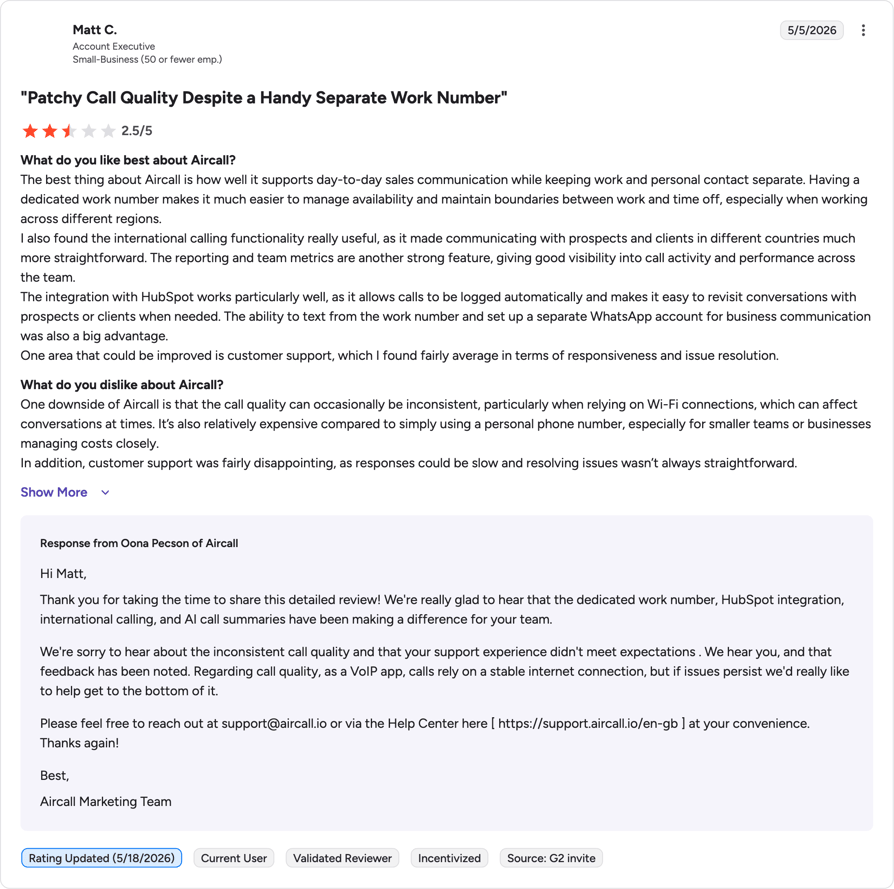
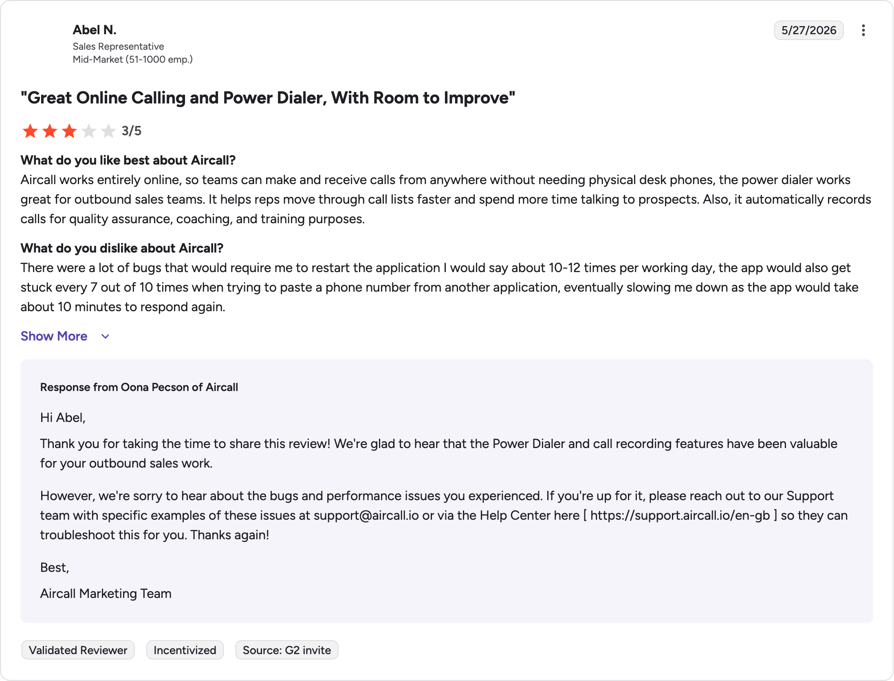
Aircall's G2 profile holds 1664 reviews, a sample big enough that a recurring complaint means something rather than reflecting one bad month. We won't paraphrase a review or reconstruct one from memory to fill this space: the two below hit both the outbound-tooling praise and the support and reliability complaints that recur across the profile.
Matt C., Account Executive, Small-Business (50 or fewer employees), 2.5/5:
Abel N., Sales Representative, Mid-Market (51-1,000 employees), 3/5:
What Real Users Say About Ringover On G2
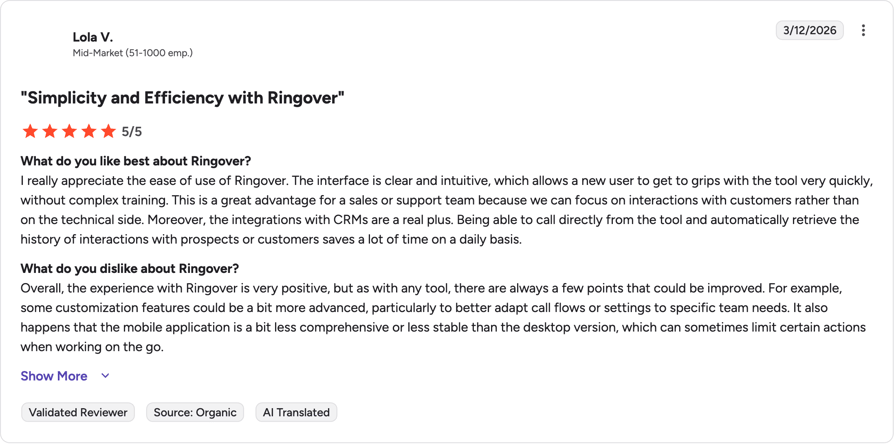
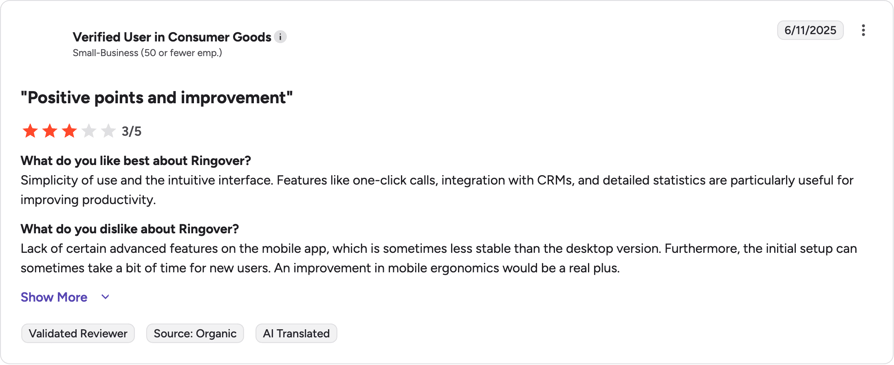
Ringover's G2 sample is smaller, at 498 reviews, so one strong opinion moves the average further and a pattern needs more evidence before anyone calls it consensus. We hold quotes to the same standard here: none goes in without a role, a company size, and a link. The two below (both originally written in French and machine-translated by G2) land on the same theme as most of the rest of the profile: an intuitive interface, with the mobile app as the recurring gap.
Lola V., Mid-Market (51-1,000 employees), 5/5:
Verified User in Consumer Goods, Small-Business (50 or fewer employees), 3/5:
Aircall Reviews vs. Ringover Reviews on Reddit & Quora
Review platforms capture buyers at a moment when they've been asked for feedback. Reddit and Quora capture them mid-frustration, or mid-recommendation to a peer, which surfaces the things a review form never asks about: the billing surprise, or the specific reason someone finally switched. Google reads it the same way: a Reddit thread cluster ranks on page one for this comparison.
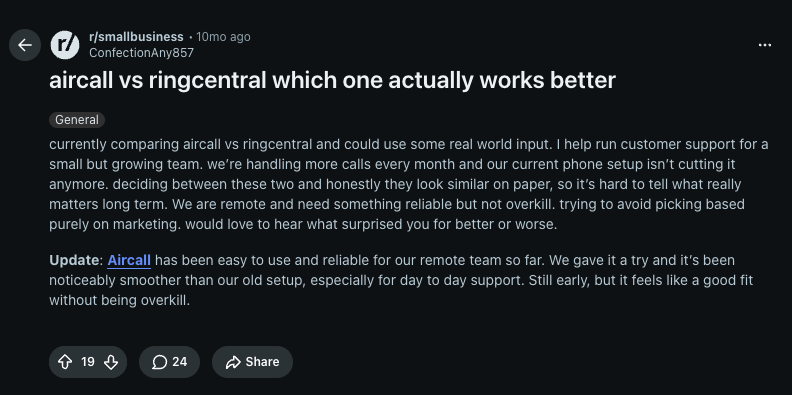
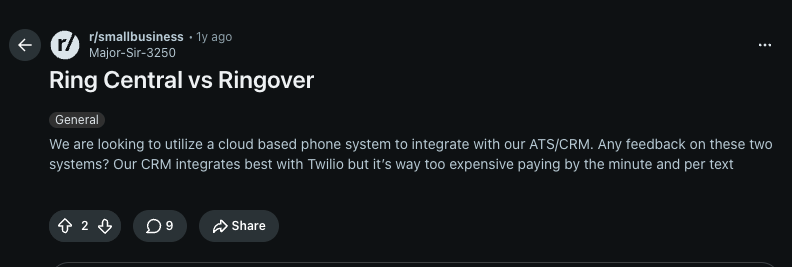
The thread Google surfaces most often for this comparison is "Tools like Aircall/ Ringover" in r/SaaS. Its title is the tell: buyers treat these two as one category and go looking for the rest of it, which is the same instinct behind our roundup of Aircall alternatives. Two more threads rank in the same cluster: "Ring Central vs Ringover" in r/smallbusiness, and "aircall vs ringcentral which one actually works better", also in r/smallbusiness. We link the threads we have URLs for and summarize none of them, because a second-hand paraphrase of a comment is not evidence of anything.
What Real Users Say About Aircall On Reddit & Quora
Aircall appears in two of the three Reddit threads that rank for this comparison: the r/SaaS thread linked above, and a separate thread weighing Aircall against RingCentral in everyday use. Neither is a review submission, so nobody commenting was prompted by a vendor or a review platform to say anything. That is the reason they are worth reading, and also the reason we won't characterize what anyone in them said without showing you the comment itself.
What Real Users Say About Ringover On Reddit & Quora
Ringover turns up in that same r/SaaS thread and in "Ring Central vs Ringover" in r/smallbusiness, which is the small-business end of the same question. Its Reddit footprint is thinner than Aircall's, and that changes how you should read it: one comment from one frustrated admin is one person's week, not a pattern. The same standard holds as for Aircall, so we quote these threads and don't summarize them.
Aircall Pros & Cons vs. Ringover Pros & Cons
Both are credible business phone systems, so the useful question isn't which one is flawless. It's which set of trade-offs your team can live with for the length of a contract.
Aircall Pros & Cons
| Pros | Cons |
|---|---|
| 250+ native integrations, available on the entry plan | No native team messaging or video conferencing |
| Deep Salesforce and HubSpot CTI for CRM-anchored teams | AI Assist requires Professional or a $9 per-license add-on |
| Smart routing, queue callback, and skill-based distribution | The sales stack (Power Dialer, campaigns, live monitoring) sits on Professional |
| Live monitoring with whisper coaching and supervisor takeover | 3-license minimum on every published plan |
| SOC 2 Type 2 compliance documented explicitly | Support runs 24/5, not 24/7 |
| API access included from the entry plan |
Ringover Pros & Cons
| Pros | Cons |
|---|---|
| $15 per user/month entry price, billed annually | Unlimited calling to 110+ destinations applies to EEA-origin calls; 90 destinations from outside the EEA |
| AI transcription, summaries, and tags on every published plan | 12-month commitment on TALK and BUSINESS, on top of a 3-user minimum |
| Team messaging and video conferencing included | Integrations, advanced IVR, and the power dialer all require BUSINESS at $47 |
| Local numbers from 65 countries on BUSINESS annual plans | Smaller integration catalog than Aircall's, at 100+ |
| 17 points of presence including 6 in the US, with a 4.45 MOS | Certifications aren't publicly documented on the security page |
| Fast, light setup on the web-only entry tier |
Test a third set of trade-offs before you sign
Which Team Fits Which Platform?
Fit comes down to how CRM-anchored your team is, and whether you need contact-center-grade call handling more than you need one predictable bill. That's the useful frame for aircall vs ringover for sales teams, and especially for international sales teams weighing bundled calling against ecosystem depth, rather than a scorecard.
| Aircall is the right fit for... | Ringover is the right fit for... |
|---|---|
| Teams that live inside Salesforce or HubSpot all day | Internationally distributed teams making high call volumes from EEA numbers |
| Contact centers needing skill-based routing and queue callback | Teams that want calls, SMS, video, and messaging on one flat bill |
| Sales managers who coach with live monitoring and whisper | Teams that want AI transcription without a tier upgrade |
| Teams that need the broadest third-party app marketplace | Small teams whose budget can't stretch past the entry tier |
| Buyers who need documented SOC 2 Type 2 compliance | Teams that want to be live the same day with minimal configuration |
| Orgs willing to pay for Professional to unlock the sales stack | Teams comfortable with a 12-month commitment for a lower rate |
Aircall vs. Ringover: The Verdict
Asking is aircall better than ringover is the wrong question, because the two products are optimized for different jobs. What decides it is whether your reps work out of a CRM all day, and whether you run anything that behaves like a contact center. HubSpot's 2025 State of Sales Report3, based on a survey of 1,000 global sales professionals, found the two biggest deal-killers are lack of product fit at 37% and poor value for money at 35%, which is a decent description of what goes wrong when a team picks a phone system on headline price alone.
Choose Aircall if you…
- Run Salesforce or HubSpot as your system of record and need calls logged automatically against the right record.
- Need skill-based routing, queue callback, and contact-history routing rather than a simple hunt group.
- Coach reps live, with whisper and supervisor takeover on real calls.
- Want the widest native integration catalog, with API access on the entry plan.
- Have procurement requirements that need documented SOC 2 Type 2 compliance.
- Can justify $50 per license/month for Professional, where the sales features actually live.
Choose Ringover if you…
- Dial heavily into many countries from EEA-based numbers and want that bundled rather than metered.
- Want AI transcription, summaries, and automatic notes without paying for a premium tier.
- Would rather consolidate calls, SMS, video, and team messaging into one subscription.
- Need a small team live quickly, without a configuration project.
- Are comfortable with a 12-month commitment in exchange for a lower per-user rate.
- Don't need contact-center depth beyond advanced IVR, call groups, and a power dialer.
The CloudTalk Angle:
Some readers land here hunting for the best Aircall alternative because AI sits behind a tier upgrade, or the best Ringover alternative because the contact-center tooling runs out. CloudTalk puts IVR and skill-based routing on Starter, native CRM sync on Essential, and AI Conversation Intelligence on a paid add-on, from $25/user/month with no seat minimum.
Put both shortlists side by side with a live walkthrough
Sources: 1. Deloitte Insights; 2. Salesforce; 3. HubSpot
Frequently Asked Questions
Neither is better; they gate it differently. Ringover puts advanced IVR and whispering on BUSINESS at $47; Aircall puts smart routing and live monitoring on Professional at $50. Neither is on the entry plan, so price the call routing tier you need.
Aircall, on breadth. It publishes 250+ native integrations from the entry plan, with Salesforce CTI on Professional; Ringover covers Salesforce, HubSpot, Zoho, and Pipedrive from BUSINESS. CloudTalk's Salesforce integration is a third route.
Only if you dial from inside the EEA. Ringover's own footnote caps unlimited calling at 110+ destinations for EEA-origin calls and 90 from outside it, so a US team gets a smaller bundle. Check it against the country coverage you need.
Aircall publishes the clearer commitment: 24/5 support across EMEA, APAC, and North America. Ringover doesn't publish support hours on its pricing page. Neither advertises 24/7, so weekend escalations need an after-hours support plan of your own.
It's worth it when you need Salesforce CTI, skill-based routing, and the 250+ app catalog, none of which Ringover's $15 TALK plan covers. For calling plus AI notes alone, Ringover costs less. Our CloudTalk vs Aircall breakdown runs the same test.
Both gate the dialer above entry. Aircall's Power Dialer and voicemail drop need Professional at $50; Ringover's needs BUSINESS at $47, capped at 300 contacts per campaign. Match that cap to your list before picking a power dialer.
The verifiable friction is packaging, not call quality. Aircall gates AI Assist above Essentials and needs three licenses; Ringover drops to 90 destinations outside the EEA and asks for 12 months. Our review methodology weighs published terms.
It depends on where you dial from. Ringover bundles calling best for EEA-based teams, Aircall meters international minutes, and CloudTalk sells virtual phone numbers in 160+ countries with no seat minimum.