Best AI Voice Agent for E-Commerce in 2026: 10 Picks
SUMMARY:
CloudTalk is the best integrated pick for teams that want AI calling inside a full sales and support phone system; Retell AI is the strongest all-around production-ready option; Gorgias covers Shopify support automation; and Synthflow now fits enterprises buying a managed rollout, not the no-code teams older roundups point it at.
We compared 10 platforms on cart-recovery depth, storefront integration, WISMO and returns handling, omnichannel reach across voice, SMS and WhatsApp, language coverage, and published pricing. The distinction that settles most of these decisions is between purpose-built e-commerce voice platforms, general voice agents you build the e-commerce logic on yourself, and omnichannel support suites where voice is an add-on.
Top 10 AI voice agents for e-commerce by use case:
- CloudTalk: Best for AI calling inside the phone system your reps already use.
- Retell AI: Best for a production agent live fast, no annual contract.
- Yellow.ai: Best for usage-priced enterprise self-service
- Cognigy.AI (NiCE): Best for enterprise retail with a contact center.
- Synthflow AI: Best for enterprises buying a managed rollout.
- Sierra: Best for large consumer brands that want a premium, outcome-priced AI layer.
- Genesys Cloud CX: Best for enterprise retailers needing AI inside existing routing.
- Vapi: Best for engineers picking their own speech and model stack.
- Bland AI: Best for high-volume outbound with predictable per-minute cost.
- PolyAI: Best for enterprises with complex inbound voice.
Best AI Voice Agent for E-Commerce: Comparison Table
Best AI Voice Agent for E-Commerce: Comparison Table
| Provider | Key Features | Best For | Starting Price | G2 Rating |
|---|---|---|---|---|
| CloudTalk | AI Voice Agent (CeTe), WISMO + Returns templates, AI Sales Dialer, Shopify + Magento, voice/SMS/WhatsApp | AI calling inside your phone system | $25/user/month; AI Voice Agent from $99/month | 4.4/5 (1938+ reviews) |
| Retell AI | Batch Call outbound, Call Transfer, Branded Call ID, Knowledge Base | A live agent fast, no contract | $0.07–$0.31 per minute, no platform fee | 4.8/5 |
| Yellow.ai | Shopping flows in chat/voice, real-time inventory | Medium-to-large enterprises with high-volume | Free; quote-based | 4.4/5 |
| Cognigy.AI (NiCE) | Voice and chat agents, 100+ languages, contact-center integrations, Agent Assist | Enterprise retail with a contact center | Quote-based, no public pricing | 4.6/5 |
| Synthflow AI | Managed deployment, native telephony and SIP, WhatsApp, use-case templates | Enterprises buying telephony and launch support | Quote-based | 4.5/5 |
| Sierra | Multi-channel AI agent, human-like conversations | Large consumer brands that want a premium AI layer | Quote-based | 4.4/5 |
| Genesys Cloud CX | Omnichannel routing, speech-enabled IVR, workforce engagement, Agent Copilot | Enterprise retailers with a full contact center | $75/user/month | 4.4/5 |
| Vapi | Bring your own STT, LLM and TTS, forkable templates, sub-500ms target | Engineers who want the whole stack | $0.05 per minute plus model costs | 4.5/5 |
| Bland AI | All-inclusive per-minute rate, Conversational Pathways, 40+ languages, 400ms latency | High-volume outbound, predictable cost | $0.14 per minute | 5.0/5 |
| PolyAI | Agent Studio, Dialog-RSN-1, order tracking and returns, ISO 27001 / SOC 2 / PCI DSS | Enterprises with complex inbound voice | Quote-based, no public pricing | 5.0/5 |
Why Are Online Stores Putting AI Voice Agents on the Phone?
According to Baymard Institute’s 2026 analysis of 50 separate cart-abandonment studies, 70.22% of online shopping carts are abandoned.
The problem isn’t always price—it’s unanswered objections. An AI voice agent can call, ask what stopped the shopper, answer questions, and send a checkout link before they leave.
We reviewed the 10 best AI voice agents for retail and e-commerce, with pricing from each vendor’s live page. You’ll see which tools fit cart recovery, inbound support, and high call volumes—and where each one falls short.
See an AI Voice Agent Work a Real Cart-Recovery Call
What Is the Best AI Voice Agent for E-Commerce Cart Recovery and Support?
It depends on the job. Cart recovery and support inside one phone system: CloudTalk. A fast, contract-free launch: Retell AI. Shopify support automation: Gorgias. Enterprise retail contact centers: Genesys Cloud CX or Cognigy.AI.
These ten aren’t substitutes. Not every product sold as one of the AI voice agents in this category actually places calls: Tidio and Gorgias aren’t voice-first, and Vapi and Bland AI are infrastructure you build on. Cognigy, Genesys and PolyAI sell through procurement with no published price.
How Did We Choose the Best AI Voice Agents for E-Commerce?
Every fact here came off a live vendor page in August 2026. What we weighted:
- E-commerce specificity. A published cart-recovery, WISMO, returns or COD workflow, or just a retail landing page?
- Storefront integration depth. Whether the agent can read order data, and whether it can act on it.
- Outbound capability. Batch calling, scheduling and answer-rate tooling, because cart recovery is outbound work.
- Honest pricing. Published rates, their unit, and what the headline number excludes.
- Review evidence at scale. A 5.0 from 11 reviews and a 4.4 from over a thousand aren’t the same signal, so we show the count beside every rating.
- Where each tool fails. Every entry names a real disqualifier, including ours.
Why Trust Our Software Reviews?
For nearly a decade, we’ve helped over 30,000+ professionals find and implement smarter business communication tools. We’ve reviewed 200+ software tools across industries, analyzed 5,500+ verified customer reviews from platforms like G2, Capterra, Trustpilot and TrustRadius, and drawn insights from real user discussions on Reddit and Quora.
In the past year alone, we published 1,000+ articles, each one written by humans for humans.
The 10 Best AI Voice Agents for E-Commerce in 2026
1. CloudTalk: Best for AI Calling Inside Your Phone System
What Is CloudTalk?
CloudTalk is a cloud business phone system with an AI calling layer inside it. Its AI Voice Agent, CeTe, is positioned as an “AI Voice Agent for eCommerce, no developers needed”: it answers shopper calls, drives phone orders, and escalates to your team.
What Are CloudTalk’s Key Features for E-Commerce?
- Autonomous calls that end with a human when needed. CeTe understands intent, pulls from a knowledge base, executes actions in connected systems and escalates only when needed.
- Shopper context on the call. The Shopify integration imports customer and order data, enables click-to-call, and logs call and SMS activity in Shopify. The order context helps agents personalize support and outbound conversations. Adobe Commerce (Magento) is another supported storefront integration.
- Store events trigger calls. The Workflow Automation Designer fires multi-step sequences off events, with SMS automation, CRM write-back, webhooks and Zapier. That’s how cart recovery gets built here.
- One workspace for the follow-up. Voice, SMS/MMS and WhatsApp, plus numbers in 160+ countries, 60+ languages, sub-800ms latency and a 99.999% uptime SLA.
What Are CloudTalk’s Pros and Cons?
| Pros | Cons |
|---|---|
| Transparent, usage-based pricing with a 14-day free trial | No native video conferencing |
| Built-in global VoIP—no third-party telephony needed | Solo users may not need its collaboration and routing depth |
| No-code Call Flow Designer for instant routing changes | No support for on-premises landline (PBX) hardware |
What Is the Pricing of CloudTalk?
- Starter: $25/user/month annually. Baseline everywhere, including IVR and skill and smart condition-based routing.
- Essential: $29/user/month. Smart Dialer, the 100+ integrations, API and data sync start here.
- Expert: $49/user/month, adding Power Dialer, Salesforce and WhatsApp. Custom is quoted by sales.
- AI Voice Agents: From $99/month for 200 minutes, first 50 free.
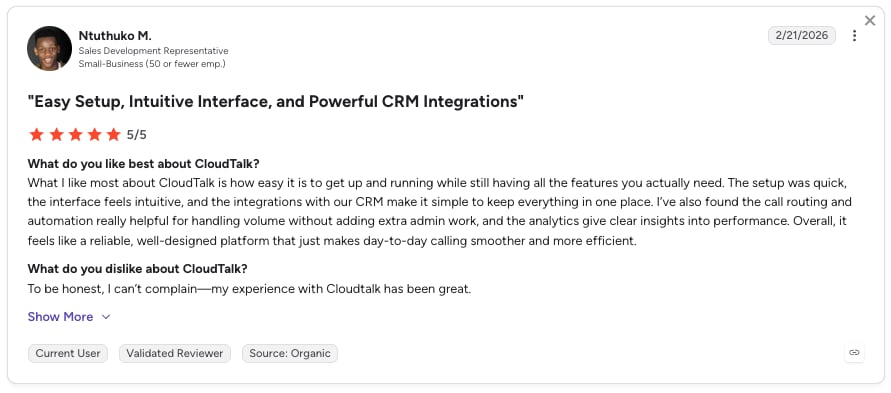
CloudTalk's current G2 rating is 4.4/5, out of 1938+ verified user reviews.
When Should You Use CloudTalk ?
Use CloudTalk when the phone is already part of how you sell and support, and you want the AI on the same lines and analytics as your reps. It fits the store that needs WISMO answered at 3 am and a human closing a high-value order at 3 pm.
2. Retell AI: Best for a Fast, Contract-Free Launch
What Is Retell AI?
Retell AI positions itself as one of the best AI voice agents with a retail and consumer goods offering for automating sales and support calls. It targets teams that want a production agent quickly and are fine with usage-based tooling.
What Are Retell AI’s Key Features for E-Commerce?
- Outbound at scale without a long‑term contract: Retell’s Batch Call lets you run high‑volume outbound campaigns (e.g., abandoned‑cart recovery, COD confirmation) using AI voice agents, launched from the dashboard or API.
- Your calls get answered. Branded Call ID and Verified Phone Numbers cut spam flagging. You can bring your own SIP trunk or import numbers to improve caller ID and control.
- Order data on the line. Retell can pull real‑time order data (e.g., status, items) by integrating with systems like Shopify, Salesforce, or Magento via webhooks/function calls or middleware (e.g., Make, n8n)
What Are Retell AI’s Pros and Cons?
| Pros | Cons |
|---|---|
| Fast to deploy, intuitive workflow builder | Limited built-in VoIP infrastructure |
| Enterprise-grade compliance (SOC 2, HIPAA, GDPR) | Fewer native CRM integrations than full phone systems |
What Is the Pricing of Retell AI?
- Pay-as-you-go with no commitment: $0.07 to $0.31 per minute for AI voice agents. That’s the headline range on Retell’s pricing page.
- Component pricing stacks on top: voice engine plus LLM plus telephony.
- Chat agents from $0.002 per message.
What Do Customers Say About Retell AI?
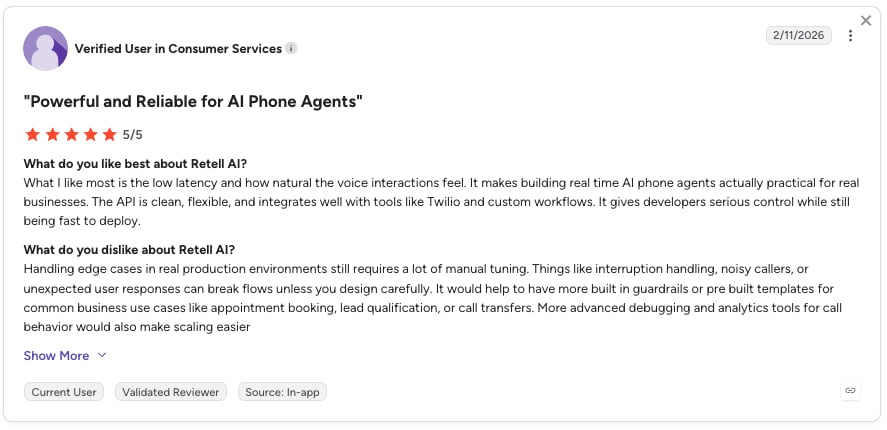
Retell AI customers highlight that they can go from idea to a working voice agent quickly, thanks to an intuitive interface and clear workflow builder, but note the platform struggles with highly complex or dynamic conversational logic compared to more developer-first tools.
Retell AI G2 Rating
Retell AI's current G2 rating is 4.8/5, out of 2,640+ verified user reviewssources disagree by roughly a thousand. Better nothing than a number we can’t stand behind.
When Should You Use Retell AI (and When Shouldn’t You)?
Use Retell when you want a recovery campaign calling this month and can build the logic yourself.
Don’t use Retell if the calls need to sit inside your support team’s phone system, or if finance needs a fixed monthly number up front.
3. Yellow.ai: Best for Usage-Priced Enterprise Self-Service
What Is Yellow.ai?
Yellow.ai is an AI customer service platform with voice and chat agents that automate customer interactions. Its AI Voice Agent is a good fit for ecommerce because it can handle high call volumes, answer customer questions, and provide support 24/7.
What Are Yellow.ai's Key Features for E-Commerce?
- End‑to‑end shopping flows in chat/voice. Customers can browse products, check availability, compare items, add/update cart, complete payments, track orders, download invoices, and initiate exchanges/refunds
- Real‑time inventory and order status. Dynamic AI agents connect to ERP/OMS/WMS systems to provide instant product availability, back‑in‑stock notifications, and live order/tracking updates.
- Personalized recommendations and promotions. Agents use purchase history and preferences to recommend complementary products, discounts, and targeted offers; they can also trigger messages for cart abandonment or specific actions.
What Are Yellow.ai's Pros and Cons?
| Pros | Cons |
|---|---|
| Ease of use and intituive interface | Steep learning curve |
| 135+ languages | Customization options can be limited |
What Is the Pricing of Yellow.ai?
- Free: $0 to start. One AI agent, 500 resolutions a month included, then $0.99 per resolution. Also 1,000 User360 records and one active campaign with 10 templates.
- Enterprise: quote-based. Unlimited agents and chat sessions, all 35+ channels, and SOC 2, GDPR and ISO compliance.
- No per-seat price is published on either tier, and no annual figure for Enterprise.
4. Cognigy.AI (NiCE): Best for Enterprise Retail Contact Centers
What Is Cognigy.AI?
Cognigy.AI, now part of NiCE, is an enterprise conversational AI platform pitched as “Meet Your AI Workforce.” It runs agents across voice, chat and messaging, plus agent assist, for retailers already running a contact center.
What Are Cognigy.AI’s Key Features for E-Commerce?
- One AI layer across every channel. AI Agents for voice and for chat and messaging, with AI-Powered Agent Assist for the humans.
- Multilingual coverage. 100+ languages, the point at which a retail AI voice agent stops being a single-market experiment.
- It slots into what you run. Pre-built integrations with Avaya, AWS, Genesys, NiCE, Microsoft and 8x8, plus Agent Studio and AI Agent Evaluation for governance.
What Are Cognigy.AI’s Pros and Cons?
| Pros | Cons |
|---|---|
| Pre-built integrations and reusable flows at multi-brand scale | No public pricing and no self-serve path, so evaluation starts with a sales cycle |
| 100+ languages, useful for international D2C | A very small G2 review base relative to this list |
What Is the Pricing of Cognigy.AI?
Quote-based. Cognigy publishes no pricing page at all, and the only route in is a demo request. Budget for enterprise procurement rather than a card payment.
What Do Customers Say About Cognigy.AI?
Users like the product for being easy to use and flexible, even for non-technical users. However, some say its analytics could be more advanced.
Cognigy.AI G2 Rating
4.6/5 (13+ reviews) on G2.
When Should You Use Cognigy.AI (and When Shouldn’t You)?
Use Cognigy when you already run an enterprise contact center, need governed agents across dozens of languages, and have people to design them.
Don’t use Cognigy if you’re a D2C brand under a few hundred thousand orders a year. No published price, no trial, no e-commerce revenue workflow.
5. Synthflow AI: Best for a Managed Enterprise Rollout
What Is Synthflow AI?
Synthflow is a voice AI platform for ecommerce call automation, built around a no-code visual flow builder. Ecommerce teams can use it to automate customer support, answer product questions, manage orders, and handle high call volumes. Its public pricing page is now enterprise-only.
What Are Synthflow AI’s Key Features for E-Commerce?
- Visual Flow Builder: Design complex qualification paths with total control over how the AI reacts to specific prospect answers.
- Custom API Hooks: The agent can check spreadsheets or update external databases mid-call to verify lead info in real-time.
- Neural Voice Inflections: Maintain engagement during longer discovery calls using high-fidelity voices with human-like emotional range.
What Are Synthflow AI’s Pros and Cons?
| Pros | Cons |
|---|---|
| No-code builder lowers the barrier to launching a first voice agent | Less customization depth than developer-first platforms for advanced use cases |
| End-to-end Voice AI platform with its own in-house telephony infrastructure | Pricing can become expensive as call minutes increase |
What Is the Pricing of Synthflow AI?
- Enterprise contracts start at $30,000 annually, scoped around call volume, concurrency, telephony setup, integrations, security needs, and launch support.
- No self-serve tier is published. The pricing page shows the enterprise option and a contact-sales button, nothing below it.
Our guide to Synthflow pricing covers what that contract typically includes.
What Do Customers Say About Synthflow AI?
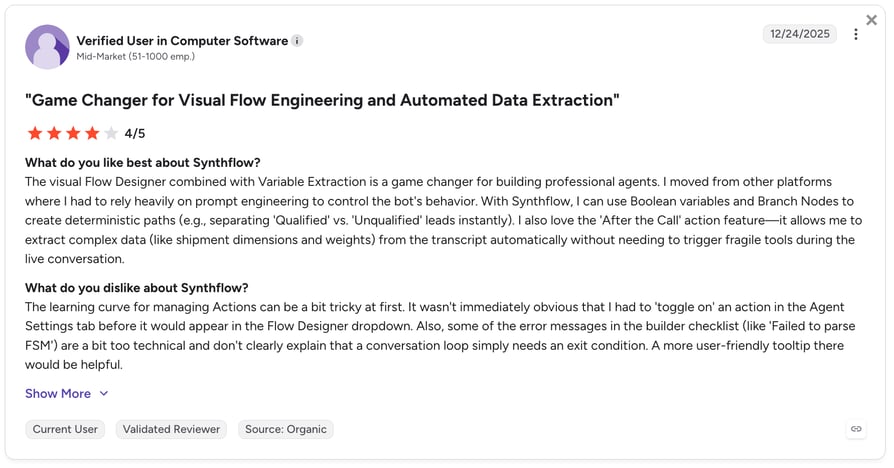
Synthflow customers consistently highlight fast deployment but also point to two key limitations: a learning curve when moving beyond simple setups and a ceiling on advanced customization.
Synthflow AI G2 Rating
Synthflow’s current G2 rating is 4.5/5 out of 1,015+ reviews.
When Should You Use Synthflow AI (and When Shouldn’t You)?
Use Synthflow when you have enterprise budget, a compliance review to satisfy, and you’d rather buy a managed deployment than staff one.
Don’t use Synthflow if you want to test before committing.
6. Sierra: Best For Large Consumer Brands Wanting Outcome-Priced AI
What Is Gorgias?
Sierra, co-founded by Bret Taylor and Clay Bavor, is an AI agent platform for customer experience that chats, answers phone calls, speaks multiple languages and takes action inside a company’s systems of record.
What Are Sierra’s Key Features for E-Commerce?
- Product recommendations & pre‑purchase guidance. Personalized, conversational recommendations that adapt to context and customer intent to increase conversion, average order value, and reduce cart abandonment.
- Order management self‑service. Customers can instantly track orders, submit warranty claims, request refunds or exchanges, and get proactive updates on shipping/returns—reducing ticket volume and resolution time.
- Account & subscription management. Update contact/billing info, manage subscription preferences, pause/cancel, and handle upsell/retention offers in‑conversation, lowering friction and churn.
What Are Sierra’s Pros and Cons?
| Pros | Cons |
|---|---|
| Accurate, natural conversations and a responsive implementation team | Not a complete telephony system |
| Outcome-based pricing aligns cost to results rather than usage | No published pricing at all, so buyers can't self-qualify budget fit without a sales conversation |
What Is the Pricing of Sierra?
Sierra's pricing is quote-based and outcome-based; the company doesn't publish a per-outcome rate.
What Do Customers Say About Sierra?
Customers praise Sierra for its natural conversations, ease of use, and seamless integrations. Common criticisms include limited customization, pricing transparency, and the need for human intervention in more complex conversations.
Sierra G2 Rating
Sierra holds a 4.4/5 rating on G2 across 35+ reviews.
When Should You Use Sierra (and When Shouldn’t You)?
Use Sierra if you want to automate customer support across voice and digital channels with one AI agent that can handle complex customer requests and take action in your business systems.
Avoid Sierra if you only need an AI voice agent or prefer a self-serve platform with transparent pricing and a simple setup.
7. Genesys Cloud CX: Best for Enterprise Omnichannel Retail
What Is Genesys Cloud CX?
Genesys Cloud CX is an enterprise cloud contact-center platform covering omnichannel routing, IVR, workforce engagement and AI, with a published retail solution. It’s for retailers who already run a contact center and want AI inside it.
What Are Genesys Cloud CX’s Key Features for E-Commerce?
- Every channel a large retailer supports. Voice, routing, speech-enabled IVR, outbound and ACD, plus web messaging, WhatsApp, email and social.
- Workforce tooling. Workforce optimization, conversational intelligence and QA sit beside the routing, with Agent Copilot and journey management on CX 4.
- No-Code AI Studio & Guides: It lets business teams build, test, and deploy voice flows in plain language with defined safety guardrails.
What Are Genesys Cloud CX’s Pros and Cons?
| Pros | Cons |
|---|---|
| Routing, workforce management, QA, compliance and AI in one platform | Expensive per-seat option |
| No-code builder | Deep dashboard customization can be rigid |
What Is the Pricing of Genesys Cloud CX?
- CX 1: $75 per user/month, voice contact centers. CX 2: $115 per user/month, omnichannel plus QA and compliance.
- CX 3: $155 per user/month, omnichannel plus full workforce engagement.
- CX 4: $240 per user/month, adding Agent Copilot, journey management and 30 AI Experience tokens.
What Do Customers Say About Genesys Cloud CX?
Reviewers describe it as the platform that can do anything a large contact center needs, with routing flexibility the most cited strength. The consistent complaints are a steep learning curve for advanced features and limited reporting.
Genesys Cloud CX G2 Rating
4.4/5 (1,558+ reviews) on G2.
When Should You Use Genesys Cloud CX (and When Shouldn’t You)?
Use Genesys when you’re an enterprise retailer with an existing contact center, a workforce management requirement, and compliance a lightweight voice tool can’t satisfy.
Don’t use Genesys to recover carts. You’d pay contact-center seat prices for infrastructure your store doesn’t need, then build the e-commerce logic anyway.
8. Vapi: Best for Engineering Teams Who Want Control
What Is Vapi?
Vapi is a developer platform for building, testing, and deploying voice AI agents, with a modular LLM, speech-to-text, and text-to-speech stack. Bring your own API keys and model costs drop to zero, leaving Vapi’s hosting fee. It’s a foundation to build on, not a finished product.
What Are Vapi’s Key Features for E-Commerce?
- Total Creative Control: Program unique conversational logic, including how the AI handles interruptions and complex, multi-path sales objections.
- Sub-Second Latency: Build on a high-speed pipeline designed to avoid the robotic pauses that cause prospects to hang up.
- Custom Tech Stack Sync: Trigger any custom webhook or API hook mid-conversation to verify lead data from your proprietary database.
What Are Vapi’s Pros and Cons?
| Pros | Cons |
|---|---|
| Deep API-level control over the voice stack | Limited no-code tooling for non-technical teams |
| Works with multiple LLM providers | Real cost can run higher than advertised once telephony and LLM usage are added |
What Is the Pricing of Vapi?
- Build: usage-based at $0.05/minute for Vapi hosting, excluding model provider costs. 10 concurrent lines included, then $10 per line per month. No platform fee.
- Scale: volume-based, contact sales. Custom rates, priority model access, dedicated account team, enterprise uptime SLA, data residency.
- HIPAA add-on: $2,000/month. Zero Data Retention add-on: $1,000/month.
Our breakdown of Vapi AI pricing models what the model-provider costs add on top of hosting.
What Do Customers Say About Vapi AI?
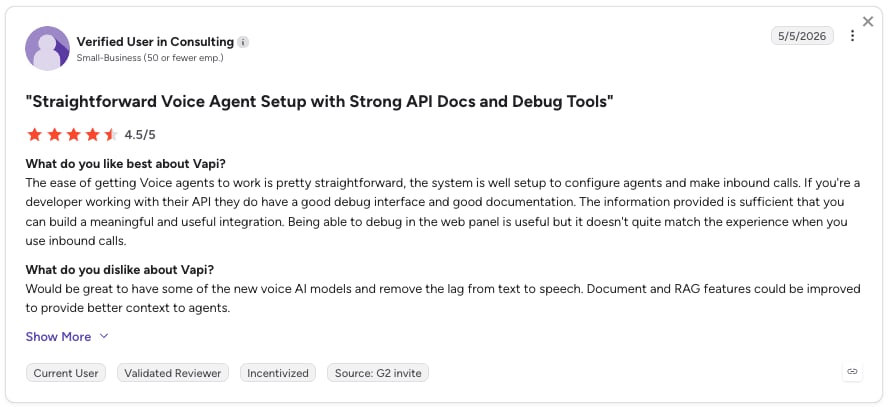
Vapi customers highlight ease of setup and flexibility for building voice AI agents, but report issues with latency, unreliable performance, additional costs, and inconsistent support.
Vapi AI G2 Rating
Vapi has limited G2 review volume just one review at 4.5/5, since it's a developer-focused
When Should You Use Vapi (and When Shouldn’t You)?
Use Vapi when you have engineers, an opinion about which speech and language models you want, and a workflow too specific for a templated platform.
Don’t use Vapi if nobody on your team writes code, or if you need a forecastable bill. Between pass-through model costs, per-line concurrency and paid compliance, the cheapest headline rate isn’t the cheapest platform.
9. Bland AI: Best for High-Volume Outbound
What Is Bland AI?
Bland AI lets developers build, deploy, and monitor voice agents through an API, with self-hosted models and sub-second latency. Because Bland hosts the models itself, the per-minute rate covers the LLM instead of passing third-party model costs to you. It increasingly targets regulated industries: healthcare, insurance, financial services, and logistics.
What Are Bland AI’s Key Features for E-Commerce?
- API-Native Customization: Gain total control over the agent's persona and tone, allowing your AI to sound like a natural extension of your brand.
- Massive Volume Handling: Specifically engineered to handle high-volume campaigns, making it a favorite for aggressive outbound sales outreach.
- Telephony-First Control: Provides advanced control over international routing protocols and caller ID integrity.
What Are Bland AI’s Pros and Cons?
| Pros | Cons |
|---|---|
| Powerful conversational capabilities | Not a full telephony platform |
| High concurrency for large outbound volumes | Steep learning curve for complex call flows |
What Is the Pricing of Bland AI?
- Start: $0.14/minute, $0 platform fee, no card required. 10 concurrent calls, 100 calls/day, 10 knowledge bases, $0.05 per transfer minute.
- Build: $0.12/minute plus $299/month. 50 concurrent calls, 2,000 calls/day, 50 knowledge bases, $0.04 per transfer minute.
- Scale: $0.11/minute plus $499/month. 100 concurrent calls, 5,000 calls/day, 100 knowledge bases, $0.03 per transfer minute.
- Enterprise: custom rate and custom scale.
Our guide to Bland AI pricing breaks the tiers down further.
What Do Customers Say About Bland AI?
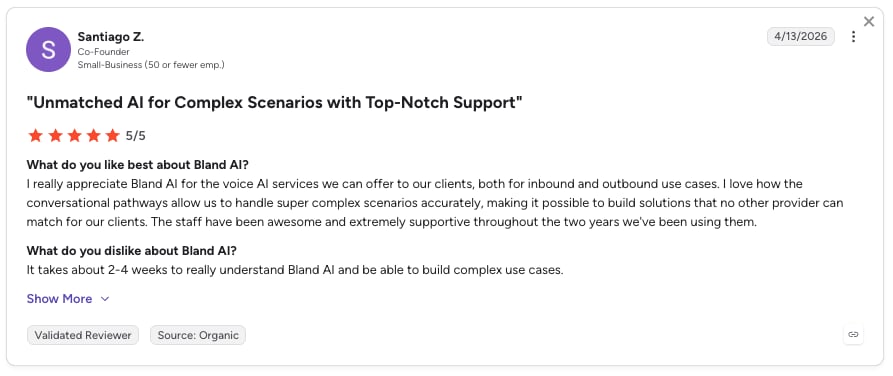
Bland AI customers highlight its ease of use and powerful conversational voice capabilities, but note a learning curve and complexity when moving beyond basic use cases.
Bland AI G2 Rating
Bland AI's current G2 rating is 5/5, based on 11+ verified user reviews
When Should You Use Bland AI (and When Shouldn’t You)?
Use Bland when outbound volume is the use case and you need cost per call modelled before committing. The all-in rate makes recovery economics calculable.
Don’t use Bland if your campaigns burst hard, since the daily and hourly ceilings bite during a sale, or if you want a storefront integration out of the box.
10. PolyAI: Best for Complex Inbound Voice at Enterprise Scale
What Is PolyAI?
PolyAI is a conversational AI platform built for enterprise customer service, designing lifelike voice assistants meant to understand callers naturally across multiple languages.
What Are PolyAI’s Key Features for E-Commerce?
- Multilingual support and customizable AI personas. Adapt conversations to different markets, languages, and customer needs while keeping your brand voice consistent.
- Real-time reporting and analytics. Track conversations, customer questions, conversion opportunities, and agent performance to optimize the shopping experience.
- Dialogue management and IVR integration. Guide shoppers through product questions, order status, returns, and other common requests with smooth, automated conversations.
What Are PolyAI’s Pros and Cons?
| Pros | Cons |
|---|---|
| Voice output among the best in the industry | Pricing is fully quote-based, with no published starting rate |
| Simple, user-friendly interface | Doesn’t run its own VoIP infrastructure |
What Is the Pricing of PolyAI?
PolyAI pricing is custom-based only, determined by business needs and interaction volume.
What Do Customers Say About PolyAI?
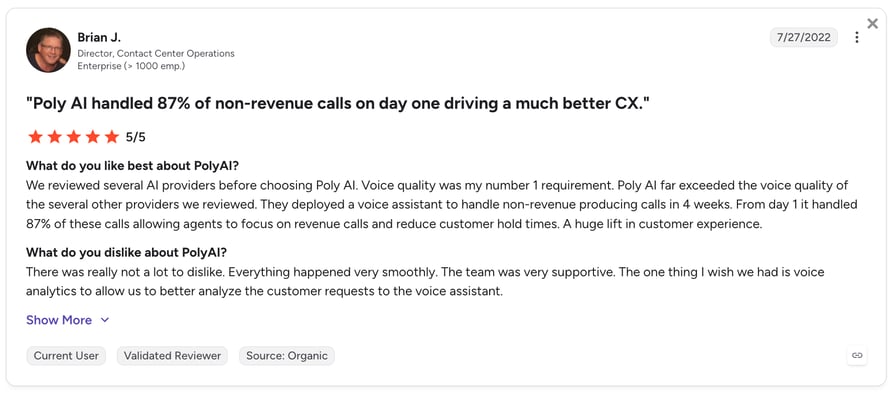
PolyAI customers praise its human-like voice and enterprise reliability, but cite limited analytics, custom pricing, and third-party telephony as common limitations.
PolyAI G2 Rating?
Synthflow’s current G2 rating is 5/5 out of 12+ reviews.
When Should You Use PolyAI (and When Shouldn’t You)?
Use PolyAI when inbound complexity is the problem and a percentage point of containment is worth a six-figure contract.
Don’t use PolyAI if you need outbound. Nothing in its published material addresses cart recovery, COD verification or win-back.
Ten entries in, if the shortlist keeps coming back to “calls plus a team to escalate to,” see how CloudTalk’s AI Voice Agent for e-commerce handles order status and returns out of the box.
How Do You Choose the Right AI Voice Agent for Your Store?
Six questions take you from ten options to one. The first eliminates the most.
Which E-Commerce Job Are You Buying For?
Outbound and inbound are different products wearing the same label. Cart recovery, COD verification and win-back are outbound. WISMO, returns and order changes are inbound. Most platforms here are strong at one and weak at the other.
Need both, and the shortlist narrows fast, because the escalated call needs somewhere to land. Separating inbound vs. outbound calls before you shop is the single cheapest way to cut the list. It’s also the argument for running the AI on the same phone system as your reps.
How Deep Does the Shopify Integration Go?
The most decision-relevant technical question in the category, and almost nobody asks it. There’s a difference between an agent that can answer a question about an order and one that can change the order.
Read-only means the agent says your parcel is in transit. Write access means it reschedules the delivery, issues the refund, updates the address. When you evaluate an AI voice agent for Shopify, ask for a demo of an action, not a lookup, and check the Shopify integrations your stack already depends on.
Can It Build the Trigger Logic Your Campaign Needs?
A cart-recovery campaign is a set of conditions before it’s a conversation. Call only carts over a value threshold. Wait 20 minutes, not 20 seconds. Skip anyone who already got an SMS, and skip repeat customers who abandon habitually and buy anyway.
You won’t find this pre-built in any of the ten. They differ on how you assemble it: call center workflow automation in CloudTalk’s case, Retell’s Batch Call, Bland’s Conversational Pathways, Vapi’s API. Ask to see the branching, not the demo call.
What Happens After the Call?
A recovered cart needs a link, and you can’t read a URL down the phone. Check whether the follow-up SMS shares a record with the call, or whether you’re stitching two systems together in a spreadsheet later.
What Does One Recovered Cart Cost?
Per-minute pricing hides this, so do the arithmetic before you sign. Take a three-minute average call, a 30% connect rate and a 15% recovery rate on connected calls. At $0.14 per minute that’s $0.42 per attempt, roughly $9.33 per recovered order once you count the calls that don’t connect or convert.
Then add what the headline rate excludes: Vapi’s model-provider costs, Bland’s $299 or $499 monthly platform fee, Retell’s $0.07-to-$0.31 spread. Our AI voice agent pricing guide shows how the units compare. Run that against your average order value and margin, and one or two platforms disqualify themselves.
Are Your Outbound Calls Legal Where You’re Calling?
Outbound AI calling to shoppers is regulated, and none of these vendors will do your compliance for you. Consent capture at checkout, do-not-call lists, calling-hours restrictions, AI disclosure and recording consent are all your obligations, and a TCPA-compliant dialer only covers part of them.
There’s a commercial reason to be careful beyond the legal one. Pew Research Center’s September 2025 survey of 5,023 US adults found half of Americans say AI’s growing role in daily life makes them more concerned than excited, against 10% who are more excited than concerned. Disclose the agent, keep a human one step away, and don’t pass it off as a person.
What Key Features Should an E-Commerce AI Voice Agent Have?
- Trigger logic that fires off store events, with value thresholds and timing windows you control
- Storefront integration that can act on an order, not only read it
- Omnichannel follow-up where voice, SMS and WhatsApp share one contact record
- Human transfer that carries context, so the shopper doesn’t repeat themselves
- Multilingual coverage matched to your actual markets, not a headline number
- Revenue attribution tying a recovered order back to the call that recovered it
E-Commerce AI Voice Agent Use Cases: What Do They Actually Solve?
The right buy depends on whether the goal is outbound revenue, inbound support, or both. Either way the job is the same one the whole channel rests on: making the benefits of e-commerce survive contact with a real order. These are the six jobs AI voice agents for e-commerce get hired to do.
AI Voice Agent for Abandoned Cart Recovery
The call runs in four steps:
- Abandonment fires the trigger. The shopper drops out at checkout and your store emits the event.
- The agent calls within minutes. It asks what stopped them instead of pitching.
- It answers the objection. Shipping cost, delivery date, or a payment method that failed.
- It texts the checkout link while the shopper is still holding the phone.
Baymard’s reason data is the script. Extra costs at 40% and slow delivery at 20% are the objections your agent needs a good answer to. Baymard also estimates that across combined US and EU e-commerce sales of $738 billion, better checkout flow and design alone could recover $260 billion in lost orders. A design argument, not an outreach one, and a reminder that a recovery call doesn’t excuse a bad checkout.
Check four things before you build: cart-value triggers, timing windows, how objection responses are authored, and how recovered revenue gets attributed. Our breakdown of how AI voice agents improve ecommerce CX walks through the same mechanics on the support side.
WISMO and Order Tracking
“Where is my order” is usually the highest-volume inbound query an online store gets, and the cleanest automation win here. An AI agent for order tracking and support pulls live order data from Shopify or your OMS and answers without a human touching it.
The limit is what the integration allows. Lookups are cheap; changes are not. Most vendors never publish whether their agent can push an update back into the store, so make them show you. Set the escalation rule: if the agent can’t resolve it in one step, transfer with the context attached. It’s the cheapest of the ways to improve e-commerce support because the volume is so concentrated.
Returns, Refunds and Post-Purchase Resolution
The National Retail Federation’s 2025 Retail Returns Landscape report, produced with Happy Returns, found retailers expect 15.8% of annual sales, some $849.9 billion, to come back as returns. That volume lands on the phone.
An AI voice agent for returns and refunds can initiate a return, confirm a refund and update the order record, if the platform supports two-way integration. Be precise about which you’re buying: some tools only answer questions, others take the action in the backend. Returns handled badly are one of the fastest ways to lose a repeat buyer, which is most of why customer service in e-commerce decides lifetime value.
COD Verification and COD-to-Prepaid Conversion
For direct-to-consumer (D2C) brands in South Asia, MENA and Southeast Asia, cash on delivery is normal and return-to-origin on unverified COD orders is the biggest margin leak. The agent calls before shipment, confirms the order is real, and tries to convert the customer to prepaid.
Not one of the ten sells COD verification as a packaged campaign. Each requires building it from a batch-calling primitive plus your order data, which is why a general-purpose retail AI voice agent needs scoping before it earns its keep here. If COD is the bulk of your problem, look at a conversational-commerce vendor that sells the campaign rather than the engine.
Post-Purchase Upsell and Review Collection
After delivery lands, the same outbound machinery does different work: cross-sell a refill, capture a satisfaction score, ask for a review. Tone matters more here than in recovery, because the customer isn’t in a problem state and a hard pitch reads badly.
Timing is the variable to test. Call too early and the customer hasn’t opened the box. Call too late and the purchase is emotionally over. Compare the response rate against whatever customer feedback tools you already send by email before you move budget.
Win-Back, VIP Outreach and Retention
An ecommerce AI voice agent also runs customer retention campaigns against CRM segments: lapsed customers, high-LTV buyers who’ve gone quiet, a flash sale for one cohort. Check whether the agent can consume a dynamic CRM segment or only a static CSV.
Before you shortlist on price, run your own volumes through the AI voice agent ROI calculator. Cost per recovered order, not cost per minute, is what decides this.
Quick Answers About AI Voice Agents for E-Commerce
What Is an AI Voice Agent for E-Commerce?
An AI voice agent for e-commerce is software that holds a real phone conversation with a shopper. It pulls live order data, answers or acts on it, and hands off to a human when it can’t finish. Unlike a chatbot, it works over the phone.
Can an AI Voice Agent Really Recover Abandoned Carts?
Yes. The agent calls the shopper, asks why they stopped, answers the objection and texts a checkout link. Recovery then depends on your triggers, timing and offer, not the voice technology.
How Does an AI Voice Agent Handle WISMO Queries?
An AI voice agent authenticates the caller, queries live order data through your storefront or order management system (OMS) integration, and reads back the status and delivery window. Changing an order rather than reporting it needs write access, so most agents escalate.
How Does an AI Voice Agent Verify COD Orders?
Before shipment, the agent calls the customer, confirms the order details and delivery address, and asks them to confirm intent to pay. Many brands add a prepaid offer with a small discount on the same call. No platform here ships it as a template.
How Is an AI Voice Agent Different From an IVR?
An IVR gives the caller a fixed menu and routes them by keypress. An AI voice agent understands free-form speech, asks follow-ups, looks up data mid-call and completes the task. An IVR sends the caller somewhere; an agent resolves the call.
Do AI Voice Agents Work in Multiple Languages?
Coverage varies, and vendors count differently. CloudTalk publishes 60+ languages and accents, Cognigy.AI 100+, Bland AI 40+ natively. Several publish none, so test accents in your markets before committing to multilingual customer support.
Which AI Voice Agent Should You Pick?
These ten answer four different questions, and most buyers only have one of them.
Best AI Voice Agent for Shopify D2C Brands
If support volume is mostly email and chat and you want AI inside a helpdesk with real order-level access, Gorgias. If the phone has to work too, CloudTalk gives you Shopify order context on calls plus a phone system your reps can use.
Best AI Voice Agent for Cart Recovery Only
Retell AI if you want to be calling within days without a contract. Bland AI if volume is high enough that per-minute predictability decides the business case. Either way, budget engineering time for the trigger logic.
Best AI Voice Agent for Enterprise Retail and Contact Centers
Genesys Cloud CX when you need AI inside existing routing and workforce management. Cognigy.AI when the requirement is governed multilingual agents across many brands. PolyAI when inbound complexity and voice quality justify the contract.
Best AI Voice Agent for Developer-Led Teams
Vapi, if you want to own the speech and model stack and have engineers to run it. Synthflow AI sits at the other end of the same axis: you buy the deployment rather than build it, from $30,000 a year.
Best Starting Point for Most Online Stores
CloudTalk is the best starting point for most ecommerce teams. Its AI Voice Agent handles routine customer conversations like order status, returns, and refunds, while human agents take over when needed. Start with one high-impact workflow and expand automation as your needs grow.

Put Your Shortlist to the Test

FAQ: AI Voice Agents for E-Commerce
Common questions about using AI voice agents for online stores, cart recovery, and support.
Because the highest-volume contacts (order status, returns, cart objections) repeat endlessly and spike outside staffed hours. Automating them cuts cost per contact, which is why AI adoption in retail keeps climbing.
CloudTalk for phone support, and Genesys Cloud CX or Cognigy.AI for enterprise retail call centers. Match the tool to the channel your customers use.
High-volume, data-lookup tickets: order status, shipping ETAs, return initiation, refund status and policy questions. Anything needing judgment, an exception, or a genuine apology still belongs with a human.
Most do, but depth varies. Gorgias covers Shopify, BigCommerce, WooCommerce and Magento; CloudTalk and Retell AI cover Shopify plus Magento. Ask whether the agent can act on an order or only read it.
Only with write access through a two-way integration. Plenty of platforms answer questions about an order but cannot change it. Ask a vendor to complete the action live in your store during the demo.
Yes. A voice agent can answer a shipping-cost or delivery-date objection mid-call, then use a call transfer when it can’t resolve. What varies is whether that transfer carries the context or makes the shopper start again.
Purpose-built D2C platforms ship cart-recovery and COD campaigns ready to switch on. CloudTalk doesn’t; you assemble recovery from workflow triggers. What you get instead is the agent, the dialer and your reps on one phone system.