TL;DR: How Much an AI Answering Service Costs in 2026
| Question | Quick Answer |
|---|---|
| What does an AI answering service cost? | Most small businesses pay $50 to $200 a month for the AI plan itself. Plans run from $29 to about $400. |
| Which pricing model is cheapest? | Depends on your calls. Per-minute suits low or seasonal volume, flat plans suit steady traffic, per-call suits long conversations. |
| What moves the bill most? | Call volume, average call length, the tier your must-have feature sits on, and the overage rate. |
| What fees hide off the pricing page? | Overage rates, rounding, billable spam calls, notice periods, and feature unlocks. |
| AI vs. live answering: how big is the gap? | $0.15 to $0.50 per AI minute against $1.43 to $5.00 for a person. Hybrid plans run $165 to $2,100 a month. |
| Is an AI answering service worth it? | Yes, when one month of recovered calls is worth more than one month of the plan. |
| Is there a free AI answering service? | Not one that could run a real phone line. Trials and free minute allowances exist, and they're handy for measuring your volume. |
| How do I price my own volume? | Pull 30 days of call logs, name three must-have features, and run your minutes through each model. |
| What does CloudTalk charge? | AI Receptionist from $99/month for 200 minutes, on top of a phone plan from $25/user/month. Overage is a published $0.50 a minute. |
See What an AI Answering Service Costs at Your Volume
Hiring a human receptionist isn't cheap. According to the U.S. Bureau of Labor Statistics, the median full-time receptionist in the United States earns $38,010 a year¹, and once you add benefits, which the Bureau's March 2026 Employer Costs report puts at 30.1% of total pay², you're close to $54,000 for one person covering the desk during business hours. That's the salary most people hold an AI answering service up against, and it's the wrong comparison.
You're not actually hiring a receptionist. You're just trying to stop losing the calls that ring at 7pm on a Tuesday, when the caller is already dialing the next number on their list.
An AI answering service, or, in other words, an AI virtual receptionist, picks those calls up on the first ring for a fraction of what an hour of human coverage costs. The catch is that the plan price is one layer of your monthly bill. That's why we're bringing you every layer, the fees no pricing page lists, and how to work out your own number before you talk to sales. Read on and get every answer you need.
How Much Does an AI Answering Service Cost? The Quick Answer
Most small businesses pay between $50 and $200 a month for an AI phone answering service, meaning software that answers your inbound calls with a conversational voice agent instead of a person. Most providers sell it as a monthly plan: a set number of answered minutes, the features that come with them (routing, messages, booking), and a per-minute rate if you use more than the plan includes. A few skip the plan and bill you for every minute the agent talks.
Those plans start at $29 a month for a small bundle of minutes and top out around $400 at high volume, which works out at $0.15 to $0.50 per minute of answered call time. What the plan sits on is what differs.
With standalone tools like Rosie AI or Dialzara, the plan is your whole bill. With phone systems like CloudTalk or Aircall, the AI plan is an add-on to your phone plan, so you pay for both. A few phone systems fold a basic AI receptionist into the phone plan itself. The table shows the same math for human and hybrid services too.
AI Answering Service Pricing at a Glance
| Service Type | Monthly Subscription | What a Minute or Call Costs | Best For |
|---|---|---|---|
| AI answering service, minute bundle | $29 to $349 for 60 to 1,000 AI minutes | $0.15 to $0.50 per minute | Low or seasonal call volume |
| AI answering service, flat plan | $79 to $599 for a set monthly cap | No meter inside the cap | Steady traffic and a fixed budget |
| Hybrid, AI plus human receptionists | $165 to $2,100 for a monthly call allowance | $7.00 to $11.50 per call | Calls that need a person some of the time |
| Live answering service, humans only | $49 to $4,299 for 0 to 3,000 receptionist minutes | $1.43 to $5.00 per minute | Complex, sensitive or high-value calls |
| Volume or custom AI contracts | Quote-based | Published rates as low as $0.15 per minute | 10,000+ AI minutes a month |
Phone answering service pricing splits along one line: whether a person or an AI picks up. Live services sell a human's time. The cheapest live plan we found is $49 a month with no minutes included, then $2.99 for every minute a receptionist spends on your calls. Small-business plans run $250 to $760, and the top tier reaches $4,299 for 3,000 minutes. Hybrid services, which send routine calls to an AI and the rest to a human, charge $165 to $2,100.
So the gap is the cost of a minute: $0.15 to $0.50 when software answers, $1.43 to $5.00 when a person does. Picking a side of that gap is the easy part. How the provider bills those minutes is where the money moves.
AI Answering Service Pricing Models Explained
Automated answering service cost varies more by model than by vendor. The first number on a pricing page isn't what you'll pay. The structure underneath it decides your bill. It's the same split you see in call center pricing models generally, and the five structures below cover every AI answering plan we've seen.
Per-Minute Pricing
Per-minute pricing means you buy a block of minutes each month and pay an overage rate for anything beyond it. Published bundles run from $29 for 60 minutes up to $349 for 1,000. The bigger the bundle, the lower the effective rate: entry tiers land at $0.48 a minute, the largest at $0.35, and volume contracts above 10,000 minutes drop to $0.15.
The model works when you can measure your volume and it doesn't swing much. It hurts when call length is unpredictable, because a handful of long calls eats a month's allowance. Ask which parts of a call are billable, since hold time and transfer time often count toward the meter. And ask what happens past the bundle. Some providers don't bill overage at all. They move you to the next plan automatically and keep you there for the following billing periods, which is a price rise you never agreed to.
Then there's the question almost nobody asks until month two: what happens to the minutes you don't use? Most AI plans reset on the first and forfeit the rest. That's why buyers who can't predict their volume buy a tier too small and blow straight through it. Not one of the seven provider pricing pages we checked publishes a rollover policy, so assume unused minutes expire and size your tier on real data, not hope.
Worked Example: 80 Calls a Month
Say you take 80 calls a month at three minutes each. That's 240 minutes. Let's see how that translates into the final invoice through a few examples:
Dialzara's Pro plan costs $99 and includes 220 minutes, with a published overage rate of $0.45 a minute. Your bill is $99 plus 20 overage minutes, so $108.
Rosie AI's Professional plan costs $49 and includes 250 minutes. On paper it wins by $59. But Rosie publishes no overage rate. Its terms move you to the next plan automatically the month you go over, $149 for 1,000 minutes, and keep you there for at least two more billing periods. $49 until the month it becomes $149.
The cheaper plan is cheaper until the month it isn't, and nothing on the pricing page tells you when that month arrives. The silences on a pricing page cost more than the numbers on it.
Per-Call Pricing
Per-call pricing charges a fixed amount for every call the service answers, however long it runs. On AI-only services it's cheap: Upfirst charges $0.67 to $1.50 a call. Answering service cost per call climbs once a human is involved, as on Smith.ai's hybrid plans, where it runs $7.00 to $11.50. In both cases the low figure is the plan price divided by the calls it includes, and the high one is the overage on every extra call.
The math flips compared with per-minute. Long calls become a bargain, since a 12-minute conversation costs the same as a 90-second one. A high volume of short calls gets punishing fast. Judge call answering service prices against your average handle time, not your call count.
Flat Monthly and Unlimited Plans
A flat monthly plan covers everything for one fee, with published plans between $79 and $599 a month. "Unlimited" almost always has a boundary, usually a fair-use cap or a caller limit, and it pays to find it before you sign. It's the same fine print you meet in inbound call center pricing. The risk runs opposite to per-minute: you pay for the ceiling even in a quiet month. Divide the flat fee by the minutes you used and you get the real number to compare against a metered plan.
Per-Unique-Caller Pricing
Per-unique-caller pricing is the least common model on this list. It bills by how many different people call you rather than by minutes. Goodcall is the main example: $66 to $208 a month on annual billing for 100 to 500 unique callers, unlimited talk time inside the cap, and $0.50 per caller beyond it. It kills call-length risk. It gets expensive the moment a campaign sends you a wave of first-time callers, which is exactly when an AI voice agent built for call spikes earns its keep.
Base Fee Plus Usage
Base fee plus usage splits your bill into two lines: a platform fee that doesn't move and metered usage that does. Most AI receptionists that sit on top of a business phone system are priced this way, so the AI line lands on top of what the phone system itself costs. Live services at the bottom end work the same way. It's the fairest structure for uneven volume and the easiest to underestimate, because you have to add the layers up yourself.
AI Answering Service Pricing Models Compared
| Pricing Model | Best For | Main Risk | Typical Range |
|---|---|---|---|
| Per-minute bundle | Volume you can measure | Overage at a rate you never checked | $29 to $349/month, $0.15 to $0.50/min |
| Per-call | Long calls, low count | A flood of short calls | $0.67 to $1.50 per AI call, $7.00 to $11.50 once humans are involved |
| Flat or unlimited | Steady, predictable traffic | Paying the ceiling in a quiet month | $79 to $599/month |
| Per unique caller | Repeat callers, long conversations | A marketing spike full of new numbers | $66 to $208/month on annual billing, $0.50 per extra caller |
| Base fee plus usage | Layering AI onto a phone system you already pay for | Two line items that both move | Per-seat fee plus $0.15 to $0.50/min |
How Do AI Answering Service Prices Compare Across Providers?
AI answering service prices look close on the headline and drift apart the moment you check what the entry price includes and what happens past it. Here's CloudTalk next to four providers we've priced in detail: Aircall, a phone system with AI plugged in, like ours. Synthflow and Retell AI, two voice AI platforms you build the agent on. And Smith.ai, which mixes AI with human receptionists. All figures come from their published pricing and help pages.
AI Answering Service Pricing: CloudTalk vs. Aircall, Synthflow, Retell AI and Smith.ai
| What You're Comparing | CloudTalk | Aircall | Synthflow | Retell AI | Smith.ai |
|---|---|---|---|---|---|
| Entry price | AI Receptionist from $99/month (200 min), on a phone plan from $25/user/month | AI Voice Agent from $175/month (500 min), on a phone plan from $30/license/month with a 3-license minimum | Enterprise contracts from $30,000 a year | No plan. You pay per minute from the first call | AI: free for 25 calls, then $150/month. Human: $300/month (30 calls) |
| Effective entry rate | About $0.50 a minute | About $0.35 a minute on the bundle, $0.49 pay as you go | Not published | About $0.09 to $0.27 a minute, depending on the voice and AI model you pick | $2.00 per AI call, $10.00 per human call |
| What a busy month costs | $0.50 a minute overage, published, dropping to $0.35 on the 2,500-minute tier | $0.49 a minute past the bundle, $0.39 above 2,550 minutes. Unused bundle minutes expire each month | Scoped into the contract. No overage rate published | Same per-minute rates at any volume, plus $2/month per phone number | $3.00 per AI call over the free 25. $8.50 to $11.50 per extra human call |
| Free to try | 50 free AI minutes in your first month, plus a 14-day phone-system trial | 100 free AI minutes at sign-up, then 50 a month. Phone-plan trial length not published | No trial published. Demo with sales | $10 in free credits | Free AI plan up to 25 calls a month |
| Books appointments on the call | Yes. The AI Receptionist books straight into your calendar. The AI Specialist adds multi-step booking and rescheduling | Yes, through Calendly | Yes, with calendar integrations | Yes, once you connect the calendar yourself | Yes, on AI plans |
| Languages | 70+ | 23 | Not published | Multiple, count not published | Bilingual answering |
| Contract | Month to month on the AI Receptionist | Annual billing for the quoted plan prices | Annual, enterprise only | None. Usage billing with no minimum | Month to month, 30-day money-back on human plans |
Compare row by row, not just the price line. Retell AI has the cheapest minute on the table, but you build the agent, connect the calendar and manage a usage bill yourself. Synthflow won't quote under $30,000 a year. Aircall and CloudTalk plug the AI into the phone system that already logs your calls, and CloudTalk's AI Receptionist is the one you set up yourself in minutes, with a published overage that matches the plan rate and no seat minimum on the phone plan.
What Reddit Buyers Check Before They Compare Prices
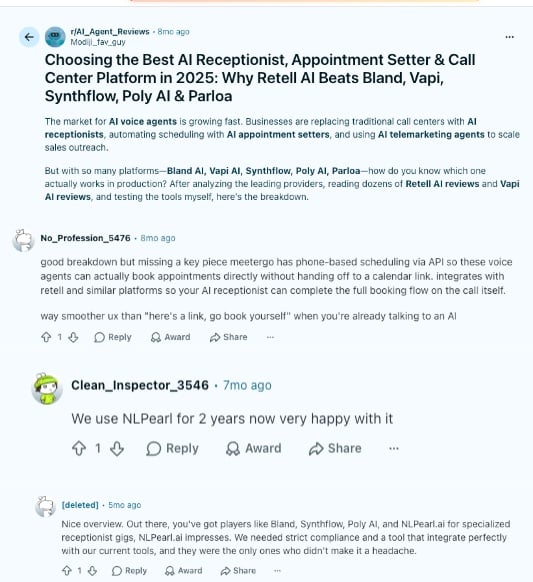
Before you rank the table by price, borrow one habit from the people shopping for the same thing on Reddit. In r/AI_Agent_Reviews, a thread comparing AI receptionists and appointment setters kept coming back to two tests: can the agent book the appointment on the call instead of texting a link, and does it fit your compliance and integration needs? Neither shows up on a pricing page, and both decide which column in that table you can actually buy. A plan that texts callers a booking link is a different product from one that books the slot on the call.
Same Rate Inside the Bundle and Past It
What Affects the Cost of an AI Answering Service?
The plan price is one layer of what an AI answering service costs. These are the others, roughly in order of how much damage each one does to a budget. Most of them trace back to the calls you're missing today, which is what you're paying to catch.
How Do Call Volume and Call Length Change Your Bill?
Volume is the obvious driver, and answering a high call volume is where a metered plan does its worst damage. Average call length is the one that catches people out. Eighty calls at one minute each is 80 minutes. Eighty calls at five minutes each is 400. At $0.45 a minute, that's a $36 line item against a $180 one, from the same number of callers. Before you compare business answering service cost across providers, you need both numbers. And ask one more: can the agent end an off-topic call or cap call length? A call stuck open for 30 minutes at 2am is the quietest way to burn a bundle.
Which Features Sit Behind a Tier Gate?
Feature pricing rarely works the way pricing pages imply. Providers don't often sell appointment booking as a $30 bolt-on. They put it on a higher tier and let you find out on your own. Rosie AI, for one, puts calendar booking on its $149 plan and not on its $49 one, which texts callers a booking link instead. So the day you need booking, the cheap plan costs $100 more a month than you budgeted.
The features most often gated behind an upgrade:
- Appointment booking and calendar sync
- CRM and helpdesk write-back
- Call summaries and transcripts
- Additional languages
- Analytics beyond a basic call log
A gated feature is only expensive if it doesn't earn back the upgrade. Circle Gym, a fitness operator, got 150% more trial bookings after putting an AI voice agent for appointment scheduling on its inbound calls.
"Now the AI just says: What time works for you? It is so simple, but it works. People reply, the AI locks it in, and we are done."
Owner of Circle Gym

Does Overnight Coverage Cost More?
Telephone answering service costs don't climb at night, whatever you've read elsewhere. We couldn't verify a single after-hours surcharge. The live providers publish no time-of-day premium, and one states plainly that evenings, weekends and holidays cost nothing extra.
If 2am costs you more, it's the underlying rate, not a night premium. A human minute costs $1.43 to $5.00 whenever it happens. An AI minute costs $0.15 to $0.50 at 2am and the same at 2pm, which is why an AI agent handling your business calls is the cheapest way to cover the other sixteen hours. On the AI side, check that 24/7 customer service means an agent that answers, not a business-hours setup with voicemail bolted onto the other sixteen hours.
When Does the Meter Start?
If you're adding an AI layer to a phone system you already pay for, find out what triggers a charge. Does the meter run when the AI answers, or on every call that reaches the number? If the AI hands over to a person after 20 seconds, are you billed for the AI minute, the human minute, or both? None of the seven pricing pages answers that, and the answer decides whether you pay once or twice for the same conversation. CloudTalk's answer: AI minutes run only while the AI is on the call. The moment it transfers to a person, a group or an outside number, the AI meter stops, and the human leg is a normal call on your plan. If the agent qualifies a caller for 45 seconds and hands over, 45 seconds is what you pay for.
Do Healthcare and Legal Calls Cost More?
Healthcare and legal work adds cost, though not as a line on an invoice. No provider we checked publishes a surcharge for a HIPAA compliant virtual receptionist, so treat any specific figure with suspicion. A signed Business Associate Agreement (BAA) usually lives in an enterprise or custom contract rather than on a self-serve plan. CloudTalk is an exception and signs one on request. Legal intake carries a quieter cost. Those calls run long and capture a lot of detail, so on a per-minute plan the same number of callers produces a much bigger bill.
Are There Setup Fees or Long Contracts?
Setup fees are close to extinct. None of the providers whose terms we could read charges for setup, onboarding or configuration, on either side of the market. Ask anyway, and ask in writing. Annual billing takes roughly 5% to 17% off the monthly rate on the plans we looked at, and that discount is the price of your flexibility. Weigh it the way you'd weigh any phone system contract: cheaper per month, harder to leave.
The question buyers forget is the one about what happens next. Can the rate change mid-contract, and how much notice do you get? A 12-month commitment at a price the provider can revise in month three isn't a 12-month price.
No 12-Month Lock-In on Your Front Desk
Hidden Fees to Watch for in AI Answering Service Contracts
The hidden fees in an AI answering service contract don't sit on the plan price. That's where most businesses start their evaluation. The questions below are where they often wish they'd started.
Overage rates: On AI plans that publish one, overage runs $0.35 to $0.50 a minute. On live services, extra minutes run $1.59 to $2.99. Several AI providers publish the rate on every tier, and the ones that don't tend to swap it for an automatic upgrade, so get your number in writing before you sign.
Rounding: A 40-second call billed as a full minute is a 50% markup on that call, and it compounds fast. Take 80 calls averaging one minute 20 seconds. That's 107 minutes of talk time. Rounded up to the whole minute, you're billed for 160, and your call log will never agree with your invoice. Not one of the seven providers publishes its billing increment, so ask whether billing runs per second, per six seconds, or per minute.
Billable spam and hang-ups: Unwanted calls are still a mass phenomenon. The Federal Trade Commission's Fiscal Year 2025 Do Not Call Registry Data Book counted about 258.5 million active registrations as of September 30, 20253, and people register because the calls keep coming. Robocalls that reach your line get answered by the AI and, on most plans, billed to you. Only two of the seven providers we checked commit in writing to not charging for spam, wrong numbers or callers who never speak.
Contract exit: A month-to-month plan with a 60-day notice requirement isn't month-to-month. Notice periods of 30 to 90 days turn up often enough to be worth checking.
Feature unlocks: The plan you priced and the plan you need are often not the same plan.
The Four Questions No Pricing Page Answers
We read five of the most-read articles on this topic and seven provider pricing pages, CloudTalk's included. Not one answers these four. Send them as an email and judge each provider by how fast a straight answer comes back.
- What happens to minutes I don't use? Do they roll over, and for how long? A good answer is a specific policy. A vague one tells you the answer is no.
- Can I set a hard spend cap? Not a lower overage rate. A ceiling, with an automatic stop when spend hits a number you choose. Anyone leaving an agent running unattended over a weekend wants a bounded bill more than a cheap one.
- How do you round a call? Per second, per six seconds, or up to the whole minute. The answer moves your bill by tens of percent, and it won't be on the pricing page.
- Can the rate rise mid-contract? If it can, with how much notice, and is there a cap on the increase?
CloudTalk answers two of the four in writing further down this page: overage on the AI Receptionist is a published $0.50 a minute, and the plan is month to month with no forced upgrade. Unused minutes don't roll over, which is exactly why the 50 free minutes exist, so you size your tier on your own numbers. On the spend question, the dashboard shows minutes used against your bundle and flags you as you get close, so nothing runs up quietly over a weekend. And the plan prices and AI bundles sit on CloudTalk's pricing page, so you can rule tiers in or out before anyone books a call.
Two Line Items, Both Published
AI Answering Service vs. Live Answering Service: Cost Comparison
An AI answering service is cheaper per minute than a live answering service. How much cheaper depends on which two plans you hold up next to each other. Telephone answering service prices from human providers run $1.43 to $5.00 a minute against $0.15 to $0.50 for the AI plans we checked. That's a spread of anywhere from 70% to 97%, which is too wide to be much use on its own.
The cleanest live answering service pricing comparison comes from a provider that sells both. On every tier of its published price list, the same bundle costs the same money and comes with double the minutes if you choose AI over a human agent. Same company, same price, twice the volume. That's 50% cheaper per minute, published by a business with no reason to flatter AI, and it's the conservative floor. The 90%-plus figures are the best case, not the norm.
AI vs. Live vs. Hybrid Answering Services
| Factor | AI Answering Service | Live Answering Service | Hybrid (AI Plus Human) |
|---|---|---|---|
| Typical monthly cost | $29 to $400 | $49 to $4,299 | $165 to $2,100 |
| Effective rate | $0.15 to $0.50 per minute | $1.43 to $5.00 per minute | $7.00 to $11.50 per call |
| Nights and weekends | Same rate around the clock | Same rate on every plan we priced | AI covers the hours humans don't |
| Simultaneous calls | Unlimited | One per available agent | Unlimited on the AI layer |
| Complex or sensitive calls | Good for routine questions, triage and booking | Best where judgment matters | AI takes routine, hands over the rest |
| Best for | Repetitive, high-volume inbound | Low-volume, high-value conversations | Humans by day, AI overnight |
A person's time is most of the cost of telephone answering service work. That's the line AI removes, and the reason you don't have to pick one. Plenty of buyers keep people on the phone during business hours and let an AI virtual receptionist take nights and overflow. It's the cheapest way to stay reachable overnight.
Oxford Royale Academy ran the numbers the other way round. Instead of hiring four seasonal callers every admissions season, the education provider put one multilingual AI voice agent on its lead calls and kept the human cost line flat while the volume swung.
"Last year, we recruited four people to just call hot leads. This year, we haven't recruited any of those four. The voice agent is doing all that."
Head of Systems and Processes, Oxford Royale Academy

Keep Your People on Days. Let AI Take the Nights.
Is an AI Answering Service Worth the Cost?
An AI answering service is worth the cost when one month of recovered calls beats one month of the plan. The cost of answering service coverage is easy to price. What you're losing to calls nobody picks up is the harder number, and only your own call log knows it. A borrowed industry average won't tell you, because your business isn't the average.
Pull the numbers from Step 1 below, then run four lines:
- How many calls did you miss last month? Count unanswered calls and calls that arrived outside business hours. Say you took 100 calls and 40 fell into one of those buckets. That 40 is an example so the arithmetic is visible. Use your own figure.
- How many would have become customers? If one in five of your inbound calls converts, those 40 calls were worth eight customers.
- What's a customer worth? At an average job value of $250, that's $2,000 of revenue that rang and got voicemail.
- Compare it to the plan: A $99 plan needs to rescue one of those calls to pay for itself. It doesn't have to catch all 40 to be the right call.
This isn't a case for replacing anybody. Run the wage figures from the top of this guide through the Bureau's benefits ratio and a receptionist costs an employer closer to $54,000 a year, about $4,500 a month. That's a different conversation, and most buyers aren't having it. In practice, small teams buy an AI answering service as insurance on the hours nobody is at the desk. The alternative is a well-written after-hours voicemail greeting, and a voicemail greeting has never booked anybody an appointment.
Yanolja, a travel and hospitality group, is what line one looks like on a real call log. After moving its inbound calls to CloudTalk, missed calls fell by 30 to 40%. Their recovery rate isn't yours, so run the same line on your own log and you'll have the only number that settles this.
"CloudTalk gives us exactly what we need: clear analytics, smooth integrations, and visibility into every call."
Business Development Executive, Yanolja

The payback window is short by software standards. Salesforce's 2026 State of Service: AI Agents Edition, which surveyed 3,075 service professionals, found that 70% of organizations running AI service agents saw measurable value within 60 days4. The same Salesforce survey found 66% of customer service organizations now use agentic AI, up from 39% a year earlier.
Is There a Free AI Answering Service?
A free AI answering service doesn't exist in any form that could carry a real phone line. Not one of the providers we checked offers a free tier that outlives a trial. Any automated answering service for small business that comes close will cap you well below the volume of a working switchboard.
What exists instead is more useful anyway. Seven-day trials are standard among AI-first services. CloudTalk gives you two separate things: 50 free AI Receptionist minutes on every new account, and a 14-day free trial of the phone system around them.
The part worth stealing: use the allowance as a measuring instrument, not a freebie. Fifty minutes will hand you the two figures Step 1 of the calculation below asks for, your monthly call count and your average call length. Then you price your tier on real data instead of a guess. That's what those 50 free minutes are for.
Measure Your Volume Before You Buy a Tier
How to Calculate Your AI Answering Service Cost Before You Buy
Calculating your AI answering service cost takes your own call data, not a market average. Telephone answering service pricing only means something once you run your real minutes through it. Ten minutes and three steps, and you'll walk into any sales call with a number of your own. It's the same discipline behind cutting call center costs without cutting service.
Step 1: Get Your Real Call Volume
Open your phone system's call log and export the last full 30 days. Filter to inbound only, then count four things:
- Total inbound calls
- Average call duration in minutes
- Calls that arrived outside your business hours
- Calls that went unanswered or to voicemail
Most business phone systems put this in a standard call report. CloudTalk's call log and analytics export it directly. Multiply your call count by average duration and you have your monthly minutes. That one number decides your tier.
If you're only pointing the AI at nights and weekends, use the after-hours count, not the total. Buyers routinely price the whole switchboard when they're buying coverage for a third of it, then wonder why every quote looks expensive.
No call data at all? Track manually for a week and multiply by four. It's rough, but it beats guessing, and 50 free AI minutes on a real line will give you clean numbers before you commit to anything.
Step 2: Name Your Three Must-Have Features
Write down the three things the service can't do without, then find out which tier each one sits on. Common ones are appointment booking, CRM sync, call transcripts, HIPAA coverage and a second language. Checking that a provider has a feature isn't the same as checking it's on the plan you priced.
Step 3: Price Your Volume Under Each Model
Run your minutes through each structure to get the real cost of phone answering service coverage at your volume:
- Per-minute: minutes multiplied by the rate, plus overage on anything above the bundle.
- Per-call: call count multiplied by the per-call rate.
- Flat: divide the flat fee by your real minutes to see what you pay per minute, then compare.
At 240 minutes, a metered plan at $0.45 costs $108, while a $199 flat plan works out at $0.83 a minute. At 600 minutes the flat plan wins outright, $199 against $270. The crossover point is the thing to find, and it moves with your volume.
Do the exercise twice: once at your current volume, once at 150% of it. The second number tells you whether that unpublished overage rate is a detail or a deal-breaker.
Then price both numbers against a published rate card rather than a quote. CloudTalk's AI Receptionist and AI Specialist tiers list the minutes and the per-minute cost at every level, so the comparison takes ten minutes instead of an email thread.
Your Number's Ready. Now Hold It Against Ours.
CloudTalk's AI Answering Service Pricing
CloudTalk publishes its AI rates instead of quoting them, so you can run the Step 3 math right here. There are two products, and your average call length picks between them.
The AI Receptionist is the self-serve front desk for calls of 30 seconds to two minutes. It answers, routes callers by what they ask for, takes messages, books meetings and blocks spam. You set it up yourself in minutes, no code, from $99/month for 200 minutes, about $0.50 a minute. The AI Specialist is the sales-led agent for two-to-ten-minute calls that finish a task, like checking an order, taking a payment or handling a multi-step booking. It starts at $349/month for 1,000 minutes, about $0.35 a minute, and goes live in one to two weeks with CloudTalk's team.
Pricing tells you what a minute costs, not what it sounds like. These are real AI Receptionist and AI Specialist calls. Listen with your own call types in mind before you read the rate card.
Signature Capability
See CloudTalk’s AI Voice Agent in Action!
CeTe is an AI that talks like a human: no breaks, no training, no time off. It makes and answers calls, updates CRMs, books meetings, and loops in a human only when needed.
Press play to hear it. Want a wow moment? Get a free test call and try it live.

Both are add-ons to a CloudTalk phone plan, priced per account, not per seat. A one-seat setup with the AI Receptionist is $25 plus $99 a month, two line items, both published. Every new account gets 50 free AI Receptionist minutes in the first month, and the 14-day free trial covers the phone system around them. Because the agent runs inside the phone system you already pay for, AI and human calls share one invoice, one call log, and a handoff that carries the caller's context. Stacked up, the bill looks like this:
CloudTalk Plans and AI Answering Pricing
| Plan | Price (Annual Billing) | What You Get | Works Out At |
|---|---|---|---|
| Starter | $25/user/month | The phone system itself: unlimited inbound and internal calls, 500 outbound minutes, call queues, transfers, click-to-call, and call recording kept for a month | Per seat, no minimum |
| Essential | $29/user/month | Everything in Starter, plus IVR and smart routing, 100+ CRM and helpdesk integrations, workflow automation, and recordings kept for good | Per seat, no minimum |
| Expert | $49/user/month | Everything in Essential, plus Power, Smart and Preview Dialers, Salesforce integration, and 24/7 phone support | Per seat, 3-seat minimum |
| AI Receptionist (add-on) | From $99/month | 200 AI minutes. Answers, routes by intent, takes messages, books meetings, blocks spam. Self-serve, no code, month to month. Tiers up to $699/month for 2,500 minutes | About $0.50 a minute, $0.28 on the top tier |
| AI Specialist (add-on) | From $349/month | 1,000 AI minutes. Checks orders, handles returns, takes payments, runs multi-step workflows end to end. Sales-led, set up with CloudTalk's team. Tiers up to $1,249/month for 5,000 minutes | About $0.35 a minute, $0.25 on the top tier |
| Custom AI Voice Agents | Contact Sales | Volume bundles above 10,000 minutes with bespoke workflows | As low as $0.15 a minute |
| Conversation Intelligence (add-on) | $9/user/month | Transcripts, call summaries, call scoring and sentiment for every call, AI-answered ones included | Per seat, on any plan |
What a Busy Month Costs on CloudTalk
Past your bundle, the AI Receptionist keeps billing at the rate you paid inside it: $0.50 a minute on the $99 to $299 tiers, $0.35 on the $699 tier. No penalty rate, no forced upgrade. The AI Specialist runs $0.50, $0.35 and $0.30 across its three tiers. The meter only runs while the AI is talking. Once a call reaches your team, it's a normal call on your plan.
One bundle covers every number and agent on your account. The AI Receptionist is month to month. AI Specialist plans carry a three-month minimum (six on the 5,000-minute tier), with the build and tuning included in the price.
Above 2,000 AI minutes a month, the Conversation Intelligence add-on at $9/user/month is required, so every one of those calls comes with a transcript, summary and score. However, unlike some other voice AI platforms, this is a published line item, not a surprise on the invoice.
Conversation Intelligence earns its row in that table because it's what turns answered calls into usable data. Every call gets a transcript, a summary, a score and a sentiment read, whether a person or the AI picked up. For an AI answering setup, that's how you check what the agent actually said at 2am, and how a human picking up a handoff knows the story so far.
Neither agent follows a rigid IVR (interactive voice response) tree. Both hold a two-way conversation around the clock in 70+ languages and hand the caller to a person when the call needs one. Call results export to HubSpot, Pipedrive, Zoho CRM, Salesforce, Zendesk and Intercom, so whoever picks up the handoff sees what the caller already said. CRM connections start on the Essential plan, Salesforce on Expert. CloudTalk's security controls comply with HIPAA, and it signs a Business Associate Agreement (BAA) with healthcare customers on request.
Autenti, a legal-tech SaaS company, shows the meter working in your favor. Its voice agents now take a large share of inbound support calls before a person ever picks up, which is the part of the bill that never turns into headcount.
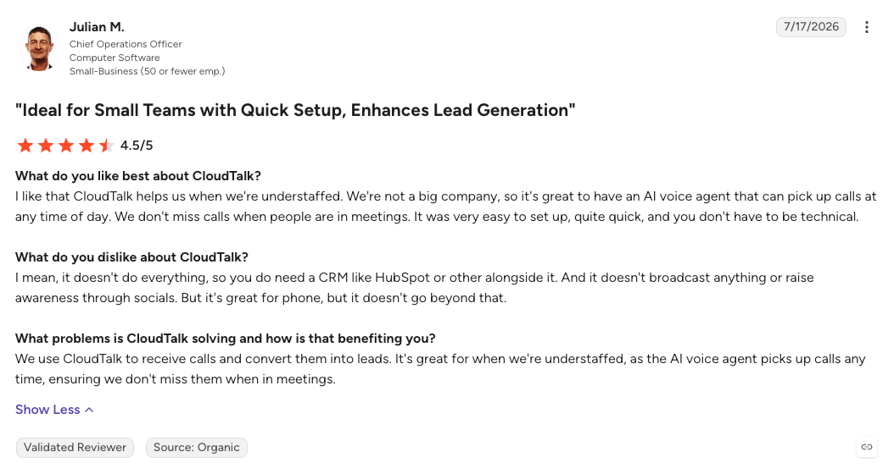
And the fact that this works is also backed up by reviews on CloudTalk's G2 profile, where the platform scores 4.4/5, out of 1,850+ verified user reviews. One of them, on the AI Voice Agent specifically, is below.
One Call Log for AI and Human Calls
The Bottom Line on AI Answering Service Costs
Budget $50 to $200 a month for an AI answering service if you're a small business with ordinary inbound volume, and treat the headline plan price as the number you'll argue about least. What you actually pay comes down to five things:
- Pricing model: per minute when you can measure your volume, flat when traffic is steady, per call when conversations run long.
- Overage: the published rate past your bundle, or the forced upgrade waiting for you if there isn't one.
- Rounding: per second, per six seconds or per whole minute moves the same calls by tens of percent.
- Feature tiers: booking, CRM sync and transcripts often sit one tier above the plan you priced.
- Contract: month to month means little with a 60-day notice period or a rate that can rise mid-term.
Run the three-step calculation before any demo, then send the four questions to every provider on your shortlist. The cheapest quote and the cheapest twelve months are rarely the same thing.
For small teams that mainly need calls answered, routed and booked around the clock, CloudTalk is the simplest case to check: an AI Receptionist from $99/month with a published $0.50 overage and no lock-in, running inside a phone system from $25/user/month that already logs every call, with 50 free AI minutes to measure your volume first. If your calls run long and need a task finished, price the AI Specialist instead. Either way, your own call log makes the decision, not a pricing page.
Join 5,500+ Businesses That Know What Their Calls Cost
Sources:
- U.S. Bureau of Labor Statistics, Occupational Employment and Wage Statistics
- U.S. Bureau of Labor Statistics, Employer Costs for Employee Compensation
- U.S. Federal Trade Commission, Do Not Call Registry Data Book
- Salesforce, State of Service: AI Agents Edition
Frequently Asked Questions about AI Answering Service Pricing
Find direct answers to the voice AI pricing questions buyers ask most.
An AI answering service costs most small businesses $50 to $200 a month. Published plans start near $29 for a 60-minute bundle and top out around $400, or $0.15 to $0.50 per answered minute. The same $99 buys very different bundles across phone answering services for small businesses, so compare minutes, not headline prices.
There is no permanently free AI answering service among the providers we checked. What you get instead is trials and small allowances. Seven-day trials are standard, and every new CloudTalk account comes with 50 free AI Receptionist minutes in the first month, separate from the 14-day phone-system trial. That won't run a phone line, but it's enough to measure what your calls cost.
An AI receptionist is worth it when the calls you currently miss are worth more than the plan. Run your own log: missed and after-hours calls, your close rate, your average job value. A $99 plan only has to rescue one decent call a month, which is why putting an AI voice agent on your inbound line often pays back faster than a hire.
The average cost of an answering service depends entirely on who answers. AI plans run $29 to about $400 a month, hybrid services $165 to $2,100, and human services $49 to $4,299. Human coverage sits closer to outsourced call center pricing than to software, because you're buying somebody's time.
Per-minute pricing bills the length of the conversation, while per-call pricing bills a fixed amount however long the call runs. Per-minute punishes long calls and per-call punishes lots of short ones, so your average call length, not your call count, decides which is cheaper.
Yes, some vendors indeed weave hidden fees into their service contracts, and they cluster in four places: overage rates, rounding, billable spam calls, and notice periods on plans sold as month to month. Rounding is the quietest. Take 80 calls averaging one minute 20 seconds and that's 107 minutes of talk time billed as 160, so check your first invoice against your own call log.
An AI minute costs $0.15 to $0.50 against $1.43 to $5.00 for a human one, so AI runs 70% to 97% cheaper depending on which plans you compare. The one same-vendor comparison we found gives double the minutes for the same money on the AI tier, a clean 50%. At those rates an AI plan pays for itself on the first recovered call. The harder question is which calls still need a person.