TL;DR
- MightyCall is a flat-rate small-business phone system from $20/user/month, with multi-level IVR, call recording and 3 phone numbers included at the entry tier.
- Aircall is CRM-integrated calling for sales and support teams from $30/license/month, with 200+ native integrations, a Power Dialer and SOC 2 Type 2 compliance.
- Neither platform wins outright — the right pick depends on your budget and CRM workflow, not a universal ranking.
- The sticker price isn't the real price — at matched capability, Aircall runs $720–$1,620 more per year for a 5-person team once add-ons are counted.
| MightyCall | Aircall | |
|---|---|---|
| Best for | Small businesses that want flat-rate billing | CRM-driven sales and support teams |
| Entry price (annual) | $20/user/month | $30/license/month |
| Native integrations | 4 | 200+ |
| G2 rating | 4.4/5 | 4.4/5 |
According to Salesforce’s 2026 State of Sales Report, sales reps spend 60% of their time on non-selling tasks like manual data entry and switching between tools. That’s why picking a business phone system is rarely a decision about call quality: whatever your reps don’t log automatically, they log by hand.
The plain version of this MightyCall vs Aircall comparison: both platforms handle calls well, but for different budgets and workflows. MightyCall is a flat-rate virtual phone system built for small businesses. Aircall is CRM-integrated calling built for revenue teams that live inside Salesforce, HubSpot or Zendesk.
On credibility, they’re closer than their sizes suggest: MightyCall holds 4.4/5 on G2 across 347 reviews, Aircall 4.4/5 across 1659.
- 01Aircall, founded in Paris in 2014 and now run from New York, publishes 20,000+ customers and 800+ employees;
- 02MightyCall, a San Francisco telecom specialist for SMBs, publishes none of those figures — worth knowing rather than worth holding against it.
Below you’ll find like-for-like pricing, a feature-by-feature table, the real 12-month cost for a five-person team, and where each platform fits. Start with the At a Glance table if you want the short version of this MightyCall vs Aircall 2026 comparison.

Book a demo to see how CloudTalk can help you.

MightyCall vs. Aircall: Core Strengths of Each Platform
Both platforms do the same core job: a business phone system in a browser and a mobile app that routes calls, records them, and reports on them. Where they split is what they optimize for. MightyCall goes for a predictable monthly bill and a system you can stand up without a CRM project; Aircall goes for calls that live inside Salesforce, HubSpot, or Zendesk and never leave.
Where MightyCall Shines
| Strength | Why it matters |
|---|---|
| Flat-rate plans that bundle features instead of charging per capability | The tier price is close to the real price. Multi-level IVR, call recording and voicemail-to-text sit in the plan, not on top of it. |
| Multi-level IVR and call recording from the $20 entry tier | Small teams get proper call routing on the cheapest plan on this page, with no upgrade needed to unlock it. |
| Three phone numbers included on every plan | Aircall includes one. Three covers a main line, a sales line and a support line before you pay for anything extra. |
| The only full outbound dialer stack here | Preview and progressive dialing on Power, predictive on Enterprise. Aircall offers no progressive or predictive mode at any tier. |
| Telecom compliance published in detail | STIR/SHAKEN certification, PCI-DSS certification, HIPAA listed as a plan feature, and automatic National Do Not Call (DNC) Registry scrubbing on every outbound campaign. |
Where Aircall Shines
| Strength | Why it matters |
|---|---|
| 200+ native integrations | Salesforce, HubSpot, Intercom, Zendesk, Pipedrive and Microsoft Dynamics connect natively, so call data lands in the CRM without a middleware layer. |
| Power Dialer and voicemail drop on Professional | Outbound reps work a list instead of a dialpad, and drop a pre-recorded voicemail in one click. |
| AI Assist included from the Professional tier | Call summaries, topic recognition, sentiment and call scoring come with the plan at that tier instead of costing extra per seat. |
| The most complete published compliance stack in this comparison | SOC 2 Type 2, an explicit GDPR commitment, CSA CAIQ Level 1, downloadable security white papers, independent penetration testing and a bug bounty program. |
| Real-time dashboards and live monitoring on Professional | Supervisors see queue and agent activity as it happens, and can listen in on live calls. |
MightyCall bundles capability into the tier price. Aircall builds around the CRM. If you landed here looking for the best Aircall alternative, MightyCall qualifies for the first kind of team and not the second. Run the comparison the other way and a MightyCall alternative has to beat it on bundled price, not on connector count.
At a Glance: MightyCall vs. Aircall, Key Differences
Use this table to find the dimension that decides it for your team, then jump to that section for the detail. The rows that separate the two most are CRM depth, dialer options and analytics retention. Both platforms land close to level on IVR call routing, so that comparison sits in the feature table further down. "Best suited for" is deliberately not a winner column, because on most of these rows there isn't one.
| Dimension | MightyCall | Aircall | CloudTalk | Best suited for |
|---|---|---|---|---|
| Pricing model | Flat-rate tiers that bundle features | Base license plus per-seat add-ons | Transparent per-user tiers | MightyCall for predictable billing; Aircall for teams that only pay for what they switch on |
| Entry price (annual) | Core, $20/user/month | Essentials, $30/license/month | $25/user/month (Starter) | Budget-led small teams |
| Seat minimum | 3 users; 5 on Enterprise | 3 licenses annual; 25 on Custom | 1 user on Starter and Essential; 3 on Expert | Solo operators and two-person teams |
| Phone numbers included | 3 local or toll-free | 1 local or toll-free | Numbers in 160+ countries | Multi-line small businesses |
| CRM integration depth | 4 native apps: HubSpot, Salesforce, Balto, Zapier | 200+ native integrations | Native two-way sync with Salesforce, HubSpot and Pipedrive; 95+ standard integrations from Essential | CRM-driven sales and support teams |
| Dialer options | Preview and progressive (Power), predictive (Enterprise) | Power Dialer (Professional); no progressive or predictive mode | Web dialer (Starter), Smart Dialer (Essential), Preview and Power Dialer (Expert) | High-volume outbound teams |
| Analytics and history depth | Analytics and reporting included from Pro | Capped at 6 months without the Analytics+ add-on | Real-time analytics and wallboards on Expert | Teams that report on historic call data |
| AI features | AI call summaries included from Pro | AI Assist add-on on Essentials, included from Professional | AI Conversation Intelligence and AI Voice Agents, always add-ons | Teams that want AI in the plan price |
| Published uptime | ~99.99% | 99.95% | 99.999% uptime SLA | Level in practice |
| Security certifications | SOC 2, ISO 27001 and GDPR not publicly documented | SOC 2 Type 2, GDPR, CSA CAIQ Level 1 | SOC 2, GDPR, HIPAA | Regulated industries and enterprise procurement |
MightyCall Features vs. Aircall Features
MightyCall Features
MightyCall is a flat-rate virtual phone system built around a multi-level IVR, a softphone that runs on web, desktop and mobile, and four tiers that add supervision and dialing as you climb. The design assumption is that you don't have a CRM to build around, or don't want to.
| What MightyCall Does Well | Where MightyCall Falls Short |
|---|---|
| Multi-level IVR from the entry tier. The feature table shows multi-level IVR in all four plan columns, so a $20 seat routes calls the same way a $65 seat does. | Four native integrations. HubSpot, Salesforce, Balto and Zapier, plus a public API. Zoho is marked as coming soon. Anything else is a Zapier bridge or a developer ticket. |
| Live monitoring, barge, whisper and intercept from Pro. Managers can coach on a live call without a separate supervisor product or an AI coaching layer for agents. | No third-party audit certifications published. SOC 2, ISO 27001 and GDPR documentation are not publicly documented, which stalls enterprise and EU procurement however good the underlying controls are. |
| A dialer stack no other platform here matches. Preview and progressive dialing on Power, predictive on Enterprise, plus AI answering-machine detection and local presence dialing with number autorotation. | SAML single sign-on (SSO) is not publicly documented, and neither is a call-recording retention period. |
| AI call summaries in the plan. Summaries arrive with the Pro tier at $38/user/month instead of as a per-seat add-on. | A 3-user minimum on every plan, rising to 5 on Enterprise. There is no single-seat option, so the real floor at Core is $60/month, not $20. |
| Setup without a CRM configuration project. Voicemail-to-text, desktop apps for Windows and macOS, a webphone, mobile apps and desk-phone support all ship as standard. |
Aircall Features
Aircall is a CRM-integrated calling platform. The product is organized around getting call data into the systems your team already works in, then layering supervision, analytics and AI on top of that pipe. Three tiers: Essentials, Professional and a quote-based Custom plan.
| What Aircall Does Well | Where Aircall Falls Short |
|---|---|
| 200+ native integrations. Salesforce, HubSpot, Intercom, Zendesk, Pipedrive and Microsoft Dynamics are first-party connectors, not Zapier recipes. | Analytics history caps at six months on Essentials and Professional unless you buy Analytics+ at $15/license/month. Only the Custom plan gets unlimited history without it. |
| Power Dialer and voicemail drop on Professional. Reps work through a queue and drop a recorded voicemail instead of repeating the same message forty times a day. | Add-ons apply to every license. You can't buy Analytics+ or AI Assist for two seats out of five, and AI Assist carries its own three-license minimum. This is the biggest driver of the gap between Aircall's headline price and its real one. |
| AI Assist included from Professional. Summaries, topic recognition, sentiment and call scoring, logged back to the CRM. On Essentials the same bundle costs $9/license/month. | No progressive or predictive dialer at any tier. If your outbound motion depends on either mode, Aircall doesn't offer it. |
| Documented security posture. AES-256 at rest, TLS 1.2 in transit, SOC 2 Type 2, PII stripped from transcriptions before they reach AI models, plus regular independent penetration tests. | SSO sits on the Custom plan, which needs 25 licenses. For a ten-person sales team that wants SAML, that isn't a purchasable upgrade. |
| Unlimited teams from Professional, against a three-team cap on Essentials, which matters once you split by region or product line. |
Feature-by-Feature Comparison
| Feature | MightyCall | Aircall | CloudTalk |
|---|---|---|---|
| IVR complexity | Multi-level on all four plans | Included from Essentials | Multi-level IVR with skill and condition-based routing, from Starter |
| Call monitoring and barging | Supervisor workspace, live monitoring, barge, whisper and intercept from Pro | Advanced analytics and live monitoring from Professional | Monitoring and coaching from Essential; advanced monitoring and coaching on Expert |
| Dialer type and tier | Preview and progressive on Power; predictive on Enterprise | Power Dialer on Professional | Web dialer (Starter), Smart Dialer (Essential), Preview and Power Dialer (Expert), Parallel Dialer up to 10 lines as an add-on |
| CRM integration depth | 4 native apps plus public API | 200+ native; Salesforce CTI from Professional | Native Salesforce, HubSpot and Pipedrive two-way sync; 95+ integrations from Essential; Salesforce Ecosystem on Expert |
| Analytics and history retention | Analytics and reporting from Pro; retention not published | Up to 6 months on Essentials and Professional; unlimited with Analytics+ | Real-time analytics and wallboards on Expert |
| Call-recording retention | Not published | Essentials up to 1 year by request; Professional and Custom unlimited by request | Recording retention controls with consent management |
| AI features | AI call summaries from Pro; AI answering-machine detection from Power | AI Assist from Professional; AI Assist Pro and AI Voice Agents always extra | AI Conversation Intelligence and AI Voice Agents, always add-ons |
| Voicemail-to-text | Included on all plans | Not separately published | Included |
| Voicemail drop | Pro | Professional | Available |
| SAML SSO | Not publicly documented | Yes, gated to the Custom plan | SAML via Okta, Azure AD and Google Workspace |
| Mobile and softphone apps | iOS, Android, webphone, Windows and macOS desktop, desk-phone support | Desktop, Android and iOS softphone | Browser, desktop (macOS, Windows, Linux), iOS and Android |
True Cost of Ownership: MightyCall vs. Aircall
Headline per-seat pricing is a poor guide to real business phone system cost here, because the two platforms put cost in different places. MightyCall's number climbs when you move up a tier, since capability is bundled into tiers rather than sold separately. Aircall's number climbs sideways, because analytics history, AI and WhatsApp are per-license add-ons that have to be applied to every seat on the account. Deloitte Digital's 2026 Global Contact Center Survey found 43% of organizations expect AI to cut contact center costs by 30% or more within three years, which is why AI pricing belongs in a cost model and not in a feature list.
The totals below are arithmetic on verified list prices, not quotes. Annual billing throughout, with taxes, fees and number charges excluded.
| Dimension | MightyCall | Aircall | CloudTalk |
|---|---|---|---|
| AI features cost | Included from Pro ($38/user/month); AI answering-machine detection from Power ($54) | AI Assist $9/license/month on Essentials, included from Professional; AI Assist Pro $49/license/month; AI Voice Agents metered from $175 per 500 minutes | AI Conversation Intelligence $9/user/month; AI Voice Agents from $99/month for 200 minutes. Both are always add-ons |
| Advanced analytics and history retention cost | Included from Pro ($38/user/month) | Analytics+ $15/license/month. Without it, history caps at 6 months on Essentials and Professional | Included on Expert ($49/user/month); no separate analytics add-on |
| Extra phone number cost | 3 included; a one-time $15 activation fee applies to additional numbers | 1 included; billed per month, price not shown on the public pricing page | Numbers in 160+ countries; no flat published rate |
| Add-on scope | Bundled into the tier, so there is no per-seat add-on decision | Add-ons apply to all licenses; AI Assist has its own 3-license minimum | Purchasable per user on the plan you're already on |
| Typical all-in, 5-person team, 12 months (AI summaries, analytics and live monitoring all included) | Pro at $38/user/month: $2,280 | Essentials plus AI Assist plus Analytics+ at $54: $3,240. Professional at $50: $3,000. Professional plus Analytics+ at $65: $3,900 | Essential plus AI Conversation Intelligence at $38: $2,280 |
At matched capability, Aircall runs $720 to $1,620 more per year for a five-person team than MightyCall Pro, a premium of 32% to 71%. Whether that premium is worth paying is a straight function of how much of your team's work happens inside a CRM. Push the scenario toward high-volume outbound and it flips. MightyCall Power costs $3,240 a year for five users against Aircall Professional's $3,000, but Aircall has no progressive or predictive dialer to compete with at any price.
Two hidden costs deserve their own line, because no other comparison currently ranking for this query reports them. Aircall's monthly-billing minimum is four licenses, not three, a quiet step up over the advertised annual minimum. And because add-ons apply account-wide, one rep who needs unlimited analytics history puts every seat on Analytics+.
CloudTalk offers predictable and transparent pricing.
MightyCall Pricing vs Aircall Pricing
Both vendors publish per-seat list prices in USD. Everything below is the annual rate, so this Aircall vs MightyCall pricing comparison is like-for-like.
MightyCall Pricing
- 01Core: $20/user/month.Multi-level IVR, call recording, voicemail-to-text, integrations and API access, 3 phone numbers. 3-user minimum.
- 02Pro: $38/user/month.Adds live call monitoring, barge, whisper and intercept, AI call summaries, voicemail drop, analytics and reporting. 3-user minimum.
- 03Power: $54/user/month.Adds preview and progressive dialers, AI answering-machine detection, local presence dialing with number autorotation, and a dedicated account manager. 3-user minimum.
- 04Enterprise: $65/user/month.Adds predictive dialing and SIP trunking. 5-user minimum.
Every plan includes three local or toll-free numbers. A one-time $15 activation fee applies to additional numbers. Federal, state and local taxes and fees are added on top of list price, and MightyCall states there are no setup or maintenance fees. The free trial runs 7 days with 100 domestic US and Canada minutes, 5 SMS and 5 MMS, and full Auto Dialer access whichever plan you select. Those minutes are domestic-only, so the trial tells you little if you're shopping VoIP providers for international calls.
Aircall Pricing
- 01Essentials: $30/license/month.IVR, call recording, click-to-dial, SMS and MMS, unlimited simultaneous outbound calls, integrations and API access, 1 phone number, maximum 3 teams. 3-license minimum.
- 02Professional: $50/license/month.Adds Power Dialer, voicemail drop, Salesforce CTI, advanced analytics and live monitoring, AI Assist, and unlimited teams. 3-license minimum.
- 03Custom: quote-based.Adds single sign-on, an SLA, API developer support and custom onboarding. 25-license minimum.
The structure of that list matters more than the individual prices. Add-ons are applied to all licenses, so there is no partial-seat purchase. AI Assist carries a three-license minimum of its own. And switching to monthly billing raises the seat floor from three licenses to four, which is the clearest answer to the MightyCall vs. Aircall hidden fees question on either side. Aircall's trial runs 7 days with both Essentials and Professional features, then expires automatically. We break Aircall pricing down tier by tier, including how the add-on stack compounds as you climb.
Pricing Compared Line by Line
| Pricing dimension | MightyCall | Aircall | CloudTalk |
|---|---|---|---|
| Entry price (annual) | $20/user/month (Core) | $30/license/month (Essentials) | $25/user/month (Starter) |
| Published tiers | 4: Core, Pro, Power, Enterprise | 3: Essentials, Professional, Custom | Starter, Essential, Expert, Custom |
| Seat minimum, annual billing | 3; 5 on Enterprise | 3; 25 on Custom | 1 on Starter and Essential; 3 on Expert |
| Seat minimum, monthly billing | Not stated separately | 4 licenses | 1 on Starter and Essential; 3 on Expert |
| What's included at the base tier | Multi-level IVR, call recording, voicemail-to-text, 3 numbers, integrations and API | IVR, call recording, click-to-dial, SMS and MMS, 1 number, integrations and API, max 3 teams | Unlimited US and Canada calling, IVR with smart routing, call recording, web dialer, softphone across web, desktop and mobile |
| Notable add-on costs | One-time $15 number activation fee; taxes added to invoice | AI Assist $9, AI Assist Pro $49, Analytics+ $15, WhatsApp $10, Salesforce Voice $30, all per license and applied to every license | Power Dialer $15/user/month, Parallel Dialer $39/user/month, AI Conversation Intelligence $9/user/month, AI Voice Agents from $99/month |
| Annual discount | Up to 20% (Core 20%, Pro 17%, Power 17%, Enterprise 14%) | Annual discount applied via the pricing-page toggle | Pay annually and save the equivalent of 3+ months |
| Free trial | 7 days, 100 domestic minutes, 5 SMS, 5 MMS | 7 days, Essentials and Professional features | 14 days, including 50 AI Voice Agent minutes |
MightyCall Integrations vs. Aircall Integrations
Integration depth is the widest gap between MightyCall and Aircall: four native connectors against more than 200. Salesforce's 2026 State of Sales Report found that 51% of sales leaders using AI say tech silos are delaying or limiting their AI initiatives, which is why that gap belongs in the buying decision instead of a spec-sheet footnote.
MightyCall Integrations
MightyCall lists exactly four native integrations: HubSpot, Salesforce, Balto, and Zapier. Zoho is marked as coming soon. Behind those sits a public API with webhooks, and integrations plus API access are included from the Core plan rather than gated to a higher tier.
Does MightyCall work with Salesforce, HubSpot, and Zendesk? Salesforce and HubSpot are native. Zendesk is not on the list, so it would run through Zapier or the API. The Zapier-and-API route works for a team whose CRM is mainly a record-keeping system. It runs thin for a HubSpot-first RevOps team that expects call outcomes, recordings and summaries to write back automatically and trigger workflows.
Aircall Integrations
Aircall's marketplace and site navigation both advertise 200+ integrations, covering Salesforce, HubSpot, Intercom, Zendesk, Pipedrive and Microsoft Dynamics as first-party connectors. Salesforce CTI arrives on the Professional tier, and a separate Aircall for Salesforce Voice product sells at $30/license.
Aircall's own site publishes three different integration counts on one page, which is part of why third-party comparisons of these two platforms disagree with each other. The page title says 250+, the navigation and marketplace say 200+, and the structured data behind the Essentials plan says 100+. The 200+ figure is the one Aircall shows in its own navigation, so that's the one used here. Depth varies by connector, and Aircall's HubSpot integration is broken down field by field in a separate comparison.
Integration Capability Compared
| Integration capability | MightyCall | Aircall | CloudTalk |
|---|---|---|---|
| Total native integrations | 4 (HubSpot, Salesforce, Balto, Zapier) | 200+ | 100+ native; 95+ standard CRM, helpdesk and ATS integrations from Essential |
| HubSpot sync depth | Native integration; depth not specified by the vendor | Native connector | Native CTI with two-way contact, call and recording sync, campaign result export and Conversation Intelligence data export |
| Salesforce sync depth | Native integration; depth not specified by the vendor | Salesforce CTI from Professional; separate Salesforce Voice product at $30/license | Full CTI, Salesforce Support Performance Dashboard, Conversation Intelligence data export; Salesforce Ecosystem on Expert |
| Helpdesk coverage | Not natively listed | Zendesk and Intercom native | Zendesk, Freshdesk and Intercom |
| Developer requirement | Zapier or the API for anything outside the four native apps | Native connectors for the marketplace; API for the rest | None for native connectors; public API, webhooks and Zapier for the rest |
| Workflow automation | Via Zapier or the public API | Via native connectors and the marketplace | Workflow Automation Designer with multi-step support, no code required |
| Availability by plan | Integrations and API included from Core | Integrations and API included from Essentials | 95+ integrations from Essential |
Get 200-integration depth without the add-on stack.
Security & Compliance: MightyCall vs. Aircall
Neither platform leads on every security line. MightyCall and Aircall lead on different ones, which is what most comparisons of the two miss, so read the rows rather than a summary.
MightyCall Security & Compliance
MightyCall publishes a full security page, and on technical controls it is in places more specific than Aircall. Encryption in transit is SSL/TLS v1.2 or above at 256-bit. Data at rest sits behind several layers of encryption in a segmented network with no public internet access, though no named standard is given. New encryption keys are generated daily and existing keys rotated regularly, a detail Aircall doesn't publish. Infrastructure runs on AWS with N+1 redundancy, multiple availability zones, multiple underlying carriers, a public status page and a stated uptime of roughly 99.99%.
On telecom and industry compliance, MightyCall leads: PCI-DSS certified, STIR/SHAKEN certified with a verified-call checkmark in the interface, National DNC Registry scrubbing applied automatically to every outbound campaign, and HIPAA compliance listed as a plan feature. That last one matters if you're shopping for HIPAA-compliant VoIP. Two-factor authentication and custom user roles are standard.
What's missing is third-party audit certification. SOC 2, ISO 27001, GDPR documentation and SAML SSO are not publicly documented. For a small business that distinction rarely blocks a purchase. For an enterprise security questionnaire or an EU procurement process, it usually does.
Aircall Security & Compliance
Aircall's strength is the audit trail. Aircall states SOC 2 Type 2 compliance, publishes an explicit GDPR commitment and holds CSA CAIQ Level 1. It also makes downloadable artifacts available: a Security Overview white paper, a Business Continuity and Disaster Recovery white paper last modified in October 2025, and an Account Takeover white paper. Independent penetration testing and a bug bounty program run on an ongoing basis.
On controls, encryption is TLS 1.2 in transit and AES-256 at rest, with TLS and SRTP on the call path. Infrastructure runs on AWS across multiple availability zones with 99.95% published uptime and a public status page. Aircall is also the only platform here that documents how it handles AI data: call transcriptions are anonymized and PII is stripped before anything reaches an AI model.
Two things qualify that. Aircall's security program is described as aligned with ISO 27001, not certified to it, and at least one third-party comparison page claims a certification Aircall doesn't. And SAML SSO exists, but the pricing page gates single sign-on to the Custom plan and its 25-license minimum. HIPAA, PCI-DSS, STIR/SHAKEN and DNC Registry integration are not published.
Security & Compliance Compared
| Security and compliance | MightyCall | Aircall |
|---|---|---|
| Encryption in transit | SSL/TLS v1.2 or above, 256-bit | TLS 1.2; TLS and SRTP on calls |
| Encryption at rest | Layered encryption in a segmented network; no named standard | AES-256 |
| Key management | New keys daily, existing keys rotated regularly | Not published |
| SOC 2 | Not publicly documented | SOC 2 Type 2 |
| GDPR | Not publicly documented | Explicit commitment |
| HIPAA | Listed as a plan feature | Not published |
| PCI-DSS | Certified; billing via a PCI-DSS Level 1 processor | Not published |
| STIR/SHAKEN | Certified, with verified-call indicator in the UI | Not published |
| National DNC Registry scrubbing | Automatic on every outbound campaign, with per-campaign toggle | Not published |
| SAML SSO | Not publicly documented | Yes, gated to the Custom plan (25 licenses) |
| AI data handling | Not published | Transcriptions anonymized; PII stripped before AI processing |
| Published audit artifacts | Security page only | Security Overview, BC/DR and Account Takeover white papers, CSA CAIQ Level 1 |
CloudTalk covers SOC 2, GDPR and HIPAA across plans, with SAML SSO via Okta, Azure AD and Google Workspace rather than gated to an enterprise tier. That combination is worth knowing about if you are in a regulated industry and need both halves of the table above from one vendor.
SOC 2, GDPR and HIPAA — without a 25-license gate.
Usability & Reliability: MightyCall vs. Aircall
Both platforms score well where buyers usually look and worse where they usually don't. Read MightyCall vs Aircall reviews across three sites instead of one and the picture shifts for both of them.
MightyCall Usability & Reliability
Setup is the strongest part of the MightyCall experience. There is no CRM configuration step to clear, and the interface is built for a non-technical small-business owner rather than an admin. Free onboarding and white-glove setup come with every plan, support runs by call, chat and email, and a dedicated account manager arrives at the Power tier.
Reliability sentiment depends heavily on where you read it. On MightyCall's G2 profile, 94% of its 347 reviews sit at four or five stars and only 3% at one or two, the strongest distribution of any platform in this comparison. On Capterra the picture changes: 3.8/5 across 95 reviews, with 19% at one or two stars. On MightyCall's Trustpilot page it's 2.7/5 across 172 reviews, with 22% at one or two stars. A 1.7-point spread across three platforms points to differences in who leaves reviews where, and it's worth weighing before you treat the G2 score as the whole story.
Aircall Usability & Reliability
Aircall's interface is clean and the learning curve is short; reps who've used any modern SaaS dialer get productive fast. The catch is that full functionality means configuring and paying for add-ons, so the version of Aircall a team trials and the version it eventually buys can be two different products at two different prices. Support runs 24/5 across EMEA, APAC and North America, with personalized onboarding and porting for existing numbers, which our Aircall number porting guide walks through step by step.
Aircall's cross-platform spread runs the same direction and lands harder at the bottom. Aircall's G2 profile: 4.4/5 with 92% at four or five stars across 1659 reviews. Capterra: 4.2/5 across 457 reviews, 8% at one or two stars. Aircall's Trustpilot page: 3.0/5 across 1,013 reviews, with 29% at one or two stars and 274 one-star reviews. Both platforms have a Trustpilot problem, and Aircall's is the larger of the two by share and by volume.
Usability & Reliability Compared
| Dimension | MightyCall | Aircall |
|---|---|---|
| Setup | Minutes; no CRM configuration required | Fast, though full capability means configuring add-ons |
| Learning curve | Built for non-technical small-business owners | Short; clean, modern interface |
| Published uptime | ~99.99% | 99.95% |
| G2 distribution | 94% at 4 to 5 stars, 3% at 1 to 2 | 92% at 4 to 5 stars, 6% at 1 to 2 |
| Capterra | 3.8/5 across 95 reviews; 19% at 1 to 2 stars | 4.2/5 across 457 reviews; 8% at 1 to 2 stars |
| Trustpilot | 2.7/5 across 172 reviews; 22% at 1 to 2 stars | 3.0/5 across 1,013 reviews; 29% at 1 to 2 stars |
| Support model | Free onboarding and white-glove setup on all plans; call, chat and email; dedicated AM from Power | 24/5 across EMEA, APAC and NA; porting and personalized onboarding; dedicated AMs |
| Scalability | Four tiers to Enterprise with SIP trunking; 5-user minimum at the top | Three tiers; SSO and SLA require the 25-license Custom plan |
| Entry seat floor | 3 users | 3 licenses annual, 4 monthly |
Both platforms make you trade simplicity against depth somewhere in the tier list. CloudTalk starts at one user on its entry plan and covers small-team simplicity and CRM-driven sales workflows in the same product, which is worth a look if the seat floor is what's blocking you.
MightyCall Reviews vs. Aircall Reviews on G2
G2 is the most widely used peer review platform for B2B software, and the MightyCall vs. Aircall G2 comparison is closer than most buyers expect. Read the review counts before the scores, though. Aircall's sample is roughly 4.7 times the size of MightyCall's, so the two averages are not equally well evidenced even when they're identical. Our standalone MightyCall review and Aircall review go deeper on each platform on its own terms.
G2 Ratings Compared
| Review dimension | MightyCall | Aircall |
|---|---|---|
| G2 rating | 4.4/5 | 4.4/5 |
| G2 review count | 347 | 1659 |
| Share of G2 reviews at 4 to 5 stars | 94% | 92% |
| Share of G2 reviews at 1 to 2 stars | 3% | 6% |
| Capterra | 3.8/5 across 95 reviews | 4.2/5 across 457 reviews |
| Trustpilot | 2.7/5 across 172 reviews | 3.0/5 across 1,013 reviews |
| Spread between highest and lowest platform score | 1.7 points | 1.4 points |
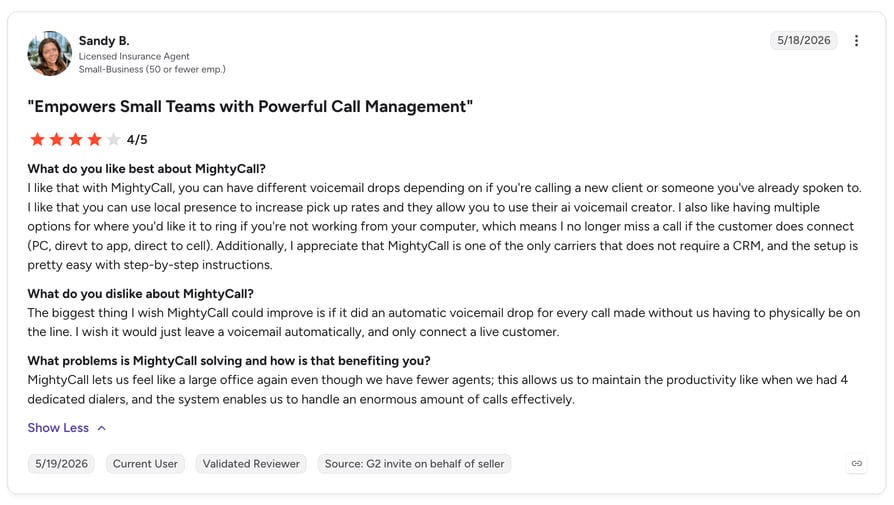
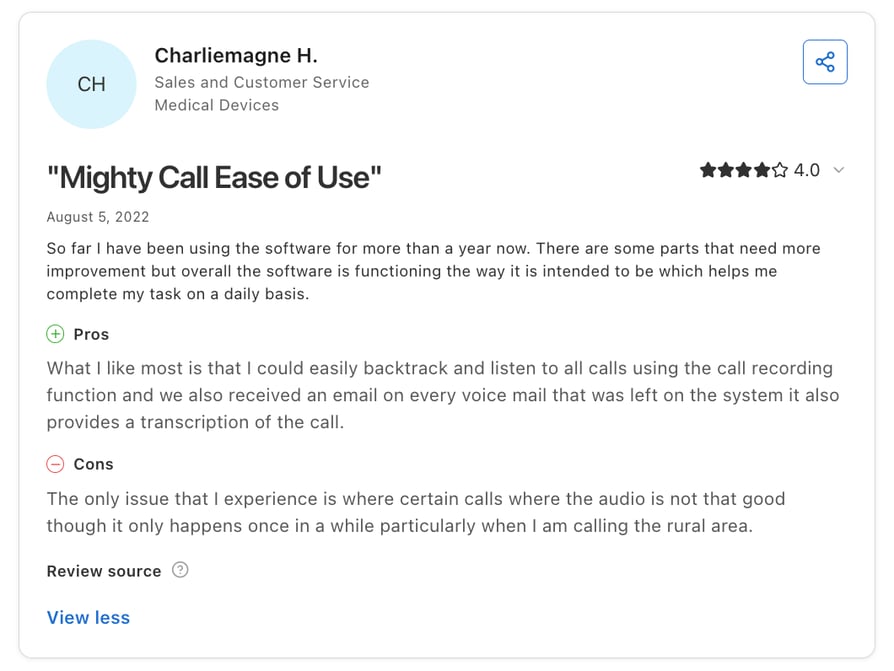
What Real Users Say About MightyCall
MightyCall User Review On G2:
MightyCall User Review on Capterra:
What Real Users Say About Aircall
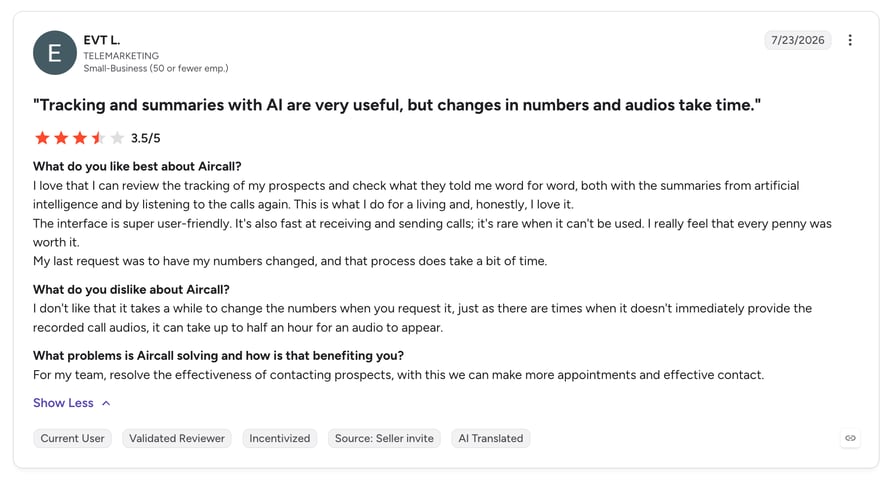
Aircall User Review on G2:
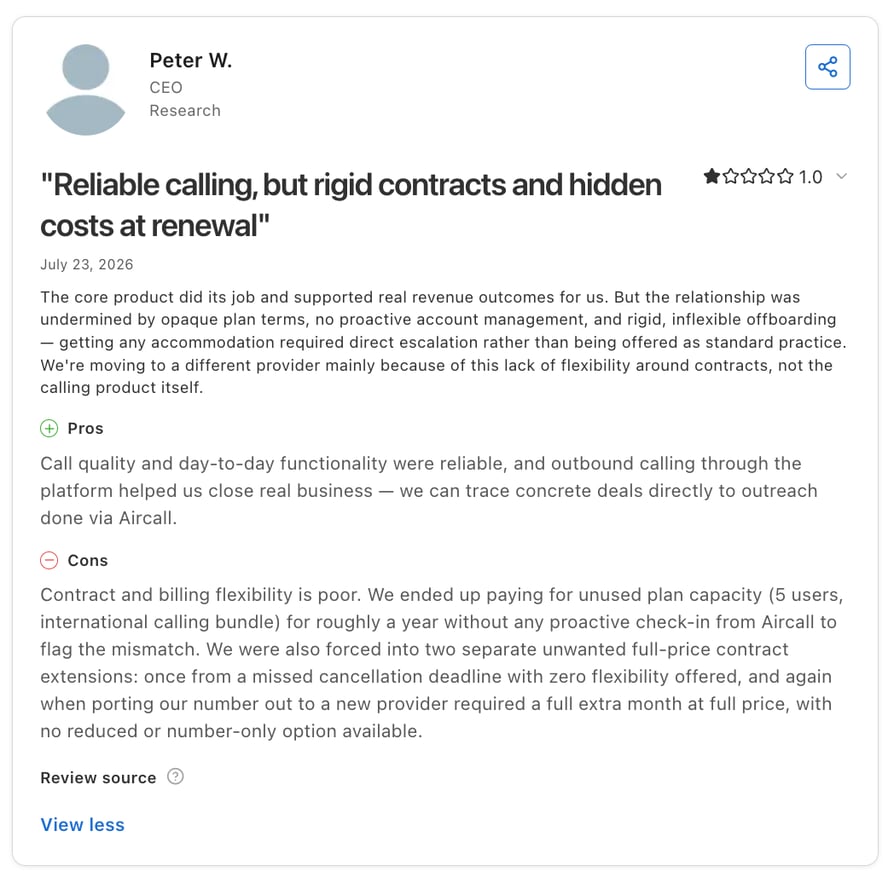
Aircall User Review on Capterra:
MightyCall Reviews vs. Aircall Reviews on Reddit & Quora
What Real Users Say About MightyCall On Reddit & Quora
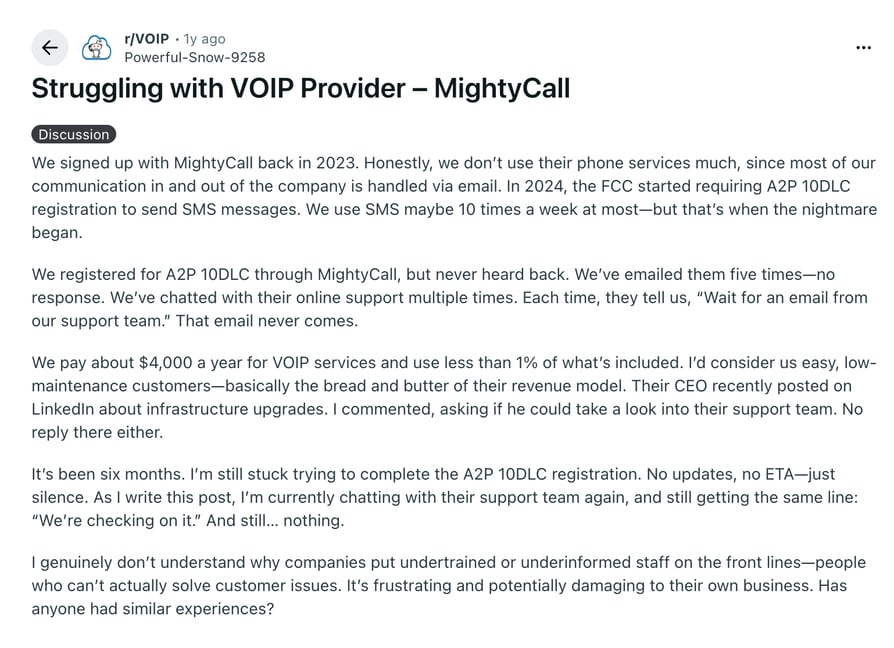
Reddit thread about MightyCall:
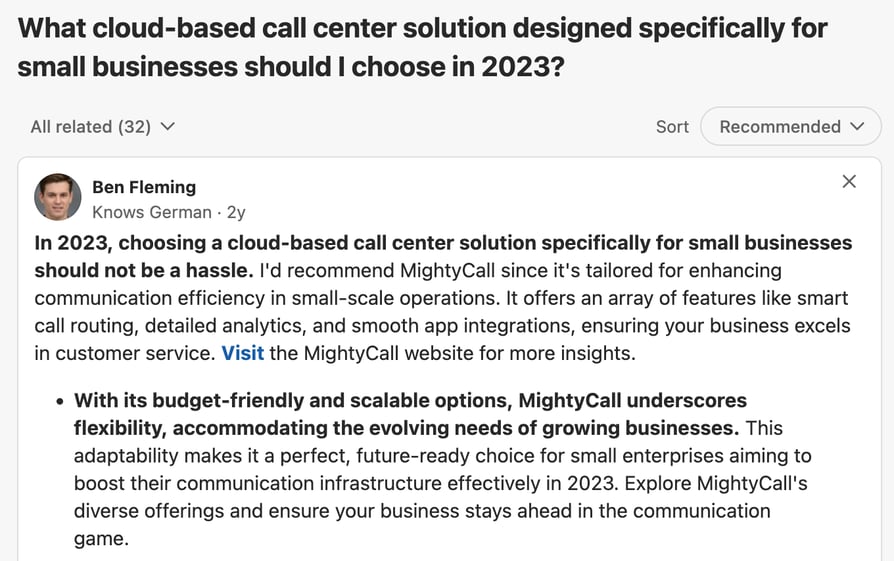
Quora discussion about MightyCall:
What Real Users Say About Aircall On Reddit & Quora
Reddit thread about Aircall:
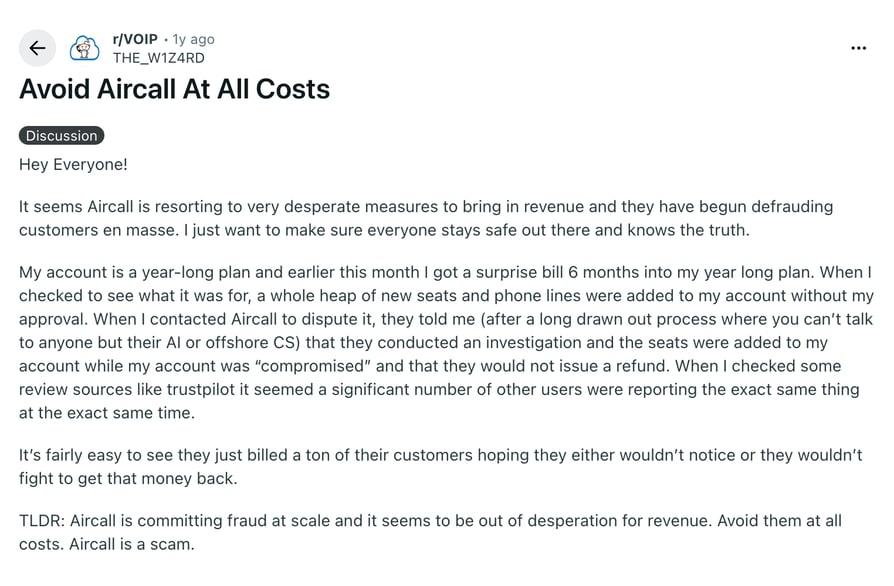
Quora discussion about Aircall:
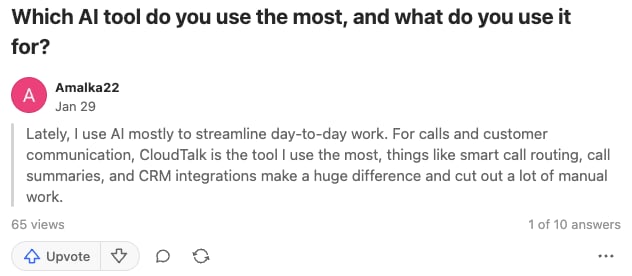
MightyCall Pros & Cons vs. Aircall Pros & Cons
Both tables run five pros and five cons, so the trade-offs line up row for row. If the dialer rows are what decide it, our breakdown of power dialer vs progressive dialer explains what changes between the modes.
MightyCall Pros & Cons
| Pros | Cons |
|---|---|
| Lowest entry price here at $20/user/month, with multi-level IVR and call recording included at that tier | Four native integrations against Aircall's 200+, the widest single gap in this comparison |
| The only platform here with a predictive dialer, and the only one offering preview, progressive and predictive modes | SOC 2, ISO 27001 and GDPR documentation are not publicly documented, which stalls enterprise and EU procurement |
| Three phone numbers included on every plan | SAML SSO and call-recording retention are not publicly documented |
| AI call summaries bundled into the Pro tier instead of sold per seat | Ratings fall from 4.4/5 on G2 to 3.8 on Capterra and 2.7 on Trustpilot, a 1.7-point spread |
| Strongest published telecom compliance posture here: HIPAA, PCI-DSS, STIR/SHAKEN and automatic DNC scrubbing | 3-user minimum on every plan and 5 on Enterprise, so no single-seat option |
Aircall Pros & Cons
| Pros | Cons |
|---|---|
| 200+ native integrations, including Salesforce, HubSpot, Zendesk, Intercom and Pipedrive | Analytics history caps at six months on Essentials and Professional without Analytics+ at $15/license/month |
| AI Assist included from Professional instead of charged per seat at that tier | Add-ons apply to every license, so no partial-seat purchase, and AI Assist adds its own 3-license minimum |
| The most complete published compliance stack here: SOC 2 Type 2, GDPR, CSA CAIQ Level 1 and downloadable audit artifacts | No progressive or predictive dialer at any tier |
| AES-256 at rest, plus PII stripped from transcriptions before AI processing | SSO sits on the Custom plan and its 25-license minimum, out of reach for most SMBs |
| Published company scale: 2014 founding, 20,000+ customers, 800+ employees | Worst Trustpilot distribution here, with 29% of 1,013 reviews at one or two stars |
Try CloudTalk free for 14 days
Which Team Fits Which Platform?
Fit comes down to three questions: what your real budget per seat is, whether your team works inside a CRM all day, and how much you'll use sales-specific tooling. HubSpot's 2025 State of Cold Calling Report found that 24% of sales organizations still use cold calling as a primary channel and another 25% as a secondary one, so the dialer question matters to roughly half of sales teams. For those teams this is as much a cold calling software decision as a phone-system one.
| MightyCall is the right fit for... | Aircall is the right fit for... |
|---|---|
| Small businesses, agencies and freelancers running a professional phone presence without a CRM to integrate | Sales and support teams whose day happens inside Salesforce, HubSpot, Zendesk or Pipedrive |
| Teams that want predictable flat-rate billing with capability bundled into the tier price | Teams comfortable treating add-ons as a planned part of the real cost |
| Outbound teams that need progressive or predictive dialing, which Aircall doesn't offer at any tier | Outbound teams whose motion fits a Power Dialer working a CRM-driven list |
| Businesses that need HIPAA, PCI-DSS, STIR/SHAKEN or automatic DNC scrubbing documented today | Businesses whose procurement process requires SOC 2 Type 2 and downloadable audit artifacts |
| Teams that want a phone system running in an afternoon, with three numbers and IVR included | Growing teams that need unlimited team structures, live monitoring and supervisor dashboards |
MightyCall vs. Aircall: The Verdict
Is MightyCall better than Aircall? Neither is better. MightyCall holds 4.4/5 on G2 and Aircall 4.4/5. MightyCall is cheaper and includes more at the entry tier; Aircall has far deeper CRM integration. The right pick depends on whether your team works inside a CRM.
Choose MightyCall if you…
- 01Want the lowest entry price with multi-level IVR, call recording and three numbers already in the plan
- 02Run outbound campaigns that need progressive or predictive dialing
- 03Would rather move up a tier than assemble a stack of per-seat add-ons
- 04Need HIPAA, PCI-DSS, STIR/SHAKEN or automatic DNC scrubbing documented right now
- 05Don't have a CRM to integrate, or have one your team doesn't work inside all day
- 06Want a phone system live this week without a configuration project
Choose Aircall if you…
- 01Work inside Salesforce, HubSpot, Zendesk or Pipedrive and want calls logged there natively
- 02Have a procurement process that asks for SOC 2 Type 2 and downloadable audit artifacts
- 03Run a Power Dialer motion against CRM-driven lists rather than uploaded call lists
- 04Need real-time supervisor dashboards and live monitoring across several teams
- 05Can budget Analytics+ or AI Assist across every license rather than only the seats that need them
- 06Are scaling past a handful of teams and need unlimited team structures
If neither set of trade-offs fits, CloudTalk offers transparent per-user pricing from $25/user/month with native Salesforce, HubSpot, and Pipedrive sync, and no seat minimum on the entry plan.
See CloudTalk next to both platforms
Frequently asked questions
MightyCall holds 4.4/5 on G2 and Aircall 4.4/5, so peer scores alone won't decide it. MightyCall costs less per seat and bundles more into its entry tier. Aircall connects to far more CRMs. Your CRM workflow decides it.
On annual billing, MightyCall runs $20/user/month (Core) to $65 (Enterprise). Aircall is $30/license/month (Essentials) and $50 (Professional), with Custom quoted on request. Both enforce a three-seat minimum, so it pays to evaluate VoIP pricing on the real seat count, not the headline rate.
Not hidden, but easy to miss. Analytics+ costs $15/license/month for history beyond six months, add-ons apply to every license, extra numbers are billed monthly at an unpublished rate, and monthly billing needs four licenses. That's how the real business phone line cost ends up above the sticker price.
Both are native MightyCall integrations, but they are two of only four. Aircall ships 200+ native connectors including Zendesk, Intercom, Pipedrive and Microsoft Dynamics, plus Salesforce CTI from the Professional tier.
MightyCall, on price. Core is $20/user/month against Aircall's $30 and includes three numbers to Aircall's one. Both need three seats, so the real floor for a small-business phone system is $60 versus $90 a month.
Sometimes. CloudTalk sits between them at $25/user/month with native Salesforce, HubSpot and Pipedrive sync and a one-user minimum, but it has no predictive dialer and its AI features are always add-ons.