Mitel Pricing: Plans, Costs, and What You’ll Actually Pay in 2026
TL;DR — Mitel Pricing at a Glance
Mitel's cloud (UCaaS) pricing has historically run from about $20.99 to $38.49 per user/month across three tiers—Essentials, Premier, and Elite—while MiVoice Business (on-prem and private cloud) is quote-based with no public price.
Mitel is known for limited pricing transparency. Most current deals are quoted by sales, and the company has shifted focus toward enterprise and private-cloud telephony. Confirm live pricing directly, and budget for add-ons, hardware, and onboarding on top of the per-user rate.
Summary of Mitel Pricing Plans
Mitel Pricing Plans
| Plan | Price (indicative) | Best For |
|---|---|---|
| Essentials | ~$20.99 /user/month | Small teams needing core PBX, collaboration, and conferencing |
| Premier | ~$26.59 /user/month | Growing teams needing CRM integrations and call recording |
| Elite | ~$38.49 /user/month | Larger teams needing archiving and operator functions |
| MiVoice Business | Quote-based | Enterprises wanting on-prem or private-cloud telephony |
What Pricing Plans Does Mitel Offer?
Mitel splits its lineup between cloud UCaaS tiers (Essentials, Premier, Elite) and its enterprise-grade MiVoice Business platform, which is sold by quote. The per-user cloud rates below are indicative and typically apply to annual billing; Mitel is well documented for opaque pricing and add-on charges, so treat published figures as a starting point.
Here is a summary of the key features by tier and the type of business each plan suits best:
| Aspect/Feature | Essentials | Premier | Elite |
|---|---|---|---|
| Price (indicative) | ~$20.99 /user/mo | ~$26.59 /user/mo | ~$38.49 /user/mo |
| PBX & conferencing | Yes | Yes | Yes |
| CRM integrations | No | Yes | Yes |
| Call recording | No | Yes | Yes |
| Archiving | No | No | Yes |
| Operator / attendant | No | No | Yes |
| Ideal for | Small teams | Mid-size teams | Larger teams |
Heads up on Mitel pricing:
Mitel does not publish a single, consistent price list, and several tiers require a sales quote. Hardware, onboarding, and premium support are commonly billed separately. Always confirm the current rate and inclusions in writing.
Want pricing you can actually see before you buy?
Mitel's Essentials Plan
What Is Mitel's Essentials Plan?
The Essentials tier is Mitel's entry cloud plan, covering the fundamentals a small team needs to run business calls without on-prem hardware. Indicative pricing is around $20.99/user/month.
What's included in Mitel's Essentials Plan?
- Cloud PBX (phone system)
- Team collaboration
- Audio conferencing
- Softphone / mobile apps
Who is Mitel's Essentials Plan best for?
Small teams that need a professional cloud phone system with the basics and don't require CRM logging or call recording yet.
What you need to know about Mitel's Essentials Plan:
Core calling only—CRM integrations and call recording are reserved for higher tiers, so most growing teams outgrow Essentials quickly.
Mitel's Premier Plan
What Is Mitel's Premier Plan?
Premier is Mitel's mid tier, adding the productivity features sales and support teams rely on. Indicative pricing is around $26.59/user/month.
What's included in Mitel's Premier Plan?
- Everything in Essentials
- CRM integrations
- Call recording
- Reporting
Who is Mitel's Premier Plan best for?
Mid-size teams that want their phone system connected to a CRM and need recording for coaching or compliance.
What you need to know about Mitel's Premier Plan:
This is the tier most businesses actually need, so the real starting price for a usable setup is closer to Premier than Essentials.
Mitel's Elite Plan
What Is Mitel's Elite Plan?
Elite is Mitel's top cloud tier, layering in advanced administration and archiving. Indicative pricing is around $38.49/user/month.
What's included in Mitel's Elite Plan?
- Everything in Premier
- Call archiving
- Operator / attendant console
- Advanced admin controls
Who is Mitel's Elite Plan best for?
Larger teams and contact centers that need archiving, operator functions, and tighter administration.
What you need to know about Mitel's Elite Plan:
At roughly $38/user, Elite sits well above typical mid-market cloud phone pricing—compare total cost against dedicated call-center platforms before committing.
Mitel's MiVoice Business Plan
What Is Mitel's MiVoice Business Plan?
MiVoice Business is Mitel's enterprise telephony platform for on-prem and private-cloud deployments. It is sold by quote only, with no public price.
What's included in Mitel's MiVoice Business Plan?
- On-prem or private-cloud deployment
- Enterprise call control
- Scalable to thousands of users
- Hardware and endpoint options
Who is Mitel's MiVoice Business Plan best for?
Enterprises with dedicated IT that want ownership and control of their telephony infrastructure, often in regulated industries.
What you need to know about Mitel's MiVoice Business Plan:
Expect a sales-led process, hardware and licensing costs, and implementation fees. Budgeting requires a formal quote; there is no self-serve price.
Recommended Content
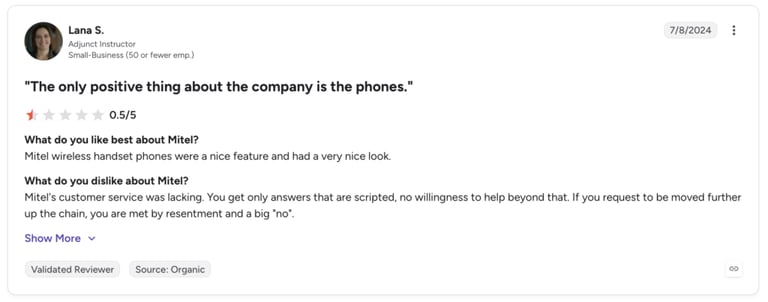
What Do Real Users Say About Mitel Pricing on G2?
On G2, Mitel's platforms hold solid ratings for reliability and feature depth, while some reviewers note the interface can feel dated and that pricing/support depends heavily on the partner or contract. Confirm the current G2 score for the specific Mitel product you're evaluating.
How Much Does Mitel Cost per Month?
For the cloud tiers, the honest per-user monthly figures land around $20.99 (Essentials), $26.59 (Premier), and $38.49 (Elite), typically on annual terms. MiVoice Business has no public monthly price. Because most real deals are quoted, add hardware, onboarding, and support to estimate your true monthly spend.
| Plan | Indicative price (per user) | Notes |
|---|---|---|
| Essentials | ~$20.99 /user/mo | Core cloud PBX |
| Premier | ~$26.59 /user/mo | Adds CRM + recording |
| Elite | ~$38.49 /user/mo | Adds archiving + operator |
| MiVoice Business | Quote-based | On-prem / private cloud; hardware + implementation extra |
Other Costs to Budget For
- Hardware & endpoints: desk phones and gateways for on-prem/MiVoice deployments.
- Onboarding & implementation: enterprise deployments are typically sales-led and billed separately.
- Premium support: higher support tiers and SLAs can carry additional fees.
- Add-ons: advanced analytics, contact-center modules, and integrations may cost extra.
What Are the Pros and Cons of Mitel?
| Pros | Cons |
|---|---|
| Reliable, enterprise-grade call platform | Limited pricing transparency; most tiers quote-based |
| Flexible on-prem, private-cloud, and cloud options | Higher tiers get expensive (~$38/user for Elite) |
| Deep feature set for large organizations | Hardware, onboarding, and support often billed separately |
| Strong track record in regulated industries | Interface and admin can feel dated vs newer cloud tools |
Recommended Content
How Competitive Is Mitel Pricing vs Similar Vendors?
Against modern cloud phone systems, Mitel's quote-based model and higher cloud tiers can be a hard sell for SMBs that want transparent, per-user pricing. CloudTalk leads this comparison, followed by two other popular options.
| Provider | Starting price (annual) | Entry minimum | What to know |
|---|---|---|---|
| CloudTalk | From $25 /user/month (Starter) | 1 user | Per-user billing, 160+ countries, unlimited analytics history |
| Mitel | Quote-based (cloud UCaaS from ~$20.99 /user) | Varies / enterprise-led | Opaque pricing; focus shifted to enterprise & private cloud; hardware/onboarding extra |
| RingCentral (RingEX) | From $20 /user/month (Core) | 1 user | UCaaS with video; AI and some limits add cost as you scale |
| Dialpad (Connect) | From $15 /user/month (Standard) | 1 user | AI transcription included on all plans; CRM integrations gated to Pro ($25) |
In summary:
- CloudTalk offers transparent per-user pricing from $25/user, a single-seat entry point, and 160+ country coverage—no quote required.
- RingCentral is a mainstream UCaaS with bundled video, publicly priced from $20/user.
- Dialpad is the cheapest entry at $15/user with AI transcription included on every plan.
“Unlike other VoIP systems we've used, such as AirCall or Dialpad, CloudTalk genuinely listens to your queries. There are very few companies that patch up small details and organize a call with their support and tech team to answer your questions. There are very few, if not none.”

Skip the sales gauntlet.
CloudTalk Beats Mitel: A Clear Winner on Price and Simplicity
Mitel is a capable enterprise platform, but its opaque, quote-led pricing and hardware-heavy deployments make it a poor fit for teams that want to move fast and know their costs up front.
CloudTalk charges a transparent per-user rate, starts at a single seat, and includes advanced features in lower tiers—so growing teams get more value without an enterprise contract. With international numbers in 160+ countries and carrier-grade call quality, it scales globally without the guesswork.
Ready to compare? Try CloudTalk and see your real cost in minutes, not after a sales call.
Why sign an enterprise contract to make a phone call?

Frequently asked questions
Mitel's cloud tiers are indicatively around $20.99 (Essentials), $26.59 (Premier), and $38.49 (Elite) per user/month, usually on annual terms. MiVoice Business is quote-based with no public price. Confirm current figures directly, as Mitel pricing is largely sales-led.
Not fully. Some cloud tiers have indicative rates, but MiVoice Business and most enterprise deals require a custom quote. Hardware, onboarding, and support are commonly billed separately.
Mitel typically offers a demo rather than a self-serve free trial. Availability varies by product and region, so check with Mitel or its partners.
Both. Mitel offers cloud UCaaS tiers as well as MiVoice Business for on-premise and private-cloud deployments, which is where much of its enterprise focus sits.
Popular alternatives include CloudTalk (transparent per-user pricing from $25/user, 160+ countries), RingCentral (from $20/user with bundled video), and Dialpad (from $15/user with AI transcription included). CloudTalk is the closest fit for teams that want enterprise features without quote-based pricing.