In 2026, the AI voice agent market is worth $2.54B and growing 39% a year toward $35.24B by 2033, with inbound agents, receptionists, support lines, and booking, making up 52.1% of revenue. Most organizations now use AI somewhere; customers increasingly accept AI answering simple calls, and the dominant design pattern is "AI answers first, humans escalate."
The workforce data points to augmentation, not replacement: only 20% of service leaders have cut headcount because of AI. This page pulls together the market size, adoption, performance, ROI, workforce, and industry statistics that matter, every number sourced and free to cite.
As organizations transition away from legacy infrastructure toward cloud-based telephony solutions and modern small business VoIP networks, deployment of AI voice capabilities is accelerating. Rather than relying on standard calling software for PC, modern contact centers are embedding agentic AI directly into their core voice stack.
TL;DR: The 2026 AI Voice Agent Statistics at a Glance
| Category | statistics | Source |
|---|---|---|
| Market | AI voice agent market: $2.54B (2025) → $35.24B (2033), 39.0% CAGR; inbound = 52.1% of revenue | Grand View Research |
| Market | Conversational AI: $14.3B → $78.9B by 2033 (23.8% CAGR) | Grand View Research |
| Adoption | 88% of organizations use AI in at least one function; 62% are experimenting with AI agents | McKinsey, State of AI 2025 |
| Adoption | 1 in 6 contact centers has already deployed generative AI | Deloitte Digital, 2024 |
| Acceptance | 74% of consumers now expect 24/7 service because of AI | Zendesk CX Trends 2026 |
| Acceptance | 75% of CX leaders expect 80% of interactions resolved without a human; 88% still prefer a person for complex help | Zendesk / Ipsos, 2023 |
| Speed & outbound | ~7× more likely to qualify a lead contacted within an hour | Harvard Business Review |
| Speed & outbound | 12% action rate via AI voice vs. 0% email on the same webinar leads | CloudTalk field research |
| Cost & ROI | AI voice ~$0.08/min vs. $7.16 per human-handled call | ElevenLabs / ContactBabel |
| Cost & ROI | $3.70 back per $1 in generative AI; payback ~13 months | DC & Microsoft, 2024 |
| Predictions | Agentic AI to resolve 80% of common service issues by 2029, cutting costs 30% | Gartner, Mar 2025 |
| Workforce | Only 20% of service leaders cut headcount due to AI; augmentation beats replacement | Gartner, Dec 2025 |
| By industry | BFSI leads at 32.9% share; retail 21.2%; healthcare fastest at 42.0% CAGR | Mordor / Master of Code / Grand View Research |
This page collects the most important AI voice agent statistics in one place: market size, adoption, performance versus human agents, ROI, workforce impact, and industry-by-industry data. Every number is sourced, and everything here is free to cite. New to the technology?
39% Growth a Year. Here's Where AI Voice Agents Are Headed.
AI voice agents have moved from pilot budgets to production budgets, and the market is compounding at roughly 39% a year.
Grand View Research values the AI voice agent market at $2.54 billion in 2025, growing to $35.24 billion by 2033 - a 39.0% CAGR. Inbound voice agents (receptionists, support lines, booking) already account for 52.1% of 2025 revenue, which confirms that answering calls, not making them, is the beachhead use case. There's no separately published virtual receptionist market size for 2026; receptionist-style deployments sit inside that dominant inbound segment.
The wider context points the same direction:
| Technology | Forecast | Source |
|---|---|---|
| Conversational AI | $14.3B → $78.9B by 2033 (23.8% CAGR) | Grand View Research |
| Voice AI agents (global) | $14.6B → $23B+ by 2027 | Juniper Research |
| Voice recognition (enabling layer) | $18.4B → $61.8B by 2031 (22.4% CAGR) | Mordor Intelligence |
| All AI agents (every type, not just voice) | $7.84B → $52.62B by 2030 (46.3% CAGR) | MarketsandMarkets, 2025 |
Analyst predictions frame what this buys your businesses. Gartner expects conversational AI to cut contact center agent labor costs by $80 billion in 2026, with 1 in 10 agent interactions automated, up from just 1.6% in 2022 (Gartner, Aug 2022). By 2029, Gartner projects agentic AI will autonomously resolve 80% of common customer service issues (Gartner, Mar 2025). And the shift is happening now: task-specific AI agents embedded in enterprise apps jump from under 5% in 2025 to 40% by the end of 2026 (Gartner, Aug 2025).
For the trends that matter operationally, inbound-first deployments, hybrid AI + human design, per-minute pricing; see our full AI voice agents overview.
Signature Capability
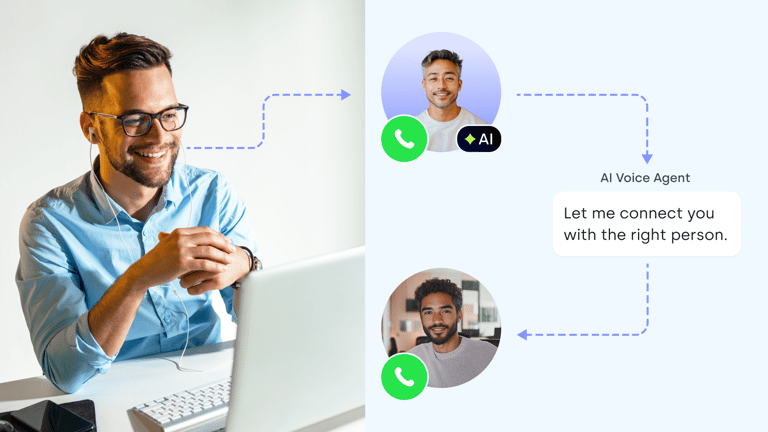
See CloudTalk’s AI Voice Agent in Action!
CeTe is an AI that talks like a human: no breaks, no training, no time off. It makes and answers calls, updates CRMs, books meetings, and loops in a human only when needed.
Press play to hear it. Want a wow moment? Get a free test call and try it live.

What an AI Voice Agent Actually Changes on Your Calls
The short answer: A voice agent answers every call, day or night, at a fraction of the cost of a human-handled call, and pays back inside roughly a year.
Here's what a voice agent, or an AI virtual receptionist, changes in practice, with one statistic behind each benefit.
Traditional interactive voice response (IVR) setups are rapidly giving way to next-generation AI. Upgrading to an automated phone system for small businesses provides more than basic IVR; it delivers the best phone answering service for small business needs by combining human-like conversation with best call routing software practices to direct callers instantly without manual intervention.
| Benefit | The statistic behind it | Source |
| Answers around the clock | 74% of consumers now expect round-the-clock service because of AI. In CloudTalk's live field experiment, the AI receptionist answered 100% of inbound calls. | Zendesk CX Trends 2026 / CloudTalk field research |
| Leaves no caller behind | 79% of consumers will switch to a competitor that responds faster, and 75% have hung up after being kept on hold too long. | Invoca B2C Buyer Experience Report, 2026 |
| Lowers cost per conversation | AI voice minutes start around $0.08/min against a $7.16 average cost for a human-handled inbound call. | ElevenLabs, 2025 / ContactBabel, 2025 |
| Speeds up handling | Wyndham cut average handle time by 30–50% with AI agents covering 28% of incoming calls. A McKinsey telecom client cut call volume ~30% and handle time by more than a quarter. | PwC, 2025 / McKinsey, 2024 |
| Pays back fast | Organizations see a $3.70 return per $1 invested in generative AI, with value realized within roughly 13 months. | IDC & Microsoft, 2024 |
AI Voice Agent Statistics: The 30+ Statistics That Matter in 2026
This is the stats hub of the article, the essential statistics grouped by theme. Each section opens with a one-line answer, then a table you can scan or cite. Every row is a single stat with its source.
How Many Businesses Use AI Voice Agents?
Whether managing inbound, outbound, or hybrid setup types of call centers, leaders are reconsidering how to start a virtual call center equipped for scale. By offloading repetitive intake tasks to AI, the daily duties and responsibilities of call center agents shift toward high-value customer interactions and specialized problem-solving.
Most organizations now use AI somewhere, and contact centers are moving from experiments into live operations.
| Statistic | Source |
|---|---|
| 88% of organizations use AI in at least one function | McKinsey, State of AI 2025 |
| 62% of organizations are experimenting with AI agents | McKinsey, State of AI 2025 |
| 1 in 6 contact centers have deployed generative AI; another 42% planned deployment in 2025 | Deloitte Digital, 2024 |
| 71% of customers say it's important for a human to validate AI output (the case for hybrid AI + human setups) | Salesforce, State of the Connected Customer, 7th ed. |
| 41% of German companies (20+ employees) now use AI; another 48% are planning or discussing it | Bitkom, Mar 2026 |
| 30% to 53% share of service cases German professionals say AI handles today vs. by 2027 | Salesforce State of Service, 7th ed., 2025 |
| 139.8M to 168.2M US voice assistant users, 2022 to 2029 | eMarketer, 2025 |
The pattern behind these adoption statistics is AI in customer service crossing from experiments into everyday operations.
Do Customers Accept AI Answering Their Calls?
The short answer: Yes for simple, fast requests, and acceptance rises when the AI sounds natural and the handoff to a human is clear. Modern outbound sales teams are replacing manual dialing and basic dialers for cold calling with intelligent conversational agents. By integrating the best auto dialer software for small businesses alongside best AI telemarketing software, organizations can instantly engage inbound web leads and re-engage dormant databases automatically.
- 75% of CX leaders expect 80% of interactions resolved without human intervention. Zendesk CX Trends 2025
- 81% of consumers say AI is part of modern customer service. Zendesk, 2026
- 28% of Wyndham's incoming calls are handled by AI agents, with handle time down 30–50%. PwC, 2025
- 61% of customers prefer self-service for simple issues. Salesforce
- 64% are more likely to trust AI agents that show friendliness and empathy. Zendesk CX Trends 2025
- 88% of consumers still prefer to talk to a person when they need help (2023 sentiment), the case for natural-sounding AI. Ipsos Consumer Tracker, 2023
- 72% of customers say it's important to know whether they're talking to an AI agent. Salesforce, State of the Connected Customer, 7th ed.
- 39% are already comfortable with AI agents booking appointments for them. Salesforce, State of the Connected Customer, 7th ed.
- Up to 70% of calls can be contained by AI virtual agents without a human, saving ~$5.50 per contained call (vendor ceiling figure). IBM / Forrester TEI, 2022
- 29% of consumers stopped buying from a brand after a poor experience; the stakes of a missed call. PwC 2025 Customer Experience Survey
Among consumers who prefer AI, the reasons cited are better availability (41%), faster resolution (37%), and more accurate information (30%) (SurveyMonkey CX & AI Report). The 70% containment figure is a vendor ceiling; CloudTalk's real customer result is the 37.5% deflection case further down this page. See how an AI phone answering service meets these expectations.
Takeaway:
Customers accept AI for simple, fast requests, especially when it sounds natural and hands off cleanly to a human.
How Much Faster Does AI Follow Up On Leads?
The short answer: Speed decides the deal, and an AI agent calls back in seconds instead of hours.
- 7× companies that contact a lead within an hour are ~7× more likely to qualify it than those that wait longer (and 60×+ vs. waiting 24 hours). Harvard Business Review, Oldroyd study
- 37% of phone leads convert during the call. Invoca, 2026
- 56% of consumers expect a response within an hour of submitting a form. Invoca, 2026
- 36% actually get a response within that hour. Invoca, 2026
- 12% vs. 0% action rate of AI voice follow-up vs. email replies among webinar registrants. CloudTalk field research
- 11.47% connect rate CloudTalk's AI agent hit on untouched long-tail leads, generating 70+ SQLs. CloudTalk field research
- 600,000+ of calls per month analyzed by Entel at under $0.01 per call; AI call analysis lifted inbound service sales 40% in 10 weeks. McKinsey, 2026
Takeaway:
Whoever calls back first usually wins the lead, and an AI agent is always first.
What Is The ROI Of An AI Voice Agent?
The short answer: most teams recover their spend inside about 13 months, and the standout campaigns return many times the cost.
- $3.70 per $1 average return on generative AI investment (top performers reach $10.30), realized within ~13 months. IDC & Microsoft, 2024
- 93% of service professionals with AI say it saves time. Salesforce State of Service, 6th ed., 2024
- 92% of service teams with AI say it reduces costs. Salesforce AI agents research
- $80B in contact center agent labor costs conversational AI will cut in 2026. Gartner, Aug 2022
- 30% operational cost reduction from agentic resolution of common issues by 2029. Gartner, Mar 2025
- 74% of organizations say their most advanced GenAI initiative meets or exceeds ROI expectations. Deloitte State of Generative AI, Wave 4, 2025
- 78% plan to increase AI spending next fiscal year. Deloitte State of Generative AI, Wave 4, 2025
- 17× ROI of CloudTalk's long-tail campaign: €12.8K in SQL value on ~€750 cost. CloudTalk customer story
Takeaway:
The payback usually lands inside about a year, and the strongest campaigns return many times their cost.
Is AI Replacing Call Center Jobs?
The short answer: No. The data describes augmentation and reallocation, not replacement; only 20% of service leaders have cut headcount because of AI.
- 20% of customer service leaders cut agent headcount due to AI (55% kept staffing stable at higher volumes; 42% are creating specialized AI roles). Gartner, Dec 2025
- 50% of organizations that cut service staff due to AI will rehire for similar functions by 2027. Gartner, Feb & Mar 2026
- 80% plan to shift agents into new roles; 84% are adding new skills; 50%+ will double service tech spend by 2028. Gartner, Feb & Mar 2026
- +14% / +34% more support issues resolved per hour with AI assistance, on average / for the newest agents (chat-based agent assist, not voice specifically). NBER: Brynjolfsson, Li & Raymond, 2023
- 35% lower likelihood that GenAI-using contact centers report agents feeling overwhelmed by information during calls. Deloitte Digital, 2024
- 43% to 27% one-year fall in trust in fully autonomous AI agents; Gartner expects 40%+ of agentic AI projects canceled by end of 2027. Capgemini, 2025 / Gartner, Jun 2025
AI Voice Agent Adoption by Industry: Who's Winning and Where
Adoption isn't evenly distributed, financial services and retail lead on share, healthcare grows fastest, and trades leak the most missed calls.
TL;DR: Every industry is adopting voice agents, but not at the same pace or for the same reason:
- 01Healthcare is growing fastest at a 42% CAGR through 2033.
- 02Financial services leads on adoption with 32.9% market share, the largest of any vertical.
- 03Retail and e-commerce leads conversational AI overall at 21.2% share, with voice commerce set to drive up to 30% of e-commerce revenue by 2030.
- 04Telecom and hospitality use agents to cut call volume and handle time (Wyndham handles 28% of calls with AI; a McKinsey telecom client cut volume ~30%).
- 05Real estate uses them for instant callbacks on listing inquiries (82% of agents already use AI tools).
- 06Trades and home services have the most to gain because they miss the most calls (roofers answered just 37 of 100 inquiries).
#1 Healthcare
The fastest-growing voice agent end-use segment at a 42.0% CAGR through 2033 (Grand View Research). Clinicians using ambient voice AI (DAX Copilot) saw 11.3 more patients per month and spent 24% less time on notes (Microsoft / Northwestern Medicine, 2024). Best use case: appointment booking and after-hours triage.
The power dialer has been a game-changer for managing our call volume. Since we implemented the feature, about 90% of our agents are using it to automate dialing, saving time. The power dialer makes handling both new and old leads easier. It’s been crucial for our growth — our call volume has seen a 2.5X increase in just 8 months.
#2 Financial Services & Insurance
BFSI leads voice AI adoption with a 32.9% market share; the largest of any vertical (Mordor Intelligence, 2025). Best use case: balance inquiries, claims status, and identity-verified routine requests. Coupled with a secure phone recording system for small businesses and enterprises, AI agents allow financial institutions to maintain compliance, transcribe interactions, and handle routine balance or claims inquiries seamlessly.
Once we switched to CloudTalk, our missed calls dropped by 23%. That’s not just a number; that’s customers we’re able to connect with before it’s too late.
#3 Retail & E-commerce
Retail and commerce lead conversational AI adoption overall with a 21.2% market share (Master of Code, 2026), and voice commerce is projected to drive up to 30% of e-commerce revenue by 2030 (RaftLabs, 2026). Best use case: order status ("where is my order?") and returns.
We are not at the moment where AI can read emotions and figure out what the person on the other side really needs. But I can call 20 times more people. So even if it’s twice less efficient, the math works.
#4 Telecom
A McKinsey telecom client cut call volume ~30% and handle time by more than a quarter in a gen-AI-led service transformation (McKinsey, 2024), while Entel analyzes 600,000+ calls per month at under $0.01 per call (McKinsey, 2026). Best use case: plan changes, outage information, and QA at scale.
Now we have charts and can monitor and compare stats whenever we choose. We can immediately see discrepancies between agents and change the way we work.
#5 Real Estate
82% of agents use AI tools and 68% save 1+ hour per week (Realtors Property Resource, Feb 2026); 50% of NAR members report positive AI business impact: 17% significant, 33% moderate (NAR 2025 Technology Survey). Best use case: instant callback on listing inquiries.
Top-performing brokerages combine dialers for real estate with conversational AI to handle instant callbacks on property listing inquiries. AI agents can also dial using local or international numbers to establish immediate trust with cross-border investors.
“We were able to find that we reduced the number of calls with those topics in them with our support team by 66%.”
#6 Trades & Home Services
In a standardized German test, roofers responded to only 37 of 100 customer inquiries; nearly two-thirds went unanswered (Aroundhome via Deutsche Handwerks Zeitung, May 2026; measures inquiries, not calls specifically). Every unanswered inquiry is a job lost to a competitor, the strongest virtual-receptionist angle in the dataset.
Calls that ring in now pull up their CRM record instantly, so we know exactly who they are. And if we don’t recognize the number, agents can run a custom playbook to verify the caller and update their record.
#7 Hospitality
Wyndham's 28% AI-handled call share with 30–50% faster handling (PwC, 2025) is the vertical's flagship public case. Best use case: reservations, modifications, and loyalty questions.
Thanks to CloudTalk, we managed to greatly improve our team’s cost and efficiency. The script feature allows us to lead the calls in a much more systematic way, as well as all the action buttons to trigger actions directly into our backend.
How CloudTalk Customers Use AI Voice Agents
Market forecasts are useful. Production numbers are better. Here are three documented CloudTalk deployments, the full methodology and data live in our AI voice agent research and reports.
| Case | Key result | Details |
| Written-off leads (outbound prequalification) | 17× ROI (€12.8K SQL value on ~€750 cost) | A CloudTalk AI agent automatically contacted 6,531 leads the sales team had written off, holding 997 conversations of roughly 3 minutes each, on leads that would have rotted in a spreadsheet. Read the customer story → |
| Inbound deflection (US government services provider) | 37.5% of calls deflected; human AHT down 44% (25 to 14 min) | A US government services provider put CloudTalk's AI agent in front of its inbound line. It now fully handles more than a third of calls, and the ones that reach humans are shorter because they arrive pre-qualified. AI-handled calls averaged 1 minute 26 seconds. Read the customer story → |
| AI as the virtual receptionist (CloudTalk field research) | 100% of calls answered; 96% graceful endings; 70+ SQLs; 12% voice action rate vs 0% email | In CloudTalk's own field experiments, the AI receptionist answered every inbound call and revived dormant lead lists email couldn't move. The webinar experiment saw a 12% action rate via voice versus 0% email replies, with 11% of registrants opting into 1:1 calls. Read the research report → |
Takeaway:
Across outbound, inbound, and receptionist use cases, CloudTalk's AI Voice Agent delivers these results in production, not just in forecasts.
What The 2026 Numbers Really Say
Three findings define the year. The voice agent market is compounding at 39% CAGR toward $35B (Grand View Research) real production spend, not pilot money. "AI answers first, humans escalate" has become the default service design, with hybrid setups outperforming both extremes. And the workforce data says augmentation, not replacement: only 20% of service leaders cut headcount due to AI (Gartner, Dec 2025), while most reinvest in new roles and skills.
If you're ready to test these facts against your own call volume, explore CloudTalk's AI Voice Agents, including options built for small and mid-sized businesses.
Your AI agents talk to 1000s of leads, so your team can close the best ones

Recommended Articles
FAQs: Everything you need to know about AI voice agents
The AI voice agent market grows from $2.54B (2025) to $35.24B (2033) at 39.0% CAGR (Grand View Research), with inbound agents holding 52.1% of revenue. Explore CloudTalk AI Voice Agents.
Track cost per handled minute against your cost per human-handled call, then multiply the gap by the calls the AI covers. AI voice minutes start around $0.08/min (ElevenLabs, 2025) versus a $7.16 average human-handled inbound call (ContactBabel, 2025). CloudTalk's own long-tail campaign returned 17× in €12.8K in SQL value on €750 cost.
Pricing is typically per-minute or per-seat. AI voice minutes start around $0.08/min (ElevenLabs, 2025). See AI voice agent pricing for how per-minute and per-seat models compare.
Not by replacing people. Only 20% of service leaders cut headcount due to AI, while 55% kept staffing stable at higher volumes and 42% created specialized AI roles (Gartner, Dec 2025). The winning pattern is AI answering first and humans escalating.
BFSI leads voice AI adoption at 32.9% market share (Mordor Intelligence, 2025), retail leads conversational AI at 21.2% (Master of Code, 2026), and healthcare is the fastest-growing voice segment at 42.0% CAGR (Grand View Research).
Because customers expect instant, around-the-clock answers; 74% now expect 24/7 service because of AI (Zendesk CX Trends 2026) and AI answers every call at a fraction of the cost while paying back inside roughly 13 months (IDC & Microsoft, 2024).
When an AI voice agent encounters a recipient's inbox, it can detect what is voicemail active on the line and either leave a personalized, natural audio message or trigger workflows that determine how to make call go straight to voicemail with tailored follow-up drops, keeping agent call queues clear for live connections.