Nextiva vs RingCentral 2026: Which One Fits Your Needs?
Nextiva vs RingCentral: At a Glance
| Nextiva | RingCentral | |
|---|---|---|
| What it is | One bundled platform: phone, contact center and digital channels from a single vendor. | Three products bought separately: RingEX for phone, RingCX for contact center, RingWEM for workforce engagement. |
| Best for | Teams that want one vendor and a console a generalist admin can run. | Teams that need global numbers, deep integrations and a developer platform. |
| Starting price | $15 per user per month, billed annually. | $20 per user per month, billed annually. |
| Contact center | Nextiva Contact Center, on the same platform, from $75 per agent per month. | RingCX, a separate product priced per agent. |
| Integrations | About 30 native apps. CRM is an add-on on every plan. | Over 500 apps and an open API. CRM starts on Advanced. |
| AI | XBert, from $99 per month on top of any plan. | AI Receptionist from $39 per month, RingSense from $60. |
| Global numbers | US and Canada confirmed. No published country list. | Country-level coverage published, including local PSTN and BYOC. |
| Uptime | 99.999% marketed. We could not locate an SLA document. | 99.999% with a published SLA and service credits. |
| Where users push back | Onboarding steps and mobile app stability. | Reaching support, and getting out of a contract. |
Nextiva or RingCentral? Compare their pricing, features, contracts and global coverage side by side, and see which fits your needs. If neither one convinces you, there's a third option worth a look.
Nextiva and RingCentral are both mature, credible business phone systems. However, they optimize for different things: Nextiva for simplicity, support and a single vendor across phone and contact center, RingCentral for scale, integration breadth and verified global reach. So the real question is which set of trade-offs matches how your team works.
This nextiva vs ringcentral comparison 2026 covers pricing, features, reliability, contracts, integrations, AI, contact center, international coverage, security, usability and user reviews. For the short version, jump to the At a Glance comparison table.


Why You Can Trust This Comparison
For nearly a decade, we've helped over 30,000+ professionals find and implement smarter business communication tools. We've reviewed 200+ software tools across industries, analyzed 5,500+ verified customer reviews from platforms like G2, Capterra, Trustpilot and TrustRadius, and drawn insights from real user discussions on Reddit and Quora.
In the past year alone, we published 1,000+ articles, each one written by humans for humans. Every figure on this page is either sourced to a vendor's own published page or marked as unverified, and where a number could not be confirmed we left the gap visible instead of filling it. Read our content integrity statement for the rules behind that.
Nextiva vs. RingCentral: Core Strengths of Each Platform
Both platforms cover business phone, messaging and a contact center product, and both have for well over a decade. They differ on priority: one is built to be run by a generalist admin with a support team behind them, the other to be extended and deployed across borders.
Read the tables below as parallel strengths rather than a scoreboard, which is the honest answer to the ringcentral vs nextiva framing on most comparison pages. For a single-vendor view of either platform, we keep a standalone Nextiva review and a RingCentral review alongside this comparison.
Where Nextiva Shines
| Strength | Why it matters |
|---|---|
| Higher ease-of-use and support scores | Reviewers consistently rate it the simpler product to run, and support responsiveness is its most-mentioned praise theme |
| Simpler admin and faster setup | A generalist admin can configure users, routing and greetings without a telephony specialist on the team |
| One vendor for unified communications (UCaaS) and customer experience (CX) | After the Thrio and Simplify360 acquisitions, phone, contact center and digital channels sit under a single contract |
| Low entry price | Core starts at $15/user/month on annual billing |
| HITRUST alongside the standard certification set | Healthcare and other regulated buyers get HITRUST practices on top of HIPAA with a signed BAA |
Where RingCentral Shines
| Strength | Why it matters |
|---|---|
| Much larger pre-built integration catalog | The App Gallery is an order of magnitude bigger than Nextiva's marketplace |
| Open API and SDK platform | Developer access with language SDKs means custom call flows and internal tooling are a supported path, not a workaround |
| Published multi-country number footprint | RingCentral publishes country-level coverage for numbers, local public switched telephone network (PSTN) service and bring-your-own-carrier (BYOC) connections |
| Contractual uptime SLA with service credits | A marketed 99.999% uptime SLA |
| Newer agentic AI suite | AIR, AVA and ACE were announced in November 2025, with the AI Receptionist supporting 11 languages |
Two Cautions Before You Compare Prices
First, Nextiva repackaged its plans into Core, Engage and Scale, so any roundup still showing the retired Essential / Professional / Enterprise lineup has out-of-date prices too. Second, Nextiva publishes no country count for international number availability, so a page that gives you one sourced it somewhere other than Nextiva. We contrast RingCentral's published coverage with that absence rather than filling the gap with a guess.
At a Glance: Nextiva vs. RingCentral, Key Differences
Find the dimension that matters most for your use case, then jump to that section for the detail behind it. If your requirements aren't settled yet, our call center software buyer's guide is a better starting point than any vendor comparison.
| Dimension | Nextiva | RingCentral | Best suited for |
|---|---|---|---|
| Entry price, annual | Core $15/user/month | RingEX Core $20/user/month | Nextiva for teams on budget |
| Plan lineup | Core, Engage, Scale | Core, Advanced, Ultra | Nextiva for simplicity, RingCentral for a cleaner split between phone and contact center |
| Integration count and depth | Short marketplace, two native helpdesk connectors (Zendesk, ServiceNow), CRMs sold as an add-on | Large App Gallery, CRM and industry integrations gated to Advanced and Ultra | RingCentral for integration-heavy stacks |
| Open API and developer platform | No public developer platform | Open API platform with language SDKs | RingCentral for teams that build |
| International number coverage | No published country count | Published country-level coverage for numbers, local PSTN and BYOC | RingCentral for multi-country footprints |
| AI products and cost | XBert and AI plans from $99/month, add-on at every tier | AI Receptionist from $39/month, Conversational Intelligence from $60, both add-ons | RingCentral for lower AI entry cost, Nextiva for bundled AI conversations |
| Published uptime SLA | 99.999% marketed, no SLA document located | 99.999% with service credits | RingCentral for teams that need reliability in writing |
| Ease of use and setup | Rated the easier platform to set up and administer | More capable once configured, steeper learning curve | Nextiva for teams without IT support |
| Support reputation | Support responsiveness is its strongest review theme | Support access is its most-cited weakness | Nextiva for support-led buyers |
| Contract terms | Advertised annual rate requires a 12-month minimum term | Auto-renews for successive terms, 30 days' notice of non-renewal | RingCentral for shorter commitments |
Nextiva Features vs. RingCentral Features
Nextiva Features
Nextiva consolidates phone, messaging, contact center and digital channels onto its NEXT platform, so you get one vendor, one bill and one admin console.
What Nextiva Does Well
- One vendor across phone and customer experienceVoice, digital channels and the contact center come from the same platform, which keeps procurement and support escalations simple.
- Genuinely simple admin and onboardingCall routing, greetings and user provisioning are approachable for a generalist admin, which is why ease of use is Nextiva's strength.
- Unlimited domestic calling on every tierUS and Canada calling isn't gated behind a higher plan, so cost modeling for a domestic team is predictable.
- Higher included SMS allowance at the entry tierNextiva bundles more text messaging into its cheapest plan (100 per user/mo) than RingEX does (25 per user/mo).
- Four dialer modes in the contact centerPredictive, progressive, preview and priority preview cover most outbound patterns, with the more aggressive modes gated to higher contact center tiers.
Where Nextiva Falls Short
- A short integration marketplaceOnly two native helpdesk connectors, Zendesk and ServiceNow, and CRM integration is sold as an add-on at every UCaaS tier rather than included.
- No public developer or API platformIf a workflow isn't in the marketplace, Zapier is the practical fallback rather than building against a documented API.
- No published international country coverageNextiva publishes per-minute international rates but no country list for number availability, which makes it hard to plan a non-US rollout.
- No locatable SLA document behind the marketed 99.999%The figure appears in marketing; we could not find a service attachment attaching credits to it.
RingCentral Features
RingCentral is modular rather than bundled: RingEX handles phone, messaging and video, RingCX is the contact center, RingWEM covers workforce engagement, and the AI suite layers on top. You buy what you need, which means more room to scale and more decisions to make.
What RingCentral Does Well
- A large pre-built integration catalogThe App Gallery covers mainstream CRM, helpdesk and productivity tools without custom work, though CRM sits behind Advanced.
- Open APIs and SDKsA documented developer platform with multiple language SDKs makes custom call flows and internal tooling a supported route.
- Verified global number and PSTN coverageRingCentral publishes which countries it sells numbers in, where it has local PSTN, and where BYOC is available.
- RingCX with AI quality management across every interactionPreview, progressive and predictive dialing plus quality scoring applied to all interactions rather than a sampled subset.
- A documented uptime SLA with service creditsReliability is contractual rather than aspirational, which matters for teams whose phone system is revenue-critical.
Where RingCentral Falls Short
- Support access is its most-cited weaknessGetting hold of a person is the complaint that recurs most across peer review platforms.
- Steeper learning curve and admin complexityReviewers describe overly involved steps for routine changes like voicemail greetings or hold music.
- CRM and AI are gated or charged separatelyThere's no CRM integration below Advanced, and AI Receptionist ($39/month) plus Conversational Intelligence ($60) remain add-ons even on Ultra, per RingCentral's pricing page.
- The lowest included SMS allowance at entry, with no unlimited SMS tierTexting-heavy teams end up buying the Business SMS Booster at $25 on top of the seat fee.
Feature-by-Feature Comparison
| Feature | Nextiva | RingCentral | CloudTalk |
|---|---|---|---|
| Plan lineup | Core, Engage, Scale | RingEX Core, Advanced, Ultra | Starter, Essential, Expert, Custom |
| Integration catalog | Short marketplace, CRM as an add-on at every tier | Large App Gallery, CRM from Advanced | 100+ integrations |
| Native helpdesk connectors | Zendesk, ServiceNow | Mainstream helpdesks covered in the App Gallery | Zendesk, Freshdesk, Intercom, Help Scout, Front, Gorgias, Kustomer |
| Open API and developer platform | Not published | Open API platform with language SDKs | Public API and webhooks from Essential, plus a Zapier connector |
| Dialer modes | Predictive, progressive, preview, priority preview | Preview, progressive, predictive, plus voice broadcast in RingCX | AI Sales Dialer with multiple dialing modes (click-to-call, preview, power and parallel dialers) |
| Call routing and IVR | Included, tier-dependent | Included, tier-dependent | IVR, skill and smart condition-based routing from Starter |
| AI conversation intelligence | XBert and AI plans from $99/month, add-on | Conversational Intelligence from $60, add-on | AI Conversation Intelligence add-on at $9 per user/month |
| AI receptionist or voice agent | XBert, add-on at every tier | AI Receptionist from $39/month, add-on even on Ultra | AI Voice Agents add-on, from $99/month for 200 minutes (first 50 minutes free) |
| International numbers | No published country count | Published country-level coverage | Numbers in 160+ countries |
| Free trial | Not published on the current pricing page | Limited to five users and two desktop phones, per RingCentral's pricing page | 14-day free trial, no credit card required |
Feature-Complete Out of the Box
Reliability & Uptime: Nextiva vs. RingCentral
Both vendors market 99.999% uptime. RingCentral publishes an SLA, and at the time of writing we could not locate an equivalent Nextiva service attachment. So lean on third-party status monitoring instead of either pitch, and on your own tests of VoIP call quality during a trial.
| Dimension | Nextiva | RingCentral | CloudTalk |
|---|---|---|---|
| Network architecture | Geo-redundant points of presence, eight in total | Distributed global data centers | Multi-carrier routing with live call-quality monitoring |
| Status-page transparency | Public status page | Public status page and trust center | Public status page |
Nextiva Pricing vs RingCentral Pricing
Headline per-seat rates are the least useful part of a ringcentral vs nextiva pricing comparison, because on both platforms the real bill depends on what's gated and sold separately. Start with the published rates below, then add the pieces your team actually needs.
Nextiva Pricing
- Core at $15/user/month on annual billing$23/user/month billed monthly.
- Engage at $25/user/month on annual billing$50/user/month billed monthly.
- Scale at $75/user/month on annual billingNextiva does not publish a monthly Scale rate.
- Nextiva Contact Center from $75/agent/monthThat's the Essential tier; Professional and Premium are quote-only.
- AI plans from $99/monthSold as an add-on at every tier.
One Condition Most Comparison Pages Leave Out
That annual rate isn't open to everyone. Nextiva's own pricing page limits eligibility for annual Small Business pricing to "new small business customers with 1–100 employees signing a paid 12-month or longer minimum term agreement." Our Nextiva pricing breakdown goes deeper on the tiers.
RingCentral Pricing
- RingEX Core at $20/user/month on annual billing$30/user/month billed monthly.
- RingEX Advanced at $25/user/month on annual billing$35/user/month billed monthly.
- RingEX Ultra at $35/user/month on annual billing$45/user/month billed monthly.
- AI Receptionist from $39/monthPer the "Extend any RingEX plan" block on RingCentral's pricing page.
- Conversational Intelligence (RingSense) from $60Same source.
- Call Queues Booster at $35 and Business SMS Booster at $25Both included in RingCentral's Customer Engagement Bundle.
Those last four add-ons are the part most reviews skip, and where a RingEX quote drifts from the sticker price. Our RingCentral pricing breakdown tracks the tiers and the boosters as they change.
What to Know About Both Pricing Models
- What's gated matters more than the entry-price gapCRM integration is an add-on at every Nextiva tier and locked behind Advanced at RingCentral, AI is an add-on on both, and SMS is capped on every plan from both vendors. Two platforms can look a few dollars apart at entry and land far apart on the invoice.
- The two ladders are shaped differentlyNextiva's top UCaaS tier at $75 is priced at contact-center level and overlaps its own Essential contact center tier, while RingCentral keeps RingEX and RingCX as separate products with separate price lists. Compare the tier you would actually buy rather than the entry rate.
- Annual pricing carries conditions on both sidesNextiva's headline rate has an explicit eligibility test, and RingCentral's annual rates come with an auto-renewing term. Neither is a month-to-month product at its advertised price.
CloudTalk's Pricing
Now, compare it to CloudTalk's transparent and predictable pricing, so you always know what you're paying for.
Flexible Pricing Plans to Scale with You
Compare our plans
Contracts, Auto-Renewal & Cancellation: Nextiva vs. RingCentral
Contract terms matter as much as the headline rate, because leaving a phone system isn't simple: you port numbers, update every listing and signature carrying them, and retrain everyone who uses it daily.
A 12-month minimum or a renewal that rolls over unnoticed costs more than a few dollars of seat price ever will. Read the term length and the notice period before you sign, and check how each vendor handles a port-out.
| Dimension | Nextiva | RingCentral |
|---|---|---|
| Minimum term on advertised pricing | 12 months or longer for annual Small Business pricing, per Nextiva's pricing page | Initial Term is set on the Order Form and not stated in the published terms of service |
| Auto-renewal behavior | Contracts renew automatically for another full term unless you cancel properly ahead of time | Automatically renews for successive periods of the same length as the Initial Term |
| Notice period to cancel | No official public documentation. Reviews report 30 days | At least 30 days before the end of the term |
| Number port-out process | Standard US porting process; see our guide to Nextiva number porting | Standard US porting process, initiated by the gaining carrier; see our guide to RingCentral number porting |
The asymmetry in that table is deliberate: RingCentral publishes its terms of service and service attachments as readable web pages, and Nextiva's equivalent document was not reachable at the time of writing. Don't read the blanks as favorable terms.
Nextiva Integrations vs. RingCentral Integrations
Nextiva Integrations
Nextiva's marketplace is short and CRM-weighted. It covers the mainstream sales stack (HubSpot, Salesforce, Zoho, Pipedrive, Microsoft Dynamics, Bullhorn) and only two helpdesk platforms natively: Zendesk and ServiceNow.
The catch is packaging rather than coverage, since CRM integration is an add-on at every tier.
RingCentral Integrations
RingCentral treats integration as a platform rather than a list. The App Gallery carries far more pre-built apps across CRM, helpdesk, productivity and vertical tools, with an open API platform and SDKs in multiple languages behind it.
The constraint is tiering: CRM and industry integrations are gated to Advanced and Ultra, so the entry plan is a phone system rather than a connected one. We looked at one of the most-used connectors in detail in our write-up of the RingCentral HubSpot integration.
Integration Capability Compared
| Integration capability | Nextiva | RingCentral | CloudTalk |
|---|---|---|---|
| Native catalog size | Short marketplace | Large App Gallery | 100+ integrations |
| Salesforce depth | Marketplace integration, sold as an add-on | Included from Advanced | Full CTI plus Conversation Intelligence data export, from Expert |
| HubSpot depth | Marketplace integration, sold as an add-on | Included from Advanced | CTI, campaign result export and Conversation Intelligence data export, from Essential |
| Helpdesk coverage | Two native connectors | Mainstream helpdesks in the App Gallery | Zendesk, Freshdesk, Intercom, Help Scout, Front, Gorgias, Kustomer |
| Tier or add-on required for CRM | Add-on at every tier | Advanced or Ultra | Included from Essential |
| Open API and SDKs | Not published | Open API platform with language SDKs | Public API and webhooks from Essential |
| Workflow automation | Available in the contact center product | Available, tier-dependent | Workflow Automation Designer from Essential |
| Zapier fallback | Yes, and the practical route for anything unsupported | Yes | Yes, reaching roughly 5,000 downstream apps |
Customer story: Pipedrive (SaaS and IT services) logs 100% of its call activity into Pipedrive automatically across its global teams since moving to CloudTalk. Read the Pipedrive story.
AI Capabilities: Nextiva XBert vs. RingCentral AIR, AVA & ACE
AI is the newest axis here and the one where the platforms diverge most, in what they do and in how they bill for it.
Nextiva's AI (XBert, Agent Assist, Intelligent Virtual Agents)
- XBert answers calls around the clockIt qualifies intent, books appointments and replies across SMS and web chat.
- It logs to the CRM and preserves context on transferA human picking up the call sees what was already said.
- Transcription and summaries come with itThey feed after-call notes rather than requiring a separate tool.
- Agent Assist and Intelligent Virtual AgentsThese extend the same models into the contact center for live agent support and self-service containment.
- Pricing is an add-on at every tier, from $99/monthThat covers a bundle of AI conversations before overage applies. Ask what counts as a "conversation" before you model the cost, because that definition is where the real bill sits.
Nextiva publishes no list of languages XBert supports, so treat multilingual coverage as an open question.
RingCentral's AI (AIR, AVA, ACE, RingSense)
- AIR, the AI ReceptionistHandles inbound calls autonomously, captures leads, schedules meetings, integrates with Salesforce and HubSpot, and supports 11 languages. We covered it in detail in our RingCentral AI receptionist review.
- AVAProduces summaries, drafts and translates messages, and assists both agents and supervisors during live interactions.
- ACEAdds voice analytics with natural-language querying, so a supervisor can ask questions of call data instead of building a report.
- RingSense conversation intelligencePlus AI Quality Management, which scores every interaction rather than a sampled subset. That is a meaningful difference for QA teams.
- Pricing keeps AI outside the planAI Receptionist starts at $39/month and Conversational Intelligence at $60, per RingCentral's pricing page, and both remain add-ons even on Ultra.
AI Compared
| AI capability | Nextiva | RingCentral |
|---|---|---|
| AI receptionist product and price | XBert, AI plans from $99/month | AIR, from $39/month |
| Language coverage | Not published | 11 languages for AIR |
| Conversation intelligence | Included in the AI plans | RingSense, from $60 |
| Agent assist | Agent Assist in the contact center | AVA for agents and supervisors |
| Quality management coverage | Sampled review | Every interaction scored via AI Quality Management |
| Base plan or add-on | Add-on at every tier | Add-on even on Ultra |
| Billing model | Per AI conversation, after a bundled allowance | Per month with a minute allowance for AIR, per user for RingSense |
For reference, CloudTalk sells AI Conversation Intelligence as a $9 per user/month add-on covering transcription, AI call summaries, sentiment analysis, topic detection and transcript search, and AI Voice Agents priced separately from $99/month for 200 minutes.
Hear our Voice Agent Before You Compare Contracts
Contact Center: RingCX vs. Nextiva Contact Center
Get the product names right, because plenty of comparison pages don't: the ringcx vs nextiva contact center comparison is RingCX (not RingEX) against Nextiva Contact Center. RingEX is the phone and messaging product, and comparing it to call center software is how pages get the channel list wrong.
Nextiva Contact Center
- ChannelsVoice with IVR, chat, SMS, email, Messenger, social and video.
- Four dialer modesPredictive, progressive, preview and priority preview, with predictive and progressive gated to Professional and above.
- Workforce managementFor scheduling and adherence.
- PCI-DSS secure payment handlingAvailable at higher tiers.
- PricingEssential from $75/agent/month, with Professional and Premium quote-only.
RingCX
- ChannelsRingCentral markets "20+ digital channels", which it doesn't enumerate; the channels it actually lists are voice, web chat, SMS, email and mainstream social and messaging apps. Treat the headline count as marketing.
- DialingPreview, progressive and predictive, plus voice broadcast.
- RingWEMAdds AI quality management across interactions.
- Interaction analyticsIncluding predictive CSAT and workforce management.
- PricingPer agent per month, with the legacy enterprise Contact Center quote-only.
Contact Center Compared
| Contact center capability | Nextiva Contact Center | RingCX |
|---|---|---|
| Entry price per agent | $75/agent/month (Essential) | Per agent, unverified without a browser |
| Dialer modes and tier required | Four modes, predictive and progressive from Professional | Preview, progressive, predictive plus voice broadcast |
| Digital channels | Voice, chat, SMS, email, Messenger, social, video | "20+" marketed; voice, chat, SMS, email and social confirmed |
| Workforce management | Included | Included, with RingWEM for engagement |
| Quality management approach | Sampled review | AI scoring across every interaction |
International Coverage & Global Calling: Nextiva vs. RingCentral
If your team sells or supports outside the US, local numbers stop being optional. Calls from a local number get answered more often, and some markets expect or require a local point of contact. This is where the two platforms differ most concretely, and where the published evidence is lopsided.
RingCentral publishes country-level detail: numbers available across a large set of countries, local PSTN service in a subset of those, local inbound coverage wider still, and BYOC available in dozens of countries and territories. It also documents a real limitation, that emergency services are unavailable in Japan and Taiwan on Global RingEX.
Nextiva publishes per-minute international calling rates and confirmed local numbers in the US and Canada. It does not publish a country count for international number availability. We're not going to invent one, and you should be skeptical of any comparison page that gives you a figure without saying where it came from.
For context on what full coverage looks like, CloudTalk offers virtual numbers in 160+ countries with local-presence dialing, so a distributed team can present a local number in each market it sells into.
Security & Compliance: Nextiva vs. RingCentral
Nextiva Security & Compliance
Per Nextiva's network page, its posture covers ISO/IEC 27001, a SOC 2 attestation, PCI-DSS, HIPAA-compliant plans with signed BAAs, GDPR-adherent data handling and HITRUST practices.
Calls are encrypted with TLS and SRTP, traffic runs through geo-redundant points of presence, and the network is monitored by a 24/7 NOC with third-party penetration testing.
RingCentral Security & Compliance
RingCentral publishes a broader certification list on its trust center: ISO/IEC 27001, 27017 and 27018, ISO 22301, SOC 2 Type 1 and Type 2, SOC 2+ covering FINRA CSR and HIPAA components, SOC 3, HITRUST CSF, HIPAA, GDPR, CCPA, PIPEDA, PCI DSS, C5, Cyber Essentials Plus and a VPAT. If your procurement process is certification-driven, that list is the shortest route through review.
Security & Compliance Compared
| Security & compliance | Nextiva | RingCentral |
|---|---|---|
| GDPR | Adherent data handling, per its network page | Yes |
| SOC 2 Type 2 | SOC 2 attestation published; type not specified | Type 1 and Type 2, plus SOC 2+ and SOC 3 |
| ISO 27001 | Yes | Yes, plus 27017, 27018 and 22301 |
| HIPAA with BAA | Yes, on HIPAA-compliant plans | Yes |
| HITRUST | HITRUST practices | HITRUST CSF |
| PCI DSS | Yes | Yes |
| Encryption | TLS and SRTP on every call | TLS and SRTP |
| SSO / SAML | Available, tier-dependent | Available, tier-dependent |
| Data residency options | Not published | Not published |
| FedRAMP | No authorization found | No authorization found |
For regulated-industry readers, CloudTalk's security and compliance posture covers GDPR, SOC 2 and HIPAA-aligned controls including BAA support across plans.
Usability & Developer Experience: Nextiva vs. RingCentral
Nextiva Usability
- Rated the easier platform to set up and runIt has a higher ease-of-use score on peer review sites and a console a generalist admin can handle without a VoIP specialist.
- The counter-evidence is real, thoughOnboarding complexity is Nextiva's own two most-mentioned dislikes, and some reviewers describe the portal as clunky.
- No public developer platformExtending the system beyond the marketplace means Zapier or nothing.
RingCentral Usability
- More capable once configuredDeeper routing, analytics and channel options than Nextiva exposes.
- Steeper learning curveComplex processes and unintuitive admin options are among its most-cited dislikes, with reviewers pointing at how many steps a basic change like a voicemail greeting or hold music takes.
- The strongest developer story of the twoOpen APIs, language SDKs and a large developer community to lean on.
Usability & Scalability Compared
| Dimension | Nextiva | RingCentral |
|---|---|---|
| Setup time | Faster, workable in-house | Longer, often with professional services |
| Learning curve | Shallower | Steeper |
| Admin experience | Simpler console | Powerful but multi-step |
| Suitability for teams without IT support | Strong | Weaker |
Both platforms make you pick a side of the same trade-off: simple but narrow, or powerful but demanding.
CloudTalk puts native CRM sync, dialer modes and workflow automation in one platform built to be set up without a specialist. If that trade-off is what's blocking you, start your 14-day free trial, no credit card required.
Nextiva Reviews vs. RingCentral Reviews on G2 & Capterra
G2 and Capterra are the most widely used peer review platforms for business software, and both vendors have thousands of reviews between them.
G2 and Capterra Ratings Compared
| Review dimension | Nextiva | RingCentral |
|---|---|---|
| G2 overall rating and review count | 4.5/5 from 3,400+ reviews | 4.3/5 from 3,330+ reviews |
| Capterra overall rating and review count | 4.6/5 from 900+ reviews | 4.2/5 from 250+ reviews |
One thing to be explicit about: the RingCentral G2 figure quoted most often, 4.3/5 from 3,330+ reviews, is a seller-level aggregate across RingCentral's whole product line, not a RingEX product-page score.
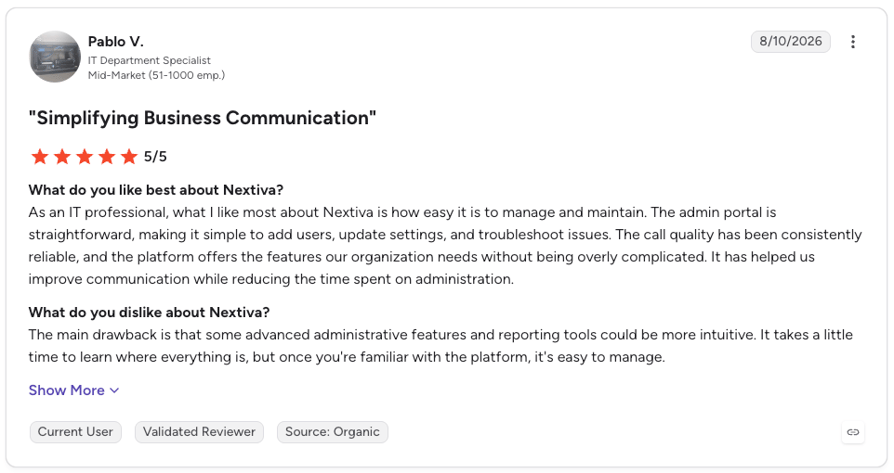
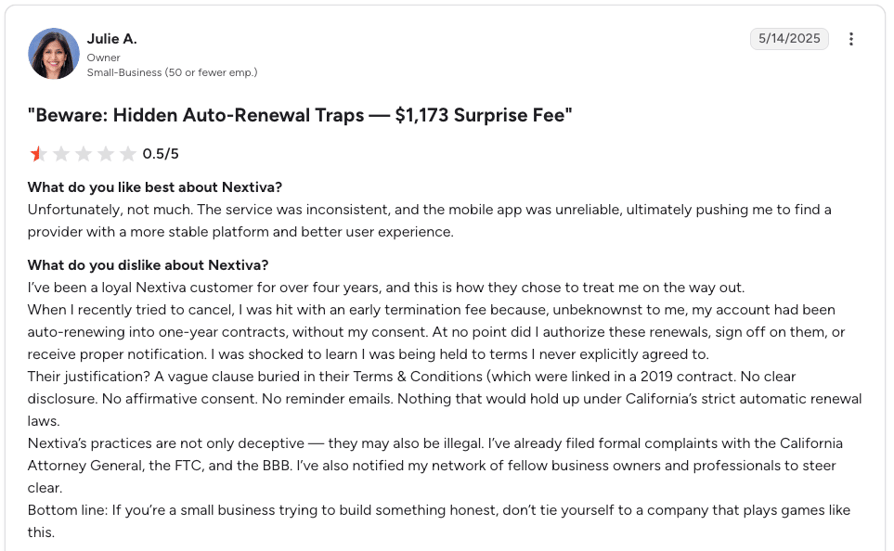
What Real Users Say About Nextiva?
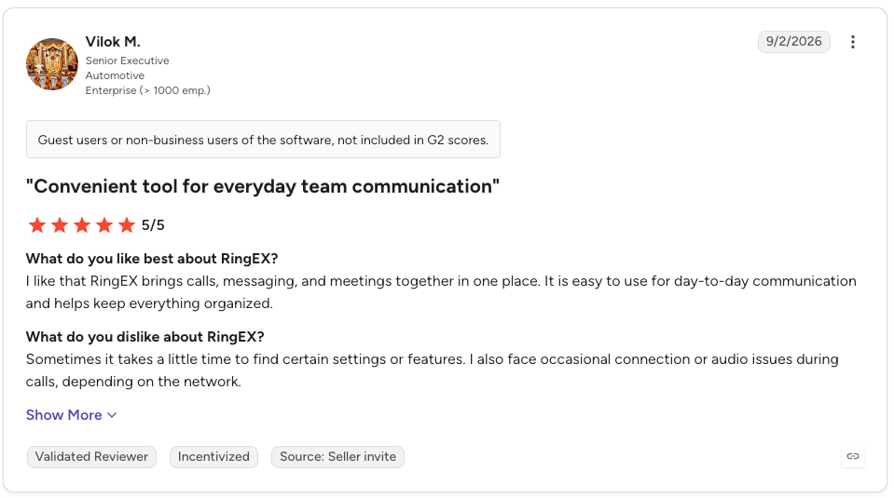
What Real Users Say About RingCentral?
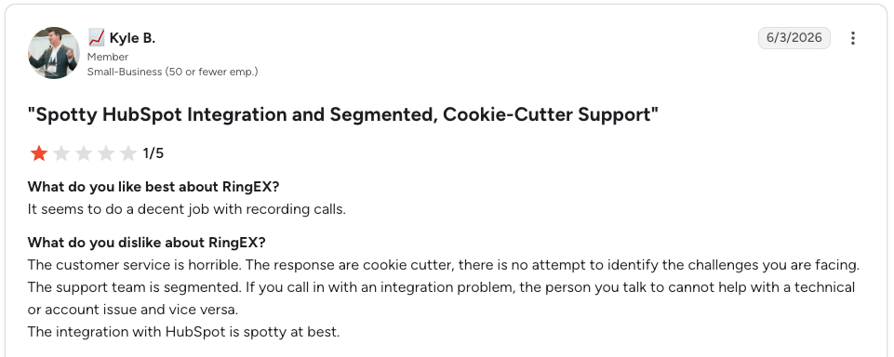
Nextiva Reviews vs. RingCentral Reviews on Reddit & Quora
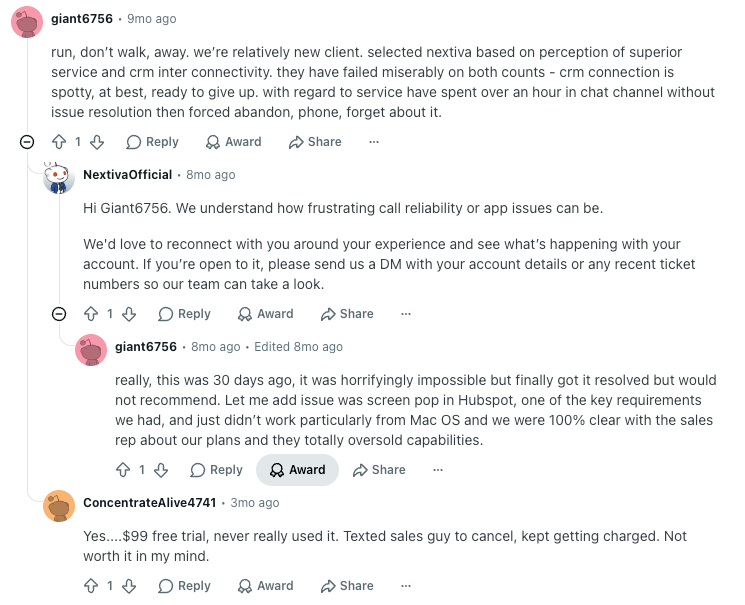
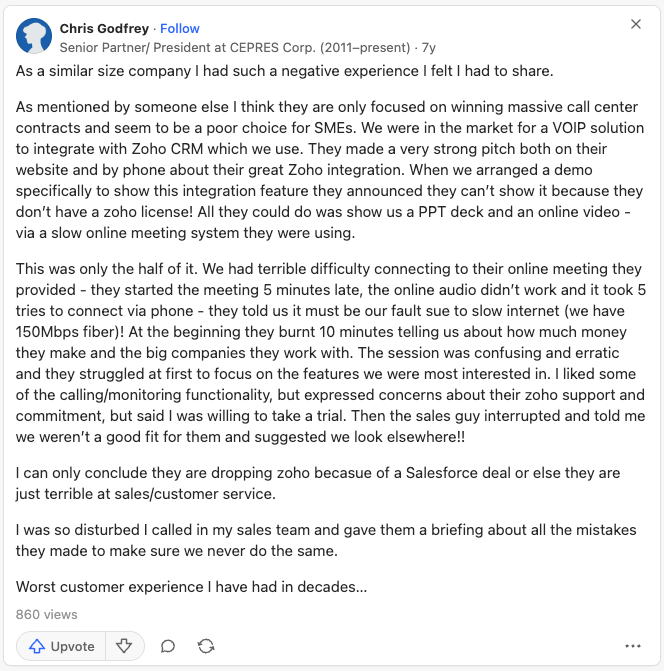
Peer review sites capture considered opinions; Reddit and Quora capture what people say when they're annoyed. Search nextiva vs ringcentral reddit and a pattern shows up that no top-ranking comparison page frames properly, so it's worth naming directly.
What Real Users Say About Nextiva On Reddit & Quora
Nextiva's complaints cluster on reliability and integrations.
What Real Users Say About RingCentral On Reddit & Quora
RingCentral's complaints cluster on customer support.
Nextiva Pros & Cons vs. RingCentral Pros & Cons
Six pros and six cons each, drawn from the vendors' own documentation and from recurring patterns in public user discussion.
Nextiva Pros & Cons
| Pros | Cons |
|---|---|
| Easier to set up and administer without a specialist | Short integration marketplace with only two native helpdesk connectors |
| Support responsiveness is its strongest review theme | CRM integration sold as an add-on at every UCaaS tier |
| One vendor across phone, contact center and digital channels | No published international number coverage |
| Unlimited domestic calling on every tier | No locatable SLA document behind the marketed 99.999% |
| Low published entry price on annual billing, at $15/user/month | Mobile app and SMS reliability reports recur in user discussion |
| HITRUST practices alongside HIPAA and a signed BAA | No public developer or API platform, so Zapier is the fallback |
RingCentral Pros & Cons
| Pros | Cons |
|---|---|
| Large pre-built integration catalog | Support access is its most-cited weakness |
| Open API platform with language SDKs | Steeper learning curve and multi-step admin |
| Published multi-country number, PSTN and BYOC coverage | No CRM integration below Advanced |
| Contractual uptime SLA with service credits | AI Receptionist and Conversational Intelligence remain add-ons even on Ultra |
| RingCX with AI quality management across every interaction | Lowest included SMS at entry, with no unlimited SMS tier |
| Agentic AI suite with an 11-language AI receptionist | Auto-renewing terms with a 30-day notice requirement |
Want a Third Data Point Before You Commit?
Which Team Fits Which Platform?
Read both columns and pick the one that describes your team, which is also the practical way to settle Nextiva or RingCentral for small business questions.
If neither column fits cleanly, write your call center software requirements down first and shop against that list instead.
| Nextiva is the right fit for... | RingCentral is the right fit for... |
|---|---|
| Small and mid-sized US or Canada teams without a dedicated IT or VoIP admin | Teams operating across multiple countries and needing local numbers |
| Teams that rate support responsiveness above feature breadth | Integration- or API-heavy teams building custom workflows |
| Teams that want one vendor for phone and contact center | Teams that need a contractual uptime SLA with service credits |
| Budget-conscious teams that qualify for the annual entry rate | Contact centers wanting AI quality management across every interaction |
| Healthcare and other teams that value HITRUST alongside HIPAA | Larger organizations with admin resource to configure and maintain the platform |
Nextiva vs. RingCentral: The Verdict
The choice between these two comes down to what your team needs: simplicity and responsive support in a mostly domestic footprint, or breadth and global reach with the admin capacity to run it.
Neither answer says anything about which product is better built. Both platforms deliver what they're designed for; they're just designed for different teams.
The bottom line: both platforms are strong at what they're built for, and there's no overall winner to declare here. The deciding factors are your footprint, your integration requirements and how much admin capacity you can spare, not the products themselves.
If neither set of trade-offs fits, look wider. CloudTalk combines native Salesforce, HubSpot and Pipedrive sync, numbers in 160+ countries, an auto dialer with multiple dialing modes, and AI conversation intelligence in one platform. Our roundup of alternatives to Nextiva covers the strongest Nextiva alternative options, the best RingCentral alternatives guide does the same on that side, and CloudTalk vs RingCentral goes head to head.
Frequently Asked Questions about Nextiva vs RingCentral
Quick answers on pricing, contact center differences, support, porting and cancellation for Nextiva and RingCentral.
Nextiva publishes the lower entry rate: Core is $15/user/month on annual billing. That rate applies only to new customers with 1–100 employees signing a 12-month or longer term.
For a small business shopping the business VoIP market without a dedicated IT or VoIP admin, Nextiva is usually the easier platform to live with: simpler setup, a console a generalist can run, and support responsiveness as its strongest review theme. RingCentral becomes the better fit as soon as you need local numbers outside North America, CRM integration included rather than added, or a developer-accessible API. Neither is universally better for small teams.
Nextiva is a US and Canada-centric platform that puts phone, contact center and digital channels under one vendor and optimizes for simple administration. RingCentral is modular and global: RingEX for phone and messaging, RingCX for contact center, RingWEM for workforce engagement, plus an open API platform and published multi-country number coverage. Both sit near the top of any list of VoIP providers.
RingCX is RingCentral's dedicated contact center product, priced per agent and separate from RingEX, with preview, progressive and predictive dialing, voice broadcast, and AI call center quality management that scores every interaction. Nextiva Contact Center is part of the same platform as its phone system, starts at $75/agent/month on the Essential tier, and offers four dialer modes, with the more aggressive ones gated to Professional and above. Comparing RingEX to Nextiva Contact Center, which several comparison pages do, gets the channel list wrong.
Both are AI voice agents priced differently enough that "better" depends on your volume. RingCentral's AI Receptionist starts at $39/month with a minute allowance and supports 11 languages. Nextiva's XBert comes in AI plans from $99/month billed against a bundle of AI conversations, and Nextiva publishes no supported-language list. If your inbound is multilingual, RingCentral has the documented advantage; if you prefer bundled conversations to per-minute metering, ask Nextiva what counts as a conversation before you sign.
Nextiva has the stronger reputation here, and responsive support is the most consistent theme in its reviews. Reaching RingCentral's support is the complaint recorded most often against it on peer review platforms.
Yes. US number portability means you own the number, not the carrier, and a port-out is initiated by the provider you're moving to rather than the one you're leaving. Both vendors attract complaints about port-out friction and about being billed after cancellation, so start the port before you cancel and keep the account active until the numbers have moved. Timelines vary by carrier, so check how long number porting takes before you set a cutover date.
Neither is a one-click cancellation. RingCentral's terms of service state that recurring services automatically renew for successive periods matching the Initial Term unless either party gives notice at least 30 days before the current term ends, and the Initial Term itself is set on your Order Form. Nextiva's advertised annual pricing requires a 12-month or longer minimum term. Diary the notice date when you sign and build the notice period into your VoIP implementation plan; missing it is what most cancellation complaints about both vendors come down to.
Both support international calling, but only RingCentral publishes country-level coverage for its VoIP numbers, including where it has local PSTN service and where BYOC is available. Nextiva publishes per-minute international rates and confirmed local numbers in the US and Canada, but no country count.
That depends on which trade-off pushed you away. Teams leaving Nextiva usually want more integrations and real international coverage; teams leaving RingCentral usually want simpler administration and fewer add-ons. Among nextiva competitors, CloudTalk covers native Salesforce, HubSpot and Pipedrive sync, virtual numbers in 160+ countries, auto dialer with multiple dialing modes, and AI conversation intelligence.