TL;DR:
Salesloft publishes no prices. It sells two packages, Advanced and Elite, both quote-only and both on annual contracts with no monthly billing and no free trial. Procurement platform Vendr reports a median annual contract of $30,740 across 710 purchases, with buyers saving 18% against the opening quote.
The packaging changed in August 2025. Essentials, Prospect, Premier and Enterprise are retired, and most pricing guides online still describe the old structure. Four capabilities now sit outside both packages as paid add-ons.
Four things the quote will not tell you:
- Calling is not included in any package. The Dialer is a separate add-on, even on Elite, and mobile calling needs it too.
- Forecasting is an add-on, not a tier feature. Older guides place it on the retired Premier plan as the reason to upgrade. It now attaches to either package for a separate fee.
- Elite adds three things, not a product tier. Multi-team admin, a sandbox, and custom Salesforce object signals. Most teams do not need it.
- Budget 25% to 40% above the seat quote for onboarding, escalators and add-ons.
For a published-price comparison, CloudTalk pricing lists every plan and add-on up front. Here is the whole picture at a glance:
| Plan | Best For | Starting Price | Add-Ons | Free Trial |
|---|---|---|---|---|
| Advanced | Revenue teams building pipeline on a single business unit | Quote only, reported $125 to $150/user/mo | Dialer, Forecasting, Account Agent, Coaching Agent | No |
| Elite | Complex orgs needing multi-team admin and custom Salesforce objects | Quote only, reported $165 to $200+/user/mo | Same four add-ons | No |
| Dialer add-on | Any team that calls | Reported $300 to $400/user/year | LocalDial $1 per number/mo | No |
| Onboarding | One-off, year one | $5,000 to $25,000+ | n/a | n/a |
Add to every row: annual contracts only, a reported 10 to 15 seat minimum, and escalators of 5% to 12% a year.
How Much Does Salesloft Cost in 2026?
The median Salesloft buyer pays $30,740 per year, according to procurement platform Vendr, which bases that figure on 710 recorded purchases and reports an average saving of 18% against the opening quote. Actual contracts in its dataset run from $5,152 to $146,494. Per seat, most mid-market teams land between $100 and $130 per user per month, against a reported list of $125 to $165.
Salesloft sells two packages, Advanced and Elite, both quote-only and both on annual contracts with no monthly billing option. There is no free trial. Four capabilities sit outside the packages and are priced separately: the Dialer, Forecasting, Account Agent and Coaching Agent. Calling is the one most teams get caught by, because it is not included in any package, including the top tier.
For context on what the category costs more broadly, our guide to call center software pricing breaks down how per-seat, per-minute and add-on models compare.
Salesloft Plans: Advanced vs Elite
Salesloft consolidated its packaging in August 2025. According to Salesloft's own packages documentation, the old four-tier lineup of Essentials, Prospect, Premier and Enterprise is retired, and existing customers now see those licences marked as "Legacy" in user management. Most pricing guides still published online describe the old structure, so check the tier names on any quote you are given against what Salesloft currently sells.
Both packages share almost everything. Rhythm, Conversations, Deals, Cadence, Coaching, Sales Email, the Ask Salesloft Agent, Automation, Calendaring, Mobile App access, CRM Sync, Security and Compliance, Analytics and the Partner Ecosystem are all included at both levels.
Salesloft Advanced: Reported $125 to $150 per User/Month
Advanced is the entry package and where most buyers land. It covers the full engagement workflow: automated cadences across email and calls, conversation intelligence with recording and AI insight, deal and pipeline management, Rhythm's signal-driven task prioritisation, and two-way CRM sync. Billing is annual only, quoted per seat, and buyers report minimums in the region of 10 to 15 users.
What you get on top of a standalone sequencing tool:
- Conversation intelligence included rather than sold as a module
- Deal and opportunity management, provided your CRM is Salesforce
- Rhythm, which converts buyer signals into a ranked task list for reps
- Coaching workflows built on recorded calls
- Analytics across the full buyer journey
- Two-way CRM sync, the same pattern covered in our guide to VoIP CRM integration
Advanced suits a single sales organisation of roughly 15 reps or more with someone to administer it. The value case holds if your team genuinely lives in cadences, because that is the engine you are paying for. The limitation is that it does not include calling, so a team whose main activity is outbound dialling pays full platform price and then buys the Dialer on top. If your reps mostly phone rather than email, you are funding a lot of capability you will not open.
Salesloft Elite: Reported $165 to $200+ per User/Month
Elite is everything in Advanced plus three enterprise controls. It is aimed at organisations running several business units or a heavily customised Salesforce instance.
Elite adds exactly three things:
- Multi-team: managing multiple orgs from a single admin experience
- Sandbox: a non-production environment for testing changes safely
- No-code custom object signals: triggering plays from custom Salesforce objects
The honest read is that most teams do not need Elite. If you are not running multiple business units, do not maintain custom Salesforce objects, and do not need a testing environment, Advanced covers the same product. The uplift between tiers is governance, not capability, so ask your rep to justify the step up against those three features specifically rather than accepting Elite as the default enterprise option.
What Are Salesloft's Add-Ons?
Four capabilities are quoted separately from the packages. This is where the real cost of a Salesloft contract accumulates, and it is the part most buyers underestimate when they compare a per-seat figure against another vendor's.
| Add-on | What it does | Attaches to |
|---|---|---|
| Dialer | Calling from the Salesloft app and Chrome, with recording and automatic activity logging | Any package, required for mobile calling too |
| Forecasting | Automatic forecast roll-up and submission, plus AI-driven next actions on deals | Any package |
| Account Agent | Buyer identification, account research and person research agents | Any package |
| Coaching Agent | The Sales Strategist agent: live guidance for reps, coaching insight for managers | Any package |
If you are comparing dialer add-ons across vendors, our roundups of Salesforce dialer pricing and HubSpot calling pricing show the same add-on pattern elsewhere.
Two points worth flagging, because they are commonly reported the other way around. Forecasting is an add-on, not a feature of the top tier. Older guides place it on the retired Premier plan and treat it as the reason to upgrade; it now attaches to either package for a separate fee. And Conversations is included on both packages, so you should not be quoted for it as an expansion.
On cost, Vendr's benchmark data puts conversation intelligence at 20% to 40% of base platform cost, workflow automation at 15% to 30%, and pipeline analytics at 10% to 20%. Those percentages were recorded against the previous module names, so treat them as the shape of the uplift rather than a quote for a specific add-on.
How Much Does the Salesloft Dialer Cost?
Salesloft does not publish a per-user price for the Dialer. Third-party trackers report figures in the range of $300 to $400 per user per year, but that number does not come from Salesloft, so treat it as reported rather than confirmed. Our Salesloft dialer pricing guide goes deeper on the calling side.
What Salesloft does publish, in its Dialer Pricing Guide, are the purchasing options:
| Purchasing option | Description | Price |
|---|---|---|
| Unlimited Talk & Text North America | Unlimited calling to the US, Canada and other (+1) regions including the Caribbean | Contact Sales |
| Unlimited Talk Europe | Unlimited calling to 33 designated European countries at a flat rate | Contact Sales |
| LocalDial Numbers | Local area codes for higher answer rates | $1 per number/month, plus $1 to provision a new number in its first month |
| Unlimited LocalDial U.S. | Local presence across all US area codes, including Alaska and Hawaii | No additional monthly charge |
Two details that work in Salesloft's favour and rarely appear in comparisons: call recording and recording storage carry no charge, and Unlimited LocalDial in the US genuinely costs nothing extra. Outside the US, Canadian and international LocalDial numbers stay on standard $1 per number pricing.
What Will Salesloft Actually Cost?
Per-seat pricing only tells you the opening position. The table below models three realistic teams on Advanced with the Dialer, using the mid-point of the reported ranges ($130/user/month platform, $350/user/year dialer) and adding onboarding at the lower end of the reported band.
| Scenario | Seats | Platform per year | Dialer per year | Onboarding (year 1) | Year 1 total |
|---|---|---|---|---|---|
| Small team getting started | 10 | $15,600 | $3,500 | $5,000 | $24,100 |
| Growing mid-market team | 25 | $39,000 | $8,750 | $10,000 | $57,750 |
| Established sales org | 50 | $78,000 | $17,500 | $15,000 | $110,500 |
If you want to model this against your own call volume rather than seat count, our outbound call center metrics guide covers the inputs worth tracking.
Note that the 25-seat scenario lands close to Vendr's reported median of $30,740 once you strip out onboarding and assume a negotiated rate nearer $100 per seat. That is the gap between list and settled price doing its work.
Three-Year Cost for a 10-Seat Team
Annual escalators are where multi-year budgets drift. Vendr reports standard increases of 5% to 8% in Salesloft contracts; Woodpecker, citing Landbase data, reports 8% to 12%. Using 8% as a middle figure on a 10-seat team on Advanced with the Dialer:
- Year 1: $19,100 subscription, plus $5,000 onboarding, for $24,100
- Year 2: $20,628 subscription
- Year 3: $22,278 subscription
- Three-year total: roughly $67,006
That sits inside the $54,000 to $73,800 three-year range Woodpecker publishes for a comparable team, which is a reasonable sense check. Swap your own seat count into the same formula: seats multiplied by the monthly rate, multiplied by 12, plus the dialer, then compounded by your negotiated escalator.
The practical lesson is that the escalator matters more than the opening discount on any term longer than a year. A 12% annual increase on a three-year deal costs more than most of the discounts buyers celebrate winning at signature.
Are There Hidden Costs in Salesloft?
Several costs sit outside the per-seat subscription and rarely appear on a first quote. The ranges below come from Vendr's Salesloft benchmark data.
| Cost | Reported range |
|---|---|
| Onboarding and implementation | $5,000 to $25,000+, depending on team size and integration complexity |
| Annual price escalators | 5% to 8% (Vendr); 8% to 12% (Woodpecker, citing Landbase) |
| Premium support on lower tiers | 10% to 15% of annual contract value |
| Mid-term seat additions | Pro-rated at the contracted rate, which may be above your blended rate |
| Extended data retention | Standard plans carry a defined retention window; longer storage is quoted separately |
| Custom integrations and high-volume API use | Quoted separately, outside standard CRM connectors |
Buyers who account for onboarding, add-ons and support typically budget 25% to 40% above the base subscription figure. If the dialer add-on is the line that pushes you over budget, it is worth knowing what a sales dialer should actually do before you pay for one. That is the single most useful planning number in this guide.
There are also five contract terms that change whether Salesloft belongs on your shortlist at all:
- No free trial. Access requires a demo and a sales process.
- Annual contracts only. There is no monthly billing option.
- Seat minimums apply. Buyers report 10 to 15, though Salesloft does not document a figure publicly.
- Deals requires Salesforce. If you run HubSpot or Dynamics, that module does not apply to you.
- Mobile calling requires the Dialer add-on. The mobile app alone will not place calls.
How to Negotiate a Better Salesloft Quote
Because there is no rate card, preparation moves the number here more than it would with a vendor who publishes one. Five levers consistently work:
- Engage 60 to 90 days before your decision date. Negotiating against a deadline removes your strongest position, which is the ability to walk.
- Anchor to the published benchmark ranges rather than to the first quote. Opening at $100 to $130 per seat with a reason is more effective than asking for a percentage off.
- Cross a volume threshold deliberately. Per-seat rates step down near 25, 50 and 100 seats. Committing to a higher count upfront, even if you deploy gradually, can cost less than growing into it.
- Take a multi-year term for 15% to 30% lower effective annual pricing, but cap the escalator in writing. An uncapped increase erases the discount by year three.
- Quote every add-on in the same negotiation. Price them against standalone dialer providers so you know what each module is worth on its own. Bundling the Dialer, Forecasting and the agents together is where the largest concessions sit. Buying them one at a time later costs more.
What Do Buyers Say About Salesloft's Pricing?
Recurring themes across review platforms and procurement data point in the same direction, and they are about structure rather than value.
Pricing opacity is the most consistent complaint. With no public rate, comparable companies pay materially different amounts for the same configuration, which rewards buyers with procurement support and penalises those without. It also makes internal budgeting difficult before a sales cycle has run.
Per-seat cost scales awkwardly. There is no role-based pricing, so a manager who only reads reports carries the same licence cost as a rep running full cadences and calls. Teams with a mix of heavy and light users feel this quickly.
Implementation is a real line item, not a formality. Reviewers describe CRM integration work that needs technical resource, and new reps typically taking two to four weeks to reach full productivity. Neither cost appears on a quote.
If cadence discipline is the reason you are buying, our guide to building an efficient sales cadence covers what the workflow should deliver.
Post-merger uncertainty is now part of the conversation. Since the Clari combination, buyers report questions about roadmap direction and which capabilities will be bundled, retained or consolidated.
What the Clari Merger Means for Your Quote
Salesloft's merger with revenue platform Clari closed on 3 December 2025, with Steve Cox leading the combined company. Both platforms still operate largely in parallel, and the company describes full unification as a multi-year project. Clari Forecast and Inspect now sit inside Salesloft's own product navigation, which means forecasting-led bundling will come up in your renewal conversation whether you ask for it or not.
Because Deals and the custom object signals both depend on Salesforce, teams on that CRM are the most exposed to packaging changes; our roundup of dialers for Salesforce covers the calling side if you decide to unbundle.
Three questions to take into that call:
- Which Clari capabilities are available on my package today, as opposed to on the roadmap?
- What happens to my price if packaging changes mid-term?
- Will you cap the annual increase for the full contract term, in writing?
Which Alternatives Are Better Value Than Salesloft?
In the following, here are several other options you might consider before making the final call:
CloudTalk: Best for Teams Whose Main Activity Is Calling
What Is CloudTalk?
CloudTalk is a cloud phone system built for sales and support teams, with Power Dialer, Smart Dialer, call routing, recording and analytics in the product rather than sold alongside it. It covers numbers in 160 countries and integrates with the CRM and helpdesk tools most revenue teams already run. Where Salesloft orchestrates a revenue motion, CloudTalk runs the phone.
Key Features
- Power Dialer and Smart Dialer, included rather than sold as an add-on
- IVR and skill-based call routing from the entry plan
- Call recording with unlimited storage from Essential upward
- Local and toll-free numbers in 160 countries
- 95+ CRM and helpdesk integrations, including a native Salesloft connector
- Call monitoring, VIP queues and real-time analytics
How Much Does CloudTalk Cost?
Flexible Pricing Plans to Scale with You
Compare our plans
Pros and Cons
| Pros | Cons |
|---|---|
| Every plan and add-on price published, no quote required | Not a sales engagement platform: no cadences or forecasting |
| Dialers included on Expert instead of a separate licence | AI Conversation Intelligence is a paid add-on |
| 14-day free trial, no mandatory annual contract | Deal management lives in your CRM, not in CloudTalk |
| Numbers in 160 countries with local presence | Built for calling teams rather than email-led outbound |
What G2 Users Say About CloudTalk
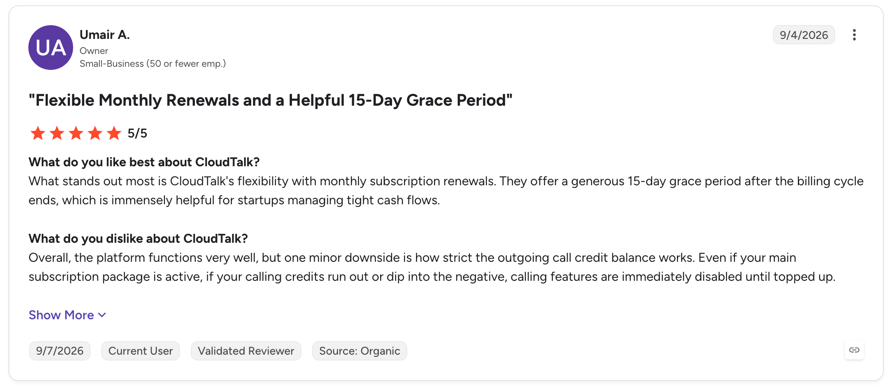
CloudTalk holds 4.4/5 on G2 from 1960 reviews. Reviewers consistently highlight call quality, the speed of setup and the depth of the CRM integrations, with routing and analytics named most often as the reason teams consolidate onto it.
Outreach: Best for Enterprises Wanting Deeper AI in the Same Category
What Is Outreach?
Outreach is Salesloft's closest direct competitor and sits in the same sales engagement category, covering sequences, conversation intelligence, deal management and forecasting. It sells Standard, Professional and Enterprise tiers, all quote-only, and is typically bought by larger organisations with a dedicated admin.
Key Features
- Multi-step sequences across email, phone and social
- Outreach Voice for sequential dialling on call tasks
- Kaia conversation intelligence with live content cards
- Commit for revenue forecasting, priced separately
- Deep Salesforce and Microsoft Dynamics integrations, including custom object sync
How Much Does Outreach Cost?
Vendr's data puts the median Outreach contract at $45,600 per year across 921 purchases, with a range of $8,700 to $215,400 and an average saving of 12%. That is noticeably above Salesloft's $30,740 median. Pricing is per seat plus consumption-based AI credits, and Kaia, conversation intelligence and Commit are each quoted separately. Onboarding runs on the same $5,000 to $25,000+ pattern.
Pros and Cons
| Pros | Cons |
|---|---|
| Deeper AI tooling than Salesloft at enterprise scale | Higher median contract value than Salesloft |
| Published pricing model, even though rates are quoted | Consumption-based AI credits make bills harder to predict |
| Strong Salesforce and Dynamics custom object support | Calling needs Outreach Voice set up and permissioned |
| Mature sequence logic and reporting | Steeper admin burden, needs a dedicated owner |
What G2 Users Say About Outreach
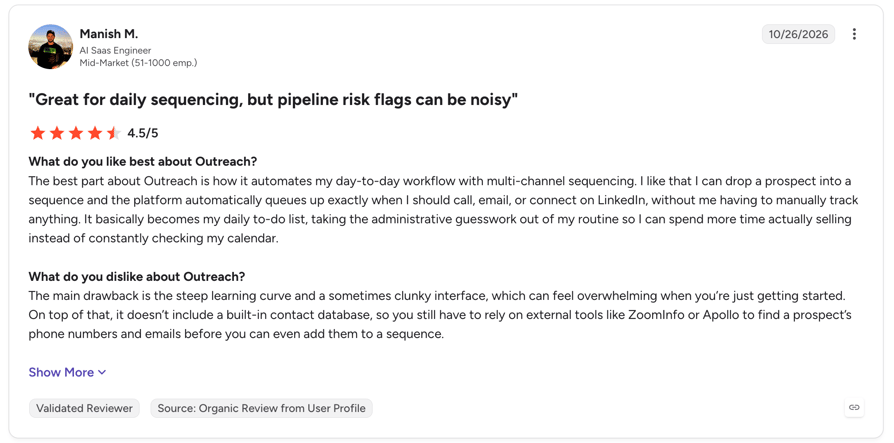
Outreach is rated 4.3/5 by 3,600+ verified users on the platform.
Gong: Best for Conversation Intelligence as the Primary Job
What Is Gong?
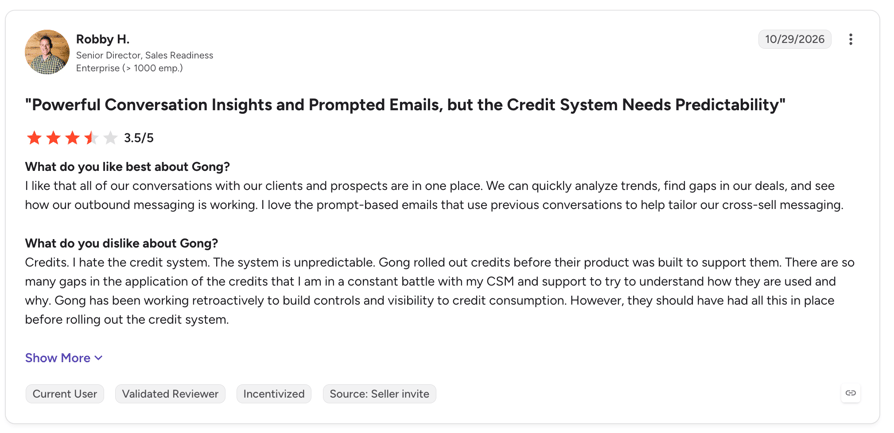
Gong is a revenue intelligence platform built around recording, transcribing and analysing customer conversations. If the reason you are evaluating Salesloft is call coaching rather than cadences, Gong is the specialist in that category and is worth pricing on its own rather than as part of an engagement platform.
Key Features
- Call and meeting recording with automatic transcription
- Deal intelligence and pipeline risk signals
- Coaching workflows built on real conversation data
- Market intelligence across competitor and objection mentions
- Gong Engage for sequences, sold alongside the core platform
How Much Does Gong Cost?
Gong does not publish pricing. Buyers report a platform fee plus a per-seat licence, with the platform fee typically quoted annually and separately from seats, so the entry cost is higher than a pure per-seat tool. Expect an annual contract and a seat minimum, as with Salesloft.
Pros and Cons
| Pros | Cons |
|---|---|
| Best-in-class conversation intelligence and coaching | No published pricing, and a platform fee on top of seats |
| Strong deal and pipeline risk signals | Overlaps with Salesloft Conversations if you run both |
| Useful market intelligence across recorded calls | Not a phone system: it analyses calls rather than placing them |
| Mature integrations with major CRMs | Expensive for teams that only need recording |
What G2 Users Say About Gong
Gong is rated 4.7/5 by 6,700+ verified users on the platfom.
Running Both: The Option Most Teams Miss
You do not necessarily have to choose. CloudTalk's Salesloft integration logs calls and outcomes back into Salesloft cadences automatically, so reps keep the engagement workflow they already use while calls run on a platform built for volume. For teams that like Salesloft but balk at the Dialer add-on, this is usually the cheaper path.
Is Salesloft Worth It? Who Should Buy It
You are a mid-market or enterprise revenue team of roughly 15 reps or more, you run structured multi-touch cadences as your core motion, you have Salesforce and someone to administer the platform, and email and workflow orchestration matter more to you than call volume. For that team the cadence engine, conversation intelligence and deal management genuinely justify the per-seat cost, and Advanced will almost certainly cover you without stepping up to Elite.
Your team is under 10 seats, you cannot commit to an annual contract before testing, you need a published price to get budget approved, or calling is the main thing your reps do all day. That last case is the most common mismatch: paying platform price plus a dialer add-on to make calls is an expensive way to buy a phone system, and an AI sales dialer will usually do the job for less, and it is where a dedicated power dialer costs substantially less.
FAQs: Salesloft Pricing
Salesloft does not publish per-user pricing. Procurement platform Vendr reports a median annual contract of $30,740 across 710 purchases, which works out to roughly $100 to $130 per user per month for most mid-market teams against a reported list of $125 to $165. Your quote depends on seat count, contract term and which of the four add-ons you take.
Two: Advanced and Elite. Salesloft retired Essentials, Prospect, Premier and Enterprise in August 2025, and existing customers see those licences marked as Legacy. Elite adds multi-team management, a sandbox environment and no-code custom object signals. Everything else is shared between the two.
No. Calling requires the Dialer add-on on every package, including Elite, and mobile calling needs it too. Third-party trackers report roughly $300 to $400 per user per year, though Salesloft publishes no per-user figure. By comparison, CloudTalk includes Smart and Power Dialers in its published Expert plan.
No. Forecasting is a paid add-on that attaches to either package. This is a common error in older pricing guides, which place it on the retired Premier tier and describe it as the reason to upgrade. Under current packaging, moving from Advanced to Elite does not get you forecasting.
No. There is no free trial and no free plan. Access requires booking a demo and going through a sales process, and contracts are annual with no monthly billing option. If testing before committing matters to you, that is a meaningful constraint.
Salesloft does not document a seat minimum publicly. Buyers and procurement platforms report minimums in the range of 10 to 15 users depending on package and region. Treat any figure you read, including this one, as unconfirmed and ask your rep to put the minimum in writing.
They are close competitors with similar quote-based pricing. Salesloft is generally considered easier to adopt and strong on cadence automation, while Outreach leans into deeper AI for large enterprises and carries a higher median contract value. Both require add-ons or an integration for serious calling, so compare them on sales dialer capability separately from the platform.
No. Salesloft is a sales engagement platform that sits on top of your CRM, automating outreach workflows and syncing activity data back to systems like Salesforce rather than replacing them. Its Deals module is only available to customers running Salesforce, and it syncs activity the same way a Salesloft phone integration does.
The merger closed on 3 December 2025, with Steve Cox leading the combined company. Both platforms still run largely in parallel and full unification is described as a multi-year project. For buyers, the practical effect is forecasting-led bundling in sales and renewal conversations, so negotiate price protection accordingly.
There are no published discounts, but because every price is negotiated, discounts are common in practice. The reliable levers are multi-year terms, crossing a seat threshold at 25, 50 or 100 users, and bundling add-ons into the initial deal. Always ask for the annual increase to be capped in writing.