10 Best Amazon Connect Alternatives in 2026: Tested & G2-Rated
Amazon Connect was a reasonable place to start. It runs on AWS, and it bills per minute instead of per seat, so you never pay for an idle agent. The wall usually shows up later, when a routing tweak becomes a Lambda ticket, a brand-new instance caps out at 10 concurrent calls until support approves a quota increase, and the monthly invoice arrives as eleven separately metered line items. Below are the 10 best Amazon Connect alternatives for 2026, from dedicated Amazon Connect VoIP alternatives to full enterprise CCaaS platforms, with real prices and the specific team each one suits.
TL;DR: 10 Best Alternatives to Amazon Connect
| # | Tool | Best For | Starting Price (annual billing) | G2 Rating |
|---|---|---|---|---|
| 1 | CloudTalk | Global sales and support teams that need a contact center, not a construction project | $25 per user/mo | 4.4/5 |
| 2 | Genesys Cloud CX | Enterprise workforce engagement management out of the box | $75 per user/mo | 4.4/5 |
| 3 | Five9 | Outbound dialer operations at enterprise volume | $119/seat/mo (digital); voice from $159 | 4.1/5 |
| 4 | Talkdesk | Fast mid-market deployment with industry accelerators | $85/user/mo (digital); voice from $105 | 4.4/5 |
| 5 | NiCE CXone Mpower | Regulated enterprises with heavy workforce-optimization needs | Quote-based | 4.3/5 |
| 6 | Twilio Flex | Engineering teams that want programmable control without AWS lock-in | $35 per monthly active user | 4.1/5 |
| 7 | RingCentral RingCX | Consolidating UCaaS and contact center on one bill | $65 per agent/mo | 4.3/5 |
| 8 | Dialpad | Real-time AI transcription and live coaching | $15/user/mo (phone system; contact center priced separately) | 4.4/5 |
| 9 | 8x8 | Global voice coverage across UCaaS and contact center | Not publicly listed | 4.2/5 |
| 10 | Zendesk Talk | Voice inside an existing ticketing workspace | $19/agent/mo (Talk minutes metered separately) | No rating yet |
Skip the reading. See it live.
Why Are Teams Searching for an Amazon Connect Alternative?
Amazon Connect is a capable platform, and the honest criticism has nothing to do with missing features. AWS sells contact-center infrastructure; most teams shopping for it wanted a contact center, and the gap only shows up once you’re inside. Amazon Connect holds 4.4/5 on G2 from 92 reviews, and the six cons below are evidenced against AWS’s own pricing pages, quota tables and admin guide rather than against opinion.
6 Main Cons of Amazon Connect That Make Businesses Look for an Alternative
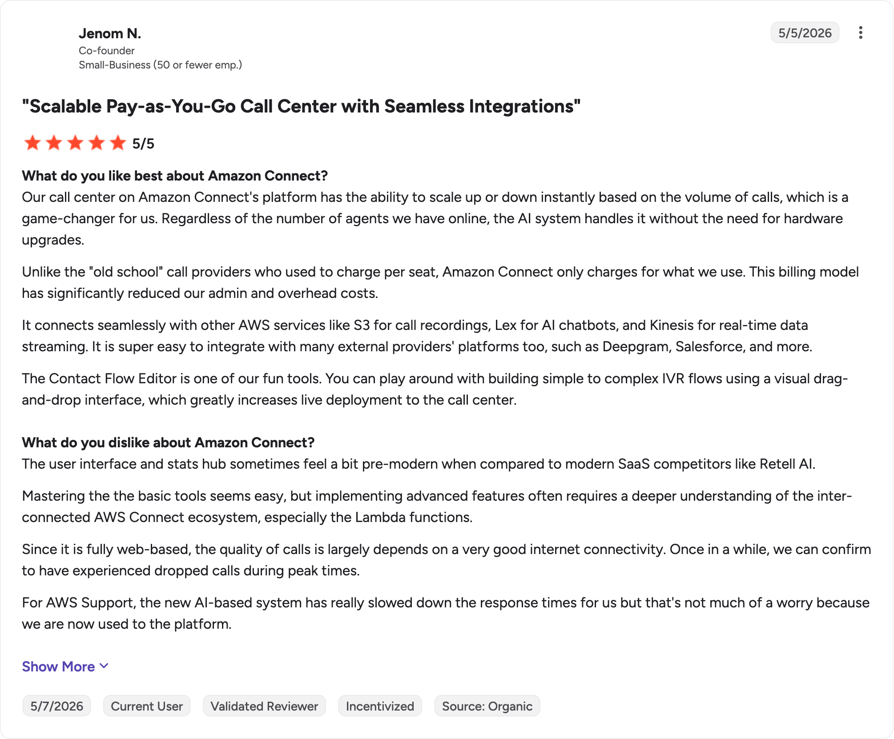
- You Need AWS Engineers Before You Can Take a CallA new instance handles 10 concurrent active calls by default, and lifting that quota means filing a support request first. Custom logic runs on Lambda (capped at 50 functions per instance); bots run on Lex (capped at 70, no option to raise it). Most cloud contact center software hands you queues, routing and a working number on day one instead. Per Salesforce’s 2026 State of Service report, 70% of AI-service-agent adopters see value within 60 days1, a pace you can’t hit when day one is a quota ticket.
- Standard Contact Center Features Are Separately MeteredOn the legacy Customer Basic tier, forecasting and scheduling cost $27/agent/month and performance evaluations $12/agent/month, on top of every per-minute charge, despite AWS marketing "no seat-based licensing." The FinOps Foundation’s 2026 survey found 98% of practitioners now manage AI spend, up from 63% a year earlier.2 Metered AI is exactly what’s hardest to govern.
- There Is No Native CRM, So Every Integration Is a ProjectAmazon Connect ships no CRM layer of its own. Salesforce, Zendesk and ServiceNow connect through integration work you build and then own forever, so every CRM change becomes a ticket for whoever wrote the connector. A platform with pre-built native CRM integrations turns that project into a checkbox.
- Reporting, Logic and Bots All Route Back Through AWSNative dashboards cover the basics; anything past that routes through Amazon QuickSight or a third-party BI tool. Logic lives in Lambda, bots live in Lex, and voice from outside AWS needs an external connector at $0.032/minute plus $100/connector/day. If your stack isn’t already AWS-native, you’re paying for a bridge at every edge of the platform.
- Routine Contact Center Tasks Turn Into Support TicketsAWS’s own admin guide documents a "You’ve reached the limit of Phone Numbers" error on the very first number you claim, and says resolving it requires Support. Claiming or porting a number is the most routine task in telephony, and the vendor’s own docs say it may need a human at AWS.
- Per-Minute Billing You Cannot ForecastThe current Customer tier charges $0.038/minute plus telephony, up 111% from the legacy tier’s $0.018. AWS’s own example: a 75-agent center running 100,000 voice minutes, 50,000 chats and 20,000 SMS lands at $4,800.90/month, roughly $64/agent, before fees, taxes, Cases or Customer Profiles charges. Flexera’s 2026 report found wasted cloud spend rose to 29%, the first increase in five years.3 A bill built from minutes, messages, cases, connectors and per-agent fees is hard to forecast even when you know every rate.
What Is the Best Alternative to Amazon Connect?
CloudTalk is the best Amazon Connect alternative for global sales and support teams that want routing, dialing and CRM sync working on day one. It starts at $25/user/month on Starter, carries a 99.999% uptime SLA, and needs no AWS expertise.
Why Do Teams Consider CloudTalk the Best Amazon Connect Alternative?
Fit matters more here than displacement. Amazon Connect sells cloud primitives to teams that want to build; CloudTalk sells a working contact center to teams that want to run one. If your evaluation started because a routing change needed a developer, that difference is the whole decision.
CloudTalk runs on a geographically distributed, decentralized SIP architecture with multiple backup carriers, serves 5,500+ customers across 100+ countries, and publishes a price list you can read without a sales call.
5 Main Pros of CloudTalk That Fix What Amazon Connect Leaves to You
5 Main Pros of CloudTalk That Fix What Amazon Connect Leaves to You
- Visual routing on the entry plan, no Lambda required (fixes con 1)The Call Flow Designer is a drag-and-drop builder for incoming call flows with 19 actions, branching logic, failover actions and real-time edits that don’t interrupt live calls. Interactive voice response (IVR) with skill and smart condition-based routing is included from the Starter plan.
- True two-way CRM sync instead of a connector you maintain (fixes con 3)100+ native integrations bring two-way sync of contacts, calls, recordings, AI summaries and tags, plus click-to-call and computer telephony integration (CTI) screen-pops inside the partner UI. Integrations start on the Essential plan; the Salesforce Ecosystem integration sits on Expert.
- A borderless number footprint on one contract (fixes con 4)Local and international numbers in 160+ countries with number porting and anti-spam number protection, so international coverage doesn’t mean an external voice connector billed by the day.
- Flat, published per-user pricing (fixes cons 2 and 6)Three tiers, a public add-on rate card, and a bill that doesn’t move because a campaign went well.
- 24/7 live support (fixes con 5)Live support is included from the Essential plan, and the people answering do contact centers rather than infrastructure.
Two of those pillars have customers attached to them. Pipedrive gets 100% of its call activity logged automatically into its CRM across global teams, which is precisely the two-way sync Amazon Connect expects you to build and then maintain. Allycom, a financial services provider, reached 100% reliable call recording across 100 countries without assembling regional infrastructure to do it.
14 days is enough to know.
How We Chose The Best Amazon Connect Alternatives and Competitors
For nearly a decade, we’ve helped over 30,000+ professionals find and implement smarter business communication tools. We’ve reviewed 200+ software tools across industries, analyzed 5,500+ verified customer reviews from platforms like G2, Capterra and Trustpilot, and drawn insights from real user discussions on Reddit and Quora. In the past year alone we published 1,000+ articles, each one written by humans for humans.
Every price in this Amazon Connect alternatives 2026 roundup was read on the vendor’s own pricing page rather than copied from another listicle, which is why some entries say "quote-based" instead of guessing. Amazon Connect’s figures come from AWS’s published pricing appendix and quota documentation. Where a rating couldn’t be sourced from data we already hold, we left it blank.
We scored every Amazon Connect competitor on six benchmarks:
- Call stability: carrier redundancy, architecture, and what happens when one route degrades.
- Overall costs: advertised price against the real all-in cost once add-ons, minutes and gated tiers are counted.
- CRM deep-sync: genuine two-way sync versus shallow call logging.
- Global footprint: number coverage, porting, and what international calling actually costs.
- Support response: who answers, how fast, and whether they understand contact centers.
- AI productivity: what the AI does, and whether it’s included, metered or an add-on.
One exclusion is worth explaining. We left out SMB business phone systems that can’t replace a contact-center platform, even where they top other rankings. A tool without queueing, routing depth or a dialer isn’t an Amazon Connect replacement, and putting one at #1 is how these articles lose credibility. Deloitte Digital’s 2026 contact center research found that 43% of surveyed organizations expect AI to cut contact center costs by 30% or more within three years,4 and a tool that can’t route a queue on its own won’t get anyone there.
The Top 10 Alternatives to Amazon Connect for 2026
Amazon Connect differs from the contact center as a service (CCaaS) platforms teams shortlist against it in a handful of measurable ways. Cells marked "not publicly listed" are gaps in the vendor’s own published information, not omissions on our side.
Amazon Connect vs. CloudTalk and Genesys Cloud CX
| Feature | Amazon Connect | CloudTalk | Genesys Cloud CX |
|---|---|---|---|
| Starting price (annual) | No seat license: $0.038/min voice + telephony | $25/user/mo | $75/user/mo |
| Seat minimum | None | 1 (3 on Expert) | Not publicly listed |
| Published price for every tier | Yes: per-unit rate card | Yes | Yes: four tiers |
| Bill moves with call volume | Yes: every minute, message, task and case | No: flat per user; telco metered only on non-bundled destinations | Yes: AI Experience tokens on top of the seat |
| Voice routing on the entry plan | Yes: contact flow designer, custom logic via Lambda | Yes: Call Flow Designer and IVR from Starter | Yes: CX 1 includes IVR and inbound/outbound routing |
| AI summaries | Included on the Customer tier; per-minute meter on Customer Basic | Paid add-on, $9/user/mo | Included, but consumes AI Experience tokens |
| Free trial | AWS free tier; no time-boxed product trial | 14 days | Not publicly listed |
Amazon Connect vs. Five9, Talkdesk and Twilio Flex
| Feature | Amazon Connect | Five9 | Talkdesk | Twilio Flex |
|---|---|---|---|---|
| Starting price (annual) | No seat license: $0.038/min voice + telephony | $119/seat/mo (digital); voice from $159 | $85/user/mo (digital); voice from $105 | $35 per monthly active user |
| Seat minimum | None | Not publicly listed | Not publicly listed | None published |
| Published price for every tier | Yes: per-unit rate card | No: three of five tiers quote-only | Yes: four tiers | Yes: three billing models |
| Bill moves with call volume | Yes: every minute, message, task and case | No: per seat | No: per seat | Yes: metered primitives on top of the user fee |
| Voice routing on the entry plan | Yes: contact flow designer, custom logic via Lambda | No: entry tier is digital-only | No: entry tier is digital-only | Yes: Studio, but you build it |
| AI summaries | Included on the Customer tier; per-minute meter on Customer Basic | Bundled by tier | Not publicly listed | Separate metered usage |
| Free trial | AWS free tier; no time-boxed product trial | Not publicly listed | 25 licenses + $100 credit for teams under 50 | 5,000 free active user hours |
The Amazon Connect Cost Trap:
"Pay only for what you use" reads like savings until you total the meters. AWS’s own example: a 75-agent center running 100,000 voice minutes, 50,000 chats and 20,000 SMS lands at $4,800.90/month, roughly $64/agent, before SMS fees, taxes, Cases, Customer Profiles or anything else layered on top. The two tiers make it worse: the current Customer tier charges $0.038/minute; legacy Customer Basic is cheaper at $0.018 but adds $27/agent for forecasting and $12/agent for evaluations, so $39/agent lands before a single call connects. Either way, you’re quoting your CFO a range, not a number.
CloudTalk Expert is $49/user/month billed annually, with Power Dialer, wallboards, real-time call monitoring and advanced analytics inside the seat price. A campaign that goes unusually well doesn’t change the invoice.
Explore CloudTalk Plans & Add-Ons
1. CloudTalk: The #1 Amazon Connect Alternative for Global Sales and Support Teams
What is CloudTalk?
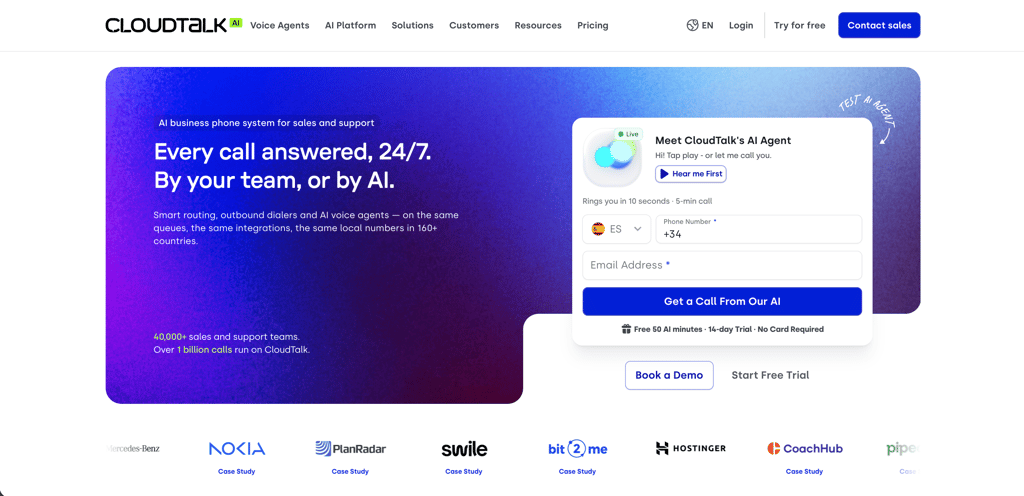
CloudTalk is global AI business calling software built for SMB and mid-market growth. It replaces on-premise PBX hardware with a cloud VoIP service that distributed sales and support teams run from a browser, desktop or mobile app, with calls, SMS, WhatsApp, recordings, transcripts and analytics in one workspace. It suits teams who need a contact center working this week.
Why Is CloudTalk a Strong Amazon Connect Alternative?
- Live in a day, not a quarterIVR, skill-based routing and the Call Flow Designer ship on the entry plan, so nothing stands between you and your first queue.
- A bill you can put in a budgetFlat per-user pricing across three published tiers, against a per-interaction model assembled from eleven-plus meters.
- CRM sync that’s already built100+ native integrations write the call, the recording, the tags and the AI summary back onto the right record on their own, and the screen-pop puts the customer’s history in front of the agent before anyone says hello.
- International coverage without a bridgeYou buy local numbers in 160+ countries on the contract you already have, so opening a new region is a purchase rather than an infrastructure project.
- Outbound that scales with the teamSmart Dialer from Essential, Power Dialer included on Expert with campaign management and real-time monitoring.
What Are the Pros & Cons of CloudTalk?
| Pros | Cons |
|---|---|
| Routing, IVR and call flows work on the entry plan with no engineering | No native video meetings or full UCaaS suite; it’s a calling platform by design |
| Published flat pricing with a public add-on rate card | AI Conversation Intelligence and AI Voice Agents are paid add-ons, never bundled into a plan |
| 100+ native two-way integrations rather than a connector you maintain | Expert carries a 3-license minimum, so a two-person team pays for three seats to reach it |
What Are CloudTalk’s Plans & Pricing?
CloudTalk pricing starts at $25/user/month billed annually ($34 monthly), with the following plans:
- Starter - $25/user/month. ACD, Call Flow Designer, IVR with skill and smart condition-based routing, unlimited call queues, softphone apps. Minimum 1 license.
- Essential - $29/user/month. Adds the public API, 100+ native integrations, Workflow Automation Designer, Smart Dialer, real-time analytics, unlimited recording storage and 24/7 live support. Minimum 1 license.
- Expert - $49/user/month. Adds Salesforce, Power Dialer, wallboards, custom dashboards, real-time call monitoring and advanced analytics. Minimum 3 licenses.
- Custom - Contact Sales.
- Add-ons: Power Dialer $15/user/month (included on Expert), Parallel Dialer $39/user/month, AI Conversation Intelligence $9/user/month, AI Voice Agents from $99/month for 200 minutes, Branded Caller ID from $0.07/call.
The Add-On Catch:
CloudTalk’s AI layer is not bundled. AI Conversation Intelligence and AI Voice Agents are always paid add-ons, on every plan, and Power Dialer is only included once you reach Expert. Budget for them separately, because the seat price doesn’t cover the AI.
What Are CloudTalk Customers Saying?
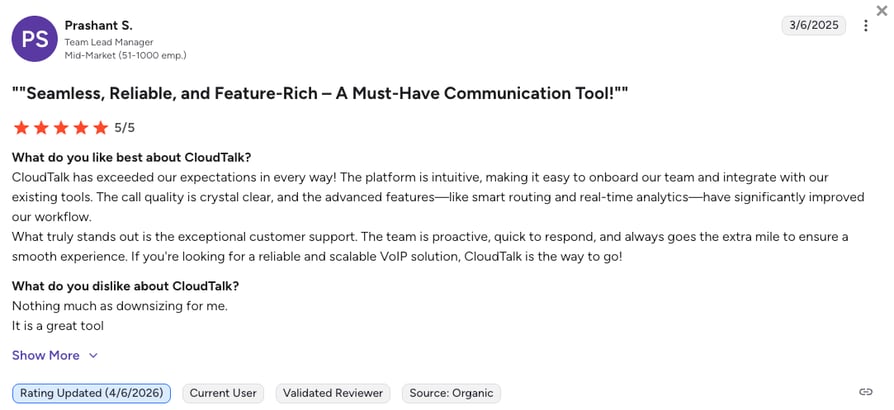
CloudTalk holds 4.4/5 on G2 from 1930+ reviews, with 1,970+ reviews across G2 and Capterra combined. Yanolja, a travel and hospitality operator, reduced missed calls by 30-40% after switching to CloudTalk, which is the metric that actually moves when routing stops being a configuration project.
How G2 Users Rate CloudTalk?
Try it against your own call volume.
2. Genesys Cloud CX: Best for Enterprise Workforce Engagement Out of the Box
What is Genesys Cloud CX?
Genesys Cloud CX is an all-in-one CCaaS platform that Genesys sells as AI-powered experience orchestration. It’s built for large enterprises that want workforce engagement management and predictive routing as native product rather than as separate purchases.
Why Is Genesys Cloud CX a Strong Amazon Connect Alternative?
- Workforce engagement management is included at tier 3the direct answer to Amazon Connect’s per-agent forecasting and evaluation meters.
- List pricing is published across all four tiersso the seat cost is knowable before a sales call.
- Omnichannel routing and journey orchestrationwork without custom development.
What Are the Pros & Cons of Genesys Cloud CX?
| Pros | Cons |
|---|---|
| Native WEM suite: quality management, forecasting, scheduling, gamification | $75/user/month entry is roughly triple CloudTalk’s Starter |
| Four published tiers with real prices | AI features are gated behind a token allowance, reintroducing a consumption meter |
| Predictive routing and journey orchestration built in | Heavyweight for teams under roughly 50 agents |
What Are Genesys Cloud CX’s Plans & Pricing?
Genesys Cloud CX pricing starts at $75/user/month annually, with the following plans:
- Genesys Cloud CX 1 - $75/user/month. Voice-focused: IVR, inbound and outbound routing, Agent Copilot.
- Genesys Cloud CX 2 - $115/user/month. Adds email, chat, SMS, digital routing and quality assurance.
- Genesys Cloud CX 3 - $155/user/month. Adds the full WEM suite, AI-driven scheduling, forecasting and gamification.
- Genesys Cloud CX 4 - $240/user/month. Adds journey management and maximized AI tokens.
The AI Token Catch:
Every plan includes 250 named or 350 concurrent AI Experience tokens per organization per month, plus 30 named or 39 concurrent per agent. Certain AI features consume those tokens, so AI capacity is a second variable sitting on top of the seat price. You escaped Amazon Connect’s meter and inherited a smaller one.
We go tier by tier in our Genesys pricing guide.
What Are Genesys Cloud CX Customers Saying?
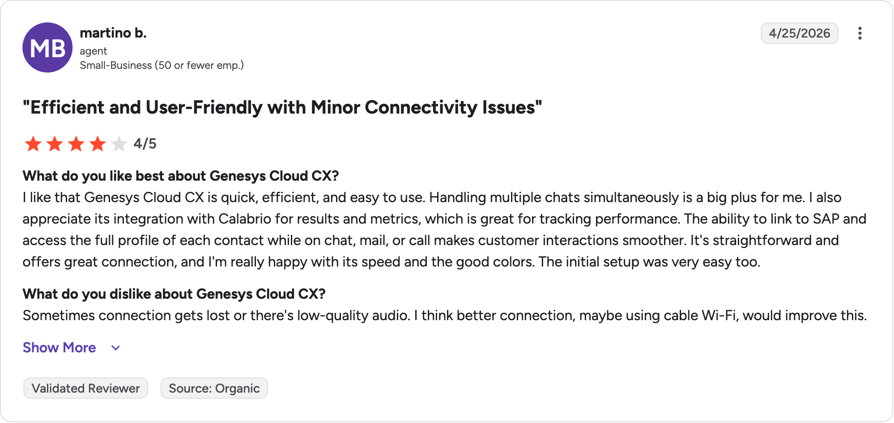
Genesys Cloud CX holds 4.4/5 on G2 from 1,571 reviews. It has no entry in our July 2026 review cache, so this profile still carries capability facts from Genesys’s own pricing and product pages rather than reviewer quotes.
How G2 Users Rate Genesys Cloud CX?
3. Five9: Best for Outbound Dialer Operations at Enterprise Volume
What is Five9?
Five9 is a cloud contact center platform sold as the Intelligent CX Platform, though its heritage sits in outbound dialing. It’s built for blended and outbound-heavy operations at enterprise volume, where predictive dialing and agent occupancy are the numbers that matter.
Why Is Five9 a Strong Amazon Connect Alternative?
- Predictive, power, preview and progressive dialing are nativewhere Amazon Connect meters outbound campaigns at $0.045 per minute.
- 24/7 support is includedat every published tier.
- Pre-built CRM and UC adaptersreplace an integration project.
What Are the Pros & Cons of Five9?
| Pros | Cons |
|---|---|
| Four native dialing modes out of the box | $119 entry tier is digital-only; voice starts at $159 |
| 24/7 support on every published tier | Three of five tiers are quote-based, so total cost needs a sales call |
| Blended inbound and outbound desktop with geo-redundancy | Lowest G2 rating in this comparison set |
What Are Five9’s Plans & Pricing?
Five9 pricing starts at $119/seat/month, with the following plans:
- Digital - $119 per seat/month. Chat, email, SMS/MMS and social only.
- Core - $159 per seat/month. All channels with AI essentials.
- Premium, Optimum and Ultimate - quote-based. Five9 publishes the tier structure and a "Get a Quote" button rather than a list price.
The Quote-Only Catch:
Workforce management and the deeper AI modules sit in the three tiers Five9 doesn’t price publicly. If you’re leaving Amazon Connect because the bill was opaque, notice that the upper 60% of this rate card is opaque too.
There is more on the published tiers in our Five9 pricing breakdown.
What Are Five9 Customers Saying?
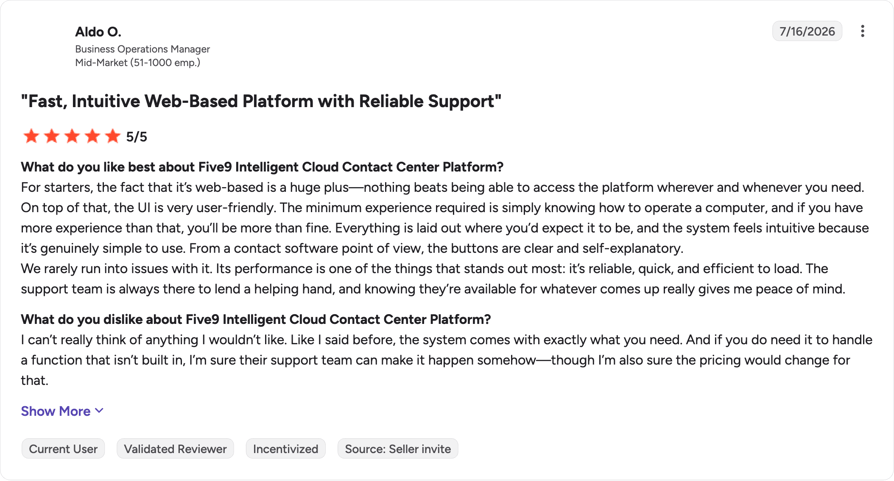
Five9 holds 4.1/5 on G2 from 598+ reviews, and 2.7/5 on Trustpilot from 735 reviews, verified live in September 2026 (the earlier 3.6/5 figure was stale).
How G2 Users Rate Five9?
4. Talkdesk: Best for Fast Mid-Market Deployment With Industry Accelerators
What is Talkdesk?
Talkdesk CX Cloud is a contact center platform built on a microservices architecture. Its differentiator is the set of Industry Experience Clouds for healthcare, retail and financial services, which hand mid-market teams a pre-configured starting point instead of a blank canvas.
Why Is Talkdesk a Strong Amazon Connect Alternative?
- Industry accelerators remove much of the configuration workAmazon Connect expects you to do yourself.
- List pricing is published across all four tierswhich is unusual in enterprise CCaaS.
- The voice tier at $105 undercutsFive9’s $159 voice entry by a wide margin.
What Are the Pros & Cons of Talkdesk?
| Pros | Cons |
|---|---|
| Pre-built vertical accelerators shorten deployment | The $85 entry tier is digital-only; voice costs $105 |
| Transparent four-tier price list | Workforce management and quality management are gated behind the $165 Elite tier |
| AppConnect marketplace of pre-built integrations | Seat minimums aren’t published for the standard tiers |
What Are Talkdesk’s Plans & Pricing?
Talkdesk pricing starts at $85/user/month, with the following plans:
- Digital Essentials - $85 per user/month.
- Voice Essentials - $105 per user/month.
- Elite - $165 per user/month. Adds workforce management and quality management.
- Industry Experience Clouds - $225 per user/month.
- Talkdesk also advertises a starter offer of 25 licenses and $100 in free credit for businesses under 50 employees, with no commitment or contract.
The Voice Upgrade Catch:
Most comparison articles quote Talkdesk at $85, and that tier can’t make a phone call. Voice starts at $105, and the workforce tools you’d pay Amazon Connect $27 and $12 per agent for sit at $165.
Our Talkdesk pricing guide covers the same four tiers in more detail.
What Are Talkdesk Customers Saying?
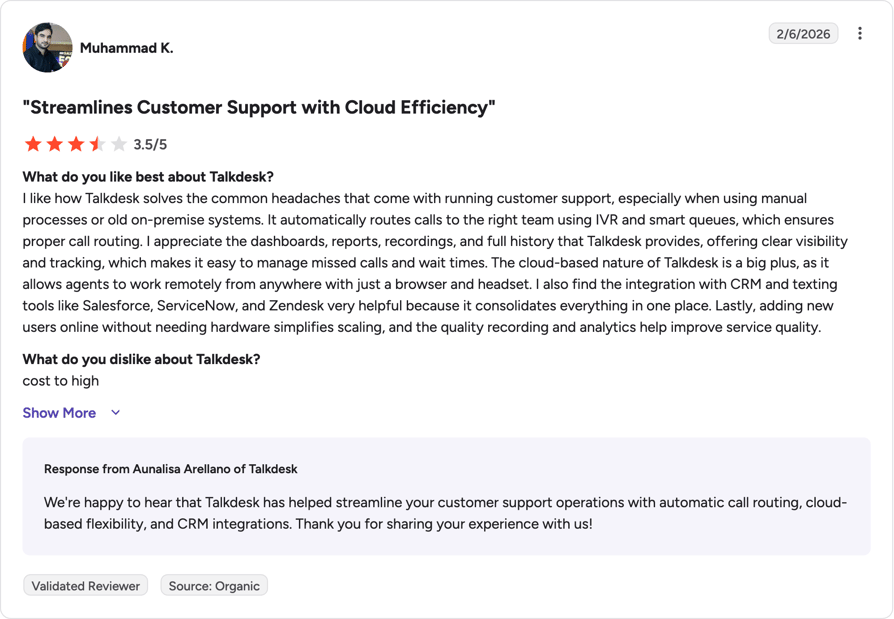
Talkdesk holds 4.4/5 on G2 from 2,500+ reviews in our July 2026 cache, and 1.5/5 on Trustpilot from 871 reviews, verified live in September 2026.
How G2 Users Rate Talkdesk?
5. NiCE CXone Mpower: Best for Regulated Enterprises With Heavy Workforce Optimization
What is NiCE CXone Mpower?
NiCE CXone Mpower is an all-in-one customer experience (CX) AI platform for orchestrating customer service end to end. It’s aimed at regulated enterprises that need compliance-grade recording, interaction analytics and a full workforce-optimization suite from one vendor.
Why Is NiCE CXone Mpower a Strong Amazon Connect Alternative?
- The deepest workforce-optimization and interaction-analytics stack hereexactly what Amazon Connect meters per agent per month on Customer Basic.
- Billing runs monthly in arrears with no prepayper NiCE’s own pricing page.
- Pre-configured contact center packagescut the configuration work relative to building on AWS.
What Are the Pros & Cons of NiCE CXone Mpower?
| Pros | Cons |
|---|---|
| Full WFO suite: QM, WFM, performance management, interaction analytics | No published list price anywhere; every evaluation starts with a sales call |
| Compliance-oriented recording, monitoring and analytics | Usage-based tiered model means the bill still moves with volume |
| Packaged bundles for faster enterprise deployment | Enterprise implementation effort; not a fit under roughly 50 agents |
What Are NiCE CXone Mpower’s Plans & Pricing?
NiCE publishes no per-agent list price:
- Quote-based. NiCE’s pricing page describes monthly billing in arrears with no prepay, on a usage-based tiered model, with packages customized per business.
The No-Price Catch:
If you’re here because Amazon Connect’s costs were hard to predict, know what you’re signing up for. NiCE’s model is usage-based and tiered, and you can’t see the rate card until you’re in a sales cycle.
See our NiCE CXone pricing guide for more on how the packaging works.
What Are NiCE CXone Mpower Customers Saying?
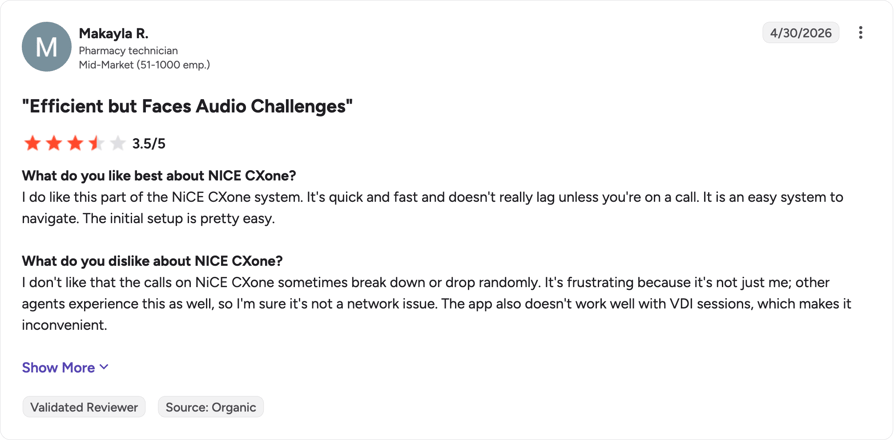
NiCE CXone Mpower holds 4.3/5 on G2 from 1,730 reviews (G2 still lists the product under its pre-rebrand name, "NICE CXone"). It sits outside our July 2026 review cache, so everything above comes from NiCE’s own product and pricing pages rather than from buyers.
How G2 Users Rate NiCE CXone Mpower?
6. Twilio Flex: Best for Engineering Teams That Want Programmable Control Without AWS Lock-In
What is Twilio Flex?
Twilio Flex is a fully programmable cloud contact center that you build and own: the desktop is React, the routing is TaskRouter, the flows are Studio. It’s the closest philosophical match to Amazon Connect on this list, minus the AWS dependency.
Why Is Twilio Flex a Strong Amazon Connect Alternative?
- Three published billing modelsincluding a fixed $150 named-user option that removes consumption risk.
- No AWS dependencyvoice and messaging run on Twilio’s own global network.
- A generous trialat 5,000 free active user hours.
What Are the Pros & Cons of Twilio Flex?
| Pros | Cons |
|---|---|
| Fixed named-user pricing available, which no other platform here offers | Same core problem as Amazon Connect: it’s a toolkit, so you still need engineers |
| Fully customizable agent desktop and routing logic | Twilio states there are no free quotas on the underlying primitives |
| 5,000 free active user hours to evaluate | Selecting a billing model forfeits any unused free hours |
What Are Twilio Flex’s Plans & Pricing?
Twilio Flex offers three billing models:
- $35 per monthly active user: any user who logs into Flex at least once that month.
- $150 per named user per month: agent, supervisor or administrator, for fully predictable spend.
- $1 per active user hour: hourly consumption.
- Free trial: 5,000 free active user hours, one-time grant, new Twilio Flex accounts only.
The Primitives Catch:
Twilio’s own pricing page says it plainly: "There are no free quotas; all underlying services like Conversations, TaskRouter, Studio, and Functions are charged by individual usage." The Flex user fee sits on top of metered Twilio usage, so the $35 figure is a floor, not a total.
We unpack the three billing models in our Twilio Flex pricing guide.
What Are Twilio Flex Customers Saying?
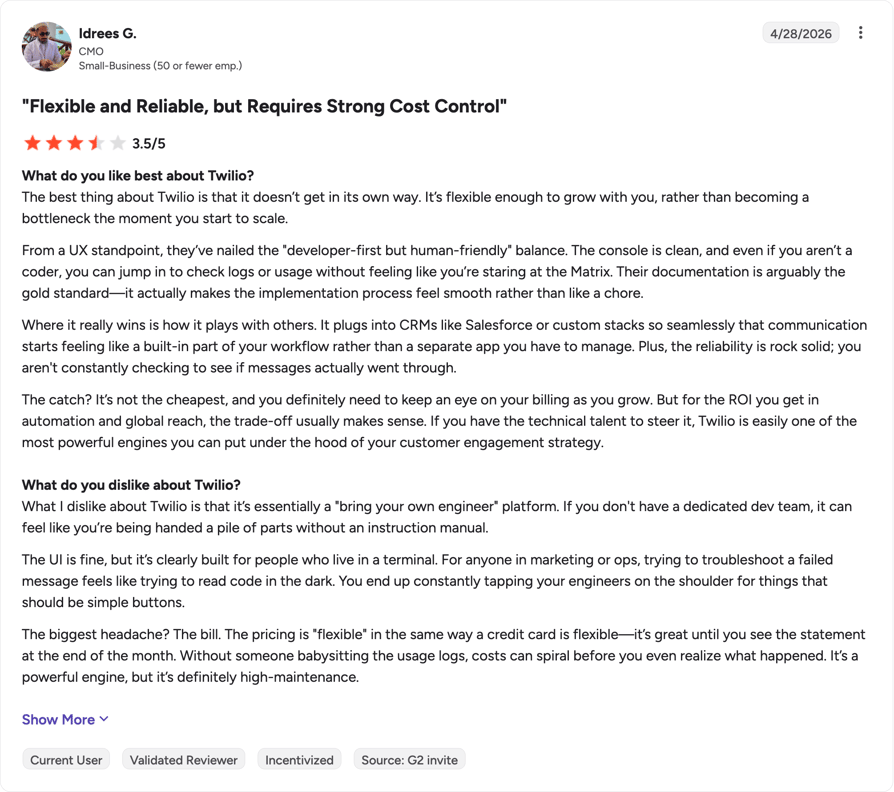
One nuance is worth stating plainly. 4.2/5 and 492 cover Twilio as a company, not the Flex product listing, and those are two different populations of reviewer. G2 does carry a Flex-specific listing, and it’s a small one: 4.1/5 from 37 reviews, well short of Twilio’s company-wide count.
How G2 Users Rate Twilio Flex?
4.1/5 (37 reviews) on G2. This is the Flex-specific listing, not the Twilio-wide score.
7. RingCentral RingCX: Best for Consolidating UCaaS and Contact Center on One Bill
What is RingCentral RingCX?
RingCentral RingCX is a contact center product built on RingCentral’s global communications platform and marketed as AI-first. It sits alongside RingEX, the company’s unified communications (UCaaS) product, so a team runs its phone system and contact center on one vendor and one invoice.
Why Is RingCentral RingCX a Strong Amazon Connect Alternative?
- One per-agent price covers voice, video, 20+ digital channels and AI summariesagainst Amazon Connect’s per-channel meters.
- Unlimited domestic inbound and outbound minutesremove the per-minute variable entirely for domestic operations.
- Carrier-grade global voice infrastructureyou don’t have to assemble.
What Are the Pros & Cons of RingCentral RingCX?
| Pros | Cons |
|---|---|
| Voice, video, digital channels and AI summaries in one per-agent price | $65/agent/month is more than double CloudTalk’s Starter and above Expert |
| Unlimited domestic inbound and outbound minutes | Weakest consumer sentiment in this set at 1.7/5 on Trustpilot |
| One vendor for phone system and contact center | Buying RingCX generally means buying into the wider RingCentral platform |
What Are RingCentral RingCX’s Plans & Pricing?
RingCentral RingCX pricing starts at $65/agent/month, with the following:
- RingCX - $65 per agent/month, including voice, video, 20+ digital channels, AI summaries and unlimited domestic inbound and outbound minutes. Confirmed live on RingCentral’s own pricing page.
- RingEX (the UCaaS product, for context) - three published tiers, Core, Advanced and Ultra, at $20, $25 and $35 per user/month billed annually ($30, $35 and $45 monthly). A fourth tier, the Customer Engagement Bundle, adds SMS and call-queue add-ons and is quote-based rather than list-priced.
- RingCentral notes further add-ons and integrations on top of the RingCX base price.
The Platform Catch:
RingCX is priced as a contact center attached to a phone system you’re also expected to buy. If you only need the contact center, you’re paying for a consolidation benefit you won’t use, and the add-ons sit above the $65 line.
More detail sits in our RingCentral pricing guide.
What Are RingCentral RingCX Customers Saying?
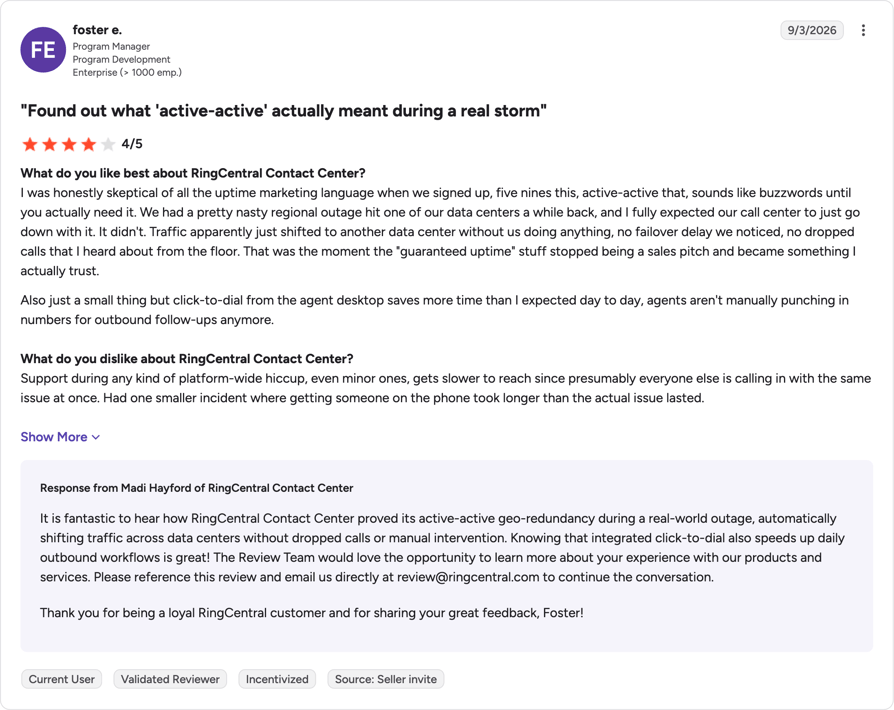
RingCentral as a company holds 4.3/5 on G2 from 2,900+ reviews, but that figure spans RingCentral’s whole portfolio (RingEX, RingCentral Events, RingCentral Video and more), not the RingCX contact-center product specifically. RingCX’s own G2 listing shows 4.4/5 from 103 reviews, a much smaller population. RingCentral holds 1.7/5 on Trustpilot from 1,985 reviews, verified live in September 2026 (the earlier 2.0/5, 1,800+ figures were stale).
How G2 Users Rate RingCentral RingCX?
4.4/5 (103 reviews) on G2, the RingCX-specific listing. RingCentral’s portfolio-wide score (4.3/5, 2,900+ reviews) is a different, much larger population and shouldn’t be quoted as RingCX’s own rating.
8. Dialpad: Best for Real-Time AI Transcription and Live Coaching
What is Dialpad?
Dialpad is a cloud communications platform sold as one AI platform for every conversation, workflow and channel: Dialpad Connect is the phone system, Dialpad Support is the contact center. Its distinguishing feature is real-time transcription and live coaching as core product rather than a post-call analytics purchase.
Why Is Dialpad a Strong Amazon Connect Alternative?
- Real-time transcription and AI Live Coachrun during the call rather than as a metered analytics layer afterwards.
- The lowest published entry price in this setat $15/user/month annually for Connect Standard.
- AI Agent pricing charges only when the AI retrieves information or executes a real actionwhich is about as legible as consumption billing gets.
What Are the Pros & Cons of Dialpad?
| Pros | Cons |
|---|---|
| Real-time transcription, AI Live Coach, AI Playbooks and AI Scorecards | The published $15 and $25 prices are for the phone system, not the contact center |
| Lowest published entry price of any tool here | The contact center product costs $80-$150/agent/month, well above the $15 phone-system headline |
| AI credits bill on action taken, not on time elapsed | AI credits are still consumption billing, with the same forecasting risk |
What Are Dialpad’s Plans & Pricing?
Dialpad Connect (the phone system) pricing starts at $15/user/month, with Dialpad Support (the actual contact-center product) priced separately:
- Dialpad Connect Standard - $15 per user/month billed annually ($27 monthly).
- Dialpad Connect Pro - $25 per user/month billed annually ($35 monthly).
- Enterprise - quote-based, annual plans only.
- Dialpad AI Agents - consumption-based on a pool of AI Agent Credits, billed only when the AI takes a real action.
- Dialpad Support (the contact center) - Essentials at $80/user/month, Advanced at $115/user/month, Premium at $150/user/month, each adding real-time coaching, CRM logging, additional channels and quality-management tooling on top of the last.
The Wrong-Product Catch:
The $15 headline is a business phone system. The contact center is Dialpad Support, a separate and considerably higher line item at $80-$150/user/month. Comparing the $15 Connect price against Amazon Connect’s contact-center cost isn’t a like-for-like comparison; Dialpad Support’s own starting price is the fair one to use.
Our Dialpad pricing guide goes deeper on the plan structure.
What Are Dialpad Customers Saying?
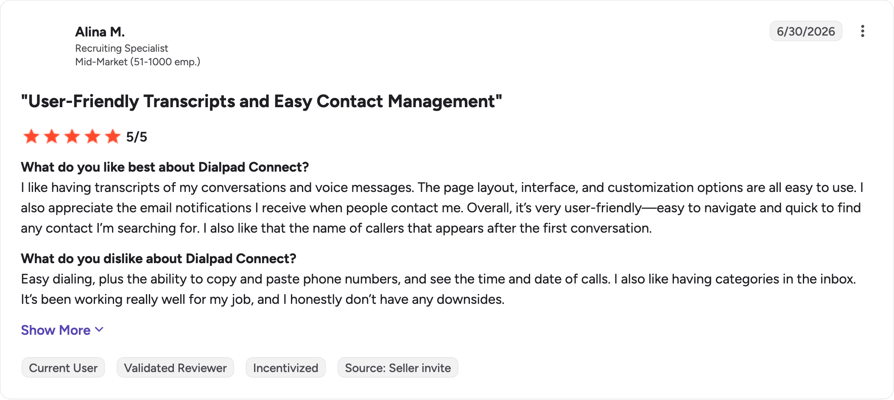
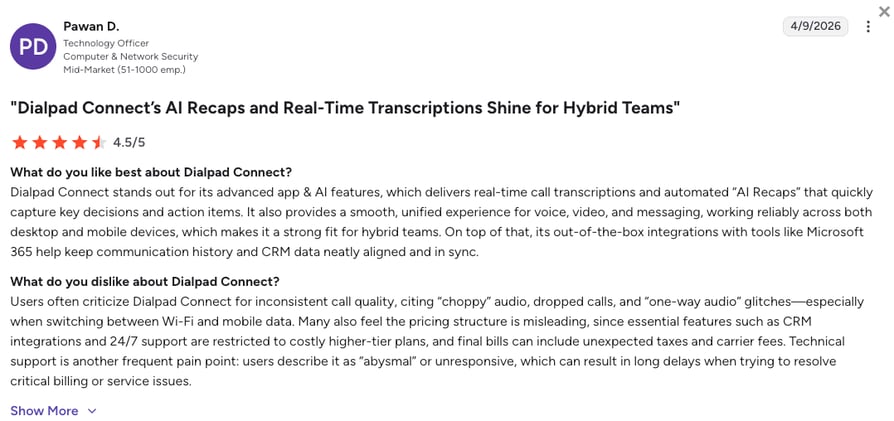
Dialpad holds 4.1/5 on Trustpilot from 3,166 reviews, verified live in September 2026. On G2, Dialpad Connect (the phone system) and Dialpad Support (the contact center) have separate listings: Connect is 4.4/5 from 4,205 reviews, Support is 4.4/5 from 709 reviews.
How G2 Users Rate Dialpad?
Dialpad Connect: 4.4/5 (4,205 reviews) on G2. Dialpad Support (the contact center): 4.4/5 (709 reviews).
9. 8x8: Best for Global Voice Coverage Across UCaaS and Contact Center
What is 8x8?
8x8 X-Series is a single platform combining AI-powered contact center, unified communications and CPaaS. It’s aimed at global enterprises replacing international PSTN (public switched telephone network) service alongside their UCaaS and CCaaS estate, and it’s one of the few vendors with a dedicated contact center for Microsoft Teams.
Why Is 8x8 a Strong Amazon Connect Alternative?
- One vendor and one platform for phone system and contact centerwhich suits teams consolidating away from an assembled AWS stack.
- A strong international voice footprintrelevant if you’re running Amazon Connect for global inbound.
- A pooled minute allowancerather than pure per-minute metering on every call.
What Are the Pros & Cons of 8x8?
| Pros | Cons |
|---|---|
| Combined UCaaS and CCaaS on one contract | No published list price; pricing is sales-led |
| Broad international calling coverage across X-Series licenses | Billing reverts to per-minute rates once the pooled allowance is used |
| 8x8 Contact Center for Microsoft Teams | Enterprise-oriented, with the procurement cycle that implies |
What Are 8x8’s Plans & Pricing?
8x8 does not publish per-user contact center pricing that we could verify at source:
- Not publicly listed. X6, X7 and X8 contact center users share a pooled fair-usage allowance of 4,000 call minutes per user per month, with additional minutes billed at standard 8x8 rates.
The Pooled-Minutes Catch:
4,000 pooled minutes per user is generous, and it is still a minute budget. Blow through it and you’re back on a per-minute rate card, which is the exact mechanic you were trying to leave behind.
Our 8x8 pricing guide covers what the company does publish.
What Are 8x8 Customers Saying?
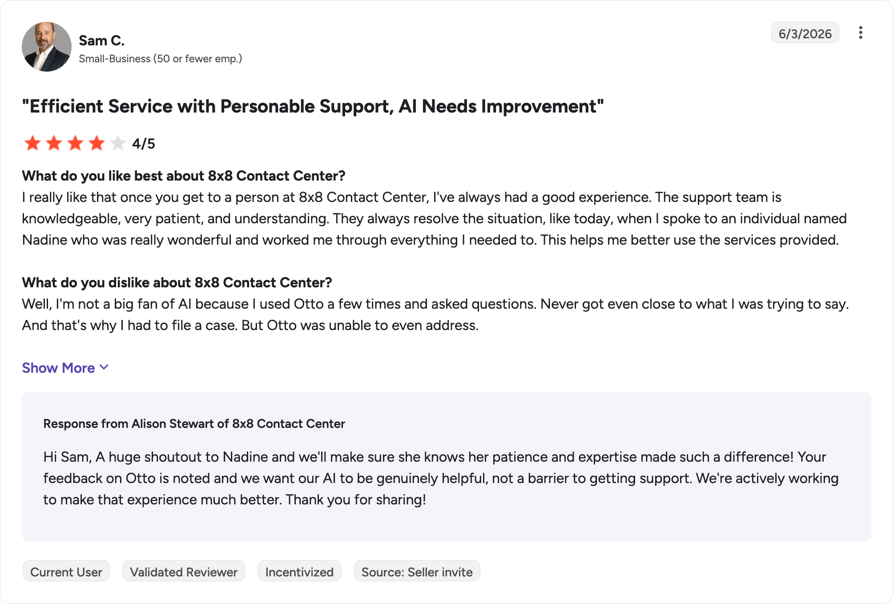
8x8 holds 4.2/5 on G2 from 936+ reviews, and 2.8/5 on Trustpilot from 625 reviews, verified live in September 2026 (the earlier 3.2/5 figure was stale).
How G2 Users Rate 8x8?
10. Zendesk Talk: Best for Voice Inside an Existing Ticketing Workspace
What is Zendesk Talk?
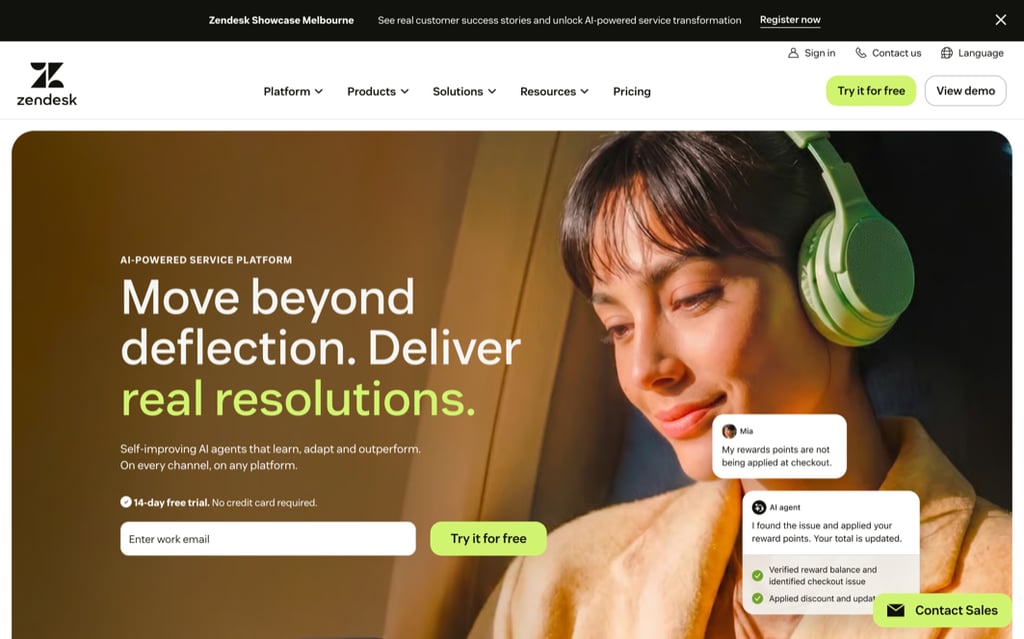
Zendesk Talk is the voice channel inside the Zendesk Suite, in the same agent workspace as email, chat and messaging, and every call becomes a ticket with the customer’s history already on screen. It’s for support teams whose system of record is already Zendesk.
Why Is Zendesk Talk a Strong Amazon Connect Alternative?
- Voice arrives with no new tooling if your team already lives in Zendeskand full customer context loads with the call.
- Per-agent pricing is published across every tierwhich almost no contact-center vendor offers.
- Call recording, routing, IVR and voicemailare managed from the same admin console as your other channels.
What Are the Pros & Cons of Zendesk Talk?
| Pros | Cons |
|---|---|
| Voice inside the ticket, with unified cross-channel reporting | Talk minutes and phone numbers are metered separately, so per-minute unpredictability doesn’t go away |
| Transparent published pricing on every tier | It’s a helpdesk with a voice channel: no predictive dialer, no workforce management |
| Lowest published entry price in this set at $19/agent/month | Only makes sense if Zendesk is already your system of record |
What Are Zendesk Talk’s Plans & Pricing?
Zendesk Talk pricing starts at $19/agent/month, with the following plans:
- Support Team - $19 per agent/month billed annually ($25 monthly).
- Suite Team - $55 per agent/month billed annually ($69 monthly).
- Suite Growth - $115 per agent/month, monthly billing.
- Suite Professional - $149 per agent/month, monthly billing.
- Suite Enterprise + Copilot - $219 per agent/month, monthly billing.
The Telephony Catch:
The Suite price is the software license only. Zendesk Talk call minutes and phone numbers are metered and billed separately on top, so a Zendesk voice deployment still carries a per-minute bill. On a list about escaping usage-based billing, that’s the honest weakness of this pick.
There is more on those line items in our Zendesk Talk pricing guide.
What Are Zendesk Talk Customers Saying?
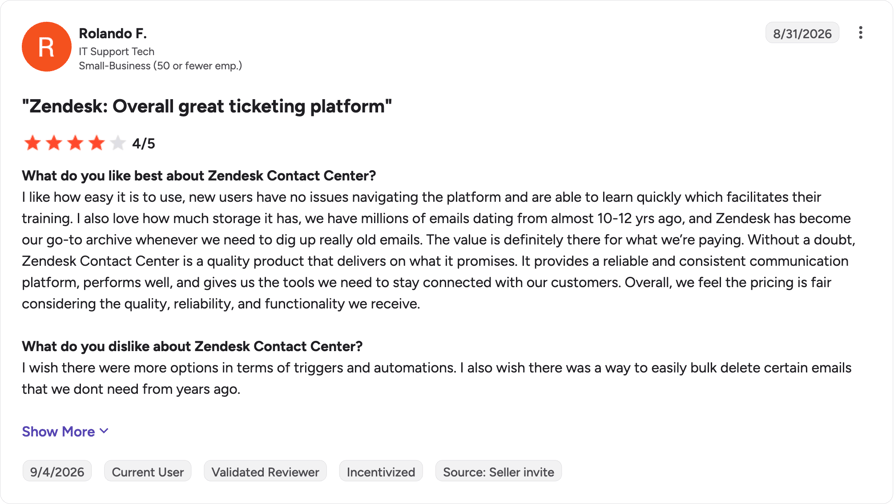
Zendesk Talk is absent from our July 2026 review cache, and the Zendesk Suite reviews that do exist describe the helpdesk rather than the voice channel. Borrowing a Suite score would flatter Talk unfairly, so this profile stays on Zendesk’s published product and pricing facts.
How G2 Users Rate Zendesk Talk?
Rating pending. A Suite-level score would not describe the Talk voice channel specifically, so no figure appears here. Zendesk Talk does have its own G2 listing, but it carries zero reviews as of September 2026, so there’s no score to publish.
What Users Are Really Saying About Amazon Connect Alternatives and Competitors
Two of the three highest-ranking results for "amazon connect competitors" are forum threads rather than vendor pages, which tells you where this decision actually gets made. People shortlisting an Amazon Connect replacement talk to practitioners on Reddit, Quora and developer Q&A boards long before they open anyone’s list of VoIP providers. Below is where those conversations sit, and an honest note on what we could and could not read.
What Redditors Are Asking About Amazon Connect Alternatives
The most visible discussion is r/VOIP’s "Are there services similar to Amazon Connect?", which sits at position 2 on Google for the query and is cited as a source in the AI Overview for it. A second thread, r/AZURE’s "Amazon Connect equivalent in Azure", appears in the same discussion block and reframes the search as a cloud-platform choice rather than a software one.
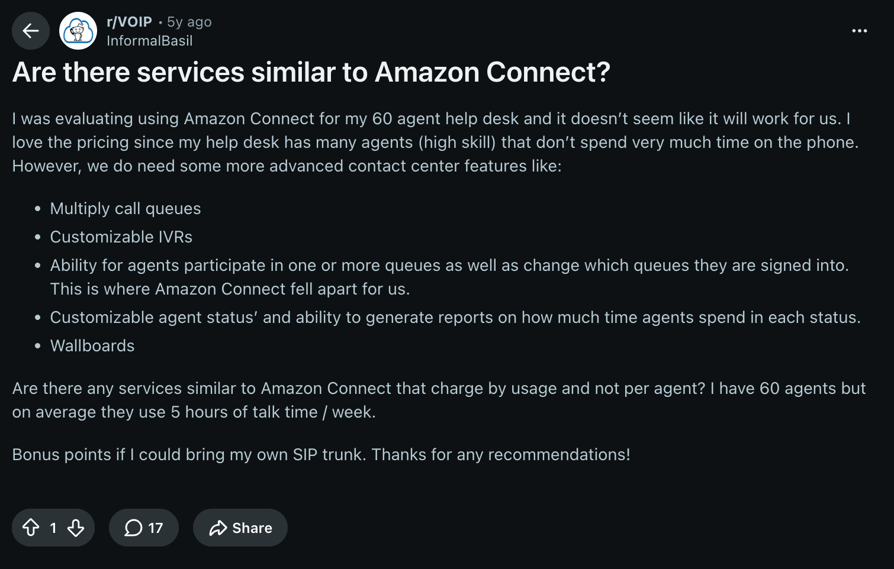
We are not going to put words in those commenters’ mouths, because we could not read the replies at source. The questions themselves are the finding. Nobody in those titles is asking which vendor scores highest on satisfaction; they are asking whether anything exists that does what Connect does without the assembly work.
Microsoft’s own Q&A board carries the same question in a different accent. In a Microsoft Learn Q&A thread about an Amazon Connect equivalent, a user asks whether Azure has an AWS Connect counterpart. The answer points at Azure Communication Services with a contact center built on top of it, covering ACD, IVR and workforce management. That is the same trade the entire category offers: assemble it from cloud primitives, or buy something that already routes a call.
What Quora Users Are Asking About Amazon Connect Competitors
Quora’s Amazon Connect questions cluster around head-to-head evaluations and implementation reality rather than list price. Three we tracked while building this ranking:
- "Which is the best cloud-based contact center service, Amazon Connect or Genesys?"
- "Has anyone built out an AWS connect contact center using SIP trunks?"
- "What is a good cloud-based contact center solution?"
Again, we are naming the questions rather than summarizing answers we could not read at source. Note what the second one implies: a buyer far enough into an Amazon Connect build to be wiring up SIP trunks is still asking strangers whether anyone has ever finished the job.
What Verified G2 Reviewers Say About Switching From Amazon Connect
We publish review data we can trace, and we do not scrape review platforms to get it. Every G2 figure on this page comes from CloudTalk’s verified rating variables, our July 2026 cache, or a live G2 check run in September 2026: CloudTalk at 4.4/5, Genesys Cloud CX at 4.4/5, Dialpad and Talkdesk at 4.4/5, NiCE CXone Mpower at 4.3/5, Twilio Flex (product-specific) at 4.1/5, RingCentral’s own portfolio at 4.3/5 against RingCX specifically at 4.4/5, 8x8 at 4.2/5 and Five9 at 4.1/5.
Amazon Connect itself holds 4.4/5 on G2 from 92 reviews, confirmed live in September 2026, which is why you’ll now see a score for it above where this section previously said none existed. One verbatim reviewer quote (Jenom N., on Lambda complexity and per-minute billing) appears under con 1 above. A second cached review, from Emma C., covers Zendesk-integration UI friction rather than setup complexity, billing or reporting, so it wasn’t strong enough to use here.
How to Choose the Right Amazon Connect Alternative for Your Team?
Pick the Amazon Connect alternative that fixes your most expensive problem first, then check that it clears the rest. Shortlists stall when every criterion carries the same weight, so work through the questions below in the order your own problems rank.
1. What Is the Best Amazon Connect Alternative for Predictable Billing?
CloudTalk, and it isn’t close among the platforms with published pricing. Flat per-user tiers at $25, $29 and $49 per user/month mean a busy quarter doesn’t change the invoice, and telco usage is metered only on non-bundled destinations.
Twilio Flex’s $150 named-user model is the runner-up and the only other option that decouples spend from volume, though the underlying primitives are still metered. Skip anything quote-based if predictability is your main reason for leaving; a published contact center pricing page is the cheapest due diligence available.
2. Which Amazon Connect Alternative Has the Deepest CRM Sync?
CloudTalk again. Its 100+ native integrations sync in both directions, so an edit in the CRM reaches CloudTalk and a finished call reaches the CRM without a nightly job standing between them. Integrations start on the Essential plan, and the Salesforce Ecosystem integration is on Expert.
One test worth running during a trial: place a call, hang up, and check whether the recording, transcript, disposition and summary land on the right CRM record untouched. Tools that write a call ID into a note field pass that on paper and fail it by month three. A real Salesforce VoIP integration clears the bar without anyone touching an API.
3. Which Alternatives to Amazon Connect Work Without Engineers?
If nobody on your team writes Lambda functions, the real question is whether you can change how calls get routed without opening a ticket. Your shortlist is CloudTalk, Talkdesk and Genesys Cloud CX, in that order of setup effort. CloudTalk puts IVR, skill-based routing and the visual Call Flow Designer on Starter; Talkdesk’s Industry Experience Clouds hand you a pre-configured vertical; Genesys gives you routing at CX 1 with an enterprise implementation cycle attached.
Take Twilio Flex off this list. It’s a good product with the same requirement that pushed you off AWS Connect in the first place.
4. What Is the Best Amazon Connect Replacement for Teams Under 50 Agents?
CloudTalk. Genesys and NiCE price for enterprises, Five9’s voice tier starts at $159 per seat, and RingCX at $65 per agent assumes you want the wider platform. At $25/user/month with a one-license minimum on Starter and Essential, CloudTalk is the only option here priced for a team that size. Watch the Expert tier’s 3-license minimum if you’re a two-person operation that needs the Power Dialer.
5. Which Amazon Connect Competitor Is Best for Global Call Coverage?
CloudTalk for coverage breadth. It sells virtual phone numbers in 160+ countries on a single contract, and it ports the numbers you already own instead of making you re-paper every region. 8x8 is the credible alternative if you’re consolidating international PSTN alongside UCaaS, though its pricing isn’t published. Check what happens at the edges: Amazon Connect’s external voice connector costs $0.032 per minute plus $100 per connector per day, and that line item only appears once you’re live in a new region.
6. How Do You Migrate Off Amazon Connect Without Breaking Anything?
Run the move in four stages, in this order.
- Take an inventory, not an export. List every active contact flow, every Lambda function attached to one, every Lex bot, every integration and every saved report, then rank them by call volume. A small number of flows usually carry most of the traffic, and that’s where you start.
- Map the integrations before you touch telephony. CRM connections and webhooks are the most common breaking point in any contact-center migration, and a connector built against Amazon Connect’s event model won’t survive the move unchanged.
- Port numbers in stages and run both platforms in parallel. Check how long number porting takes with each carrier before you commit to a date, and keep Amazon Connect on your lowest-volume queues until the new routing is proven.
- Export your historical performance data before you close the account. Resolution rates, handle times and CSAT baselines are the only way you’ll know afterwards whether the switch worked.
According to Forrester’s 2026 Customer Experience Index, US customer experience quality improved year over year for the first time since 2021, with 26% of the 225 brands measured in both years improving significantly and only 7% declining.5 The bar you are measured against is rising.
Which Amazon Connect Alternative Fits Your Team?
Find your row, start with that tool, and keep one runner-up. Teams replacing an AWS-assembled stack at real scale should also read our guide to enterprise VoIP before they shortlist.
Which Amazon Connect Alternative Fits Your Team?
| If your team is... | The fit is... | Because |
|---|---|---|
| A global sales or support team under 100 agents with no AWS engineers | CloudTalk | Routing, IVR and CRM sync on the entry plan at $25/user/month |
| An enterprise that needs WEM as native product | Genesys Cloud CX | Full WEM suite at CX 3, published list pricing |
| Outbound-heavy at enterprise volume | Five9 | Four native dialing modes, 24/7 support on every tier |
| Mid-market and in a hurry | Talkdesk | Industry accelerators, voice from $105/user/month |
| Regulated, with deep WFO and compliance needs | NiCE CXone Mpower | Deepest WFO and interaction-analytics stack, quote-based |
| An engineering team that wants to build, minus AWS | Twilio Flex | Programmable primitives, fixed $150 named-user option |
| Consolidating phone system and contact center | RingCentral RingCX | One $65/agent price, unlimited domestic minutes |
| Coaching-led, wanting live AI in the call | Dialpad | Real-time transcription and AI Live Coach as core product |
| Global enterprise replacing international PSTN | 8x8 | UCaaS and CCaaS on one platform, broad international coverage |
| Already running support entirely in Zendesk | Zendesk Talk | Voice inside the ticket, from $19/agent/month |
Ready to Make the Switch from Amazon Connect?
You already know the trade. Amazon Connect hands you primitives and expects you to supply the engineering; the platforms above hand you a contact center and expect you to supply the phone numbers. Four things change on the week you move:
- No more quota tickets. Queues, IVR and routing are configuration screens rather than support requests, so a change to your escalation path takes an afternoon instead of a sprint and an approval.
- Billing you can put in a plan. Flat per-user tiers from $25/user/month replace eleven separately metered line items, and a quarter that goes unusually well stops being a budget event.
- Support that answers the first time. 24/7 live support from the Essential plan, and the person on the other end can open your call flow with you instead of forwarding you to an infrastructure queue.
- Notes that log themselves. Two-way CRM sync writes calls, recordings, tags and summaries onto the right record automatically, so nobody has to rebuild a connector after an API change.
CloudTalk is call center software you can have running this week, at 99.999% uptime, across 160+ countries, with no AWS account attached to any of it.
See it running on your own numbers.
Sources:
Frequently Asked Questions about Amazon Connect Alternatives
Find direct answers to the most common questions teams have about replacing Amazon Connect.
CloudTalk, Genesys Cloud CX, Five9, Talkdesk, NiCE CXone Mpower, Twilio Flex, RingCentral RingCX, Dialpad, 8x8 and Zendesk Talk. They split into turnkey contact centers and programmable toolkits, which is the first fork in any VoIP alternatives shortlist.
Yes, for AWS-native enterprises with engineers on staff. It is a mature platform with strong AI and no seat license. It is a poor fit if you want a working contact center rather than the parts to build one, which is what a hosted contact center gives you instead.
Pros: no seat license, deep AWS integration, AI included on the Customer tier, per-second billing. Cons: 10 concurrent calls by default, no native CRM, reporting through QuickSight, eleven-plus meters on one invoice. It is the same build-versus-buy call our guide to VoIP advantages and disadvantages frames.
CloudTalk, Talkdesk and Dialpad. Each treats routing, IVR and dialing as configuration rather than code, so a non-technical admin can run it. CloudTalk starts at $25/user/month with IVR on the entry plan, and it is on our best call center software list for the same reason.
Dialpad and Genesys Cloud CX bundle AI into the product; CloudTalk sells it separately. Dialpad transcribes and coaches live, Genesys meters AI Experience tokens, and CloudTalk’s conversation intelligence software is a $9/user/month add-on. None of the three needs a Lex bot or a Lambda function.
Yes. Zendesk Talk’s Support Team tier is $19 per agent/month, Dialpad Connect Standard is $15, and CloudTalk Starter is $25 with a one-license minimum. Watch the metered extras, though: Zendesk bills Talk minutes on top, the same VoIP pricing trap Amazon Connect sets.
Most charge per seat, so the bill stops tracking call volume. AWS’s own example lands near $64 per agent per month at 75 agents; CloudTalk Expert is $49. Per-seat costs more at low volume and much less at high volume, as our guide to how much VoIP costs explains.
CloudTalk. Numbers, IVR, queues and CRM sync are configuration screens, so a small team can take calls the same day rather than filing a quota request first. Number porting is usually the long pole, which our VoIP implementation guide covers in sequence.
You need it for anything past the basics. Contact flows are drag-and-drop, but custom logic runs on Lambda, bots run on Lex, reporting runs on QuickSight, and a new instance caps at 10 concurrent calls until support lifts the quota. That is what call center software normally includes.
CloudTalk, with 100+ native integrations and two-way sync of calls, recordings, tags and AI summaries from the Essential plan. Zendesk Talk is native to Zendesk only. Our Pipedrive call center integration page shows what real two-way sync does on a live record.
Yes, for distributed sales and support teams up to a few hundred agents. Routing, dialing and CRM sync work on day one at $25/user/month with 99.999% uptime. If you want programmable primitives, pick Twilio Flex instead. See our top contact center software list.