Decagon AI Pricing & Plans: Complete Cost Guide for 2026
| Plan/Model | Price | Best for |
| Per-Conversation Pricing | Custom (typically $50K+/year min) | Enterprises needing predictable forecasting across high ticket volumes |
| Per-Resolution Pricing | Custom (higher per-unit rate) | Teams that want to pay only when the AI fully resolves a case |
| Annual Platform Fee | ~$50,000 base + usage fees | Standard contract structure for all Decagon customers |
| Enterprise Custom | $100K–$580K+/year | Large enterprises with 10,000+ monthly tickets and omnichannel needs |
Decagon AI does not provide public pricing. The company operates on a custom-quote, enterprise-only model built around two usage-based pricing structures: per conversation pricing (you pay for every interaction the AI touches) or per resolution pricing, a form of outcome based pricing where you pay a higher rate but only for tickets fully resolved without human help. Both are designed for enterprises automating customer experience at scale.
Based on marketplace data from Vendr and reported buyer numbers, median annual contracts run between roughly $386,000 and $400,000, with most deals landing somewhere in the $95,000 to $590,000 per year range, and a hard minimum of around $50,000. There is no free trial, no self-serve plan, and no way to evaluate the product without going through sales. If your annual contract value is below $50K, you're almost certainly not a fit.
See why thousands of teams choose CloudTalk for AI-powered calling
What Pricing Plans Does Decagon AI Offer?
Decagon AI pricing is structured around two usage based models rather than traditional tiered plans. There's no "Starter," no "Pro," and no "Enterprise" tier with a number next to it. Nothing is listed publicly; instead, Decagon charges based on the work its AI agents perform - either per conversation handled or per ticket fully resolved.
If you're comparing Decagon to tools like a conversational AI platform with transparent pricing, expect a very different buying experience. Decagon's pricing model is built on the idea that AI agents are workers, not tools, so you pay for output rather than seats.
Counting AI agents as employees rather than software seats makes the platform more scalable in theory.This works for enterprises with dedicated buying teams, but for smaller teams transparent pricing is essential.
What Do Real Users Say About Decagon AI Pricing?
G2 reviewers consistently rate Decagon highly on functionality, with average scores around 4.9 out of 5. Verified users describe the platform as "highly intuitive," praise the strength of the implementation team, and call out the value of programmable Agent Operating Procedures (AOPs) for non-technical CX staff. The most common positive theme is partnership quality, with one G2 reviewer noting the Decagon team "has truly become an extension of ours."
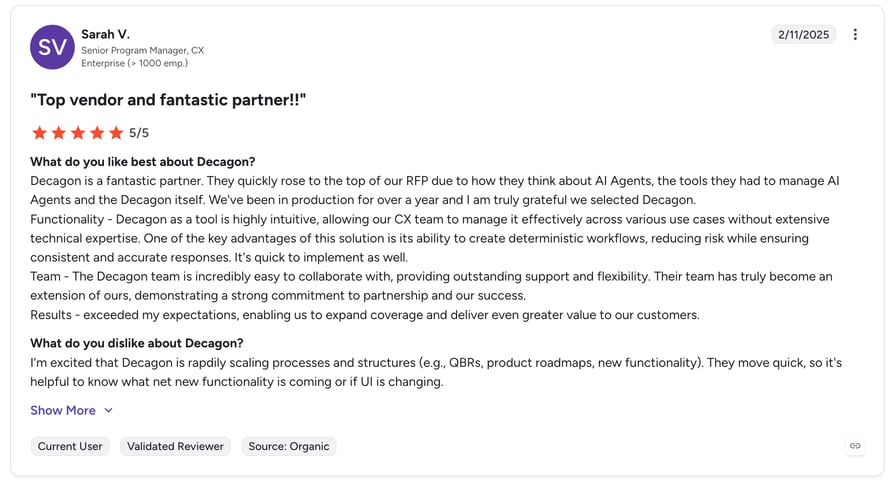
The flip side appears most often in pricing-focused reviews and analyst reports. Buyers flag the lack of a public pricing page, the long sales cycle, and the fact that annual contracts routinely land between $95K and $590K+ - putting the product out of reach for most SMBs and even mid-market teams. Reviewers also note that defining "resolution" in per-resolution contracts can create billing disagreements, a point Decagon itself acknowledges in its own glossary of resolution-based pricing.
The takeaway: Decagon delivers genuine enterprise value when the budget supports it, but the inaccessibility and ambiguity around what counts as a billable event are legitimate concerns to weigh before signing.
What is Decagon AI's Per-Conversation Pricing Model?
Per-conversation is the Decagon AI pricing model most customers choose. You pay a fixed rate for every conversation the AI handles, regardless of whether the AI fully resolves the customer's issue or escalates it to a human. If the AI touches 10,000 tickets in a month, you're billed for 10,000 conversations - costs scale directly with conversation volume.
How much does Decagon AI's per-conversation pricing cost?
Decagon does not publish per-conversation rates, and individual quotes vary based on volume, channel mix, and contract length. Based on public buyer reports, the annual platform fee starts around $50,000, with per-conversation rates negotiated on top. At enterprise scale, total contract value typically lands in the $100,000–$400,000 range, depending on monthly ticket volume.
What's included in Decagon AI's per-conversation plan?
- Autonomous AI agents that handle inbound conversations end-to-end across chat, email, voice, and SMS
- Agent Operating Procedures (AOPs) for natural-language workflow definition
- Watchtower observability dashboard for monitoring, sentiment analysis, and policy compliance
- Multi-model orchestration that routes each query to the best-performing LLM (OpenAI, Anthropic, and others)
- Native integrations with Zendesk, Salesforce, and major helpdesk platforms
- Enterprise-grade compliance: SOC 2 Type II, ISO 27001, GDPR, with HIPAA available for healthcare and other regulated industries
- White-glove implementation included in the contract
- Dedicated AI Deployment Engineer (AIDE) for setup and tuning
Decagon AI's per-conversation plan: who is it best for?
Per-conversation pricing is best for enterprises with stable, predictable ticket volumes - typically 10,000+ tickets per month - who want forecastable monthly costs and don't want to argue over what counts as "resolved." For AI customer support pricing where budget predictability matters more than pay-for-outcomes alignment, this is the cleaner of the two models.
What you need to know about Decagon AI's per-conversation plan
You pay even when the AI fails. Escalations to human agents, simple one-message inquiries, and incomplete resolutions all count toward your monthly bill. Volume spikes during peak periods like Black Friday or product launches can balloon the invoice significantly.
What is Decagon AI's Per-Resolution Pricing Model?
Per-resolution pricing flips the model. You pay a higher fixed rate per unit, but only when the AI successfully closes a ticket without human intervention. If the AI solves 6,000 out of 10,000 tickets, you pay for those 6,000 resolutions. The other 4,000 - escalations, abandonments, partial answers - don't generate a charge. The trade-offs here come down to predictability versus outcome-alignment.
How much does Decagon AI's per-resolution pricing cost?
Like per-conversation, Decagon AI pricing per conversation and per resolution are both custom-quoted. Based on industry benchmarks, per-resolution rates from comparable enterprise AI platforms range from roughly $0.50 to over $1.00 per resolved ticket, with at least one publicly reported Decagon rate sitting near $0.50.
Because the rate is higher per unit, total monthly spend can land in a similar range to per-conversation pricing if your AI resolution rate is solid.
What's included in Decagon AI's per-resolution plan?
- Everything in the per-conversation model
- Outcome-aligned billing tied to fully resolved cases
- Contractual definition of what qualifies as a "resolution"
- Performance reporting tied to resolution rates and CSAT
- Same enterprise compliance, observability, and integrations
Decagon AI's per-resolution plan: who is it best for?
Per-resolution suits teams confident in their AI workflows who want to align cost with outcomes. It's also a better fit for organizations where finance teams scrutinize spend tightly and prefer paying only for completed work. For AI agent assist deployments where the success metric is fully closed tickets, this model can feel cleaner.
What you need to know about Decagon AI's per-resolution plan:
The catch is defining "resolved." Decagon's own resources acknowledge that gray areas can lead to billing disagreements. If a customer abandons a chat partway through, was that resolved? If the AI provides a technically correct but unsatisfying answer, does it count? These edge cases need contractual definition up front, and they routinely become the focus of renewal negotiations.
What is Decagon AI's Enterprise Plan?
Every Decagon contract is effectively an enterprise plan. There is no self-serve tier and no lower-cost alternative. The Enterprise structure layers a base annual platform fee on top of either per-conversation or per-resolution usage fees, then bundles in implementation services, security controls, and a dedicated success team.
How much does Decagon AI's Enterprise plan cost?
Based on Vendr marketplace data and direct buyer reports, Decagon AI cost at the Enterprise level breaks down as follows:
- Median annual contract: roughly $386,000–$400,000/year
- Typical contract range: $95,000–$590,000/year
- Redline (minimum viable deal): ~$50,000/year
- Payment terms: Net 30 or Net 60
- Best months to negotiate: January, February, March (end-of-quarter pressure)
What's included in Decagon AI's Enterprise plan?
- Unlimited AI agents across chat, email, voice, and SMS channels
- Dedicated AI Deployment Engineer (AIDE) and Customer Success Manager
- Custom integrations with internal systems, ERPs, and legacy ticketing
- 99.9%+ uptime SLAs (higher tiers available)
- SOC 2 Type II, ISO 27001, GDPR, and multi-region deployment, with HIPAA available for regulated industries handling sensitive health data
- Watchtower for real-time monitoring, PII protection, and quality assurance
- Voice AI through partnerships including ElevenLabs
- White-glove onboarding, ongoing tuning, and quarterly business reviews
Decagon AI's Enterprise plan: who is it best for?
The Enterprise plan is built for digital-first companies processing 10,000+ monthly support tickets across multiple channels, with dedicated CX operations resources and a procurement function comfortable with six-figure software contracts. Decagon's customer list - Duolingo, Chime, ClassPass, Hertz, Oura, Affirm, Dropbox, Notion, and Rippling - reflects the profile.
What you need to know about Decagon AI's Enterprise plan
The sales cycle is long. Expect a discovery call, a technical scoping session, a custom demo, security review, and multiple rounds of contract negotiation. Most buyers report 3–6 months between first contact and signed contract. If you need a working AI agent in 30 days, Decagon is the wrong choice.
What Are Decagon AI's Additional Costs?
The base contract is rarely the full Decagon AI cost. Several factors influence your final number - Decagon's pricing model is wrapped in services, infrastructure, and usage-tied line items that can materially change your year-one spend.
Like most enterprise AI platforms, Decagon negotiates each deal around variables like monthly ticket volume and workflow complexity, which is why two companies of similar size can end up paying very different amounts for what looks on paper like the same product. Volume discounts can offset some of this at scale, but they're negotiated case-by-case rather than published. Here's what to budget for beyond the headline contract value.
| Additional cost | Estimated amount | Notes |
| Implementation fees | Often included, sometimes extra | White-glove setup is bundled in most contracts but custom integrations may carry add-on fees |
| Professional services | Custom (typically $10K–$50K+) | Required for ERP connectors, legacy ticketing systems, or non-standard workflows |
| Voice channel premium | 30–50% above chat rates | Real-time voice processing and telecom infrastructure cost more than text-based channels |
| Premium support tiers | Custom | Dedicated CSMs, 24/7 priority response, and elevated SLAs add to base pricing |
| Volume spike charges | Variable | Peak-season ticket surges (Black Friday, product launches, outages) under per-conversation pricing can spike monthly bills |
| Custom integrations | Custom | Non-standard tools or proprietary systems require professional services work |
| Multi-region deployment | Custom | Higher uptime guarantees and geo-redundancy come at a premium |
The "Resolution Definition" Cost Risk
Under per-resolution pricing, the Decagon AI subscription cost can swing meaningfully based on how a resolved conversation is defined in the contract. A loose definition (any closed ticket = resolved) inflates your bill; a strict definition (only tickets that meet CSAT and don't reopen) deflates it but creates renegotiation friction.
Buyers should treat the resolution definition as a negotiated business term, not a technical detail - and make sure procurement can explain internally why the chosen definition makes sense.
Does Decagon AI Have a Free Plan or Trial?
No. There is no free plan, no free trial, and no self serve signup. Every evaluation requires a sales call, and proof-of-concept deployments are typically built into the early phase of a paid contract rather than offered for free. This is a significant difference from most AI voice agents and SaaS platforms in the customer support category, where 14–30 day trials are standard.
See CloudTalk in action - built for teams that need transparent pricing.
What Will Decagon AI Actually Cost?
The published Decagon AI price doesn't exist, so the only honest way to model spend is by scenario. Below are four realistic deployments based on Vendr marketplace data, public buyer reports, and reasonable assumptions about channel mix and volume. These are illustrative - your actual quote will vary based on negotiation, contract length, and feature scope.
Scenario 1: Mid-Market SaaS, Chat-Only, Per-Conversation
Profile: A 50-person mid-market SaaS company processing roughly 8,000 monthly support tickets, all via chat and email. No voice channel. Standard Zendesk integration.
Verdict: This is roughly the floor of a Decagon engagement. Below this volume, you'd struggle to justify the $50K minimum. Comparable AI customer support pricing from transparent providers can deliver similar functionality for a fraction of this spend.
| Cost Item | Annual cost |
| Base annual platform fee | $50,000 |
| Per-conversation usage (96,000/yr) | ~$60,000 |
| Standard integration | Included |
| Total | ~$110,000/year |
Scenario 2: Growing Fintech, Chat + Voice, Per-Conversation
Profile: A fintech with 15,000 monthly tickets across chat, email, and voice. Includes voice AI via the ElevenLabs partnership. Custom integration with a proprietary KYC system.
Verdict: This is close to the median Decagon AI pricing per month equivalent (~$28K/month) and represents the sweet spot for the platform. Voice capability adds meaningful cost but is also where Decagon differentiates from most competitors.
| Cost Item | Annual cost |
| Base annual platform fee | $75,000 |
| Per-conversation usage (180,000/yr) | ~$180,000 |
| Voice channel premium | ~$60,000 |
| Custom KYC integration (professional services) | ~$25,000 |
| Total | ~$340,000/year |
Scenario 3: Large Consumer Brand, Omnichannel, Per-Resolution
Profile: A large consumer brand processing 25,000 monthly tickets across all channels, including voice and SMS. Heavy seasonal volume during holidays. Per-resolution pricing with 65% AI resolution rate.
Verdict: At this scale, Decagon AI pricing 2026 moves toward the upper end of public buyer ranges. The per-resolution model only pays off if the AI resolution rate stays high; below 50% resolution, per-conversation would likely be cheaper.
| Cost Item | Annual cost |
| Base annual platform fee | $100,000 |
| Per-resolution usage (195,000 resolved/yr × ~$1.50 avg) | ~$293,000 |
| Voice + SMS channel premium | ~$80,000 |
| Premium support tier (24/7 + dedicated CSM) | $40,000 |
| Seasonal spike buffer | ~$30,000 |
| Total | ~$543,000/year |
Scenario 4: Global Enterprise, Multi-Region, Custom
Profile: A global enterprise with 40,000+ monthly tickets across multiple regions, requiring 99.99% uptime SLA, multi-region deployment, and integration with custom internal tools.
Verdict: This is the top end of the publicly reported Decagon AI subscription cost band. At this scale, dedicated procurement, legal review, and 6+ months of implementation are standard. The ROI math typically works only because the savings on outsourced human support are substantial.
| Cost Item | Annual cost |
| Base platform + premium SLA | $150,000 |
| Per-conversation usage (480,000/yr) | ~$300,000 |
| Multi-region infrastructure | ~$60,000 |
| Custom integrations + professional services | ~$70,000 |
| Total | ~$580,000+/year |
The Bottom Line on Real Costs
The gap between Decagon's "starting around $50K" floor and the median $400K contract is wide, and most of that variance is driven by channel mix, ticket volume, and integration complexity. Buyers should budget at least 20–30% above their initial quote to account for professional services, peak-season usage, and the predictable scope creep of enterprise deployments.
Try CloudTalk free for 14 days. No credit card. No six-figure minimums.
Which Alternatives Are Better and Cheaper Than Decagon AI?
Decagon is a powerful platform for the right buyer, but its AI agents model effectively excludes anyone below enterprise scale. If you're looking for a Decagon alternative that delivers real value at a more accessible price point, here are four options that offer competitive automation with transparent pricing, each suited to a different use case.
| Alternative | Starting Price | Pricing Model | Free Trial | Best For |
| CloudTalk | $25/user/month | Transparent per-seat | 14 days, no credit card | Sales and support teams that need AI-powered calling and analytics |
| Sierra AI | Custom (enterprise) | Outcome-based, per-resolution | None | Consumer brands prioritizing conversational quality and brand voice |
| Fin by Intercom | $0.99 per resolution | Transparent per-resolution | Pay-as-you-go | Teams already on Intercom wanting instant AI deployment |
| Ada | Custom (mid-market+) | Volume-based, custom-quoted | None | Mid-market CX teams wanting no-code AI without enterprise friction |
CloudTalk: Best for Teams That Need AI-Powered Calling and Customer Support
What is CloudTalk?
CloudTalk is an AI-powered business phone system and customer communication platform built for sales and support teams. Where Decagon focuses on autonomous text-based ticket resolution, CloudTalk delivers a complete voice-first stack: inbound and outbound calling, AI voice agents, AI agent assist, real-time analytics, and 160+ country coverage.
Why is CloudTalk Better than Decagon AI?
CloudTalk wins on transparency and accessibility. Decagon requires a six-month sales cycle and a $50K+ minimum commitment before you can even use the product. CloudTalk publishes flat rate per-seat pricing, offers a 14-day free trial with no credit card, and lets you deploy in hours rather than months - accessible to the vast majority of teams that Decagon's enterprise floor excludes.
- Transparent, per-user pricing with no $50K minimum
- 14-day free trial with no credit card required
- AI Voice Agents available as an add-on (no enterprise contract required)
- Integrations with HubSpot, Salesforce, Pipedrive, Zendesk, Intercom, and 100+ more
- 160+ country coverage with local numbers
- Real-time call analytics, AI call summaries, sentiment analysis, and call scoring - AI driven analytics on one platform
- Built-in conversational AI platform capabilities
What is CloudTalk's Pricing?
- Essential: $29/user/month (annual billing)
- Expert: $49/user/month (annual billing)
- AI Voice Agents: From $99/month for 200 minutes (add-on)
- 14-day free trial included, no credit card required
What are G2 Users Rating CloudTalk?
CloudTalk is rated 4.4/5 by 1,700+ verified G2 users.
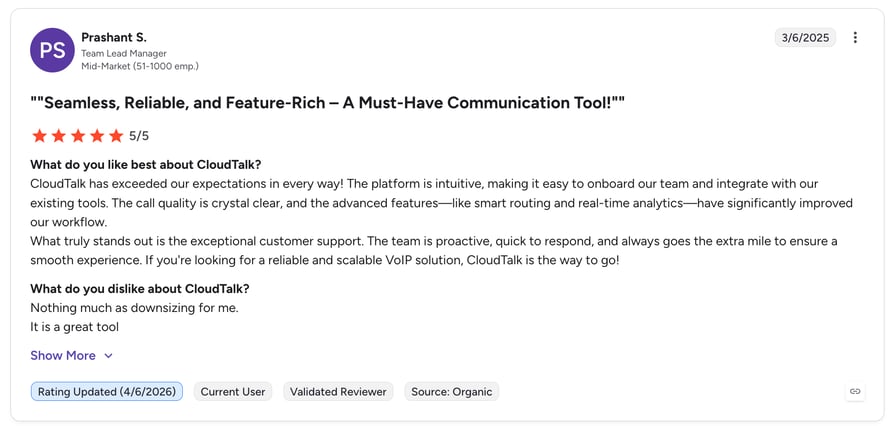
Bottom line: If your support or sales team relies on phone calls or needs a transparent path from trial to scale, CloudTalk is the more accessible choice. Decagon's text-first, enterprise-only model leaves out everyone except the largest digital-first brands.
Sierra AI: Best for Consumer Brands That Want Premium Conversational Quality
What is Sierra AI?
Sierra is an enterprise AI agent platform founded by former Salesforce co-CEO Bret Taylor. Like Decagon, it targets large consumer brands and operates on custom enterprise pricing. Sierra differentiates on conversational quality, brand voice fidelity, and a hands-on managed deployment model.
Why Sierra AI is Better than Decagon AI
Sierra is often described as more "white-glove" than Decagon. While Decagon emphasizes programmable Agent Operating Procedures that customer teams configure themselves, Sierra ships a managed implementation closer to a consulting engagement. For brands that prioritize conversational polish over deep technical control, Sierra is frequently the better fit.
- Strong focus on brand-aligned conversational quality and empathy
- Managed deployment model with hands-on configuration support
- Outcome-based pricing tied to resolution success
- Strong customer references in consumer-facing industries
- Closed Series C at a $15.8B valuation in 2026, signaling enterprise traction
What is Sierra AI's Pricing?
- Custom enterprise pricing only
- Outcome-based model (per-resolution structure)
- Generally considered more expensive than Decagon at comparable scale
- No public rates; requires sales engagement
Worth knowing: Sierra's outcome-based pricing introduces the same "what counts as resolved" ambiguity that affects Decagon's per-resolution contracts, but with potentially higher per-unit rates.
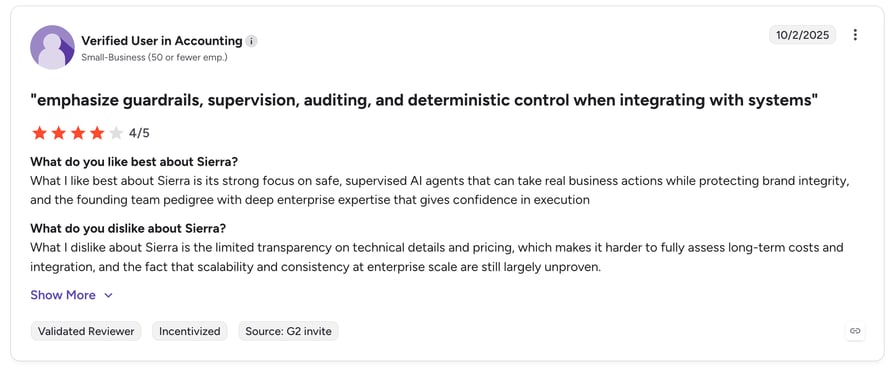
What Are G2 Users Rating Sierra AI?
Sierra AI is rated 4.4/5 on G2.
Fin by Intercom: Best for Teams Already on Intercom Wanting Quick AI Deployment
What is Fin?
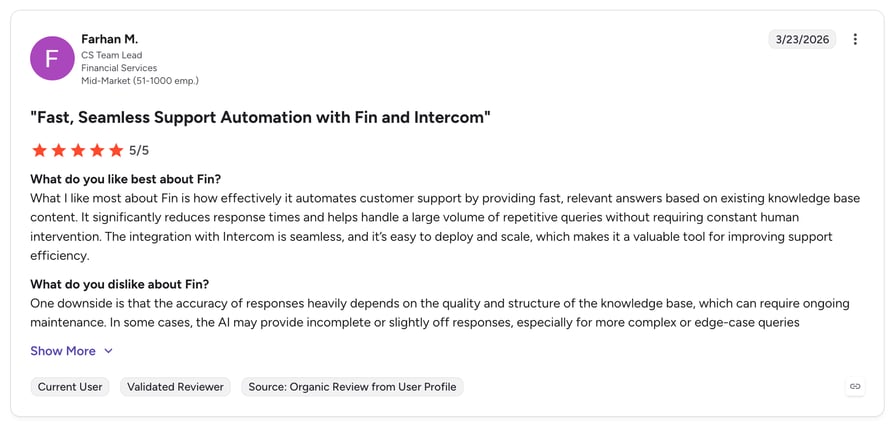
Fin is Intercom's native AI agent, built directly into the Intercom messaging and support platform. Unlike Decagon, Fin uses a transparent per-resolution pricing model that's published on Intercom's website, making it dramatically easier to forecast costs.
Why Fin is Better than Decagon AI
The biggest advantage is transparent pricing and instant deployment. If you're already on Intercom, Fin can be activated within hours. There's no sales cycle, no $50K minimum, and no custom contract negotiation. For mid-market teams already in the Intercom ecosystem, Fin removes most of the friction that makes Decagon inaccessible.
- Transparent published per-resolution pricing
- Native Intercom integration (no implementation lift)
- Free to evaluate before committing to volume
- Strong knowledge base ingestion and conversational quality
- Works for SMB through mid-market, not just enterprise
What is Fin's Pricing?
- $0.99 per resolution (transparent, published rate)
- No annual minimum commitment
- Pay-as-you-go billing
- Requires an Intercom subscription as the underlying platform
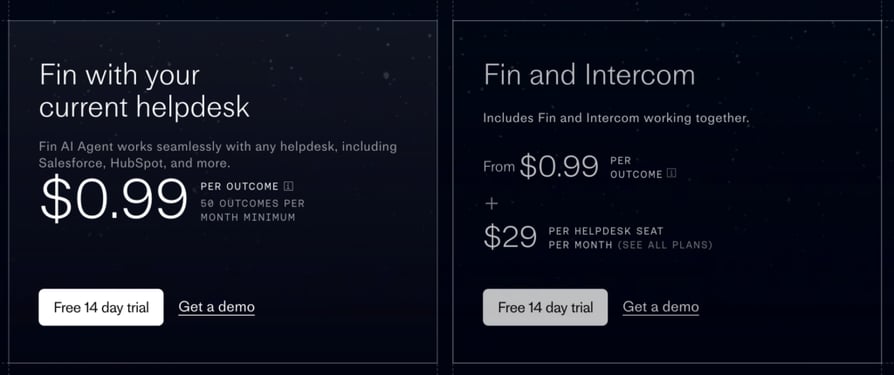
Worth knowing: At $0.99 per resolution, Fin's costs can scale up quickly at high volumes - a team handling 10,000 resolved tickets monthly would pay roughly $9,900/month or $118,800/year. At that scale, custom-quoted alternatives may offer better economics.
What Are G2 Users Rating Fin?
Fin is rated 4.5/5 by 3,800+ verified users on G2.
Ada: Best for Mid-Market Teams Wanting No-Code AI Without Enterprise Friction
What is Ada?
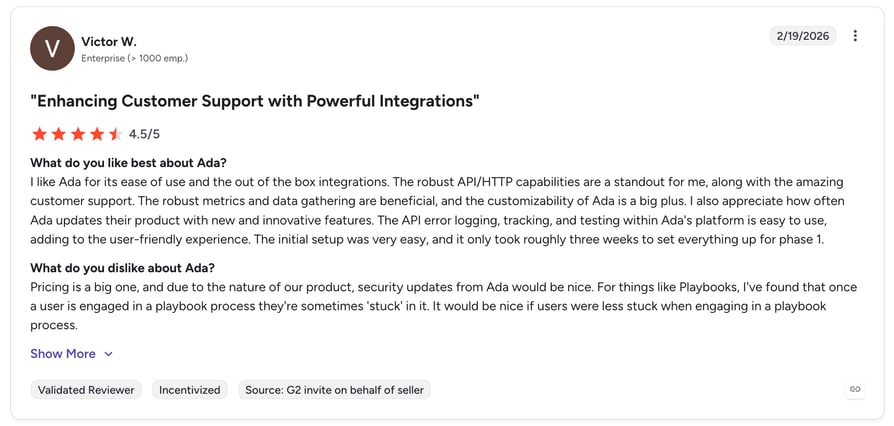
Ada is an established AI customer service platform built around a no-code builder that lets non-technical CX teams design conversational flows without engineering involvement. It targets mid-market and enterprise buyers and competes directly with Decagon on automation depth.
Why Ada is Better than Decagon AI
Ada offers a more accessible entry point than Decagon while still delivering enterprise-grade automation. The no-code builder appeals to CX leaders who want to own their AI workflows without needing dedicated Agent Engineers. Ada also offers stronger e-commerce support and broader pre-built integrations out of the box.
- No-code visual builder accessible to non-technical CX teams
- Strong pre-built integrations across e-commerce platforms
- Lower implementation friction than Decagon's AIDE-led model
- Established player with mature customer reference base
What is Ada's Pricing?
- Custom enterprise pricing (no published rates)
- Generally considered more accessible than Decagon's $50K floor
- Pricing scales with conversation volume
- Annual contracts standard
Worth knowing: Ada's pricing is still custom-quoted and gated behind sales calls, so transparency remains an issue. The advantage over Decagon is typically faster time-to-value and a lower commitment threshold.
What Are Users Rating Ada on G2?
Ada is rated 4.6/5 by 800+ verified users on G2.
What Are Decagon AI's Best Features?
Understanding Decagon AI pricing AI agents' value means understanding what you're actually paying for. The headline isn't volume - it's the depth of enterprise-grade tooling baked into every contract. Here are the four features that justify the cost when budget allows.
Agent Operating Procedures (AOPs)
AOPs are Decagon's flagship differentiator. They let non-technical CX managers define agent behavior in natural language rather than code. A support lead can write something like "If a customer requests a refund over $100, verify their purchase date and escalate to the billing team" and the AI follows that logic deterministically. For complex support environments with complex workflows - processing refunds, identity verification, account changes - AOPs handle the logic while maintaining context across turns.
This bridges the gap between rigid rule-based chatbots and unpredictable freeform LLMs. CX teams can iterate on agent behavior week-by-week without filing engineering tickets.
Where it could be better: AOPs work best for well-defined, repeatable flows. For long-tail support questions or edge cases that require improvisation, the structured approach can feel limiting compared to more freeform agentic architectures.
Multi-Channel Resolution Across Chat, Email, Voice, and SMS
Decagon deploys a unified agent across channels, so a customer who starts in chat and switches to voice keeps the same context. The voice capability - powered through a partnership with ElevenLabs and Decagon's own Voice 2.0 architecture - is particularly strong, with reported 65% reductions in latency in recent releases.
For brands where customers expect consistent service regardless of channel, this omnichannel architecture is a meaningful advantage over text-only competitors.
Where it could be better: Voice carries a 30–50% premium over chat in pricing, and high-volume voice deployments can quickly push annual contracts toward the upper end of Decagon's range.
Watchtower Observability and Governance
Watchtower is Decagon's monitoring layer. It tracks every AI and human interaction for policy compliance, PII handling, sentiment, and quality. CX leaders can set automated guardrails - for example, flagging any conversation involving payment data for human review - and Watchtower enforces them across all channels.
For regulated industries (fintech, healthcare, insurance), this governance posture is a key reason Decagon wins deals over lighter-weight alternatives. Strong guardrails reduce the kind of off-policy responses that frustrate customers and tank customer satisfaction scores.
Where it could be better: The depth of observability is a strength, but it also requires dedicated CX operations staff to interpret and act on the data. Smaller teams may not have the bandwidth to leverage Watchtower fully.
Multi-Model Orchestration
Rather than locking customers into a single LLM provider, Decagon's platform intelligently routes each query to the best-performing model - whether from OpenAI, Anthropic, Cohere, or its own fine-tuned open-source models. This avoids vendor lock-in at the model layer and improves response quality across diverse use cases.
Where it could be better: Customers don't directly control the routing logic, which is handled by Decagon's orchestration layer. For teams that want granular control over model selection per workflow, this can feel like a black box.
What are the pros and cons of Decagon AI?
| Pros | Cons |
|---|---|
| Enterprise-grade AOPs - Natural-language workflow control without code | Opaque pricing - No public rates, sales-call required for every quote |
| True omnichannel resolution - Unified agent across chat, email, voice, SMS | High floor - $50K minimum effectively excludes SMBs and most mid-market |
| Strong compliance posture - SOC 2 Type II, ISO 27001, GDPR, multi-region | Long sales cycle - 3–6 months from first contact to deployment |
| Watchtower observability - Real-time monitoring, PII protection, QA | Resolution-definition risk - Per-resolution billing creates renegotiation friction |
| Multi-model orchestration - Routes queries to best-fit LLM dynamically | Single-agent architecture - May struggle with conversations that pivot across domains |
Buyer feedback from analyst reports and G2 highlights a recurring theme: Decagon impresses technically but tests organizational patience on procurement and implementation. One reviewer from a Reddit thread summarized it as: "Super impressive autonomous agent. Fast to spin up and great demos. The tradeoff is limited transparency you can't always see why it decided something or tune behavior as granularly as you might want."
Is Decagon AI the Right Choice for Your Customer Support Team?
Decagon AI is a genuinely powerful platform, but it's built for a narrow profile: digital-first enterprises processing high ticket volumes with the budget, time, and internal resources to absorb a six-figure annual contract. For that profile, Decagon delivers measurable ROI through deflection rates of 70–90% reported by customers like Chime, Duolingo, and ClassPass.
For everyone else, the math gets harder fast. The $50K floor, $400K median contract, and 3–6 month sales cycle mean Decagon simply isn't accessible to most teams evaluating AI customer support.
Decagon makes sense if:
- You're an enterprise processing 10,000+ monthly support tickets
- You operate across multiple channels and need voice AI as a first-class feature
- You have a procurement team and budget for $400K+ annual contracts
- You have dedicated CX operations resources to manage AOPs and Watchtower
- You're in a regulated industry where SOC 2, ISO 27001, and PII handling are non-negotiable
- You can wait 3–6 months for full deployment
Decagon is probably not the right fit if:
- You're an SMB or startup with limited budget
- Your ticket volumes are below ~8,000 per month
- You need transparent, predictable pricing without negotiation
- You want to deploy AI support within weeks, not quarters
- Phone-based customer interactions are central to your business model
- You lack dedicated resources for AOP design and ongoing tuning
For teams where phone communication drives revenue - sales calls, inbound support, appointment booking - Decagon's text-first architecture isn't the right tool, even if budget allows. The voice capability is real, but it's an extension of a text-first platform rather than a purpose-built calling infrastructure.
If calling is core to your business, CloudTalk gives you a complete AI-powered calling platform with transparent per-seat pricing, real-time analytics, AI voice agents available as a simple add-on, and 160+ country coverage - built specifically for sales and support teams that live on the phone.
Frequently Asked Questions
Both target enterprise CX automation but differ in approach. Decagon offers programmable Agent Operating Procedures non-technical teams can configure, while Sierra ships a white-glove, consulting-style deployment. Sierra typically costs more due to outcome-based billing. Teams wanting transparent voice automation often pick a CloudTalk AI Voice Agent instead.
Decagon uses multi-model orchestration, routing queries to OpenAI, Anthropic, or Cohere depending on the task. Voice runs on its fine-tuned Decagon Voice 2.0 models built with Modal. CloudTalk takes a similar provider-agnostic approach - see how Conversation Intelligence handles model selection on the voice side.
No. Decagon's minimum is ~$50K/year with median contracts near $400K, 3–6 month sales cycles, and no free trial - it's built for 10,000+ tickets/month. SMBs are better off with transparent, deploy-in-hours options like CloudTalk's pricing plans starting at $25/user/month.
Per-conversation pricing balloons during peak periods like Black Friday or outages. Per-resolution invites billing disputes over what counts as "resolved." Negotiate the definition and add volume caps upfront. For predictable costs, see CloudTalk's AI Voice Agent pricing with fixed bundled minutes.
Decagon custom-quotes every contract based on volume, channels, integrations, and SLAs - a deliberate enterprise sales strategy that creates friction for fast evaluation. If transparency matters, compare against vendors that publish rates publicly, like CloudTalk's plans page and full feature pricing breakdown.
CloudTalk publishes per-seat rates: $25/user/mo Starter, $29/user/mo Essential, $49/user/mo Expert (annual), with AI Voice Agents from $99/200 min/month, a 14-day free trial, and deployment in hours. Decagon requires a sales call, ~$50K annual minimum, and 3–6 months to launch - built for enterprise text-first ticket resolution, not phone-first teams.