10 Best Fin AI Alternatives: TL;DR Comparison Table
| # | Tool | Best For | Starting Price | G2 Rating |
|---|---|---|---|---|
| 1 | CloudTalk | International SMB sales and high-volume contact center teams | $25/user/month (Starter) | 4.4/5 |
| 2 | Sierra AI | Enterprise brands outsourcing full support conversations to AI | Custom (outcome-based) | 4.4/5 |
| 3 | Retell AI | Engineering teams building custom voice agents | ~$0.07/min + usage (PAYG) | 4.8/5 |
| 4 | Ada | Enterprise B2C brands automating chat containment | Custom (quote-only) | 4.6/5 |
| 5 | Decagon | High-growth tech companies needing AI on chat, email, and voice | Custom (quote-only) | 4.8/5 |
| 6 | Salesforce Agentforce | Enterprise teams running support inside Salesforce | From $0.10/action (Flex Credits) | 4.3/5 |
| 7 | Zendesk AI | Support teams that want AI inside their helpdesk | $55/agent/month (Suite Team) | 4.3/5 |
| 8 | Freshdesk | Growing teams needing affordable ticketing with bundled AI | $19/agent/month (Growth) | 4.4/5 |
| 9 | Tidio | Small ecommerce teams on flat-rate budgets | Lyro AI from $32.50/month (50 conversations) | 4.6/5 |
| 10 | Dialpad | Teams wanting one app for calls, meetings, and messaging | $15/user/month (Standard) | 4.4/5 |
Skip the Reading. See It Live.
What Are the Top Fin AI Alternatives?
The top Fin AI alternatives in 2026 are CloudTalk, Sierra AI, Retell AI, Ada, and Salesforce Agentforce. CloudTalk leads for teams whose support and sales run on phone calls, Sierra AI and Ada compete for enterprise chat automation, and Retell AI serves developers building custom voice agents.
Why Are Teams Searching for a Fin AI Alternative?
Teams search for a Fin AI alternative for three structural reasons: metered pricing that grows with every resolved ticket, chat-first limits that leave phone calls uncovered, and rough handoffs when a customer needs a human. To be objective, though, the switch is rarely about quality: Fin holds a 4.5/5 rating on G2 across 3,800+ reviews, with hundreds of reviewers praising its quick, accurate answers.
Fin's future adds a fourth reason. The product began as the Intercom Fin AI Agent, became the company name in May 2026, and a month later Salesforce signed a definitive agreement to acquire Fin for approximately $3.6 billion,¹ expected to close in late 2026 or early 2027. Roadmap and pricing during that transition are open questions.
So teams searching for tools like Fin AI or apps similar to Fin AI usually want one of two things: a cheaper way to deflect chat tickets, or a platform that also covers calls. The alternatives to Fin AI below are grouped so you can tell the two apart at a glance.
5 Main Cons of Fin AI That Make Businesses Look for an Alternative
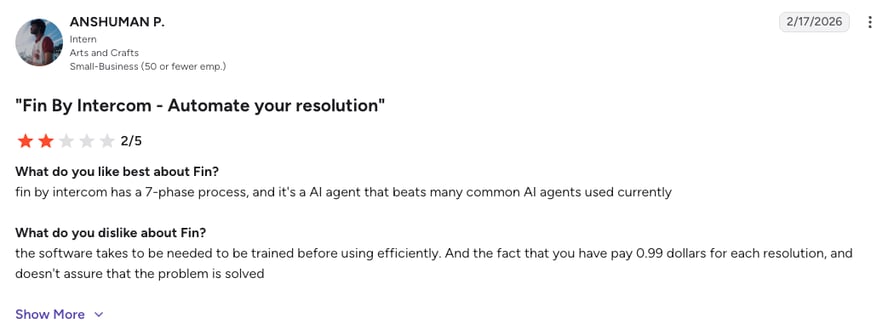
- Every resolved ticket is a line item, foreverFin bills $0.99 per outcome (resolutions, procedure handoffs, disqualifications) and $9.99 per sales qualification, with a 50-outcome monthly minimum on external helpdesks. There are no published volume discounts, and dozens of G2 reviewers flag high pricing and unexpected bills. Success gets more expensive every month it works. For more info, check out our Fin AI pricing guide.
- A billed resolution isn't always a solved problemPer Fin's own pricing FAQ, a conversation counts as resolved when no further help is requested after Fin's last answer. A customer who gives up quietly still gets billed as a win. The r/SaaS thread covered further down this page puts it plainly: Fin answers the questions "but not really solving my problem."
- It's an AI agent, not a phone systemFin Voice, Fin AI's AI voice agent, exists, but it is custom-priced, sales-led, and available only to select customers. Phone numbers, call routing, and outbound dialers all have to come from somewhere else. If your customers call you, Fin is a layer you add to a phone system you still need to buy.
- The full experience assumes the Intercom stackFin works on Salesforce, HubSpot, Zoho, and other helpdesks, but the complete package pairs it with Intercom seats at $29 to $132 per seat/month (annual billing), plus Copilot at $35/user/month and the Pro analysis add-on at $99 per 1,000 conversations. The add-ons stack quickly for lean teams.
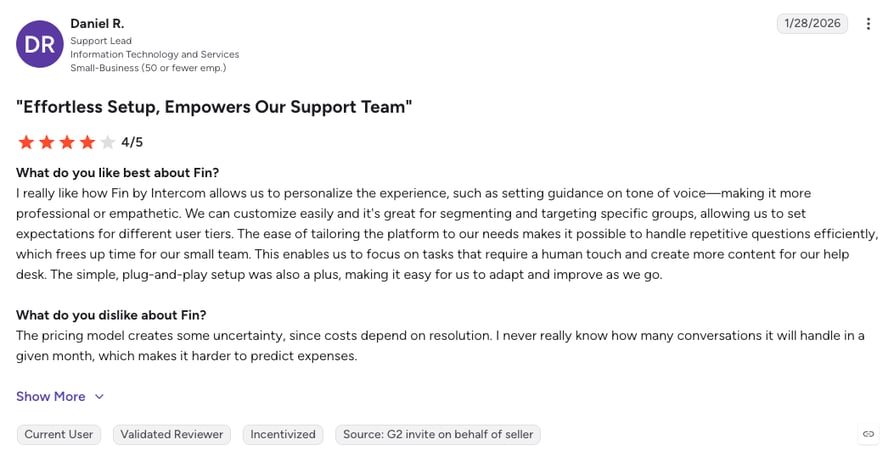
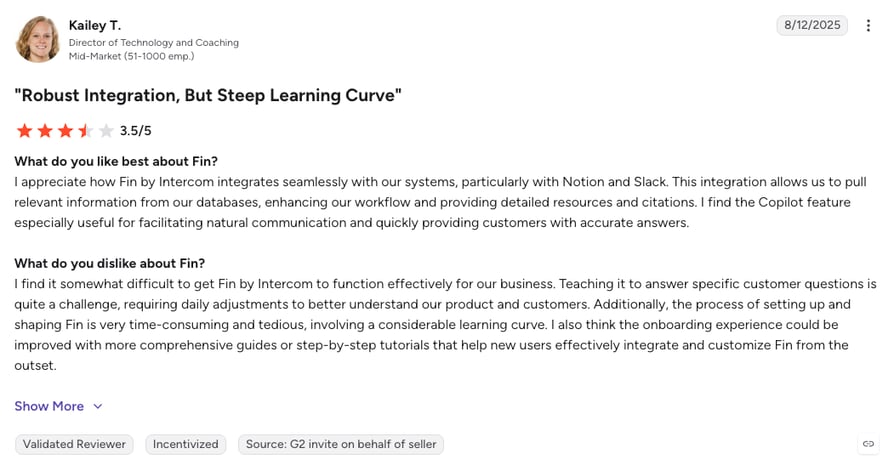
- Human handoff is where the reviews sourOn G2, many reviewers report delayed responses and frustrating agent handoffs, others flag answers that lack nuance or lean on outdated information, and the rest describe a steep learning curve. Complex, emotional, or account-specific queries still need a human, and that bridge is Fin's weakest span.
Where Fin AI Shines
If your support volume is chat-shaped, high-volume, and repetitive, Fin remains one of the strongest AI agents you can deploy, and its published resolution rates back that up. The question is what happens to the conversations that need a voice. That's where AI customer service agents built on a real phone system like CloudTalk take over.
What Is the Best Alternative to Fin AI?
CloudTalk is the best Fin AI alternative for growing, high-volume international sales and customer service teams. Unlike Fin AI, CloudTalk covers 160+ countries on globally distributed infrastructure and includes AI features like call summaries, sentiment analysis, and agent coaching as transparently priced add-ons. You pay flat per-seat plans and fixed monthly AI prices instead of Fin's $0.99-per-outcome metering.
Whether anything is better than Fin AI depends on the job. For chat deflection alone, Fin is hard to beat. But the best Fin AI alternative for 2026 for teams whose revenue rides on phone calls is a platform where AI and calling live together, and that's the case this blog makes.
Why Do Teams Consider CloudTalk the Best Fin AI Alternative?
CloudTalk plans start at $25/user/month (annual billing) with no seat minimums until Expert (3-seat minimum), covering unlimited inbound calls, automatic call recording, call queues, transfers, and click-to-call from day one. The platform also runs on a 99.999% uptime SLA. And where Fin positions itself squarely as a support agent, CloudTalk's AI covers both sides of the phone, support and sales.
5 Main Pros of CloudTalk and Why Businesses Switch from Fin AI
- Flat per-seat plans instead of per-outcome meteringThree tiers from $25 to $49/user/month on annual billing. Your bill comes from your seat count, not from how many tickets your AI happened to close. You always know what next month costs.
- A real phone system underneath the AIBuy and port virtual numbers in 160+ countries, set up queues and routing from the dashboard, and go live without an implementation partner. Fin needs a phone system, while CloudTalk is one.
- AI features at fixed monthly pricesConversation Intelligence adds AI call summaries, sentiment analysis, and agent coaching for $9/user/month flat. The AI Receptionist answers routine inbound calls with 50 free minutes on every account, then fixed tiers from $99/month.
- Works with the stack you already run100+ CRM and helpdesk integrations from the Essential plan, including Intercom, Zendesk, HubSpot, and Pipedrive, log calls, recordings, and contacts both ways. Salesforce deep-sync is available on Expert.
- Humans you can actually reach24/7 chat and email support on every plan (phone support on Expert), and your AI and human agents work the same queues on one platform. Escalation is a transfer, not a ticket that sits for days.
Test the Best Fin AI Alternative for 14 Days. No Contract Needed.
How We Chose the Best Fin AI Alternatives and Competitors
We aggregated user experiences from Reddit, Quora, and G2, reviewed every vendor's official pricing page, and read the technical documentation where pricing models needed decoding. To help you make an informed decision, each platform was then evaluated against six benchmarks:
- Call Stability & ReliabilityUptime guarantees, call quality reports, and how often users mention dropped calls in reviews.
- Total Cost of OwnershipThe real monthly bill: seat prices, per-outcome or per-minute fees, add-ons, and minimum commitments.
- CRM & Helpdesk Integration DepthWhether integrations sync data both ways, and which pricing tier unlocks them.
- Global Coverage & Number AvailabilityHow many countries you can buy numbers in, and what international calling actually costs.
- Support Quality & AvailabilitySupport channels, hours, and whether smaller accounts get a human or a portal.
- AI & Automation CapabilitiesWhat the AI does, what it costs, and whether it's priced per seat, per outcome, or per minute.
The Top 10 Alternatives to Fin AI for 2026
Fin AI customer service competitors split into two camps: conversational AI platforms like Sierra AI and Ada, and full phone systems with AI built in. The matrix below compares Fin AI against the four alternatives from G2's own comparison set, and the profiles that follow cover all ten in detail.
Fin AI vs. CloudTalk vs. Sierra AI vs. Retell AI vs. Ada
| Feature | Fin AI | CloudTalk | Sierra AI | Retell AI | Ada |
|---|---|---|---|---|---|
| Starting Price | $0.99/outcome (50-outcome min. on external helpdesks) | $25/user/month (Starter) | Custom (outcome-based) | ~$0.07/min voice engine + usage | Custom (quote-only) |
| Pricing Model | Per outcome | Flat per seat | Per outcome, negotiated contracts | Per minute (PAYG) | Annual platform contracts |
| Free Trial | 14 days | 14 days |  | Pay-as-you-go signup | |
| Voice & Calling | Fin Voice: custom pricing, select customers | Full call center: numbers, routing, queues, dialers | Voice agents for enterprise deployments | Voice-first AI agents | Chat and messaging first |
| Live Chat & Omnichannel | Chat, email, WhatsApp, SMS, social | Voice-first by design (no native chat) | Chat and voice | Voice only | Chat, email, social |
| CRM & Helpdesk Integrations | Works inside Intercom, Salesforce, HubSpot, Zoho + more | 100+ tools from Essential | Custom enterprise integrations | Via API and webhooks | Enterprise integrations (Salesforce, Zendesk + more) |
| AI Summaries & Insights | Pro add-on: $99 per 1,000 conversations | Conversation Intelligence add-on ($9/user/month) | Included in custom contracts | Call analysis built in | Reporting dashboards |
| Outbound Dialers | | Power Dialer (Expert, or $15/user/month add-on), Parallel Dialer ($39/user/month add-on). Smart & Preview on Expert. Click-to-call from Starter. | | Outbound campaigns via API | |
| Global Number Coverage | | 160+ countries | | Via Twilio/SIP telephony | |
| Customer Support | In-app messenger and email | 24/7 chat & email (phone on Expert) | Dedicated enterprise teams | Email + enterprise SLAs | Dedicated CSMs on contracts |
The Real Fin AI Question: Chat Layer or Phone System?
Three of the five columns above can't sell you a phone number, and that's the split that decides this comparison: AI agents that need your existing infrastructure, and platforms that bring their own. It also decides the bill. A team resolving 3,000 conversations a month through Fin pays $2,970 before helpdesk seats ($290 for ten on Intercom Essential) and Copilot ($350) push it near $3,610 a month, growing with every ticket. Ten agents on a business phone system like CloudTalk Essential pay $290 plus $90 for Conversation Intelligence, $380 flat, whatever the volume does.
1. CloudTalk: The Top Fin AI Alternative for International Sales and High-Volume Contact Center Teams
What Is CloudTalk?
CloudTalk is a voice-first contact center platform for fast-growing small business and mid-market sales and support teams. It combines calling infrastructure in 160+ countries, two-way CRM sync, outbound dialers, and AI call handling in one product you can set up yourself in an afternoon.
Its AI voice agents that serve as your virtual front desk are also why buyers rank CloudTalk among the best alternatives to Intercom AI Agent Fin: they answer, route, and resolve real phone calls on the same platform your human agents already use.
Why Is CloudTalk a Strong Fin AI Alternative?
- Pricing you can put in a budget: Three flat tiers run $25 to $49/user/month on annual billing. There are no per-outcome charges anywhere in the core plans, so a record support month costs the same as a quiet one.
- The phone layer Fin never had: Buy local numbers in 160+ countries, build call queues and routing rules from the dashboard, and put the Power Dialer behind your outbound team. Fin's own materials position it for support, but CloudTalk runs sales calls too.
- AI on both sides of the call: The AI Receptionist picks up routine inbound calls (50 free minutes on every account, then from $99/month), while Conversation Intelligence ($9/user/month) adds transcripts, sentiment analysis, summaries, AI call scoring, and coaching insights for your human team.
- Your helpdesk stays: 100+ CRM and helpdesk integrations from the Essential plan, including Intercom, Zendesk, HubSpot, and Pipedrive, sync calls and contacts both ways. Salesforce deep-sync comes with Expert.
- Built for international teams: Globally distributed infrastructure keeps call quality steady across markets, and Smart Dialer workflows (Expert plan) queue up cross-border campaigns without a separate tool.
What Are the Pros & Cons of CloudTalk?
| Pros | Cons |
|---|---|
| Flat per-seat pricing from $25/user/month with no per-outcome fees | Voice-first by design: no native live chat, email ticketing, or omnichannel inbox |
| Live in hours with self-serve setup and a 14-day free trial | Salesforce integration requires the Expert plan |
| 100+ CRM and helpdesk integrations from Essential (including Intercom and Zendesk) | Parallel Dialer $39/user/month only available as an add-on |
| AI Receptionist (50 free minutes) and Conversation Intelligence at fixed monthly prices | |
| 24/7 chat and email support on all plans (phone on Expert) |
What Are CloudTalk's Plans & Pricing?
CloudTalk pricing starts at $25/user/month (Starter, billed annually), with the following plans:
CloudTalk Plans and Pricing
| Plan | Price (annual billing) | Key Features |
|---|---|---|
| Starter | $25/user/month | Unlimited inbound & internal calls, 500 outbound minutes (regional calling bundle), call queues, transfers, click-to-call, automatic call recording (1-month retention) |
| Essential | $29/user/month | Everything in Starter + IVR and smart routing, 100+ CRM/helpdesk integrations, workflow automation, unlimited recording retention |
| Expert | $49/user/month | Everything in Essential + Power, Smart & Preview Dialers, Salesforce integration, 24/7 phone support (3-seat min) |
| Conversation Intelligence (add-on) | $9/user/month | AI transcripts, call summaries, sentiment analysis, agent coaching insights |
| AI Receptionist (add-on) | From $99/month (200 min) | Inbound AI call answering; 50 free minutes on every account; tiers up to $699/mo (2,500 min) |
| AI Voice Agent (add-on) | From $349/month (1,000 min) | Sales-led custom AI agents for inbound and outbound workflows; plans scale up to $1,249/mo (5,000 min) |
What Do CloudTalk's Customers Say?
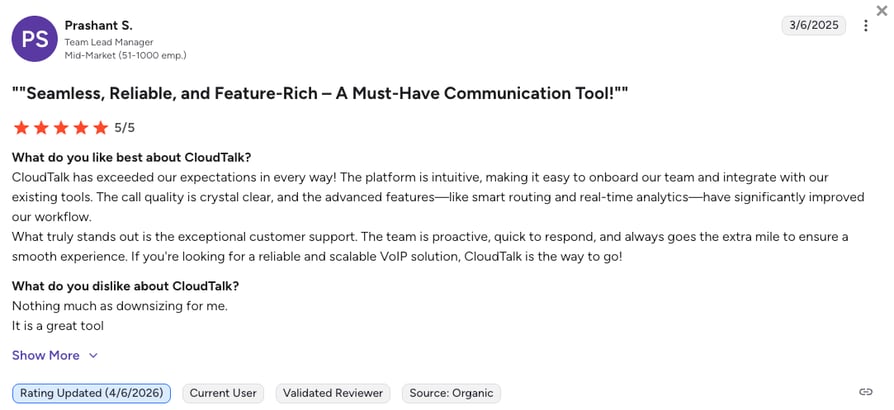
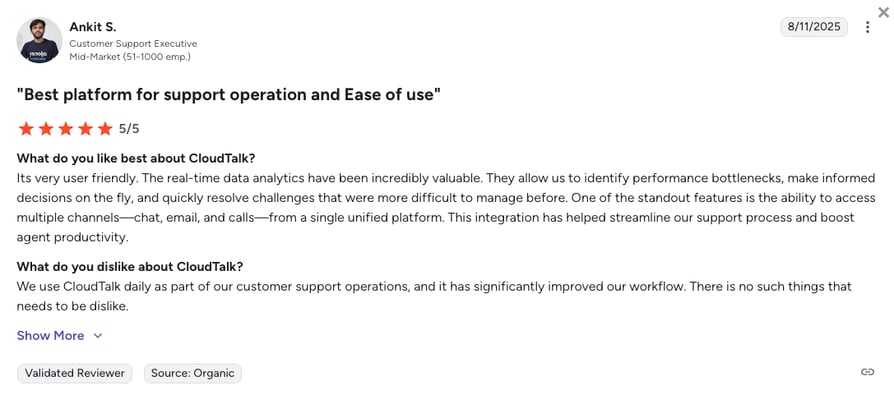
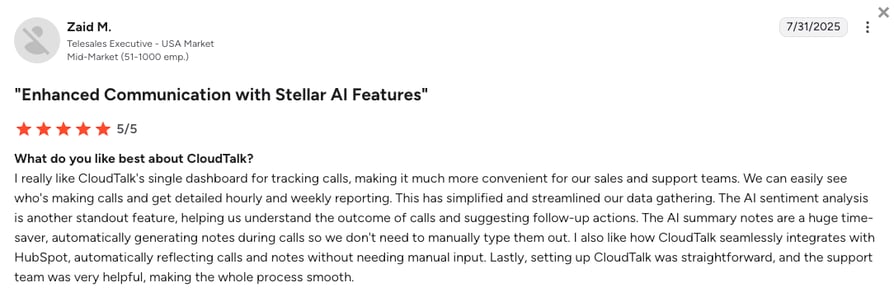
Across G2 and Capterra, reviewers most often praise how quickly CloudTalk goes live, call quality on international routes, and CRM integrations that log calls without agent effort. Ease of use and ease of setup are its highest-scoring G2 categories.
The most common criticism is that Salesforce deep-sync requires the Expert plan, a real tier jump for smaller Salesforce shops. Some reviewers also want richer native reporting, which is usually where the Conversation Intelligence add-on enters the conversation.
CloudTalk Global Scale in Action: Revolut's Story
Revolut shows what the phone side of this comparison looks like at full scale. The fintech giant grew its SDR operation from zero to more than 500 reps in 18 months on CloudTalk, with local numbers across its markets and deep CRM sync keeping the data clean. That's an operation a chat agent billed per outcome was never designed to carry.
Jamie Devlin, Revolut's Head of Operations for Business Sales, sums up the outcome:
”We managed to reduce sales operations by 40 hours per month and give our team the tools they need to scale globally — without sacrificing efficiency.”
Head of Operations for Business Sales at Revolut

How Do G2 Users Rate CloudTalk?
CloudTalk holds 4.4/5 on G2 across 1,800+ verified reviews, with ease of use and ease of setup among its highest-scoring categories.
Ready to Make the Switch?
2. Sierra AI: Best for Enterprise Brands Outsourcing Full Support Conversations to AI
What Is Sierra AI?
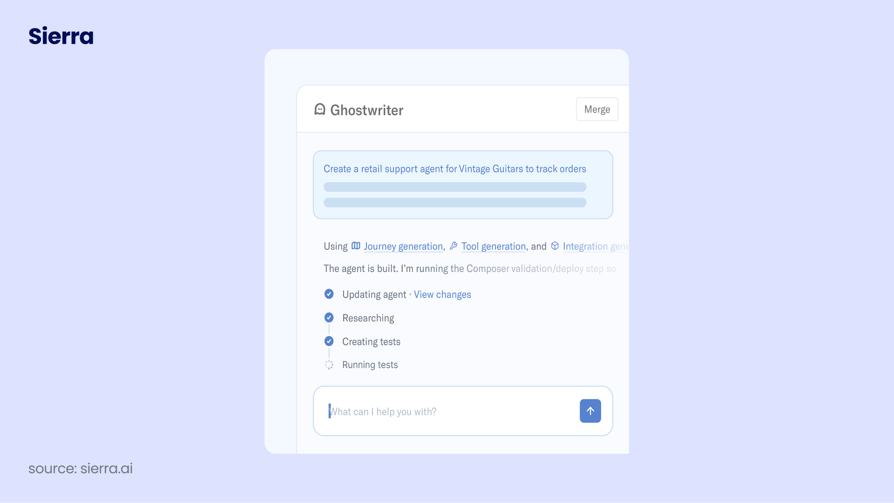
Sierra AI is an enterprise AI agent platform co-founded by former Salesforce co-CEO Bret Taylor. It builds managed, brand-safe agents that handle complete support conversations over chat and voice for large consumer brands. Deployments are white-glove projects, with Sierra's team building and tuning the agent alongside yours.
Why Is Sierra AI a Strong Alternative to Fin AI Software?
- Outcome pricing tied to results: Like Fin, Sierra charges when the agent completes the job, but resolutions are negotiated into a contract rather than metered at a flat public rate, which large buyers can use to cap spend.
- Agents that act, not just answer: Sierra agents take real actions in backend systems, from processing exchanges to saving cancellations, with supervision guardrails built for brand protection.
- Voice and chat under one roof: Sierra deploys phone-capable agents alongside chat, so an enterprise can automate both channels in one program instead of adding a separately priced voice product later.
What Are the Pros & Cons of Sierra AI?
| Pros | Cons |
|---|---|
| Outcome-based contracts align cost with resolved conversations | Quote-only pricing with limited public transparency on rates and technical detail |
| Managed, white-glove agent builds with brand-safety guardrails | Enterprise-only motion; no self-serve signup or trial |
| Handles chat and voice in a single enterprise deployment | Small public review base (under 20 G2 reviews) makes peer validation harder |
What Are Sierra AI's Plans & Pricing?
Sierra AI pricing is not publicly listed. Contracts are custom, outcome-based, and negotiated per deployment, and the structure looks like this:
Sierra AI Plans and Pricing
| Plan | Price | What's Included |
|---|---|---|
| Enterprise (custom) | Quote-only, outcome-based | Managed agent build, chat and voice channels, supervision tooling, dedicated team |
| Lower-value interactions | Blended flat fee per session (negotiated) | Routing, greetings, and other tasks priced per session instead of per outcome |
The Opacity Trap
Outcome pricing sounds fair until you try to forecast it: the rate, the outcome definition, and the session blend are all negotiated behind an NDA. Budget owners comparing Sierra against per-seat platforms should model a high-volume month before signing anything.
What Are Sierra AI's Customers Saying?
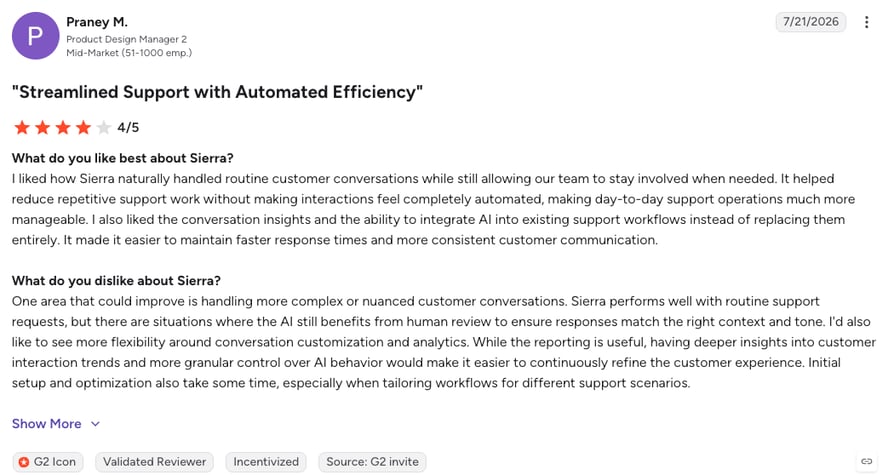
Reviewers praise Sierra's focus on safe, supervised agents that take real actions without going off-brand, and its deployment teams get high marks. The recurring complaints are limited transparency on pricing and technical detail, plus agents that can lose context in longer conversations.
How Do G2 Users Rate Sierra AI?
Sierra AI holds 4.4/5 on G2, though from a small review base of 20+ verified reviews, typical for an enterprise-only product.
3. Retell AI: Best for Engineering Teams Building Custom Voice Agents
What Is Retell AI?
Retell AI is developer-first voice AI infrastructure. Engineering teams use its low-latency voice engine, API, and SDKs to build custom phone agents for support lines, appointment booking, and outbound campaigns, choosing their own LLM and telephony underneath.
Why Is Retell AI a Strong Fin AI Competitor?
- Voice is the product, not a gated add-on: Where Fin Voice is custom-priced and limited to select customers, Retell's whole platform is phone calls, with published per-minute rates you can start on today.
- Build-your-own flexibility: Swap LLMs, tune conversation flows, and wire webhooks into your own stack. Teams with engineers get exactly the agent they design.
- Scales with concurrency: The platform is built for high parallel call volumes, which is why agencies and SaaS teams run production deployments on it.
What Are the Pros & Cons of Retell AI?
| Pros | Cons |
|---|---|
| Low-latency voice engine with published pay-as-you-go rates | Requires engineering time; there's no no-code path to production |
| Bring-your-own LLM and telephony for full technical control | Per-minute stack math (voice engine + LLM + telephony) makes bills volume-dependent |
| Strong developer community and fast-moving feature set | No helpdesk features: tickets, routing to humans, and QA live elsewhere |
What Are Retell AI's Plans & Pricing?
Retell AI pricing starts at roughly $0.07/minute for the voice engine on pay-as-you-go billing, and the full per-minute cost stacks these layers:
Retell AI Plans and Pricing
| Layer | Price | What It Covers |
|---|---|---|
| Voice engine | ~$0.07 to $0.08/min | Retell's proprietary low-latency conversation engine |
| LLM usage | ~$0.006 to $0.50/min | Scales with the model you choose (GPT-4o, Claude, and others) |
| Telephony | ~$0.015/min | Twilio-based SIP; 20 free concurrent lines included |
| Enterprise | Custom (volume discounts) | Dedicated support, SLAs, higher concurrency |
The Per-Minute Stack Trap
Retell's advertised $0.07/min is one of three meters running on every call. With a capable LLM and telephony added, real-world costs often land between $0.13 and $0.31 per minute, so a 10,000-minute month swings from $700 to $3,100 depending on configuration choices your engineers make. If budget clarity matters to you, then you should look for Retell AI alternatives like CloudTalk.
What Are Retell AI's Customers Saying?
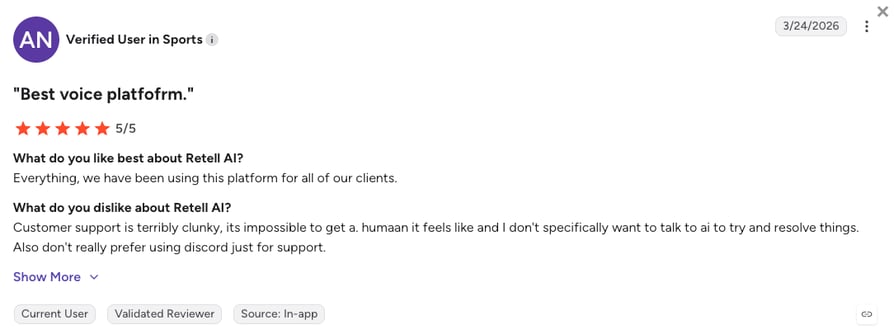
Reviewers consistently praise Retell's latency, voice quality, and how quickly a working prototype comes together. The friction points are the learning curve for non-developers and unpredictable monthly costs once usage scales, the same complaint that follows every per-unit pricing model in this list.
How Do G2 Users Rate Retell AI?
Retell AI holds 4.8/5 on G2 across 2,600+ verified reviews, one of the strongest scores in the voice AI category.
4. Ada: Best for Enterprise B2C Brands Automating Chat Containment
What Is Ada?
Ada is a no-code AI customer service platform popular with high-volume ecommerce and consumer brands. Its agents deflect and resolve routine questions across chat, email, and social channels, with workflows that reach into order systems and CRMs to complete tasks.
Why Is Ada a Strong Alternative to Fin AI?
- Containment as the core metric: Ada is built around keeping routine volume away from human agents entirely, and its playbooks for ecommerce use cases (orders, returns, subscriptions) are mature.
- No-code automation at enterprise scale: Support leaders build and adjust flows without engineering tickets, which keeps iteration in the support team's hands.
- Multi-system workflows: Ada connects into Salesforce, Zendesk, and order platforms so resolutions update the systems of record along with the chat window.
What Are the Pros & Cons of Ada?
| Pros | Cons |
|---|---|
| Mature no-code builder praised for ease of use and admin | Quote-only pricing; budgeting requires a sales cycle |
| Strong ecommerce and B2C automation playbooks | Reviewers flag limited reporting and workflow customization |
| Enterprise integrations that let resolutions update source systems | Chat-first platform; phone support isn't the focus |
What Are Ada's Plans & Pricing?
Ada pricing is quote-only. There are no published tiers, and market estimates put annual platform contracts in five figures before usage, so treat the numbers below as structure rather than list prices:
Ada Plans and Pricing
| Plan | Price | What's Included |
|---|---|---|
| Platform contract | Custom (annual) | AI agent, no-code builder, integrations, analytics |
| Usage component | Negotiated per resolution/interaction | Volume-based fees on top of the platform contract |
The Quote-Only Trap
Ada's pricing conversation starts where Fin's ends: after you've committed to a sales cycle. If your team wants to compare real numbers this week, note which vendors on this list publish rates and which require an NDA to see them.
What Are Ada's Customers Saying?
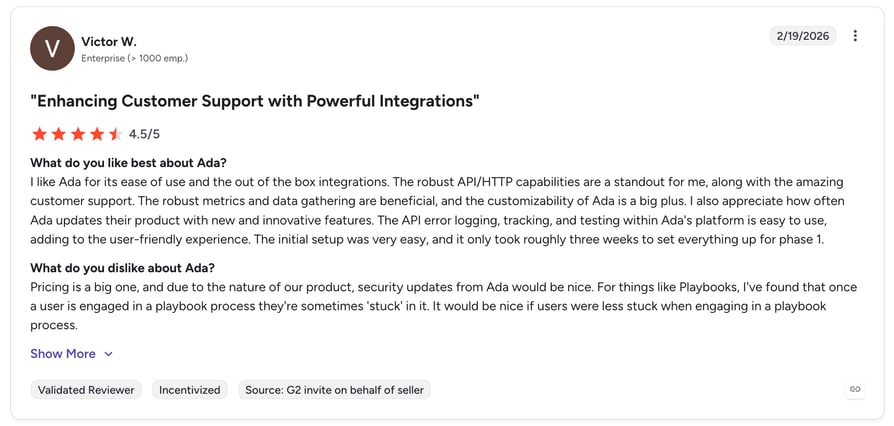
G2 reviewers rate Ada highly for ease of use, ease of admin, and responsive support during rollout. The criticism clusters around reporting depth and customization limits, with some teams outgrowing the analytics as their automation programs mature.
How Do G2 Users Rate Ada?
Ada holds 4.6/5 on G2 across 150+ verified reviews, with ease of administration among its best-scoring categories.
5. Decagon: Best for High-Growth Tech Companies Needing AI on Chat, Email, and Voice
What Is Decagon?
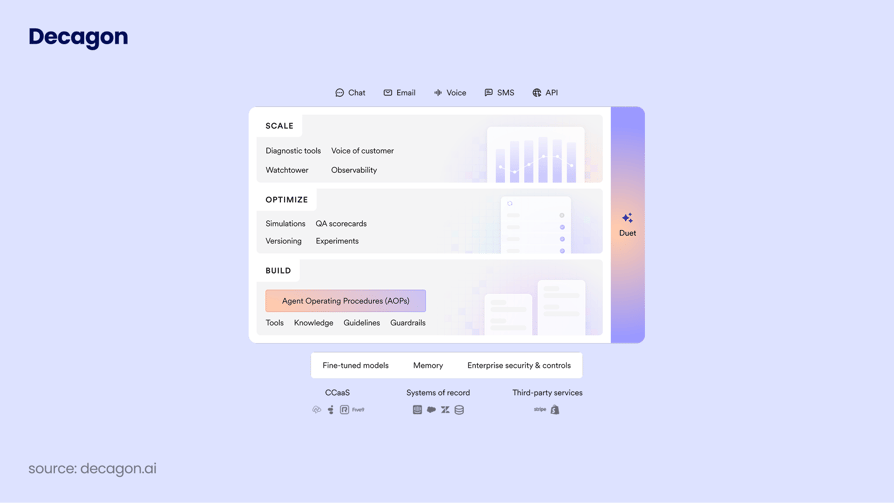
Decagon builds AI customer service agents for high-growth technology companies, with chat, email, and voice treated as first-class channels. Customers include Chime, Duolingo, ClassPass, Rippling, and Notion, and its agents follow natural-language operating procedures rather than rigid decision trees.
Why Is Decagon a Strong Fin AI Alternative?
- Voice ships as a real channel: Decagon Voice handles phone conversations natively, where Fin's voice product remains custom-priced and limited to select customers.
- Procedures written in plain language: Support teams describe workflows the way they'd brief a new hire, and the agent follows them across channels.
- Built for scale-up volume: Its reference customers run large, spiky consumer volumes, exactly the profile where per-outcome economics get uncomfortable.
What Are the Pros & Cons of Decagon?
| Pros | Cons |
|---|---|
| Chat, email, and voice covered by one agent platform | Quote-only enterprise pricing with no published rates |
| Natural-language procedures that support teams maintain themselves | Young platform with a small public review base (about 20 G2 reviews) |
| Proven with high-volume consumer tech brands | Enterprise sales motion; no self-serve way to test it |
What Are Decagon's Plans & Pricing?
Decagon pricing is quote-only. The company discusses per-conversation and per-resolution models in its own materials but publishes no rates, so plan on a sales process to get numbers:
Decagon Plans and Pricing
| Plan | Price | What's Included |
|---|---|---|
| Enterprise contract | Custom | AI agents across chat, email, and voice; AOP workflow tooling; integrations |
Point Solution or Platform?
Decagon automates conversations brilliantly, but your phone numbers, routing, and human agents still need a home. Before adding another standalone layer, it's worth understanding how a standalone voice agent compares with an integrated system where AI and agents share one platform.
What Are Decagon's Customers Saying?
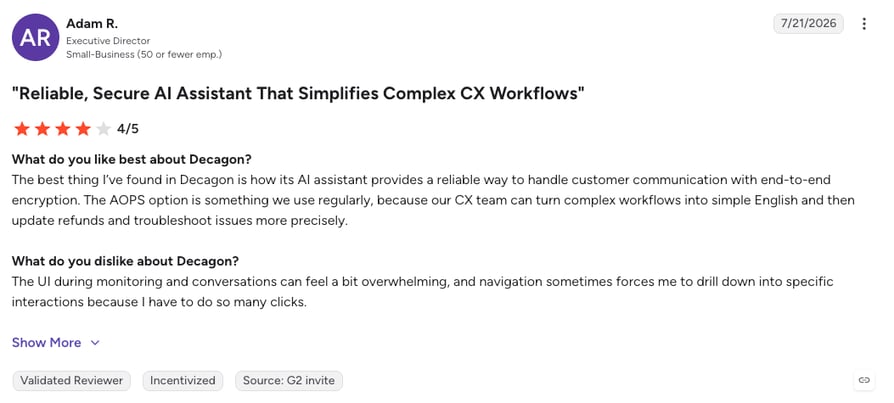
Early reviews are strongly positive: teams highlight resolution quality, the speed of iteration with plain-language procedures, and responsive deployment support. The caveats are the ones you'd expect from a young enterprise product: a small review base and pricing you can't see without a call. Also, some reviewers point out Decagon's UI can be hard to navigate at times.
How Do G2 Users Rate Decagon?
Decagon holds 4.8/5 on G2, though from a small base of verified reviews.
6. Salesforce Agentforce: Best for Enterprise Teams Running Support Inside Salesforce
What Is Salesforce Agentforce?
Salesforce Agentforce embeds autonomous AI agents directly into Salesforce, where they act on CRM data, cases, and workflows without leaving the platform. It's also the reason Fin's future is a live question: Salesforce signed an agreement in June 2026 to acquire Fin and fold its technology into the Agentforce family.
Why Is Salesforce Agentforce a Strong Fin AI Competitor?
- Agents native to your system of record: Agentforce reads and writes Salesforce objects directly, so resolutions update cases, contacts, and opportunities without an integration layer.
- Two pricing meters to choose from: Flex Credits ($500 per 100,000 credits, about $0.10 per standard action) or a flat $2 per conversation, letting ops teams pick the model that fits their volume shape.
- The roadmap magnet: With the Fin agreement signed, Salesforce is positioning Agentforce as the destination for exactly the packaged, fast-to-deploy agents Fin built.
What Are the Pros & Cons of Salesforce Agentforce?
| Pros | Cons |
|---|---|
| Deep native access to Salesforce data and workflows | Consumption pricing is hard to forecast: multi-step conversations burn multiple actions |
| Choice of per-action (Flex Credits) or per-conversation pricing | Assumes a Salesforce ecosystem; value drops sharply outside it |
| Enterprise governance, trust layer, and admin tooling built in | Real deployments are sales-led with credits, add-ons, and editions to reconcile |
What Are Salesforce Agentforce's Plans & Pricing?
Salesforce Agentforce pricing starts at $0.10 per standard action via Flex Credits, and the published structure looks like this:
Salesforce Agentforce Plans and Pricing
| Component | Price | What It Covers |
|---|---|---|
| Flex Credits | $500 per 100,000 credits | Standard action = 20 credits (~$0.10); voice actions = 30 credits (~$0.15) |
| Conversations model | $2 per conversation | Flat rate for customer-facing agent conversations |
| Agentforce add-ons | $125/user/month | Agent capabilities added to existing Salesforce user licenses |
| Agentforce 1 Editions | From $550/user/month | Bundled editions including 2.5M Flex Credits per org per year |
The Credit Burn-Down Trap
A single customer conversation can trigger several billable actions: a lookup, an update, a routing step, a summary. At 20 credits each, a four-action conversation costs $0.40 on Flex Credits, and nothing on the pricing page caps how many actions a hard conversation takes. Model your worst tickets, not your average ones.
What Are Salesforce Agentforce's Customers Saying?
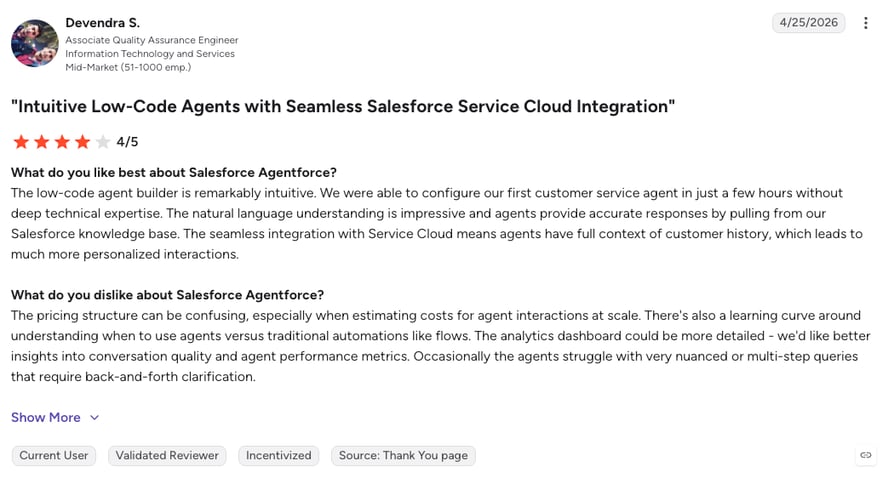
Reviewers like how naturally agents inherit Salesforce permissions, data, and flows, and enterprise admins praise the governance tooling. The recurring gripes are setup complexity outside simple use cases and difficulty predicting consumption costs before real traffic hits.
How Do G2 Users Rate Salesforce Agentforce?
Salesforce Agentforce holds 4.3/5 on G2 across 1,200+ verified reviews.
7. Zendesk AI: Best for Support Teams That Want AI Inside Their Helpdesk
What Is Zendesk AI?
Zendesk is one of the most widely deployed helpdesks in the world, and Zendesk AI is the agent layer built into it. AI agents now come included in every Suite and Support plan, billed by automated resolutions, so teams already on Zendesk can switch on automation without adding a vendor.
Why Is Zendesk AI a Strong Fin AI Alternative?
- AI where your tickets already live: No new platform, no data migration: the agent works inside the queues, macros, and SLAs your team runs today.
- Included resolution allocations: Every plan bundles automated resolutions per agent per month (5 on Team, 10 on Professional, 15 on Enterprise), so light automation may cost nothing extra.
- Omnichannel ticketing native: Email, chat, social, and phone (via Zendesk Talk) feed one workspace, with AI triage and routing across all of it.
What Are the Pros & Cons of Zendesk AI?
| Pros | Cons |
|---|---|
| AI agents included in every Suite and Support plan | Automated resolutions beyond the included allocation bill in overage blocks |
| Massive marketplace and mature ticketing workflows | Copilot for agents is a $50/agent/month add-on (included only on Suite Enterprise) |
| Omnichannel coverage with AI triage built in | Phone support depends on Zendesk Talk usage pricing on top of seats |
What Are Zendesk AI's Plans & Pricing?
Zendesk pricing starts at $19/agent/month (Support Team, annual billing), and you can choose from these plans:
Zendesk Plans and Pricing
| Plan | Price (annual billing) | Key Features |
|---|---|---|
| Support Team | $19/agent/month | Email and ticketing, routing, basic analytics, 5 automated resolutions/agent/mo |
| Suite Team | $55/agent/month | Omnichannel messaging, help center, AI agents, telephony via Zendesk Talk |
| Suite Professional | $115/agent/month | Everything in Team + skills-based routing, IVR, 10 automated resolutions/agent/mo |
| Suite Enterprise | Custom | Everything in Professional + Copilot included, sandbox, advanced governance |
| Copilot (add-on) | $50/agent/month | AI assistance for human agents; included on Suite Enterprise |
The Resolution Allocation Trap
The included AI resolutions run out fast at real volume: a 10-agent Suite Team account gets 50 automated resolutions a month before overage blocks kick in. It's the same per-resolution meter as Fin, just with a small free allowance in front of it.
What Are Zendesk AI's Customers Saying?
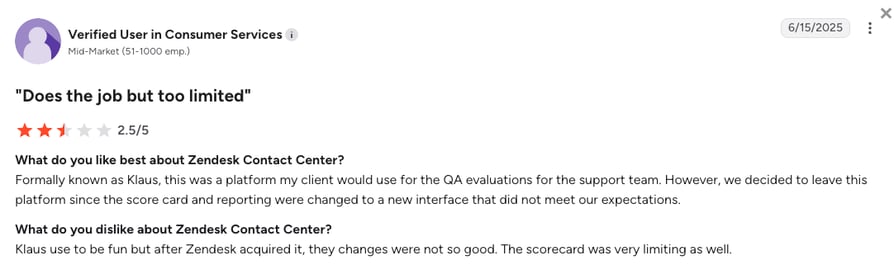
Reviewers value the depth of the ticketing engine and how much of the support operation lives in one place. Common frustrations include per-agent costs climbing as AI and add-ons stack, and admin complexity on larger instances.
How Do G2 Users Rate Zendesk?
Zendesk's Support Suite holds 4.3/5 on G2 across 7,000+ verified reviews, one of the largest review bases in customer service software.
8. Freshdesk: Best for Growing Teams Needing Affordable Ticketing with Bundled AI
What Is Freshdesk?
Freshdesk is Freshworks' helpdesk for small and mid-sized teams, with Freddy AI as its automation layer. Every paid plan includes the Freddy AI Agent with 500 free sessions, making it one of the cheapest ways to put a working AI agent in front of customers.
Why Is Freshdesk a Strong Alternative to Fin AI?
- AI bundled from $19/agent: The Freddy AI Agent ships with every paid plan, so a small team gets ticketing and AI deflection in one bill instead of a helpdesk plus a metered agent.
- Session pricing with a free runway: 500 free Freddy sessions per month, then $49 per 100 sessions, keeps early automation costs visible and small.
- A gentler admin curve: Freshdesk is consistently rated easier to set up than enterprise helpdesks, which matters for teams without a dedicated admin.
What Are the Pros & Cons of Freshdesk?
| Pros | Cons |
|---|---|
| Freddy AI Agent included on all paid plans (500 sessions free) | Freddy AI Copilot costs $29/agent/month extra and needs Pro or Enterprise |
| Low entry price for a full ticketing system | Advanced routing and analytics sit on the $55+ tiers |
| Easy setup and administration for small teams | Phone support relies on Freshcaller, a separate usage-billed product |
What Are Freshdesk's Plans & Pricing?
Freshdesk pricing starts at $19/agent/month (Growth, annual billing), with the following plans available:
Freshdesk Plans and Pricing
| Plan | Price (annual billing) | Key Features |
|---|---|---|
| Free | $0 (2 agents) | Basic ticketing and knowledge base |
| Growth | $19/agent/month | Ticketing, portal, automations, Freddy AI Agent (500 sessions included) |
| Pro | $55/agent/month | Multilingual support, custom dashboards, intelligent routing, Copilot eligible |
| Enterprise | $89/agent/month | Freddy AI Insights, skill-based routing, sandbox, audit logs |
| Freddy AI Copilot (add-on) | $29/agent/month | AI assistance for agents; Pro and Enterprise only |
The Session Meter Trap
Freddy's 500 free sessions sound generous until you check the definition: a session starts every time the AI engages a customer, resolved or not. Past the allowance it's $49 per 100 sessions, so a busy month can quietly double the Growth plan's per-agent cost.
What Are Freshdesk's Customers Saying?
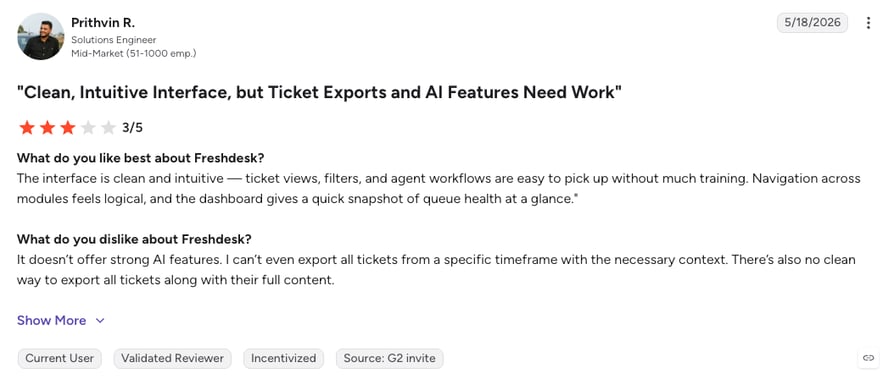
Reviewers like the price-to-feature ratio, the clean interface, and how quickly new agents learn it. Complaints center on Freddy's occasional misfires on complex queries and on features (like Copilot) that require both an add-on fee and a higher tier.
How Do G2 Users Rate Freshdesk?
Freshdesk holds 4.4/5 on G2 across 3,700+ verified reviews, with ease of use a consistent highlight.
9. Tidio: Best for Small Ecommerce Teams on Flat-Rate Budgets
What Is Tidio?
Tidio is a live chat and helpdesk platform for small ecommerce and service businesses, and Lyro is its AI agent. Lyro answers routine customer questions from your knowledge content, works on Tidio or standalone on helpdesks like Zendesk, and is priced by conversation bundles rather than per seat.
Why Is Tidio a Strong Fin AI Alternative?
- Predictable AI bundles: Lyro starts at $32.50/month for 50 AI conversations (annual billing), a number a small team can actually budget, unlike an open-ended per-outcome meter.
- Fast website deployment: Widget on the site, knowledge sources connected, and Lyro answering the same day, with 50 lifetime free conversations to test it.
- Ecommerce-native features: Shopify integration, order-status flows, and cart-recovery chats are first-class citizens, not custom projects.
What Are the Pros & Cons of Tidio?
| Pros | Cons |
|---|---|
| Flat-rate Lyro bundles from $32.50/month | Conversation caps per tier; growth means the next bundle |
| Quick setup with a free tier to start | Feature depth is SMB-scale; big teams outgrow the analytics |
| Built for ecommerce workflows out of the box | No voice channel; Tidio is chat and email territory |
What Are Tidio's Plans & Pricing?
Tidio pricing starts at $24.17/user/month (Starter, annual billing), and Lyro AI is added as a usage bundle on top:
Tidio Plans and Pricing
| Plan | Price (annual billing) | Key Features |
|---|---|---|
| Free | $0 | 50 conversations/month, 50 lifetime Lyro conversations |
| Starter | $24.17/month | 100 conversations, live chat, ticketing |
| Growth | From $49.17/month | From 250 conversations, analytics, automation |
| Plus | From $300/month | Custom limits, dedicated success manager, discounted usage |
| Lyro AI (add-on) | From $32.50/month | 50 AI conversations/month, scalable to 1,000/month |
The Conversation Cap Trap
Lyro's bundles are honest but finite: hit your 50, 100, or 250 conversations mid-month and the AI stops until you upgrade. Ecommerce teams with seasonal spikes should size bundles for peak months, or look at how AI voice agents handle order-status calls where chat volume overflows.
What Are Tidio's Customers Saying?
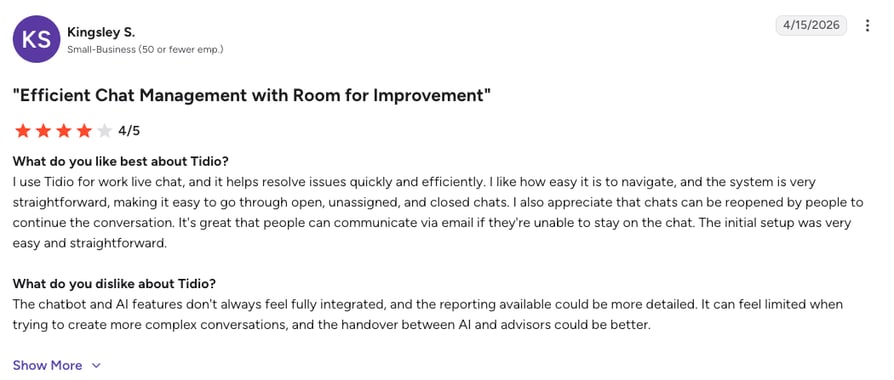
Reviewers praise the setup speed, the clean widget, and Lyro's answer quality on well-documented questions. The recurring wish-list items are deeper reporting and more generous conversation limits on the lower tiers.
How Do G2 Users Rate Tidio?
Tidio holds 4.6/5 on G2 across 1,900+ verified reviews, an unusually strong score for a product at SMB price points.
10. Dialpad: Best for Teams Wanting One App for Calls, Meetings, and Messaging
What Is Dialpad?
Dialpad is an AI-powered business communications platform that puts calls, video meetings, and messaging in one app. Dialpad Connect, its business phone product, bakes AI transcription and call summaries into even the cheapest plan, making it the most phone-shaped Fin AI alternative on this list after CloudTalk.
Why Is Dialpad a Strong Fin AI Competitor?
- AI on every call from $15: Live transcription, post-call summaries, and voicemail transcription come with the Standard plan, no add-on required.
- One app for the whole conversation stack: Calls, meetings, and team messaging share one interface, which suits teams consolidating tools.
- Real-time coaching on higher tiers: Live coach cards and sentiment cues help supervisors step in while the call is still happening.
What Are the Pros & Cons of Dialpad?
| Pros | Cons |
|---|---|
| AI transcription and summaries included from the $15 Standard plan | Call recording and CRM integrations (Salesforce, HubSpot) require Pro at $25/user/month |
| Unified app for calls, meetings, and messaging | The contact center is a separate product, Dialpad Support, from $80/user/month |
| Clean, modern interface that teams adopt quickly | Two product lines with similar names make quotes confusing |
What Are Dialpad's Plans & Pricing?
Dialpad pricing starts at $15/user/month (Standard, annual billing), with the following tiers available:
Dialpad Connect Plans and Pricing
| Plan | Price (annual billing) | Key Features |
|---|---|---|
| Standard | $15/user/month | Unlimited calling, AI transcription, AI call summaries, SMS, voicemail |
| Pro | $25/user/month | Everything in Standard + call recording, CRM integrations, international numbers |
| Enterprise | Custom | SLA, advanced admin and analytics, priority support |
The Two-Product Trap
The $15 headline price buys the business phone; the contact center is a separate quote. Queues, agent monitoring, and real-time coaching live in Dialpad Support, which starts at $80/user/month, more than five times the Connect price. Check which product your quote actually names before comparing it against per-seat platforms.
What Are Dialpad's Customers Saying?
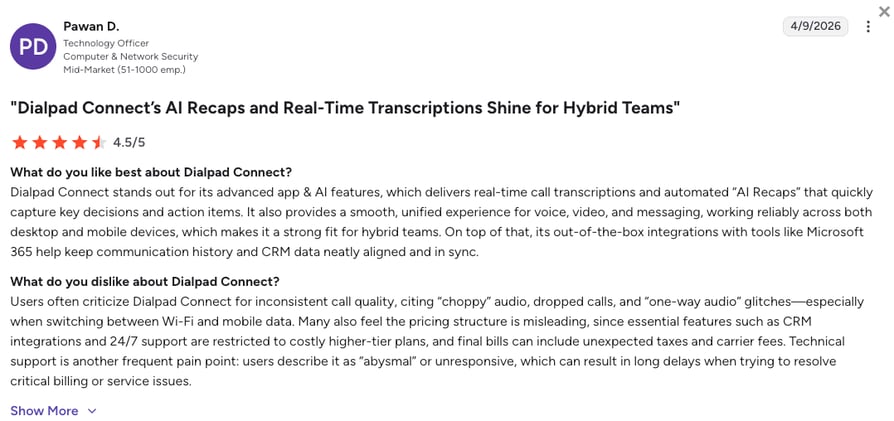
Reviewers consistently call out the accuracy of the AI transcriptions and the convenience of one app for everything. Complaints focus on features gated behind Pro, and on support responsiveness for smaller accounts.
How Do G2 Users Rate Dialpad?
Dialpad holds 4.4/5 on G2 across 4,100+ verified reviews on its platform-wide listing.
What Real Users Are Saying about Fin AI and Its Alternatives
Pricing pages tell you what a tool does. Real user posts tell you whether it works as claimed once the invoices start arriving. Here's what buyers and builders are saying across Reddit, Quora, and G2.
What Redditors Are Saying about Fin AI Alternatives
We reviewed active threads in r/SaaS, r/AgentsOfAI, and r/AI_Agent_Reviews where founders and support leads compare Fin AI with its alternatives:
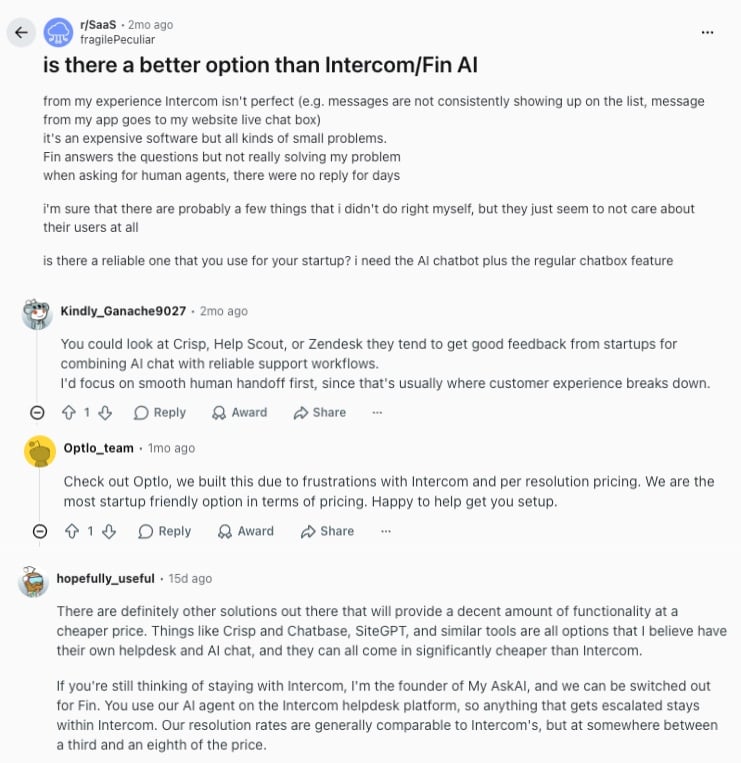
- Fin AI frustrations inside Intercom: A SaaS founder in r/SaaS describes Fin answering questions "but not really solving my problem," with human agents not replying for days when escalation was needed. Replies pointed to Crisp, Help Scout, and Zendesk, and several urged him to prioritize smooth human handoff, the exact gap AI agent assist workflows are built to close.
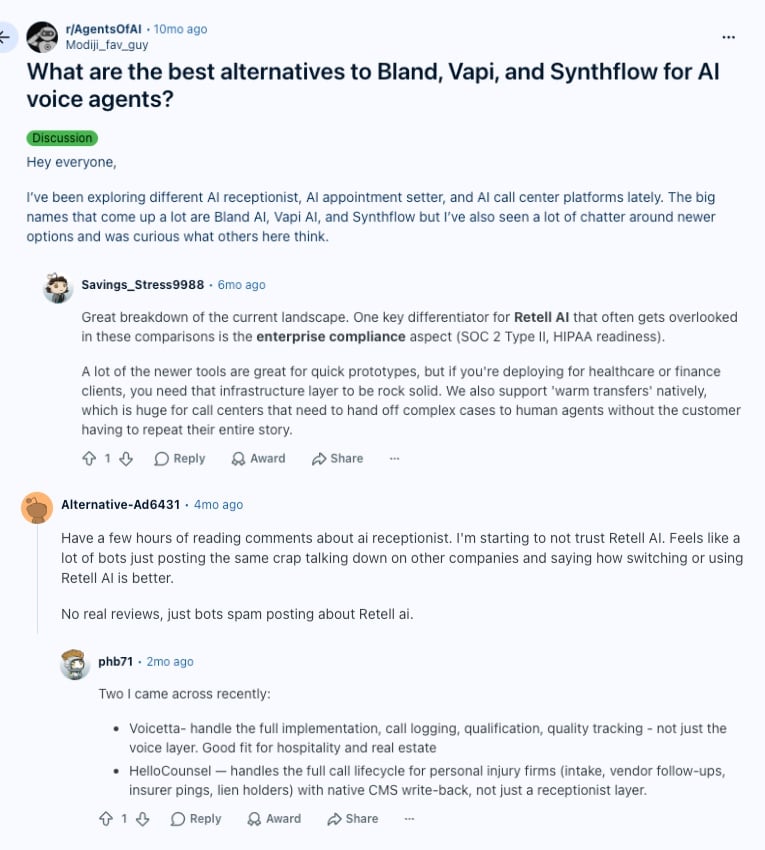
- Voice agent buyers compare notes: The r/AgentsOfAI thread on alternatives to Bland, Vapi, and Synthflow shows how quickly the conversation moves from chat deflection to AI voice agents. Commenters flagged warm transfers and compliance as the make-or-break features, and one warned that some vendor praise in these threads reads like bot-posted marketing, advice worth keeping for every tool on this page.
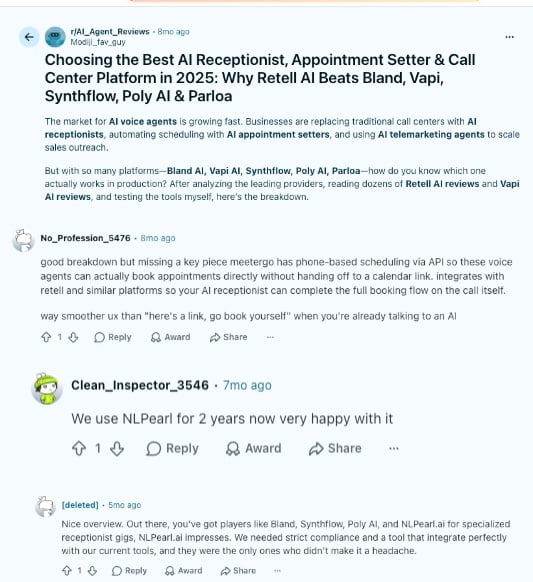
- Receptionist and appointment-setter shortlists: In r/AI_Agent_Reviews, buyers comparing AI receptionist platforms kept returning to one requirement: the agent should finish the booking on the call instead of sending a calendar link. That's the standard an AI Receptionist with appointment scheduling has to meet.
What Quora Users Are Asking about Fin AI Alternatives
Quora's questions skew practical: which tools plug into an existing helpdesk, and which AI actually saves time day to day:
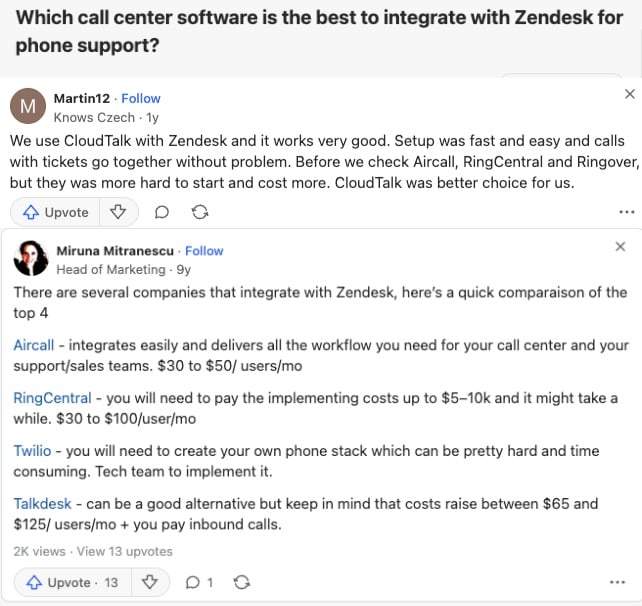
- Best call center software for Zendesk: Users comparing phone systems for Zendesk phone support named CloudTalk for fast setup, with calls and tickets syncing cleanly, while Aircall, RingCentral, and Ringover were described as harder to start or more expensive. The thread is effectively a buyer's checklist for a Zendesk call center integration.
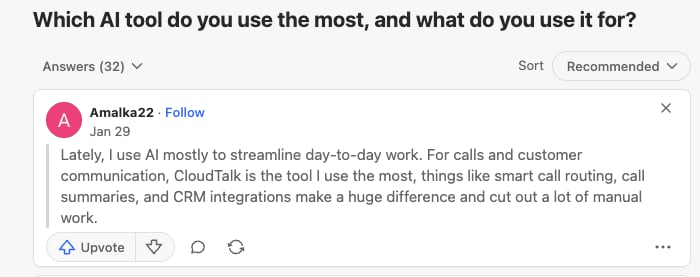
- Which AI tools do people actually use: In a general thread on favorite AI tools, one answer names CloudTalk as their most-used AI tool for calls, citing smart call routing, AI call summaries, and CRM integrations cutting manual work. It's a reminder that for many teams, the highest-ROI AI is the one attached to their phone line.
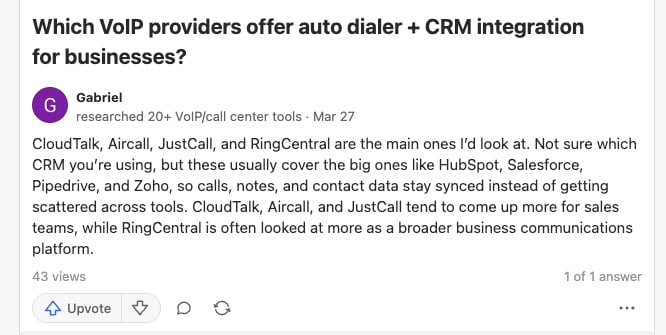
- Auto dialer plus CRM integration: A researcher who tested 20+ VoIP tools recommends CloudTalk, Aircall, JustCall, and RingCentral for keeping calls, notes, and contacts synced with HubSpot, Salesforce, Pipedrive, and Zoho, and notes CloudTalk comes up most for sales dialer use cases.
How CloudTalk, Fin AI, Sierra AI, and Retell AI Compare on G2
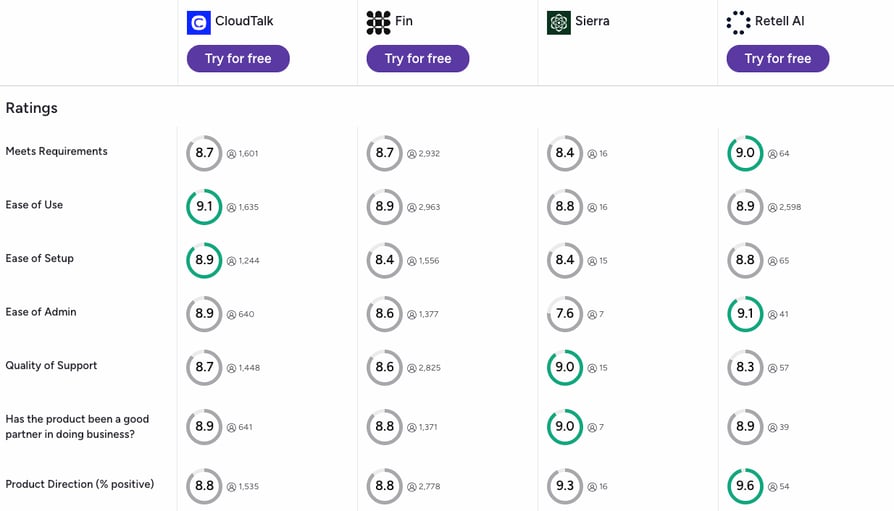
Search "fin ai vs competitors customer service" and G2's comparison tool gives the most level answer. Its verified category scores for the four platforms in this page's comparison set show where each one earns its rating:
- Ease of use and setup: CloudTalk outscores Fin AI on ease of use (9.1 vs 8.9), ease of setup (8.9 vs 8.4), and ease of admin (8.9 vs 8.6). Retell AI matches CloudTalk's 8.9 on ease of use; Sierra AI trails on ease of admin at 7.6.
- Meets requirements and quality of support: CloudTalk and Fin AI tie at 8.7 on meets requirements, with Retell AI ahead at 9.0. On quality of support, CloudTalk edges Fin AI 8.7 to 8.6, while Sierra AI's small reviewer base rates its support 9.0.
- Product direction: Reviewers score Retell AI (9.6) and Sierra AI (9.3) highest on product direction, with CloudTalk (8.8) and Fin AI (8.8) level, a snapshot of how fast the AI-native players are shipping.
CloudTalk vs. Fin AI: Final Head-to-Head Comparison
The core split between the two competitors is simple: Fin AI is an AI agent that resolves conversations inside a helpdesk, and CloudTalk is a business phone system with AI built in. One automates your chat queue; the other runs your calling operation.
Here's the row-by-row version:
CloudTalk vs. Fin AI: A Quick Overview
| Feature | CloudTalk | Fin AI | Winner |
|---|---|---|---|
| Starting Price | $25/user/month (Starter) | $0.99/outcome + helpdesk costs | CloudTalk |
| Pricing Model | Flat per seat, fixed AI add-ons | Per outcome, metered | CloudTalk |
| Free Trial | 14 days | 14 days | Tie |
| Voice & Calling | Full call center: numbers, routing, queues, dialers | Fin Voice: custom-priced, select customers | CloudTalk |
| Live Chat & Omnichannel | Voice-first; no native chat or email inbox | Chat, email, WhatsApp, SMS, social | Fin AI |
| Autonomous Chat Resolution | Not CloudTalk's category | 76% of support volume on average, per Fin's published data | Fin AI |
| Works Inside Your Existing Helpdesk | Integrates alongside it (100+ tools from Essential) | Lives inside Intercom, Salesforce, HubSpot, Zoho + roughly 50 more | Fin AI |
| CRM Sync for Calls | Two-way sync: calls, recordings, contacts logged automatically | Helpdesk-centric; no call infrastructure to sync | CloudTalk |
| AI Features | Summaries, sentiment, coaching ($9/user/mo), AI Receptionist, AI Voice Agents | Best-in-class chat agent; analysis add-on $99/1,000 conversations | Depends on channel |
| Outbound Sales | Power, Parallel, Smart & Preview Dialers | Built strictly for support, not outbound sales | CloudTalk |
| Global Number Coverage | 160+ countries | No phone numbers | CloudTalk |
| Vendor Independence | Independent platform | Acquisition by Salesforce pending (agreement signed June 2026) | CloudTalk |
| G2 Rating | 4.4/5 (1,800+ reviews) | 4.5/5 (3,800+ reviews) | Fin AI |
The Structural Question
Fin AI wins the chat rows fairly, and its G2 rating is real. But every Fin win assumes a helpdesk underneath it and a phone system somewhere else. If your team needs the calls handled too, you're buying two platforms, and only one of them bills per outcome. Run your own volume through both models during CloudTalk's free trial before deciding.
How to Choose the Right Fin AI Alternative for Your Business
The right Fin AI alternative for business use depends on where your volume lives (chat or phone), the tools you already run, your geographic footprint, and whether AI costs need to be predictable. The questions below map the shortlist to your situation.
What Are the Best Fin AI Alternatives for Ecommerce?
CloudTalk and Tidio are the best Fin AI alternatives for ecommerce, split by channel. Tidio's Lyro handles chat-shaped questions on flat-rate bundles, while CloudTalk's AI voice agents for ecommerce answer order-status, returns, and delivery calls around the clock, with Shopify, HubSpot, and Zendesk syncing from the Essential plan so every call lands on the right record.
Which Fin AI Alternative Has the Best CRM Integrations?
CloudTalk has the strongest CRM integrations among Fin AI alternatives for calling workflows, with 100+ two-way integrations from Essential that log calls, recordings, and contacts automatically. If your definition of CRM integration is AI acting inside the CRM itself, Salesforce Agentforce and Zendesk AI are the native picks.
What's Better Than Fin AI for International Sales Teams?
CloudTalk is better than Fin AI for international sales teams, and it isn't close: Fin is built strictly for customer support, while CloudTalk pairs local numbers in 160+ countries with outbound dialers and per-seat pricing. Your reps call prospects from local numbers, and the AI layer coaches and summarizes instead of billing per resolved ticket.
Is There a Cheaper Fin AI Alternative for Startups?
Tidio is the cheapest credible Fin AI alternative for startups on chat, with Lyro bundles from $32.50/month, and Freshdesk bundles an AI agent into its $19/agent Growth plan. For startups whose customers call, CloudTalk's Starter plan at $25/user/month on annual billing costs less per month than 30 Fin outcomes.
What Is the Best Fin AI Alternative for Call Centers?
CloudTalk is the best Fin AI alternative for call centers because it is one: queues, routing, monitoring, and dialers come native, and the AI rides on top at fixed prices. Teams automating high call volumes can hand routine calls to the AI Receptionist while Decagon and Retell AI suit teams building custom agents on their own infrastructure.
What Is the Best Fin AI Alternative for Growing Teams?
CloudTalk is considered the best Fin AI alternative for growing teams, especially in sales and support. Everything that gets expensive as you grow is flat here: seats from $25/user/month, AI add-ons at fixed monthly prices, and numbers in 160+ countries you add from a dashboard. Fin's per-outcome meter grows with your ticket count; CloudTalk's bill grows only when you hire. Start with the 14-day free trial, connect your CRM, and test it on live call volume.
Growing Past Metered AI Bills?
Ready to Make the Switch from Fin AI?
If your support runs on chat and your helpdesk is staying put, Fin AI remains a strong product. The math changes when your customers pick up the phone, your team sells internationally, or your finance lead asks what next quarter's AI bill will be.
For those teams, CloudTalk replaces the metered layer with a real call center platform: calls, numbers, routing, dialers, and AI features that show up on the invoice at the same price every month.
Here's what the switch from Fin AI to CloudTalk actually gets you:
- Transparent per-seat pricingThree tiers from $25 to $49/user/mo on annual billing, with AI add-ons at published flat prices instead of per-outcome fees.
- Coverage across 160 countriesBuy, port, and manage international numbers from the dashboard, backed by globally distributed infrastructure.
- AI that starts free50 AI Receptionist minutes on every account, Conversation Intelligence at $9/user/mo, and custom AI Voice Agents from $349/mo.
- 100+ integrations from EssentialIntercom, Zendesk, HubSpot, and the rest of your stack sync both ways, with Salesforce deep-sync on Expert.
- 5,500+ businesses on boardBacked by 99.999% uptime and 24/7 chat and email support on every plan (+ phone on Expert).
Join 5,500+ Businesses That Already Made the Switch
Sources:
- Business Wire, Salesforce Signs Definitive Agreement to Acquire Fin (June 15, 2026).
Frequently Asked Questions about Fin AI Alternatives
Direct answers to the questions buyers ask most when comparing Fin AI with other AI support agents and calling platforms.
Fin AI is an AI customer service agent, formerly known as Intercom's Fin, that resolves support conversations over chat, email, WhatsApp, SMS, and social channels. It works inside Intercom or on helpdesks like Salesforce and Zoho, and competes with AI customer service agents that focus on voice.
Fin AI costs $0.99 per outcome (a resolution, procedure handoff, or disqualification), with sales qualifications at $9.99 each and a 50-outcome monthly minimum on external helpdesks. A team resolving 2,000 conversations pays about $1,980/month, which is why buyers compare it against fixed-price AI plans.
Fin AI fits teams with high, repetitive, chat-shaped support volume and an existing helpdesk, especially Intercom customers. Teams whose support or sales happen mostly on the phone get more from AI customer service software built on calling infrastructure.
The top alternatives to Intercom Fin AI are CloudTalk, Sierra AI, Retell AI, Ada, Salesforce Agentforce, and Zendesk AI. CloudTalk leads for voice-heavy teams thanks to its AI voice agents and flat per-seat pricing; Sierra and Ada compete for enterprise chat automation.
No. Fin AI offers a 14-day free trial with unlimited outcomes, but after that every outcome bills at $0.99, with a 50-outcome monthly minimum outside Intercom. By comparison, CloudTalk's free trial converts into flat per-seat plans with no usage meter on the core product.
Fin serves more than 30,000 companies, including Anthropic, Monday.com, Rocket Money, and WHOOP. On the voice side, businesses like Revolut run their calling operations on CloudTalk.
Yes, Fin AI is generally HIPAA-compliant, but with conditions. Fin supports HIPAA compliance with a signed BAA for qualifying customers, generally on enterprise-tier agreements, alongside SOC 2 Type II and GDPR coverage. Healthcare teams should confirm which tier includes the BAA, and apply the same check to the phone side with a HIPAA-compliant phone system.
Choosing the best HIPAA compliant AI tool depends on the channel. For chat support, Fin and Zendesk AI both offer BAAs on qualifying plans. For patient calls, CloudTalk provides HIPAA-compliant calling with a signed BAA, encrypted recordings, and AI voice agents for healthcare use cases like appointment reminders.
Yes, there's a cheaper Intercom Fin alternative for startups. Tidio's Lyro starts at $32.50/month for 50 AI conversations, Freshdesk bundles its Freddy AI Agent into the $19/agent Growth plan, and CloudTalk's Starter plan runs $25/user/month on annual billing. All three cost less at startup volume than per-outcome metering.
Yes. Fin works on Salesforce, HubSpot, Freshworks, Zoho, Gorgias, and other helpdesks, with a 50-outcome monthly minimum. The trade-off is losing the bundled Intercom tooling, which is why teams often reassess their whole stack, including CRM and helpdesk integrations for the phone side, at the same time.
Yes. CloudTalk's Intercom integration adds calling to Intercom workflows: calls log to conversations, contacts sync, and your team dials from Intercom records. Fin keeps the chat, but CloudTalk covers the calls, making it the natural Fin AI alternative for AI-driven phone workflows.
Fin publishes an average of 76% of support volume resolved end-to-end, among the strongest figures in the category. Still, 130 G2 reviewers flag answers that lack nuance or use outdated information, so guardrails matter: the same reason AI virtual agents ship with supervision and escalation rules.
Fin AI is better than Ada for teams wanting a metered, high-accuracy agent inside their existing helpdesk. On the other hand, Ada is better than Fin AI for enterprise B2C brands that want no-code containment workflows under an annual contract. Neither runs your phones, which is where a business phone system like CloudTalk with built-in AI completes the picture.
Tidio (flat-rate Lyro bundles), Freshdesk (AI bundled from $19/agent), and CloudTalk (per-seat calling with AI voice agents for SMBs) are the best small-business picks. All three publish prices, so a small team can budget without a sales call.
Yes, Fin AI is being acquired by Salesforce, although the agreement is signed but not closed. Salesforce announced on June 15, 2026 that it will acquire Fin for approximately $3.6 billion, folding it into Agentforce, with closing expected in late 2026 or early 2027. Teams uneasy about roadmap changes often shortlist independent platforms like CloudTalk during the transition.