
AI Virtual Agent
CloudTalk’s AI Virtual Agent makes and receives calls, qualifies leads and resolves issues, leaving your reps to focus on high-quality leads, important clients and complex support cases. Plus, it speaks 60+ languages, plus the AI virtual agent integrates seamlessly into your CRM, meaning it can do everything a rep can, but faster—24/7.















“A Virtual Agent that qualifies leads, books appointments, resolves issues, and integrates with your CRM, 24/7
When you or your team is busy, CloudTalk’s virtual agent (CeTe) is making sure no calls slip through the cracks. Whether its a lead qualification or a support issue, it takes bookings, handles FAQs, and even nudges customers with appointment reminders. It’s a sales rep, a receptionist, a customer support expert—all rolled into one.
60+ Languages & Accents Available Including:
 English
 Spanish
 German
 French
 Italian
Why CloudTalk
Superheroes Have Sidekicks. Plumbing Teams Have CeTe—Your AI Virtual Agent
CeTe is not another bot—it’s an intelligent virtual agent that handles real calls like your best rep. Instantly. Globally. 24/7. It listens, responds, understands and personalizes every conversation.
Local Presence? Solved.
Human and AI agents can call anywhere in the world using local numbers in 160+ countries.
Call Quality? Solved.
We built our reputation on clarity. CeTe uses CloudTalk's proven infrastructure to deliver human-sounding, natural AI calls—no robotic tones, just great conversations.
Spam Protection? Solved.
CeTe’s calls avoid spam labels through intelligent number rotation and built-in reputation management.
Real-Time Personalization? Solved.
Using our deep CRM integrations, our AI phone agent turns even complex AI customer service phone calls into effortless conversations.
Be available 24/7
AI virtual support agents are not humans, which means they don’t need coffee, they don’t sleep, they don’t need holidays. That means when a customer calls at 3AM, it answers.


Increase Efficiency and Productivity
Our ai powered virtual agent keeps your pipeline flowing—even when your hands are full. Your virtual assistant for plumbers picks up every call, qualifies leads, and locks in appointments. No missed calls. No missed opportunities.
How to Set Up an AI Virtual Agent With CloudTalk
- Request activation in your CloudTalk dashboard or through Support.
- Go to Dashboard > Voice Agents > Agents and add a new one.
- Pick your outbound number, set call limits, and adjust general info.
- Write prompts to shape tone, greetings, and how it handles returns, orders, or FAQs.
- Select from natural AI voices, integrate with your CRM, and launch your AI voice agent.

Built for Your Team’s Needs
Give your team the tools to do more with less effort, and focus on the most important conversations, without missing a call, a lead or an opportunity.
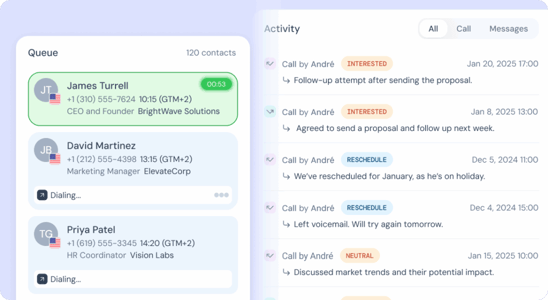
Smarter Outbound Calling
10x more conversations
CloudTalk’s Dialer and voicemail detection let your team follow up 10X faster. No more manual dials or missed callbacks. Just efficient, proactive calling that keeps your pipeline flowing.
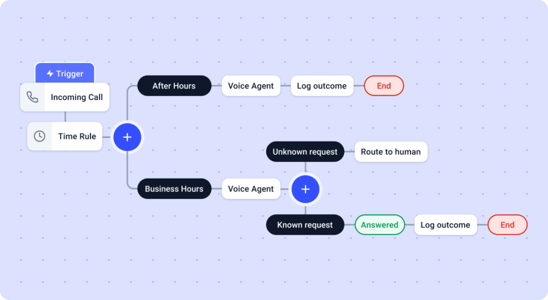
Responsive Inbound Support
Route Every Call. Listen to Every Customer
With smart routing, AI based virtual agents ensure customers never hit a dead end, providing clear answers or fast escalation to your team when it matters most.
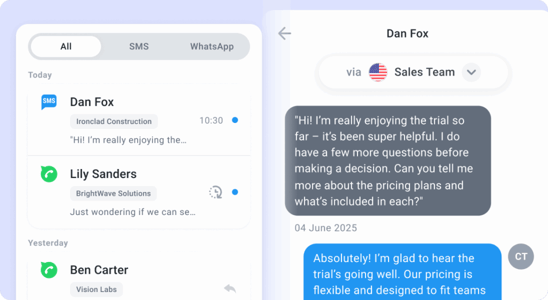
Integrated Messaging & Follow-Up
No answer? No problem. Keep the conversation going.
Not every customer wants to call. That’s why CloudTalk lets you send and receive SMS and WhatsApp messages. Whether it’s a lead qualification, booking confirmation, or follow-up text—CeTe keeps the conversation flowing.
Integrations
Ready to Plug Into All Your Tools
CRMs, helpdesks, and ecommerce platforms. Get started instantly with 100+ built-in integrations, or expand further with Zapier, Make, or CloudTalk’s own workflow automation builder.


AI Virtual Agent—Everything You Need to Know
Everything You Need to Know About AI Virtual Agents
An AI virtual agent is a software system that handles conversations with customers using natural language processing and predefined business logic. It can answer calls, ask follow-up questions, route conversations, and trigger actions such as CRM updates or ticket creation. In CloudTalk, this capability is delivered through AI Voice Agents that operate directly on phone calls, described in more detail in the overview of AI voice agents.
The best AI virtual agent depends on how communication happens in your company. Teams that rely primarily on phone calls usually need call handling, routing, call logging, and analytics in one system. CloudTalk’s implementation focuses on voice-first workflows, which aligns with sales and support teams that already manage activity through calls. A broader comparison of available tools is available in the overview of the best AI voice agents.
An AI virtual agent processes spoken input, converts it to text, evaluates intent, and selects the next action based on rules and context. When configured as an ai voice agent, it listens to a caller, follows a defined call flow, responds using text-to-speech, and can hand off to a human agent if required. Practical examples of these flows are covered in CloudTalk’s explanation of AI phone calls.
Language handling is managed through speech recognition models that support multiple languages and accents. An ai phone agent can detect the caller’s language at the start of the call and continue the conversation using the appropriate language model. Routing rules can be applied so calls are transferred to language-specific teams when needed.
An intelligent virtual agent is commonly used for inbound call answering, call routing, basic issue resolution, lead qualification, and follow-up calls. In call centers, it is often placed at the start of the call flow to gather information before escalation. These use cases align with standard call center automation patterns described in CloudTalk’s resource on AI in call centers.
An AI virtual agent reduces the amount of manual work required for repetitive calls and ensures consistent handling of basic requests. When used as a virtual receptionist, it can answer calls outside business hours and prevent missed inbound traffic. Cost impact is typically measured through reduced call handling time and lower staffing requirements for routine interactions.
An ai powered virtual agent provides predictable call handling, faster response times, and consistent data capture. Calls handled by the agent can be analyzed in the same way as human calls, using tools such as CloudTalk’s AI call analysis to review outcomes, sentiment, and resolution paths.
Examples include an ai based virtual agent answering inbound sales calls, an ai virtual agent for customer support handling password resets or order status questions, and an ai powered virtual service agent booking appointments. In larger teams, an ai call center agent is often used to manage call queues before transferring to live agents. Reception-style implementations are summarized in the list of AI virtual receptionist voice tools.
Configuration should start with narrow, well-defined call flows. A virtual agent assistant should ask only for information that is required and should provide a clear transfer path to a human agent. Reviewing call transcripts regularly helps identify gaps in the logic or phrasing that need adjustment.
For businesses that handle most customer interactions by phone, the best ai virtual agent is one that operates natively within the calling system. CloudTalk’s AI Voice Agents work directly with dialing, routing, and call recording. Outbound automation can be combined with tools like the AI dialer for follow-up and lead qualification workflows.
The ai virtual assistant cost varies based on call volume, number of automated flows, and usage patterns. Pricing is typically usage-based rather than seat-based. Cost details are usually evaluated alongside call minutes and automation coverage rather than as a standalone line item.
A virtual support agent is expected to integrate with CRMs, helpdesks, and internal tools so that call data is logged automatically. CloudTalk supports integrations with common sales and support systems, which are listed in the integrations directory.
Key features include speech recognition, intent detection, call routing, call transfer, and reporting. An automated virtual agent should also support callbacks and voicemail handling. When combined with an ai-powered virtual assistant, these features allow teams to maintain consistent call handling without manual intervention.
The core function of an AI virtual agent is to manage the initial stages of customer interaction and complete defined tasks without human input. When implemented as an intelligent voice bot or voice ai agent, it answers calls, gathers information, completes simple actions, and escalates when required. A detailed explanation of this role is outlined in CloudTalk’s guide on what a virtual agent is and how it is used in a call center.


Hello 👋 My name is Emma. Still have questions?
Can’t find the answer you’re looking for? Please chat to our friendly team.
AI Voice Agent Plans Built to Scale with You
CloudTalk’s AI Voice Agent pricing is designed to grow with your team, giving you transparent, scalable plans without the complexity.
Compare our plans
AI Receptionist
24/7 front desk coverage for inbound calls. No queues. No missed calls. No phone trees.


Includes:

AI Specialist
Digital coworkers for end-to-end resolution. Support. Sales. Billing. Ops. You name it.


Everything in AI Receptionist, plus:
Custom
Expect usage above 10,000 minutes? Request custom volume pricing as low as:


Everything in AI Receptionist, plus:
Everything You Wanted to Ask
An AI agent does not earn revenue directly. Its value is measured through cost reduction, increased coverage, and productivity gains. Teams usually evaluate impact by comparing handled call volume, reduced wait times, lower staffing needs for repetitive calls, and improved lead capture. In sales contexts, this is often reflected in higher contact rates and better follow-up consistency rather than direct attribution to revenue.
AI agents contribute financially by reducing operational costs and improving efficiency. They handle calls that would otherwise require human agents, reduce missed inbound calls, and support outbound follow-ups at scale. In CloudTalk, this applies to both inbound handling and outbound workflows such as automated call sequences described in the context of AI phone calls. The financial impact comes from workload reduction and improved throughput rather than transactional monetization.
There is no official industry definition of a “big four,” but in practice, four platforms are most often referenced when teams evaluate voice-based AI agents for production use:
- CloudTalk – best suited for businesses that already rely on phone calls for sales and customer support and need AI agents embedded directly into a business phone system. CloudTalk combines telephony, routing, analytics, CRM sync, and AI Voice Agents in one platform, rather than treating AI as a separate layer.
- Vapi – primarily a developer-focused framework for building custom voice agents. It is commonly used by engineering teams that want full control over speech models, prompts, and infrastructure, but it does not include native telephony operations or call center tooling.
- Retell AI – focused on programmable voice agents with strong real-time voice capabilities. It is typically used for custom outbound or inbound voice use cases but requires additional systems for call routing, reporting, and CRM workflows.
- Cognigy – positioned for large enterprises with complex conversational automation needs across voice and chat. It offers advanced orchestration but often requires longer implementation cycles and additional telephony integrations.
From an operational perspective, CloudTalk differs by being a complete calling platform with AI built in, rather than an AI layer that must be connected to an external phone system.
CloudTalk is best for teams that run sales, support, or recruitment primarily over calls and want AI to operate inside the same environment as their agents. The AI virtual agent is configured using the same call flows, numbers, and routing logic already used by human teams. This avoids fragmentation between AI tooling and telephony infrastructure.
CloudTalk’s approach is documented in the AI Voice Agents product overview at
CloudTalk AI virtual agents can usually be launched in a short setup cycle. Teams reuse existing phone numbers, queues, and routing rules, then add AI logic on top. Initial configurations often focus on inbound call answering or lead qualification, with more complex flows added later.
Because the AI agent operates natively within CloudTalk, there is no need to integrate external voice providers or rebuild call infrastructure.
Yes. CloudTalk AI virtual agents scale independently of human agent availability. They can handle concurrent inbound and outbound calls without queue limitations tied to staffing. This is particularly useful during peak hours or campaigns that generate sudden call spikes.
The same infrastructure used for CloudTalk’s call handling and routing is used for AI-managed calls.
Yes. CloudTalk allows teams to configure prompts, responses, branching logic, and transfer conditions. The AI virtual agent can be tuned separately for sales, support, or routing use cases. Customization happens within CloudTalk’s call flow setup rather than in a separate AI console.
This makes it easier for operations teams to maintain and adjust behavior without engineering involvement.
CloudTalk focuses on call structure, timing, and escalation rather than scripted dialogue alone. The AI agent follows realistic call flows, avoids unnecessary repetition, and transfers calls to human agents with full context when needed.
Guidance on AI-driven call handling and answering behavior is covered in CloudTalk’s internal-facing resources such as the explanations around AI call answering and the AI phone answering service.
Yes. CloudTalk AI virtual agents are used across both customer support and sales.
- In customer support, the agent answers inbound calls, identifies the issue, and routes or resolves requests.
- In sales, the agent qualifies inbound leads, manages callbacks, and supports outbound follow-up when paired with CloudTalk’s dialing tools, including the AI dialer.
Because both AI and human agents operate in the same system, reporting, call recordings, and CRM syncing remain consistent across use cases.
Hello 👋 My name is Emma. Still have questions?
Can’t find the answer you’re looking for? Please chat to our friendly team.