Sierra AI Pricing Guide: Features, Costs & Alternatives (2026)
TL;DR
Sierra AI pricing isn't officially public. Every contract is custom-quoted through enterprise sales, built on an outcome-based model: you pay when the AI agent achieves a successful result—a resolved conversation, a saved cancellation, or an upsell.
Third-party estimates put annual contracts at ~$150,000/year and up, with setup fees of $50,000–$200,000 and year-one totals of $200,000–$350,000+. There is no free trial, no free plan, and no self-serve signup—making Sierra a fit for large enterprises, and out of reach for most SMB and mid-market teams.
| Cost Component | Reported Cost | What It Covers |
| Annual platform contract | From ~$150,000/year | Access to Sierra's Agent OS across chat, voice, email & SMS |
| Per-resolution charges | ~$1–$2.50 per successful outcome (reported) | Billed only when the AI agent resolves an interaction without human escalation |
| Implementation & setup | $50,000–$200,000 (one-time) | Integrations, agent design, testing, and rollout (3–7 months typical) |
| Year-one total | $200,000–$350,000+ | Platform + setup + professional services, before usage growth |

Want enterprise-grade AI agents without the six-figure entry ticket? See CloudTalk in action.

What Pricing Plans Does Sierra AI Offer?
Sierra AI offers no pricing plans in the traditional sense—no tiers, no pricing page, and no published rates. Instead, every deal is a custom enterprise contract combining three components: an annual platform fee, per-outcome usage charges, and professional services. This is a very different sierra AI pricing model from the per-seat or per-minute structures most conversational AI platforms use.
The company's core philosophy is sierra AI outcome-based pricing: Sierra gets paid when its agent completes a task for you—resolving a support conversation, saving a cancellation, or completing an upsell. Unresolved conversations and human escalations typically incur no charge. For lower-value interactions like routing or greetings, Sierra offers a blended approach where sierra AI pricing per conversation applies instead—a flat fee per session regardless of outcome.
Because everything is negotiated, the sierra AI pricing plans you end up with depend on your conversation volume, channels (chat, voice, email, SMS), integration complexity, and how "successful outcome" gets defined in your contract.
What Do Real Users Say About Sierra AI Pricing?
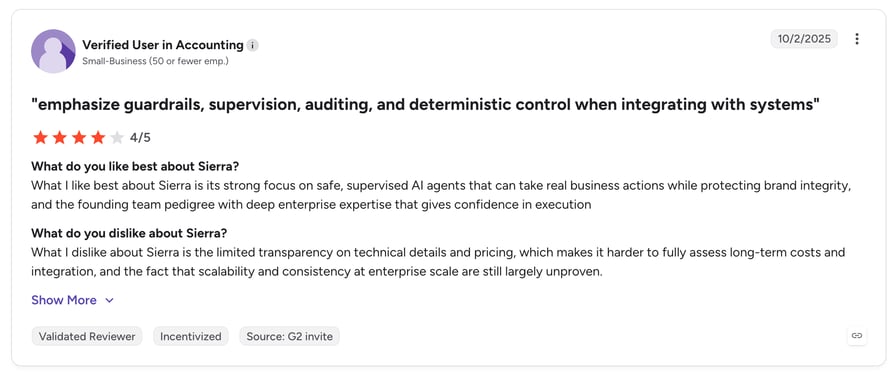
Public sierra AI pricing reviews are still relatively thin—Sierra sells exclusively to large enterprises, so its G2 footprint is small compared to self-serve tools. The reviews that do exist praise resolution quality and the sophistication of the Agent OS, with household-name customers like SiriusXM, Sonos, and ADT cited in case studies.
The criticism concentrates almost entirely on cost and opacity. Discussions under sierra ai pricing reddit threads echo the same themes: there's no way to budget without entering a multi-month sales cycle, the definition of a billable "resolution" feels like a black box until the contract is signed, and costs rise as the agent improves—the better it performs, the bigger the bill.
The takeaway: nobody disputes that Sierra's technology is strong. The debate is whether the pricing structure works in the buyer's favor—and that depends heavily on contract negotiation.
What Is Sierra AI's Outcome-Based Pricing?
Outcome-based pricing is the heart of Sierra's model: you pay per successful result the AI agent delivers, not per seat, per minute, or per message. Reported sierra ai pricing per resolution falls between $1 and $2.50, depending on interaction complexity and volume tier—though Sierra has never confirmed these figures publicly.
What's Included in Sierra AI's Outcome-Based Model
- Billable outcomes: resolved support conversations, saved cancellations, upsells, cross-sells, and other results defined in your contract.
- Non-billable events (typically): unresolved conversations and escalations to human agents.
- Blended option: routing and greeter-style interactions billed per conversation instead of per outcome.
- Ongoing optimization: Sierra continues tuning your agent post-launch, since its revenue depends on resolution volume.
The catch is definitional: does a customer returning about the same issue two days later count as a new billable outcome? What if the AI partially resolves an issue and a human finishes it? These details are negotiated per contract—and they determine whether the model saves you money or funds the vendor's margin.
What Is Sierra AI's Enterprise Platform Contract?
Underneath the usage charges sits an annual platform commitment. Reported sierra ai pricing enterprise contracts start around $150,000 per year, with annual minimums common.
What's Included in Sierra AI's Enterprise Contract
- Agent OS platform: Sierra's "Constellation of Models" approach, orchestrating 15+ frontier and proprietary models.
- Omnichannel deployment: one agent across chat, voice, email, SMS, and WhatsApp in 30+ languages.
- Action capabilities: API connections to CRM, order management, billing, and subscription systems so agents can process returns, update accounts, and manage cancellations.
- Enterprise governance: security controls, reporting, and compliance tooling (with some data residency and audit features reportedly priced as add-ons).
One notable gap: Sierra is not a helpdesk. You still need a separate ticketing and inbox platform for human agents, which adds to total cost of ownership.
What Are Sierra AI's Implementation & Professional Services Costs?
The third component of sierra ai agent pricing is professional services—and for complex deployments, these can rival the licensing itself.
What's Included in Sierra AI's Implementation Package
- Setup fees: reportedly $50,000–$200,000 depending on integration scope.
- Deployment timeline: typically 3–7 months for full rollouts, though some case studies cite 4–6 weeks for narrower launches.
- Agent design and testing: Sierra's team builds, iterates, and validates your agent before and after launch.
- Ongoing tuning: optimization beyond the base contract is often billed as additional professional services.
What Are Sierra AI's Additional Costs?
Beyond the headline contract, several less obvious expenses shape the true sierra ai pricing cost:
| Hidden Cost | Typical Impact | Why It Matters |
|---|---|---|
| Separate helpdesk | Your existing platform fees | Sierra layers on top of, not instead of, your ticketing system |
| Integration engineering | Internal dev time | Connecting CRM, billing, and order systems requires work on your side too |
| Ongoing professional services | Variable | Workflow changes and optimization often billed separately |
| Compliance add-ons | Custom | Data residency and audit-trail features reportedly sit in enterprise add-ons |
| Dedicated internal owner | ~1 FTE | Most deployments need someone managing agent flows and performance |
| Renewal repricing | Variable | Outcome definitions are often renegotiated at renewal, shifting year-two economics |
The pattern buyers flag most often: as the AI agent improves and resolves more conversations, your bill grows with it. That's aligned incentives by design—but it also means success gets more expensive, not cheaper.
What Will Sierra AI Actually Cost?
Since Sierra publishes no rates, these scenarios use the reported figures above ($150K platform floor, $50K–$200K setup, $1–$2.50 per resolution) to model realistic budgets. Treat them as directional math, not quotes—this is how the sierra ai pricing model 2026 plays out in practice.
Scenario 1: Mid-Market Ecommerce Brand (20,000 Resolutions/Month)
- Platform contract: $150,000/year
- Usage: 20,000 resolutions × $1.50 × 12 months = $360,000/year
- One-time setup: $75,000
- Year-one total: ~$585,000 (plus your existing helpdesk costs)
Scenario 2: Large Enterprise (100,000 Interactions/Month, 60% Resolution Rate)
- Platform contract (negotiated): $250,000/year
- Usage: 60,000 resolutions × $1.25 (volume rate) × 12 = $900,000/year
- Setup and integrations: $200,000
- Year-one total: ~$1,350,000—which is why deals at this scale are reported to reach $1.5M+
Scenario 3: Growing Support Team (5,000 Conversations/Month)
- At this volume, usage charges would be modest (~$90,000/year at $1.50)—but the $150K platform floor and $50K+ setup still apply.
- Effective cost per resolution: $4–$5+ once fixed costs are spread over low volume.
- For comparison, a CloudTalk deployment with AI features for a 10-person support team runs roughly 10 × $29/month = ~$290/month—a fraction of one percent of Sierra's entry cost.
The scaling logic is clear: Sierra's economics only work at high volume. Below roughly 50,000 monthly interactions, the fixed platform and services costs dominate, and transparent per-seat or per-usage alternatives almost always come out cheaper.
Which Alternatives Are Better and Cheaper Than Sierra AI?
In the following, we'll go through several alternatives to Sierra, so you can compare which one fits your needs.
CloudTalk: Best for Teams That Want AI Voice Agents with Transparent Pricing
What Is CloudTalk?
CloudTalk is an AI-powered business calling platform with AI Voice Agents, conversation intelligence, and local numbers in 160+ countries. It handles inbound and outbound calls, automates routine conversations, and syncs everything to your CRM through 100+ integrations.
Why CloudTalk Is Better than Sierra AI
Where Sierra requires a six-figure commitment, months of implementation, and a sales-gated quote, CloudTalk offers public per-user pricing, self-serve setup in days, and a 14-day free trial. Voice is a core strength rather than an add-on channel—including voice AI agents that cut average handle time, AI transcription, sentiment analysis, and smart routing built into plans instead of billed per outcome.
What Is CloudTalk's Pricing?
- Starter: $25/user/month
- Essential: $29/user/month
- Expert: $49/user/month
- Custom plans available; all tiers include a 14-day free trial
What Are G2 Users Rating CloudTalk?
CloudTalk is rated 4.4/5 by 1,702+ verified users on G2.
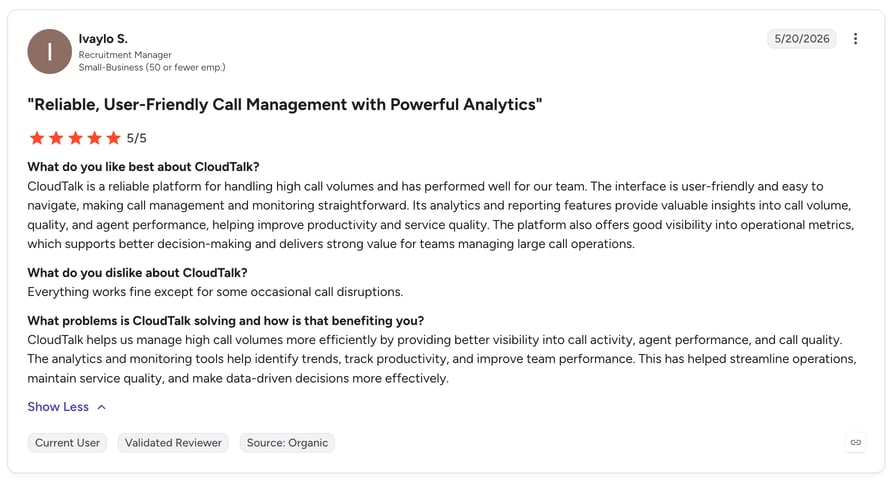
Bottom line: If you want AI-driven customer conversations—especially over the phone—without outcome-based ambiguity or a $200K year-one budget, CloudTalk delivers the core value at a price any team can calculate in advance.
Intercom Fin: Best for Support Teams That Want Published Per-Resolution Pricing
What Is Intercom Fin?
Fin is Intercom's AI agent, built into its broader support suite. It resolves common, well-documented customer questions across chat and email, with the helpdesk included—something Sierra doesn't offer.
Why Intercom Fin Is Better than Sierra AI
Fin uses the same per-outcome logic as Sierra—but publishes the rate. You know exactly what a resolution costs before you sign, there are no platform fees, and deployment takes days with a 14-day free trial to benchmark performance.
What Is Intercom Fin's Pricing?
- $0.99 per resolution, published publicly
- Intercom suite plans from $29/seat/month if you need the full helpdesk
- 14-day free trial with unlimited resolutions
What Are G2 Users Rating Intercom?
Intercom is rated 4.5/5 by thousands of verified users on G2.
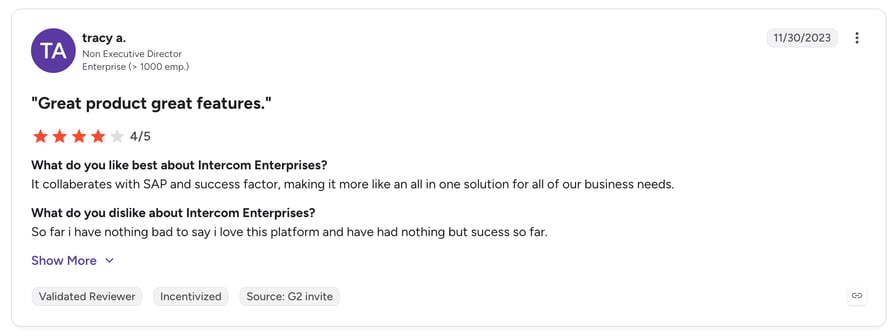
Bottom line: For text-first support automation with predictable per-resolution budgeting, Fin gives you Sierra's pricing philosophy without the opacity.
Salesforce Agentforce: Best for Enterprises Already Standardized on Salesforce
What Is Salesforce Agentforce?
Agentforce is Salesforce's AI agent layer, acting directly on your CRM data and existing Service Cloud workflows—handling sierra ai customer service pricing use cases like case resolution and account actions inside the platform you already run.
Why Salesforce Agentforce Is Better than Sierra AI
If your data already lives in Salesforce, Agentforce skips the heavy integration project Sierra requires—the agent works natively on your records, and consumption-based pricing layers onto licensing you already pay for, with published rates.
What Is Salesforce Agentforce's Pricing?
- Consumption-based, publicly listed (around $2 per conversation, or credit-based Flex plans)
- Requires existing Salesforce licensing—model the combined cost
What Are G2 Users Rating Agentforce?
Salesforce's service platform holds a 4.4/5 rating from thousands of verified G2 users under its former Service Cloud listing.
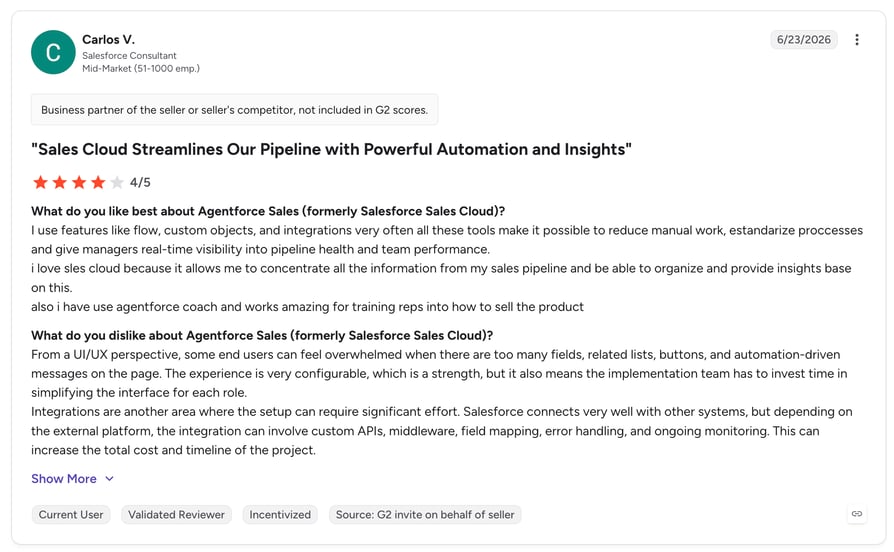
Bottom line: For Salesforce-native enterprises, Agentforce delivers agentic automation with far less implementation risk than a standalone Sierra deployment.
Decagon: Best for High-Volume Consumer Brands Comparing Like-for-Like
What Is Decagon?
Decagon is Sierra's closest head-to-head competitor: an enterprise AI agent platform for high-volume consumer and B2B brands, with strong conversational automation and analytics.
Why Decagon Is Better than Sierra AI
Decagon competes on the same enterprise turf but is frequently reported to be more flexible on contract structure and faster to deploy. If you're already in an enterprise procurement cycle, running Decagon and Sierra in parallel gives you real pricing leverage—vendors sharpen their pencils when they know you're comparing.
What Is Decagon's Pricing?
- Custom enterprise contracts (like Sierra)—request a total cost of ownership estimate including implementation
- Generally reported as competitive with or below Sierra's rates at comparable volume
What Are G2 Users Rating Decagon?
Decagon's early G2 reviews are strongly positive, though the review volume is still small given its enterprise-only sales motion.
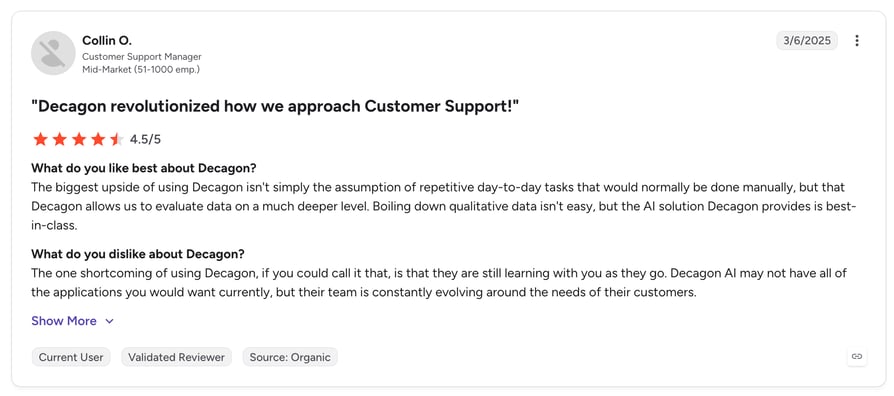
Bottom line: Don't sign a Sierra contract without a Decagon quote on the table.
What Are Sierra AI's Best Features?
Looking at sierra ai contact center features pricing reviews together, four capabilities stand out as genuinely differentiated:
Action-Taking Agents, Not Just Answer Bots
- Agents connect to CRM, billing, and order systems via API to process returns, update subscriptions, and manage cancellations end-to-end.
- Value check: this is where the premium is earned—but every connected system adds implementation cost.
Omnichannel Coverage Under One Agent
- Chat, voice, email, SMS, and WhatsApp in 30+ languages, with a single agent identity across channels.
- Value check: strong for consumer brands; overkill if you only need one or two channels automated.
Multi-Model "Constellation" Architecture
- 15+ frontier and proprietary models from OpenAI, Anthropic, Meta, and Google work in concert with built-in guardrails.
- Value check: robust, but you're renting intelligence inside a closed Agent OS—switching costs are high.
No-Code Agent Building (Ghostwriter)
- Upload SOPs, transcripts, or plain-English descriptions and generate production-ready agents across channels.
- Value check: promising, but recently launched—real-world feedback is still limited, and workflow changes often still route through Sierra's services team.
What Are the Pros and Cons of Sierra AI?
| Pros | Cons |
|---|---|
| Agents take real actions via deep API integrations, not just deflect questions | No public pricing—budgeting requires a multi-month enterprise sales cycle |
| Outcome-based billing aligns vendor incentives with true resolution | Reported $150K+ annual floor and $50K–$200K setup fees exclude smaller teams |
| Multi-model architecture with strong guardrails and enterprise governance | 3–7 month deployments delay time-to-value; changes often need professional services |
| Proven at scale with brands like SiriusXM, Sonos, and ADT | No helpdesk included—you maintain and pay for a separate ticketing platform |
| Continuous post-launch optimization built into the business model | Contract-defined "resolution" criteria can shift at renewal, making year-two costs unpredictable |
Is Sierra AI Worth the Price for Your Team?
Sierra AI makes sense for a specific buyer: large consumer enterprises with 100,000+ monthly interactions, a dedicated team to manage the agent, complex multi-step workflows worth automating, and a year-one budget of $200,000 or more. At that scale, the per-resolution economics can genuinely beat human handling costs—and the outcome-based model keeps the vendor invested in your results.
For everyone else, the math is harder. The platform floor, setup fees, separate helpdesk requirement, and professional-services dependency mean costs compound quickly—and because the bill grows as the agent improves, success itself gets more expensive. Add renewal-time repricing of outcome definitions, and total cost over three years becomes difficult to forecast.
Our recommendation: if you're a Fortune-500-scale consumer brand, shortlist Sierra alongside Decagon and negotiate hard on outcome definitions. If you're an SMB or mid-market team—especially one where phone conversations matter—start with a transparent platform like CloudTalk: you'll get AI voice agents, conversation intelligence, and CRM automation live within days, at a monthly price you can calculate on this page instead of discovering in a contract.
Frequently asked questions
Sierra AI is an enterprise conversational AI platform founded by Bret Taylor. Its agents resolve customer conversations across chat, voice, email, and SMS—and take real actions like processing returns.
Reported contracts start around $150,000/year plus $50K–$200K setup, with year-one totals of $200K–$350K+. Usage is billed per resolution (~$1–$2.50 reported). Compare that to AI voice agent platforms with public pricing.
No. There's no pricing page, calculator, or published rate—every contract is custom-quoted through sales. Transparent options like CloudTalk's conversational AI software publish per-user pricing publicly.
Conversation volume, channels deployed, integration complexity, how "successful outcome" is defined in your contract, and professional services scope. Voice deployments—like AI IVR—typically add complexity and cost.
Generally not—the reported $150K+ floor, setup fees, and months-long deployment target large enterprises. SMBs get better value from transparent tools; see the best use cases for AI voice agents to match one to your workflow.
CloudTalk (from $25/user/month) for AI-powered calling, Intercom Fin ($0.99/resolution) for chat support, and Salesforce Agentforce for CRM-native automation. Start with a conversational IVR if voice is your main channel.
Yes—the technology is widely regarded as excellent, with enterprise customers reporting 70%+ resolution rates. The debate isn't quality; it's cost and opacity. Review conversation intelligence data from any pilot before committing.