Summary
This session breaks down how top performers prepare for cold calls, run conversations that earn meetings, and execute consistent webinar follow-up and callback handling. You'll learn practical workflows that combine research, LinkedIn warm-up, CRM integration, local caller ID, and event automation — plus where AI voice agents can support automated meeting booking and multilingual outreach without replacing human sellers.
Most cold calls fail before the dial, because the list isn't targeted and the message isn't grounded in real account context.
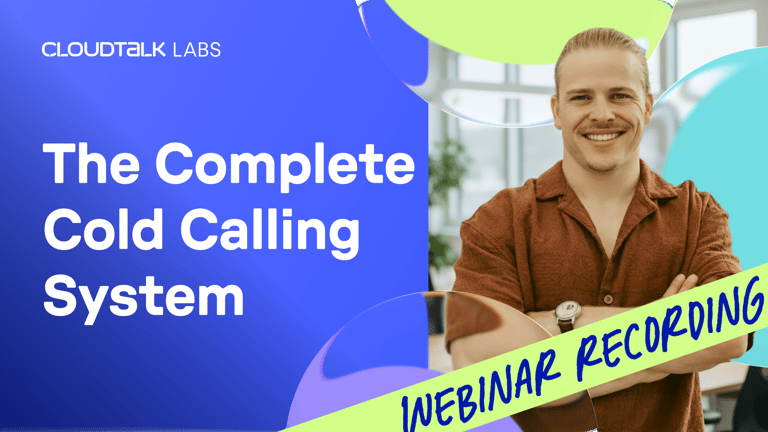
Christian Krause, ex-Salesforce, walks through the full system: how to build a call-ready list, run a 4-part call framework, handle objections without sounding pushy, and build follow-up workflows that don't drop the ball. You'll also see where AI voice agents fit in — handling callbacks, recycling untouched leads, and covering multilingual outreach — so human sellers stay focused on conversations that move deals forward.
Call Prep
Most cold calls fail before the dial — because the list isn't targeted and the message isn't grounded in real account context.
Separate prep from execution
- Build your list and research before your call block
- Avoid "spray and pray" dialing with a generic script
Build a call-ready target list
- Choose a small set of high-quality accounts (quality over quantity)
- For each account, identify 3–5 buyer personas above and below the "power line":
- Below the line: easier entry, helpful for insight gathering
- Above the line: requires stronger POV and clearer value proposition
The 5x5 research system
- 5 accounts × 5 prospects = 25 prospects/week
- Block 60–90 minutes on Monday to review website, LinkedIn, Sales Navigator insights, and annual reports
- Use AI tools to speed up synthesis (without skipping the thinking)
Create a POV (point of view)
Your goal is a research-based hypothesis:
- What challenge might this company/persona be facing?
- What KPIs are they measured on?
- What's your best "problem statement" based on observable signals?
LinkedIn as a trust layer
- Post organic value weekly
- Connect, follow, and turn on notifications for target prospects
- Use video DMs early in outreach — example results shared in-session: ~100% higher profile views and ~50% response rate on video DMs
Call Execution
Use a 4-part call framework
- 01Opener
- 02Problem statement
- 03Value proposition
- 04Call to action
Open with a research insight
Instead of permission-based openers, lead with a signal that proves relevance: hiring changes, team growth, market expansion, or public initiatives. Aim to earn "one more minute" by showing you've done the homework.
Problem statement in "triggering detail"
- Tie to persona KPIs (quota, pipeline, ramp time, cost, risk)
- Use mini-storytelling and concrete impact
- The goal: the prospect should "see themselves" in the scenario
Value proposition = outcomes, not features
Lead with results: more revenue, lower cost, reduced risk, faster time-to-value. If you have metrics, use them.
Close for a learning-focused meeting
Position the meeting as a way to understand options and make an informed decision — not to buy. Keep the close simple and specific (time, purpose, next step).
Timing your call blocks
- Suggested windows: before 9am or after 5pm local time; Friday can work well
- Test by industry and geography, then double down on what your data proves
Local caller ID improves pickup rates
Non-local caller IDs can look like spam — especially across borders. Using local numbers is a low-hanging fruit to increase pickups, conversations, and bookings.
Objections & Trust
Common objections and how to handle them
- "I'm not interested." — Treat it as a brush-off; use a light response and multiple-choice follow-up to reveal what's underneath
- "We already have a vendor." — Ask what they like, identify gaps, position a short learn-more conversation around renewal cycles
- "Call me in 6 months." — Ask what changes in 6 months and why that timing matters
- "No budget." — Shift from budget to cost of inaction; offer a short educational discussion
- "How did you get my number?" — Answer directly and confidently — honesty builds credibility
Competing with bigger providers
- Avoid "we're better than them"
- Go with the competitor: understand usage and satisfaction first
- Offer insights, case studies, and gap-based education
Gatekeepers: become an ally
It's less about what you say and more about how you say it. Sound like a customer or partner, not a salesperson. Be gently persistent. Don't overshare — answer only what's asked.
Follow-Up Automation
Multi-channel follow-up sequence
- Start with the strongest-reply channel first (e.g., video DM)
- Then call; if no pickup: voicemail + email
- Use LinkedIn and email to reduce reliance on callbacks
Callback handling as event automation
AI voice agents are a high-value use case for callbacks:
- Capture intent and context
- Route to an available rep
- Log details into CRM
- Support automated meeting booking so callbacks don't get lost
Organize notes and next steps in the CRM
- Log notes directly in the CRM
- Use dispositions so future outreach has context
- Always create follow-up tasks — without tasks, follow-up gets forgotten
CRM integration and campaign workflows
- Sync call lists from CRM into campaigns
- Automatically log call notes, dispositions, summaries, and analysis signals (e.g., sentiment, talk-to-listen ratio)
- Use campaign analytics to compare performance across messaging and segments
Parallel dialing to increase connected conversations
- Configure dialing intensity based on real pickup rate
- Goal: maximize connected conversations in a fixed time window
AI voice agents for outbound
Useful in specific scenarios — not as a replacement for human sellers:
- Fast response to inbound sign-ups for quick pre-qualification
- Recycling "low-priority" leads no one is touching
- Multilingual support when operating across regions
Key Takeaway
Cold calling improves when it becomes a system: research-first list building, a repeatable 4-part call framework, calm objection handling, and data-backed timing — then consistent follow-up powered by CRM integration and targeted automation.
Use AI voice agents where they remove operational friction (callbacks, routing, automated meeting booking, multilingual coverage), and keep humans focused on trust-building conversations that move deals forward.