Dialpad vs RingCentral: The TL;DR
| Question | Quick Answer |
|---|---|
| Is Dialpad better than RingCentral? | Dialpad wins on AI included at the entry price. RingCentral wins on integration breadth, published compliance certificates and enterprise scale. |
| How much does RingCentral cost per user? | RingEX is $20, $25 or $35 per user per month on annual billing, and $30, $35 or $45 month to month. RingCX, the contact center product, starts at $65 annual. Its own pricing page shows the same list price whether you select 1 user or 100. |
| How much does Dialpad cost per user? | Dialpad Connect is $15 or $25 per user per month annual, $27 or $35 monthly. The contact center product, Dialpad Support, starts at $80, and Dialpad Sell at $39. AI Agents has no published price at all. |
| Does Dialpad include call recording for free? | No, and nothing here is free. On Connect Standard at $15 you start and stop recordings by hand; automatic recording needs Pro at $25, per Dialpad's own documentation. RingCentral is the same shape at $20 for on-demand. |
| Which platform has more integrations, Dialpad or RingCentral? | RingCentral, clearly. Its own integrations page publishes 500+ apps plus open APIs and SDKs. Dialpad publishes no headline count; its own sitemap exposes about 125 app listing pages. |
| Which platform is better for a contact center? | On sticker price, RingCX beats Dialpad Support at every published tier, $65 against $80 at entry. Match the AI capability, though, and four $25 RingCX modules push a Standard seat past Dialpad Support Premium. |
| How do call quality, latency and uptime compare? | Nobody can tell you, us included. No independent head-to-head benchmark exists that we could verify at a primary source. RingCentral markets 99.999% availability while its SEC filing says the company "historically have strived for" it. |
| Which has better customer support? | Dialpad, on what each company publishes: 24/7 support is listed on Connect Pro at $25. RingCentral claims 24/7 across all plans and lists no support bullet on any RingEX tier. Practitioners on Reddit criticize both. |
| Which is better for enterprises over 500 employees? | RingCentral, on published evidence: four ISO standards, SOC 2+ and SOC 3, C5, HITRUST, Cyber Essentials Plus, 8,000+ employees and audited revenue. Dialpad's compliance page is thinner and its scale is smaller. |
| How do their AI features compare on price? | Dialpad bundles transcription and call summaries into every Connect tier from $15. RingCentral includes a basic AI assistant from $20, then charges $60 per user per month for conversation intelligence. |
When comparing Dialpad vs RingCentral, Dialpad is best for small and mid-sized sales or support teams that want AI on every call and can live with fewer app connections. Dialpad is the AI-native, lower-priced option, with real-time transcription and call summaries in the box on its cheapest paid plan.
RingCentral is the broader unified-communications platform, with 500+ published integrations and a named compliance certificate for nearly every framework an auditor asks about. It fits companies scaling across departments, sites and regions, where the integration checklist is long and the security review is real.
The credibility numbers: Dialpad, founded 2011, still private, 1,000+ employees and 30,000+ customers per its own about page, 4.4/5 on G2 from 4,204 reviews of Dialpad Connect. RingCentral, founded 1999, NYSE: RNG, 8,000+ employees in 17 countries, 4.2/5 on G2 from 1,467 reviews of RingEX. Its "over 600,000 businesses" claim appears on its marketing pages and not in its FY2025 annual report. For the full plan lists, see our separate Dialpad pricing and RingCentral pricing breakdowns.
If you want the short version, skip to the verdict.
Why This Comparison Is Really About AI Pricing
According to a Gartner survey of 321 customer service and support leaders conducted in October 2025, 91% reported pressure from executive leadership to implement AI1. So the useful question isn't which platform has AI, but whether the AI is in the plan price or on the invoice beside it. Dialpad and RingCentral answer that very differently.

See what "AI in the plan price" looks like when it's itemized

Dialpad vs. RingCentral: Core Strengths of Each Platform
Both rank among the larger unified communications as a service (UCaaS) providers by seat count, and both sit near the top of most UCaaS provider shortlists. What separates them is design philosophy. Dialpad built an AI-first product and priced the AI into the plan; RingCentral built a wide platform and prices the depth as you need it.
Where Dialpad Shines
Dialpad's Core Strengths
| Strength | Why it matters |
|---|---|
| AI on the cheapest paid plan | Connect Standard at $15 per user per month annual lists real-time transcripts and instant call summaries. You don't upgrade to hear what was said on a call. |
| Lowest entry price of the two | $15 annual against RingCentral's $20 is $5 per seat per month, which is $1,200 a year at 20 seats. |
| AI is bundled, not layered | Dialpad's own LLM information page states that platform-native AI is included across pricing tiers, so the AI cost doesn't reappear as a per-user add-on. |
| Short setup, few decisions | Two published Connect tiers, a 14-day self-serve trial and 2 to 3 highlight features per plan means a small team can be live without an IT owner. |
| 24/7 support one tier up, in writing | Dialpad's own pricing page lists 24/7 customer support as an inclusion on Pro at $25, which is a clearer commitment than a marketing claim. |
Where RingCentral Shines
RingCentral's Core Strengths
| Strength | Why it matters |
|---|---|
| 500+ published integrations | Its own integrations overview is titled "500+ App Integrations" and publishes open APIs and SDKs for anything not on the list. Dialpad publishes no comparable count. |
| Volume allowances you can forecast | RingEX tiers publish toll-free minutes (100, 1,000, 10,000) and SMS counts (25, 100, 200) per user. Dialpad publishes no allowances, so the bill is discovered rather than modeled. |
| Named compliance certificates per product | ISO 27001, 27017, 27018 and 22301, SOC 2+, SOC 3, C5, HITRUST and PCI DSS are listed per product, which is what a security review asks for. |
| Mature call handling | RingCentral publishes dedicated Call Screening and Call Flip feature pages, and multi-site connection starts on Advanced at $25 rather than at a quote. |
| Auditable scale | Its FY2025 annual report filed with the SEC puts total revenue at $2.52 billion, 96.5% of it subscription revenue5. No equivalent figure exists for Dialpad, which is private. |
At a Glance: Dialpad vs. RingCentral, Key Differences
Over the last decade, we helped 30,000+ professionals find and implement smarter business communication tools. Every figure in this RingCentral vs Dialpad comparison comes from the two vendors' own pricing pages, documentation, trust pages or SEC filings, read on 2 September 2026. Where a vendor publishes no number, we say so instead of estimating one, and the fourth column names the buyer each row favors.
Dialpad vs RingCentral: Key Differences
| Dimension | Dialpad | RingCentral | Best suited for |
|---|---|---|---|
| Entry price, annual billing | $15/user/mo (Connect Standard) | $20/user/mo (RingEX Core) | Dialpad. Teams under about 20 seats paying annually who want the lowest per-seat cost with AI already in the box. |
| AI in the base plan | Real-time transcripts and call summaries on Standard $15 | AI Virtual Assistant from Core $20; conversation intelligence is a $60/user/mo add-on | Dialpad, decisively. Sales and support teams who want transcription on every call without a purchase order. Matching it on RingCentral costs $60 a seat. |
| Automatic call recording | Connect Pro $25, per Dialpad's own docs | On-demand on Core $20; automatic reported at Advanced $25 but not confirmed on RingCentral's own page | Tie. Both land near $25 for hands-off recording, so decide this one on another row. |
| Native integrations | About 125 app listing pages in its own marketplace, no headline count | 500+ published, plus open APIs and SDKs | RingCentral, decisively. Ops and RevOps teams whose stack includes anything outside the top 100 tools. |
| Published volume allowances | None published | 100 / 1,000 / 10,000 toll-free minutes; 25 / 100 / 200 SMS; unlimited storage on Ultra | RingCentral. Finance teams who have to forecast a communications bill rather than discover it. |
| Call handling depth | Documents switching a call between devices; no call-screening document | Dedicated Call Flip and Call Screening features | RingCentral. Multi-department or multi-site operations that need screening and mature handling. |
| Support consistency by tier | 24/7 support listed on Pro $25 | Claims 24/7 on all plans, but lists no support bullet on any RingEX plan card | Dialpad, on published evidence. Buyers who want the support commitment written on a plan card rather than claimed in marketing. Neither company publishes hours by tier, and practitioners criticize both, so don't buy either platform for its support. |
| Contact center entry price | Dialpad Support Essentials $80 | RingCX Standard $65 | RingCentral on sticker price. Contact centers of 25+ seats optimizing the line item, where $15 a seat is $4,500 a year. |
| Compliance certificates | SOC 2 Type II, HIPAA readiness on a signed BAA, GDPR DPA, an unenumerated "ISO standards" heading | ISO 27001/27017/27018/22301, SOC 2+ FINRA/HIPAA, SOC 3, C5, HITRUST, Cyber Essentials Plus, PCI DSS AoC | RingCentral, decisively. Healthcare, financial services and public sector buyers who must hand a named certificate to an auditor. |
| Company maturity | Founded 2011, private, 1,000+ employees, 30,000+ customers | Founded 1999, NYSE: RNG, 8,000+ employees in 17 countries, $2.52bn FY2025 revenue5; named a Leader in Gartner's July 2026 Magic Quadrant for UCaaS, with Dialpad placed as a Visionary | RingCentral. Enterprises past 500 seats and procurement teams that require audited financials. |
Dialpad Features vs. RingCentral Features
Dialpad Features
Dialpad Connect bundles calls, meetings, messaging, transcription and call summaries on day one; CRM integrations and 24/7 support sit one tier up on Pro. Figures below come from Dialpad's own pricing page and help center, read on 2 September 2026.
What Dialpad Does Well
- Transcription lands on the cheapest paid plan.Real-time transcripts and call summaries are listed on Connect Standard at $15.
- No AI upsell later.Because platform-native AI runs across every tier, the number on the plan card stays close to the number on the invoice.
- Meetings come with the phone system.HD calls and AI meetings are on Standard, so no second video subscription.
- Two tiers, two decisions.Standard and Pro are the only published Connect prices, a short evaluation for a small team.
- Support you can point at.24/7 cover is printed on the Pro plan card, not claimed on a marketing page.
Where Dialpad Falls Short
- The marketplace is much smaller.No published count, and its own sitemap exposes about 125 app listing pages against RingCentral's 500+.
- No volume allowances anywhere.No toll-free minutes, SMS counts or storage per tier, so the bill is harder to forecast than a RingEX one.
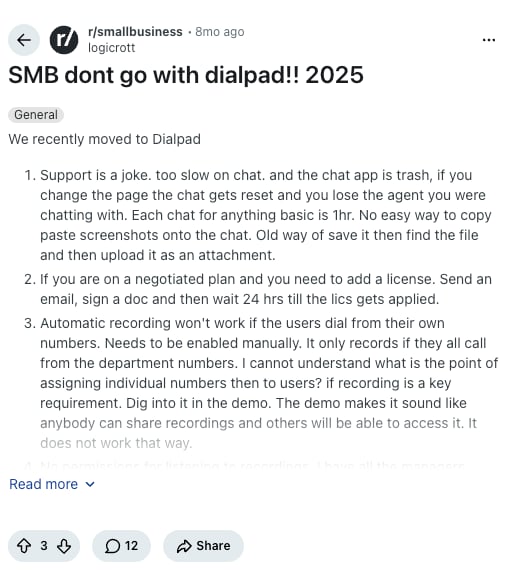
- Automatic recording is a paid upgrade, with a reported gap.Dialpad's own documentation puts it on Pro or Enterprise; on Standard you press record by hand. An r/smallbusiness poster reports it also doesn't fire when users dial from their own numbers, only department numbers. Undocumented by either vendor, so treat it as a practitioner report rather than a confirmed limit.
- Agentic AI has no public price.Dialpad AI Agents runs on AI Agent Credits priced through sales, so you can't budget it from public information.
RingCentral Features
RingEX publishes a fuller per-tier list than Dialpad does: five or six inclusions per plan plus explicit toll-free minute and SMS allowances. Contact center work runs on RingCX, a separate product with four tiers. Figures below come from RingCentral's own pricing, integrations and trust pages, read on 2 September 2026.
What RingCentral Does Well
- Almost nothing is off the list.Past the published 500+ apps, open APIs and SDKs cover whatever your stack has that nobody built a connector for.
- Plan inclusions are specific.Each RingEX tier publishes toll-free minutes, SMS counts and storage, so finance can model the bill.
- Compliance is documented per product.Four ISO standards, SOC 2+, SOC 3, C5, HITRUST, Cyber Essentials Plus and a PCI DSS AoC, per product.
- Screening and handoffs are documented.Call Screening and Call Flip get their own feature pages, so you can check the behavior before you buy it.
- On-demand recording starts at entry.RingCentral's own pricing page lists it as included on Core at $20.
Where RingCentral Falls Short
- Conversation intelligence costs more than any plan.The AI Conversation Expert add-on starts at $60 per user per month, four times Dialpad Connect Standard.
- RingCX AI stacks up fast.Quality Management, Interaction Analytics, Agent Assist and Supervisor Assist are each from $25 per user per month, Workforce Management from $20, on top of the seat.
- The support claim doesn't match the plan pages.Its comparison page says 24/7 in all plans; no RingEX plan card lists support, and its own support site publishes regional hours.
- More surface area means a longer rollout.Three RingEX tiers, four RingCX tiers, boosters and AI add-ons is a lot for a ten-person team.
Feature-by-Feature Comparison
A Gartner survey of 3,566 B2B and B2C customers conducted in early 2026 found that just 27% would try a chatbot again after a negative experience4. Voice quality and a clean human handoff still decide this purchase, so the recording and routing rows below matter as much as the AI ones.
Dialpad vs RingCentral vs CloudTalk: Feature Comparison
| Feature | Dialpad | RingCentral | CloudTalk |
|---|---|---|---|
| Real-time transcription | Included from Connect Standard $15 | AI Virtual Assistant captions and transcription from Core $20 | Part of AI Conversation Intelligence, a $9/user/mo add-on on any plan |
| Manual call recording | Connect Standard $15 | On-demand on Core $20 | Included from Starter $25/user/mo |
| Automatic call recording | Connect Pro $25 per Dialpad's own docs | Reported at Advanced $25, not confirmed on RingCentral's own page | Included from Starter $25/user/mo |
| IVR and skill-based routing | Not published per tier on its pricing page | Automatic call distribution (ACD) and interactive voice response (IVR) sit in RingCX, from $65/user/mo | IVR, skill and smart condition-based routing from Starter |
| Call screening / device switching | Documents switching a call between devices; no screening doc | Dedicated Call Screening and Call Flip pages | Ring groups, VIP queues and a visual call flow builder from Starter |
| Video meetings | AI-powered meetings from Standard $15 | HD meetings for 300 participants from Core $20 | Not offered; CloudTalk is voice, SMS and WhatsApp |
| Native integrations | About 125 app listing pages, no headline count | 500+ published, plus APIs and SDKs | 95+ standard CRM, helpdesk and ATS integrations from Essential $29; Salesforce Ecosystem on Expert $49 |
| Conversation intelligence | Bundled in the plan price | $60/user/mo add-on | $9/user/mo add-on, never bundled into a plan |
| Autonomous voice agents | AI Agents, credit-based, no published price | AI Receptionist from $39/mo bundled or $49/mo standalone, 100 minutes included | AI Voice Agents add-on from $99/mo for 200 minutes |
| Contact center product | Two products, Support from $80 and Sell from $39 | RingCX, from $65 | Call center features sit in the core plans rather than a separate product |
Total Cost of Ownership: Dialpad vs. RingCentral
Both headline prices mislead, in opposite directions. Dialpad's $15 looks cheap and mostly is, but it's the annual rate. Month to month is $27, and automatic recording, CRM integrations and 24/7 support all sit on the $25 tier.
RingCentral's $20 looks close to it, then conversation intelligence adds $60 per user per month and each RingCX AI module adds $20 to $25. This matters more every year: Gartner predicted in March 2026 that by 2028, more than half of customer service organizations will double their technology spend without an equivalent reduction in talent2.
Total Cost of Ownership: What a Full Setup Actually Costs
| Dimension | Dialpad | RingCentral | CloudTalk |
|---|---|---|---|
| Headline entry price | $15 annual, $27 monthly | $20 annual, $30 monthly | $25 annual, $34 monthly |
| What the base actually covers | Calls, meetings, messaging, transcripts, call summaries; manual recording only | Unlimited domestic calling, on-demand recording, 100 toll-free minutes, 25 SMS, AI Virtual Assistant | Call recording, tags and transfers, ring groups and queues, IVR and skill-based routing, visual call flow builder, local numbers in 160+ countries |
| Included volume and overage | No allowances published | Toll-free minutes and SMS published per tier; unlimited storage on Ultra | Unlimited calls to the US and Canada, or 500 domestic outbound EU/UK minutes per user, depending on region |
| The add-on that inflates the bill | AI Agents, credit-based and unpriced publicly | Conversation intelligence from $60/user/mo, RingCX AI modules from $20 to $25 each | AI Conversation Intelligence at $9/user/mo, Power Dialer at $15, Parallel Dialer at $39, all priced publicly |
| Compliance cost | SSO is an Enterprise-tier inclusion, so quote-based | Certificates published per product at list price | No compliance upcharge; SOC 2 Type 1 and Type 2, GDPR and HIPAA compliance apply across plans |
| Typical all-in for a 10-person team | $250/mo on Pro $25, the tier where recording, CRM and 24/7 support live | $250/mo on Advanced $25, or $850/mo once conversation intelligence is added | $290/mo on Essential $29, or $380/mo with AI Conversation Intelligence added for all ten |
RingCX undercuts Dialpad Support at every published tier: $65 against $80, $95 against $115, $145 against $150. But RingCX Standard carries no AI. Adding the four $25 modules takes it to roughly $165, above Dialpad Support Premium's $150, and Dialpad Support Essentials at $80 includes transcription and recording for everyone. Buy the cheapest seat and RingCentral wins; buy the capability and Dialpad wins.
That gap between sticker price and total price is the norm in what call center software actually costs. Gartner forecast in January 2026 that by 2030 generative AI will cost more than $3 per resolution, more than many offshore human agents3.
RingCentral sells RingEX plus RingCX, while Dialpad sells three separately priced products, Support for service, Sell at $39, and AI Agents on credits. Comparing "the contact center" isn't like for like until you name the use case.
Dialpad Pricing vs. RingCentral Pricing
RingCentral pricing vs Dialpad pricing gets misreported everywhere for one reason: billing term. Almost every comparison page quotes "$15 and $25" or "$20, $25 and $35" with no qualifier, and those are annual rates. Month to month, Dialpad is $27 and $35, an 80% and 40% premium; RingCentral is $30, $35 and $45. Both sets were read on each vendor's own pricing page on 2 September 2026.
Dialpad Pricing
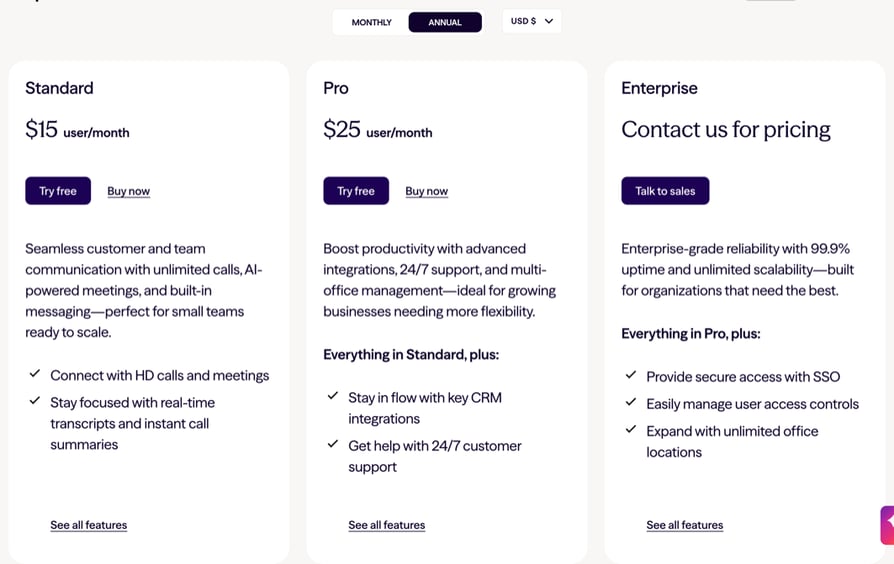
Dialpad's pricing page is tabbed by product, and the default tab publishes no price at all.
- Connect Standard: $15 annual, $27 monthly. Unlimited calls, AI meetings, messaging, real-time transcripts, call summaries.
- Connect Pro: $25 annual, $35 monthly. Standard plus key CRM integrations, 24/7 support and multi-office management.
- Connect Enterprise: quote only. Adds SSO, access controls, unlimited locations and a published 99.9% uptime figure.
- Dialpad Support (contact center): Essentials $80, Advanced $115, Premium $150 annual; Enterprise custom.
- Dialpad Sell (outbound): Essentials $39, Advanced $95, Premium $150 annual.
- Dialpad AI Agents: no published price. You buy AI Agent Credits, consumed when the agent retrieves information or acts, and pricing runs through sales.
RingCentral Pricing
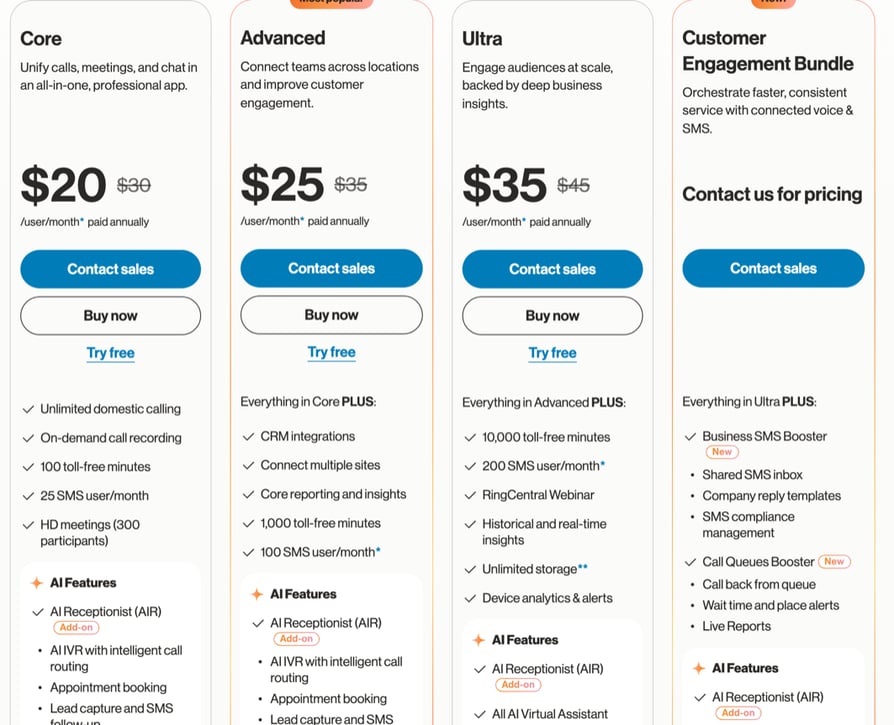
RingCentral publishes more per tier. Its pricing page has a user-count selector, but 1 to 5 users, 6 to 100 and 100+ all return the same $20, $25 and $35, so any discount at scale is negotiated.
- RingEX Core: $20 annual, $30 monthly. Unlimited domestic calling, on-demand recording, 100 toll-free minutes, 25 SMS per user, HD meetings for 300, AI Virtual Assistant.
- RingEX Advanced: $25 annual, $35 monthly. Adds CRM integrations, multiple sites, core reporting, 1,000 toll-free minutes, 100 SMS, AI Writer.
- RingEX Ultra: $35 annual, $45 monthly. Adds 10,000 toll-free minutes, 200 SMS, Webinar, real-time insights, unlimited storage.
- Customer Engagement Bundle: quote only. Ultra plus the Business SMS and Call Queues boosters, $25 and $35 separately.
- RingCX (contact center): Standard $65, Professional $95, Elite $145 annual; Enterprise Contact Center quote only.
- AI add-ons: AI Receptionist from $39/mo bundled with RingEX or $49 standalone; AI Conversation Expert from $60 per user per month; RingCX AI modules $20 to $25 each.
Pricing Compared Line by Line
Dialpad vs RingCentral vs CloudTalk: Pricing Line by Line
| Pricing dimension | Dialpad | RingCentral | CloudTalk |
|---|---|---|---|
| Entry price | $15 annual, $27 monthly | $20 annual, $30 monthly | $25 annual, $34 monthly |
| What's included at entry | Calls, meetings, messaging, transcripts, summaries; manual recording | Unlimited domestic calling, on-demand recording, toll-free minutes, SMS, AI assistant | Call recording, IVR and skill-based routing, queues, call flow builder, numbers in 160+ countries |
| Middle tier | Pro $25: CRM integrations, 24/7 support, multi-office | Advanced $25: CRM integrations, multiple sites, reporting | Essential $29: 95+ integrations, API and data sync, Smart Dialer |
| Top published tier | Enterprise, quote only | Ultra $35 | Expert $49: Power Dialer included, Salesforce Ecosystem |
| AI cost structure | Bundled per tier; AI Agents unpriced | Basic assistant included; conversation intelligence from $60/user/mo | Add-on only: AI Conversation Intelligence $9/user/mo, AI Voice Agents from $99/mo for 200 minutes |
| Contact center model | Separate products: Support from $80, Sell from $39 | Separate product: RingCX from $65 | Call center features included in the core plans |
| Cost at 10 seats | $150/mo Standard, $250/mo Pro | $200/mo Core, $250/mo Advanced | $250/mo Starter, $290/mo Essential |
| Cost at 100 seats | $1,500/mo Standard, $2,500/mo Pro | $2,000/mo Core; no published volume discount | $2,500/mo Starter, $2,900/mo Essential |
Dialpad Integrations vs. RingCentral Integrations
This is the widest gap on the page, and it decides most Dialpad integration setup vs RingCentral evaluations. Count matters less than depth in the one CRM your team lives in, and a real Salesforce VoIP integration behaves nothing like a shallow one.
Dialpad Integrations
Dialpad publishes no headline count, so we counted app detail pages in its own XML sitemap on 2 September 2026: about 125, excluding collection pages. Named on its own pages: Salesforce, HubSpot, Zendesk, Zoho, ServiceNow, Clio, Google Workspace, Microsoft 365, Okta, Outreach, Slack, Microsoft Dynamics 365, Front, Verint, Epic and athenahealth. CRM integrations start on Connect Pro at $25.
RingCentral's own comparison page claims Dialpad has "fewer than 80 integrations". That appears nowhere in Dialpad's material, and its sitemap exposes roughly 125 app listings, so treat it as a rival's marketing claim rather than a count.
RingCentral Integrations
RingCentral's integrations overview page is titled "500+ App Integrations within RingCentral", and its body reads "easily connect RingCentral with over 500 tools, CRMs, and business apps". Open APIs and SDKs cover custom work. RingCX advertises its own, much smaller set of over 50 pre-built integrations, a number that gets conflated with the 500+ constantly. CRM integrations start on RingEX Advanced at $25.
Most Dialpad vs RingCentral 2026 comparisons still repeat RingCentral's stale "330+ integrations" figure. Its own current page says 500+.
Integration Capability Compared
Dialpad vs RingCentral vs CloudTalk: Integration Capability
| Integration capability | Dialpad | RingCentral | CloudTalk |
|---|---|---|---|
| Published native count | None published; about 125 app listing pages in its own sitemap | 500+ published | 95+ standard CRM, helpdesk and ATS integrations |
| Tier where CRM sync starts | Connect Pro $25 | RingEX Advanced $25 | Essential $29 |
| Major CRMs named | Salesforce, HubSpot, Zoho, Zendesk, ServiceNow, Microsoft Dynamics 365 | Salesforce and the major productivity suites, within the 500+ catalogue | Salesforce, HubSpot, Pipedrive, Zoho CRM, Microsoft Dynamics 365 Sales; Salesforce Ecosystem on Expert $49 |
| Productivity suites | Google Workspace, Microsoft 365, Slack | Google Workspace, Microsoft 365, Microsoft Teams | Microsoft Teams, Slack, Google Workspace |
| Developer access | Published APIs | Open APIs and SDKs | Public API and webhooks from Essential $29, plus a Zapier connector |
| Workflow automation | Not published as a named product | Available through APIs and the app catalogue | Workflow Automation Designer with multi-step support, custom syncs, SMS triggers and Slack alerts |
Security & Compliance: Dialpad vs. RingCentral
One of these companies publishes a named certificate register per product. The other publishes a heading reading "ISO standards" and names none.
Dialpad Security & Compliance
From Dialpad's own trust page, read 2 September 2026:
- SOC 2 Type II, audited against the AICPA Trust Services Principles.
- HIPAA readiness once a BAA is signed, which is not blanket HIPAA compliance.
- GDPR handled through a one-click Data Processing Agreement.
- An "ISO standards" heading that never names which standards.
- TLS in transit, AES 256-bit at rest on Google Cloud, WebRTC with SRTP for calls.
- SAML and SCIM through Okta, Azure, Google Workspace and OneLogin; SSO is an Enterprise-tier inclusion.
- Two options to help customers maintain PCI compliance, which supports yours rather than certifying Dialpad's.
- AI-driven redaction of personally identifiable information in transcripts.
RingCentral Security & Compliance
From RingCentral's own trust center compliance page, read 2 September 2026, which names a register per product:
- ISO 27001, ISO 27017, ISO 27018 and ISO 22301 for RingEX and RingCX.
- SOC 2+ with FINRA CSR and HIPAA reporting for RingEX and RingCX separately, plus SOC 3 for both.
- C5, the German cloud computing attestation, in English and German.
- HITRUST CSF certificate and assessment letter for Office and Engage.
- Cyber Essentials Plus, the UK government-backed scheme, for the UK and EU.
- PCI DSS Attestation of Compliance for RingCX, and for the NICE-based Contact Center.
- TLS encryption, SRTP secure voice and single sign-on.
- GDPR handled through DPAs and a Security Addendum rather than a certificate, which is correct: GDPR isn't certifiable.
Security & Compliance Compared
Dialpad vs RingCentral: Security and Compliance
| Security and compliance | Dialpad | RingCentral |
|---|---|---|
| SOC | SOC 2 Type II | SOC 2+ with FINRA CSR and HIPAA reporting, plus SOC 3, per product |
| ISO | "ISO standards" heading, not enumerated | ISO 27001, 27017, 27018, 22301 |
| HIPAA | Readiness once a BAA is signed | HIPAA reporting inside its SOC 2+ report, per product |
| Regional attestations | None published | C5 (Germany), Cyber Essentials Plus (UK) |
| PCI DSS | Options to help customers maintain compliance | AoC for RingCX and for the NICE-based contact center |
| Encryption | TLS in transit, AES 256-bit at rest, SRTP for calls | TLS in transit, SRTP secure voice |
| SSO and provisioning | SAML and SCIM; SSO is an Enterprise-tier inclusion | Single sign-on, per the trust center |
RingCentral wins this dimension outright: if your review ends with handing a named certificate to an auditor, RingCentral publishes it. If your review is lighter but still real, CloudTalk covers SOC 2 Type 1 and Type 2, GDPR and HIPAA compliance across plans, with call recording consent management.
Call Quality, Latency and Uptime: What Nobody Can Tell You
Search Dialpad call quality vs RingCentral and you'll find confident answers. None are measured. We found no independent head-to-head benchmark of call quality, latency, mean opinion score or observed uptime between these platforms, so any ranking here, ours included, would be opinion dressed as data. The only honest number is a call quality score measured on your own network during a trial.
What exists is what each says about itself. RingCentral markets 99.999% availability; its own FY2025 Form 10-K says the company "historically have strived for" it5, an aspiration rather than a service level. Dialpad publishes 99.9%, Enterprise-tier only, or roughly 8.8 hours a year. Skip the five-minutes-of-downtime arithmetic: with either vendor, if availability is load-bearing, get the number into the contract.
Usability & Scalability: Dialpad vs. RingCentral
A Dialpad vs RingCentral scaling comparison comes down to when you'd rather do the configuration work: now, or later with more departments.
Dialpad Usability
- Two published Connect tiers and 2 to 3 highlight features per plan: a short evaluation.
- A self-serve trial and browser setup gets small teams live without an IT owner.
- The trade-off is depth: no per-tier feature matrix, no volume allowances, no call-screening docs, so complex flows are harder to plan.
- Multi-office management arrives on Pro at $25; unlimited locations only at quote-based Enterprise.
RingCentral Usability
- Three RingEX tiers, four RingCX tiers, two boosters and a stack of AI add-ons to configure up front.
- The payoff is a published growth path: multi-site connection from Advanced at $25 rather than a quote.
- Device analytics and alerts on Ultra give IT something to operate once phones outnumber the people who understand them.
- Per-tier allowances and per-product certificates answer finance and security questions without a call.
Usability Compared
Dialpad vs RingCentral: Usability and Scalability
| Dimension | Dialpad | RingCentral |
|---|---|---|
| Setup effort | Low; two tiers, self-serve trial, browser-based | Higher; more tiers, boosters and add-ons to decide between |
| Learning curve | Short for a small team | Steeper initially, more to operate long term |
| Call-flow configuration depth | Not published per tier; no screening documentation | ACD, IVR and skills-based routing published, inside RingCX from $65 |
| Scaling across sites | Multi-office on Pro $25; unlimited locations at Enterprise quote | Multiple sites on Advanced $25; device analytics on Ultra |
| Support consistency | 24/7 listed on Pro $25 | Claimed on all plans, listed on none; regional hours on its own support site |
Dialpad wins on time to value, RingCentral on long-term depth. CloudTalk sits in between: IVR, skill-based routing and a visual call flow builder from Starter at $25 per user per month, 95+ integrations from Essential.
Dialpad Reviews vs. RingCentral Reviews on G2
G2 is the most widely used peer review platform for B2B software. On Dialpad vs RingCentral reviews the two compare cleanly once you read the right pages, which are Dialpad Connect and RingEX. RingCentral's seller page aggregates the whole portfolio and is not a like-for-like number. Both product pages were read at source on 2 September 2026. Peer scores are one input among several, and our call center software buyer's guide covers the rest.
G2 Ratings Compared
Dialpad vs RingCentral: Peer Review Scores
| Review dimension | Dialpad | RingCentral |
|---|---|---|
| G2 rating | 4.4/5 (Dialpad Connect) | 4.2/5 (RingEX) |
| G2 review volume | 4,204 | 1,467 |
| Trustpilot | 4.1/5 from 2,900+ reviews | 2.0/5 from 1,800+ reviews |
| Trustpilot one-star share | No comparable skew | About 6 in 10 reviews are one-star |
| Cross-platform consistency | Scores alike on G2 and Trustpilot | Splits sharply between the two |
Dialpad wins this dimension, and Trustpilot is why. The products sit 0.2 apart on G2, close enough that the sample sizes matter more: Dialpad's is nearly three times RingEX's. Widen the view and the gap opens. RingCentral falls to 2.0/5 on Trustpilot, where roughly six in ten reviewers leave one star, while Dialpad holds 4.1/5. For a buyer who weights peer sentiment, scoring alike on two platforms is the steadier signal.
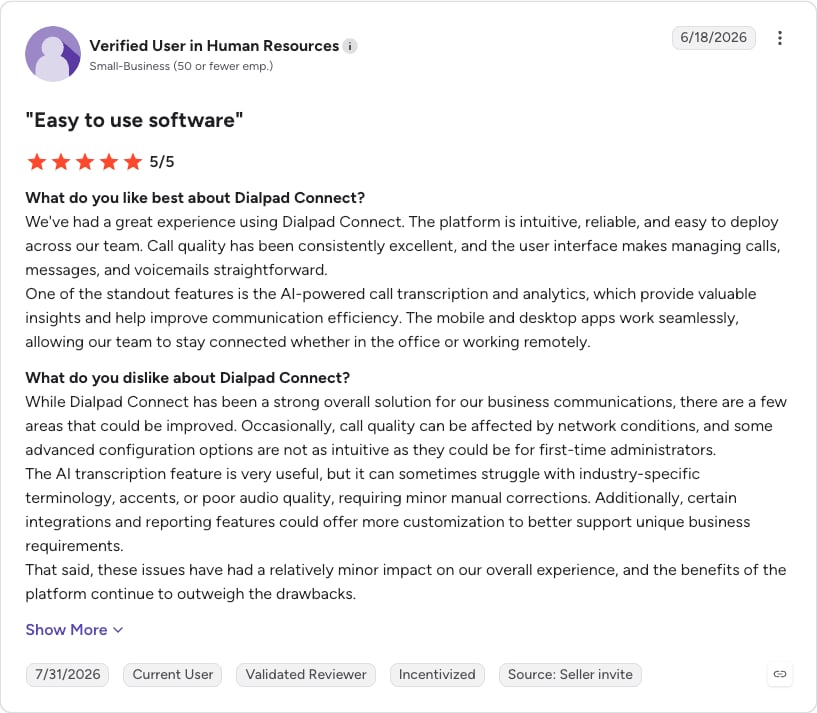
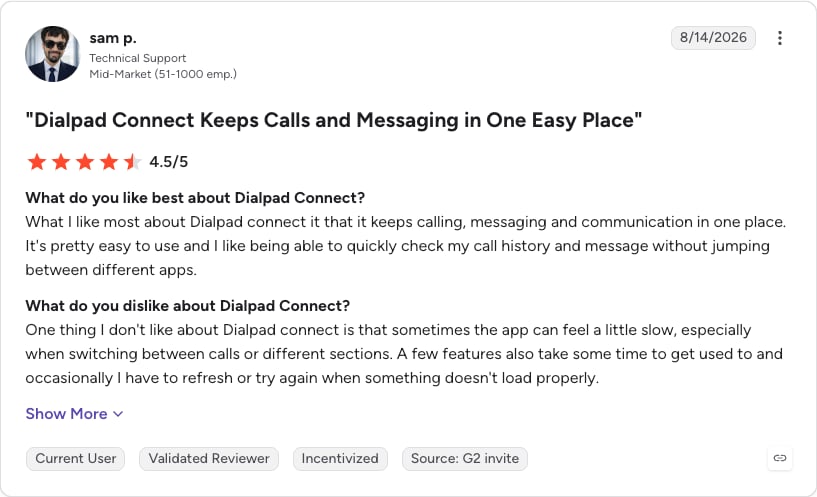
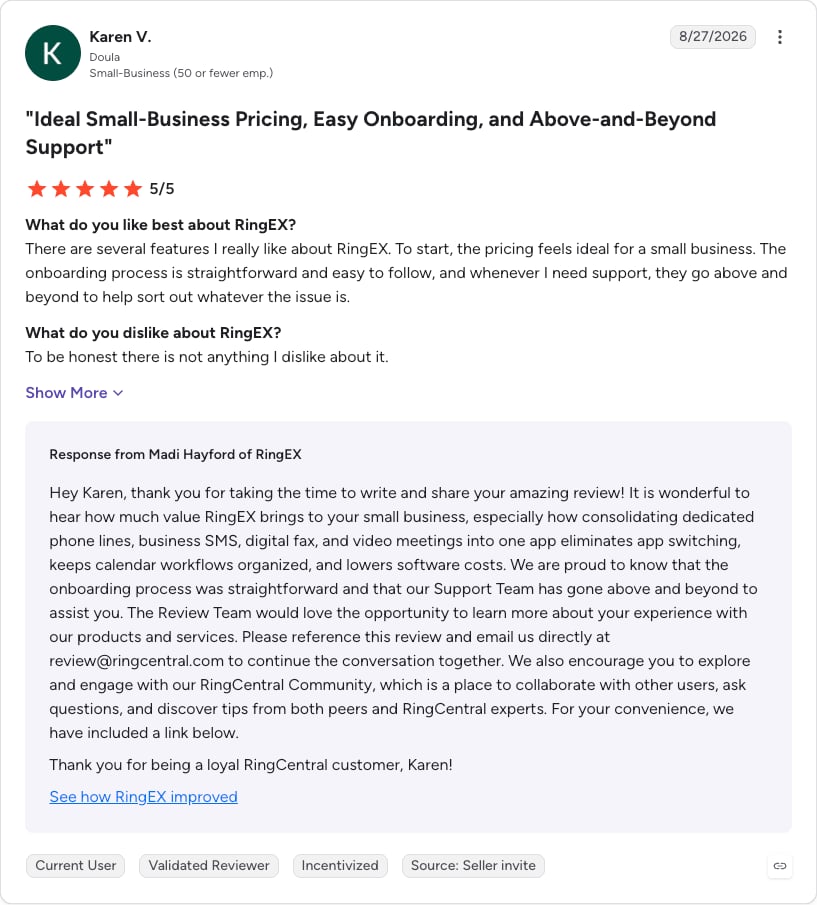
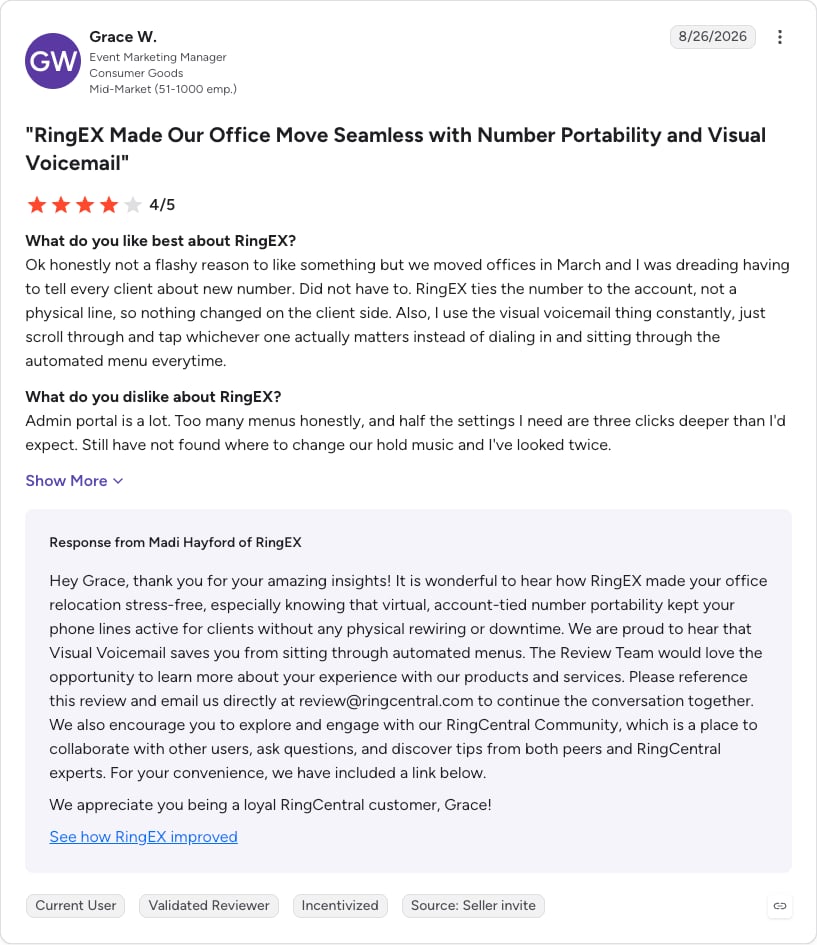
One caveat applies to both equally. Every review on page one of both products, under G2's default sort, carries an "Incentivized" badge, and nearly all also read "Source: Seller invite"; you can see the badge text in the screenshots further down. Soliciting reviews is standard and G2 labels it openly, but it makes the top of each page a vendor-assembled sample rather than a spontaneous one.
What Real Users Say About Dialpad On G2
"The platform is intuitive, reliable, and easy to deploy across our team. Call quality has been consistently excellent, and the user interface makes managing calls, messages, and voicemails straightforward." Verified G2 reviewer, 5/5, 18 June 2026, Dialpad Connect on G2. Their criticism is the AI: transcription "can sometimes struggle with industry-specific terminology, accents, or poor audio quality".
"The voip calling works fine. However, since opening the account- over six months- the text-messaging has never functioned properly. Note- this is on a 10 tdlc approved business line." Verified G2 reviewer, 0/5, read at source 2 September 2026, Dialpad Connect on G2. They add that support could not resolve it across six months. This is one of only two reviews on Dialpad's G2 page one not badged "Incentivized".
What Real Users Say About RingCentral On G2
"With RingEX, we have a much clearer setup for extensions, call transfers, and team availability. I can send a call to the right person without having to message them first, and people can take calls from the app when they are away from their desk." Verified G2 reviewer, 4/5, read at source 2 September 2026, RingEX on G2. Their criticism is the configuration surface: "The admin side has more options than we needed at first."
"There's a monthly text limit per user before extra charges kick in, we blew past it in a busy month running an SMS campaign and the bill was a bit higher than we planned for." Verified G2 reviewer, 5/5, read at source 2 September 2026, RingEX on G2. The published allowances in practice: 25 SMS per user on Core, 100 on Advanced, 200 on Ultra, then overage.
For context on the third option here, CloudTalk holds 4.4/5 on G2 from 1941 reviews.
Dialpad Reviews vs. RingCentral Reviews on Reddit & Quora
G2 tells you what the product does; Dialpad vs RingCentral Reddit threads tell you what happened when it didn't. This is also where Dialpad vs RingCentral user preferences turn specific: what happened during a RingCentral number port, and which support queue picked up.
What Real Users Say About Dialpad On Reddit & Quora
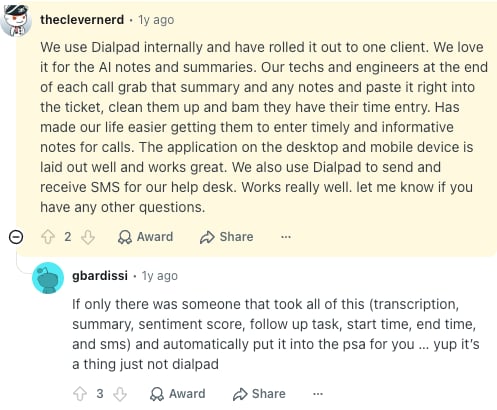
An r/msp technician describes the AI paying for itself in the smallest possible way: the team pastes Dialpad's call summary straight into a ticket to create the time entry. An r/smallbusiness poster gives the other side, with hour-long support chats, a 24-hour wait to add one license on a negotiated plan, and automatic recording that doesn't fire when users dial from their own numbers.
What Real Users Say About RingCentral On Reddit & Quora
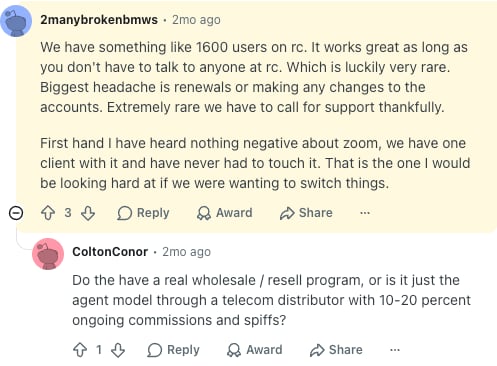
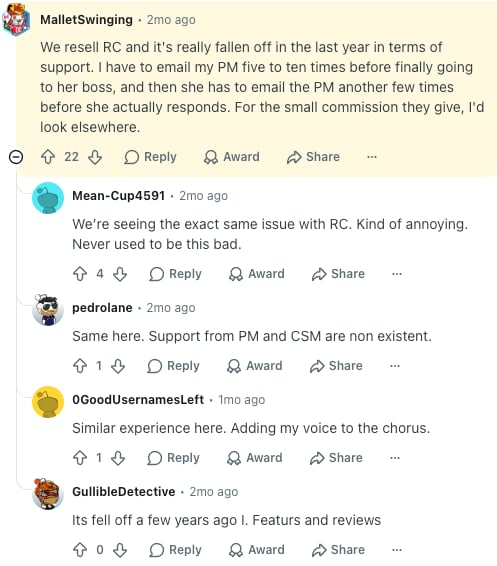
Both RingCentral captures are administrators, and both separate the platform from the company. One runs about 1,600 seats: "It works great as long as you don't have to talk to anyone at rc." The other is a RingCentral reseller who says support has "really fallen off in the last year", at 22 upvotes with three replies agreeing. That's practitioner sentiment from a self-selected sample, not a benchmark, and Dialpad draws its own complaints above. It's still the closest thing to evidence on a dimension neither company documents.
Dialpad Pros & Cons vs. RingCentral Pros & Cons
Read both as the trade-off each platform asks you to accept, on the terms you'd judge any business VoIP phone system.
Dialpad Pros & Cons
| Pros | Cons |
|---|---|
| Lowest entry price of the two at $15 per user per month annual | Month-to-month billing costs $27, an 80% premium over the annual rate |
| Real-time transcripts and call summaries on the cheapest paid plan | Automatic call recording needs Pro at $25, per its own documentation |
| 24/7 support listed on Pro at $25, one tier above entry | Publishes no integration count; its own sitemap shows about 125 app listings |
| Video meetings bundled from the entry tier | Publishes no volume allowances, so the bill is discovered rather than forecast |
| Short, self-serve setup for a small team | AI Agents runs on credits with no public price, so it can't be budgeted |
RingCentral Pros & Cons
| Pros | Cons |
|---|---|
| 500+ published integrations, plus open APIs and SDKs | Every comparable tier costs more than Dialpad's, starting at $20 against $15 |
| Toll-free minutes, SMS counts and storage published per tier | Conversation intelligence is a $60 per user per month add-on, more than any RingEX plan |
| Named compliance certificates per product, including four ISO standards | Four RingCX AI modules at $20 to $25 each can more than double a contact center seat |
| Dedicated Call Screening and Call Flip features | The 24/7 support claim appears on its comparison page but on no RingEX plan card |
| Auditable scale: $2.52bn FY2025 revenue in its SEC filing5 | Trustpilot sits at 2.0/5 from 1,800+ reviews against 4.2/5 on G2 |
Put a third option in the same spreadsheet
Which Team Fits Which Platform?
Fit is about team size, budget, integration checklist and whether you plan to scale across departments, not about which product is better built.
Which Team Fits Which Platform
| Dialpad is the right fit for... | RingCentral is the right fit for... |
|---|---|
| Sales or support teams of 5 to 40 seats that want transcription on every call at the lowest per-seat price | Companies scaling past a few hundred seats across multiple sites or regions |
| Teams paying annually, where the $15 rate is real and the $27 monthly rate isn't the plan | Buyers whose security review requires named certificates per product, in healthcare, finance or public sector |
| Startups and solo operators with a short integration checklist | Ops and RevOps teams whose stack includes tools outside the top 100 apps |
| Teams with no dedicated IT owner who need to be live this week | Finance teams that need published toll-free minute and SMS allowances to forecast against |
| Contact centers that will genuinely use AI quality management, where bundled AI beats stacked modules | Multi-department operations that need call screening and mature call handling |
| Buyers who want one price rather than a plan plus four AI line items | Procurement teams that require audited financials and long vendor track record |
Gartner's July 2026 Magic Quadrant for UCaaS is the neutral read on that last row: RingCentral a Leader, Dialpad a Visionary. If you're sizing a contact center rather than a phone system, start from a written list of call center software requirements instead of a feature grid.
Dialpad vs. RingCentral: The Verdict
The choice comes down to budget, integration checklist and growth plans, not platform quality, and the per-dimension calls above split fairly evenly. What deserves more attention than the risk of picking wrong: four widely quoted claims in this category, two of them from the vendors' own comparison pages, turned out to be stale or unsupported at primary sources.
Choose Dialpad if you…
- Run a 5 to 40 seat sales or support team and want transcripts on every call without a separate AI line item.
- Will pay annually, so $15 per user per month is what you actually pay.
- Have a short integration list that one major CRM on Pro at $25 covers.
- Want a contact center where AI is bundled per tier, not $20 to $25 a module.
- Have no dedicated IT owner and need the phone system live before the next quarter.
- Weight peer sentiment over certificates: 4.4/5 on G2 and 4.1/5 on Trustpilot is unusually even.
Choose RingCentral if you…
- Are scaling past a few hundred seats and adding sites or departments over the next 24 months.
- Need named per-product certificates, because your auditor wants ISO 27001 or a HITRUST letter, not a readiness statement.
- Have a stack that needs more than a hundred integrations, or something only an open API will reach.
- Have to forecast the bill from published toll-free minutes, SMS counts and storage rather than discover it on an invoice.
- Need call screening and mature call handling across departments, the one call-management row that clearly favors RingCentral.
- Run a procurement process requiring audited financials, which only the public company here can supply.
When to Choose CloudTalk?
Choose CloudTalk if Neither Trade-Off Works
CloudTalk is the pick for 10 to 100 seat outbound and support teams that want the whole cost visible up front. Starter at $25 per user per month carries call recording, IVR with skill-based routing and a visual call flow builder; native Salesforce, HubSpot and Pipedrive sync arrives on Essential at $29. AI Conversation Intelligence is a $9 per user per month add-on rather than a $60 line item or an unpriced credit pool. Power Dialer, Parallel Dialer, Predictive Dialer, Smart Dialer. Essentially, CloudTalk has it all.
The bottom line. Dialpad wins where AI belongs in the plan price and the team is small. RingCentral wins where the integration list is long (100+), the auditor is real and the seat count is growing. Work out which describes you and the decision makes itself. CloudTalk wins over both for SMBs who want full telephony tech stack integrations, phone numbers in 160+ countries, plus easy to set up and quick to implement AI voice agents and AI receptionists.
Still choosing between two sets of trade-offs?
Sources
- Gartner, "Gartner Survey Finds 91% of Customer Service Leaders Under Pressure to Implement AI", February 2026
- Gartner, "Gartner Predicts Over 50% of Customer Service Organizations Will Double Their Technology Spend by 2028", March 2026
- Gartner, "Gartner Predicts GenAI Cost Per Resolution for Customer Service Will Exceed Offshore Human Agent Costs by 2030", January 2026
- Gartner, "Gartner Finds Only 27% of Customers Would Try a Chatbot Again After a Negative Experience", September 2026
- RingCentral, Inc., Form 10-K for the fiscal year ended 31 December 2025, filed with the US Securities and Exchange Commission
Frequently Asked Questions
The questions that come up in almost every Dialpad vs RingCentral evaluation: what each costs per user, what the base plan covers before add-ons, which suits a contact center, and where CloudTalk fits if neither trade-off works.
Neither Dialpad nor RingCentral is better overall; the answer changes row by row. Dialpad wins on AI at the entry price, with transcripts and call summaries on the $15 annual plan. RingCentral wins on integration breadth, named compliance certificates and forecastable volume allowances, which is why the verdict names a winner per scenario rather than one champion.
RingCentral's RingEX costs $20, $25 or $35 per user per month annual, and $30, $35 or $45 month to month, read on its own pricing page on 2 September 2026. RingCX, the contact center product, starts at $65. Selecting 1 user or 100 returns the same list price, so discounts are negotiated, and our business phone system cost breakdown puts a $20 seat in context.
No. Dialpad Connect Standard at $15 lets you start and stop recordings by hand; automatic recording needs Connect Pro at $25, per Dialpad's own documentation. RingCentral is the same shape, with on-demand recording on Core at $20. That $25 matters because call recording only pays off when nobody has to remember to press record.
RingCentral, clearly: its own page publishes 500+ apps plus open APIs and SDKs, while Dialpad publishes no count and its sitemap exposes about 125 app listings. Depth beats count if your stack is really one CRM, so check whether the best Salesforce integrations on your list sync both ways first.
RingCX wins on sticker price at every tier: $65 against Dialpad Support's $80, $95 against $115, $145 against $150. Dialpad wins once you match the AI, because four RingCX modules at $20 to $25 each push a Standard seat past Dialpad Support Premium's $150. RingCX publishes ACD, IVR and skills-based routing at $65; Dialpad publishes no per-tier matrix.
Dialpad, on published evidence: it lists 24/7 support as a Connect Pro inclusion at $25, the clearer written commitment. RingCentral claims 24/7 across all plans, but no RingEX plan card lists support and its own site publishes regional hours. Practitioners criticize both, including a RingCentral reseller on r/msp who says support has "really fallen off in the last year", so get your hours in the contract.
The best RingCentral alternative depends on what you're leaving for. Teams escaping the $60 conversation intelligence add-on want AI in the plan price; teams escaping three RingEX tiers, four RingCX tiers and a stack of boosters want fewer decisions. Our guide to RingCentral alternatives ranks them by which you're solving for.
The best Dialpad alternative is also scenario-dependent, but the reasons cluster: integration breadth, published volume allowances, or a price for agentic AI, since Dialpad AI Agents runs on a credit pool with no public rate. The Dialpad alternatives worth shortlisting publish what Dialpad doesn't.
Yes, for 10 to 100 seat outbound and support teams. CloudTalk includes call recording, IVR and routing from Starter at $25 per user per month, with native Salesforce, HubSpot and Pipedrive sync among 95+ integrations from Essential at $29. AI Conversation Intelligence is $9 per user per month rather than $60, always an add-on. It's the wrong pick if you need video meetings or a named ISO certificate per product.