


Cloud Call Center Software for Sales and Support
CloudTalk unifies your calling operations in the cloud. Smart routing, call summaries, sentiment analysis, and native CRM sync.
Go live in under an hour with no hardware.
- Local numbers in 160+ countries for instant local presence
- 99.999% uptime on multi-carrier infrastructure
- AI on every call — with voice agents built in, not bolted on
- Dialers — Power, Parallel, Preview, Sales
- 100+ popular app and native CRM integrations
Trusted by 30,000+ sales & support professionals to power more & better conversations
















The Basics
What Is Cloud Call Center Software?
Cloud call center software is a platform that runs your company's inbound and outbound calling entirely over the internet – no on-premises PBX hardware, no server rooms. A cloud call center gives agents a browser or app to take calls anywhere, while IVR menus, skill-based routing, queues, and callbacks manage the flow automatically, and every call logs itself to your CRM.
Because the provider hosts the infrastructure, cloud-based call center software deploys in hours instead of months, scales per seat instead of per server, and ships updates automatically. CloudTalk's platform adds native AI to that foundation: summaries, sentiment, and voice agents on every call – so growing teams get enterprise call center solutions without enterprise complexity. And if most of your volume is incoming support calls, our inbound call center software is built for exactly that.
CloudTalk's Platform
Get a Taste of CloudTalk
Explore the cloud call center hands-on — routing, dialer, and the live dashboard. No sign-up required.
Know the Difference
Cloud vs. On-Premise Call Center Software
Both handle your business calls, but the difference is who owns the infrastructure.
HOW WE HELP
One Platform for Sales, Support, and Operations
Accelerate Sales with High-Performance Outreach
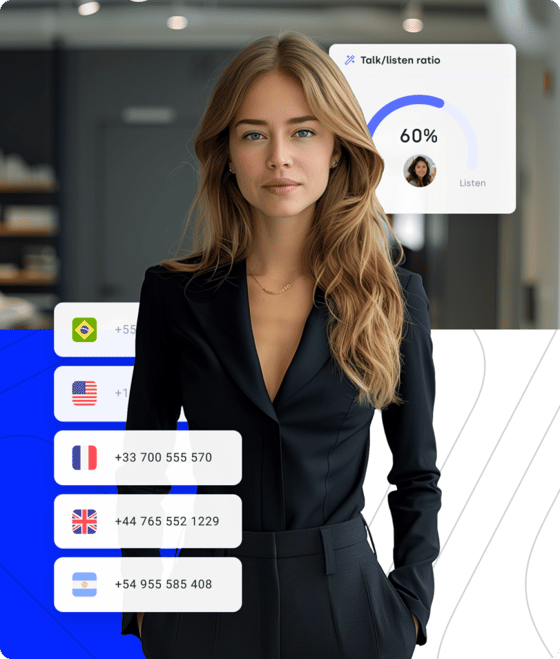
- AI Sales Dialer: Handle every call mode from preview to parallel, with Answering Machine Detection so reps only connect with live humans.
- Local Presence Dialing: Increase answer rates by showing familiar local numbers in every market you call.
- Workflow Automation: Trigger instant updates in HubSpot or Salesforce via two-way sync — no manual logging.
Resolve Issues on the First Interaction
- IVR & Smart Routing: Guide callers with a smart call menu and skill-based routing that lands them with the right agent the first time.
- Call Flow Designer: Build custom inbound flows with drag-and-drop logic — time-of-day rules, overflow routing, callbacks. No code.
- Call Queuing: Hold calls with position announcements and callback offers instead of busy signals.
Turn Voice Data into Coaching Insights
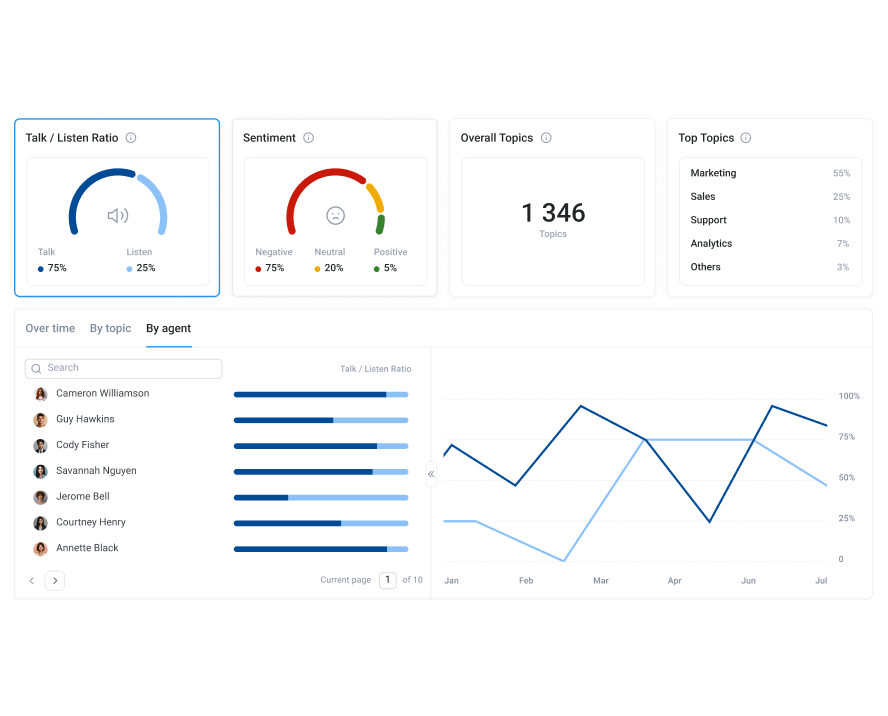
- AI Conversation Intelligence: Detect sentiment trends and key topics automatically to understand the why behind every call.
- Live Monitoring & Whispering: Coach reps in real time with guidance the customer never hears.
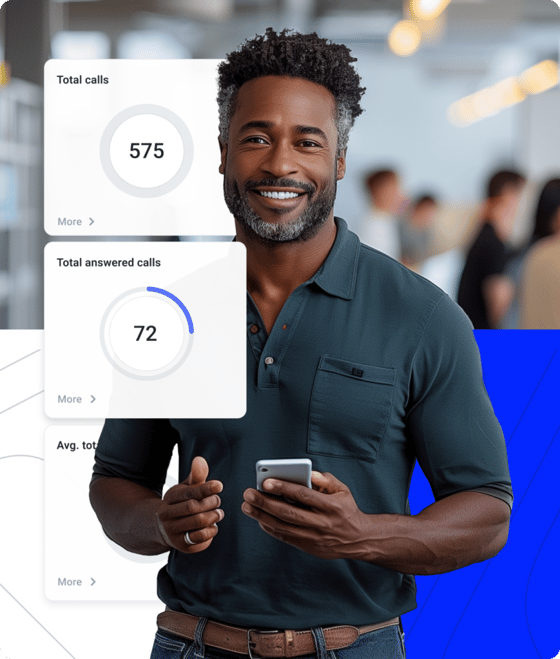
- Real-Time Dashboard: Track wait times, abandonment rates, and agent occupancy at a glance.

Why Teams Choose CloudTalk
AI on Every Call, Built In
Summaries, sentiment, and transcripts generate automatically, and AI voice agents handle routine calls end to end — so agents spend time on conversations, not admin.
Global Reach, Local Presence
Local numbers in 160+ countries mean customers see a familiar caller ID. My Mortgage Finder went from 15 to 100+ calls per agent, per day on CloudTalk.
Reliability You Can Bet On
Globally distributed, multi-carrier infrastructure with a 99.999% uptime SLA. When one carrier degrades, calls reroute automatically — no dropped calls, no IT intervention.
The Cloud Call Center Software Trusted by High-Growth Teams
Ditch the complexity of legacy telephony. Here is why growing teams run their calling on CloudTalk.

Scale Global Operations with Instant Local Presence
Secure international local numbers in 160+ countries to build immediate trust in any market — no physical offices required. Crystal-clear voice quality and native CRM sync mean distributed teams move into new territories with full customer context from day one.
The user interface is intuitive, and the setup was quick and painless. Our team members were up and running with their own phone numbers in no time. The call quality is crystal clear, and we've had no issues with dropped calls or connectivity.

Your Entire Stack, In Perfect Sync
One-click integrations with Salesforce, HubSpot, Pipedrive, and 100+ tools keep voice data and customer records in two-way sync. Agents get full context before they pick up; automated call logging kills manual data entry.
It's very easy to work with, the overview of the program is given. Basically once it is set, it's hard to do anything wrong. I liked that when it is integrated with Pipedrive you can record and call right away with not much fuzz around it. So I would call it efficient in my workflow, and it does allow me to streamline the whole process.

Secure and Compliant by Default
Every voice interaction is protected with encrypted protocols, strict access controls, and globally distributed data centers with redundancy. CloudTalk is ISO 27001 certified and GDPR compliant — full details live in our security documentation, so your team can focus on customers instead of compliance paperwork.
Nokia increased calls handled by 38% and cut wait time by 47% after switching to CloudTalk — read the Nokia story.
More CloudTalk Features
And Then, There's AI…
Sales agents save 3 hours a week on manual data entry and handle 20 more calls. Supervisors gain back 25 hours weekly with automated call reviews, transcripts, and AI analytics.
Here's a taste of what our AI Conversation Intelligence offers:
- Structured recaps land in your CRM the moment a conversation ends — zero post-call admin, searchable history of every deal and ticket.
- AI Voice Agents for routine callsScheduling, FAQ resolution, and after-hours coverage handled end-to-end — escalating to a human only when needed.
Signature Capability
See CloudTalk’s AI Voice Agent in Action!
CeTe is an AI that talks like a human: no breaks, no training, no time off. It makes and answers calls, updates CRMs, books meetings, and loops in a human only when needed.
Press play to hear it. Want a wow moment? Get a free test call and try it live.

CloudTalk's Pricing
How Much Does CloudTalk Cost?
Our pricing is transparent, so you always know what you're paying for.
No hidden fees, no additional costs.
Compare Providers
Cloud Call Center Software Comparison
You shouldn't need a sales call to find out what you'll pay.
CloudTalk's pricing is public, from $25 per user/month with no seat minimums.
Here's how the leading platforms compare.
Cloud Call Center Software:
Everything You Need to Know
Whether you’re replacing an on-premise system, comparing cloud call center solutions, or setting up your first call center — here are the answers teams ask most.
The core benefit is removing infrastructure from the equation: your team gets enterprise calling capabilities without owning any of the machinery that delivers them. In practice, that means:
- No hardware costs — no PBX servers, SIP trunks, or desk phones to buy and depreciate.
- Same-day deployment — teams go from signup to live calls in under an hour, not months.
- Per-seat scaling — add agents, numbers, and markets in clicks as demand grows, and scale back down just as fast.
- Remote-ready by default — agents sign in from a browser, desktop, or mobile app anywhere with internet.
- AI built in — modern platforms layer summaries, sentiment, and voice agents onto every call automatically.
A cloud call center converts voice into digital packets and routes them over the internet through the provider’s distributed infrastructure. When a customer calls, an IVR menu greets them, routing rules match them to the right agent based on skills, availability, or history, and queues with callbacks catch anything your team can’t answer live.
Because the provider manages the infrastructure, everything configurable lives in a dashboard: managers build call flows with drag-and-drop logic, watch queues in real time, and every call logs itself to the CRM with recording, outcome, and notes attached. Agents just sign in and talk.
A cloud call center is built around voice: routing, queues, dialers, and analytics for phone conversations. A cloud contact center layers additional channels on top — email, live chat, SMS, and social — managed from one shared workspace with a unified customer history. The terms get used interchangeably by vendors, which is why comparing platforms by their actual channel support matters more than the label on the pricing page.
CloudTalk sits deliberately between the two: calls-first depth — IVR, skill-based routing, and AI on every call — with SMS and WhatsApp built in and 100+ app integrations connecting the rest of your channels. Teams that live on the phone get cloud contact center reach without paying omnichannel-suite prices.
Feature lists look similar across vendors; the differences show up in daily operation. The capabilities that matter most for sales and support teams:
- Routing depth — IVR, skill-based routing, and time-of-day rules that put callers with the right agent the first time.
- Outbound efficiency — a dialer with power and parallel modes plus answering machine detection.
- Native CRM integrations — two-way sync with your stack, not a third-party connector.
- Real-time analytics — live dashboards for queues, wait times, and agent performance.
- AI capabilities — call summaries, sentiment analysis, transcription, and voice agents that reduce per-call admin.
- Coverage and reliability — local numbers where your customers are, on infrastructure with a published uptime SLA.
The honest trade-offs: a cloud call center depends on your internet connection — if your office loses connectivity, calling moves to mobile apps and cellular data rather than stopping, but the dependency is real. Per-seat pricing that starts cheap can also grow at scale, so large teams should model costs at their actual headcount rather than the entry price.
Organizations with strict data-residency or regulatory requirements should verify where the provider processes calls and what certifications back it up — CloudTalk’s security documentation covers encryption, data centers, and compliance in detail. For most sales and support teams, these trade-offs are far outweighed by eliminating hardware, maintenance, and deployment time.
Any team whose work runs on phone conversations: sales teams using dialers to reach more prospects, support teams routing high inbound volume, and IT and operations managing calling infrastructure across departments.
By size, it spans micro businesses deploying their first call center in an hour, small businesses growing without IT overhead, and midsize teams absorbing high call volumes on infrastructure built to scale.

CloudTalk is built to simplify calling operations with reliable AI business calling
Schedule a demo today to see how CloudTalk can support your teams.
Cloud Call Center Software FAQs
A cloud call center runs a company’s inbound and outbound calling over the internet instead of on-premise PBX hardware. Agents sign in from a browser or the CloudTalk app, and routing, queues, and analytics run in the cloud.
Yes. CloudTalk supports number porting, so you transfer existing business numbers with no interruption — and provision new local numbers from 160+ countries instantly alongside them.
A call center handles voice; a cloud contact center adds channels like email, chat, and social on the same platform. CloudTalk is calls-first with SMS and WhatsApp built in, plus 100+ app integrations to connect the rest of your stack.
Pricing is per user per month with no hardware or installation costs. CloudTalk’s plans start at $25 per user/month, with flexible add-ons for advanced dialers and AI features.
Yes. CloudTalk offers native integrations with Salesforce, HubSpot, Pipedrive, and more — syncing call data automatically to enrich customer records and workflows.
Most teams are operational within the hour. With no hardware, you simply sign up, add users, pick numbers, configure your call flow, and start taking calls the same business day.
Yes. CloudTalk uses encrypted protocols, strict access controls, and globally distributed data centers, and is ISO 27001 certified and GDPR compliant. Details are in CloudTalk’s security documentation.
CloudTalk Analytics tracks call volume, wait times, and agent performance in real time, while AI Conversation Intelligence adds sentiment, topics, and call summaries automatically.


Hello 👋 My name is Emma. Still have questions?
Can’t find the answer you’re looking for? Please chat to our friendly team.