Summary
A scenario is a fixed path your AI Receptionist follows when something specific happens. But bundle too many of them together, and everything can easily fall apart. In episode 5, we cover what scenarios and guardrails actually do, what makes them different from skills, and when you should use one versus the other.
Some parts of the AI Receptionist setup feel like the same thing, wearing two different jackets. Take skills and scenarios, the one I kept getting stuck on. They both react to something the caller says, and shape what the agent does next. So, when do you reach for one over the other?
This was the question I brought into lesson 5, after spending the last episodes building out the skills and knowledge base for our HVAC business with Nazarii Ovcharchyn, CloudTalk’s Senior Product Manager.
In this episode, we discussed how you can tell a skill from a scenario, why overlapping triggers are a problem, when to chain them together, and the moment Nazarii flagged where you should stop adding scenarios and write a skill instead.
What scenarios actually do
Scenarios are the reactive piece of your voice agent. They follow a simple shape: if A happens, do B.
"If A happens, B should be the voice agent's reaction," Nazarii said.
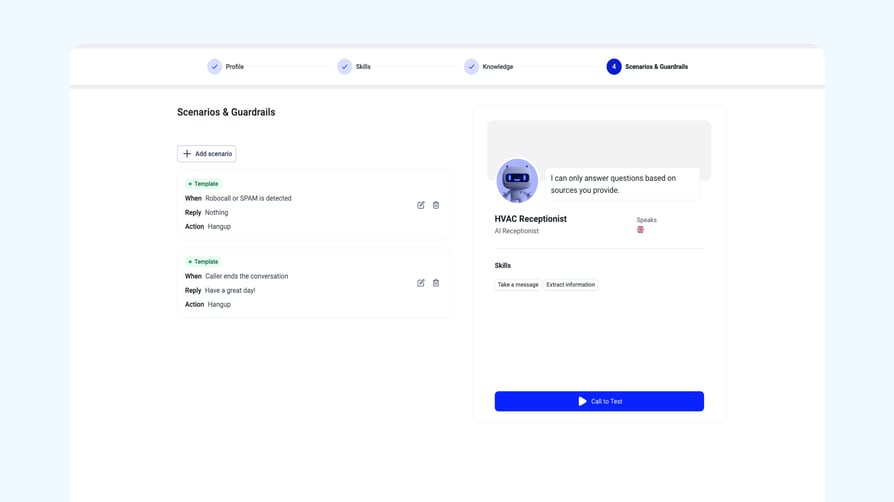
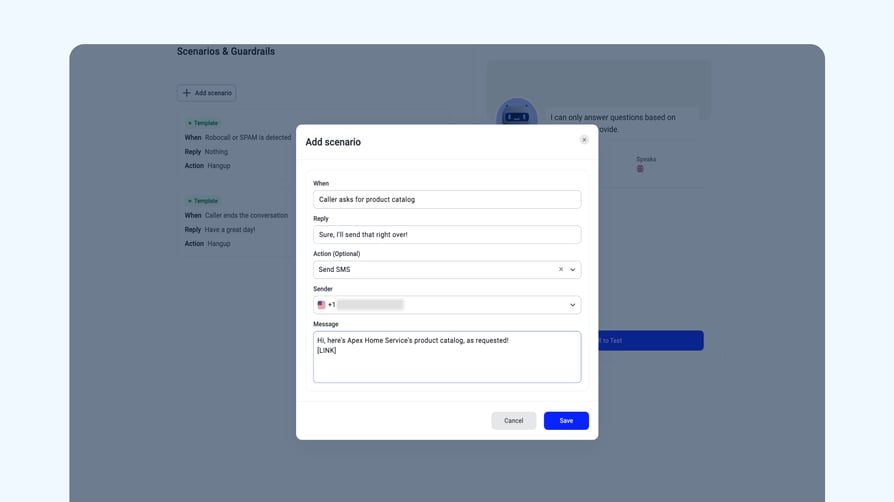
The defaults are easy to read. When a robocall or spam is detected, reply nothing and hang up. When the caller ends the conversation, say "Have a great day" and hang up. Each scenario has one trigger and one action, drawn from a short list: hang up, send SMS, or tool call.
Send SMS is the one I hadn't used before, and Nazarii shared a good use case for it. Imagine someone calls and asks for the product catalog. In this case, the scenario can fire a pre-written SMS with a link to the Apex Home Services catalog, then keep the conversation going. There’s also the tool call option, which can be connected to API endpoints. But, for everyday situations like ours, hanging up and sending SMS covers most of it.
How skills are different
The answer is easier than I thought. Skills give the agent room to think, scenarios don’t.
Skills give you much more room for creativity. You can think of skills as sub-agents or experts in a specific domain. Whereas scenarios are much more reactive and shorter.
The way I now think about it: scenarios are line items, skills are paragraphs. A scenario tells the agent what to do in one specific moment. A skill describes a whole situation and lets the agent figure out the conversation from there.
Take a Message, the skill we built in lesson 2, is a good example. It doesn't fire off one action, it handles a back-and-forth: ask why they're calling, capture the message, confirm the details, and forward it. A scenario can't carry that kind of flow.
The overlap problem
This is where it got interesting. I asked Nazarii: can two things happen at the same time? Can the caller ask for the catalog and end the conversation in one move?
His answer: technically yes, but you don't want to set it up that way. If you create two scenarios with the same trigger, you're handing the voice agent a choice it shouldn't have.
You're allowing the voice agent to be creative regarding what scenario or what skill should kick in first.
Creative is good when you want it. Creative in scenario logic is how you end up with an agent that sometimes sends the SMS and sometimes hangs up first.
The way to fix it is simple: you have to chain them. Scenario one sends the catalog; scenario two waits for a signal confirming the catalog was successfully sent, then ends the call.
When to use a skill, instead of a scenario
At this point in the conversation, there was something I kept asking myself: if I have a few scenarios related to one another, how should I bundle them? What should fire first? What depends on what?
When this happens, that’s when you should take a step back. You’re looking for a skill, not a scenario, as Nazarii explained.
If you have a couple of scenarios and you're already thinking, 'Okay, how do I bundle them together? This should happen first, then this and this.' Then it's already better to start describing this as a skill.
He shared an example: if a caller asks about routine repairs, the agent replies with the $80 fee. A different caller asks to be called back, and the agent asks for a suitable time. Both can be scenarios, they are fine on their own.
But if you have five or six of these all related to the same kind of inquiry, you're better off describing the full situation in a skill prompt. Let the agent handle the flow.
The rule of thumb I left with: the moment you find yourself drawing a flowchart between scenarios, you've outgrown scenarios.
One big prompt, behind the scenes
The mental model Nazarii left me with: everything you set up, skills, scenarios, guardrails, gets compiled into one big prompt. That prompt is what the LLM actually reads.
Inside the prompt, skills sit one after another, each as its own block. Scenarios get grouped by action. So all the "hang up" scenarios are listed together under one heading in the prompt, all the "send SMS" ones under another.
It's actually not grouped together and not mentioned in series, but it's grouped according to a particular action.
What's next
And just when I thought we were done… there’s still one more step we need to go through before our AI Receptionist is ready to fulfill its duties: connect it to an actual number.
That’s what we’ll be covering in the next one: assigning a number and configuring the call flow steps.
See you there.