Retell AI vs Vapi AI: The TL;DR
| Question | Quick Answer |
|---|---|
| What is Retell AI? | Retell AI is a low-code path AI voice agent builder with a visual Conversation Flow builder, native two-way Salesforce and HubSpot sync, branded caller ID, and component-based pricing from $0.07 per minute with voice infrastructure included. |
| What is Vapi AI? | Vapi AI is a developor first AI voice agent bulder, with agents defined in JSON, roughly 40 swappable model, voice, transcriber and telephony providers, and bring-your-own-key billing on top of $0.05 per minute for hosting. |
| Which is better, Retell AI or Vapi AI? | Neither wins overall, and product quality isn't what settles it. Your engineering capacity is: no engineer to assign and you want an agent live this week (Retell), or engineers who will own the agent config like any other service (Vapi). |
| Which is cheaper? | The two headline rates aren't comparable. Retell's $0.07 to $0.31 per minute includes its voice infrastructure; Vapi's $0.05 is hosting alone and excludes speech-to-text, the LLM and text-to-speech. A mainstream Retell setup lands near $0.11 to $0.13, while Vapi publishes no all-in figure, so model what voice AI actually costs against your own volumes. |
| Does either require coding? | Retell doesn't for a standard agent; Vapi effectively does. Vapi retired its visual Workflows builder on August 18, 2026, so agent design is prompt and configuration work. |
| Which is faster? | Unknown. Retell claims ~600ms, Vapi claims under 500ms, both self-reported, and neither has been independently benchmarked. Vapi's own docs warn against comparing figures whose test conditions differ. |
| Which connects to more tools? | Retell on native connectors, with Salesforce, HubSpot, Twilio, Telnyx, Vonage, Make, n8n, GoHighLevel and Cal.com against Vapi's four documented tool integrations. Vapi covers the gap through Custom Tools and its API. |
| Which is stronger on compliance? | It depends how you buy. Retell puts HIPAA, SOC 2 Type 1 and 2 and GDPR on self-serve at no fee. Vapi gates SOC 2, SSO, RBAC and residency behind Scale and prices HIPAA at $2,000 per month, but publishes PCI and data residency that Retell doesn't. |
| What changed this year? | Vapi retired its visual Workflows builder in August 2026 and consolidated on Squads, after a $50 million Series B in May. Most Retell AI vs Vapi 2026 comparisons still describe the node canvas. |
| What's the best alternative to Retell AI and Vapi AI? | CloudTalk's AI Voice Agent, if you want the agent and the phone system in one subscription: no-code setup, live-agent handoff with full context, and a 14-day free trial. |
- Retell AI is a low-code, fast-deployment AI voice platform with transparent, predictable pricing. It is best for growth teams and non-technical builders needing a fast, plug-and-play setup with integrated phone features. Backed by Y Combinator ($5.1M raised), it delivers a reliable 600ms–800ms median latency out of the box.
- Vapi AI is an API-first voice engine designed for maximum developer customization and control over every model in the pipeline. It best fits engineering-heavy teams needing full architectural freedom to swap STT/LLM/TTS providers and write custom logic. Backed by top tech investors ($72M raised), it powers custom setups optimized for sub-500ms response targets.
Below, we break down setup complexity, telephony features, and total costs to help you select the right engine.
👉 Jump directly to the full Retell AI vs Vapi comparison table
How We Compared Retell AI and Vapi AI
Every figure on this page comes from Retell's and Vapi's own pricing, product, and compliance pages, read in August 2026. Nothing here leans on either vendor's marketing about the other, and both publish a comparison page of their own. Here's what we scored:
- Pricing you can actually forecastPublished rates, what each base rate includes, and what it leaves out. Retell's floor carries its voice infrastructure and Vapi's carries no model cost at all, so we priced a mainstream setup instead of comparing headlines.
- Feature depth, not feature countBuilder architecture, knowledge retrieval, transfer behavior, and testing loops. Vapi retiring its visual builder changes what "no-code" means on that platform, so we scored what ships today rather than what an older comparison describes.
- Latency claims, treated as marketingNeither vendor has an independent benchmark, so we kept their numbers apart, labeled the source of each, and noted which stages of the call each figure leaves out.
- Integration reality over logo wallsA directory listing and a working two-way sync are different things. We sorted every integration into three tiers: native and vendor-documented, community or unofficial, and reachable only through the API.
- Compliance packaging, not certification logosBoth vendors are certified. What differs is which controls reach a self-serve buyer at no fee and which sit behind an annual contract or a monthly add-on, so we scored the packaging.

See what a voice AI agent sounds like on a real call

Retell AI vs. Vapi AI: Core Strengths of Each Platform
Both platforms solve the same orchestration problem: audio in, a speech-to-text transcript, a model response, speech back out, fast enough that the caller doesn't notice. Retell optimizes for how fast a non-engineer ships a working agent. Vapi optimizes for how much of the stack an engineer can replace.
What Is Retell AI?
Retell AI is a low-code voice AI platform built around a visual Conversation Flow builder and telephony it ships itself. You're not buying a toolkit; you're buying something already assembled, with branded caller ID, three transfer modes and free SIP trunking in the box. Keep in mi d - It's low code compared to Vapi, but relatively dev-first when compared to plug-and-play platforms like CloudTalk.
Where Retell AI Shines
Where Retell AI Shines
| Strength | Why it matters |
|---|---|
| Visual Conversation Flow builder | Typed nodes for dialogue, tools, transfers, code and transitions let an ops lead change branching logic without a deploy. |
| Native two-way CRM sync | Salesforce and HubSpot contacts sync both ways every five minutes on phone-number match, with call activity written back to Tasks or the HubSpot timeline. |
| Compliance on the self-serve plan | The HIPAA BAA, GDPR DPA and EU SCCs are self-signable at no fee, and Retell holds SOC 2 Type 1 and Type 2. |
| Telephony features built in | Branded Call and Verified Phone Number are native, alongside three transfer modes and free SIP trunking. |
That curated stack is a deliberate choice. Vapi made the opposite one.
What Is Vapi?
Where Vapi AI Shines
Where Vapi AI Shines
| Strength | Why it matters |
|---|---|
| Provider choice on every layer | Roughly 40 documented provider pages across LLM, voice, transcriber and telephony, including ElevenLabs, Cartesia, Deepgram and Azure. |
| Bring-your-own-key billing | Provider costs pass through at cost, or at $0 through Vapi with your own API key: no markup, no lock-in. |
| A real tool layer for engineers | Custom Tools, an API Request tool, and a Code Tool that runs TypeScript with no server to host, plus argument encryption and rejection plans. |
| Granular turn-taking controls | Start Speaking and Stop Speaking Plans expose numeric defaults per assistant, with Smart Endpointing via Krisp, Deepgram Flux, Assembly or LiveKit. |
One trade, seen from both ends: Retell gives up provider freedom to buy speed, Vapi gives up speed to buy provider freedom.
At a Glance: Retell AI vs. Vapi AI, Key Differences
Find the dimension that decides it for your team, then jump to that section. A Vapi vs Retell AI comparison in 2026 usually turns on two or three of these rows. Both are standalone platforms rather than voice agents built into an existing phone system.
Retell AI vs Vapi AI: Key Differences
| Dimension | Retell AI | Vapi AI | Best suited for |
|---|---|---|---|
| Builder model | Visual Conversation Flow, typed nodes | Assistants and Squads in JSON; Vapi retired the visual Workflows builder on August 18, 2026 | Ops teams editing logic in a browser, and engineers who want config in version control |
| Published pricing | $0.07 to $0.31 per minute, components priced individually | $0.05 per minute hosting, excluding model costs | Finance teams needing one invoice, and teams that own provider contracts |
| Headline latency claim | Retell states "~600ms", citing unnamed independent benchmarks | Vapi advertises "<500ms average", no methodology published | Teams that will test barge-in on a trial call rather than trust either number |
| Concurrency included | 20 calls, then $8 per concurrency per month; no cap on Enterprise | 10 calls, then $10 per line per month | Low-volume pilots, and high-volume campaigns modelling line costs |
| Compliance packaging | HIPAA, SOC 2 Type 1 and 2, GDPR, PII controls on self-serve | SOC 2, SSO, RBAC, residency on Scale; HIPAA a $2,000 per month add-on | Regulated small teams buying self-serve, and enterprises signing annual |
Retell AI Features vs. Vapi AI Features
Retell AI Features
Retell includes the full package for AI voice workflows: a visual builder, pre-built templates, a "Conductor" assistant that plans and applies changes, and telephony features that come with the platform. The API is there when you need it, and you can run a production agent without touching it.
Wat Retell AI Does Well
- Visual conversation flows.Typed nodes cover dialogue, tool calls, transfers, code and transitions, so branching logic is something you read on a canvas.
- Native branded caller ID.Branded Call costs $0.10 per outbound call and a Verified Phone Number $10 per month, both on US numbers after a business-profile check.
- Three transfer modes plus AI-to-AI handoff.Cold, warm and agentic warm transfer, plus Agent Transfer, which Retell documents as lower-latency and as carrying full conversation history.
- Native batch calling.Schedule batch calls from the dashboard at $0.005 per dial, with no separate campaign tool to wire up.
Where Retell AI Falls Short
- Concurrency is capped unless you go Enterprise.Pay-as-you-go includes 20 concurrent calls, then charges $8 per concurrency per month. Only the Enterprise tier removes the cap.
- The provider list is curated, not open.You pick from Retell's set. Bringing an arbitrary model, voice or transcriber isn't an option the way it is on a bring-your-own-key platform.
- Enterprise pricing isn't published.RBAC, custom SSO and the dedicated stable server all sit behind a tier with no public figure, so budgeting for them means a sales call.
- Testing bills at production rates.Text tests bill per message and voice tests at the full per-minute rate, so a heavy simulation cycle shows up on the invoice.
Vapi AI Features
Vapi is an API with a dashboard on top. Agents are Assistants defined in configuration, and multi-agent behavior comes from Squads, where specialised assistants hand a call between themselves. Vapi retired its visual Workflows builder on August 18, 2026 and consolidated on Squads, reasoning publicly that current AI systems can't yet hold node-level awareness as autonomous agents.
What Vapi AI Does Well
- Provider breadth across the pipeline.Transcriber, model and voice are each swappable from roughly 40 documented integrations, with custom endpoints for anything off the list.
- Squads for multi-agent calls.Specialised assistants hand off mid-call, so each prompt stays small and testable instead of one prompt covering every branch.
- A Code Tool that needs no server.Run TypeScript inline alongside Custom Tools and the API Request tool, with argument encryption and rejection plans built in.
- Outbound Campaigns.Scheduling, recipient lists, metrics and call logs, with docs advising batches of 50 to 100 numbers to stay inside the concurrency cap.
Where Vapi AI Falls Short
- No visual builder to fall back on.Vapi retired the visual Workflows builder on August 18, 2026 and consolidated on Squads, so agent design is prompt and configuration work.
- The headline rate understates the bill.That $0.05 per minute covers hosting alone. Speech-to-text, the LLM and text-to-speech are all excluded, and Vapi publishes no all-in figure anywhere.
- Compliance sits behind the annual contract.SOC 2, SSO, RBAC, data residency and the uptime SLA are Scale-plan items marked unavailable on Build, and HIPAA is a $2,000 per month add-on.
- Vendor sprawl is the price of the freedom.Bring-your-own-key means separate contracts, invoices and security reviews for every transcriber, model, voice and telephony provider you pick.
The Third Option: An Agent That Arrives Pre-Wired
Both Retell AI and Vapi AI are standalone platforms: you build the agent, then connect it to your phone system. CloudTalk's AI Voice Agent (CeTe) takes the other approach: a no-code agent (a paid add-on) that arrives wired into a full call center, so it answers on your existing numbers and hands off to a live rep without an integration project. Autenti, a SaaS company, has it handling roughly 30% of inbound support calls.
Feature-by-Feature Comparison
Retell AI vs Vapi AI: Feature Comparison
| Feature | Retell AI | Vapi AI |
|---|---|---|
| Builder type | Visual Conversation Flow, single and multi-prompt agents | Assistants and Squads defined in configuration |
| Warm transfer | Cold, warm, agentic warm, plus AI-to-AI Agent Transfer with full history; phone calls only | Assistant-based, with hold music, transferSuccessful to merge or transferCancel to return the caller |
| SIP trunking | Elastic, with guides for Twilio, Telnyx, Vonage, Avaya Aura, Genesys Cloud and Five9; no charge | Guides for Twilio, Telnyx, DIDWW, DIDLogic, Zadarma, Plivo, Amazon Chime SDK; SIP REFER supported |
| IVR and DTMF | Navigate IVR is a named feature; DTMF validated in phone testing | A dtmf default tool, sending tones out of band via RFC 2833 |
| Knowledge base | Native, from URLs, documents and text, with query-rewrite tuning | Built-in bases and query tool, plus custom knowledge base servers |
| Webhooks and tool calling | Function calling for transfers, appointments, SMS, custom APIs; call, SMS and alert webhooks | Default tools (transferCall, endCall, sms, dtmf, apiRequest), Custom Tools, Code Tool, client-side tools |
One caveat applies to both warm-transfer cells. Callers judge a handoff by the dead air they hear, not by the spec sheet. Vapi documents hold music and a cancellation timeout, Retell documents optional pre-transfer messages, and neither predicts how a handoff sounds on your carrier. Test it on a trial call.
Latency & Voice Quality: Retell AI vs. Vapi AI
Latency is the difference between a caller who talks normally and one who starts repeating themselves. Voice-to-voice delay stacks across five stages: transport, endpointing, transcription, model response and speech synthesis. Endpointing decides when the caller has finished talking, and getting it wrong gives you an agent that talks over people or leaves a gap. Both platforms can sound natural by different means: Retell tunes in the dashboard, Vapi tunes in JSON. The retell ai vs vapi latency question is which you'd rather maintain.
Retell AI vs Vapi AI: Latency and Voice Quality
| Dimension | Retell AI | Vapi AI |
|---|---|---|
| Published headline figure | Retell states "~600ms latency" on its homepage, attributed to unnamed independent benchmarks | Vapi advertises "<500ms average latency" in its homepage metrics strip, no methodology given |
| Interruption control | An Interruption Sensitivity setting; docs recommend 0.8 in noisy environments and note it "will hinder the ability of your agent getting interrupted" | A Stop Speaking Plan: numWords (default 0), voiceSeconds (0.2s), backoffSeconds (1s) |
| Turn-taking and endpointing | Transcription mode: optimize for speed, or for accuracy at roughly 200ms more latency, which mainly improves capture of numbers and dates | A Start Speaking Plan with a 0.4s default wait, plus Smart Endpointing; the LiveKit default waitFunction runs 200ms to 8,200ms by confidence |
| Voice provider options | Retell Platform, Minimax, Fish, ElevenLabs, Cartesia, OpenAI | ~40 provider doc pages including ElevenLabs, Cartesia, Rime AI, Deepgram, Azure, PlayHT, xAI |
| Tuning effort | Per-agent dashboard settings | Per-assistant JSON, via startSpeakingPlan and stopSpeakingPlan |
A retell ai vs vapi latency comparison built on those two headline numbers doesn't hold up. Neither has been independently benchmarked, and Retell cites benchmarks it never names. Vapi's own documentation says its displayed figure excludes endpointing and transport, the two stages a caller feels most, and tells you to "compare figures only when their scope and conditions match." The vendor advertising the lower number is the one explaining why that class of number travels badly between vendors.
What breaks calls is messier than milliseconds. Callers on speakerphone, callers talking to someone else mid-sentence, callers who mumble a one-word answer or cut in before the greeting finishes. No published figure predicts how either platform handles that, which is the practical limit on the accuracy of voice AI, so run your own script on your own carrier during a trial. One clarification: ElevenLabs isn't a third contender. It's a text-to-speech provider inside both platforms, at $0.040 per minute on Retell and on Vapi's HIPAA-approved list.
Retell AI Pricing vs. Vapi AI Pricing
How Much Does Retell AI Cost?
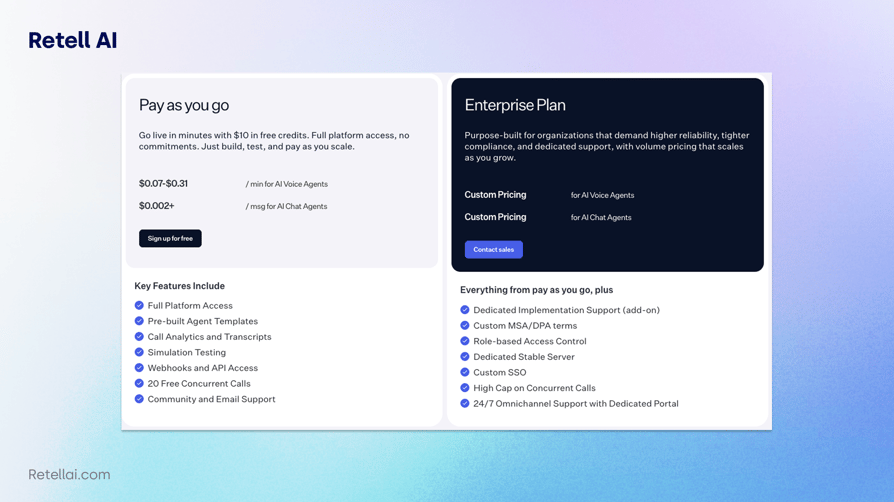
Retell has two plans, Pay-as-you-go and Enterprise, with no annual contract to start. Pay-as-you-go publishes $0.07 to $0.31 per minute for voice agents, plus $0.002 and up per message for chat. That covers platform access, templates, analytics, simulation testing, webhooks, API access, 20 free concurrent calls and email support. New accounts get $10 in credits.
The range exists because Retell AI pricing is component-based. Retell Voice Infra at $0.055 per minute always applies, platform TTS voices add $0.015 (ElevenLabs $0.040), US telephony through Twilio adds $0.015, and SIP trunking with your own carrier costs nothing. The model moves the number most, from $0.003 per minute for GPT 5 nano to $0.32 for GPT 5.5 on the fast tier.
A mainstream setup ($0.055 infra, $0.015 platform voice, $0.045 GPT 4.1, $0.015 telephony) lands near $0.13 per minute. Retell's own calculator returns $0.11 at default settings, and the $0.31 ceiling is what premium models and voices cost. Enterprise pricing is custom with no published figure; it's the tier that removes the concurrency cap and adds RBAC, custom SSO and a dedicated stable server.
How Much Does Vapi AI Cost?
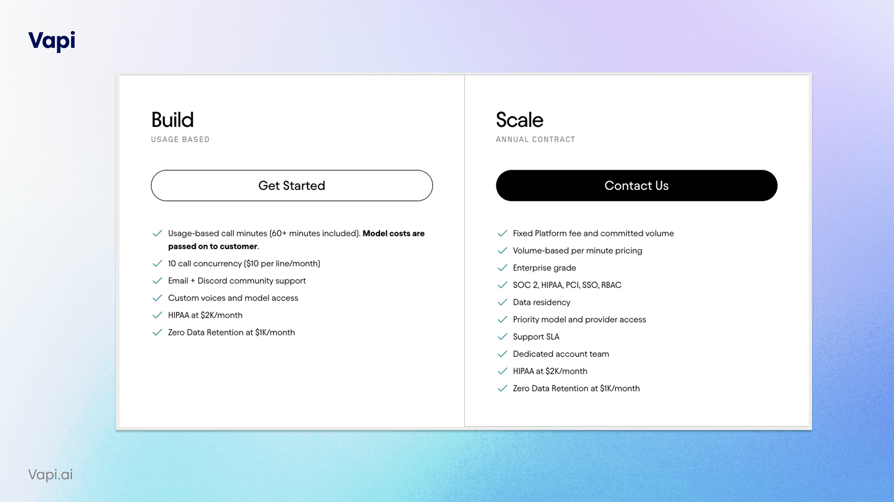
Vapi also has two plans: Build, usage-based and self-serve, and Scale, an annual contract with volume pricing. Build charges $0.05 per minute for hosting and $0.005 per message for SMS and chat, and includes 60 or more minutes to start plus 10 concurrent calls, with extra lines at $10 each per month. Call history is kept 14 days, chat history 30.
The important line on the Vapi AI pricing page is the exclusion. That $0.05 is hosting and nothing else. Speech-to-text, the LLM and text-to-speech are separate, passed through at cost, or billed at $0 by Vapi if you bring your own key and pay the provider direct. Compliance add-ons sit on top of both plans: HIPAA at $2,000 per month and Zero Data Retention at $1,000 per month, and the two are mutually exclusive.
So the retell ai pricing vs vapi pricing question has a trap in it. Vapi publishes no all-in per-minute range anywhere, and we won't invent one: the total depends on which providers you bring and what you've negotiated. Retell's $0.07 floor contains its voice infrastructure, Vapi's $0.05 contains no model cost, so the two aren't comparable.
What to Budget for Beyond the Base Rate
- Model choice, which dominates everything else.Retell's LLM line alone swings from $0.003 to $0.32 per minute; on Vapi it's whatever your provider charges.
- Voice and transcription.ElevenLabs runs $0.040 per minute inside Retell against $0.015 for a platform voice; on Vapi each transcriber and voice provider bills separately.
- Numbers and concurrency.Retell charges $2 per number per month and $8 per concurrency past the first 20; Vapi charges $10 per line past the first 10.
- Compliance and quality add-ons.Retell prices PII removal at $0.01 per minute and denoising at $0.005; Vapi's levers are HIPAA at $2,000 and ZDR at $1,000 per month.
Pricing Compared Line by Line
Retell AI vs Vapi AI: Pricing Line by Line
| Pricing dimension | Retell AI | Vapi AI |
|---|---|---|
| Published base rate | $0.07 to $0.31 per minute | $0.05 per minute |
| What the base rate includes | Retell Voice Infra at $0.055, plus platform access, templates, analytics and API | Vapi hosting only; speech-to-text, LLM and text-to-speech all excluded |
| Typical all-in cost | Roughly $0.11 to $0.13 per minute for a mainstream model and voice, by our arithmetic from Retell's published rates | Not published by Vapi; $0.05 plus your own provider costs |
| Concurrency cost | 20 included, then $8 per concurrency per month; no cap on Enterprise | 10 included, then $10 per line per month |
| Compliance add-on cost | No fee for the HIPAA BAA, GDPR DPA or EU SCCs | HIPAA $2,000 per month, ZDR $1,000 per month, mutually exclusive |
| Billing complexity | One vendor, one invoice | Vapi plus each provider you bring: multiple contracts and invoices |
| Enterprise availability | Custom pricing, contact sales, no published figure | Scale: platform fee plus committed volume, contact sales |
Neither platform is strictly cheaper. Retell uses predictable all-in pricing, making costs easy to forecast. Vapi can be cheaper at high volume if you bring your own AI provider keys, but its overall costs are harder to predict.
CloudTalk's AI Voice Agent Pricing, Published in Full
CloudTalk's AI Voice Agent is a paid add-on on every plan, never bundled into a subscription. Its AI Voice Agent pricing is public down to the minute: 200 minutes at $99/month, 500 at $199, 1,000 at $299, 2,500 at $699, with an AI Specialist tier from $349/month for 1,000 minutes. Retell publishes no Enterprise figure and Vapi publishes no all-in rate at all, so these are the numbers on this page you can budget from without a sales call.
Retell AI Integrations vs. Vapi AI Integrations
Integration claims here are slippery: a directory listing and a supported connector aren't the same product. Sort every integration into three tiers instead: native and vendor-documented, community or unofficial, and reachable only through the API. Neither vendor publishes a meaningful integration count, and neither do we.
Retell AI Integrations
Retell's first-party documented list is short and specific: Salesforce, HubSpot, Twilio, Telnyx, Vonage, Make, n8n, GoHighLevel and Cal.com. The CRM integration is the substantial one: two-way contact sync every five minutes, phone number as the matching key, configurable field mappings, and call activity logged back as Salesforce Tasks or on the HubSpot timeline.
Retell's public directory runs much longer, and a large share of those entries carry an explicit "Unofficial Connector" label: Zendesk, Five9, Talkdesk, RingCentral, Intercom, Shopify. That label matters when you're planning who owns support.
Vapi AI Integrations
Vapi's documented first-party tool integrations are Google Calendar, Google Sheets, Slack and GoHighLevel. There's no native Salesforce or HubSpot connector in the docs. Everything else, any CRM included, is reached through Custom Tools, the API Request tool, the Code Tool or webhooks.
That's a deliberate architectural position, not an oversight. A custom tool you wrote does what your data model needs, versions with your codebase, and doesn't break when a vendor changes a field mapping. Someone has to write and maintain it, which is the real variable in how easy voice AI is to integrate. Teams comparing retell vs vapi api surface find Vapi's more complete, because so much more of the product is reached that way.
Integration Capability Compared
Retell AI vs Vapi AI: Integration Capability
| Integration capability | Retell AI | Vapi AI |
|---|---|---|
| Native, vendor-documented connectors | Salesforce, HubSpot, Twilio, Telnyx, Vonage, Make, n8n, GoHighLevel, Cal.com | Google Calendar, Google Sheets, Slack, GoHighLevel |
| CRM connectors | Two-way Salesforce and HubSpot sync, five-minute interval, activity write-back | None documented; reached via Custom Tools or API Request |
| API and webhook surface | Function calling, inbound call and SMS webhooks, alert webhooks | Custom Tools, API Request, Code Tool, client-side tools, server URLs |
| Engineering requirement | None for the documented connectors, engineering time beyond them | Engineering time for every business-system integration |
Where you land on that table usually comes down to who signs off on your data leaving the building.
Voice AI That Lives Inside Your Phone System
Security & Compliance: Retell AI vs. Vapi AI
Compliance is where voice AI deployments stall, and both vendors are certified. The difference is packaging: which controls come with the self-serve plan, and which you buy or negotiate. If your legal team is starting from first principles on how secure data is when using voice AI, the rows below are what they'll ask about.
Retell AI Security & Compliance
- HIPAA:compliant, BAA required before transmitting PHI, self-signable at Retell's click-agreements portal at no fee.
- SOC 2:Type 1 and Type 2, independently audited for security, availability and confidentiality.
- GDPR:compliant via AWS, with a self-signable DPA and EU SCCs. Retell publishes the caveat itself: it does not operate services inside the EU.
- PII handling:per-agent Data Storage Settings (Everything, Everything except PII, Basic Attributes Only), plus PII Removal at $0.01 per minute.
- Access control:Admin, Developer, Analyst and Viewer roles are documented, though the pricing page lists role-based access control under Enterprise.
- Retention and uptime:transcripts, recordings and logs are configurable per agent from one day to two years, and the docs claim more than 99.9% uptime.
Vapi AI Security & Compliance
- HIPAA:a $2,000 per month add-on or an Enterprise subscription, BAA by email. It applies organization-wide, can't be enabled via API, and restricts you to a HIPAA-approved subset of providers.
- SOC 2:listed as a Scale-plan item, marked unavailable on Build.
- GDPR:a compliance page covering legal bases, data-subject rights, encryption in transit and at rest, and named subprocessors. Residency is a Scale feature.
- PII handling:recording consent plans and tool-argument encryption, plus Zero Data Retention at $1,000 per month, which stops storage of recordings, transcripts and logs.
- Access control and SSO:RBAC and SSO via SAML or OIDC are Scale-plan items, marked unavailable on Build.
- Retention and uptime:Build keeps 14 days of call history and 30 days of chat history, with no infrastructure SLA; Scale adds custom retention and a support SLA.
Security & Compliance Compared
Retell AI vs Vapi AI: Security and Compliance
| Compliance dimension | Retell AI | Vapi AI |
|---|---|---|
| HIPAA | Standard, BAA self-signable, no fee | $2,000 per month add-on or via Enterprise; BAA by email |
| SOC 2 | Type 1 and Type 2, on the self-serve plan | Scale-plan item, unavailable on Build |
| GDPR | Compliant, DPA and EU SCCs self-signable; no services operated inside the EU | Documented compliance page; data residency is a Scale feature |
| PII redaction | Per-agent storage settings plus PII Removal at $0.01 per minute | Consent plans, argument encryption, ZDR at $1,000 per month |
| Role-based access control | Four roles documented; listed under Enterprise additions on the pricing page | Scale-plan item, unavailable on Build |
| Training on customer data | Yes by default, free opt-out; Retell's terms say recorded data is de-identified and aggregated first | Yes by default per the privacy policy, with the paid ZDR or HIPAA add-ons as the opt-out levers |
The trade-off runs both ways. A self-serve buyer in a regulated industry gets more compliance surface from Retell without signing a contract. An enterprise buyer gets the PCI and data residency from Vapi that Retell doesn't publish. Both are facts about how the companies sell, not about how either platform runs a call.
Compliance That Covers the Whole Call Center
Both platforms certify the AI layer and leave the rest of the stack to you: the telephony, the storage and the CRM each need their own accounting, and on Vapi that extends to every provider you bring. CloudTalk's HIPAA, SOC 2 and GDPR coverage applies to the whole call center its AI Voice Agent runs inside, rather than the AI layer alone.
Usability & Developer Experience: Retell AI vs. Vapi AI
Retell AI Usability
Retell's docs set the expectation directly: build your first phone agent in 15 minutes. The path is dashboard-driven, with a visual flow builder, templates and a Conductor assistant that plans and applies changes. Advanced work still exposes API keys, webhooks and tuning parameters, so the ceiling sits higher than "no-code" implies.
Testing is where Retell is unusually well equipped for a low-code product: an LLM Playground, simulation and batch testing with pass rates, audio testing, and web and phone call testing. Text tests bill per message and voice tests at production per-minute rates, so a heavy test cycle shows up on the invoice.
Vapi AI Usability
Vapi starts from code. There's a dashboard quickstart, but the product is SDKs, a public GitHub organisation, JSON assistant configs, custom tools and server URLs, plus an MCP server that plugs the docs into an AI coding client.
That learning curve is the price of the control, and so is the vendor count. Bring-your-own-key means separate contracts, invoices and security reviews for your transcriber, model, voice and telephony providers, in exchange for no markup and no lock-in. Teams weighing vapi vs retell for developers settle that trade, and the wider DIY versus paid voice AI question behind it, before anything else.
Usability & Scalability Compared
Retell AI vs Vapi AI: Usability and Scalability
| Dimension | Retell AI | Vapi AI |
|---|---|---|
| Setup time | Docs target 15 minutes to a first phone agent, from templates | A quickstart, then per-assistant configuration work |
| Technical skill required | Low-code for standard agents; API keys and webhooks for advanced work | Code and configuration first, with SDKs and server URLs |
| Customization ceiling | Curated providers, node-based flows, A/B testing, agent versioning | ~40 providers, BYOK, custom LLM and TTS, custom knowledge base servers, Code Tool |
| Templates and presets | Pre-built agent templates on Pay-as-you-go | Model Presets for balanced, reasoning, low latency and low cost |
| Ideal team size | Solo founders and small teams without dedicated engineering | Teams with engineering capacity to own the configuration |
Documentation tells you what a platform does. Reviews tell you how it behaves on a bad day.
You Don't Have a People Problem. You Have a Capacity Problem.
Retell AI Reviews vs. Vapi AI Reviews on G2
G2 is the most widely used peer review platform for B2B software, which makes it the first place most buyers check for retell ai vs vapi reviews. Both products are young, so read the counts before the scores: a rating built on a handful of reviews is not a statistically meaningful signal, and both vendors sit there. The setup and support sub-scores are the useful part, because they describe implementing a voice AI agent rather than compressing it into a single star rating.
G2 Ratings Compared
It's not fair to compare G2 ratings for Retell AI and Vapi AI, because since Vapi is a niche product meant for developers, whereas Retell is more like a consumer SaaS tool, and marketplace review sites like G2 and Truspilot cater to the latter.
For example, Retell AI has 2638 reviews on G2 and Vapi has only 3.
vapi discordhttps://discord.com/channels/1211482211119796234/onboarding
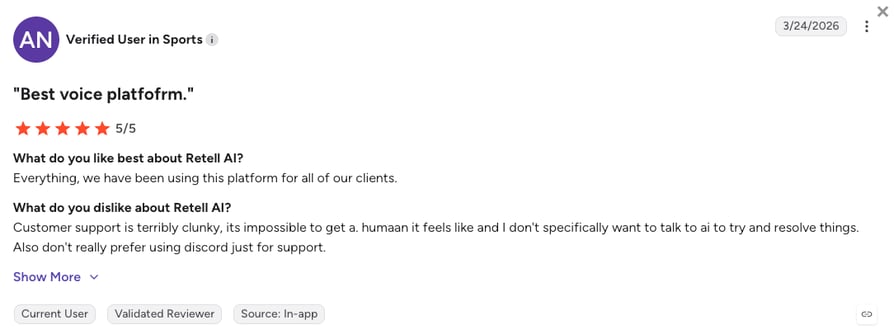
What Real Users Say About Retell AI On G2
Retell AI's current G2 rating is 4.8/5, out of 2,600+ verified user reviews.
What Real Users Say About Vapi AI On G2
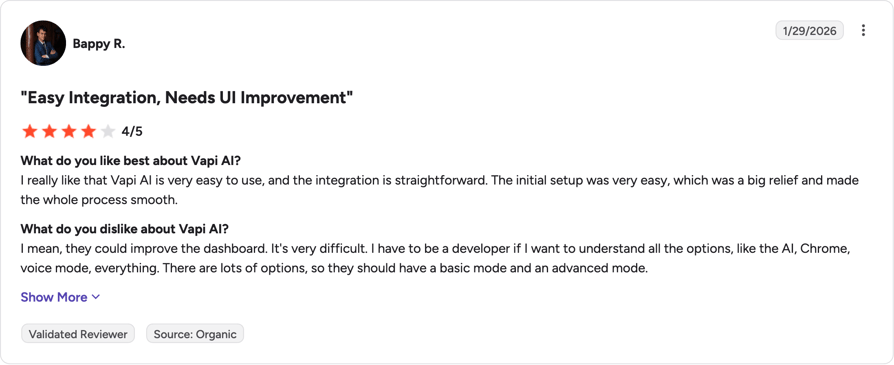
Vapi's current G2 rating is 4.2/5...out of 3 verified user reviews. Why does Vapi have so few reviews on G2? That's probably because Vapi is for the hard core developers and coders. And where do you go when you need to find the hackers? (respectfully).
You go to the Discord.
What Real Users Say About Vapi on Discord
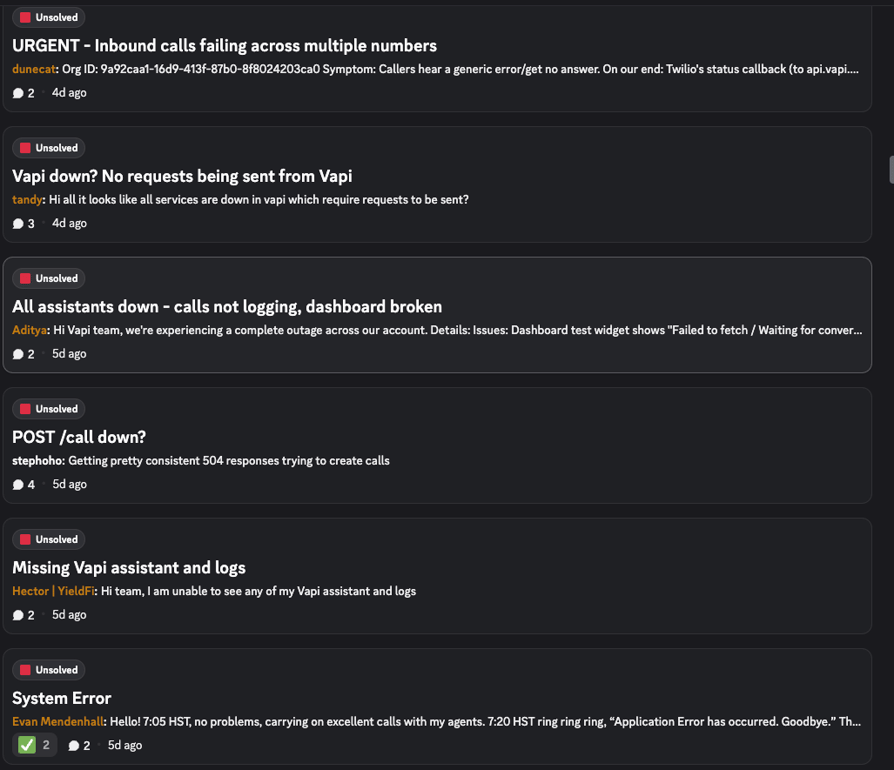
Vapi's users are developers, and developers don't write G2 reviews. They post in Vapi's Discord, mirrored to a public forum, which is where the useful signal is. Read it for what it is: a support channel. People go there when something is broken, not when it works, so it tells you what fails rather than how often. The threads sampled here run from late 2025, and some will have been fixed since.
- Provider breadth cuts both ways.Threads report a transcriber that won't authenticate, a voice degrading mid-production, and GPT Realtime sounding robotic over the phone while fine on web. Every swappable provider is one more thing that fails independently.
- Support response times come up repeatedly.Users describe multiple unanswered attempts to reach the team, including one asking to be upgraded to an Enterprise plan.
- Concurrency is a recurring friction point.Teams hit the default cap, and one asked for a way to throttle outbound calls down to match a single-channel SIP trunk.
- The knowledge base is mid-transition.After Trieve was sunset, users report the suggested replacement performing worse on both latency and accuracy.
Retell AI Reviews vs. Vapi AI Reviews on Reddit & Quora
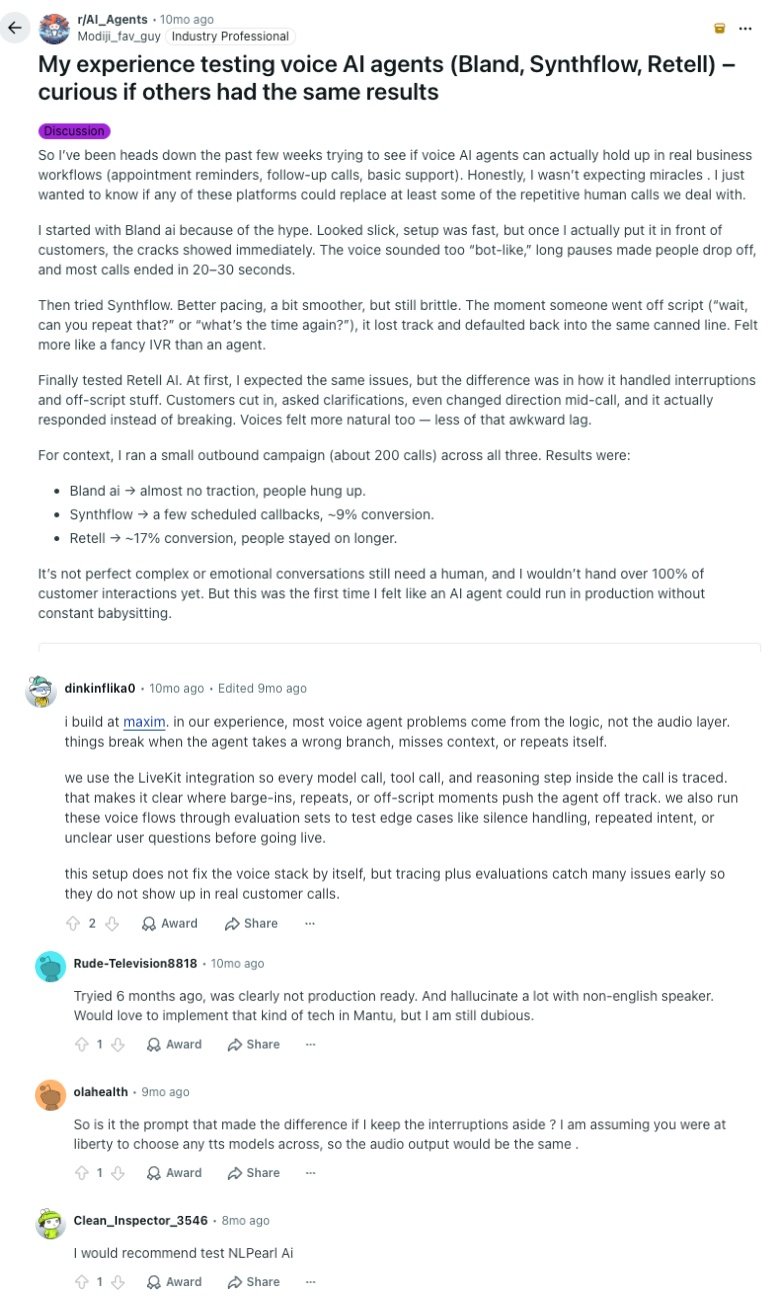
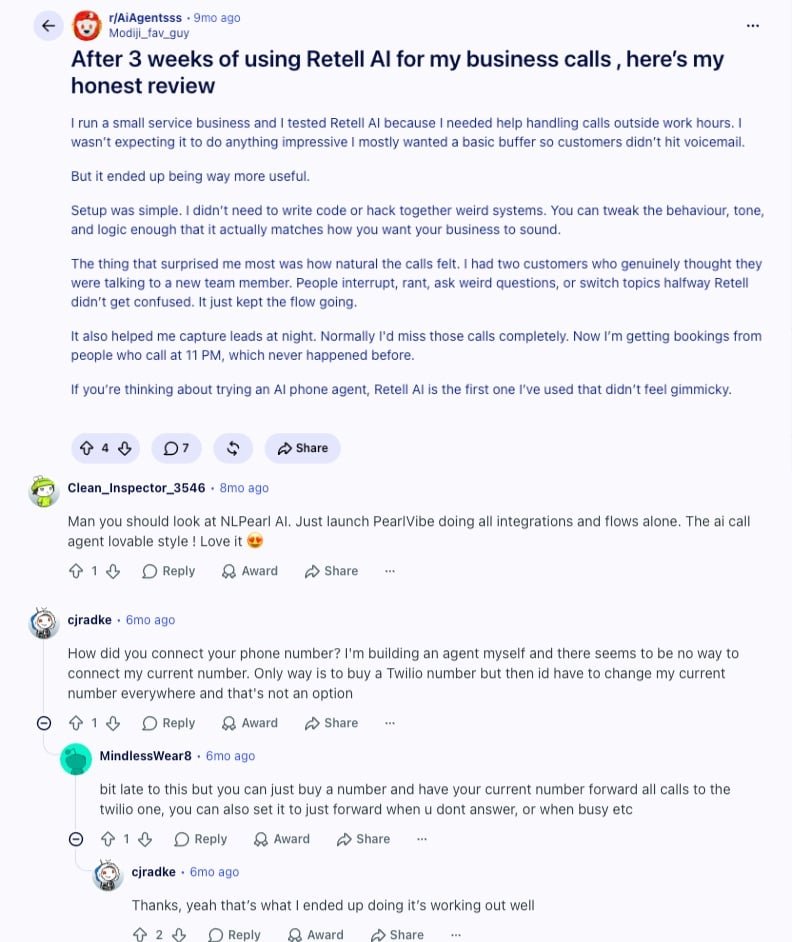
Community threads run blunter than review-site entries, and for these two platforms they're where the practitioners are. One r/b2bmarketing thread comparing Retell AI and Vapi for AI receptionists ranks on page one, which tells you how many buyers of an AI receptionist would rather hear from operators than vendors.
What Real Users Say About Retell AI On Reddit & Quora
What Real Users Say About Vapi AI On Reddit & Quora
Retell AI Pros & Cons vs. Vapi AI Pros & Cons
Both lists come from each vendor's own docs and pricing pages, and the cons bite hardest at high call volume, where concurrency limits and per-minute rates compound.
Retell AI Pros & Cons
| Pros | Cons |
|---|---|
| Visual flow builder a non-engineer can edit, with docs targeting a first agent in 15 minutes | 20 concurrent calls on Pay-as-you-go, then $8 per month each; only Enterprise removes the cap |
| HIPAA BAA, GDPR DPA and EU SCCs self-signable at no fee, with SOC 2 Type 1 and 2 in place | Curated provider list, so you can't bring an arbitrary model, voice or transcriber |
| Native two-way Salesforce and HubSpot sync, including activity write-back | Enterprise pricing isn't published, and RBAC, custom SSO and the dedicated server sit behind it |
| Telephony extras built in: branded caller ID, verified numbers, transfer modes, free SIP trunking | No PCI certification published, and Retell states it doesn't operate services inside the EU |
| One invoice at published component rates, with a calculator to model them | Testing bills at production rates, per message for text and per minute for voice |
Vapi AI Pros & Cons
| Pros | Cons |
|---|---|
| Roughly 40 documented providers across model, voice, transcriber and telephony, plus custom endpoints | Vapi retired the visual Workflows builder on August 18, 2026, so agent design is prompt and config work |
| Bring-your-own-key billing passes provider costs through at cost, or at $0 through Vapi | The $0.05 per minute hosting fee excludes every model cost, so the headline rate understates real spend |
| A deep tool layer: Custom Tools, API Request, an inline TypeScript Code Tool, encryption and rejection plans | SOC 2, SSO, RBAC, residency and the uptime SLA are Scale items, and HIPAA is $2,000 per month |
| Numeric, per-assistant control over endpointing, interruption and backoff behavior | Multiple providers means multiple contracts, invoices and security reviews to maintain |
| Scale adds PCI, data residency, SSO, RBAC and a support SLA, on a platform Vapi says has handled a billion calls | Build carries no infrastructure SLA and keeps only 14 days of call history |
CloudTalk: The Best Alternative to Retell AI and Vapi AI
Retell hands you a builder and Vapi hands you an API, and both leave the call center around the agent to you. CloudTalk's AI Voice Agent starts from the other end: the call center already exists (numbers, routing, CRM sync, analytics), and the agent is a no-code add-on that answers on your existing lines and hands off to a live rep with full context. No integration project, no provider contracts to assemble, and no tier you have to call sales to see.















That native setup matters more than it used to. When a customer calls, their intent is at its peak; miss the moment and they don't leave a voicemail, they call your competitor. An agent that answers instantly on the lines you already run, and pulls in a human the second one is needed, is the cheapest fix for that.
- No assembly requiredThe agent arrives wired into telephony, routing, and 100+ CRM and helpdesk integrations the platform already runs. The integration layer that takes engineering time on a developer-first platform is simply included.
- Pricing you can read without a sales callPlans from $25/user/month, and the AI Voice Agent add-on from $99/month for 200 minutes (the AI receptionist tier), published in full down to the per-minute rate at volume.
- A trial that includes the AIEvery 14-day free trial comes with 50 AI Receptionist minutes, so you can test it on your own callers before spending anything.
- Telephony CloudTalk owns end to endCloudTalk publishes a sub-800ms figure of its own, and like Retell's and Vapi's it is a vendor number rather than an independent benchmark. The part you can hold it to is the 99.999% uptime SLA on telephony it runs itself.
- Escalation that lands with contextWhen a call needs a human, it moves to your team inside the same platform, with the conversation attached. No silent transfer into a separate system.
Customer story: Trevo reached 20x more customers per campaign with CloudTalk's AI Voice Agent and cut handling time to under 30 seconds. Read the Trevo story.
Rather test than configure?
Which Team Fits Which Platform?
Fit depends on technical resources, team size, and how much control you'll trade for speed, not on which platform is better. Salesforce's 2026 State of Service: AI Agents Edition2, a survey of 3,075 customer service professionals, found 72% of service operations professionals name data readiness as a major blocker to AI. That's a team problem no vendor ships a fix for.
Which Team Fits Which Platform
| Retell AI is the right fit for… | Vapi AI is the right fit for… |
|---|---|
| Solo founders and small businesses with no dedicated engineering capacity | Product and platform engineering teams who will own the agent as code |
| Support and sales operations that need an agent answering calls this week | Teams building conversation logic too specific for a node graph to express |
| Regulated small businesses that need HIPAA and SOC 2 without an enterprise contract | Enterprises that need PCI, data residency or a specific region under an annual contract |
| RevOps teams that want Salesforce or HubSpot connected without writing an integration | Teams with provider contracts already who want to bring their own keys and skip markup |
If your team spans both columns, weight the row that describes whoever will be on call when the agent misbehaves at 6pm on a Friday.
Retell AI vs. Vapi AI: The Verdict
Any honest Retell AI vs Vapi 2026 comparison of voice agents ends in the same place: two competent platforms built for two different buyers. Retell compresses the distance between an idea and a live phone agent. Vapi widens the space between a default config and exactly what you want. What separates them is your technical resources and your appetite for owning the stack.
Choose Retell AI if you…
- Need a working phone agent in days with no engineer to assign to it
- Want branding, transfers and SIP trunking as product features, not integration projects
- Run Salesforce or HubSpot and want contact sync and activity logging without building it
- Need HIPAA, SOC 2 and GDPR coverage on a self-serve plan with no annual contract
- Would rather forecast cost from one vendor's published rates on one invoice
Choose Vapi AI if you…
- Have engineers who will own the agent config the way they own any other service
- Already know which model, voice and transcriber you want, and don't want a curated list
- Are building conversation logic that a fixed node graph can't express cleanly
- Need PCI, data residency or a specific compliance region under an annual contract
- Hold provider contracts already and want bring-your-own-key pricing with no markup
Still shortlisting after all that?
Sources:
- Deloitte
- Salesforce
Frequently Asked Questions About Retell AI vs. Vapi AI
Neither is better overall; they're built for different teams. Retell AI is the low-code path, with a visual flow builder, native Salesforce and HubSpot sync and compliance on the self-serve plan. Vapi AI is the configuration path, with roughly 40 provider integrations, bring-your-own-key billing and agents defined in JSON. If nobody on your team writes code, Retell gets you live faster; if you already know which model, voice and transcriber you want, Vapi gives you more room to use them.
Neither is reliably cheaper, because the two headline rates measure different things. Retell publishes $0.07 to $0.31 per minute with its own voice infrastructure included; Vapi charges $0.05 per minute for hosting and excludes speech-to-text, the LLM and text-to-speech entirely. At mainstream model and voice choices, Retell's published component rates work out around $0.11 to $0.13 per minute, while Vapi's total depends on the provider contracts you bring, so what voice AI costs is a modelling exercise rather than a rate comparison.
Yes, Vapi AI expects code or configuration work. Assistants are defined in JSON, multi-agent behavior comes from Squads, and since Vapi retired its visual Workflows builder in August 2026 there's no node canvas to fall back on. You can create a basic assistant in the dashboard, but custom tools and real business-system integrations are developer work, which is why teams without engineers usually shortlist a low-code platform instead.
Neither platform runs a conventional free trial, but both let you start without a contract. Retell's Pay-as-you-go plan gives new accounts $10 in free credits, and Vapi's Build plan includes 60 or more minutes to start. After that, both bill by usage, so your real trial is a short live test on your own script and your own numbers rather than a fixed 14-day window.
There isn't a comparable difference to report, and Vapi's own numbers disagree. Its homepage advertises under 500ms average, while the FAQ in Vapi's own documentation says end-to-end voice processing typically lands around 800ms. Retell states roughly 600ms, citing benchmarks it doesn't name or link. What decides how a call feels is interruption handling on messy audio, and your choice of speech-to-text engine moves it more than any headline claim, so test barge-in on a trial call.
Yes, Retell AI is a real, funded company rather than a shell site. It was founded in 2023, went through Y Combinator's Winter 2024 batch, raised a $4.6 million seed round in November 2024 led by Alt Capital, and holds SOC 2 Type 1 and Type 2 certification with a HIPAA BAA you can sign yourself. It is younger and smaller than Vapi, which is fair to weigh if you need a long vendor track record, but the company and its compliance posture are both verifiable.
The best Retell AI alternative depends on what you're replacing: the low-code builder, the pricing model, or the standalone architecture. Other standalone builders like Bland AI and Synthflow sit in the same bracket, while teams that want the agent inside their phone system instead of beside it tend to look at CloudTalk. Any Retell AI alternative shortlist should start with whether you want a platform to build on or a product to switch on.
The best Vapi AI alternative depends on whether you want to keep the bring-your-own-key freedom or trade it for a managed setup. Teams that want the freedom compare Vapi with other developer-first platforms; teams that don't tend to weigh a managed Vapi AI alternative such as CloudTalk, where the model, voice and telephony arrive pre-wired. ElevenLabs, which shows up in the same searches, is a voice provider available inside both platforms rather than a rival to them.
Both let you tune barge-in, but in different places. Retell exposes a single Interruption Sensitivity setting in the dashboard, with docs recommending 0.8 in noisy environments and warning that higher values make the agent harder to interrupt. Vapi exposes numbers per assistant in JSON through its Stop Speaking Plan, defaulting to 0 words and 0.2 seconds of voice with a 1 second backoff, plus Smart Endpointing via Krisp, Deepgram Flux, Assembly or LiveKit. Neither publishes how it behaves on speakerphone or with a mumbled one-word answer, which is what actually breaks calls, so test barge-in on a trial call.
Both offer HIPAA, but they package it very differently. Retell treats it as standard: the BAA is self-signable at no fee, alongside SOC 2 Type 1 and Type 2 and a self-signable GDPR DPA, though Retell states it does not operate services inside the EU. Vapi sells HIPAA as a $2,000 per month add-on or through Enterprise, applied organization-wide, restricting you to an approved subset of providers, and it puts SOC 2, SSO, RBAC and data residency on the Scale plan. A regulated small team gets more without a contract from Retell; an enterprise gets PCI and residency from Vapi that Retell doesn't publish.
Vapi, if the deciding factor is API surface. Assistants are defined in configuration, and the product is SDKs, a public GitHub organisation, custom tools, server URLs and an MCP server that plugs the docs into an AI coding client, with a Code Tool that runs TypeScript inline. Retell has a real API too, with function calling and webhooks, but its centre of gravity is the dashboard and most of the product is reachable without it. The trade is maintenance: Vapi means separate contracts, invoices and security reviews for every transcriber, model, voice and telephony provider you bring.
Retell, in most cases. It gives you $10 in credits, a visual builder a non-engineer can edit, docs targeting a first agent in 15 minutes, and HIPAA and SOC 2 without an annual contract. Vapi's $0.05 per minute looks cheaper until you add the model, voice and transcriber costs it excludes, and it expects someone who writes code. If you'd rather not run a voice platform at all, a voice agent for small business that arrives inside a phone system removes the build step entirely.