8 Best AI Phone Call Platforms for Sales and Support Teams in 2026
TL;DR Comparison Table: 8 Best AI Phone Call Platforms
| # | Software | Best For | Starting Price | G2 Rating |
|---|---|---|---|---|
| 1 | CloudTalk | SMB to mid-market sales and support teams that want AI phone calls and human agents on one platform | $25/user/month, AI voice agents from $99/month | 4.4/5 (1,900+ reviews) |
| 2 | Retell AI | Engineering teams that want the lowest-latency AI phone calls they build themselves | Usage-based, from $0.055/min plus model and telephony costs | 4.8/5 (2,600+ reviews) |
| 3 | Bland AI | Developers running high-volume outbound AI phone calls through an API | $0.14/min, no platform fee | 5.0/5 (11 reviews) |
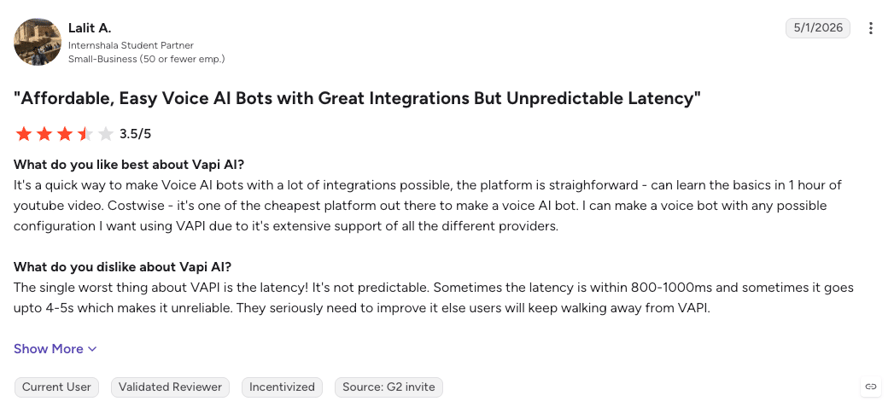
| 4 | Vapi | Teams that want to bring their own language, speech, and voice models | $0.05/min platform fee plus your own provider costs | 4.2/5 (3 reviews) |
| 5 | Synthflow | Enterprises buying a managed voice AI program with a signed contract | Enterprise contracts from $30,000/year | 4.5/5 (1,000+ reviews) |
| 6 | Dialpad | Teams that want AI phone calls inside one business phone app | $80/user/month (Dialpad Support) | 4.4/5 (4,200+ reviews) |
| 7 | Five9 | Large contact centers that can commit to 50 concurrent seats | $119/user/month, voice from $159 (50-seat minimum) | 4.1/5 (600+ reviews) |
| 8 | Amazon Connect | AWS-native teams that want pure usage-based AI phone calling | $0.038/voice minute plus telephony | 4.4/5 (90+ reviews) |
Eight Platforms in One Table. One Call Shows You the Difference.
AI phone calls are no longer a demo trick. AI-powered call center software now answers the phone, holds a two-way conversation, books the meeting, and passes the caller to a human when it hits something it cannot finish. The question in 2026 is not whether AI phone calling works, but rather which platform gets you there without a six-week engineering project.
That question matters because most of the work on a phone line is repetitive. Same questions, same qualifying, same follow-ups. According to Salesforce's 2026 State of Sales report, the average seller spends just 40% of their time actually selling, and the newest reps lose around two hours a week to manual data entry.¹ An AI phone call platform takes the repeatable half and leaves your team the conversations worth their time.
The eight tools below take very different routes to the same outcome. Some hand you an API and expect you to assemble numbers, routing, and analytics yourself. Others sell AI as an add-on to a phone system you already pay for. We compared CloudTalk, Retell AI, Bland AI, Vapi, Synthflow, Dialpad, Five9, and Amazon Connect on what each one actually gives you on day one.
How We Evaluated the Best AI Phone Call Platforms in 2026
To rank these eight, we read every vendor's own documentation, pricing page, and product specification line by line, then checked ratings and recurring review themes on G2. We did not run production traffic through all eight, and we will not pretend we did. In this category the useful finding is usually what a vendor leaves out of its pricing page.
We scored every platform against five criteria:
- What the AI can actually do on a callAnswer inbound only, or place outbound calls too? Transfer to a human mid-call, or dead-end when it gets stuck? These are different products sold under the same two words.
- Whether telephony comes includedNumbers, carrier routing, and call quality are either in the box or they are your problem. This single line decides whether you are buying a platform or a component.
- How long it takes to go liveWe only credit a no-code setup where the vendor documents one. Everything else is an engineering estimate dressed up as onboarding.
- Pricing published with its termsVendor figures plus the seat minimums, contract lengths, and per-minute add-ons attached to them. A headline rate that excludes the language model is not a price.
- Where AI-handled calls end upA transcript in a separate dashboard is worth less than a call that lands in the same log, the same reports, and the same CRM record as the calls your agents take.
What Is the Best AI Phone Call Platform in 2026?
CloudTalk is the best AI phone call platform for teams that want the AI answering on the same line as their agents. The AI voice agents sit inside CloudTalk's own telephony layer, so numbers in 160 countries, routing, call quality, and CRM sync are already there. Every account gets 50 free AI minutes, and paid AI voice agent plans start at $99/month on top of a $25/user/month phone plan.
The practical difference shows up on the handoff. When the AI reaches something it cannot finish, it transfers to a human agent inside the same call flow, and both halves of the conversation land in one call log and one analytics report. Developer platforms can match the conversation quality. What they cannot hand you on day one is the phone system underneath it.
The eight breakdowns below show what each platform does on a call, what it leaves you to build, and what it costs, so you can compare them side by side before you commit.
8 Best AI Phone Call Platforms: Full Breakdowns
Every capability and price below was read from the vendor's own documentation and pricing page in September 2026, and where a vendor publishes nothing on a point, we say so instead of guessing. The overview table shows the split between platforms and building blocks at a glance, and the eight breakdowns that follow explain what each gap costs you in practice.
AI Phone Call Platform Comparison: CloudTalk vs. Retell AI, Bland AI, Vapi, Synthflow, Dialpad, Five9, and Amazon Connect
| Feature | CloudTalk | Retell AI | Bland AI | Vapi | Synthflow | Dialpad | Five9 | Amazon Connect |
|---|---|---|---|---|---|---|---|---|
| Starting price | $25/user/month plus AI from $99/month | From $0.055/min plus model and telephony | $0.14/min, no platform fee | $0.05/min plus your own provider costs | From $30,000/year | $80/user/month | $119/user/month, voice from $159 (50-seat min) | $0.038/voice min plus telephony |
| AI call direction |  Inbound and outbound Inbound and outbound | Inbound and outbound | Inbound and outbound | Inbound and outbound | Inbound and outbound | Inbound and outbound | Inbound and outbound | Inbound and outbound |
| Telephony included | Numbers in 160 countries |  Twilio-based SIP you configure Twilio-based SIP you configure | Numbers sold separately | Bring your own provider | Native telephony or SIP trunking | Numbers in 50+ countries | Full contact center telephony | AWS telephony, billed per minute |
| No-code setup | Live in minutes | Developer setup | API-first | Developer orchestration layer | Template-based agent builder | Configured in the admin dashboard | Implementation project | AWS configuration |
| AI and human agents on one platform | Same call flow and analytics | Voice agents only | Voice agents only | Voice agents only | Voice agents only | One workspace | One platform | One instance |
| Pricing model | Per seat plus account-level AI minutes | Usage, billed per component | Usage, model included in the rate | Usage plus your own provider bills | Annual contract | Per seat plus AI Agent credits | Per concurrent seat, 50 minimum | Pure usage, no seats |
| Learn more | CloudTalk review, CloudTalk alternatives | Retell AI review, Retell AI alternatives | Bland AI review, Bland AI alternatives | Vapi review, Vapi alternatives | Synthflow review, Synthflow alternatives | Dialpad review, Dialpad alternatives | Five9 review, Five 9 alternatives | Amazon Connect pricing |
Every Cross in That Table Is a System You'd Have to Build Yourself.
1. CloudTalk: Best AI Phone Call Platform for Sales and Support Teams That Want AI and Humans on One Platform
What Is CloudTalk?
CloudTalk is an AI-powered business calling platform for sales and support teams. It started as the phone system, which is why its AI phone calls run on CloudTalk's own carrier layer rather than on a third-party API: numbers in 160+ countries, routing, call recording, and CRM integrations are already in place before the AI answers anything.
CloudTalk splits AI phone calling into two products instead of one. The AI Receptionist answers inbound calls, clears routine questions, and routes by intent with a no-code setup. The AI Specialist runs a defined workflow end to end, inbound or outbound, and connects to your systems through an API. Matching the tool to the job keeps both the setup time and the bill predictable.
What Are CloudTalk's Key AI Calling Features?
- AI voice agents that answer and place callsThe AI handles inbound calls the moment they arrive and runs outbound workflows triggered from your CRM: lead qualification, appointment confirmations, and payment reminders. Every account starts with 50 free AI minutes.
- 70+ languages with automatic detectionThe agent picks up the caller's language on its own rather than asking them to choose one, which is what makes a single agent workable across several markets.
- Live transfer to a human, with contextWhen the AI reaches its limit it hands the call to the right agent through call transfers in the same call flow, and the human sees what was already said instead of restarting the conversation.
- AI and human calls in one reportCalls the AI handles land in the same call log and analytics as your team's, with the recording, transcript, and extracted data attached. Adding Conversation Intelligence at $9/user/month layers summaries, tags, and sentiment analysis on top of both.
- No-code setup in the call flow designerSales and support managers build the agent, its escalation rules, and its routing logic in the call flow designer without a developer or a consultant.
What Are CloudTalk's Pros and Cons?
| Pros | Cons |
|---|---|
| Numbers, routing, and AI ship together, so there is no telephony stack to assemble | AI voice agent minutes are billed on top of the per-seat phone plan |
| 50 free AI minutes on every account, then a published $99/month entry price | The AI Specialist is sales-led with a three-month minimum, so complex outbound workflows are not self-serve |
| AI-handled and human-handled calls appear in one call log, one report, and one CRM record | Voice-first by design: no live chat, email ticketing, or social messaging channels |
Who Is CloudTalk Best For?
CloudTalk fits SMB and mid-market sales and support teams that want AI phone calls running next week, not next quarter, and that need the AI and their agents on the same system. If you have three reps today and plan to have thirty, the one-seat entry plan and the account-level AI pricing mean you are not switching platforms when the volume arrives.
How Much Does CloudTalk Cost?
CloudTalk pricing starts at $25/user/month (Starter, billed annually), with AI voice agents priced per account on top:
CloudTalk Plans and Pricing
| Plan | Price (annual billing) | Key Features |
|---|---|---|
| Starter | $25/user/month | Unlimited inbound & internal calls, 500 outbound minutes (regional calling bundle), call queues, transfers, click-to-call, automatic call recording (1-month retention) |
| Essential | $29/user/month | Everything in Starter + IVR and smart routing, 100+ CRM/helpdesk integrations, workflow automation, unlimited recording retention |
| Expert | $49/user/month | Everything in Essential + Power, Smart & Preview Dialers, Salesforce integration, 24/7 phone support (3-seat min) |
| Custom | Contact sales | Quote-based plan for larger teams, with custom onboarding and enterprise security |
| Conversation Intelligence (add-on) | $9/user/month | AI transcripts, call summaries, automatic tags, sentiment analysis, and call scoring, on any plan |
| AI voice agents (add-on) | From $99/month (200 min) | AI Receptionist for inbound calls (50 free minutes on every account) and AI Specialist for custom inbound and outbound workflows from $349/month. AI calls land in the same call log as human calls |
What Are Real Users Saying About CloudTalk?
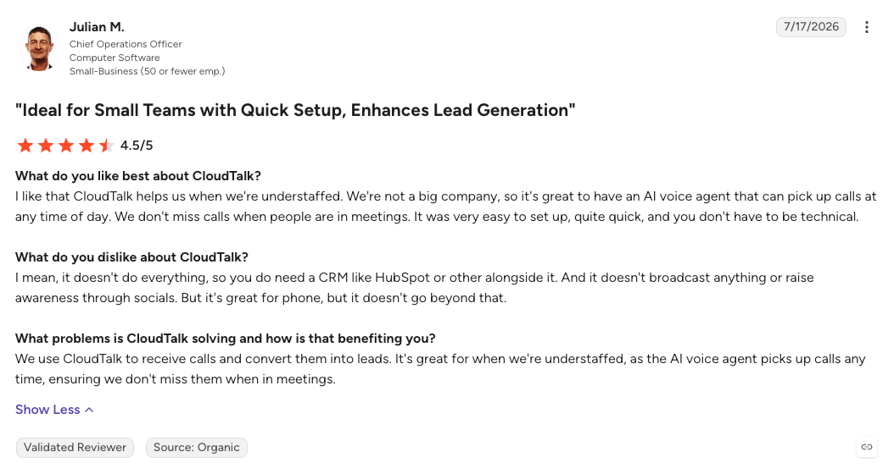
CloudTalk reviewers keep landing on two things: setup that does not need an IT project, and CRM sync that holds. Ease of use and ease of setup are its highest-scoring categories on G2 and Capterra, and call quality on international routes comes up often from teams calling across borders.
The most common criticism is that deep Salesforce sync needs the Expert plan, a real jump for a small Salesforce shop. Some reviewers also want richer reporting out of the box, which is usually where the Conversation Intelligence add-on enters the picture.
What Is CloudTalk's G2 Rating and Review Count?
CloudTalk holds 4.4/5 on G2 across 1,900+ verified reviews, with ease of use and ease of setup among its highest-scoring categories.
And it's not just individual reps that enjoy CloudTalk. Oxford Royale Academy runs summer courses across five campuses and recruits students from 176 countries, which used to mean four seasonal hires whose whole job was calling hot leads back before they went cold. An AI voice agent now makes that first call within minutes, in five languages, whatever the time zone.
“I looked at the email communications and the customer had written, 'You called me first, so I enrolled with you.'”
Head of Systems and Processes, Oxford Royale Academy

Oxford Royale Replaced Four Seasonal Hires With One AI Voice Agent.
2. Retell AI: Best AI Phone Call Platform for Engineering Teams Building Their Own Voice Agents
What Is Retell AI?
Retell AI is a developer platform for building AI phone agents. You assemble the agent from parts: Retell's voice engine, a language model you choose, a text-to-speech voice, and telephony. It handles the hard real-time work of turn-taking, so conversations feel less like waiting for a chatbot to finish thinking.
Retell has the largest verified review base of any AI-native voice platform here. That makes it a serious option and a fair benchmark. What it does not give you is a phone system: numbers run through a Twilio-based SIP setup you configure, and there is no place for human agents to work alongside the AI.
What Are Retell AI's Key AI Calling Features?
- Low-latency conversation engineRetell's own voice engine at $0.055 per minute handles interruptions and turn-taking, the part most buyers judge an AI phone call on within ten seconds.
- Pick your own language modelPublished per-minute rates from $0.003 for a small model up to $0.16 for a frontier one, so you can trade cost against quality per agent instead of accepting one bundled price.
- Inbound and outbound agentsAgents both answer calls and place them, with 20 concurrent calls included and more at $8 per line per month.
- Branded call ID and compliance add-onsBranded caller ID at $0.10 per outbound call, PII removal at $0.01 per minute, and safety guardrails at $0.005 per minute, each billed separately.
What Are Retell AI's Pros and Cons?
| Pros | Cons |
|---|---|
| Strongest review base of any AI-native voice platform on this list, at 2,600+ G2 reviews | No phone system underneath: numbers, routing, and analytics are yours to assemble |
| Every cost component is published, so an engineer can model a per-minute price before building | A realistic all-in rate lands well above the headline $0.055, once model, voice, and telephony are added |
| Model choice per agent lets you spend on quality only where the conversation needs it | No shared workspace for human agents, so AI calls and human calls live in separate tools |
Who Is Retell AI Best For?
Retell fits product and engineering teams that want to own the agent and have someone who can keep it running. If you are building AI calling into your own application, that control is the point. If you wanted a phone system with AI in it, this is the wrong shape of tool.
How Much Does Retell AI Cost?
Retell AI pricing is usage-based and billed per component, starting at $0.055/min for the voice engine alone, with $10 in free credits at signup:
Retell AI Pricing Components
| Component | Price | Notes |
|---|---|---|
| Voice engine | $0.055/min | Retell's low-latency conversation engine, charged on every call |
| Language model | $0.003 to $0.16/min | $0.003/min on a small model, $0.08/min on a mid-tier model, $0.16/min on a frontier model |
| Text-to-speech | $0.015 to $0.040/min | $0.015/min on platform voices, $0.040/min on premium third-party voices |
| Telephony | ~$0.015/min | Twilio-based, varies by country. Phone numbers $2.00/month |
| Concurrency | 20 included, then $8/line/month | Extra simultaneous calls billed per line |
| Enterprise | Custom | Volume pricing, dedicated support, and SLAs |
Retell AI vs. CloudTalk
Retell gives you excellent building blocks and a bill you have to model yourself: voice engine, language model, speech, telephony, and concurrency are five separate line items before a single customer hears anything. That is a fair trade if you are building AI calling into your own product.
CloudTalk sells the finished calling system instead. Numbers, routing, transfers, and analytics are already there, AI voice agents start at $99/month with 50 free minutes on every account, and your human agents work in the same platform the AI calls run through. If the goal is a working AI phone line rather than a voice stack you maintain, that is the difference that matters.
What Are Real Users Saying About Retell AI?
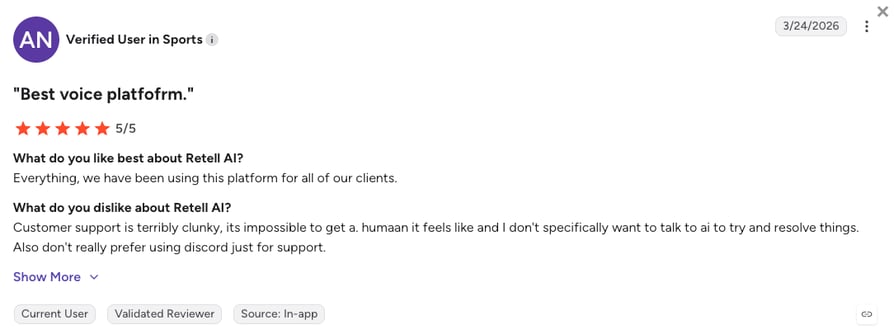
Retell reviewers consistently praise how natural the conversations feel, particularly how the agent handles being interrupted, and how quickly a developer can get a first agent talking. The recurring complaints are the cost of stacking components once volume grows, and the amount of infrastructure work left over: telephony, monitoring, and reporting are all yours to solve.
What Is Retell AI's G2 Rating and Review Count?
Retell AI holds a 4.8/5 rating on G2 across 2,600+ reviews, the largest review base of any AI-native voice platform on this list.
3. Bland AI: Best AI Phone Call Platform for High-Volume Outbound Calling Through an API
What Is Bland AI?
Bland AI is an API-first AI phone call platform aimed at developers running calls at volume. Its Conversational Pathways let you map a call as a flow rather than a single prompt, which is what makes it workable for scripted outbound campaigns where the conversation has to go somewhere specific.
Bland is the most transparent platform here about what a minute costs. The language model, speech-to-text, and text-to-speech are all included in the per-minute rate rather than billed separately, which makes forecasting easier than on a component-priced platform. The trade-off is everything around the call: numbers, routing, and reporting are not part of the product.
What Are Bland AI's Key AI Calling Features?
- One rate that includes the modelThe language model, transcription, and premium voices are bundled into the per-minute price, so the number on the pricing page is close to the number on the invoice.
- Conversational PathwaysCalls are built as branching flows rather than one open-ended prompt, which keeps scripted outbound conversations on track.
- Warm and live transfers on EnterpriseTransfer minutes are billed separately at $0.05 per minute on Start and $0.04 on Build, and live transfers are documented as an Enterprise capability.
- Self-hosting and data residency on EnterpriseOn-premises or VPC deployment, a signed BAA, and data residency options for regulated buyers, all gated behind a custom contract.
What Are Bland AI's Pros and Cons?
| Pros | Cons |
|---|---|
| The per-minute rate includes the language model, speech-to-text, and voices, so forecasting is simple | Just 11 verified G2 reviews, against 1,900+ for CloudTalk, so there is little independent evidence |
| A free Start tier with no card required lets a developer test before committing | Warm transfers, appointment scheduling, and guardrails are Enterprise-only |
| Pathways give scripted outbound campaigns real structure instead of one long prompt | Numbers, routing, and human agent workflows are outside the product entirely |
Who Is Bland AI Best For?
Bland suits engineering teams pushing high outbound volume where the conversation follows a script and the main variable is cost per minute. If your calls need a human to step in mid-conversation, check which tier that lands on before you compare prices.
How Much Does Bland AI Cost?
Bland AI pricing starts at $0.14/min on a free Start tier with no platform fee, with volume discounts behind a monthly platform fee:
Bland AI Plans and Pricing
| Plan | Price | Key Features |
|---|---|---|
| Start | $0/month plus $0.14/min | 100 calls per day, 10 concurrent calls, 10 knowledge bases, no card required, inbound number included |
| Build | $299/month plus $0.12/min | 2,000 calls per day, 50 concurrent calls, 50 knowledge bases |
| Enterprise | Custom | Unlimited calls and concurrency, on-premises or VPC deployment, dedicated engineer, SSO, BAA, data residency, warm transfers, guardrails |
Bland AI vs. CloudTalk
Bland's all-in per-minute rate is far easier to forecast than a component-priced platform, and for scripted outbound at volume that clarity is worth something. The catch is what sits outside the rate: live transfers and guardrails are Enterprise features, and the phone system is not included at any tier.
CloudTalk includes transfers to a human agent on every AI voice agent plan, because the AI and the agent are already in the same call flow. AI voice agents start at $99/month for 200 minutes on top of a $25/user/month phone plan, with 50 free minutes to test the handoff first.
What Are Real Users Saying About Bland AI?
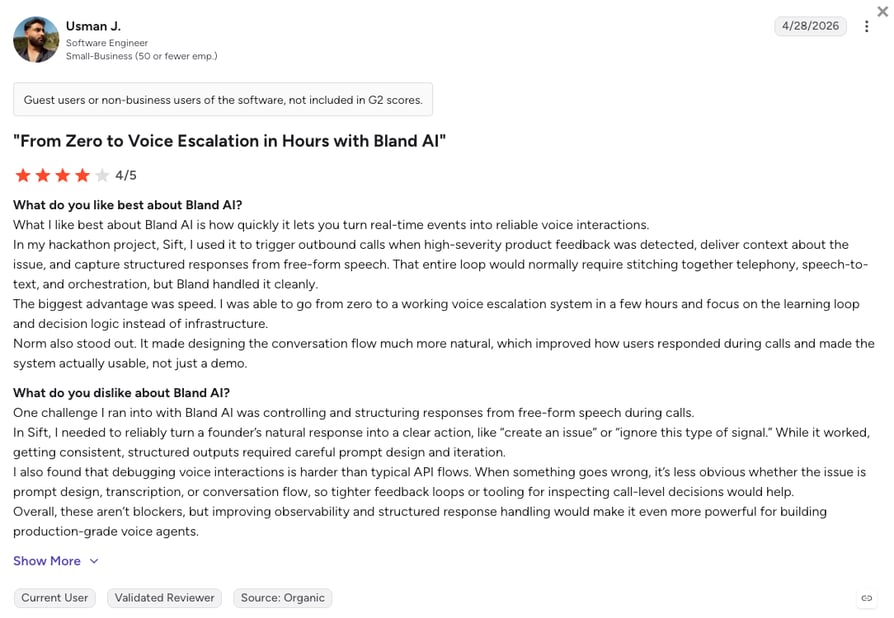
With 11 verified reviews, Bland's public feedback is too thin to draw broad conclusions from, but the recurring themes are consistent: developers praise how fast a first agent goes live and how predictable the per-minute cost is, and the complaints cluster on support response times and on capabilities turning out to be Enterprise-gated.
What Is Bland AI's G2 Rating and Review Count?
Bland AI holds a 5.0/5 rating on G2, but across just 11 verified reviews. A perfect score on 11 reviews tells you far less than Retell's 4.8/5 across 2,600+, so read the individual reviews rather than the average.
4. Vapi: Best AI Phone Call Platform for Teams Bringing Their Own AI Stack
What Is Vapi?
Vapi is an orchestration layer for AI phone calls. It coordinates the conversation and connects the pieces, but you supply the pieces: your own language model, speech-to-text, and text-to-speech providers, with your own API keys. Vapi charges $0.05 per minute for the orchestration and nothing for the models if you bring your own keys.
That architecture is the whole pitch. If you have already chosen your AI vendors and want a thin layer that runs the call, Vapi gives you exactly that and stays out of the way. If you have not chosen them, you now have four procurement decisions instead of one.
What Are Vapi's Key AI Calling Features?
- Bring your own modelsSpeech-to-text, language model, and text-to-speech run at cost, or free if you connect your own provider keys. Only the $0.05 per minute orchestration fee is Vapi's.
- Inbound and outbound callsAgents answer and place calls, with 10 concurrent lines included and additional lines at $10 per line per month.
- Compliance available as paid add-onsHIPAA support at $2,000/month and zero data retention at $1,000/month, both priced on top of usage on either plan.
- Short default data retentionCall history is kept for 14 days and chat history for 30 on the Build plan, with custom retention reserved for the Scale contract.
What Are Vapi's Pros and Cons?
| Pros | Cons |
|---|---|
| The lowest platform fee on this list at $0.05/min if you already own your AI provider contracts | Only 3 verified G2 reviews, so there is almost no independent evidence to weigh |
| Full control over which model handles which part of the conversation | You assemble and maintain the model stack, the telephony, and the reporting yourself |
| Usage-based with no seat licenses, so a pilot costs close to nothing | Compliance features that are standard elsewhere cost $1,000 to $2,000 per month here |
Who Is Vapi Best For?
Vapi fits engineering teams with strong opinions about their AI stack and the people to maintain it. Those teams get real control out of it. For a sales or support team without a developer on hand, that same flexibility is a cost rather than a feature.
How Much Does Vapi Cost?
Vapi pricing starts at $0.05/min for the platform itself, with model and telephony costs billed separately or brought in under your own keys:
Vapi Plans and Pricing
| Plan | Price | Key Features |
|---|---|---|
| Build | $0.05/min platform fee | Usage-based, 10 concurrent calls included, extra lines $10 each per month, 14-day call history, SMS and chat at $0.005 per message |
| Scale | Fixed platform fee plus committed volume | Volume-based per-minute pricing, uptime and support SLAs, dedicated account team, SOC 2, RBAC, SSO, data residency |
| HIPAA add-on | $2,000/month | Signed BAA and HIPAA-eligible infrastructure, on either plan |
| Zero data retention add-on | $1,000/month | No data retained across the platform, on either plan |
Vapi vs. CloudTalk
Vapi is deliberately a component, and it is honest about that. You choose the models, the voices, and the telephony, and Vapi runs the conversation between them for $0.05 a minute. Teams with an AI engineering function get real value out of that control.
CloudTalk sells the opposite trade. The models, the voices, the numbers, the routing, and the human agent workspace are one product with one bill and one support contact, and compliance is part of the platform rather than a $2,000 monthly add-on. Pick by whether you want to own the stack or run the phone line.
What Are Real Users Saying About Vapi?
With three verified G2 reviews, Vapi's public feedback is thin enough that the score is close to meaningless. Across developer communities the pattern is consistent: praise for the modular architecture and the speed of a first prototype, frustration with debugging when a call fails somewhere across four vendors, and surprise at the price of the compliance add-ons.
What Is Vapi's G2 Rating and Review Count?
Vapi holds a 4.2/5 rating on G2 across just 3 reviews, the smallest verified review base on this list. Treat it as an anecdote rather than a rating, and weigh the individual reviews instead.
5. Synthflow: Best AI Phone Call Platform for Enterprises Buying a Managed Voice AI Program
What Is Synthflow?
Synthflow is a no-code AI phone call platform that repositioned itself around enterprise buyers during 2026. Its pricing page is now titled Enterprise Voice AI Pricing, and the self-serve monthly plans that used to start at $29 are gone. Agents are built from industry templates, and the company reports powering over 65 million voice calls a month across 30+ countries.
Synthflow is the only AI-native platform here that includes telephony. Native numbers, SIP trunking, concurrency planning, and escalation paths are part of the contract, along with implementation and ongoing optimization. That is a genuine platform rather than a component, priced accordingly.
What Are Synthflow's Key AI Calling Features?
- No-code agent builder with industry templatesAgents are assembled from prebuilt templates rather than written from scratch, which is what made Synthflow popular with agencies before the enterprise pivot.
- Telephony included in the contractNative telephony, SIP trunking, or a connection to your existing enterprise phone estate, with concurrency planned as part of the scoping.
- Routing, escalation, and fallback logicHandoffs and fallback paths are designed during implementation rather than left as an API you wire up.
- Enterprise integrations and security reviewCRM, calendar, contact center, webhook, and API integrations, plus MSA and DPA support and a formal security review before launch.
What Are Synthflow's Pros and Cons?
| Pros | Cons |
|---|---|
| Telephony, routing, and escalation are included rather than assembled, unlike the developer platforms here | Entry point is a $30,000 annual contract, which rules out every small and most mid-sized teams |
| Implementation, onboarding, training, and ongoing optimization are part of the contract | No per-minute or per-call rates published at all, so you cannot model a cost before talking to sales |
| 1,000+ verified G2 reviews, a real evidence base for an AI-native platform | The self-serve monthly plans that made Synthflow accessible have been discontinued |
Who Is Synthflow Best For?
Synthflow now fits organizations with a procurement process and a voice automation budget in five figures: large service operations, outsourcers, and regulated industries that want a vendor to run the program rather than an API to build against. A 20-person sales team is no longer its buyer.
How Much Does Synthflow Cost?
Synthflow pricing is quote-based, with enterprise contracts starting at $30,000 per year and no rates published below that:
Synthflow Plans and Pricing
| Plan | Price | Key Features |
|---|---|---|
| Agent builder | Free to build | Industry templates and agent design, with usage billed once an agent is deployed |
| Enterprise | From $30,000/year | Custom SLA and support terms, native telephony or SIP trunking, concurrency planning, routing and escalation design, CRM and contact center integrations, MSA and DPA support, security review, implementation and launch support |
Synthflow vs. CloudTalk
Synthflow's enterprise pivot bought it a real platform: telephony in the box, an implementation team, and a signed SLA. For a large service operation that wants a managed program, that is a reasonable package. It also puts the entry point at $30,000 a year with no published rate to sanity-check it against.
CloudTalk reaches the same outcome from the other direction. AI voice agents start at $99/month on a phone plan from $25/user/month, every account gets 50 free AI minutes, and you can hear the agent on a real number before anyone signs anything. If you are under a five-figure annual budget, that is the comparison that matters.
What Are Real Users Saying About Synthflow?
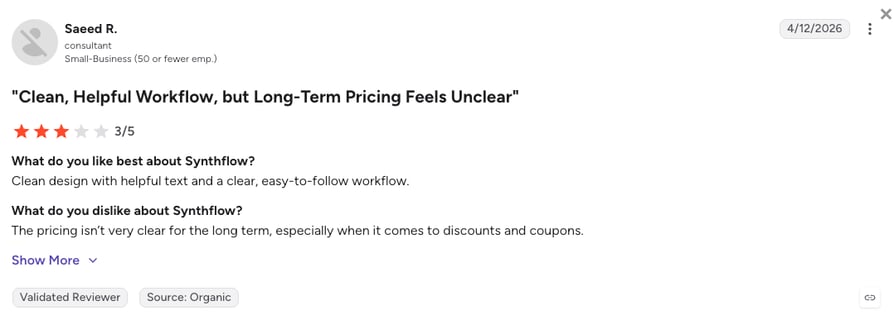
Synthflow reviewers praise how quickly a non-developer can get an agent live from a template, and the depth of the integration list. The recurring complaints since the repositioning are pricing opacity, now that nothing below the enterprise tier is published, and slower support for smaller accounts.
What Is Synthflow's G2 Rating and Review Count?
Synthflow holds a 4.5/5 rating on G2 across 1,000+ reviews. Note that much of that base was built while the self-serve plans still existed, so older reviews describe a product you can no longer buy.
6. Dialpad: Best AI Phone Call Platform for Teams That Want AI Inside One Business Phone App
What Is Dialpad?
Dialpad is an AI-native communications platform sold as three products: Dialpad Connect for business phone, Dialpad Support for contact centers, and Dialpad Sell for outbound. Its AI works during the call as well as after it, with live transcription and coaching prompts while the rep is still talking.
Dialpad's autonomous AI Agents are a separate purchase from the seat license. They are billed through a pool of AI Agent Credits, consumed only when the AI retrieves information or takes a real action such as scheduling, routing, or an order lookup. It is a sensible model, but it means the cost of AI phone calls is not visible on the pricing page.
What Are Dialpad's Key AI Calling Features?
- Autonomous voice and chat agentsAI Agents answer calls and messages on their own, with documented handoffs to human agents in the same workspace.
- Live transcription and in-call coachingDialpad's AI works during the conversation, surfacing prompts to the rep in real time, which is a genuine strength for coaching-first teams.
- Ai Recaps after every callAutomatic summaries post to the CRM once the call ends, the single most-cited benefit in recent Dialpad reviews.
- Conversation-based AI billingAI Agent Credits are spent only when the AI does something measurable, rather than on every conversation it touches.
What Are Dialpad's Pros and Cons?
| Pros | Cons |
|---|---|
| AI and human agents share one workspace, one number pool, and one set of reports | AI Agent pricing is not published, so the real cost of AI phone calls needs a sales conversation |
| Real-time coaching during the call, not just a summary afterwards | The contact center product starts at $80/user/month before any AI credits are added |
| AI Agent credits are consumed only when the AI takes an action, so idle conversations cost nothing | Autonomous AI Agents sit on the Support product, not on the cheaper business phone tiers |
Who Is Dialpad Best For?
Dialpad suits teams that want calls, messaging, and video in one app and value coaching their reps as much as automating calls. If your priority is autonomous AI phone calls at a predictable price, the credit model makes budgeting harder than a published per-minute rate.
How Much Does Dialpad Cost?
Dialpad pricing for the contact center product starts at $80/user/month, with autonomous AI Agents billed separately through credits:
Dialpad Support Plans and Pricing
| Plan | Price | Key Features |
|---|---|---|
| Essentials | $80/user/month | Routing and queueing, real-time transcription, call recording, agent status monitoring |
| Advanced | $115/user/month | Everything in Essentials + live coach cards, CRM moment logging, additional channels |
| Premium | $150/user/month | Everything in Advanced + automated quality management, AI CSAT, workforce management add-on |
| Dialpad AI Agents (add-on) | Conversation credits, talk to sales | Autonomous voice and digital agents, billed only when the AI retrieves information or takes an action such as scheduling, routing, or an order lookup |
Dialpad vs. CloudTalk
Dialpad's AI works during the call, with live transcripts and coaching prompts while the rep is still talking. CloudTalk's works around it: the AI voice agent takes the call itself, and Conversation Intelligence gives the manager the record afterwards. Those are two different jobs, so pick by the one you need first.
On autonomous AI phone calls specifically, the gap is transparency. Dialpad prices AI Agents through credits you have to ask about, while CloudTalk publishes $99/month for 200 AI minutes and puts 50 free minutes on every account so you can test the agent before you budget for it.
What Are Real Users Saying About Dialpad?
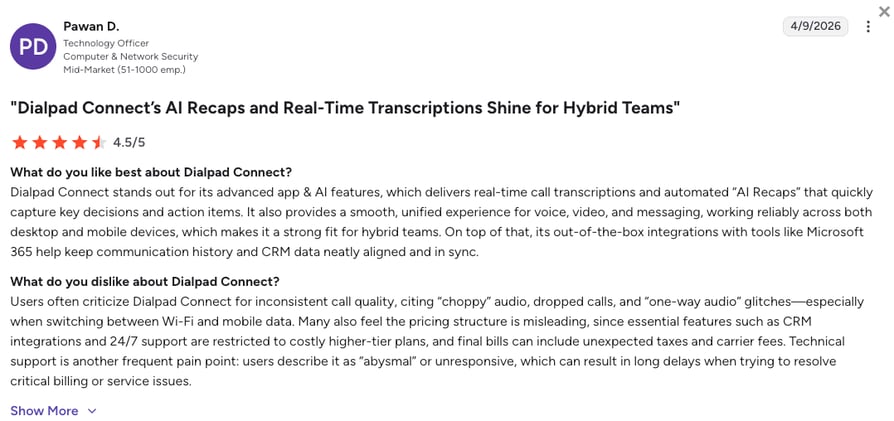
Dialpad reviewers keep coming back to one benefit: AI notes that post themselves to the CRM after every call, so nobody types up a summary. The intuitive interface and having calls, messaging, and video in one app follow close behind. The recurring complaints are CRM sync failures on HubSpot and Salesforce, where calls go missing from the account record, dropped calls at peak times, and settings that feel over-built for a small team.
What Is Dialpad's G2 Rating and Review Count?
Dialpad Connect holds a 4.4/5 rating on G2 across 4,200+ reviews, the largest review base on this list. The listing covers the Dialpad platform broadly, not the contact center product alone.
7. Five9: Best AI Phone Call Platform for Large Contact Centers on 50 Concurrent Seats
What Is Five9?
Five9 is an enterprise contact center platform with AI built across the stack: Intelligent Virtual Agents that handle calls autonomously, Agent Assist that guides humans in real time, and Genius AI for analytics. It is a mature product with the operational depth large operations expect, including workforce management and omnichannel routing.
The barrier is the commercial model. Every plan requires a minimum of 50 concurrent seats, and the entry tier at $119 per seat per month covers digital channels only. Voice, the reason you are reading this page, starts at $159 per seat per month.
What Are Five9's Key AI Calling Features?
- Intelligent Virtual AgentsAutonomous voice agents that handle routine calls end to end and hand the rest to a human, with 3,000 AI minutes bundled per seat before usage charges begin.
- AI Agent AssistReal-time guidance, next-best actions, and knowledge suggestions delivered to the human agent mid-call.
- Genius AI analyticsGenerative AI that consolidates knowledge across sources and surfaces insights to agents and supervisors.
- Predictive dialing for outbound at scaleAdvanced dialing modes built for large outbound sales operations rather than a handful of reps.
What Are Five9's Pros and Cons?
| Pros | Cons |
|---|---|
| AI virtual agents and human agents run in one mature contact center platform | 50 concurrent seats minimum on every plan, so smaller teams pay for licenses nobody uses |
| 3,000 AI minutes bundled per seat, which is generous once you are at scale | The $119 entry tier has no voice at all, making the real voice entry $159/user/month |
| Deep enterprise integrations across Salesforce, Microsoft Dynamics, ServiceNow, Zendesk, and Oracle | Advanced AI and workforce management tiers are quote-only, so total cost needs a sales cycle |
Who Is Five9 Best For?
Five9 fits established contact centers with 50 or more concurrent agents, a workforce management requirement, and a procurement team. For a growing sales or support team of fewer than 50, the seat minimum alone decides the question.
How Much Does Five9 Cost?
Five9 pricing starts at $119/user/month for digital channels only, with voice from $159/user/month and a 50-seat minimum on every plan:
Five9 Plans and Pricing
| Plan | Price | Key Features |
|---|---|---|
| Digital | $119/user/month | Digital channels only (chat, email, SMS and MMS, social). No voice calling |
| Core | $159/user/month | All channels with essential AI: voice, chat, email, SMS and MMS, social, AI summaries, transcription, agent assist |
| Plus | Contact sales | All channels with advanced AI |
| Pro | Contact sales | All channels with essential AI plus workforce engagement management |
| Enterprise | Contact sales | All channels with advanced AI plus workforce engagement management |
Five9 vs. CloudTalk
Five9 is built for operations that already have 50 agents on the floor and a workforce management problem to solve. At that size the AI minutes bundled per seat are good value and the platform depth earns its price.
Below that line the arithmetic breaks. Fifty seats at $159 is $7,950 a month before AI usage, while CloudTalk starts at one seat on $25/user/month and adds AI voice agents from $99/month for the whole account. If you are growing toward a contact center rather than running one, start where the seat minimum is one.
What Are Real Users Saying About Five9?
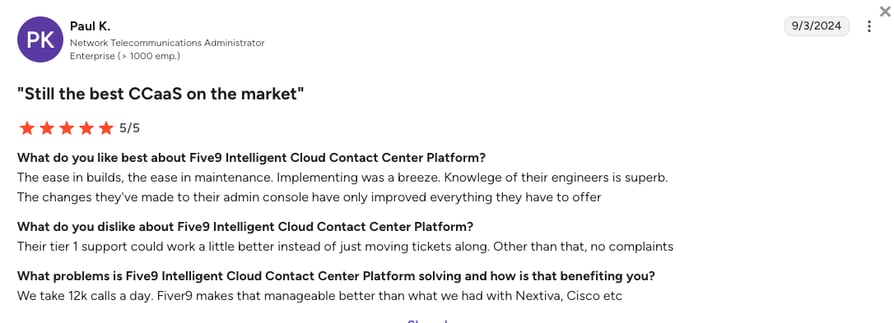
Five9 reviewers praise the reliability of the platform at scale, the depth of the reporting, and how well the virtual agents deflect routine volume once configured. The recurring frustrations are the length and cost of implementation, an administrative interface that needs training to operate, and pricing that smaller reviewers describe as out of reach.
What Is Five9's G2 Rating and Review Count?
Five9 holds a 4.1/5 rating on G2 across 600+ reviews, the lowest average on this list, with implementation effort and cost the most common themes in critical reviews.
8. Amazon Connect: Best AI Phone Call Platform for AWS-Native Teams on Usage-Based Pricing
What Is Amazon Connect?
Amazon Connect is AWS's cloud contact center service, with AI phone calling built in through prebuilt AI agents, conversational self-service, and real-time agent assistance. There are no seats and no contracts: you pay $0.038 per voice minute plus standard telephony rates, and the platform scales with the rest of your AWS footprint.
The pricing model is the most honest on this list and the setup is the most demanding. AWS states plainly that there are no minimums and no long-term contracts. It also assumes you have people who configure AWS services for a living, because Connect is built and operated the way any other AWS service is.
What Are Amazon Connect's Key AI Calling Features?
- Prebuilt AI agents and an agent designerAgentic self-service handles calls autonomously, with a designer for building new agents rather than writing them in code.
- Conversational self-service instead of menusNatural language handling replaces IVR trees, so callers say what they need rather than pressing a number.
- Real-time agent assistLive guidance to human agents during the call, with conversational analytics and predictive insights on the same platform.
- Pay only for what you useAWS states plainly that there are no minimums and no long-term contracts. Voice is $0.038 per minute, chat $0.010 per message, and SMS $0.014 per message.
What Are Amazon Connect's Pros and Cons?
| Pros | Cons |
|---|---|
| True pay-as-you-go billing that suits volume swinging hard from month to month | Setup is an AWS engineering project, not a configuration task for a sales manager |
| AI agents, analytics, and forecasting are included in the per-minute rate rather than sold as add-ons | Telephony is charged separately on top of the per-minute rate, so the real cost needs modeling |
| Scales to any volume on AWS infrastructure and integrates with the rest of your AWS estate | Only 90+ verified G2 reviews, a small base for a platform of this scale |
Who Is Amazon Connect Best For?
Amazon Connect fits teams already running on AWS with engineers who can build and maintain it, and operations with volume that swings hard enough that per-minute pricing beats per-seat licensing. Without an AWS practice in-house, the total cost is much higher than the per-minute rate suggests.
How Much Does Amazon Connect Cost?
Amazon Connect pricing is entirely usage-based, starting at $0.038 per voice minute with telephony billed on top:
Amazon Connect Pricing
| Channel | Price | Notes |
|---|---|---|
| Voice | $0.038 per minute | Includes agentic self-service, prebuilt AI agents, the AI agent designer, real-time agent assist, conversational analytics, and predictive insights |
| Chat | $0.010 per message | Per message sent or received |
| $0.080 per email | Per email sent or received | |
| SMS and third-party messaging | $0.014 per message | Per message sent or received |
| Telephony | Standard AWS rates | Charged separately, varies by country and number type |
Amazon Connect vs. CloudTalk
Amazon Connect's pricing is the cleanest on this list. You license no seats, commit to no minimum, and sign nothing, and AI is included in the voice rate. For an AWS-native team with spiky volume, that is hard to beat on paper.
The cost that does not appear on the pricing page is the engineering. Connect is configured the way AWS services are configured, and someone has to own it. CloudTalk trades a per-seat price for a platform a sales manager sets up in an afternoon, with AI voice agents live from $99/month and 50 free minutes to try first.
What Are Real Users Saying About Amazon Connect?
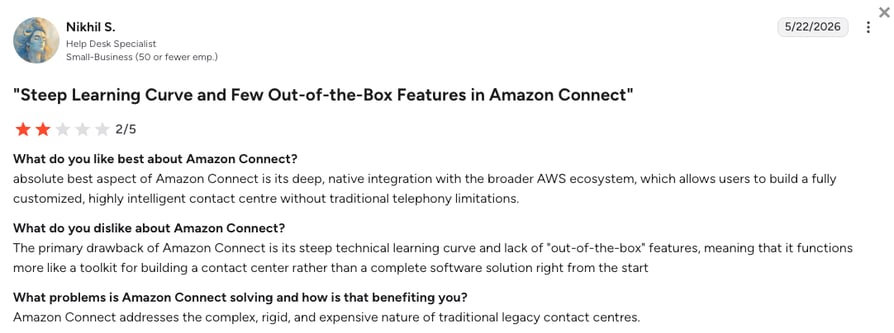
Amazon Connect reviewers praise the elasticity, the absence of license negotiations, and how naturally it fits a team already invested in AWS. The recurring complaints are the steep learning curve, the engineering time needed before the first call is answered, and reporting that reviewers describe as raw compared with purpose-built contact center platforms.
What Is Amazon Connect's G2 Rating and Review Count?
Amazon Connect holds a 4.4/5 rating on G2 across 90+ reviews, a small base for a platform of this size, with flexibility and scale the most-praised strengths.
What Is an AI Phone Call and How Does AI Phone Calling Work?
An AI phone call is a call handled by software that listens, understands, and answers in real time, without a person on one end of the line. It's not a recorded message and it's not a menu. The AI hears what the caller says, works out what they want, decides what to do, and speaks back, then repeats that loop until the call is finished or a human takes over.
Four technologies run in sequence on every AI phone call, fast enough that the caller experiences one continuous conversation:
- Speech recognition converts the caller's voice into text as they speak, rather than waiting for them to finish.
- Natural language understanding works out the intent behind the words: a booking, a complaint, a price question, a wrong number.
- Response generation decides what to say or do next, pulling from your knowledge base, your CRM, or a defined workflow.
- Text-to-speech turns the answer back into speech, and the loop starts again on the caller's next sentence.
The whole cycle has to complete in a few hundred milliseconds. That latency budget, not the language model, is what separates an AI phone call that feels natural from one that feels like a video call with a bad connection.
Can AI Make Phone Calls Autonomously in 2026?
Yes. AI can both make and receive phone calls with no human on the line. Every platform on this list places outbound calls and answers inbound ones, holds a two-way conversation, and acts on what it hears rather than reading a script at the caller.
What AI phone calls handle reliably today: qualifying inbound leads, booking and confirming appointments, answering questions from a knowledge base, collecting details before a handoff, chasing payment reminders, and routing a caller to the right team by what they said rather than which button they pressed.
What still needs a person: emotional escalations, negotiations, and anything where judgment or accountability matters more than speed. The useful design is not AI instead of your team. It is AI taking the repetitive volume so your team gets the conversations worth their time, with a live transfer connecting the two.
What Is Conversational AI for Phone Calls?
Conversational AI for phone calls is software that understands free-form speech instead of menu choices. A traditional IVR asks the caller to press 1 for sales. Conversational AI lets them say “I was charged twice last month” and routes on the meaning.
The distinction matters commercially, because it changes what the caller has to know. A menu requires them to translate their problem into your org chart. Conversational AI does that translation itself, which is why intent-based routing sends fewer calls to the wrong team than a menu tree does.
What Telephony Infrastructure Works with AI Phone Calling?
AI phone calling runs on ordinary VoIP infrastructure, so you rarely need to replace your phone system to add it. There are three shapes this takes, and the one you pick decides how much you build yourself:
- AI inside a calling platform: numbers, routing, and the AI ship together and one vendor owns the whole call. CloudTalk, Dialpad, Five9, and Amazon Connect work this way.
- AI as a layer on your existing telephony: Retell AI, Bland AI, and Vapi supply the conversation and connect to a SIP or Twilio setup you configure and maintain.
- AI as a managed program: Synthflow bundles native telephony or SIP trunking into an enterprise contract with implementation included.
The practical question is who you call when a transfer fails at 4pm on a Friday. With a single platform it is one support line. With an assembled stack it is whichever of four vendors owns the layer that broke, and finding out which one is your job.
AI Phone Calling for Business: Where It Actually Pays Off
AI phone calls earn their cost in a few specific places rather than everywhere at once. These are the four patterns that show up repeatedly in real deployments, with what each one changed.
AI Phone Calls for Inbound Support
Inbound is where AI phone calling proves itself fastest, because so much inbound volume is the same handful of questions. The AI voice agent for inbound support answers instantly at any hour and any volume, resolves what it can from your knowledge base, and passes the rest to the right team with the context already gathered.
Autenti: Nine AI Voice Agents Across Three Teams
Autenti's support team was growing headcount just to keep up with the phone. “That's also why we are implementing Voice Agent, because we don't want to invest to hire more people just to be on the phone calls,” says Michał Jarlaczyński, Customer Support Lead at Autenti. The digital signature platform now runs nine voice agents across three teams and two languages.
The result went well past the internal target. Jarlaczyński set the bar at a 10% reduction in calls reaching live agents and reports it is now around 40%, alongside a 20% increase in pickup rate on the calls that still need a person.
AI Phone Calls for Outbound Sales
Outbound is where the math gets obvious. A human team can only work the top of a list, so most of a database never gets called. An AI voice agent for outbound sales works the whole list, qualifies who is interested, and hands warm conversations to reps who now only speak to people worth speaking to. Pair it with a power dialer and the human half of the operation stops dialing entirely.
MadRent: 60,000 Outbound AI Minutes a Month
MadRent, a South African vehicle rental company, calls every fresh lead within seconds of it arriving. The AI voice agent runs around 1,000 outbound calls a day and over 60,000 outbound minutes a month, qualifying leads and collecting documents before anyone from the team gets involved.
At R31 per conversion the AI sits inside MadRent's human benchmark of R20 to R40. The team it replaced did not leave. “I've already moved all of my validators that used to do the qualification work. I've moved them all to sales now,” says Wessel Davel, Finance Director at MadRent.
AI Phone Calls Across Borders: The UK, Germany, and Beyond
International calling is where an AI phone call platform without telephony gets expensive. Reaching a UK or German buyer well means a local number they recognize, call quality on the route, and GDPR-compliant recording. On a developer platform each of those is a separate integration. On a calling platform they come with the account.
CloudTalk covers local numbers in 160 countries, including UK numbers and German numbers, and its AI voice agents work in 70+ languages with automatic language detection. That last part matters more than the language count: the agent hears which language the caller used and continues in it, so one agent covers several markets instead of one per country. And, like previously shown, organizations like Oxford Royale Academy runs exactly that setup across 176 countries in five languages.
AI Phone Call Apps: Mobile and Desktop Options in 2026
An AI phone call platform is only as useful as the places you can work from it. CloudTalk runs on iOS, Android, desktop, and the browser, with the same call log and CRM sync on each, so a rep can review what the AI agent captured on a call between meetings and pick up the follow-up from a phone. Dialpad, Five9, and Amazon Connect are similarly app-based.
The developer platforms work differently. Retell AI, Bland AI, and Vapi are APIs, so there is no app for your team at all: whatever interface your reps use is one you build. Worth knowing before you compare per-minute rates against a per-seat price.
Trevo: Reaching 20 Times More Customers per Campaign
Trevo sells packaged heating fuel, which means a short season and a long quiet period. Its human team could realistically reach about 5% of its database at peak. The AI voice agent now covers the whole list, reaching 20 times more customers per campaign, with returning customers handled in under 30 seconds against roughly three minutes before.
“We are not at the moment where AI can read emotions and figure out what the person on the other side really needs. But I can call 20 times more people. So even if it's twice less efficient, the math works,” says Ariel Maciaszek, VP at Trevo.
Hear an AI Phone Call on Your Own Number Before You Compare Another Price.
How to Choose the Best AI Phone Call Platform for Your Business
To choose an AI phone call platform, answer five questions in order: which direction your calls run, whether telephony is included, who has to build it, what a minute really costs once every line item is added, and where the AI-handled calls end up afterwards. Marketing pages agree on almost everything, so the answers come from the pricing page and the documentation.
- Inbound, outbound, or both?Inbound AI answers what your customers start. Outbound AI starts the conversation itself. Most platforms here do both, but the workflows, the compliance obligations, and the pricing differ enough that you should know which one you are buying for.
- Does telephony come in the box?Numbers, carrier routing, and call quality are either included or they are a second project. This is the single biggest fork on this list, and it separates CloudTalk, Dialpad, Five9, Amazon Connect, and Synthflow from Retell AI, Bland AI, and Vapi.
- Who builds and maintains it?A no-code builder means a sales or support manager ships the agent this week. An API means an engineer owns it permanently. Both are valid, but only one of them is free.
- What does a minute actually cost?Add every line: platform fee, language model, speech-to-text, text-to-speech, telephony, concurrency, and transfers. A $0.055 headline rate can land north of $0.20 once the stack is assembled.
- Where do AI calls land afterwards?A transcript in a separate dashboard is worth far less than a call that lands in the same log, the same analytics, and the same CRM record as the calls your agents take.
Inbound vs Outbound AI Phone Calls: Which Do You Need?
Inbound AI phone calls answer demand you already have. The agent picks up instantly, handles the routine questions, and routes the rest by intent. Typical jobs are inbound sales calls and peak-volume overflow. The measure of success is how much volume never reaches a human at all, and the buyer is usually support or operations. Autenti's nine inbound agents cut calls reaching live agents by around 40%.
Outbound AI phone calls create demand. The agent is triggered by an event, a form fill, an overdue invoice, a renewal date, and calls with your CRM data already loaded. That covers lead qualification, lead follow-up, appointment scheduling, and payment reminders. The measure of success is conversion or revenue recovered, and the buyer is usually sales or revenue operations. MadRent runs 60,000 outbound minutes a month on exactly this pattern.
Most teams start with inbound because it is lower risk, then add outbound once they trust the agent. If you want to see what a finished agent looks like for your situation before you commit to either, CloudTalk publishes a library of prebuilt voice agent use cases you can work backwards from.
The difference is easier to hear than to read about. An inbound agent opens by finding out why a stranger is calling, then either answers or routes. An outbound agent already knows who it is calling and why, so it opens with the reason and works toward a booking, a qualification, or a confirmed detail. Same technology, opposite starting point, and the recordings below run through both so you can judge the pacing, the interruption handling, and the moment the agent decides a human should take over.
Signature Capability
See CloudTalk’s AI Voice Agent in Action!
CeTe is an AI that talks like a human: no breaks, no training, no time off. It makes and answers calls, updates CRMs, books meetings, and loops in a human only when needed.
Press play to hear it. Want a wow moment? Get a free test call and try it live.

Can You Start Small and Scale Your AI Phone Call Volume?
Yes, and this is worth checking before you sign anything, because the platforms diverge sharply at the bottom of the market. CloudTalk gives every account 50 free AI minutes and then a published $99/month tier, with no commitment on the entry plans. Bland AI's Start tier is free with usage at $0.14 a minute and no card. Amazon Connect has no minimum at all.
At the other end, Five9 requires 50 concurrent seats before you make a single call, and Synthflow's entry point is a $30,000 annual contract. Neither is unreasonable at the scale they are built for. Both are impossible to pilot.
The ceiling matters as much as the floor. Circle Gym began with four agents at a single studio, while Oxford Royale Academy runs the same product across 176 countries in five languages, and neither changed platform to get there. If you want to size the decision before you start, CloudTalk publishes its AI voice agent pricing in full, an ROI calculator for modeling the payback, and a plan built for smaller teams that do not have a procurement process.
AI Phone Calls vs Traditional Auto-Dialers: What's the Difference?
An auto-dialer places the call. An AI phone call platform has the conversation. A traditional dialer works through a list and either plays a recording or connects whoever answers to a waiting rep. It cannot answer a question, and it cannot tell an interested prospect from a wrong number.
An AI phone call platform holds a two-way conversation: it understands what the person says, responds in context, qualifies them, and only then decides whether to book, resolve, or transfer. The dialer saves your reps the dialing. The AI saves them the conversation that was never going anywhere.
The two are not rivals, and the strongest outbound teams run both. Trevo pairs an AI voice agent with an AI sales dialer so the agent works the cold list while reps stay on the warm one, and CloudTalk sells the auto-dialer and the voice agent on the same platform rather than as two products to reconcile. The warm-lead dialing agent sits exactly on that line.
AI Phone Call Platforms Compared by Buyer, Pricing Model, and What You Build
| Software | Best Fit | Pricing Model | What You Build Yourself |
|---|---|---|---|
| CloudTalk | Sales and support teams that want AI and agents on one platform | Per seat from $25/user/month plus AI from $99/month per account | Nothing on the calling side: numbers, routing, transfers, and analytics come with the right plan |
| Retell AI | Engineering teams building a custom voice agent | Usage-based, billed per component | Telephony, monitoring, reporting, and the human workflow |
| Bland AI | Developers running scripted outbound at volume | Usage-based, model included in the rate | Numbers, routing, and everything around the call |
| Vapi | Teams that already own their AI provider contracts | $0.05/min orchestration plus your own provider costs | The model stack, the telephony, and the reporting |
| Synthflow | Enterprises buying a managed voice AI program | Annual contract from $30,000 | Nothing, but implementation runs on the vendor's timeline |
| Dialpad | Teams that want AI inside one business phone app | Per seat from $80/user/month plus AI Agent credits | Nothing, but autonomous AI Agents sit on the Support product and the cost needs a sales conversation |
| Five9 | Contact centers with 50+ concurrent agents | Per seat from $119/user/month, voice from $159, 50-seat minimum | Nothing, but voice needs the right tier and implementation is a project |
| Amazon Connect | AWS-native teams with engineering capacity | Pure usage: $0.038/voice min plus telephony | The AWS configuration and the operational ownership |
Why CloudTalk Is the Best AI Phone Call Platform for Growing Teams
CloudTalk is the only platform on this list where AI phone calls and human agents run through the same telephony system, on a plan a single seat can buy. That sounds like an architectural detail. It decides how long setup takes, what happens when the AI reaches its limit mid-call, and whether you can see both halves of your call volume in one report.
Here is what growing sales and support teams get from CloudTalk that the rest of this list only partly matches:
- AI phone calls without a telephony projectNumbers in 160 countries, routing, recording, and CRM sync are already there. The AI voice agent is a setting on a platform that already works, not a system you assemble around it.
- 50 free AI minutes on every account, then a published priceTest the agent on a real number before you budget for it. Paid tiers run from $99/month for 200 minutes, with the sales-led AI Specialist from $349/month for custom inbound and outbound workflows.
- A handoff that actually worksThe AI transfers to the right human inside the same call flow, passing what it already learned, so the caller does not start the conversation over. That is the single hardest thing to build on an assembled stack.
- 70+ languages with automatic detectionOne agent covers several markets because it hears the caller's language and continues in it, instead of needing a separate agent and a separate number per country.
- Every call in one record, whoever took itAI-handled and human-handled calls land in the same log and the same reports, sync to HubSpot, Salesforce, Pipedrive, and Zendesk, and can be transcribed, summarized, and scored with Conversation Intelligence at $9/user/month.
Circle Gym: 150% More Trial Bookings, With Nobody Answering the Phone
Circle Gym is run remotely from another country, so every system has to work without an owner watching it. “We depended on individuals being available and ready. But sometimes, our staff was not available. And when that happened, we got zero bookings,” says Christian Stistrup, Owner of Circle Gym. Four AI voice agents now handle lead contact, callbacks, routine questions, and rebooking.
The change came from the AI doing something a link cannot. “We went from 5% conversion with links to double-digit bookings just by letting the AI ask, 'What time works for you?'” The gym reports a 150% increase in trial bookings and 20+ hours saved per week.
Pick the Platform, Not the Demo
Every platform on this list can hold a convincing phone conversation. That stopped being the differentiator some time in 2025. What separates them now is everything around the conversation: whether the numbers come included, how long setup takes, what the minute really costs, and whether your team can see the AI's calls next to their own.
Like we said at the start, the average seller already spends only 40% of their time selling.¹ Handing the repetitive calls to AI only helps if the AI is part of the system your team already works in. Here is the short version by situation:
- You want AI phone calls live this month, on the same platform as your agents: CloudTalk. Fifty free AI minutes, $99/month after that, and a handoff into a human that works out of the box.
- You have engineers and want to own the agent: Retell AI for the strongest track record, Bland AI for predictable per-minute outbound, or Vapi if you already own your AI provider contracts.
- You are buying a managed program with a procurement process: Synthflow, from $30,000 a year with implementation included.
- You already run at contact center scale: Five9 above 50 concurrent seats, or Amazon Connect if your team lives in AWS and volume swings hard.
One caution worth keeping. Deloitte's Customer Service Excellence 2025 research found that although AI adoption in contact centers rose 15% between 2023 and 2025, customer and employee experience ratings fell by an average of half a point over the same period.² Automating a broken call flow makes it break faster. Fix what the AI is supposed to handle first, then let it handle it.
Join 5,500+ Businesses Whose Phones Get Answered Every Time
Sources:
- Salesforce, State of Sales Report (2026)
- Deloitte, Customer Service Excellence 2025
Frequently Asked Questions About AI Phone Call Platforms
Quick answers on what AI phone calls cost, how AI phone calling works, and how the eight platforms above differ.
CloudTalk is the best AI phone call platform for most sales and support teams, because the AI voice agents run inside its own phone system: numbers in 160 countries, routing, and CRM sync are already in place, and calls transfer to human agents in the same call flow. Retell AI and Bland AI are stronger picks if you have engineers and want to build the agent yourself, while Five9 and Amazon Connect suit large operations that already run at contact center scale.
An AI phone calling platform is software that makes and answers phone calls without a person on one end. It works in four steps on every call: speech recognition turns the caller's voice into text, natural language understanding works out what they want, response generation decides what to say or do next, and text-to-speech turns the answer back into speech. The whole loop runs in a few hundred milliseconds, which is what makes the conversation feel natural rather than stilted.
Yes, AI can place and answer phone calls with no human involved, holding a two-way conversation and acting on what it hears. AI phone calls reliably handle lead qualification, appointment booking, knowledge base questions, payment reminders, and intent-based routing. Emotional escalations and negotiations still need a person, which is why the better platforms transfer to a human agent mid-call with the context already gathered.
CloudTalk is the best AI calling app for business teams that need the AI and their agents in one place: it runs on iOS, Android, desktop, and the browser, with the same call log and CRM sync on each. Dialpad, Five9, and Amazon Connect are also app-based. Retell AI, Bland AI, and Vapi are APIs rather than apps, so any interface your team uses is one you build yourself.
CloudTalk is the strongest fit for UK-based calling: it provides local UK numbers alongside numbers in 160 countries, GDPR-compliant call recording, and AI voice agents in 70+ languages that detect the caller's language automatically. Pricing starts at $25/user/month with AI voice agents from $99/month, well below the enterprise entry points at Five9 and Synthflow.
Conversational AI for phone calls is software that understands free-form speech rather than menu presses. A traditional IVR (Interactive Voice Resposne) asks the caller to press 1 for sales, while conversational AI lets them describe the problem in their own words and routes on the meaning. It combines speech recognition, natural language understanding, a language model, and text-to-speech, which is what lets it handle a question it was never explicitly scripted for.
AI phone calling runs on standard VoIP infrastructure, so you rarely need to replace your phone system. There are three options: a platform where the AI and telephony ship together (CloudTalk, Dialpad, Five9, Amazon Connect), an AI layer that connects to SIP or Twilio telephony you configure yourself (Retell AI, Bland AI, Vapi), or a managed enterprise contract with telephony bundled in (Synthflow).
CloudTalk suits most outbound teams, because the AI voice agent qualifies leads and the power dialer and smart dialer handle the human half of the campaign on one platform. Bland AI is a strong pick for developer-run scripted outbound at $0.14 a minute, and Five9's predictive dialing fits operations already running 50+ concurrent agents.
Yes. Retell AI, Bland AI, and Vapi are built API-first for exactly this, and Amazon Connect is configured as an AWS service. Expect to supply the telephony, monitoring, and reporting yourself on the first three. CloudTalk also has an open API, but the difference is that you do not need it to get an AI voice agent answering calls.
An auto-dialer places calls and either plays a recording or connects whoever answers to a waiting rep. It cannot answer a question or tell an interested prospect from a wrong number. An AI phone call platform holds a real two-way conversation, understands what the person says, responds in context, qualifies them, and then books, resolves, or transfers. The dialer saves your reps the dialing. The AI saves them the conversation that was going nowhere.
The price of an AI phone call depends entirely on the pricing model. Usage-based platforms start around $0.05 to $0.14 per minute before language model, speech, and telephony costs are added, which can push a real rate above $0.20. Per-seat platforms run from $25/user/month at CloudTalk to $119/user/month at Five9 with a 50-seat minimum. CloudTalk's AI voice agents are priced per account from $99/month for 200 minutes, with 50 free minutes included on every account.
AI phone calls don't really sound like a robot any more, and the giveaway is no longer the voice. Modern platforms sound natural enough that callers regularly finish a conversation without asking. What still separates a good AI phone call from a poor one is latency and interruption handling: whether the agent responds fast enough and stops talking when the caller starts. Listen to a live demo on a real phone line before you judge any platform on its recorded samples.