How to Get an International Phone Number in 2026

The easiest way to get customers on the line is with a phone call that feels close to home. No one’s picking up if you look like a stranger.
If your number doesn’t look familiar, it’s going straight to voicemail—or worse, flagged as spam. But when your caller ID shows a local area code? Suddenly, the odds tilt in your favor. People are nearly four times more likely to pick up a local number¹.
Here’s the better part: you don’t need an office in every country where you do business, or a pocket full of SIM cards to pull it off. With the right cloud phone system, your team can appear local from anywhere—no contracts, no hardware, no borders.
If you are wondering exactly how to get an international phone number without dealing with foreign telecom carriers, modern cloud phone systems have made the process entirely digital and frictionless. This guide walks you through every step with plain‑language explanations, real cost math, and a friction‑free setup checklist.
Key takeaways
- International phone numbers help your business build a trusted local presence in multiple countries without needing a physical office.
- VoIP-based international numbers also slash communication costs. You get local calling rates for global conversations and avoid the high overhead of traditional phone systems.
- To get real value, go beyond the dial tone. Look for smart features like CRM integrations, call routing, analytics, and enterprise-grade security that grow with your team.
- Getting an international number is easy and fast. With cloud-based platforms like CloudTalk, it takes just a few clicks—no hardware, no hassle.

CloudTalk vs. your current setup? Let the platform speak for itself.
What Is an International Phone Number?
At its core, an international phone number is a standard phone number with a country code prefix. This prefix identifies each country or region and allows you to call globally from anywhere in the world.
When a company based in Toronto buys a +44 20 (London) number, customers in the U.K. see a hometown caller ID, even though the agents sit six time zones away.
See why this is important in the video below:

Here are a few examples of prefixes, as mentioned in the video:
- USA: +1
- UK: +44
- Spain: +34
- Germany: +49
- Australia: +61
- Japan: +81
- Brazil: +55

Types of International Numbers
To make sense of international calling, it helps to know the two main types of phone numbers businesses typically use.
#1. Local Phone Numbers
Local numbers—sometimes called geographic numbers—are tied to specific locations. Each one uses a regional area code that makes your business appear as if it’s based in that exact city or region. This allows you to connect more personally with customers in cities like Madrid or London by displaying a number that looks just like the one their neighbor might have.
For example:
- Madrid, Spain, uses the country code +34 and the city code 91, so a number might look like +34 91 123 4567.
- London, UK has the format +44 20 1234 5678.
This structure also applies in the U.S., where different states—and even neighborhoods within a city—have their own area codes. For instance:
- Montana: +1 406 123 4567
- Maine: +1 207 123 4567
- Delaware: +1 302 123 4567
- New York City (overall): +1 917 123 4567
- Manhattan specifically: +1 212, +1 646, or +1 332
Local numbers help businesses “blend in” and increase the chance of getting their calls answered.
#2. Toll-free Phone Number
Toll-free numbers allow customers to call your business without incurring any charges—the receiving party pays instead. These numbers are ideal for support hotlines or any service where you want to remove financial friction from the customer’s side. In some cases, the cost may be shared between caller and receiver, depending on the toll-free type.
You’ll often hear terms like:
- Green toll-free numbers – where the business pays the full amount
- Blue toll-free numbers – where the cost is split
These numbers typically begin with special 3-digit prefixes starting with 8 (e.g., 800), making them easy to identify and remember. More than just free-to-call, toll-free numbers help businesses appear more credible and approachable, especially to customers who might hesitate to place an international call.
Here’s what toll-free numbers might look like in different countries:
- UK: +44 8XX 123 456
- US: +1 8XX 123 456
- Spain: +34 8XX 123 456
- Germany: +49 8XX 123 456
#3. UIFN Numbers
UIFN stands for Universal International Freephone Number, and it’s designed for businesses that want one single toll-free number accessible from multiple countries. Instead of managing a different toll-free line for every market, UIFN gives you a single number your customers can dial from any participating country—free of charge.
These numbers start with +800, followed by eight digits, such as:
+800 1234 5678
UIFN numbers are a great fit for multinational companies running centralized support centers or global campaigns. They help unify your brand’s presence and simplify communication across borders.
However, there are a few trade-offs:
- Not all countries support UIFN, so coverage is limited to a set of participating nations.
- Registration is more complex than standard toll-free numbers, often requiring a business presence or proof of registration in at least two countries.
- Costs can be higher upfront, but the convenience of having one global contact number often outweighs the investment for companies with international scale.
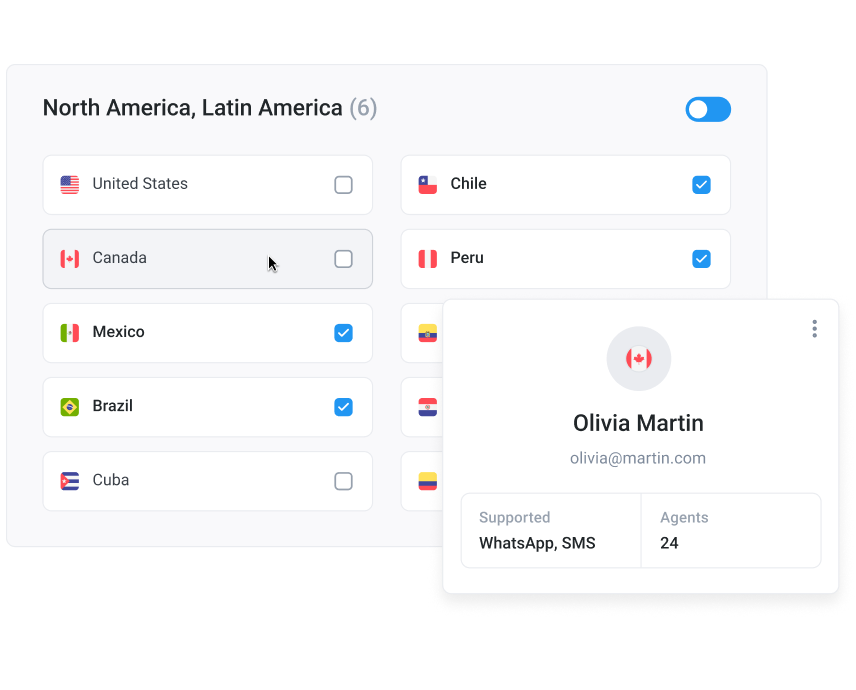
Cloud-Based vs. Traditional International Numbers
Not all international phone numbers work the same way. While they may look identical on the surface, the technology behind them falls into two very different camps: virtual (cloud-based) numbers and traditional landlines.
Virtual Numbers (Cloud-Based)
Cloud-based numbers, often called virtual numbers, live in the cloud—not in a specific SIM card or physical phone line. That means they can be used from anywhere, on any internet-connected device. For remote teams and traveling sales reps searching for how to get an international number on cell phone, a cloud-based VoIP app is the ultimate solution, allowing you to instantly route global calls directly to your iOS or Android device without swapping SIM cards.
Traditional Landline Numbers
Landline-based international numbers are tied to a physical location and copper infrastructure. They’re provided by legacy telecom carriers and typically require long-term contracts and manual provisioning. While evaluating the non-VOIP international phone number services 2026 has to offer—such as traditional copper landlines or overseas prepaid SIM cards—you will quickly find they require physical hardware and lack the scalability, growing sales, and support teams need. Use recorded calls to onboard faster, highlight best practices, and give precise feedback. It’s the simplest way to turn every rep into your best rep.
Aspect
Virtual Phone Number
Legacy PSTN Number
Device lock-in
Works on any device
Fixed to one line/SIM
Flexibility
Very flexible. Only tied to the user’s VoIP account.
Not flexible. Tied to a location, device, or SIM.
Device Flexibility
Can be used on any device (mobile, PC, landline).
Restricted to the assigned phone line/device
Call Forwarding
Easily configurable. Can forward to multiple devices.
Limited and often incurs extra charges.
Call Rates
Very affordable. Especially international.
Expensive. Especially international.
Setup & Maintenance
Low, no physical infrastructure required.
Higher. Requires physical phone lines for call center integration.
Voicemail
Advanced features like email and text transcription.
Basic.
Auto-Attendant
Commonly available.
Rare and often expensive.
Portability
High. Easy to move and add new numbers.
Low, difficult to move to a different location or provider.
Call Management
Advanced options, including call recording, analytics, etc.
Basic.
Remote-Friendly
Excellent, ideal for remote teams.
Limited, not ideal for remote work.
Scalability
Highly scalable due to software-centric design.
Limited
Reliability
Dependent on the connection.
Generally reliable.
Why Your Business Needs an International Number Now
1. Cut Costs for You and Your Customers
One of the most practical advantages of international virtual numbers is the massive reduction in calling expenses—for both sides. Customers can reach your team just like they would call any local business in their own country, and your agents can do the same in return.
We’re not just talking about shaving off a few cents. A one‑hour PSTN call from New York to Shanghai can still top $300. With a cloud-based number, the same call uses your internet connection and usually costs just $0.02 to $0.04 per minute.
Lower barriers mean customers are far more likely to reach out—because they know the call won’t break the bank. That improves accessibility, builds trust, and strengthens loyalty over time. Your business starts to look not just global, but genuinely customer-friendly.
What did Glovo achieve with CloudTalk?
- 82% Increase in the volume of calls
- 24% Decrease in missed calls

2. Boost Revenue by Building Local Trust
Ever ignored a call from an international number? Most people have—and for two good reasons: they’re either worried about high fees, or they suspect it’s a scam. That hesitation disappears when your number looks familiar.
That local presence helps customers feel confident about picking up the phone—and that translates into more answered calls, more sales opportunities, and stronger brand loyalty.
What did Glovo achieve with CloudTalk?
- 20% Increase in agent efficiency
- 70% Increase in call handling efficiency

3. Scale Your Number Inventory on Demand
Traditional phone lines come with logistical headaches—hardware, limits, paperwork, and delays. Expanding into new regions means adding complexity.
With VoIP-based international numbers, it’s all point-and-click. No equipment to install, no contracts to sign, and no limits on how many numbers you can manage. You can spin up or retire numbers on demand, all from a single interface.
4. Prioritize Data Protection
Business leaders often focus on cost, growth, and efficiency—but security should never be an afterthought. Especially when customer conversations involve sensitive data.
According to Forbes, the average cost of a data breach hit $4.45 million². It’s not just financial—it’s reputational, and potentially legal.
Top-tier VoIP providers encrypt all calls and signaling, shielding your data from eavesdropping or interception. They also run frequent security updates and operate within strict compliance frameworks to keep your communications secure.
5. BONUS: Do More with Built-In VoIP Features
When you choose virtual international numbers, you’re not just getting a phone line—you’re unlocking a powerful suite of productivity tools.
VoIP platforms come packed with advanced features to help your teams perform better: smart dialers to automate outbound calling, live call monitoring for coaching, sentiment analysis for deeper customer insight, and performance dashboards to fine-tune your strategy.
It’s everything your business needs to scale outreach, handle more calls, and make every interaction count.

Six Practical Ways to Get an International Phone Number
Most “how can I get an international phone number?” answers stop at “sign up for VoIP.” Reality offers more paths, each with trade‑offs.
Method
Up‑front effort
Ongoing cost
Scalability
Best for
Cloud phone platform (e.g., CloudTalk)
5–10 min online signup
Seat‑based monthly fee
Elastic to 250+ agents
SMBs & scale‑ups
Local SIM in each country
High (logistics, KYC)
Variable prepaid rates
Manual
Solo travelers, micro‑teams
Call‑forwarding reseller
Medium
Mark‑ups on minutes
Limited feature set
Legacy PBX users
Carrier “international add‑on”
Low
Often >$50/mo/line
Tied to contract
Individuals making rare calls
Annual price UIFN through ITU registrar
Complex paperwork
Higher one‑time fee
One global number only
Multinational hotlines
Number porting to VoIP
Moderate (forms, LOA)
Same as VoIP seat
Keeps existing identity
Businesses locked into old numbers

Call effortlessly worldwide without worrying about SIM cards or devices.
Step‑by‑Step: How to Get an International Phone Number with CloudTalk
By now, it’s clear why CloudTalk stands out as a go-to solution for businesses seeking virtual international numbers. Here’s exactly how to get started:
#1 Order Your International Number
From the CloudTalk Dashboard, you’ll navigate to the “Numbers” tab.
Then, you’ll click “Get a number”.

After that, you’ll select a country and specify the type of number you need. In the bottom section “Additional documents (ID, business license, etc.)”, you will see the requirements per number and you’ll be able to upload them into the form.
If the section is blank, it means that there are no requirements.
The order form does not have a ‘requirement section’, but you can check all our number requirements by country and number type.

Next, after sending your request, you will see an order confirmation banner in the top corner. You will also receive a confirmation to your account email address.

#2 We Will Review Your Request
The numbering team either adds the number or, if we need any additional documents or information from you, we will follow up in the confirmation email.
#3 We Will Add the Number to Your Account
Our team will include billing for the number and send a final confirmation email.
Tip: You can see the status of your ongoing requests in the main numbers section under “My Requests”.
Here’s what the different status stages mean:
- New: We have received your request, but an agent has not processed it yet. We typically respond within 8-24 hours.
- Waiting for information: We have reviewed your request but need more information or additional documents. If you see this status, you should check your CloudTalk email.
- Processing: Our team has everything they need for the request and is in the process of activating the number with our operator.
- Completed: The number has been added to your CloudTalk account. Our agent will clarify which specific number was added.
- Canceled: The request was canceled by your team.
- Expired: If a request stays in the “Waiting for information” stage for 2+ business days without a response from your side, we may close your request and mark it as expired.
Cost Breakdown: What Will You Pay in 2026?
There’s no single price tag for international numbers—the total cost can vary widely depending on a few key variables. To help you estimate your budget, here are the three main factors that influence pricing.
1. The Provider You Choose
Your choice of provider has a major impact on what you’ll pay. The first decision is whether to go with a traditional telecom carrier (like AT&T) or opt for a cloud-based VoIP provider.
In general, VoIP solutions are far more cost-effective. Many offer international call rates as low as $0.02 per minute—far cheaper than conventional phone services.
The cost of acquiring the number itself also depends on the platform you use. VoIP pricing plans can range anywhere from $10 to over $200 per user per month, depending on the features and service tier.
So, when evaluating providers, consider:
- The type of provider (traditional vs. cloud-based)
- The specific vendor you choose
- The pricing tier or subscription plan that fits your needs
For example, CloudTalk offers five plans, ranging from $19 to $49. You’ll also get one phone number for free.
2. The Quantity and Origin of Your Numbers
With VoIP systems, each international number typically comes with a one-time acquisition fee. Prices differ based on the country and the provider’s coverage in that region.
Numbers from highly requested markets (like the U.S., U.K., Germany, or Spain) tend to be more affordable, while those from less common destinations may carry a higher fee.
Here’s a quick snapshot of typical starting prices:

Grow your reach with 160+ international numbers!
3. Your Calling Infrastructure
This final factor is less about the numbers themselves and more about how you set things up.
If you’re still relying on physical desk phones or on-premise hardware, every new number may require additional equipment—driving up your total cost significantly. Hardware investments can easily run into the hundreds per user.
With modern cloud-based VoIP systems, there’s no need for any physical setup. All you pay for is the software license and the numbers you need—nothing more.
Coverage Map: Where You Can Get International Numbers Today
CloudTalk maintains inventory in 160+ countries across every region.
- Americas: USA, Canada, Mexico, Brazil, Chile, Colombia…
- EMEA: All EU states, U.K., UAE, South Africa, Nigeria, Israel…
- APAC: Australia, New Zealand, Japan, India, Singapore, Philippines…
- Emerging markets: Kenya, Vietnam, Peru, Kazakhstan, and dozens more.

Nine Features to Demand From Your International Number Provider
The right international number is only as good as the system behind it. These nine features ensure your calls connect clearly, route intelligently, and scale with your business.
- Automatic local caller ID: Instantly display local numbers without manual switching for every call.
- AI Voice Agents: Handle routine inquiries around the clock and reduce agent workload by up to 80%.
- CRM integrations: Sync call notes and data automatically with your CRM or help desk tools.
- Call Flow Designer: Build and automate call workflows in a few clicks with intuitive drag-and-drop software.
- HD voice: Ensure crystal-clear calls through automatic network failover with multi-carrier routing.
- Real-time Analytics: Get key insights in a few clicks to boost agent productivity, improve customer satisfaction, and optimize every call.
- Call Monitoring: Monitor calls live and guide agents with whisper or barge-in features.
- Regulatory-Grade Security: Keep customer data secure and privacy regulations covered.
- Transparent, scalable pricing: Seat-based plans that grow with your team—no hidden fees.
FAQ: How do I get an international phone number?
To get an international phone number, sign up with a cloud-based VoIP provider like CloudTalk. From the provider’s dashboard, select your desired country, choose a local or toll-free number type, and provide any business documentation required by local regulations. Once approved, the number is activated digitally, allowing you to make and receive global calls immediately.
Getting Started: Your First International Number in Under Ten Minutes
Global reach used to require local offices, carrier contracts, and dedicated IT teams. In 2026, it’s a dashboard toggle away. Sign up for CloudTalk’s free trial, choose the country that matters to your growth plan, and place your first “local” call before your coffee cools down.
Ready to turn every market into a local market?

Ready to sound local in 160+ countries? Schedule your CloudTalk demo and get started in minutes.
Sources: