Retell AI vs Synthflow: The TL;DR
| Question | Quick Answer |
|---|---|
| What is Retell AI? | Retell AI is a pay-as-you-go voice AI platform for phone calls, with a drag-and-drop agent builder, a model picker, and published per-minute components. |
| What is Synthflow? | Synthflow is an enterprise voice AI platform with a visual Flow Designer, its own telephony network, and a single published tier. |
| Which is better, Retell AI or Synthflow? | Neither wins universally, and product quality isn't what settles it. Your engineering capacity is: own the build and manage usage-based billing (Retell), or buy a managed rollout on an annual contract (Synthflow). |
| Which is cheaper? | Retell at the entry point, by a wide margin: $10 in free credits and no minimum against a $30,000 annual floor. At scale nobody can say, since Synthflow publishes no rate, so model what voice AI actually costs against your own volumes. |
| Does either require coding? | No. Both ship a visual builder. Retell rewards a developer; Synthflow doesn't need one. |
| Which is faster? | Unknown. Retell claims ~600 ms, Synthflow claims under 800 ms, both self-reported, and no independent benchmark exists for either. |
| Which connects to more tools? | Synthflow on count, with 200+ enterprise apps against Retell's 32 named connectors. Retell covers the gap through its API. |
| Which is stronger on compliance? | Synthflow on paper: it names more certifications, including ISO 27001 and PCI DSS, though its own pages disagree on the exact set. |
| What changed this year? | Both repositioned toward enterprise, Retell shipped a visual builder, and Synthflow removed its self-serve tiers. Most Retell AI vs Synthflow 2026 comparisons still describe the old lineup. |
| What's the best alternative to Retell AI and Synthflow? | CloudTalk's AI Voice Agent, if you want the agent and the call center in one subscription: no-code setup, published pricing from $99/month for 200 minutes, and a 14-day trial with 50 AI minutes included. |
Retell AI and Synthflow both do the same core job well: they put a working AI voice agent on a phone line. The split is commercial, not technical. Retell sells usage by the second, no platform fee, no monthly minimum, so a two-person team can ship an agent this afternoon. Synthflow publishes exactly one tier, and it starts at $30,000 a year.
Everything else follows from that gap. Retell hands you a toolkit: a model picker, a knowledge base, a documented API. Synthflow hands you a running deployment on its own telephony network, with its own engineers on the build. So the question was never which one is better, but which one matches the resources you already have.
How We Compared Retell AI and Synthflow
Every figure on this page comes from Retell's and Synthflow's own pricing, product, and compliance pages, read in August 2026. Nothing here leans on either vendor's marketing about the other. Here's what we scored:
- Pricing you can actually forecastPublished rates, billing granularity, and what the base rate hides. A cheap headline rate that rounds up per call isn't cheap.
- Feature depth, not feature countBuilder architecture, knowledge retrieval, testing loops, and what "not published" really means for your rollout.
- Latency claims, treated as marketingNeither vendor has an independent benchmark, so we kept their numbers apart and labeled the source of each.
- Integration reality over logo wallsA connector on a logo wall and a working two-way sync are different things. We scored the connectors teams actually depend on.
- Verified reviews over vendor badgesG2 and Trustpilot scores from our verified dataset, with every self-published rating labeled as exactly that.
Want a Third Data Point for the Shortlist?
Retell AI vs. Synthflow: Core Strengths of Each Platform
Engineering capacity is what decides between them, so start with each platform's real strengths. Treat the synthflow vs retell question the way you'd treat building voice AI in-house versus paying for a platform: who does the assembly work, and who carries the commercial risk.
What Is Retell AI?
Retell AI is a pay-as-you-go voice AI platform for phone calls. You assemble an agent from a model, a knowledge base, and function calls, and pay per second of usage. It's developer-first infrastructure: the dashboard gets you started, and the API takes you the rest of the way.
Where Retell AI Shines
Where Retell AI Shines
| Strength | Why It Matters |
|---|---|
| No platform fee, no monthly minimum | You can pilot on $10 in free credits before anyone signs. |
| Published component pricing | You can model a rate instead of guessing at one. |
| Per-second billing, no per-call round-up | Short calls don't get rounded into full minutes. |
| Model choice per agent | A triage agent needn't run on the same model as a complex one. |
| Streaming knowledge retrieval | Answers stay current without a manual re-upload. |
What Is Synthflow?
Synthflow is an enterprise voice AI platform built around a visual flow designer and telephony it owns. You're not buying a toolkit; you're buying a managed deployment, with Synthflow's engineers staffing the launch against a published three-week window.
Where Synthflow Shines
Where Synthflow Shines
| Strength | Why It Matters |
|---|---|
| One published tier | You budget a single annual figure. |
| Telephony it owns | Call transport isn't a third party's problem. |
| 200+ enterprise app integrations | Most of your stack is a connector, not a build. |
| Forward-deployed engineers | Its people are in the build, which changes who's awake during launch week. |
| The BELL framework | Build, Evaluate, Launch, Learn gives an ops team a QA loop instead of a blank canvas. |
Those lists barely overlap, so a single grid is the fastest way to see where the two diverge.
At a Glance: Retell AI vs. Synthflow, Key Differences
Use this Retell vs Synthflow comparison table to find the dimension that decides it for you, then jump to that section for the detail.
Retell AI vs Synthflow: Key Differences
| Dimension | Retell AI | Synthflow | Best Suited For |
|---|---|---|---|
| Builder type | Drag-and-drop framework; single-prompt, multi-prompt, and conversation-flow agents | Visual Flow Designer with subflows as specialized agents | Both are visual now, so this no longer separates them |
| Pricing model | Modular usage, $0.07 to $0.31/min, no platform fee, $10 in free credits | Committed annual contract from $30,000, no per-minute rate published | Self-serve pilots vs. funded rollouts |
| Native integrations | 32 connectors, plus API, SDKs, webhooks, hosted MCP server | 200+ enterprise apps | Broad SaaS estates vs. custom stacks |
| Certifications | SOC 2 Type I and II, HIPAA, GDPR | The same three, plus PCI DSS and ISO 27001 | Procurement with an ISO 27001 line item |
| Latency claim | ~600 ms, credited to unnamed "independent benchmarks" | Under 800 ms; its sub-100 ms figure measures telephony transport | Nobody: both are vendor-reported |
Each of those rows hides a real decision. The first is what a voice agent can actually do on a call.
Retell AI Features vs. Synthflow Features
The retell ai vs synthflow features split is depth of control against breadth of pre-built machinery.
Retell AI Features
Retell builds outward from the agent: you assemble one from a model, a knowledge base, and function calls. Everything past that is API and webhook territory.
What Retell AI Does Well
- Model selection per agentA triage call doesn't have to run on the model your complex calls need, so cost tracks difficulty.
- Streaming knowledge retrievalKnowledge bases sync from your web content and are reused across agents, first 10 free.
- Batch calling built inOutbound campaigns don't need you to build a queue runner.
- Testing you don't have to assembleSimulation Testing and continuous QA over past calls ship as metered features.
Where Retell AI Falls Short
- The headline rate tells you little$0.07/min is the floor of a range that moves with every model and voice choice.
- Baseline-feeling features are meteredPII removal, guardrails, denoising, and QA all cost extra per call.
- Concurrency has a wall the marketing skipsYou get 20 concurrent calls, then $8 each per month, against a homepage claim of batch calling "without concurrency limits."
- Access control is gatedRole-based access control (RBAC) and single sign-on (SSO) are Enterprise-only. More below.
Synthflow Features
Synthflow builds inward from the deployment. The Flow Designer is the front door, and the whole thing sits inside its BELL framework: Build, Evaluate, Launch, Learn.
What Synthflow Does Well
- Flow Designer with real structureSubflows keep a complex journey from collapsing into one giant prompt.
- A testing loop with scoring built inTest Center scores simulated calls against your KPIs, and the AI Sandbox versions changes so you can roll one back.
- Telephony it controlsRegional deployment, instant failover, and bring-your-own-carrier (BYOC) over SIP on its own network.
- Vendor engineers on the buildA three-week launch window with its people in it, then Auto-QA after go-live.
Where Synthflow Falls Short
- You can't price it yourself, and the floor is highNo per-minute rate is published anywhere, and $30,000 a year rules out pilots.
- No published model pickerChoosing or bringing your own LLM isn't documented as a customer-facing control.
- Its own site disagrees with itselfIts homepage FAQ still describes building free and paying per call while its pricing page shows only Enterprise, and language support reads 30+ in one place, 50+ in another.
- Fine-tuning is roadmapSynthflow writes about it in the future tense, so plan around it being unavailable at launch.
Feature-by-Feature Comparison
Here's how the two stack up, capability by capability. Where you see "not published," the vendor doesn't state it; that doesn't mean it doesn't exist, but it does mean you should ask before you sign.
Feature-by-Feature Comparison
| Feature | Retell AI | Synthflow |
|---|---|---|
| Agent architecture | Single-prompt, multi-prompt, conversation-flow | Multi-agent, subflows as specialized agents |
| Custom LLM selection | Model picker plus a custom-LLM option | Not published as a customer-facing control |
| Knowledge and retrieval | Streaming retrieval, auto-sync from web content | Knowledge-source integrations, depth not published |
| Warm transfer | Yes, alongside cold transfer | Not published as a named capability |
| Batch outbound | Yes, dashboard or API | Campaigns via flows, batch limits not published |
| Testing and simulation | Simulation Testing, plus QA over past calls | Test Center, plus a sandbox with rollback |
| Multilingual support | No language count published, only "multiple languages" | Its own figures conflict: 30+ in one place, 50+ in another |
| Developer surface | REST API, SDKs, webhooks, hosted MCP server | API-connected flows |
The Third Option: An Agent That Arrives Pre-Wired
Both Retell AI and Synthflow are infrastructure you build an agent on top of. CloudTalk's AI Voice Agent (CeTe) takes the other approach: a no-code agent (a paid add-on) that arrives wired into a full call center, so it answers on your existing numbers and hands off to a live rep without an integration project. Autenti, a SaaS company, has it handling roughly 30% of inbound support calls.
None of these grids tell you how either platform sounds to a caller, and that's where most shortlists get decided.
Latency & Voice Quality: Retell AI vs. Synthflow
Response delay is what callers notice first, and conversational memory is what they notice second. A half-second gap reads as a bad line; an agent that forgets what it heard two turns ago reads as a bot. So the retell ai vs synthflow latency question gets asked constantly, and the published answers are close to useless. Retell credits its figure to "independent benchmarks" it never names. Synthflow quotes two numbers that measure different things, one for the conversation and one for transport across its own network. The table below keeps them apart.
The Catch with Every Latency Number Here, Including Ours
No independent benchmark exists for either platform. Every figure here was published by a company with a commercial interest in it, so treat them as marketing until you've run your own traffic through both, on your own carriers, with your own accents and background noise. And no latency chart covers the failure mode that actually bites: agents that sail through internal testing stall on speakerphone, car noise, mumbling and one-word answers, because the people who test them already know how to talk to a bot.
Latency and Voice Quality Compared
| Dimension | Retell AI | Synthflow |
|---|---|---|
| Claimed conversational latency | ~600 ms, on its homepage | Under 800 ms, in its own comparison table |
| Attribution for that claim | "Independent benchmarks," none named | Self-published, corroborated only by its own pages |
| Telephony transport latency | Not published | Under 100 ms, on its own network |
| Conversation memory approach | Streaming retrieval (see the feature table above) | Knowledge-source integrations, depth not published |
| Tuning effort | Prompts, models, and flows are yours | Flow tuning with vendor engineering support |
Test the handoff too. Most conversations that matter end up with a human, and a long silence between "let me put you through" and a live voice is what makes buyers regret the project. Retell publishes cold and warm transfer and stops its AI billing at the handoff. Synthflow doesn't name warm transfer as a capability, so ask for it specifically.
Latency claims on both platforms come partly from each vendor's own marketing, and CloudTalk's are no different. CloudTalk publishes sub-800 ms response latency for its AI Voice Agent on its own telephony infrastructure, alongside call-quality data and a 99.999% uptime commitment. A useful third reference point, still a vendor number.
Voice quality you can test in a week. Cost is the part that surprises people six months in.
Put an AI Front Desk on Your Existing Numbers
Retell AI Pricing vs Synthflow Pricing
The Retell AI vs Synthflow pricing comparison is where these two stop resembling each other. A low per-minute rate sets your expectation of a fair price and tells you almost nothing about your invoice, because the number that matters is what you'll spend in month six across every market you run in. And most teams are running a wider comparison than this one: voice AI against the cost of two or three more reps. Run that math before either sales call.
Retell AI Pricing
Retell's pricing is true pay-as-you-go: no platform fee, no monthly minimum. Voice agents run $0.07 to $0.31 per minute, and Retell's own estimator defaults to $0.11/min from four parts: $0.04 LLM, $0.055 voice infrastructure, $0.015 text-to-speech, and $0.015 telephony via Twilio or Telnyx, free if you bring your own SIP trunk.
The line items stack from there. Twenty concurrent calls and 10 knowledge bases are free, then $8 a month for each additional one, and batch dialing, PII removal, guardrails, denoising, and QA are metered on top at $0.005 to $0.10/min. New accounts get $10 in free credits, and Retell doesn't publish how many minutes that buys.
Synthflow Pricing
Synthflow pricing now sits behind a single tier: Enterprise. Contracts start at $30,000 a year, scoped around volume, integrations, and launch support. No self-serve plan, no included-minute bundle, and no per-minute rate anywhere on the site.
Most comparisons you'll read still describe Growth and Agency tiers the pricing page no longer shows, and Synthflow's own homepage FAQ hasn't caught up either. Its enterprise comparison page sets that $30,000 floor against rivals it puts at $150,000 and up, which tells you who it thinks it's selling against.
What to Budget for Beyond the Base Rate (Both Platforms)
- Ask how each vendor rounds. If a platform bills to the started minute and your calls average 15 seconds, your real rate is four times the advertised one. Retell publishes a per-second commitment; Synthflow publishes no billing-granularity terms at all, so get it in writing.
- Retell's modular pricing rewards attention and punishes neglect. Moving a triage agent to a cheaper model changes your rate that day, but nobody does that optimization for you.
- Synthflow's contract is predictable and hard to size. You can forecast an annual figure easily, and overbuy on it just as easily, because you scope volume before you know your call mix.
Pricing Compared Line by Line
Pricing Compared Line by Line
| Pricing Dimension | Retell AI | Synthflow | CloudTalk AI Voice Agent |
|---|---|---|---|
| Pricing model | Modular usage, billed per minute | Committed annual enterprise contract | Per-seat subscription plus a usage-based AI add-on |
| Published entry point | $0.07/min at the low end of its range | $30,000 a year | Plans from $25/user/month; the AI Voice Agent add-on from $99/month for 200 minutes |
| Per-minute rate published | Yes, as a range plus an estimator | No | Yes at volume: as low as $0.15/min above 10,000 minutes |
| Platform fee or minimum | None published | $30,000 annual floor | No minimum beyond the add-on bundle you choose |
| What the base rate covers | Voice infrastructure only; LLM, speech, telephony are separate | Not published | Telephony, CRM sync, and routing, in one subscription |
| Free entry point | $10 in free credits, self-serve | Not published | 14-day trial including 50 AI Voice Agent minutes |
| Billing granularity | Per second, no per-call round-up | Not published | Drawn against the monthly minute bundle you buy |
CloudTalk's AI Voice Agent Pricing, Published in Full
CloudTalk's AI Voice Agent is a paid add-on on every plan, never bundled into a subscription. Its AI Voice Agent pricing is public down to the minute: 200 minutes at $99/month, 500 at $199, 1,000 at $299, 2,500 at $699, with an AI Specialist tier from $349/month for 1,000 minutes. No sales call needed to see the numbers.
One cost sits on neither price list, and it's usually the one that slips the timeline: connecting the agent to the systems your team already works in.
Retell AI Integrations vs. Synthflow Integrations
Connector counts differ by a factor of six here: Retell AI names 32, Synthflow names 200+, and neither total tells you how deep the sync goes.
Retell AI Integrations
Retell connects to 30+ apps, and the list leans hard into contact centers and healthcare; the clinical-systems lineup is unusually deep for a voice AI vendor. Anything beyond the named set is yours to wire up through the API, webhooks, or an automation platform.
Synthflow Integrations
Synthflow connects to 200+ enterprise apps, from calendars and CRMs to CCaaS and commerce tools. The telephony side is what stands out: direct connections into Cisco, Avaya, Genesys, and RingCentral, plus bring-your-own-carrier over SIP.
Why Connector Count Is the Wrong Number to Compare
A connector on a logo wall and a working two-way sync are different things, and integrating voice AI is where most projects lose weeks. Specialist platforms tend to be strongest at the AI layer and thinnest exactly where the data has to land: contact records, ownership, call outcomes written back to the right object. Either way the integration layer is yours to own, so score the two connectors you actually depend on rather than the totals.
Integration Capability Compared
| Integration Capability | Retell AI | Synthflow |
|---|---|---|
| Named native integrations | 32 named connectors | 200+ enterprise apps |
| CRM coverage | HubSpot, Zendesk, Intercom, Shopify, GoHighLevel | Salesforce, HubSpot, Freshworks, plus a vertical CRM category |
| Telephony and CCaaS | Amazon Connect, Five9, NICE, Talkdesk, Twilio, Telnyx, Vonage, SIP trunking | In-house network, plus Cisco, Avaya, Genesys, RingCentral, BYOC over SIP |
| Developer path for anything else | REST API, SDKs, webhooks, hosted MCP server | API-connected flows |
| Automation platforms | Make, n8n, viaSocket, Zapier | Make, Zapier |
| Vertical depth | Deep healthcare set: Epic, Dentrix, Open Dental, Jane App | Vertical CRM category, connectors not enumerated |
One Vendor Fewer on the Stack
Reaching your CRM takes integration work either way, and every vendor you add brings its own failure points, legal review, and procurement cycle. That consolidation instinct is the argument for CloudTalk's AI Voice Agent, which runs on the same 100+ CloudTalk integrations as your reps. The two-way syncs with HubSpot, Salesforce, and Pipedrive that a specialist platform asks you to build are already there.
Voice AI That Lives Inside Your Phone System
Legal review is the other item on that list, and it has its own way of stalling a rollout.
Security & Compliance: Retell AI vs. Synthflow
Both platforms publish SOC 2, HIPAA and GDPR. Synthflow claims two certifications Retell AI does not, and Retell AI puts its access controls behind an Enterprise contract.
Retell AI Security & Compliance
Retell holds SOC 2 (Type I and II), HIPAA, and GDPR, and pay-as-you-go accounts get the data-handling controls that go with them. The part security teams care about sits behind the Enterprise contract: SSO, RBAC, custom MSA, custom DPA, and custom BAA are all Enterprise-only. And Retell claims neither ISO 27001 nor PCI DSS, so don't assume either.
Synthflow Security & Compliance
Synthflow claims the longer list of the two: SOC 2, HIPAA, and GDPR, plus PCI DSS and ISO 27001. The catch is that the list changes depending on which of its pages you're reading; the homepage, the enterprise comparison page, and the footer badges don't fully agree. Ask for the current certificate set in writing rather than trusting whichever page you landed on.
Security & Compliance Compared
The table sticks to what each vendor actually claims about itself. Where it says "not published," the vendor says nothing, and that silence is worth probing on a sales call.
Security and Compliance Compared
| Security and Compliance | Retell AI | Synthflow |
|---|---|---|
| SOC 2, HIPAA, GDPR | All three, SOC 2 at Type I and Type II | All three, named |
| ISO 27001 | No claim published | Named on its enterprise comparison page and footer |
| PCI DSS | No claim published | Named on its homepage, Level 1 in its comparison table |
| RBAC and SSO | Enterprise only | Not published |
| PII redaction, opt-out recording, custom retention | Included on pay-as-you-go | Not published |
| Custom DPA and BAA | Enterprise only; HIPAA BAA on pay-as-you-go | Not published |
How secure your data is inside a voice AI platform comes down to a row that sits on neither compliance page: whether they train models on your call data. Legal asks it early, a written no-training commitment clears the blocker, and neither vendor publishes a position we could confirm. Ask both, in writing, before the security review starts.
Compliance That Covers the Whole Call Center
Compliance on either platform is mostly a build-your-own-stack exercise: the certifications cover the AI layer, and you still account for the telephony, storage, and CRM around it. CloudTalk's HIPAA, SOC 2, and GDPR coverage applies to the whole call center its AI Voice Agent runs inside, rather than the AI layer alone.
Certificates are a procurement problem; staffing the build is a separate one.
Usability & Developer Experience: Retell AI vs. Synthflow
The old no-code voice AI vs low-code voice AI split doesn't survive 2026, because both platforms ship a visual builder. The split now is whose calendar the work lands on. Implementing an AI voice agent on a specialist platform takes someone comfortable with webhooks, JSON payloads, and automation tooling, and the teams that get burned are the ones who assumed the vendor would carry that part.
Retell AI Usability
Configuration starts in the dashboard and turns into API work fast. Prompts, flows, and agent settings stay editable by a non-engineer once the build is done, so ops and CX can own day-to-day changes. Integrations and custom logic land on your engineers, and they stay there. Asked purely as synthflow vs retell for developers, Retell has the deeper surface, and it isn't close.
Synthflow Usability
The Flow Designer is genuinely no-code, and Synthflow staffs the launch with its own engineers against a published three-week window. An ops team can own the agent without borrowing engineering time, and the vendor is accountable for going live. The trade is that you work inside their model of how a deployment should run, on an annual commitment.
Usability & Scalability Compared
On the retell vs synthflow api question, only Retell publishes a full developer surface.
Usability and Scalability Compared
| Dimension | Retell AI | Synthflow | CloudTalk AI Voice Agent |
|---|---|---|---|
| Skill needed to launch | Prompts and the dashboard; API for anything custom | None, with vendor engineers in the build | None; self-service configuration |
| Time to a working agent | Self-serve signup, same day | Three weeks, per its own deployment program | Self-guided setup in under 5 minutes |
| Who owns ongoing changes | Ops or CX for prompts and flows; engineering for integrations | Ops team, with forward-deployed engineering support | Ops or CX team |
| Who owns the integration layer | You | Shared during deployment, yours after | Included in the platform |
That's the vendors' account of the work. Peer reviews are where you'd normally check it, so that's where we went next.
You Don't Have a People Problem. You Have a Capacity Problem.
Retell AI Reviews vs. Synthflow Reviews
G2 is the most widely used peer review platform for B2B software, and it's the referee both vendors quote when it suits them. Rating and award claims on both vendors' sites come from their own marketing, so the table below sticks to verified peer-review data and labels every vendor-published claim as exactly that.
Retell AI vs Synthflow: Verified Ratings
| Review Dimension | Retell AI | Synthflow |
|---|---|---|
| G2 rating | 4.8/5 from 2,600+ reviews | 4.5/5 from 980+ reviews |
| Trustpilot rating | Not in our verified dataset | 4.4/5 from 210+ reviews |
| Rating the vendor publishes about itself | 4.8 from 929 reviews, on its own pricing page, with no platform named | A "4.5, 1,000+ reviews on G2" badge on its own pricing page |
That self-published row is the whole caveat. A rating a vendor prints on its own pricing page is a marketing asset, not a peer score, and Retell AI's badge doesn't even name a platform. The verified numbers above are the ones to trust, and even those move fast on products this young, so re-check both before you sign.
What Real Users Say About Retell AI on G2
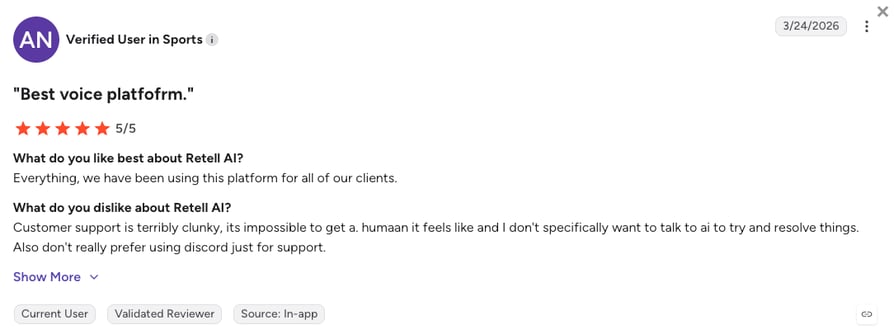
Retell AI's current G2 rating is 4.8/5, out of 2,600+ verified user reviews.
What Real Users Say About Synthflow on G2
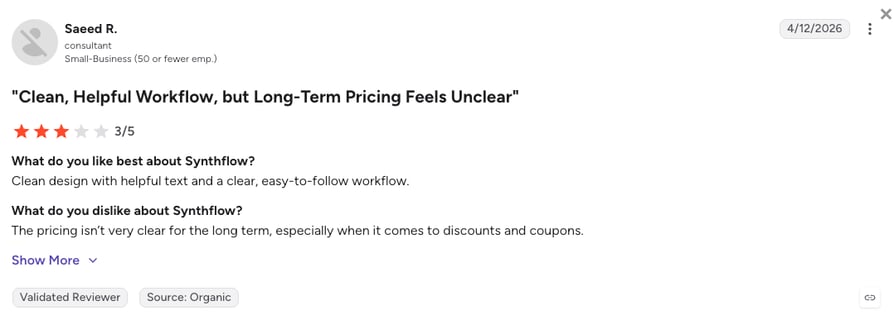
Synthflow's current G2 rating is 4.5/5, out of 980+ verified user reviews.
What Redditors Are Saying About Retell AI and Synthflow
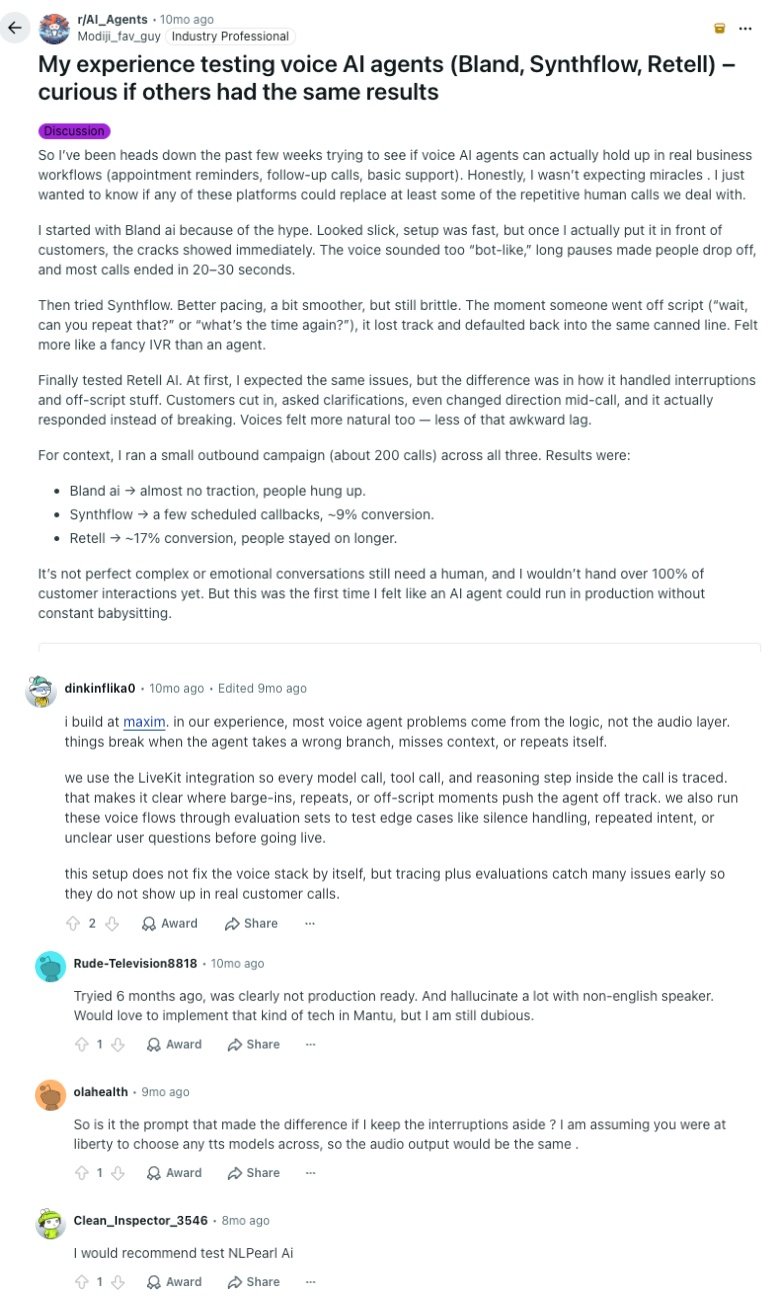
Three of the top ten results for this comparison are Reddit threads, which tells you buyers want hands-on accounts of the accuracy limits of voice AI more than another feature grid. Two threads stood out, both written by people running these platforms on real calls rather than demo scripts.
- Synthflow reads as "a fancy IVR" once callers go off script: In r/AI_Agents, an operator ran roughly 200 outbound calls (appointment reminders, follow-ups, basic support) across Bland, Synthflow, and Retell. Synthflow paced well but lost track the moment someone asked "wait, can you repeat that?", converting around 9% of calls; Retell handled interruptions and mid-call topic changes and roughly doubled that, at about 17%. The operator's caveat matches this page's latency section: complex or emotional conversations still need a human.
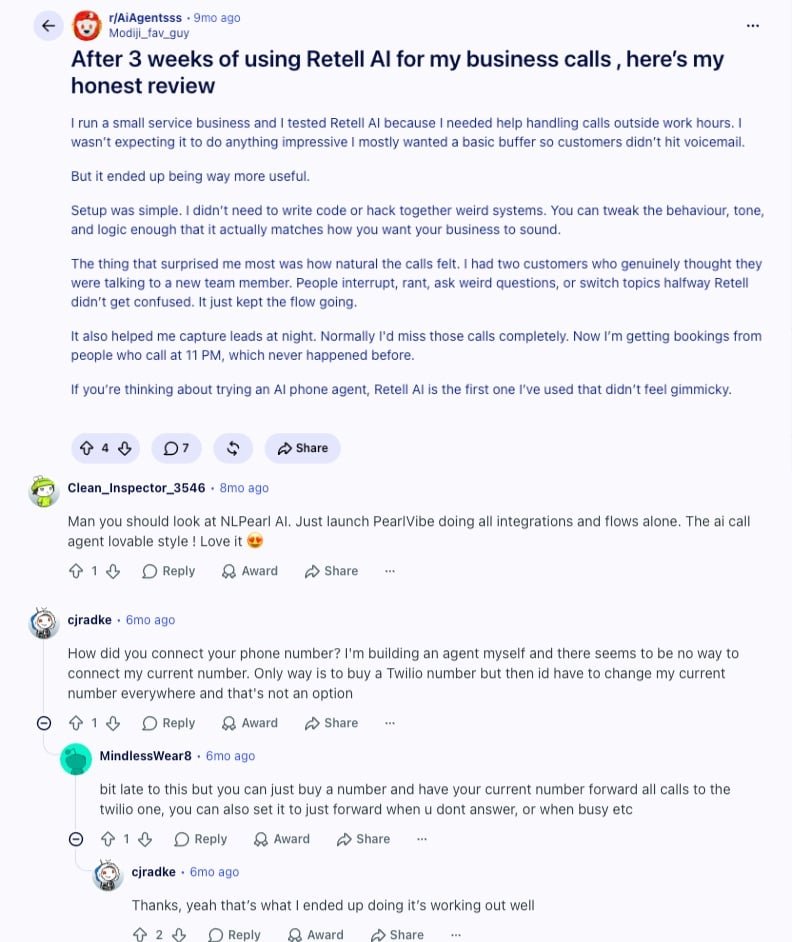
- Three weeks on Retell won a small business over, but the replies expose the telephony gap: In r/AiAgentsss, a service business owner praised Retell's no-code setup, natural-sounding calls, and the 11 PM bookings it started capturing. The most practical question underneath was how to connect an existing business number, and the community's answer was to buy a Twilio number and forward calls to it. That workaround is exactly the gap CloudTalk closes: the agent answers on the numbers you already run, because the phone system and the agent are the same platform.
Retell AI Pros & Cons vs. Synthflow Pros & Cons
Both tables below draw only on figures each vendor publishes about itself.
Retell AI Pros & Cons
| Pros | Cons |
|---|---|
| No platform fee or monthly minimum | The all-in rate moves with your model and voice |
| Component pricing you can model upfront | Guardrails, PII removal, and denoising are metered extras |
| Per-second billing, no round-up | Concurrency capped at 20, then $8 each per month |
| Model choice, including a custom LLM | RBAC and SSO are Enterprise-only |
| Streaming knowledge retrieval | No ISO 27001 claim, no published language count |
| Cold and warm transfer |
Synthflow Pros & Cons
| Pros | Cons |
|---|---|
| One published tier, no line-item math | No per-minute rate published anywhere |
| Telephony it owns, with BYOC over SIP | A $30,000 annual floor rules out pilots |
| 200+ pre-built connectors | Its own site contradicts itself on self-serve pricing |
| Vendor engineers and a three-week launch | Language support reads 30+ in one place, 50+ in another |
| Test Center and a sandbox with rollback | Fine-tuning is roadmap, not shipped |
| The broader certification set |
CloudTalk: The Best Alternative to Retell AI and Synthflow
Retell and Synthflow sell you the AI layer and leave the rest of the stack to you. CloudTalk's AI Voice Agent starts from the other end: the call center already exists (numbers, routing, CRM sync, analytics), and the agent is a no-code add-on that answers on your existing lines and hands off to a live rep with full context. No integration project, no three-week deployment program, no $30,000 floor.















That native setup matters more than it used to. When a customer calls, their intent is at its peak; miss the moment and they don't leave a voicemail, they call your competitor. An agent that answers instantly on the lines you already run, and pulls in a human the second one is needed, is the cheapest fix for that.
- No assembly requiredThe agent arrives wired into telephony, routing, and 100+ CRM and helpdesk integrations the platform already runs. The integration layer that eats weeks on a specialist platform is simply included.
- Pricing you can read without a sales callPlans from $25/user/month, and the AI Voice Agent add-on from $99/month for 200 minutes (the AI receptionist tier), published in full down to the per-minute rate at volume.
- A trial that includes the AIEvery 14-day free trial comes with 50 AI Receptionist minutes, so you can test it on your own callers before spending anything.
- Sub-800 ms latency on telephony it ownsA vendor number like everyone else's, but backed by published call-quality data and a 99.999% uptime SLA.
- Escalation that lands with contextWhen a call needs a human, it moves to your team inside the same platform, with the conversation attached. No silent transfer into a separate system.
Customer story: Trevo reached 20x more customers per campaign with CloudTalk's AI Voice Agent and cut handling time to under 30 seconds. Read the Trevo story.
Hear a Voice Agent Before You Compare Contracts
Which Team Fits Which Platform?
Fit comes down to resourcing. Either platform will get an agent answering calls, whether that's inbound support or outbound AI voice agents for lead qualification. They differ on how much of the work is yours, how fast you need to be live, and whether you can commit budget before proving the use case.
Which Team Fits Which Platform
| Retell AI Is the Right Fit For... | Synthflow Is the Right Fit For... |
|---|---|
| Teams with engineering time to own integrations and custom logic | Ops and CX teams with no engineering time to spare |
| Anyone who needs to pilot before committing budget | Anyone with budget approved and a launch date to hit |
| Teams that want to pick a model per call type and tune cost down | Teams that want one forecastable annual number |
| Long, fact-heavy conversations that lean on knowledge retrieval | Broad SaaS estates where connector coverage beats model control |
| Healthcare and contact center stacks that need specific named connectors | Enterprises that want the vendor's engineers inside the build |
Most teams recognize themselves within a row or two. If you didn't, the scenarios below are more specific.
Retell AI vs. Synthflow: The Verdict
Both platforms build agents that hold real conversations, and both repositioned toward enterprise buyers over the past year. Platform quality isn't the variable here. You're choosing who does the assembly and how you'd rather pay for it.
Choose Retell AI If You...
- Want to test on real calls before anyone signs a contract
- Have engineering time for integrations and custom logic
- Need model-level control, including a custom LLM per agent
- Run long, fact-heavy conversations that depend on knowledge retrieval
- Want usage-based billing you can optimize, and will actually watch it
- Need specific healthcare or contact center connectors already built
Choose Synthflow If You...
- Would rather buy an outcome than a toolkit, with budget approved
- Have no engineering capacity to hand to a voice project
- Need the vendor's own engineers accountable for going live
- Want one committed annual figure instead of a metered invoice
- Depend on connector breadth across a large SaaS estate
- Have procurement requirements naming ISO 27001 or PCI DSS
The Bottom Line
There's no overall winner between Retell AI and Synthflow, and after a full page of tables, that's still the honest answer. What decides it is your team, not the tech. If you have engineers to own the build and want to prove the use case on real calls before spending anything, Retell fits. If the budget is approved and you'd rather buy a launch date than a toolkit, Synthflow fits, at $30,000 a year and up.
And if what you actually want is the phone answered, qualified, and logged in your CRM without an assembly project on either side, that's the gap CloudTalk's AI Voice Agent was built for. It lives inside a business phone system that already exists, the pricing is public from $99/month, and the trial comes with 50 AI minutes to test it on your own callers. Test it out and learn why CloudTalk is one of the best AI voice agents for growing teams, and an even better voice AI solution than Retell or Synthflow.
Still Working Out Who Owns the Build?
Frequently Asked Questions About Retell AI vs. Synthflow
Direct answers to the questions buyers ask most when comparing Retell AI and Synthflow.
Neither Retell AI nor Synthflow is better in general, and product quality isn't what separates them. Retell AI is the better fit for teams with engineering time who want to pilot on real calls before committing budget. Synthflow fits teams buying a managed rollout with money already approved and a launch date to hit. Both handle the same core AI voice agent use cases on a phone line, so the deciding factor is your engineering capacity, not the platform.
Retell AI is cheaper at the entry point, by a wide margin. It bills pay-as-you-go from $0.07 to $0.31 per minute with no platform fee, no monthly minimum, and $10 in free credits, while Synthflow's published floor is a $30,000 annual contract. At scale, nobody can answer this honestly: Synthflow publishes no per-minute rate at all, and Retell AI's pricing moves with the model, voice, and add-ons you pick.
No, Synthflow doesn't require coding. Its Flow Designer is a visual builder, and Synthflow staffs deployments with its own engineers against a published three-week launch window, so an ops team can own an agent without borrowing developer time. The catch is the commitment: that no-code path sits behind an enterprise contract starting at $30,000 a year, with no self-serve tier published on its pricing page.
On published figures, Retell AI claims around 600 ms of conversational latency and Synthflow claims under 800 ms, so roughly 200 ms separates them on paper. Both figures are self-reported, and no third party has benchmarked either platform. Synthflow's headline sub-100 ms number measures transport across its own telephony network, not the pause a caller hears. Until your own accents, carriers and background noise go through both, the paper gap means little.
For agencies, Retell AI is the safer default, because you can stand up a client agent without signing anything: no platform fee, no minimum, per-second billing, and an API to wire into whatever the client already runs. Synthflow's $30,000 annual floor is hard to spread across a book of small clients, though its connector breadth and vendor-led launches fit an agency running one large enterprise account.
The best Retell AI alternative depends on which part you're replacing: usage-based billing, the developer surface, or the self-serve entry point. Teams that want the same low-commitment start tend to look at other usage-priced platforms, while teams that want the build handled for them look at managed deployments like Synthflow's. Our list of Retell AI alternatives works through the options in more detail.
The best Synthflow alternative is usually whichever platform lets you prove the use case before signing an annual contract, since the $30,000 floor is what sends most buyers looking in the first place. Retell AI is the obvious comparison on that axis: self-serve, no minimum, published per-minute components. If connector breadth is what you'd be giving up instead, weigh that first; our Synthflow alternatives page covers the trade-offs.
Synthflow doesn't publish an answer either way. As of August 2026 Synthflow names HIPAA among its certifications but publishes no per-feature pricing. Its single enterprise tier is scoped case by case around security needs, so whether HIPAA handling moves your quote is a question only Synthflow's sales team can answer. Get the BAA terms and any compliance surcharge in writing first, especially if you're running AI voice agents in healthcare.